REVIEW 3 major objections 4 minor 90 references
New insight of time-transformed symplectic integrator I: hybrid methods for hierarchical triples
T0 review · 3 major / 4 minor · reviewed 2026-08-11 · deepseek-v4-flash
Pith's one-line read Hybrid scheme fixes LogH failures on triple stars
desk verdict A credible diagnosis and a practical hybrid integrator for hierarchical triples, with a narrow but honest validation and one unquantified surrogate at its core. read the letter →
The pith
A machine-rendered reading of the paper's core claim, the machinery that carries it, and where it could break.
The reading
What carries the argument
The mechanism that carries the argument is the pair of time-transformation functions of the LogH map, $g_d=1/(T+p_t)$ for drift and $g_k=1/(-U)$ for kick. For a Kepler pair $g_k\propto r_{12}$, which is what makes small steps at periapsis and lets LogH act as a Kepler solver. The defining move of BlogH is to replace the full potential $U$ in these functions by the inner binary's potential $U_b=-Gm_1m_2/r_{12}$: kick uses $g_{k,b}=1/(-U_b)$, and the drift function is approximated as $g_{d,b}=1/u_b$ with $u_b$ updated by the midpoint rule (Equation 18) so the map stays explicit and time symmetric while losing formal symplecticity. The inner binary then keeps the LogH Kepler-tracing property, and the outer body is advanced by the same drift-kick-drift sequence without any synchronization of time steps.
What would settle it
Take a hierarchical triple with an eccentric outer orbit ($e_o \ge 0.5$) and initial inclination near $90^\circ$, integrate it with BlogH and with a high-precision reference (e.g., the paper's BlogH-Y6-HP at 30-digit precision) over several Kozai–Lidov timescales, and compare the converged inner eccentricity as a function of time; if for any configuration with perturbation ratio near the switching boundary the BlogH curve deviates from the reference by more than the reference's own tolerance, then the claim that BlogH preserves Kepler tracing for the inner binary would need revision.
Extended reading notes
Core claim
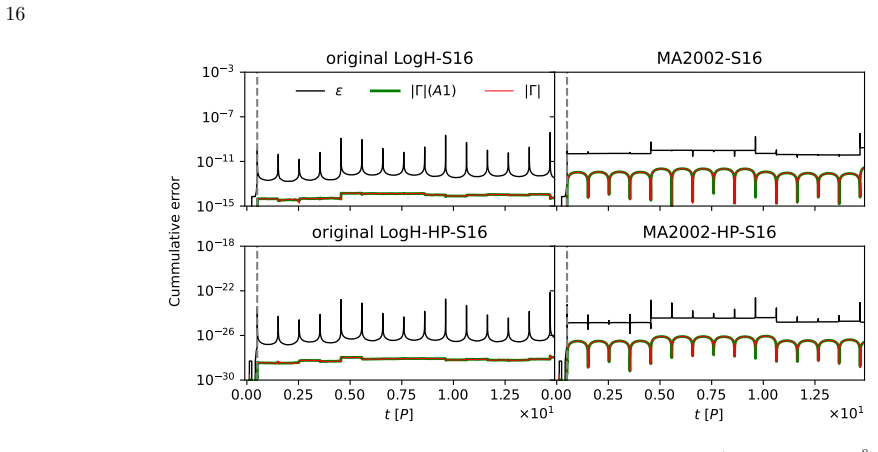
The paper's central claim is that the LogH method is a true Kepler solver only for an isolated binary: with $f(x)=\log x$ the per-step time increment is set by $g_k=1/(-U)$, which for a Kepler pair is proportional to the mutual separation $r_{12}$, so the step shrinks exactly at periapsis and the map traces the Keplerian ellipse while only the orbital phase accumulates error. Once a third body is present, the full potential $U$ appears in $g_k$, including the perturber's terms $Gm_1m_3/r_{13}$ and $Gm_2m_3/r_{23}$; these terms smooth out the variation of $g_k$ near periapsis, so the method no longer takes sufficiently small steps there and falls back to second-order accuracy. The paper demonstrates that even a perturber with mass $m_3=0.01$ (one-tenth of the lighter binary component) and outer semi-major axis $10^4$ times the inner one destroys the property (Section 3), and that in a Kozai–Lidov triple the LogH method with moderate step sizes gives an unphysical secular evolution of the inner eccentricity, confirmed by convergence to the hybrid result only at much smaller steps. The proposed remedy, BlogH, replaces $g_k$ with $g_{k,b}=1/(-U_b)$ using only the inner binary potential $U_b=-Gm_1m_2/r_{12}$, and approximates the corresponding drift function by $g_{d,b}=1/u_b$ with $u_b$ integrated during kick steps (Equation 18); this keeps the inner binary on the LogH Kepler-tracking integrator, treats the outer bodies with the same sDKD loop, and removes the need for time synchronization. The paper's quantitative claims are that BlogH is comparable to the H4 hybrid in accuracy, several times cheaper in step count, and that for the tested Kozai–Lidov triple it reproduces the converged eccentricity evolution with roughly 256 times fewer steps than LogH.
Load-bearing premise
The load-bearing premise is that the approximate drift weight $g_{d,b}=1/u_b$, with $u_b$ updated by the midpoint formula in Equation 18, is faithful enough to the exact $g_{d,b}=1/(T+p_t+U-U_b)$ that the inner binary retains LogH's Kepler-tracing property and the overall map stays time symmetric; the paper supplies no formal error bound and validates it on only two triple families.
Editorial extensions
If this is right
- LogH should not be applied directly to hierarchical triples in star-cluster simulations; the same step size that is excellent for an isolated binary becomes second-order accurate once a third body is added.
- Energy error alone cannot certify a correct orbit: in the Kozai–Lidov test, LogH models with small energy error gave an unphysical secular drift of the inner eccentricity, so convergence of the orbital elements themselves must be checked.
- BlogH eliminates the time-synchronization overhead of the Hermite–LogH hybrid (H4), reducing total integration steps by a factor of 2–5 in the tested cases at comparable accuracy.
- The perturbation ratio $R_p$ (Equation 29) provides a practical switching rule: for $R_p>1$ the original LogH is preferred over BlogH, so a general N-body code can choose per system.
- The same construction extends to any hierarchical multiple system with a single innermost binary, such as a quadruple of a binary plus two outer single bodies.
Reading between the lines
- If the mechanism is as general as stated, replacing the global potential by the dominant two-body potential in the time-transformation function should also benefit other regimes, such as planetary systems with passing stars, where the same periapsis-step dilution would otherwise occur.
- Using a higher-order quadrature in place of the midpoint rule in Equation 18 may reduce the outer-orbit secular error that the paper attributes to the sDKD loop, a testable extension that could narrow the gap to the H4 method.
- The switching criterion was calibrated on Kozai–Lidov triples at $t=2t_{\mathrm{KL}}$ using inner-eccentricity convergence; systems whose dominant error is in the outer orbit, or whose outer eccentricity is large, may need a different criterion, possibly based directly on the instantaneous inner–outer separation.
Editorial analysis
A structured set of objections, weighed in public.
Referee Report
Summary. This paper studies the logarithmic time-transformed symplectic integrator (LogH, also known as algorithmic regularization) when applied to hierarchical triple systems. The central claim is that LogH tracks isolated Kepler orbits with errors near round-off, but that the presence of a third body, even a very weak one, destroys the Kepler-solver property and reduces the method to an ordinary second-order symplectic integrator. In Kozai-Lidov triples this can produce an unphysical secular drift of the inner eccentricity even when the energy error remains small. To address this, the author introduces a new hybrid integrator, BlogH, which uses LogH-type time transformation for the inner binary only and integrates the outer bodies with the same drift-kick-drift loop, avoiding the time synchronization required by the Hermite+LogH hybrid (H4). A switching criterion Rp > 1 is proposed for choosing between LogH and BlogH based on the perturbation ratio of the outer and inner orbits. The claims are supported by convergence tests over step size, precision (double vs 30-digit), method order (second- vs sixth-order compositions), and by comparisons among LogH, H4, and BlogH in two triple families.
Significance. If the central diagnostic is correct, the paper is valuable for the N-body community: it shows that energy error alone is an insufficient accuracy indicator for algorithmic regularization in hierarchical multiples, and it identifies a concrete mechanism for the loss of the Kepler-tracking property. The proposed BlogH scheme is simple to implement in existing LogH-based codes and offers a plausible efficiency advantage over synchronized Hermite+LogH schemes. The main claims are made credible by the convergence checks across several step sizes, two floating-point precisions, and multiple method variants, as well as by the independent agreement of H4 and very small-step LogH simulations in the Kozai-Lidov case. However, the derivation of the BlogH time transformation rests on an approximate discrete surrogate without an error bound, and the numerical validation covers only two triple families plus a calibration grid with circular outer orbits, so the breadth of the claimed advantage over LogH is not yet fully established. No formal proofs or machine-checked results are provided, but the numerical evidence is the appropriate form of validation for this type of methods paper.
major comments (3)
- [§4.2, Eqs. (18), (23)–(25)] The definition gd,b = 1/ub is a load-bearing heuristic. The exact drift time transformation in Eq. (23) depends on the full potential, while Eq. (25) replaces it with the inverse of ub, which is advanced by the midpoint approximation in Eq. (18). No error bound is given for the deviation |ub − (−U_b)|, and the text does not show that the discrete update in Eq. (18) actually integrates Eq. (24) to the accuracy required to preserve the inner Kepler-tracking property. Since the accuracy and efficiency advantage of BlogH over LogH is the central claim of the paper, please provide either a local truncation error analysis showing ub = −U_b + O(Δs^2) with a statement about long-term drift, or numerical diagnostics (for example, time series of ub + U_b and the maximum deviation, plus convergence of inner orbital elements with Δs for a perturbed binary) over a wider range of perturbation strengths and outer eccentricities. Without this, the reported BlogH advantage could be configuration-dependent.
- [§4.3–4.4, Figs. 4, 5, 8] The identification of LogH behavior as 'unphysical' relies in part on reference solutions produced by the BlogH method family itself (BlogH-HP and BlogH-Y6-HP). In the Kozai-Lidov case the conclusion is independently corroborated by H4-Y6-S32 and by LogH runs at much smaller step sizes (S4096, S8192), which is reassuring. However, in the weak-perturber case of Figs. 4 and 5 the reference is BlogH-Y6-HP-S256, and the text does not state which panels depend solely on BlogH-family references. Please clarify this in the text and quantify the agreement between the H4 and BlogH reference orbits (for example, by reporting the maximum differences in ei and ai over the integration time). This would remove the circularity concern without changing the main conclusions.
- [§5, Eq. (29)] The switching criterion Rp > 1 is calibrated on a grid of Kozai-Lidov triples with circular outer orbits and fixed mutual inclination, and the paper itself states in the final paragraph of Section 5 that the criterion may not be suitable for eccentric or hyperbolic outer orbits. Given the abstract's phrasing 'criteria for switching between the LogH and BlogH methods for general triple systems', the test set is too narrow to support that generality. Either restrict the claim to quasi-circular Kozai-Lidov configurations or extend the validation to eccentric outer orbits and varied mutual inclinations, even if only for a subset of the parameter space.
minor comments (4)
- [Throughout] There are numerous typographical errors, including 'hierarichal' (abstract), 'sigularity' (Section 1, twice), 'orbitial' (Section 4.4), 'ploating style' (Figure 8 caption), and 'extropolation' (Section 6.2). A careful proofread is needed.
- [§2.1, Eq. (18) footnote] The footnote 'Here, u represents W as defined in Equation 12 of Mikkola & Aarseth (2002)' is confusing because W is already used for the extended phase-space vector in Eq. (2). Please use a distinct symbol or rephrase.
- [§4.3, Table 1 and Fig. 6] The wall-clock time comparison is acknowledged to be implementation-dependent, but it would help to state the compiler, optimization flags, and hardware used, and to note explicitly that the reported tw values are indicative rather than a benchmark of the algorithms.
- [§4.2] The paper states that BlogH is time symmetric but not symplectic. A short argument or demonstration of the time symmetry (for example, a reversal test) would strengthen this claim, since time symmetry is one of the advertised advantages over H4.
Circularity Check
No significant circularity: the novel claims rest on independent numerical convergence and honestly labeled fitted criteria, not on self-referential reduction.
full rationale
The paper's central claims are not circular in the sense required by the analysis. The claim that LogH loses its Kepler-solver property for weak perturbers is supported by convergence tests across independent methods: LogH solutions are compared with H4-Y6-S32 (an independent Hermite+LogH hybrid) and with much smaller LogH steps (S512, S4096), so the 'unphysical' judgment is externally grounded rather than defined by the method itself. The BlogH method's time-transformation functions (Eqs. 21-25) are introduced as an approximation to the exact gd,b, following the explicit MA2002 construction; the paper states that the exact form 'depends on coordinates, making it unsuitable for the explicit method' and substitutes an integrated ub. This is a stated approximation, not a conclusion that assumes the claimed accuracy. No formal error bound is given for |ub - (-Ub)|, and the manuscript's claims about BlogH are therefore limited by numerical validation rather than by a self-referential derivation; this is a robustness concern, not circularity. The switching criterion Rp > 1 is obtained empirically from a grid of Kozai-Lidov simulations by locating the Re = 1 boundary, and the paper explicitly warns that 'this switching criterion is derived for the Kozal-Lidov triple and may not be suitable for all triple systems.' It is presented as a fitted heuristic, not as a prediction, and is not used to certify the main accuracy claims. Self-citations (Wang & Nitadori 2020; Wang et al. 2020a,b) provide published proofs, definitions, and code context; they are not invoked as unverified uniqueness theorems or as the sole support for the new hybrid method. No equation in the paper reduces to its own input by construction. Accordingly, no specific circular step meets the evidentiary threshold, and the derivation chain is self-contained for the claims made.
Assumptions & free parameters
free parameters (1)
- Switching criterion threshold C (Rp > 1) =
1 (the Re = 1 curve lies between Rp contours C = 1 and C = 10)
assumptions (5)
- standard math Newtonian point-mass Hamiltonian and the extended Hamiltonian formalism of time-transformed symplectic integrators (Equations 1-7).
- standard math The LogH method traces Keplerian trajectories with only time-phase errors, as proven by Preto & Tremaine (1999) and Wang & Nitadori (2020).
- domain assumption Convergence of H4, BlogH-HP, and very-small-step LogH indicates the true secular evolution of ei in the Kozai-Lidov tests.
- ad hoc to paper The midpoint update of ub in Equation 18 is an adequate approximation for gd,b in BlogH, preserving time symmetry and the inner Kepler-tracking property.
- ad hoc to paper The switching condition Rp > 1, calibrated on the Kozai-Lidov grid, extends to other hierarchical triple systems.
Cite this review
Pith. "Pith review of New insight of time-transformed symplectic integrator I: hybrid methods for hierarchical triples." pith.science (2026). https://pith.science/paper/433W2VQH
@misc{pith2026241202124,
  author       = {Pith},
  title        = {Pith review of: New insight of time-transformed symplectic integrator I: hybrid methods for hierarchical triples},
  year         = {2026},
  howpublished = {\url{https://pith.science/paper/433W2VQH}},
  note         = {Machine review of arXiv:2412.02124}
}
abstract
Accurate $N$-body simulations of multiple systems such as binaries and triples are essential for understanding the formation and evolution of interacting binaries and binary mergers, including gravitational wave sources, blue stragglers and X-ray binaries. The logarithmic time-transformed explicit symplectic integrator (LogH), also known as algorithmic regularization, is a state-of-the-art method for this purpose.However, we show that this method is accurate for isolated Kepler orbits because of its ability to trace Keplerian trajectories, but much less accurate for hierarichal triple systems. The method can lead to an unphysical secular evolution of inner eccentricity in Kozal-Lidov triples, despite a small energy error. We demonstrate that hybrid methods, which apply LogH to the inner binary and alternative methods to the outer bodies, are significantly more effective, though not symplectic. Additionally, we introduce a more efficient hybrid method, BlogH, which eliminates the need for time synchronization and is time symmetric. The method is implemented in the few-body code SDAR. We explore suitable criteria for switching between the LogH and BlogH methods for general triple systems. These hybrid methods have the potential to enhance the integration performance of hierarchial triples.
Figures


Figures from the paper (14 more)




Reference graph
Works this paper leans on
-
[1]
, " * write output.state after.block = add.period write newline
ENTRY address archivePrefix author booktitle chapter doi edition editor eprint howpublished institution journal key month number organization pages publisher school series title misctitle type volume year version url label extra.label sort.label short.list INTEGERS output.state before.all mid.sentence after.sentence after.block FUNCTION init.state.consts ...
-
[2]
write newline
" write newline "" before.all 'output.state := FUNCTION format.url url empty "" new.block "" url * "" * if FUNCTION format.eprint eprint empty "" archivePrefix empty "" archivePrefix "arXiv" = new.block " " eprint * " " * new.block " " eprint * " " * if if if FUNCTION format.doi doi empty "" " " doi * " " * if FUNCTION format.pid doi empty eprint empty ur...
-
[4]
Aarseth , S. J. 2003, Gravitational N-Body Simulations
2003
-
[5]
2012, , 422, 841, 10.1111/j.1365-2966.2012.20666.x
---. 2012, , 422, 841, 10.1111/j.1365-2966.2012.20666.x
arXiv 2012
-
[6]
R., Miocchi , P., & Vesperini , E
Alessandrini , E., Lanzoni , B., Ferraro , F. R., Miocchi , P., & Vesperini , E. 2016, , 833, 252, 10.3847/1538-4357/833/2/252
-
[7]
Antognini , J. M. O. 2015, , 452, 3610, 10.1093/mnras/stv1552
-
[8]
Antonini , F., Chatterjee , S., Rodriguez , C. L., et al. 2016, , 816, 65, 10.3847/0004-637X/816/2/65
-
[9]
2020, , 492, 2936, 10.1093/mnras/stz3584
Antonini , F., & Gieles , M. 2020, , 492, 2936, 10.1093/mnras/stz3584
Show all 90 references
-
[10]
2014, , 781, 45, 10.1088/0004-637X/781/1/45
Antonini , F., Murray , N., & Mikkola , S. 2014, , 781, 45, 10.1088/0004-637X/781/1/45
2014 doi
-
[11]
Antonini , F., Toonen , S., & Hamers , A. S. 2017, , 841, 77, 10.3847/1538-4357/aa6f5e
2017 doi
-
[12]
2017, , 464, L36, 10.1093/mnrasl/slw177
Askar , A., Szkudlarek , M., Gondek-Rosi \'n ska , D., Giersz , M., & Bulik , T. 2017, , 464, L36, 10.1093/mnrasl/slw177
2017 doi
-
[13]
Bae , Y.-B., Kim , C., & Lee , H. M. 2014, , 440, 2714, 10.1093/mnras/stu381
2014 doi
-
[14]
Bailyn , C. D. 1995, , 33, 133, 10.1146/annurev.aa.33.090195.001025
1995
-
[15]
2017, , 467, 524, 10.1093/mnras/stw3392
Banerjee , S. 2017, , 467, 524, 10.1093/mnras/stw3392
2017 doi
- [16]
-
[17]
2020, , 102, 103002, 10.1103/PhysRevD.102.103002
---. 2020, , 102, 103002, 10.1103/PhysRevD.102.103002
2020 doi
- [18]
-
[19]
2010, , 402, 371, 10.1111/j.1365-2966.2009.15880.x
Banerjee , S., Baumgardt , H., & Kroupa , P. 2010, , 402, 371, 10.1111/j.1365-2966.2009.15880.x
2010
-
[21]
A., Sills , A., & Glebbeek , E
Chatterjee , S., Rasio , F. A., Sills , A., & Glebbeek , E. 2013, , 777, 106, 10.1088/0004-637X/777/2/106
2013 doi
-
[22]
L., & Rasio , F
Chatterjee , S., Rodriguez , C. L., & Rasio , F. A. 2017, , 834, 68, 10.3847/1538-4357/834/1/68
2017 doi
-
[23]
N., Giacobbo , N., Mapelli , M., et al
Di Carlo , U. N., Giacobbo , N., Mapelli , M., et al. 2019, , 487, 2947, 10.1093/mnras/stz1453
2019 doi
-
[24]
2023, , 675, A89, 10.1051/0004-6361/202245219
Donada , J., Anders , F., Jordi , C., et al. 2023, , 675, A89, 10.1051/0004-6361/202245219
2023 doi
-
[25]
Downing , J. M. B., Benacquista , M. J., Giersz , M., & Spurzem , R. 2010, , 407, 1946, 10.1111/j.1365-2966.2010.17040.x
2010
-
[26]
2013, , 51, 269, 10.1146/annurev-astro-081710-102602
Duch \^e ne , G., & Kraus , A. 2013, , 51, 269, 10.1146/annurev-astro-081710-102602
2013 doi
-
[27]
P., & Kiseleva-Eggleton , L
Eggleton , P. P., & Kiseleva-Eggleton , L. 2001, , 562, 1012, 10.1086/323843
2001 doi
-
[28]
2007, , 669, 1298, 10.1086/521702
Fabrycky , D., & Tremaine , S. 2007, , 669, 1298, 10.1086/521702
2007 doi
-
[29]
J., & Kobayashi , S
Fern \'a ndez , J. J., & Kobayashi , S. 2019, , 487, 1200, 10.1093/mnras/stz1353
2019 doi
-
[30]
B., Kozinsky , B., & Rasio , F
Ford , E. B., Kozinsky , B., & Rasio , F. A. 2000, , 535, 385, 10.1086/308815
2000 doi
-
[31]
2019, , 488, 728, 10.1093/mnras/stz1723
Fragione , G., & Antonini , F. 2019, , 488, 728, 10.1093/mnras/stz1723
2019 doi
-
[32]
2019, , 486, 4443, 10.1093/mnras/stz1131
Fragione , G., & Loeb , A. 2019, , 486, 4443, 10.1093/mnras/stz1131
2019 doi
-
[33]
S., Tanikawa , A., & Makino , J
Fujii , M. S., Tanikawa , A., & Makino , J. 2017, , 69, 94, 10.1093/pasj/psx108
2017 doi
-
[34]
2023, , 674, A34, 10.1051/0004-6361/202243782
Gaia Collaboration , Arenou , F., Babusiaux , C., et al. 2023, , 674, A34, 10.1051/0004-6361/202243782
2023 doi
-
[35]
Gon c alves Ferrari , G., Boekholt , T., & Portegies Zwart , S. F. 2014, , 440, 719, 10.1093/mnras/stu282
2014 doi
-
[36]
1997, Applied Numerical Mathematics, 25, 219, 10.1016/S0168-9274(97)00061-5
Hairer, E. 1997, Applied Numerical Mathematics, 25, 219, 10.1016/S0168-9274(97)00061-5
1997 doi
-
[37]
Hamers , A. S. 2018, , 476, 4139, 10.1093/mnras/sty428
2018 doi
- [38]
-
[39]
S., Perets , H
Hamers , A. S., Perets , H. B., Antonini , F., & Portegies Zwart , S. F. 2015, , 449, 4221, 10.1093/mnras/stv452
2015 doi
-
[40]
S., & Portegies Zwart , S
Hamers , A. S., & Portegies Zwart , S. F. 2016, , 459, 2827, 10.1093/mnras/stw784
2016 doi
-
[41]
R., Millman, K
Harris, C. R., Millman, K. J., van der Walt, S. J., et al. 2020, Nature, 585, 357, 10.1038/s41586-020-2649-2
2020 doi
-
[42]
Heggie , D. C. 1975, , 173, 729, 10.1093/mnras/173.3.729
1975 doi
-
[43]
C., Trenti , M., & Hut , P
Heggie , D. C., Trenti , M., & Hut , P. 2006, , 368, 677, 10.1111/j.1365-2966.2006.10122.x
2006
-
[44]
1961, Annales d'Astrophysique, 24, 369
H \'e non , M. 1961, Annales d'Astrophysique, 24, 369
1961
-
[45]
M., & Bertschinger , E
Hernandez , D. M., & Bertschinger , E. 2015, , 452, 1934, 10.1093/mnras/stv1439
2015 doi
- [46]
-
[47]
Hills , J. G. 1975, , 80, 809, 10.1086/111815
1975 doi
-
[48]
2020, , 498, 4287, 10.1093/mnras/staa2677
Hong , J., Askar , A., Giersz , M., Hypki , A., & Yoon , S.-J. 2020, , 498, 4287, 10.1093/mnras/staa2677
2020 doi
-
[49]
Hunter, J. D. 2007, Computing in Science & Engineering, 9, 90, 10.1109/MCSE.2007.55
2007 doi
-
[50]
R., Tout , C
Hurley , J. R., Tout , C. A., Aarseth , S. J., & Pols , O. R. 2001, , 323, 630, 10.1046/j.1365-8711.2001.04220.x
2001
-
[51]
2013, , 429, 1221, 10.1093/mnras/sts415
Hypki , A., & Giersz , M. 2013, , 429, 1221, 10.1093/mnras/sts415
2013 doi
-
[52]
L., Amaro-Seoane , P., et al
Kremer , K., Rodriguez , C. L., Amaro-Seoane , P., et al. 2019, , 99, 063003, 10.1103/PhysRevD.99.063003
2019 doi
-
[53]
1995, , 277, 1491, 10.1093/mnras/277.4.1491
Kroupa , P. 1995, , 277, 1491, 10.1093/mnras/277.4.1491
1995 doi
-
[54]
S., & Tanikawa , A
Kumamoto , J., Fujii , M. S., & Tanikawa , A. 2019, , 486, 3942, 10.1093/mnras/stz1068
2019 doi
-
[55]
1965, Journal für die reine und angewandte Mathematik (Crelles Journal), 1965, 204, 10.1515/crll.1965.218.204
Kustaanheimo, P., & STIEFEL, E. 1965, Journal für die reine und angewandte Mathematik (Crelles Journal), 1965, 204, 10.1515/crll.1965.218.204
1965 doi
-
[56]
2011, , 416, 1410, 10.1111/j.1365-2966.2011.19136.x
Leigh , N., Sills , A., & Knigge , C. 2011, , 416, 1410, 10.1111/j.1365-2966.2011.19136.x
2011
-
[57]
2018, , 863, 68, 10.3847/1538-4357/aad09f
Liu , B., & Lai , D. 2018, , 863, 68, 10.3847/1538-4357/aad09f
2018 doi
- [58]
-
[59]
A., & Shapiro , S
Lombardi , James C., J., Rasio , F. A., & Shapiro , S. L. 1996, , 468, 797, 10.1086/177736
1996 doi
-
[60]
2002, Celestial Mechanics and Dynamical Astronomy, 84, 343, 10.1023/A:1021149313347
Mikkola , S., & Aarseth , S. 2002, Celestial Mechanics and Dynamical Astronomy, 84, 343, 10.1023/A:1021149313347
2002 doi
-
[61]
Mikkola , S., & Aarseth , S. J. 1996, Celestial Mechanics and Dynamical Astronomy, 64, 197, 10.1007/BF00728347
1996 doi
-
[62]
1999, , 310, 745, 10.1046/j.1365-8711.1999.02982.x
Mikkola , S., & Tanikawa , K. 1999, , 310, 745, 10.1046/j.1365-8711.1999.02982.x
1999
-
[63]
2017, , 230, 15, 10.3847/1538-4365/aa6fb6
Moe , M., & Di Stefano , R. 2017, , 230, 15, 10.3847/1538-4365/aa6fb6
2017 doi
- [64]
-
[65]
M., Bae , Y.-B., & Belczynski , K
Park , D., Kim , C., Lee , H. M., Bae , Y.-B., & Belczynski , K. 2017, , 469, 4665, 10.1093/mnras/stx1015
2017 doi
-
[66]
B., & Fabrycky , D
Perets , H. B., & Fabrycky , D. C. 2009, , 697, 1048, 10.1088/0004-637X/697/2/1048
2009 doi
-
[67]
B., & Kratter , K
Perets , H. B., & Kratter , K. M. 2012, , 760, 99, 10.1088/0004-637X/760/2/99
2012 doi
-
[68]
2009, , 14, 369, 10.1016/j.newast.2008.10.006
Portegies Zwart , S., McMillan , S., Harfst , S., et al. 2009, , 14, 369, 10.1016/j.newast.2008.10.006
2009 doi
-
[69]
1999, , 118, 2532, 10.1086/301102
Preto , M., & Tremaine , S. 1999, , 118, 2532, 10.1086/301102
1999 doi
-
[70]
2018, , 864, 134, 10.3847/1538-4357/aad7fe
Randall , L., & Xianyu , Z.-Z. 2018, , 864, 134, 10.3847/1538-4357/aad7fe
2018 doi
-
[71]
P., et al
Rantala , A., Naab , T., Rizzuto , F. P., et al. 2023, , 522, 5180, 10.1093/mnras/stad1360
2023 doi
-
[72]
H., & Naab , T
Rantala , A., Pihajoki , P., Mannerkoski , M., Johansson , P. H., & Naab , T. 2020, , 492, 4131, 10.1093/mnras/staa084
2020 doi
-
[73]
2019, , 483, 1233, 10.1093/mnras/sty3193
Rastello , S., Amaro-Seoane , P., Arca-Sedda , M., et al. 2019, , 483, 1233, 10.1093/mnras/sty3193
2019 doi
-
[74]
M., Tamayo , D., et al
Rein , H., Hernandez , D. M., Tamayo , D., et al. 2019, , 485, 5490, 10.1093/mnras/stz769
2019 doi
-
[75]
L., Chatterjee , S., & Rasio , F
Rodriguez , C. L., Chatterjee , S., & Rasio , F. A. 2016 a , , 93, 084029, 10.1103/PhysRevD.93.084029
2016 doi
-
[76]
L., Haster , C.-J., Chatterjee , S., Kalogera , V., & Rasio , F
Rodriguez , C. L., Haster , C.-J., Chatterjee , S., Kalogera , V., & Rasio , F. A. 2016 b , , 824, L8, 10.3847/2041-8205/824/1/L8
2016 doi
-
[77]
2018 a , , 855, 124, 10.3847/1538-4357/aaab52
Samsing , J., Askar , A., & Giersz , M. 2018 a , , 855, 124, 10.3847/1538-4357/aaab52
2018 doi
-
[78]
Samsing , J., & D'Orazio , D. J. 2018, , 481, 5445, 10.1093/mnras/sty2334
2018 doi
- [79]
- [80]
-
[81]
E., de Koter , A., et al
Sana , H., de Mink , S. E., de Koter , A., et al. 2012, Science, 337, 444, 10.1126/science.1223344
2012 doi
-
[82]
Sills , A., Adams , T., & Davies , M. B. 2005, , 358, 716, 10.1111/j.1365-2966.2005.08809.x
2005
-
[83]
2013, , 435, 1358, 10.1093/mnras/stt1380
Tanikawa , A. 2013, , 435, 1358, 10.1093/mnras/stt1380
2013 doi
-
[84]
J., Fragione , G., & Chatterjee , S
Tiwari , A., Vijaykumar , A., Kapadia , S. J., Fragione , G., & Chatterjee , S. 2024, , 527, 8586, 10.1093/mnras/stad3749
2024 doi
-
[85]
A., & Spera , M
Trani , A. A., & Spera , M. 2023, in The Predictive Power of Computational Astrophysics as a Discover Tool, ed. D. Bisikalo , D. Wiebe , & C. Boily , Vol. 362, 404--409, 10.1017/S1743921322001818
2023 doi
-
[86]
S., & Tanikawa , A
Wang , L., Fujii , M. S., & Tanikawa , A. 2021, , 504, 5778, 10.1093/mnras/stab1157
2021 doi
-
[87]
2020 a , , 497, 536, 10.1093/mnras/staa1915
Wang , L., Iwasawa , M., Nitadori , K., & Makino , J. 2020 a , , 497, 536, 10.1093/mnras/staa1915
2020 doi
-
[88]
2020, , 497, 4384, 10.1093/mnras/staa2295
Wang , L., & Nitadori , K. 2020, , 497, 4384, 10.1093/mnras/staa2295
2020 doi
-
[89]
2020 b , , 493, 3398, 10.1093/mnras/staa480
Wang , L., Nitadori , K., & Makino , J. 2020 b , , 493, 3398, 10.1093/mnras/staa480
2020 doi
-
[90]
C., Fragione , G., Kremer , K., et al
Weatherford , N. C., Fragione , G., Kremer , K., et al. 2021, , 907, L25, 10.3847/2041-8213/abd79c
2021 doi
-
[91]
1991, , 102, 1528, 10.1086/115978
Wisdom , J., & Holman , M. 1991, , 102, 1528, 10.1086/115978
1991 doi
-
[92]
1990, Physics Letters A, 150, 262, 10.1016/0375-9601(90)90092-3
Yoshida, H. 1990, Physics Letters A, 150, 262, 10.1016/0375-9601(90)90092-3
1990 doi
Reviewed August 11, 2026 · model on record in the stance chip above.
Discussion (0). Continue with ORCID to comment.