REVIEW 4 major objections 5 minor 45 references
Anatomically-Grounded Fact Checking of Automated Chest X-ray Reports
T0 review · 4 major / 5 minor · reviewed 2026-08-11 · deepseek-v4-flash
Pith's one-line read A fact-checking model trained on synthetic finding errors catches identity and location mistakes in automated chest X-ray reports, and correcting with it lifts report quality by over 40%.
desk verdict A useful inference-time safety net for chest X-ray reports, with a solid architecture and a real 40% quality gain measured on real generator outputs, but the detection accuracy itself is only validated on synthetically generated errors, so the transfer to real error distributions is untested. read the letter →
The pith
A machine-rendered reading of the paper's core claim, the machinery that carries it, and where it could break.
The reading
What carries the argument
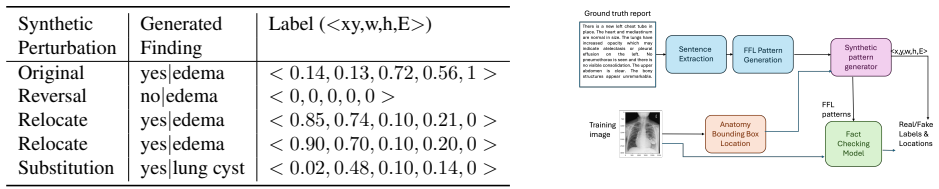
The central object is the finding–location (FL) pair: a structured representation of a reported finding as <type, polarity, normalized core finding name> paired with a normalized bounding box for its anatomical location. From ground-truth FL pairs, the authors synthesize fake pairs through three perturbations—reversal (e.g., 'yes|edema' → 'no|edema'), relocation (same finding at a different valid location), and substitution (a different finding not present in the report). The fact-checking model is a multi-label cross-modal contrastive regression network: a chest X-ray–pretrained CLIP-style encoder is fine-tuned with a multi-label supervised contrastive loss that pulls images close to their real finding labels and pushes them away from fake ones, and a regression sub-network predicts both the veracity flag E and the bounding-box coordinates, trained with L1, generalized IoU, MSE, and binary cross-entropy losses. The FC-score, computed as the fraction of findings predicted real plus the average overlap between predicted and indicated locations, serves as an inference-time surrogate for report quality assessment.
What would settle it
Take a set of reports from a generator such as XrayGPT on the ChestImaGenome Gold dataset, have radiologists mark which findings and locations are actually wrong, and measure the fact-checking model's real/fake accuracy and location overlap on those naturally occurring errors; if accuracy falls well below the 88%+ seen on synthetic perturbations, the synthetic-error assumption fails.
Extended reading notes
Core claim
The paper's central claim is that factual errors in automatically generated chest X-ray reports—wrong finding identity or wrong anatomical location—can be detected and corrected at inference time using the chest X-ray image itself as the source of veracity. The authors construct a synthetic training set by taking real ground-truth finding–location pairs and perturbing them three ways: reversing the polarity (present vs absent), relocating a finding to a different valid anatomical location, and substituting a finding that is not actually present; each perturbation is paired with the original image to form a 'fake' sample. A multi-label cross-modal contrastive regression network, built on a chest X-ray–pretrained CLIP-style encoder, is trained end-to-end to push images together with their real finding labels and apart from fake ones, while a regression head predicts a 5-dimensional output (bounding box plus veracity flag) under a combined L1, generalized-IoU, MSE, and binary cross-entropy loss. The resulting fact-checking model achieves over 88% real/fake classification accuracy and mean IoU of 0.49–0.57 on held-out test splits of ChestImaGenome, MS-CXR, ChestX-ray8, and VinDr-CXR. When the findings it flags as fake are removed and the broken sentences are repaired by a large language model, all six tested report generators improve, with average improvements of 35.6%–45.1% (over 40% on average) on BLEU, CheXbert, and RadGraph F1 against ground-truth reports on the ChestImaGenome Gold dataset.
Load-bearing premise
The load-bearing premise is that synthetic fake findings created by flipping polarity, moving a finding to another valid location, or substituting a different finding resemble the real errors that automated report generators make closely enough that a model trained on them will flag genuine errors; if real generators err in other ways, such as omissions, severity errors, or entangled multi-finding confusions, the measured accuracy and the 40% improvement may not transfer.
Editorial extensions
If this is right
- The FC-score, computed from predicted veracity and location overlap, can stand in for ground-truth-based report quality scoring at inference, since it tracks the ground-truth score across four datasets and six report generators.
- Because the fact-checker operates on extracted finding–location patterns rather than sentence style, the same model can correct reports from very different generators (RGRG, XrayGPT, GPT4-inhouse, R2GenGPT, CV2DistillGPT2, and the CheXRepair pipeline) without retraining or per-generator customization.
- Corrected reports improve most on RadGraph F1, the metric that measures clinical entity and relation accuracy, suggesting the correction is removing clinically meaningful errors rather than just improving surface fluency.
- The synthetic perturbation approach generates over 27 million training samples from 1.6 million real ones, showing that a small gold dataset can be expanded into a large discriminative training set without manual annotation.
Reading between the lines
- The same synthetic-perturbation-plus-contrastive-check recipe could transfer to other imaging domains with a structured finding lexicon, such as CT or mammography, though the paper only demonstrates chest X-ray.
- Because the FC model is itself imperfect (about 88% accuracy, IoU ~0.5) yet still yields 40% report improvement, the correction pipeline appears partially robust to flagging mistakes; a natural experiment would be to vary the flagging threshold and map how strongly report-quality gain depends on it.
- The paper explicitly leaves omitted findings for future work; adding a fourth perturbation that deletes a finding that should be present, and training the model to detect absence, is the most direct testable extension of the method.
- The approach inherits the error rates of its upstream FFL extraction (~3% negation errors) and anatomical bounding-box detector (0.88–0.90 precision/recall), so an end-to-end sensitivity analysis would reveal how much of the 40% gain is limited by those components.
Signed reviews
Editorial analysis
A structured set of objections, weighed in public.
Referee Report
Summary. The paper proposes an anatomically-grounded fact-checking (FC) model for automated chest X-ray reports. It extracts fine-grained finding patterns (FFL) and locations from generated reports, trains a multi-label cross-modal contrastive regression network on synthetic real/fake finding-location pairs (created by reversal, relocation, and substitution perturbations of ground-truth FFL pairs), and uses the FC predictions to guide an LLM in correcting the generated reports. The authors report >88% real/fake classification accuracy on test splits of multiple datasets, mean IoU 0.49–0.57 for anatomical grounding, and an average >40% relative improvement in BLEU, CheXbert, and RadGraph F1 on 439 ChestImagenome Gold images across six report generators.
Significance. If the underlying transfer assumption holds, this is a valuable step toward inference-time fact-checking for radiology reports: the proposed architecture is novel (multi-label contrastive encoder chained to a regression head), the synthetic perturbation dataset is a useful resource, and the multi-dataset evaluation is thorough. The authors also explicitly acknowledge the omission limitation in Section 6, which is commendable. However, the central claim of practical utility rests on the assumption that the synthetic perturbation distribution matches the error distribution of real generators, and this assumption is not empirically verified. The paper's own text (Section 3.1) notes that real errors include omissions and severity errors, which are not modeled, and the evaluation of real/fake accuracy is performed on test samples generated by the same procedure as the training data. Thus the significance is conditional on a transfer argument that the current experiments do not establish.
major comments (4)
- [Section 3.1 and Section 5 (Real/Fake classification performance)] The real/fake classification accuracy is evaluated on test splits generated by the same perturbation procedure (reversal, relocation, substitution) used to create the training data. This measures the model's ability to recognize the synthetic perturbation distribution, not necessarily the distribution of errors made by the automated report generators. Since the generators' errors are never independently annotated, the claim that the FC model catches real errors at inference, and the subsequent 40% improvement claim, rest on an untested transfer assumption. The paper itself acknowledges in Section 3.1 that real generators also make omissions and severity errors, which are not modeled, and Section 6 defers omissions to future work. Please evaluate the FC model on a sample of errors that are actually produced by the report generators (obtained, for example, by expert annotation or by human-verified LLM annotation) and report per-error-type performance.
- [Section 4 (Report correction)] The correction step removes the words corresponding to a flagged finding and asks the LLM to make the sentence well-formed. For a real finding that is merely relocated (e.g., 'yes|pleural effusion|left lung' in Table 3), this deletes the finding instead of correcting its location, so the corrected report no longer mentions a true finding. This design can inflate lexical and semantic scores by removing false positive mentions while simultaneously lowering clinical recall. The paper reports average improvements but does not analyze how often corrections delete true findings or how many true findings are lost. Please report precision and recall of findings before and after correction against the ground truth, and consider a correction strategy that replaces the finding with the correct identity or location rather than deleting it.
- [Section 5 (FC model assessment evaluation)] The FC-score concordance is computed by restricting ground-truth FL pairs to those that match findings in the automated report, as stated in the text: 'Since the FC model does not detect missed findings, we restrict FG to those that match findings in FA.' This means the surrogate score cannot penalize omissions, and the concordance in Table 5 is conditional on the automated report's finding set. The claim that FC-score can serve as a surrogate ground truth during inference is therefore limited to commission errors (false findings and wrong locations) and does not assess the completeness of the report. This limitation should be stated explicitly in the abstract and contributions, or the method should be extended to detect omissions (for example, by comparing against an expected-findings prior per image).
- [Table 6] The 'over 40% improvement' is an averaged relative improvement across six generators and three metrics, with per-generator values ranging from 35.6% to 45.1% and no confidence intervals or significance tests. Given the small evaluation set (439 images) and the correction-by-deletion issue, the headline claim needs a more robust analysis: report absolute improvements, per-metric and per-error-type precision/recall, and bootstrapped confidence intervals. Without this, the headline number may overstate the practical benefit.
minor comments (5)
- [Abstract and Section 1] The abstract contains a typo: 'datsaset' should be 'dataset'. In the Introduction, 'shown an the such an error' should be 'shown such an error'.
- [Section 3.1] The sentence 'Randomly drawing from this set ensures that a synthetic location generated for Fj is a valid location for some image in the dataset' is slightly misleading: the location is valid for some other image, not necessarily for the current image. This is fine methodologically, but it should be clarified to avoid confusion.
- [Table 5] In the CV2DistillGPT2 row, the last entry appears truncated: '0.412 0.4' should be '0.412 0.40' or similar. Also, the dataset name 'VinXrDR' in the text is inconsistent with 'VinDR-CXR' used elsewhere.
- [Section 4] The report correction step relies on the LLM (Llama3.2) to make 'well-formed' sentences, but there is no evaluation of whether the LLM introduces new factual errors or changes the meaning of the remaining findings. A small human or automated robustness check on corrected sentences would strengthen the results.
- [Section 5 (Datasets)] The sentence 'By using 10 fold cross-validation in the generation of the (70-10-20) splits' is confusing: a 70/10/20 split is not produced by 10-fold cross-validation. Please clarify whether the numbers are random splits with a fixed seed or actual cross-validation.
Circularity Check
The real/fake classification claim is evaluated on labels generated by the same FFL-perturbation pipeline used for training, making the 88% accuracy partially self-referential; the 40% report-quality claim, however, is benchmarked against independent ground truth.
-
self definitional
[Section 3.1 (synthetic dataset) and Section 5 (Real/Fake classification performance)]
"We then derive a synthetic dataset starting from these real FFL patterns to reflect the types of errors made by automated reporting tools. ... Specifically we create 3 variants to reflect (a) reversal of polarity (b) relocation of the finding (c) substitution with and without relocation as given below: FLiFake= {< flij, flik, flmn >} (3) ... We evaluated the accuracy of real/fake label prediction using the test partitions of the datasets shown in Table 2. The model consistently yielded an accuracy over 88% for real/fake classification, as shown in Table 4."
The binary ground truth for 'fake' is defined, by construction, as membership in the set produced by the three perturbation operations in Eq. 3, applied to the paper's own FFL-extracted real patterns. The same perturbation procedure generates the training and the test labels (Table 2 lists 'Real/Synth Samples' in every split). Consequently the reported >88% real/fake accuracy is a measure of how well the model recognizes the paper's synthetic perturbation distribution, not how well it detects the actual error distribution of automated report generators.
-
other
[Section 5, FC model assessment evaluation]
"Since the FC model does not detect missed findings, we restrict FG to those that match findings in FA from the automated reports. The corresponding FC-score (A,G) between ground truth report and automated report can then be used as the benchmark to compare with FC-Score(A,P)."
The surrogate-ground-truth validation removes from the ground-truth FC-score every finding that the automated report failed to mention, which is exactly the class of errors ('omissions') that the FC model is not designed to detect. Both FC-score(A,P) and FC-score(A,G) are thus evaluated on the restricted universe of findings present in the automated report and represented in the authors' FFL scheme. This makes the reported concordance between the FC-score surrogate and the ground-truth-based score partly a consequence of the shared restriction, rather than an independent check that the model captures all factual errors.
full rationale
The paper's strongest and most externally verifiable claim—over 40% improvement in BLEU/CheXbert/RadGraph after correction on the ChestImagenome Gold set—is not circular: corrected reports are compared to ground-truth reports with standard lexical, semantic, and clinical metrics, so that result has independent content. However, the supporting fact-checking accuracy claim is self-referential in an important way. Real/fake labels for both training and evaluation are produced by the same FFL extraction and perturbation pipeline: a 'fake' finding is by definition one of the reversal/relocation/substitution variants of Eq. 3, and the test partitions are generated with the same procedure. Thus the 88%+ classification accuracy is an in-distribution fit to the authors' synthetic error generator, not a measurement on real generator errors. The surrogate FC-score validation further restricts ground truth to findings that match the automated report, excluding the omissions the model cannot see. These are genuine circularity/validity concerns for the detection claim. The self-citations to the FFL extraction and localization algorithms [29,37,38] are load-bearing for the label generation but are published external methods with stated accuracy, so they do not by themselves force the conclusion. Overall score 4: partial self-referentiality of the core detection evaluation, while the central correction-improvement claim retains independent external validation.
Assumptions & free parameters
free parameters (1)
- temperature tau in supervised contrastive loss (Eq. 4)
assumptions (5)
- domain assumption FFL extraction algorithm [29] accurately converts report sentences into finding-location structured labels, with about 3% error, and is used to define ground truth for training and evaluation.
- domain assumption Anatomical location detector [37,38] provides correct bounding boxes for the 36 anatomical regions, so the 'indicated location' from a report can be reliably mapped to image coordinates.
- ad hoc to paper The three synthetic perturbation types (reversal, relocation, substitution) are representative of the errors that automated report generators make; errors not captured by these operations are out of scope.
- domain assumption Llama3.2, prompted to make a fragmented sentence 'well-formed', will rewrite it without introducing new factual errors.
- domain assumption Pre-trained CLIP on chest X-rays provides a suitable feature initialization for the contrastive encoder.
Cite this review
Pith. "Pith review of Anatomically-Grounded Fact Checking of Automated Chest X-ray Reports." pith.science (2026). https://pith.science/paper/SC4HU6N2
@misc{pith2026241202177,
  author       = {Pith},
  title        = {Pith review of: Anatomically-Grounded Fact Checking of Automated Chest X-ray Reports},
  year         = {2026},
  howpublished = {\url{https://pith.science/paper/SC4HU6N2}},
  note         = {Machine review of arXiv:2412.02177}
}
read the original abstract
With the emergence of large-scale vision-language models, realistic radiology reports may be generated using only medical images as input guided by simple prompts. However, their practical utility has been limited due to the factual errors in their description of findings. In this paper, we propose a novel model for explainable fact-checking that identifies errors in findings and their locations indicated through the reports. Specifically, we analyze the types of errors made by automated reporting methods and derive a new synthetic dataset of images paired with real and fake descriptions of findings and their locations from a ground truth dataset. A new multi-label cross-modal contrastive regression network is then trained on this datsaset. We evaluate the resulting fact-checking model and its utility in correcting reports generated by several SOTA automated reporting tools on a variety of benchmark datasets with results pointing to over 40\% improvement in report quality through such error detection and correction.
Figures


Figures from the paper (3 more)


Reference graph
Works this paper leans on
-
[14]
Fact-checking of ai-generated reports
Razi Mahmood, Ge Wang, Mannudeep Kalra, and Pingkun Yan. Fact-checking of ai-generated reports. Lecture Notes in Computer Science (including subseries Lecture Notes in Artificial Intelligence and Lecture Notes in Bioinformatics) , 14349 LNCS:214–223, 7 2023. 1, 2, 3, 4, 7
work page 2023
-
[1]
Shruthi Bannur, Kenza Bouzid, Daniel C. Castro, Anton Schwaighofer, Anja Thieme, Sam Bond-Taylor, Maximilian Ilse, Fernando P ´erez-Garc´ıa, Valentina Salvatelli, Harshita Sharma, Felix Meissen, Mercy Ranjit, Shaury Srivastav, Julia Gong, Noel C. F. Codella, Fabian Falck, Ozan Ok- tay, Matthew P. Lungren, Maria Teodora Wetscherek, Javier Alvarez-Valle, an...
work page 2024
-
[2]
Zhihao Chen, Yang Zhou, Anh Tran, Junting Zhao, Liang Wan, G.S.K. Ooi, L.T.-E. Cheng, C.H. Thng, Xinxing Xu, Yong Liu, and Huazhu Fu. Medical phrase grounding with region-phrase context contrastive alignment. In MICCAI,
-
[3]
Mark Endo, Rayan Krishnan, Viswesh Krishna, Andrew Y Ng, and Pranav Rajpurkar. Retrieval-based chest x-ray re- port generation using a pre-trained contrastive language- image model. Proceedings of Machine Learning Research , 158:209–219, 2021. 1
work page 2021
-
[4]
Danyang Gao, Ming Kong, Yongrui Zhao, Jing Huang, Zhengxing Huang, Kun Kuang, Fei Wu, and Qiang Zhu. Simulating doctors’ thinking logic for chest x-ray report gen- eration via transformer-based semantic query learning. Med- ical Image Analysis, 91:102982, 1 2024. 1
work page 2024
- [5]
-
[6]
Detecting and pre- venting hallucinations in large vision language models
Anisha Gunjal, Jihan Yin, and Erhan Bas. Detecting and pre- venting hallucinations in large vision language models. Pro- ceedings of the AAAI Conference on Artificial Intelligence , 38:18135–18143, 8 2023. 1, 2
work page 2023
-
[7]
Saahil Jain, Ashwin Agrawal, Adriel Saporta, Steven Q. H. Truong, Du Nguyen Duong, Tan Bui, Pierre J. Chambon, Yuhao Zhang, Matthew P. Lungren, Andrew Y . Ng, Cur- tis P. Langlotz, and Pranav Rajpurkar. Radgraph: Extracting clinical entities and relations from radiology reports. CoRR, abs/2106.14463, 2021. 3, 8
arXiv 2021
Show all 45 references
-
[8]
Johnson, Tom J
Alistair E.W. Johnson, Tom J. Pollard, Seth J. Berkowitz, Nathaniel R. Greenbaum, Matthew P. Lungren, Chih ying Deng, Roger G. Mark, and Steven Horng. Mimic-cxr, a de- identified publicly available database of chest radiographs with free-text reports. Scientific Data 2019 6:1 ...
2019
-
[9]
MIMIC-CXR: A large publicly available database of labeled chest radio- graphs
Alistair E W Johnson, Tom J Pollard, Seth J Berkowitz, Nathaniel R Greenbaum, Matthew P Lungren, Chih-ying Deng, Roger G Mark, and Steven Horng. MIMIC-CXR: A large publicly available database of labeled chest radio- graphs. arXiv:1901.07042 [cs.CV], 2019. 7
1901 arXiv
-
[10]
Ai will start fact-checking
Nieman Journalism Lab. Ai will start fact-checking. we may not like the results. 1, 2
-
[11]
Evaluating object hallucination in large vision-language models
Yifan Li, Yifan Du, Kun Zhou, Jinpeng Wang, Wayne Xin Zhao, and Ji Rong Wen. Evaluating object hallucination in large vision-language models. EMNLP 2023 - 2023 Confer- ence on Empirical Methods in Natural Language Processing, Proceedings, pages 292–305, 2023. 1, 2
2023
-
[12]
ROUGE: A package for automatic evaluation of summaries
Chin-Yew Lin. ROUGE: A package for automatic evaluation of summaries. In Text Summarization Branches Out, pages 74–81, Barcelona, Spain, July 2004. Association for Com- putational Linguistics. 3
2004
-
[13]
G-eval: Nlg evaluation using gpt-4 with better human alignment
Yang Liu, Dan Iter, Yichong Xu, Shuohang Wang, Ruochen Xu, and Chenguang Zhu. G-eval: Nlg evaluation using gpt-4 with better human alignment. EMNLP 2023 - 2023 Confer- ence on Empirical Methods in Natural Language Processing, Proceedings, pages 2511–2522, 2023. 3
2023
-
[15]
Nguyen et al
Ha Q. Nguyen et al. Vindr-cxr: An open dataset of chest x- rays with radiologist’s annotations. Scientific Data 2022 9:1, 9:1–7, 7 2022. 6
2022
-
[16]
Nguyen, Dong Nie, Taivanbat Badamdorj, Yu- jie Liu, Yingying Zhu, Jason Truong, and Li Cheng
Hoang T.N. Nguyen, Dong Nie, Taivanbat Badamdorj, Yu- jie Liu, Yingying Zhu, Jason Truong, and Li Cheng. Au- tomated generation of accurate & fluent medical x-ray re- ports. EMNLP 2021 - 2021 Conference on Empirical Meth- ods in Natural Language Processing, Proceedings , pages...
2021
-
[17]
Im- proving chest X-ray report generation by leveraging warm starting
Aaron Nicolson, Jason Dowling, and Bevan Koopman. Im- proving chest X-ray report generation by leveraging warm starting. Artificial Intelligence in Medicine , 144:102633,
-
[18]
Automat- ically correcting large language models: Surveying the land- scape of diverse automated correction strategies
Liangming Pan, Michael Saxon, Wenda Xu, Deepak Nathani, Xinyi Wang, and William Yang Wang. Automat- ically correcting large language models: Surveying the land- scape of diverse automated correction strategies. Trans- actions of the Association for Computational Linguistics , ...
2024
-
[19]
A survey on auto- matic generation of medical imaging reports based on deep learning
Ting Pang, Peigao Li, and Lijie Zhao. A survey on auto- matic generation of medical imaging reports based on deep learning. BioMedical Engineering OnLine, 22:48, 2023. 1
2023
-
[20]
Bleu: a method for automatic evaluation of machine translation
Kishore Papineni et al. Bleu: a method for automatic evaluation of machine translation. https://www.aclweb.org/anthology/P02-1040.pdf, 2002. 3, 8
2002
-
[21]
Distinguishing fake and real news of twitter data with the help of machine learning techniques
Kalpdrum Passi and Aanan Shah. Distinguishing fake and real news of twitter data with the help of machine learning techniques. ACM International Conference Proceeding Se- ries, pages 1–8, 8 2022. 1, 2
2022
-
[22]
Direct preference optimization: Your language model is secretly a reward model
Rafael Rafailov, Archit Sharma, Eric Mitchell, Christo- pher D Manning, Stefano Ermon, and Chelsea Finn. Direct preference optimization: Your language model is secretly a reward model. In Thirty-seventh Conference on Neural In- formation Processing Systems, 2023. 2
2023
-
[23]
Chi, and Pranav Rajpurkar
Vignav Ramesh, Nathan A. Chi, and Pranav Rajpurkar. Im- proving radiology report generation systems by removing hallucinated references to non-existent priors. Proceedings of Machine Learning Research, 193:456–473, 9 2022. 1, 5, 8
2022
-
[24]
Retrieval augmented chest x-ray report gen- eration using openai gpt models
Mercy Ranjit, Gopinath Ganapathy, Ranjit Manuel, and Tanuja Ganu. Retrieval augmented chest x-ray report gen- eration using openai gpt models. Proceedings of Machine Learning Research, 219:650–666, 5 2023. 1
2023
-
[25]
Generalized in- tersection over union: A metric and a loss for bounding box regression
Hamid Rezatofighi, Nathan Tsoi, Junyoung Gwak, Amir Sadeghian, Ian Reid, and Silvio Savarese. Generalized in- tersection over union: A metric and a loss for bounding box regression. 5
-
[26]
Schmidt, Jarrel C.Y
Reuben A. Schmidt, Jarrel C.Y . Seah, Ke Cao, Lincoln Lim, Wei Lim, and Justin Yeung. Generative large language mod- els for detection of speech recognition errors in radiology reports. Radiology: Artificial Intelligence, 6, 3 2024. 2
2024
-
[27]
Midas: Multi-integrated do- main adaptive supervision for fake news detection
Abhijit Suprem and Calton Pu. Midas: Multi-integrated do- main adaptive supervision for fake news detection. 2022. 1, 2
2022
-
[28]
Syeda-Mahmood et al
T. Syeda-Mahmood et al. Extracting and learning fine- grained labels from chest radiographs. In Proc. Ameri- can Medical Association Annual Symposium (AMIA) , page 1190–1199, Nov. 2020. 3, 4
2020
-
[29]
Chest x-ray report generation through fine-grained label learning
Tanveer Syeda-Mahmood, Ken C L Wong, Yaniv Gur, Joy T Wu, Ashutosh Jadhav, Satyananda Kashyap, Alexandros Karargyris, Anup Pillai, Arjun Sharma, Ali Bin Syed, Or- est Boyko, and Mehdi Moradi. Chest x-ray report generation through fine-grained label learning. In MICCAI-2020, 20...
2020
-
[30]
Interactive and explainable region-guided radiol- ogy report generation
Tim Tanida, Philip M ¨uller, Georgios Kaissis, and Daniel Rueckert. Interactive and explainable region-guided radiol- ogy report generation. In CVPR, 2023. 7, 8
2023
-
[31]
Xraygpt: Chest radiographs summarization using medical vision- language models
Omkar Thawkar, Abdelrahman Shaker, Sahal Shaji Mullap- pilly, Hisham Cholakkal, Rao Muhammad Anwer, Salman Khan, Jorma Laaksonen, and Fahad Shahbaz Khan. Xraygpt: Chest radiographs summarization using medical vision- language models. 6 2023. 1, 7, 8
2023
-
[32]
Fever: a large-scale dataset for fact extraction and verification
James Thorne, Andreas Vlachos, Christos Christodoulopou- los, and Arpit Mittal. Fever: a large-scale dataset for fact extraction and verification. NAACL HLT 2018 - 2018 Con- ference of the North American Chapter of the Association for Computational Linguistics: Human Language ...
2018
-
[33]
Langlotz, An- drew Y
Ekin Tiu, Ellie Talius, Pujan Patel, Curtis P. Langlotz, An- drew Y . Ng, and Pranav Rajpurkar. Expert-level detection of pathologies from unannotated chest x-ray images via self- supervised learning. Nature Biomedical Engineering 2022 6:12, 6:1399–1406, 9 2022. 4
2022
-
[34]
Xiaosong Wang, Yifan Peng, Le Lu, Zhiyong Lu, Mo- hammadhadi Bagheri, and Ronald M. Summers. Chestx- ray: Hospital-scale chest x-ray database and benchmarks on weakly supervised classification and localization of common thorax diseases. In Deep Learning and Convolutional Neu- ...
-
[35]
R2gengpt: Radiology report generation with frozen llms
Zhanyu Wang, Lingqiao Liu, Lei Wang, and Luping Zhou. R2gengpt: Radiology report generation with frozen llms. Meta-Radiology, 1:100033, 11 2023. 7, 8
2023
-
[36]
Wu et al
J. Wu et al. Ai accelerated human-in-the-loop structuring of radiology reports. In Proc. American Medical Association Annual Symposium (AMIA), page 1305–1314, Nov. 2020. 3, 4
2020
-
[37]
Automatic bounding box annotation of chest x-ray data for localization of abnormalities
Joy Wu, Yaniv Gur, Alexandros Karargyris, Ali Bin Syed, Orest Boyko, Mehdi Moradi, and Tanveer Syeda-Mahmood. Automatic bounding box annotation of chest x-ray data for localization of abnormalities. Proceedings - International Symposium on Biomedical Imaging, 2020-April:799–803, 4
2020
-
[38]
Wu, Nkechinyere N
Joy T. Wu, Nkechinyere N. Agu, Ismini Lourentzou, Arjun Sharma, Joseph A. Paguio, Jasper S. Yao, Edward C. Dee, William Mitchell, Satyananda Kashyap, Andrea Giovannini, Leo A. Celi, and Mehdi Moradi. Chest imagenome dataset for clinical reasoning. 7 2021. 4, 6
2021
-
[39]
Woodpecker: Hallucination correction for multimodal large language models
Shukang Yin, Chaoyou Fu, Sirui Zhao, Tong Xu, Hao Wang, Dianbo Sui, Yunhang Shen, Ke Li, Xing Sun, and Enhong Chen. Woodpecker: Hallucination correction for multimodal large language models. arXiv preprint arXiv:2310.16045 ,
-
[40]
Evaluating progress in automatic chest x-ray radiology re- port generation
Feiyang Yu, Mark Endo, Rayan Krishnan, Curtis P Langlotz, Vasantha Kumar Venugopal, and Rajpurkar Correspondence. Evaluating progress in automatic chest x-ray radiology re- port generation. Patterns, 4:100802, 2023. 2, 3, 4
2023
-
[41]
Wein- berger, and Yoav Artzi
Tianyi Zhang, Varsha Kishore, Felix Wu, Kilian Q. Wein- berger, and Yoav Artzi. Bertscore: Evaluating text genera- tion with BERT. CoRR, abs/1904.09675, 2019. 3, 8
1904 arXiv
-
[42]
Secrets of rlhf in large language models part i: Ppo
Rui Zheng, Shihan Dou, Songyang Gao, Wei Shen, Bing- hai Wang, Yan Liu, Senjie Jin, Qin Liu, Limao Xiong, Lu Chen, Zhiheng Xi, Yuhao Zhou, Nuo Xu, Wenbin Lai, Ming- hao Zhu, Rongxiang Weng, Wensen Cheng, Cheng Chang, Zhangyue Yin, Yuan Hua, Haoran Huang, Tianxiang Sun, Hang Ya...
-
[43]
Analyzing and mitigating object hallucination in large vision-language models
Yiyang Zhou, Chenhang Cui, Jaehong Yoon, Linjun Zhang, Zhun Deng, Chelsea Finn, Mohit Bansal, and Huaxiu Yao. Analyzing and mitigating object hallucination in large vision-language models. arXiv preprint arXiv:2310.00754,
-
[44]
Marka, Nicolas Lenhart, Nadja Nehls, Stefan Reischl, Felix Harder, Andreas Sauter, Marcus Makowski, Markus Graf, and Joshua Gawl- itza
Sebastian Ziegelmayer, Alexander W. Marka, Nicolas Lenhart, Nadja Nehls, Stefan Reischl, Felix Harder, Andreas Sauter, Marcus Makowski, Markus Graf, and Joshua Gawl- itza. Evaluation of gpt-4 for chest x-ray impression genera- tion: A reader study on performance and perception...
2023
-
[45]
Ziegler, Nisan Stiennon, Jeffrey Wu, Tom B
Daniel M. Ziegler, Nisan Stiennon, Jeffrey Wu, Tom B. Brown, Alec Radford, Dario Amodei, Paul Christiano, and Geoffrey Irving. Fine-tuning language models from human preferences. arXiv preprint arXiv:1909.08593, 2019. 2
1909 arXiv
Reviewed August 11, 2026 · model on record in the stance chip above.
Discussion (0). Continue with ORCID to comment.