REVIEW 5 major objections 4 minor 35 references
Cross-Attention Head Position Patterns Can Align with Human Visual Concepts in Text-to-Image Generative Models
T0 review · 5 major / 4 minor · reviewed 2026-08-11 · deepseek-v4-flash
Pith's one-line read Cross-attention heads in text-to-image diffusion models encode human-specified visual concepts, and per-head relevance vectors built without fine-tuning can steer generation.
desk verdict A useful, training-free, per-head control signal for Stable Diffusion with decent empirical support; the load-bearing weakness is an unexamined coverage assumption in the HRV construction, not the headline claims. read the letter →
The pith
A machine-rendered reading of the paper's core claim, the machinery that carries it, and where it could break.
The reading
What carries the argument
The central object is the Head Relevance Vector (HRV), an $H$-dimensional vector for each visual concept whose $h$-th component records how often the $h$-th cross-attention head was most responsible for that concept during construction. The construction feeds randomly sampled concept-words through the CLIP text encoder and each head's key-projection layer, concatenates the semantic-token embeddings into one key matrix, computes the softmax cross-attention map with the image query, averages over spatial and word-token dimensions, and applies argmax over the $N=34$ concepts so that every head-timestep contributes exactly one scale-free vote. The steering machinery is a rescaling vector: concept strengthening uses the desired concept's HRV as per-head multipliers on the semantic-token attention maps, and concept adjusting uses $2\cdot r_{\text{desired}} - r_{\text{undesired}}$ as the per-head multipliers; in both cases only the attention maps of semantic tokens are rescaled, leaving special tokens and the rest of the denoising process untouched.
What would settle it
Construct an HRV for a concept that is not among the 34, such as 'sky' or 'running', using the same pipeline, and perform ordered weakening on it. The claim would be falsified if the most-relevant-first and least-relevant-first weakening curves are indistinguishable, or if adding this distant concept substantially changes the original 34 HRVs; the paper's extension test uses Tableware, which is close to the existing set and therefore not a maximally informative check.
Extended reading notes
Core claim
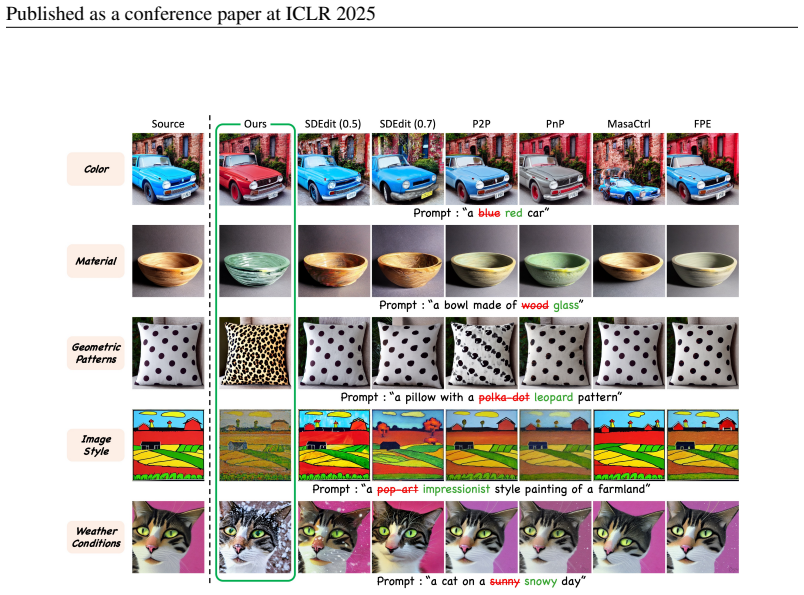
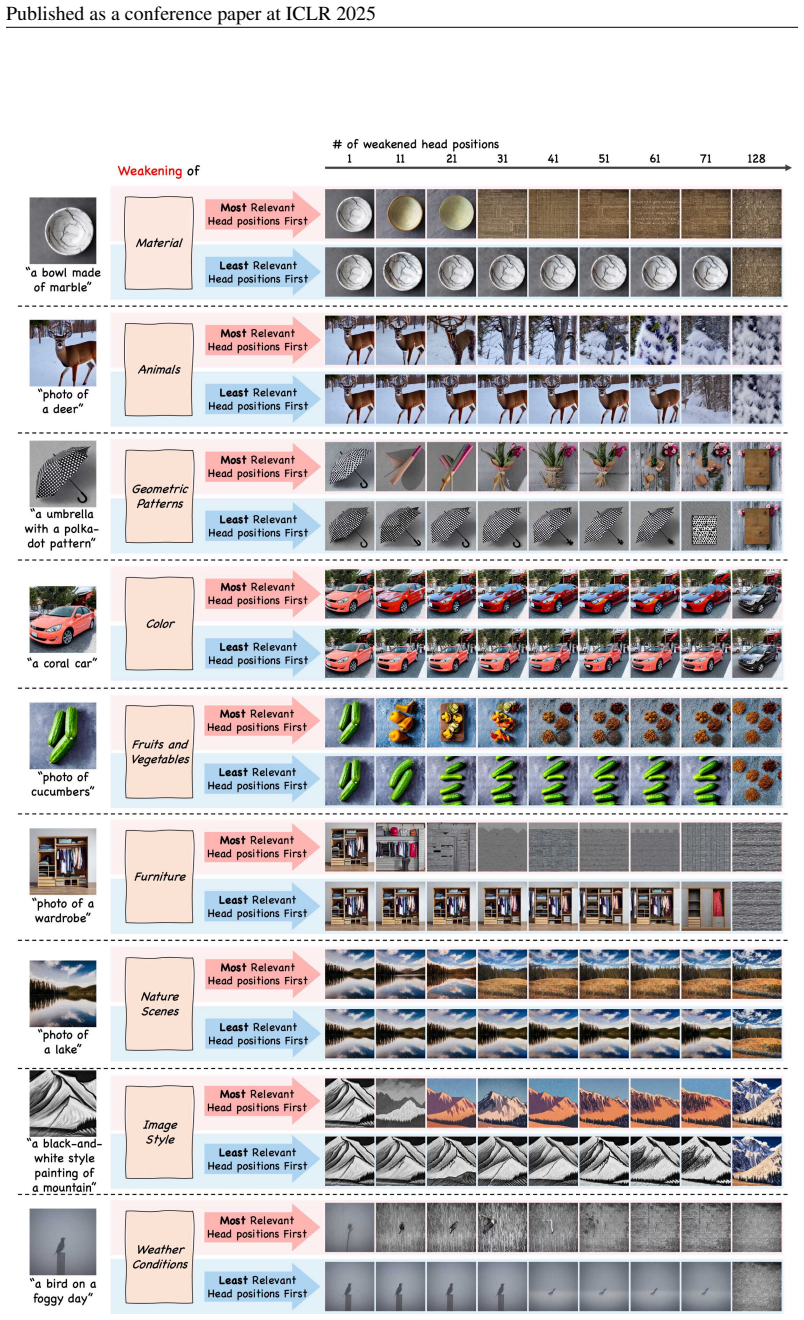
On the paper's own terms, the discovery is that cross-attention head positions in Stable Diffusion have concept-specific relevance patterns that align with human-specified visual concepts, and that these patterns are extractable from forward passes alone. For each concept, the procedure embeds one sampled concept-word per concept, concatenates the key projections, computes the cross-attention map against the image query, spatially averages it, and uses argmax to assign that head-timestep observation to the single most activated concept, incrementing that concept's HRV. The argmax is not a detail: cross-attention heads differ in scale by up to 8.1 times, so argmax converts each head into one scale-free vote. Validation by ordered weakening shows that weakening in most-relevant-first order removes the target concept from generated images markedly sooner than least-relevant-first order, in both Stable Diffusion v1.4 and SDXL. Applying the HRVs as rescaling vectors yields the paper's three application results: human-evaluated misinterpretation of polysemous words falls from 63.0% to 15.9%; image editing improves on five attributes relative to several baselines; and multi-concept generation improves over Attend-and-Excite by 2.3% to 6.3% across the reported metrics.
Load-bearing premise
The load-bearing assumption is that the 34 visual concepts, each expressed by 10 concept-words, are an exhaustive partition of what cross-attention heads can encode, because every head-timestep observation is assigned by argmax to exactly one concept and any head that truly encodes something outside the set would have its votes misattributed.
Editorial extensions
If this is right
- A user can obtain concept control over a frozen text-to-image model by running the HRV construction once, then rescaling head attention maps at inference time.
- Adding a new visual concept to the set does not materially disturb the existing HRVs, since the paper shows the 34-concept and 35-concept vectors are highly similar.
- For ambiguous tokens, concept adjusting with a chosen desired and undesired concept lowers the human-perceived misinterpretation rate from 63.0% to 15.9% on the 10 prompts tested.
- Coupling HRV rescaling with Prompt-to-Prompt improves image-text alignment and human preference for edits of color, material, geometric patterns, image style, and weather conditions.
- Coupling HRV rescaling with Attend-and-Excite reduces catastrophic neglect in two-prompt-type benchmarks, improving over the baseline by 2.3% to 6.3% on full-prompt similarity, minimum object similarity, and BLIP score.
Reading between the lines
- A stronger test than anything in the paper would build an HRV for a concept that lies far outside the 34, such as 'sky' or 'running'; the paper only demonstrates extension with Tableware, a concept close to the original set.
- Because construction is driven by CLIP text embeddings and argmax competition, concepts with poor lexical separation—such as facial expressions, which the paper itself reports as a failure case—are the likely weak points of the method.
- The finding that timesteps do not separate in the t-SNE of HRVs suggests head-level concept routing is settled globally rather than by a particular denoising phase; if so, HRV steering should transfer to shorter or distilled sampling schedules.
- The authors note an LLM can choose the desired and undesired concepts automatically but do not build that pipeline; a natural next step is an end-to-end system that takes a prompt, detects ambiguous tokens, and applies concept adjusting without human selection.
Signed reviews
Editorial analysis
A structured set of objections, weighed in public.
Referee Report
Summary. The paper proposes Head Relevance Vectors (HRVs) as concept-specific importance scores for the 128 cross-attention heads of Stable Diffusion v1.4 (and SDXL). HRVs are built by generating 2,100 random images and, for each head and timestep, computing cross-attention maps against the concatenated CLIP key embeddings of one randomly sampled word per concept (34 concepts, 10 words each), argmaxing over concepts, and incrementing the winning concept's entry (Eqs. 2-5); vectors are L1-normalized. The authors validate HRVs with an ordered weakening analysis (MoRHF vs LeRHF), then apply HRV-based rescaling ('concept strengthening' and 'concept adjusting') to reduce polysemous-word misinterpretation, to improve P2P editing on five attributes, and to improve Attend-and-Excite in multi-concept generation.
Significance. If the central claim holds, HRVs provide a simple, training-free, head-level control mechanism for text-to-image diffusion models and a new interpretability probe. The paper's strengths are its clear methodology, released code, the random-order weakening baseline, human evaluations, three downstream task benchmarks, the SDXL extension, and the Appendix J concept-addition check. The main risks are that HRV construction assumes the 34 concepts cover all visual content encountered, the primary validation is partly self-referential, and the quantitative claims lack uncertainty estimates. These issues are fixable and do not, in my view, invalidate the approach, but they currently prevent the stronger conclusions ('effectively and reliably constructed') from being fully supported.
major comments (5)
- [Section 3, Algorithm 1, Eq. (4)] The argmax in Eq. (4) assigns every head-timestep observation to exactly one of the 34 concepts, so any head that actually encodes an out-of-set concept (e.g., sky, water, motion, or an ImageNet/PromptHero category outside the list) has its votes absorbed by the nearest in-set concept, contaminating that HRV. The paper never reports the distribution of argmax margins or any coverage statistic over the 2,100 construction prompts. Appendix J's addition of Tableware shows that the original 34 HRVs are largely unchanged, but this checks robustness to adding one concept, not coverage of the prompt distribution. Please report top-1 vs top-2 margins, the fraction of low-confidence assignments, and a leave-one-concept-out or hold-out-prompt analysis.
- [Section 4, Figures 3, Appendix C.3] The ordered weakening test uses the same cross-attention maps from which HRVs were estimated, so it is partly self-referential: a summary of which heads attended most to a concept will naturally identify heads whose weakening affects that concept. The random-order baseline in Appendix C.3 mitigates this, but it does not test whether the HRV construction generalizes across prompt distributions. A split-half validation (construct HRVs on one half of the 2,100 prompts, evaluate ordered weakening on the other half) and a random head-weighting baseline for the downstream applications (e.g., uniform or shuffled HRVs in A&E and P2P) would substantially strengthen the evidence that the vectors carry concept-specific information.
- [Section 5 (Tables 1-2, Figure 7) and Appendix D.2] All quantitative comparisons are reported as point estimates without error bars, confidence intervals, or significance tests, despite the use of multiple seeds and prompts (e.g., 30 seeds, 500/250 edited images, 100 generated images per model in the polysemous evaluation). Improvements of 2.3-6.3% in Table 2 and 2.32-11.79% in Section 5.2 could be within seed or prompt variance. Please report bootstrap or paired tests over seeds and prompt sets for the main comparisons.
- [Section 5.1, Table 7, Appendix D] The polysemous-word evaluation uses 10 prompts hand-picked from known failure cases, and for each prompt the desired and undesired concepts are manually chosen (e.g., Color vs Plants for 'lavender'). This makes the 63.0% to 15.9% misinterpretation reduction hard to interpret as a general claim. The AMT protocol is well designed, but it evaluates only this curated set. Please broaden the prompt set, pre-specify selection criteria, or run the LLM-based automatic selection pipeline described in Appendix D.1 and report its performance.
- [Section 5 (Figure 4), Appendix C.4] The rescaling coefficients in the core methods are fixed without systematic justification: ordered weakening uses -2, and concept adjusting uses 2*HRV(desired) - 1*HRV(undesired). Appendix C.4 explores the weakening factor, but no sensitivity analysis is given for the concept-adjusting coefficients or for the L1 normalization in SDXL, which Appendix G.3 itself identifies as problematic. A small ablation over these coefficients would clarify how much of the reported gains depend on them.
minor comments (4)
- [Section 5.2, Table 1] The method name 'MassaCtrl' should be 'MasaCtrl' to match the reference and the surrounding text.
- [Appendix J] The sentence 'The two sets of HRVs for the original 34 visual concepts (Figure 48a and Figure 48b) are highly similar' is misworded; Figure 48b contains the 35-concept set, so the comparison is between the 34-concept and 35-concept constructions.
- [Table 8] The 'Filtering process' column contains a stray 'O' rather than a description; the table should be cleaned up.
- [References] The OpenAI reference entry uses the informal URL title 'Hello gpt-4o'; use a formal citation or consistent reference format.
Circularity Check
No significant circularity: the HRV construction is an empirical tally, and its validation and applications use held-out words, random-order controls, and external benchmarks that do not reduce to the construction inputs.
full rationale
The paper's chain is: (i) HRVs are built by tallying, per CA head and timestep, the argmax concept among 34 concept-word groups (Eqs. 3-5, Algorithm 1); (ii) ordered weakening tests whether MoRHF removes the concept faster than LeRHF; (iii) applications rescale CA maps with HRVs for polysemy, editing, and multi-concept generation. None of these steps equates a prediction to an input by construction. The ordered weakening is a causal intervention on the same model, but it is not forced: the construction uses attention statistics over 2,100 random prompts, while the reported validation uses different prompt templates and, for key concepts, held-out words (Appendix C.1 marks non-overlapping words with asterisks), and Appendix C.3 shows a random-order baseline with near-zero area. The downstream tasks are external benchmarks (P2P, A&E, human evaluation, CLIP/BLIP scores) using precomputed HRVs; success is not entailed by the argmax tally. The only self-citation (Kim et al. 2024, for the BG-DINO metric inspiration) is not load-bearing. The reader-flagged 34-concept coverage assumption is a robustness/validity concern about argmax misassignment, not a circularity, because it would make HRVs noisier rather than making the outputs equal to the inputs. Some validation and application words overlap the construction lists (e.g., Furniture and Weather in Table 5), which weakens those specific demonstrations, but the central results also include held-out concepts and external task benchmarks, so this overlap does not make the claim circular. No Eq. X = Eq. Y reduction or fitted-parameter-renamed-as-prediction was found.
Assumptions & free parameters
free parameters (5)
- Concept adjusting coefficient for desired concept =
2
- Ordered weakening rescaling factor =
-2
- Self-attention replacement rates =
0.4 for P2P, 0.9 for P2P-HRV
- HRV L1 normalization constant =
H (128 for SD v1.4, 1300 for SDXL)
- Number of visual concepts and concept-words =
34 concepts x 10 words (Table 3)
assumptions (4)
- domain assumption Attention between image queries and key-projected concept word embeddings is a valid measure of the visual concept present in the generated image.
- ad hoc to paper The 34 visual concepts and their 10 words cover all concepts relevant to the 2,100 random prompts, so argmax assignment is unbiased.
- domain assumption Multiplying a head's CA maps by a negative factor is a localized intervention that removes the head's concept contribution without breaking other generation structure.
- domain assumption A head's relevance pattern measured on random prompts transfers to new prompts and tokens, such as applying the Color HRV to the unseen word 'lavender'.
invented entities (1)
-
Head Relevance Vector (HRV)
independent evidence
Cite this review
Pith. "Pith review of Cross-Attention Head Position Patterns Can Align with Human Visual Concepts in Text-to-Image Generative Models." pith.science (2026). https://pith.science/paper/HZTMZMWG
@misc{pith2026241202237,
  author       = {Pith},
  title        = {Pith review of: Cross-Attention Head Position Patterns Can Align with Human Visual Concepts in Text-to-Image Generative Models},
  year         = {2026},
  howpublished = {\url{https://pith.science/paper/HZTMZMWG}},
  note         = {Machine review of arXiv:2412.02237}
}
read the original abstract
Recent text-to-image diffusion models leverage cross-attention layers, which have been effectively utilized to enhance a range of visual generative tasks. However, our understanding of cross-attention layers remains somewhat limited. In this study, we introduce a mechanistic interpretability approach for diffusion models by constructing Head Relevance Vectors (HRVs) that align with human-specified visual concepts. An HRV for a given visual concept has a length equal to the total number of cross-attention heads, with each element representing the importance of the corresponding head for the given visual concept. To validate HRVs as interpretable features, we develop an ordered weakening analysis that demonstrates their effectiveness. Furthermore, we propose concept strengthening and concept adjusting methods and apply them to enhance three visual generative tasks. Our results show that HRVs can reduce misinterpretations of polysemous words in image generation, successfully modify five challenging attributes in image editing, and mitigate catastrophic neglect in multi-concept generation. Overall, our work provides an advancement in understanding cross-attention layers and introduces new approaches for fine-controlling these layers at the head level.
Figures


Figures from the paper (46 more)






Reference graph
Works this paper leans on
-
[1]
and (ii) ‘a {Color A} {Animal A} and a {Color B} {Animal B}’ (Type 2). Table 11 lists the 12 animals and 10 colors used to generate these prompts, with the full prompt list available in our core codebase. Table 11: Word list for multi-concept generation Visual Concept Words Animals dog, cat, squirrel, fox, lion, frog, deer, penguin, bird, horse, bear, fis...
work page 2024
-
[3]
Table 3: 34 visual concepts and full list of concept-words. Visual Concept Concept-words Color red, blue, green, yellow, black, white, purple, gray, pink, brown Animals dog, cat, elephant, lion, bird, fish, butterfly, bear, horse, cow Plants tree, flower, grass, bush, cactus, vine, oak tree, moss, tulip, rose Fruits and Vegetables apple, banana, carrot, t...
work page 2025
-
[4]
For random order weak- ening, the H cross-attention heads are first ordered randomly, and then MoRHF is defined as the first-to-last order and LeRHF as the last-to-first order based on this random ordering. A larger (LeRHF − MoRHF) area indicates that the ordering of CA heads better reflects the relevance of the corresponding concept. Table 6 compares HRV...
-
[5]
Amir Hertz, Ron Mokady, Jay Tenenbaum, Kfir Aberman, Yael Pritch, and Daniel Cohen-Or
URL https://openreview.net/forum?id=NudBMY-tzDr. Amir Hertz, Ron Mokady, Jay Tenenbaum, Kfir Aberman, Yael Pritch, and Daniel Cohen-Or. Prompt-to-prompt image editing with cross attention control. arXiv preprint arXiv:2208.01626,
-
[7]
Sdedit: Guided image synthesis and editing with stochastic differential equations
Chenlin Meng, Yutong He, Yang Song, Jiaming Song, Jiajun Wu, Jun-Yan Zhu, and Stefano Ermon. Sdedit: Guided image synthesis and editing with stochastic differential equations. arXiv preprint arXiv:2108.01073,
-
[8]
For each question, participants are shown 5 images and asked to count how many depict the intended meaning of the polysemous word without including the unintended meaning: “Count how many of the following five images contain{intended meaning of the polysemous word} but no {unintended meaning of the polysemous word }.” This count is then subtracted from 5 ...
work page 2025
-
[9]
Accessed: 2024-06-11. Maxime Oquab, Timoth ´ee Darcet, Th ´eo Moutakanni, Huy V o, Marc Szafraniec, Vasil Khalidov, Pierre Fernandez, Daniel Haziza, Francisco Massa, Alaaeldin El-Nouby, et al. Dinov2: Learning robust visual features without supervision. arXiv preprint arXiv:2304.07193,
arXiv 2024
-
[10]
Zero-shot image-to-image translation
Gaurav Parmar, Krishna Kumar Singh, Richard Zhang, Yijun Li, Jingwan Lu, and Jun-Yan Zhu. Zero-shot image-to-image translation. In ACM SIGGRAPH 2023 Conference Proceedings , pp. 1–11,
work page 2023
Show all 35 references
-
[11]
Controlling generative models with continuous factors of variations
12 Published as a conference paper at ICLR 2025 Antoine Plumerault, Herv ´e Le Borgne, and C ´eline Hudelot. Controlling generative models with continuous factors of variations. In International Conference on Learning Representations,
2025
-
[12]
PromptHero
URL https://openreview.net/forum?id=di52zR8xgf. PromptHero. https://prompthero.com/. Accessed: 2024-06-03. Alec Radford, Jong Wook Kim, Chris Hallacy, Aditya Ramesh, Gabriel Goh, Sandhini Agarwal, Girish Sastry, Amanda Askell, Pamela Mishkin, Jack Clark, et al. Learning transf...
2024
-
[13]
Sam 2: Segment anything in images and videos
Nikhila Ravi, Valentin Gabeur, Yuan-Ting Hu, Ronghang Hu, Chaitanya Ryali, Tengyu Ma, Haitham Khedr, Roman R¨adle, Chloe Rolland, Laura Gustafson, et al. Sam 2: Segment anything in images and videos. arXiv preprint arXiv:2408.00714,
-
[14]
Grounded sam: Assembling open-world models for diverse visual tasks
Tianhe Ren, Shilong Liu, Ailing Zeng, Jing Lin, Kunchang Li, He Cao, Jiayu Chen, Xinyu Huang, Yukang Chen, Feng Yan, et al. Grounded sam: Assembling open-world models for diverse visual tasks. arXiv preprint arXiv:2401.14159,
-
[15]
U-net: Convolutional networks for biomed- ical image segmentation
Olaf Ronneberger, Philipp Fischer, and Thomas Brox. U-net: Convolutional networks for biomed- ical image segmentation. In Medical image computing and computer-assisted intervention– MICCAI 2015: 18th international conference, Munich, Germany, October 5-9, 2015, proceed- ings, ...
2015
-
[16]
13 Published as a conference paper at ICLR 2025 Richard Tomsett, Dan Harborne, Supriyo Chakraborty, Prudhvi Gurram, and Alun Preece
URL https://transformer-circuits.pub/2024/ scaling-monosemanticity/index.html. 13 Published as a conference paper at ICLR 2025 Richard Tomsett, Dan Harborne, Supriyo Chakraborty, Prudhvi Gurram, and Alun Preece. San- ity checks for saliency metrics. Proceedings of the AAAI Con...
2024
-
[17]
URL https://ojs.aaai
doi: 10.1609/aaai.v34i04.6064. URL https://ojs.aaai. org/index.php/AAAI/article/view/6064. Narek Tumanyan, Michal Geyer, Shai Bagon, and Tali Dekel. Plug-and-play diffusion features for text-driven image-to-image translation. In Proceedings of the IEEE/CVF Conference on Com- p...
-
[18]
17 B.2 Role of the argmax operation in HRV construction
14 Published as a conference paper at ICLR 2025 CONTENTS A 34 visual concepts and full list of concept-words 16 B Details of HRV construction 17 B.1 Pseudo-code for HRV construction . . . . . . . . . . . . . . . . . . . . . . . . . . 17 B.2 Role of the argmax operation in HRV ...
2025
-
[19]
We categorized the misinterpretation into three types: (i) containing the undesired meaning, (ii) missing the desired meaning, and (iii) both, and mark the images showing any of these misin- terpretations. For the last prompt, ‘A single rusted nut,’ where ‘nut’ was misinterpre...
2025
-
[20]
The MoRHF weakening rapidly removes concept-relevant content, whereas the LeRHF weakening either preserves the original image longer or removes irrelevant content first
Visual Concept Prompt Template Words Animals∗ photo of a{Animals} •{Animals}: rabbit, frog, sheep, pig, chicken, dolphin, goat, duck, deer, fox Color∗ a{Color} {Objects} •{Color}: coral, beige, violet, cyan, magenta, indigo, orange, turquoise, teal, khaki •{Objects}: car, benc...
2025
-
[23]
Both methods are evaluated on the Color editing benchmark with SA replacement rates varying from 0.0 to 1.0
Figure 21: Trade-off effect of self-attention replacement in P2P and P2P-HRV (Ours). Both methods are evaluated on the Color editing benchmark with SA replacement rates varying from 0.0 to 1.0. Red-highlighted SA replacement rates indicate points where P2P and P2P-HRV achieve ...
2025
-
[24]
The words for Objects are sampled similarly. The same process is applied to the other editing tasks, except for Weather Conditions, which uses 5 attribute pairs (Weather Condition A, Weather Condition B), generating 250 images for each T2I model. The full list of prompts and a...
2025
-
[25]
The CLIP score measures the CLIP image-text similarity between the edited image and the target prompt, assessing how well the edited image aligns with the target prompt
and BG-DINO scores. The CLIP score measures the CLIP image-text similarity between the edited image and the target prompt, assessing how well the edited image aligns with the target prompt. Meanwhile, the BG-DINO score assesses structure preservation, focusing only on the non-...
2024
-
[26]
While prior works (Parmar et al., 2023; Kim et al.,
model to obtain embeddings, and calculate cosine similarity between these two embeddings. While prior works (Parmar et al., 2023; Kim et al.,
2023
-
[27]
For human evaluation, we randomly select a seed previously used to measure CLIP image-text similari- ties. Images are then generated for each prompt pair using P2P-HRV and four other high-performing 32 Published as a conference paper at ICLR 2025 methods, resulting in 250 imag...
2025
-
[29]
34 Published as a conference paper at ICLR 2025 Figure 23: Qualitative results of image editing comparing P2P (Hertz et al.,
and ours, based on the variation of self-attention replacement rate (Part 1 of 2). 34 Published as a conference paper at ICLR 2025 Figure 23: Qualitative results of image editing comparing P2P (Hertz et al.,
2025
-
[30]
and ours, based on the variation of self-attention replacement rate (Part 2 of 2). 35 Published as a conference paper at ICLR 2025 E.5 A DDITIONAL RESULTS ON IMAGE EDITING Figures 24–34 present additional qualitative results of image editing for three object attributes and two...
2025
-
[32]
and ours. 46 Published as a conference paper at ICLR 2025 F.2 A DDITIONAL RESULTS ON MULTI -CONCEPT GENERATION Figure 36 presents additional qualitative results of multi-concept generation for both Type 1 and Type 2 prompts. Figure 36: Qualitative comparison of the results for...
2025
-
[33]
with ours. 47 Published as a conference paper at ICLR 2025 G A DDITIONAL RESULTS USING SDXL G.1 A DDITIONAL RESULTS ON ORDERED WEAKENING ANALYSIS Figures 37–42 present additional results from the ordered weakening analysis on Stable Diffusion XL (SDXL) (Podell et al., 2024). F...
2025
-
[34]
We then construct HRVs individually for both the 34-concept and 35-concept sets and compare them through visualization
To demonstrate this, we add the concept Tableware, creating a set of 35 extended visual concepts. We then construct HRVs individually for both the 34-concept and 35-concept sets and compare them through visualization. Stable Diffusion v1 has 16 multi-head CA layers, each conta...
2025
-
[46]
In Figures 45-46, we generate images using SDXL with the same random seed for three prompts in each concept case. For the first type of failure, shown in Figure 45, the model often struggles to understand certain concepts, failing to distinguish between words like ‘three’ and ...
2025
-
[2018]
Imagenet: A large-scale hi- erarchical image database
Jia Deng, Wei Dong, Richard Socher, Li-Jia Li, Kai Li, and Li Fei-Fei. Imagenet: A large-scale hi- erarchical image database. In 2009 IEEE conference on computer vision and pattern recognition, pp. 248–255. Ieee,
2009
-
[2020]
https://distill.pub/2020/circuits/zoom-in
doi: 10.23915/distill.00024.001. https://distill.pub/2020/circuits/zoom-in. OpenAI. Hello gpt-4o. https://openai.com/index/hello-gpt-4o/,
2020 doi
-
[2021]
Training-free structured diffusion guidance for compositional text-to-image synthesis
Weixi Feng, Xuehai He, Tsu-Jui Fu, Varun Jampani, Arjun Akula, Pradyumna Narayana, Sugato Basu, Xin Eric Wang, and William Yang Wang. Training-free structured diffusion guidance for compositional text-to-image synthesis. arXiv preprint arXiv:2212.05032,
-
[2022]
Interpreting clip’s image representation via text-based decomposition
Yossi Gandelsman, Alexei A Efros, and Jacob Steinhardt. Interpreting clip’s image representation via text-based decomposition. arXiv preprint arXiv:2310.05916,
-
[2023]
Multimodal neurons in artificial neural networks
11 Published as a conference paper at ICLR 2025 Gabriel Goh, Nick Cammarata, Chelsea V oss, Shan Carter, Michael Petrov, Ludwig Schubert, Alec Radford, and Chris Olah. Multimodal neurons in artificial neural networks. Distill, 6(3):e30,
2025
-
[2024]
Pseudo numerical methods for diffusion models on manifolds
Luping Liu, Yi Ren, Zhijie Lin, and Zhou Zhao. Pseudo numerical methods for diffusion models on manifolds. arXiv preprint arXiv:2202.09778,
Reviewed August 11, 2026 · model on record in the stance chip above.
Discussion (0). Continue with ORCID to comment.