REVIEW 3 major objections 6 minor 2 cited by
Scalar embedding of temporal network trajectories
T0 review · 3 major / 6 minor · reviewed 2026-08-12 · deepseek-v4-flash
Pith's one-line read A temporal network trajectory can be compressed into a one-dimensional time series—by projecting the matrix of pairwise distances between snapshots—without losing its main dynamical fingerprints: autocorrelation, periodicity, memory…
desk verdict A useful, clearly written toolbox for reducing temporal network trajectories to scalar signals, but the preservation claim is more conditional than the abstract suggests, and the chaotic validation is circular. read the letter →
The pith
A machine-rendered reading of the paper's core claim, the machinery that carries it, and where it could break.
The reading
What carries the argument
The central object is the matrix of pairwise squared graph distances between snapshots, $D^{(2)}_{t\ell}=\|G_t-G_\ell\|^2$, evaluated with a fixed node labeling and the normalized Frobenius norm of Eq. (12). The PCA-based and classical-MDS strategies are both spectral decompositions of a centered version of this matrix: PCA centers columns and diagonalizes the covariance, while classical MDS double-centers to reconstruct the Gram matrix $B=-\tfrac12 J D^{(2)} J$ and takes its leading scaled eigenvector as the scalar coordinate. The algebra that makes this work is the identity $d^2_{t\ell}=\|x_t\|^2+\|x_\ell\|^2-2x_t\cdot x_\ell$, which connects squared distances to an inner-product space so that the leading eigenvector becomes a faithful one-dimensional coordinate for the relative geometry of the snapshots. What carries the argument is the deliberate choice to preserve inter-snapshot distances rather than intra-snapshot topology.
What would settle it
Generate a network trajectory made of two independent edge sets oscillating at two incommensurate periods with comparable noise levels, so that no single scalar coordinate can track both oscillations, and check whether the scalar embedding's autocorrelation function shows both periods. If either period is missing, the claim that scalar embeddings inherit multiscale dynamics is falsified; the paper reports such multiscale results only as 'results not shown'.
Extended reading notes
Core claim
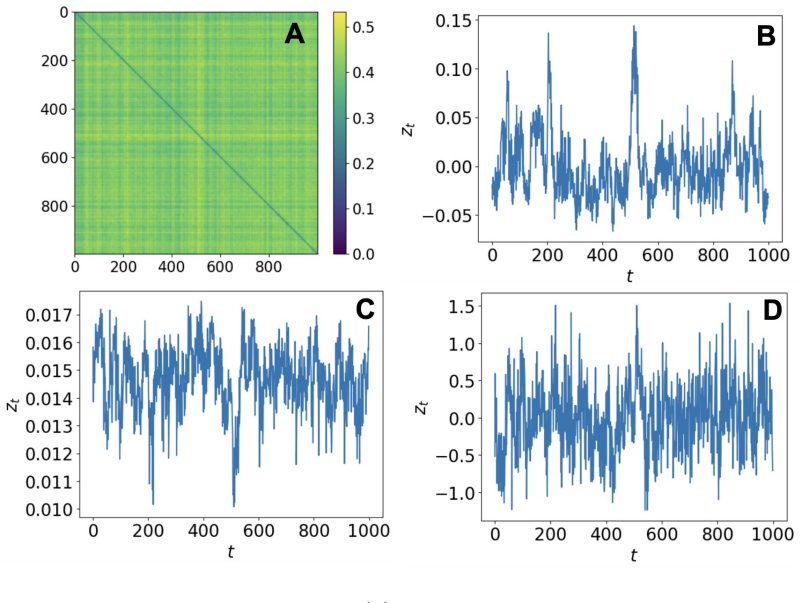
The central claim is that nontrivial dynamical properties of a network trajectory are preserved already in its scalar embedding. Given a trajectory $S=(G_1,\ldots,G_T)$ with adjacency matrices $A(t)$, the paper forms the squared-distance matrix $D^{(2)}_{t\ell}=\|G_t-G_\ell\|^2$ using the normalized Frobenius norm of Eq. (12), and extracts a scalar time series $z_t$ either by projecting the column-centered distance matrix onto the first principal component, by taking the first scaled eigenvector, or by classical MDS double-centering. The finding is that these $z_t$ inherit the network autocorrelation function—including the flat segment for lags below the memory order and the exponential tail—along with periodicity, the location of change points, and the largest Lyapunov exponent of chaotic trajectories. The one rigorous guarantee, proven in Appendix A, is that for one-dimensional input the classical-MDS embedding recovers the signal up to a mean shift and a global sign flip; for full network trajectories the preservation is demonstrated across the synthetic suite and two real datasets.
Load-bearing premise
The load-bearing premise is that the matrix of squared pairwise distances between snapshots, defined for a fixed labeling of the nodes and a chosen matrix norm, contains enough information about the intrinsic dynamics of the temporal network; if two trajectories with different dynamics ever share the same distance matrix, no embedding built on those distances can tell them apart.
Editorial extensions
If this is right
- A temporal network can be reduced to an ordinary scalar time series, so the full toolkit of time series analysis—spectral estimation, change-point detection, forecasting—can be applied to network trajectories.
- Periodicity in a network trajectory survives embedding even when the average degree is constant and when only a small fraction (about 10%) of edges carry the periodic activity, so embeddings isolate genuine dynamical structure rather than trivial density fluctuations.
- Memory in DARN(p) processes is inherited: the flat-then-decaying shape of the network autocorrelation function appears in the autocorrelation of the scalar embedding, and change points between different memory orders are visible as variance changes in the embedding.
- Chaotic network trajectories built by the dictionary trick yield scalar embeddings whose recurrence expansion rate reproduces the theoretical Lyapunov exponent ($\ln 2$ for the fully chaotic logistic map), so dynamical instability is measurable after reduction.
- The scalar embedding behaves as a noise filter: it enhances the signal-to-noise ratio of periodic and memory-laden trajectories, improving the visibility of periodicity in empirical networks.
Reading between the lines
- Because the embedding is a deterministic function of the pairwise distance matrix, any two network trajectories sharing the same distance structure will be indistinguishable after reduction; this suggests a characterization of when distance matrices are sufficient statistics (e.g., for isometry-invariant dynamics) as a natural theoretical follow-up.
- The success of the scalar embeddings across very different models suggests a universality: for dynamics that are themselves low-dimensional in graph space, a single coordinate may suffice, and the first principal component's explained variance could be used as an a priori diagnostic of whether a scalar reduction is faithful.
- The same distance-matrix recipe can be extended to unlabeled networks by replacing the Frobenius norm with a graph-invariant distance (e.g., spectral distance), which the paper explicitly identifies as an open direction; a testable prediction is that the preservation results would carry over.
- The 'antiphase' failure of metric-MDS is analogous to sign ambiguities in eigenvector-based embeddings in other spectral methods; an online or incremental variant of the successful PCA/MDS strategies could stabilize the embedding when new snapshots are appended, an issue the paper only partially explores.
Editorial analysis
A structured set of objections, weighed in public.
Referee Report
Summary. The paper proposes to embed a temporal network trajectory—a sequence of network snapshots—into a low-dimensional, typically scalar, time series by applying PCA or MDS to the matrix of pairwise squared distances between snapshots. Four variants are defined: PCA-projection, PCA-embedding, classical-MDS, and metric-MDS. The central claim is that nontrivial dynamical properties of the original trajectory—periodicity, memory, change points, and maximum Lyapunov exponent—are preserved in the scalar embedding. The method is validated on one-dimensional time series, several synthetic network trajectory models (white, pulsating periodic, DARN memory, Type-1/2/3 periodic, dictionary-based chaotic), and two empirical networks (email and primary school contacts). Appendix A proves that classical-MDS recovers a one-dimensional scalar time series exactly up to a shift and a sign flip.
Significance. The paper is clearly written and proposes a simple, computationally accessible methodology that could be useful for temporal network analysis. The key idea of using inter-snapshot distances as features is well motivated and connects to existing work on network trajectories. The numerical experiments cover a broad range of models, and the Appendix A proof is elegant. The method demonstrably works on the tested models, and the empirical results are suggestive. However, the paper's central claim as stated in the abstract is too strong: the scalar embeddings are one-dimensional projections, and the evidence is partly circular in the chaotic case. With appropriate qualifications and additional control experiments, the contribution would be a useful proof of concept.
major comments (3)
- [3.2.5 and Appendix A] The chaotic validation is circular. The dictionary is constructed so that any two networks G[s] and G[t] are exactly |s−t| rewirings apart, hence ∥G[s]−G[t]∥ = |t−s|; after assigning each cell of the logistic map to a dictionary entry, the squared distance matrix of the network trajectory is (up to discretization) the squared distance matrix of the scalar logistic time series. Appendix A proves that classical-MDS recovers a one-dimensional signal up to shift and sign, and the PCA-embedding is numerically equivalent to classical-MDS on this input. The recovery of λ = ln 2 is therefore a corollary of the scalar proof, not an independent validation for network trajectories. Please replace or supplement this experiment with a network trajectory whose distance matrix is not that of a scalar time series, for example a chaotic latent variable driving a subset of links, and test whether the scalar embedding still recovers the correct Lyapunov exponent.
- [2.1, Eqs. (4), (5), (8)] The unrestricted claim that 'nontrivial dynamical properties of the network trajectories are preserved already in their scalar embeddings' is not supported for general network trajectories. All three successful scalar embeddings are one-dimensional projections of the trajectory in the feature space, so they can only capture the component of the dynamics aligned with the first principal component (or first eigenvector). In the experiments, the planted signal is global (pulsating model, DARN memory in every link, global change points) so it dominates the variance; no experiment varies the relative variance of a signal and an independent noise component. Provide a control experiment of the form G_t = A_noise(t) + ε A_signal(t), where A_noise(t) is a white-noise adjacency matrix and A_signal(t) is periodic or memory-bearing, and report the range of ε for which the scalar ACF recovers the signal. Until then, the abstract and Section 3.2.4 should be qualified to state that preservation holds when the relevant dynamics dominate the variance of the distance matrix.
- [Section 2 and Discussion (fourth paragraph)] The paper states that the relative graph distance between snapshots is the property that needs to be preserved, but this sufficient-statistic assumption is not proven for network trajectories; Appendix A proves recovery only for scalar data. Moreover, even when the distance matrix is a sufficient statistic, the scalar embedding is a further lossy projection, so the conditions under which the first eigenvector preserves a given dynamical invariant (e.g., the maximum Lyapunov exponent or the memory order) remain unspecified. Please either provide a formal statement of when scalar recovery is exact (as in Appendix A for one-dimensional data) or explicitly frame the method as heuristic with empirical support, and discuss the classes of dynamics for which the first principal component is expected to suffice.
minor comments (6)
- [Eq. (13)] There is an extra closing parenthesis in the denominator: σ(ACF(τ ))τ <P) should be σ(ACF(τ))_{τ<P}.
- [Fig. 3 caption] The caption says 'N = 500 snapshots'; the symbol N is used elsewhere for the number of nodes. Please use T = 500 snapshots.
- [Section 3.3.1] The text refers to Fig. 8(C) for both the scalar autocorrelation function and the nACF; the scalar ACF is in panel (D) and the nACF in panel (B). Please correct the figure references.
- [3.1, list of processes] Typo: 'autorreggressive' should be 'autoregressive'.
- [3.2.5] The statement ∥G[s]−G[t]∥ = |t−s| is inconsistent with the normalized Frobenius norm in Eq. (12) (which would give sqrt(|t−s|)/N) and also with the standard unnormalized Frobenius norm (which would give sqrt(2|t−s|) for a single edge rewiring). Please specify the norm used in the dictionary construction and how it relates to Eq. (12).
- [Appendix B and 3.2.5] Please state explicitly whether the antiphase correction was applied to the metric-MDS embedding in the chaotic experiment and, if so, whether the smoothness assumption is justified for that signal; otherwise the reader cannot assess the impact of the correction on the reported Lyapunov exponent.
Circularity Check
The chaotic-network validation reduces by construction to the scalar-data proof: the dictionary trick builds graphs whose pairwise distances are exactly the logistic time series' distances, so the recovered Lyapunov exponent is a corollary, not an independent network-level test.
-
self definitional
[Section 3.2.5 (Chaotic network trajectories: the dictionary trick), with Appendix A and Eqs. (1)/(12)]
"By following these two rules, the sequence of generated networks is metrical: any two G[s] and G[t] are precisely t − s rewirings apart, so ∥G[s] − G[t]∥ = |t − s|. ... Finally, each point of the time series xt is mapped to a network which we label Gt, thereby constructing a temporal network ( Gt)T t=1 with the same dynamical properties of ( xt)T t=1."
The dictionary trick constructs the network trajectory so its squared-distance matrix (Eq. 1, Eq. 12) is literally the distance matrix of the logistic time series. Appendix A shows classical-MDS recovers any one-dimensional signal from that distance matrix up to shift/reflection, and Section 3.1 reports PCA-embedding also recovers it exactly. Hence the scalar embedding of this constructed network is, by construction, a linear image of the logistic time series, and the reported Lyapunov exponent ln 2 is a corollary of the scalar-data recovery, not an independent property of network trajectories. The test verifies only that the cell-to-graph dictionary was built metrically; the chaotic 'inheritance' is encoded in the input distances, so the prediction reduces to its own input.
full rationale
Most of the paper is a self-contained empirical study: the pulsating, DARN(p), Type-1/2/3 periodic, change-point, and empirical analyses compare scalar-embedding autocorrelations against nACF ground truth computed from adjacency matrices, and those matches are not forced by the embedding construction. The Appendix A proof for scalar data is genuine and independent. The one clearly circular validation is Section 3.2.5: the dictionary trick defines a network trajectory whose distance matrix equals that of a scalar logistic time series, so the recovered Lyapunov exponent is implied by the Appendix A recovery theorem rather than by any property of general network trajectories. This is a partial circularity: one of the paper's headline validations reduces by construction, while the central methodology retains independent content elsewhere. The more general question of whether truncation to the first principal component can discard dynamical signal aligned with lower-variance directions is a real limitation of the preservation claim, but it is a correctness/sufficiency issue rather than a circularity, so it does not by itself raise the score above 6.
Assumptions & free parameters
free parameters (2)
- z-score detection threshold z > 3 =
3
- Antiphase correction outlier threshold =
unspecified
assumptions (6)
- domain assumption Pairwise graph distances between snapshots (Frobenius norm on labeled adjacency matrices) are a sufficient statistic for the trajectory's intrinsic dynamics.
- domain assumption Snapshots have fixed number of nodes N and labeled nodes; the distance norm is not invariant under isomorphism.
- domain assumption The network autocorrelation function (Eq. 10) and network maximum Lyapunov exponent are valid and sufficient ground-truth descriptors of trajectory dynamics.
- ad hoc to paper A metrical dictionary of graphs satisfying ||G[s] - G[t]|| = |s - t| can be constructed by sequential link rewiring under the two stated rules.
- standard math Spectral decomposition of symmetric positive definite matrices and the double-centering reconstruction of the Gram matrix (MDS theory) are valid.
- domain assumption Wolf's method on the scalar embedding recovers the dominant Lyapunov exponent of the underlying network dynamics.
Cite this review
Pith. "Pith review of Scalar embedding of temporal network trajectories." pith.science (2026). https://pith.science/paper/PSKQWO3F
@misc{pith2026241202715,
  author       = {Pith},
  title        = {Pith review of: Scalar embedding of temporal network trajectories},
  year         = {2026},
  howpublished = {\url{https://pith.science/paper/PSKQWO3F}},
  note         = {Machine review of arXiv:2412.02715}
}
read the original abstract
A temporal network -- a collection of snapshots recording the evolution of a network whose links appear and disappear dynamically -- can be interpreted as a trajectory in graph space. In order to characterize the complex dynamics of such trajectory via the tools of time series analysis and signal processing, it is sensible to preprocess the trajectory by embedding it in a low-dimensional Euclidean space. Here we argue that, rather than the topological structure of each network snapshot, the main property of the trajectory that needs to be preserved in the embedding is the relative graph distance between snapshots. This idea naturally leads to dimensionality reduction approaches that explicitly consider relative distances, such as Multidimensional Scaling (MDS) or identifying the distance matrix as a feature matrix in which to perform Principal Component Analysis (PCA). This paper provides a comprehensible methodology that illustrates this approach. Its application to a suite of generative network trajectory models and empirical data certify that nontrivial dynamical properties of the network trajectories are preserved already in their scalar embeddings, what enables the possibility of performing time series analysis in temporal networks.
Figures


Figures from the paper (13 more)


Forward citations
Cited by 2 Pith papers
-
Conditional Entropy of Heat Diffusion on Temporal Networks
On temporal networks, the conditional entropy of heat diffusion is monotone in time, and its local-window version gives a signal that detects structural and activity change points.
-
Characterising the dynamics of unlabelled temporal networks
For unlabelled temporal networks, invariant-based pseudo-distances recover periodicity and memory and qualitatively detect chaotic instability, but they cannot yield model-independent Lyapunov exponents.
Reference graph
Works this paper leans on
-
[1]
Complex networks: principles, methods and applications
Vito Latora, Vincenzo Nicosia, and Giovanni Russo. Complex networks: principles, methods and applications. Cambridge University Press, 2017
work page 2017
-
[2]
Networks
Mark Newman. Networks. Oxford university press, 2018
2018
-
[3]
Naoki Masuda and Renaud Lambiotte. A Guide to Temporal Networks . 2016
work page 2016
-
[4]
Temporal networks.Physics Reports, 519(3):97–125, October 2012
Petter Holme and Jari Saram¨ aki. Temporal networks.Physics Reports, 519(3):97–125, October 2012
work page 2012
-
[5]
Modern temporal network theory: a colloquium
Petter Holme. Modern temporal network theory: a colloquium. The European Physical Journal B , 88(9), September 2015
work page 2015
-
[6]
Temporal network theory, volume 2
Petter Holme and Jari Saram¨ aki. Temporal network theory, volume 2. Springer, 2019
work page 2019
-
[7]
Temporal networks: slowing down diffusion by long lasting interactions
Naoki Masuda, Konstantin Klemm, and V ´ ıctor M Egu ´ ıluz. Temporal networks: slowing down diffusion by long lasting interactions. Physical Review Letters, 111(18):188701, 2013
work page 2013
-
[8]
Diffusion on networked systems is a question of time or structure
Jean-Charles Delvenne, Renaud Lambiotte, and Luis EC Rocha. Diffusion on networked systems is a question of time or structure. Nature communications, 6(1):7366, 2015
work page 2015
Show all 65 references
-
[9]
Causality-driven slow-down and speed-up of diffusion in non-markovian temporal networks
Ingo Scholtes, Nicolas Wider, Ren´ e Pfitzner, Antonios Garas, Claudio J Tessone, and Frank Schweitzer. Causality-driven slow-down and speed-up of diffusion in non-markovian temporal networks. Nature communications, 5(1):5024, 2014
2014
-
[10]
Starnini, A
M. Starnini, A. Baronchelli, and R. Pastor-Satorras. Modeling human dynamics of face-to-face interaction networks. Physical Review Letters, 110:168701, Apr 2013
2013
-
[11]
A dynamic network model with persistent links and node-specific latent variables, with an application to the interbank market
Piero Mazzarisi, Paolo Barucca, Fabrizio Lillo, and Daniele Tantari. A dynamic network model with persistent links and node-specific latent variables, with an application to the interbank market. European Journal of Operational Research, 281(1):50–65, 2020
2020
-
[12]
Correlated bursts in temporal networks slow down spreading
Takayuki Hiraoka and Hang-Hyun Jo. Correlated bursts in temporal networks slow down spreading. Scientific reports, 8(1):15321, 2018
2018
-
[13]
Non-markovian infection spread dramatically alters the susceptible-infected-susceptible epidemic threshold in networks
P Van Mieghem and R Van de Bovenkamp. Non-markovian infection spread dramatically alters the susceptible-infected-susceptible epidemic threshold in networks. Physical review letters, 110(10):108701, 2013
2013
-
[14]
From static to temporal network theory: Applications to functional brain connectivity
William Hedley Thompson, Per Brantefors, and Peter Fransson. From static to temporal network theory: Applications to functional brain connectivity. Network Neuroscience, 1(2):69– 99, 2017
2017
-
[15]
Dynamics in scheduled networks
Massimiliano Zanin, Lucas Lacasa, and Miguel Cea. Dynamics in scheduled networks. Chaos: An Interdisciplinary Journal of Nonlinear Science , 19(2), 2009
2009
-
[16]
Modelling the air transport with complex networks: A short review
Massimiliano Zanin and Fabrizio Lillo. Modelling the air transport with complex networks: A short review. The European Physical Journal Special Topics , 215(1):5–21, 2013
2013
-
[17]
Effects of memory on spreading processes in non-markovian temporal networks
Oliver E Williams, Fabrizio Lillo, and Vito Latora. Effects of memory on spreading processes in non-markovian temporal networks. New Journal of Physics , 21(4):043028, 2019
2019
-
[18]
Rodriguez, and Victor M
Lucas Lacasa, Jorge P. Rodriguez, and Victor M. Eguiluz. Correlations of network trajectories. Phys. Rev. Res. , 4:L042008, Oct 2022. 23
2022
-
[19]
Autocorrelation properties of temporal networks governed by dynamic node variables
Harrison Hartle and Naoki Masuda. Autocorrelation properties of temporal networks governed by dynamic node variables. arXiv preprint arXiv:2408.16270 , 2024
2024 arXiv
-
[20]
Characterization of interactions’ persistence in time-varying networks
Francisco Bauz´ a Mingueza, Mario Flor ´ ıa, Jes´ us G´ omez-Garde˜ nes, Alex Arenas, and Alessio Cardillo. Characterization of interactions’ persistence in time-varying networks. Scientific Reports, 13(1):765, 2023
2023
-
[21]
Detecting periodic time scales of changes in temporal networks
Elsa Andres, Alain Barrat, and M´ arton Karsai. Detecting periodic time scales of changes in temporal networks. Journal of Complex Networks , 12(2):cnae004, 2024
2024
-
[22]
Egu ´ ıluz, Leonardo Di Gaetano, Tobias Galla, and Lucas Lacasa
Annalisa Caligiuri, Victor M. Egu ´ ıluz, Leonardo Di Gaetano, Tobias Galla, and Lucas Lacasa. Lyapunov exponents for temporal networks. Phys. Rev. E , 107:044305, Apr 2023
2023
-
[23]
Dynamical stability and chaos in artificial neural network trajectories along training
Kaloyan Danovski, Miguel C Soriano, and Lucas Lacasa. Dynamical stability and chaos in artificial neural network trajectories along training. Frontiers in Complex Systems, 2:1367957, 2024
2024
-
[24]
Characterising the dynamics of unlabelled temporal networks
Annalisa Caligiuri, Tobias Galla, and Lucas Lacasa. Characterising the dynamics of unlabelled temporal networks. arXiv preprint arXiv:2412.14864 , 2024
2024 arXiv
-
[25]
The shape of memory in temporal networks
Oliver E Williams, Lucas Lacasa, Ana P Mill´ an, and Vito Latora. The shape of memory in temporal networks. Nature communications, 13(1):499, 2022
2022
-
[26]
Changping Wang, Chaokun Wang, Zheng Wang, Xiaojun Ye, and Philip S. Yu. Edge2vec: Edge-based social network embedding. ACM Trans. Knowl. Discov. Data , 14(4), may 2020
2020
-
[27]
Laplacian eigenmaps and spectral techniques for embedding and clustering
Mikhail Belkin and Partha Niyogi. Laplacian eigenmaps and spectral techniques for embedding and clustering. Advances in neural information processing systems , 14, 2001
2001
-
[28]
Nonlinear dimensionality reduction by locally linear embedding
Sam T Roweis and Lawrence K Saul. Nonlinear dimensionality reduction by locally linear embedding. science, 290(5500):2323–2326, 2000
2000
-
[29]
Distributed large-scale natural graph factorization
Amr Ahmed, Nino Shervashidze, Shravan Narayanamurthy, Vanja Josifovski, and Alexan- der J Smola. Distributed large-scale natural graph factorization. In Proceedings of the 22nd international conference on World Wide Web , pages 37–48, 2013
2013
-
[30]
Graph embedding techniques, applications, and perfor- mance: A survey
Palash Goyal and Emilio Ferrara. Graph embedding techniques, applications, and perfor- mance: A survey. Knowledge-Based Systems, 151:78–94, 2018
2018
-
[31]
Line: Large- scale information network embedding
Jian Tang, Meng Qu, Mingzhe Wang, Ming Zhang, Jun Yan, and Qiaozhu Mei. Line: Large- scale information network embedding. In Proceedings of the 24th international conference on world wide web , pages 1067–1077, 2015
2015
-
[32]
Asymmetric transitiv- ity preserving graph embedding
Mingdong Ou, Peng Cui, Jian Pei, Ziwei Zhang, and Wenwu Zhu. Asymmetric transitiv- ity preserving graph embedding. In Proceedings of the 22nd ACM SIGKDD international conference on Knowledge discovery and data mining , pages 1105–1114, 2016
2016
-
[33]
Structural deep network embedding
Daixin Wang, Peng Cui, and Wenwu Zhu. Structural deep network embedding. In Proceedings of the 22nd ACM SIGKDD international conference on Knowledge discovery and data mining , pages 1225–1234, 2016
2016
-
[34]
C. Gao, J. Zhu, F. Zhang, F., Z. Wang, and X. Li. A novel representation learning for dynamic graphs based on graph convolutional networks.IEEE Transactions on Cybernetics 53, 6 (2022) 3599-3612
2022
-
[35]
Deepwalk: Online learning of social repre- sentations
Bryan Perozzi, Rami Al-Rfou, and Steven Skiena. Deepwalk: Online learning of social repre- sentations. In Proceedings of the 20th ACM SIGKDD international conference on Knowledge discovery and data mining , pages 701–710, 2014
2014
-
[36]
node2vec: Scalable feature learning for networks
Aditya Grover and Jure Leskovec. node2vec: Scalable feature learning for networks. In Proceedings of the 22nd ACM SIGKDD international conference on Knowledge discovery and data mining , pages 855–864, 2016
2016
-
[37]
Rossi, Nesreen Ahmed, Eunyee Koh, and Sungchul Kim
Giang Hoang Nguyen, John Boaz Lee, Ryan A. Rossi, Nesreen Ahmed, Eunyee Koh, and Sungchul Kim. Continuous-time dynamic network embeddings. Companion Proceedings of the The Web Conference 2018 , 2018. 24
2018
-
[38]
Attributed network embedding for learning in a dynamic environment
Jundong Li, Harsh Dani, Xia Hu, Jiliang Tang, Yi Chang, and Huan Liu. Attributed network embedding for learning in a dynamic environment. In Proceedings of the 2017 ACM on Con- ference on Information and Knowledge Management , CIKM ’17, page 387–396, New York, NY, USA, 2017. A...
2017
-
[39]
Embedding and trajectories of temporal networks
Chanon Thongprayoon, Lorenzo Livi, and Naoki Masuda. Embedding and trajectories of temporal networks. IEEE Access, 11:41426–41443, 2023
2023
-
[40]
Detecting sequences of system states in temporal networks
Naoki Masuda and Petter Holme. Detecting sequences of system states in temporal networks. Scientific Reports, 9(1), January 2019
2019
-
[41]
From time series to complex networks: The visibility graph
Lucas Lacasa, Bartolo Luque, Fernando Ballesteros, Jordi Luque, and Juan Carlos Nuno. From time series to complex networks: The visibility graph. Proceedings of the National Academy of Sciences, 105(13):4972–4975, 2008
2008
-
[42]
Online landmark replacement for out-of-sample dimensionality reduction methods
Chanon Thongprayoon and Naoki Masuda. Online landmark replacement for out-of-sample dimensionality reduction methods. arXiv preprint arXiv:2311.12646 , 2023
2023 arXiv
-
[43]
Spline tie-decay temporal networks
Chanon Thongprayoon and Naoki Masuda. Spline tie-decay temporal networks. arXiv preprint arXiv:2408.11913, 2024
2024 arXiv
-
[44]
Multidimensional scaling
Trevor F Cox and Michael AA Cox. Multidimensional scaling. CRC press, 2000
2000
-
[45]
Jolliffe
Ian T. Jolliffe. Principal Component Analysis. Springer, New York, 2nd edition, 2002
2002
-
[46]
Ingwer Borg and Patrick J. F. Groenen. Modern Multidimensional Scaling: Theory and Applications. Springer, New York, 2nd edition, 2005
2005
-
[47]
Determining lyapunov exponents from a time series
Alan Wolf, Jack B Swift, Harry L Swinney, and John A Vastano. Determining lyapunov exponents from a time series. Physica D: nonlinear phenomena , 16(3):285–317, 1985
1985
-
[48]
The network data repository with interactive graph analytics and visualization
Ryan Rossi and Nesreen Ahmed. The network data repository with interactive graph analytics and visualization. In Proceedings of the AAAI conference on artificial intelligence, volume 29, 2015
2015
-
[49]
High- resolution measurements of face-to-face contact patterns in a primary school
Juliette Stehl´ e, Nicolas Voirin, Alain Barrat, Ciro Cattuto, Lorenzo Isella, Jean-Fran¸ cois Pin- ton, Marco Quaggiotto, Wouter Van den Broeck, Corinne R´ egis, Bruno Lina, et al. High- resolution measurements of face-to-face contact patterns in a primary school. PloS one , ...
2011
-
[50]
Metrics for graph comparison: a practitioner’s guide
Peter Wills and Fran¸ cois G Meyer. Metrics for graph comparison: a practitioner’s guide. Plos one, 15(2):e0228728, 2020
2020
-
[51]
Graph kernels
S Vichy N Vishwanathan, Nicol N Schraudolph, Risi Kondor, and Karsten M Borgwardt. Graph kernels. The Journal of Machine Learning Research , 11:1201–1242, 2010
2010
-
[52]
Time series irreversibility: a visibility graph approach
Lucas Lacasa, Angel Nunez, ´Edgar Rold´ an, Juan MR Parrondo, and Bartolo Luque. Time series irreversibility: a visibility graph approach. The European Physical Journal B , 85:1–11, 2012
2012
-
[53]
Irreversibility of symbolic time series: A cautionary tale
Llu ´ ıs Arola-Fern´ andez and Lucas Lacasa. Irreversibility of symbolic time series: A cautionary tale. Physical Review E , 108(1):014201, 2023
2023
-
[54]
Structural reducibility of multilayer networks
Manlio De Domenico, Vincenzo Nicosia, Alexandre Arenas, and Vito Latora. Structural reducibility of multilayer networks. Nature communications, 6(1):6864, 2015
2015
-
[55]
Algorithmic complexity of multiplex networks
Andrea Santoro and Vincenzo Nicosia. Algorithmic complexity of multiplex networks. Physical Review X, 10(2):021069, 2020
2020
-
[56]
Tem- poral network compression via network hashing
R´ emi Vaudaine, Pierre Borgnat, Paulo Gon¸ calves, R´ emi Gribonval, and M´ arton Karsai. Tem- poral network compression via network hashing. Applied Network Science , 9(1):3, 2024
2024
-
[57]
An embedding-based distance for tem- poral graphs
Lorenzo Dall’Amico, Alain Barrat, and Ciro Cattuto. An embedding-based distance for tem- poral graphs. Nature Communications, 15(1), 2024
2024
-
[58]
Lagrangian betweenness as a measure of bottlenecks in dynamical systems with oceanographic examples
Enrico Ser-Giacomi, Alberto Baudena, Vincent Rossi, Mick Follows, Sophie Clayton, Ruggero Vasile, Crist´ obal L´ opez, and Emilio Hern´ andez-Garc ´ ıa. Lagrangian betweenness as a measure of bottlenecks in dynamical systems with oceanographic examples. Nature communications, ...
2021
-
[59]
Net- works in climate
Henk A Dijkstra, Emilio Hern´ andez-Garc ´ ıa, Cristina Masoller, and Marcelo Barreiro. Net- works in climate . Cambridge University Press, 2019
2019
-
[60]
Lagrangian network analysis of turbulent mixing
Giovanni Iacobello, Stefania Scarsoglio, JGM Kuerten, and Luca Ridolfi. Lagrangian network analysis of turbulent mixing. Journal of Fluid Mechanics , 865:546–562, 2019
2019
-
[61]
From static to temporal network theory: Applications to functional brain connectivity
William Hedley Thompson, Per Brantefors, and Peter Fransson. From static to temporal network theory: Applications to functional brain connectivity. Network Neuroscience, 1(2):69– 99, 06 2017
2017
-
[62]
Ecological networks in motion: micro-and macro- scopic variability across scales
Kristian Trøjelsgaard and Jens M Olesen. Ecological networks in motion: micro-and macro- scopic variability across scales. Functional Ecology, 30(12):1926–1935, 2016
1926
-
[63]
On the structure of species-function participation in multilayer ecological networks
Sandra Herv ´ ıas-Parejo, Mar Cuevas-Blanco, Lucas Lacasa, Anna Traveset, Isabel Donoso, Ruben Heleno, Manuel Nogales, Susana Rodr ´ ıguez-Echeverr ´ ıa, Carlos J Meli´ an, and Victor M Egu ´ ıluz. On the structure of species-function participation in multilayer ecological net...
2024
-
[64]
Stock market as temporal network
Longfeng Zhao, Gang-Jin Wang, Mingang Wang, Weiqi Bao, Wei Li, and H Eugene Stanley. Stock market as temporal network. Physica A: Statistical Mechanics and its Applications , 506:1104–1112, 2018
2018
-
[65]
Dynamical model for power grid frequency fluctuations: Application to islands with high penetration of wind generation
Mar ´ ıa Mart ´ ınez-Barbeito, Dami` a Gomila, and Pere Colet. Dynamical model for power grid frequency fluctuations: Application to islands with high penetration of wind generation. IEEE Transactions on Sustainable Energy , 14(3):1436–1445, 2023. 26
2023
Reviewed August 12, 2026 · model on record in the stance chip above.
Discussion (0). Continue with ORCID to comment.