REVIEW 3 major objections 4 minor 20 references
Unpaired Modality Translation for Pseudo Labeling of Histology Images
T0 review · 3 major / 4 minor · reviewed 2026-08-11 · deepseek-v4-flash
Pith's one-line read The paper establishes that translating labeled TEM histology images into SEM style and training a segmentation model on the synthetic images yields pseudo labels with mean Dice $0.736 \pm 0.005$, a usable starting point for manual…
desk verdict Useful practical pseudo-labeling pipeline with an untested checkpoint-selection assumption and a recommendation that contradicts its own SEM results. read the letter →
The pith
A machine-rendered reading of the paper's core claim, the machinery that carries it, and where it could break.
The reading
What carries the argument
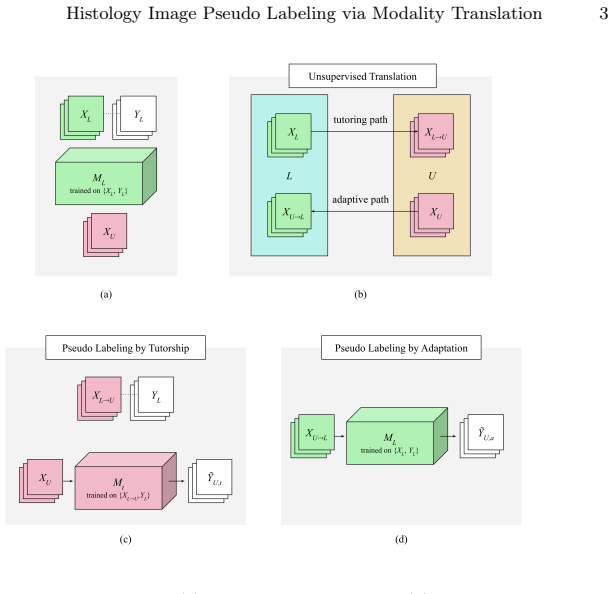
The central mechanism is a cycle-consistent adversarial diffusion translation model (SynDiff) paired with an automatic segmentation framework (nnU-Net). SynDiff learns unpaired translations between the labeled domain $L$ and the unlabeled domain $U$ in both directions: a pair of non-diffusive GANs produce initial coarse translations, and denoising diffusion GANs refine them in fewer than eight timesteps, with a cycle-consistency loss forcing $L \to U \to L$ and $U \to L \to U$ to reconstruct the original images. The tutoring path takes the $L \to U$ translation, recycles the original annotations as if they labeled the synthetic images, trains nnU-Net on those synthetic pairs, and applies it to real $U$ images. The adaptive path takes the $U \to L$ translation and runs a model pre-trained on $L$ on the translated images. What carries the argument is that cycle consistency is assumed to preserve the geometry and boundaries of axons and myelin, so labels remain meaningful across a modality change.
What would settle it
Take a set of real SEM images with expert axon and myelin annotations, run the tutoring path using checkpoints selected by cycle-reconstruction SSIM, PSNR, and L1 exactly as the paper describes, and compare the pseudo labels to the expert masks on the same images. If the Dice score does not replicate near $0.736$ for axons, or if errors concentrate at myelin boundaries, the claim that cycle-consistent translation preserves geometry for labeling is weakened. A sharper variant is to re-select the translation checkpoint by downstream segmentation Dice instead of image-quality metrics; if Dice changes materially, the paper's checkpoint rule is not the one that best serves pseudo labeling.
Extended reading notes
Core claim
The paper claims that unpaired modality translation can generate usable pseudo labels for histology segmentation in a target domain that has no annotations. Using a labeled TEM dataset as the source, it translates images into three increasingly different target domains (TEM-MACAQUE, SEM, and BF) and tests two labeling strategies. The tutoring path, which translates labeled TEM images into the target modality, trains an nnU-Net on the synthetic images with the recycled annotations, and applies it to real target images, achieves a mean Dice score of $0.736 \pm 0.005$ for axons and $0.652 \pm 0.005$ for myelin on the SEM dataset. The adaptive path, which translates unlabeled target images into TEM style and applies a pre-trained TEM model, lags on SEM with axon Dice $0.238 \pm 0.088$ but surpasses tutoring on the BF dataset with axon Dice $0.586 \pm 0.025$ versus $0.454 \pm 0.010$. The paper concludes that when the domain shift is large enough to defeat a pre-trained model, translation-based pseudo labeling provides useful initial masks for manual correction.
Load-bearing premise
The pipeline assumes the TEM-to-SEM translation preserves axon and myelin geometry and boundaries, so annotations made on original TEM images remain valid for translated images and transfer to real SEM.
Editorial extensions
If this is right
- On the SEM dataset, tutoring-path pseudo labels reach $0.736 \pm 0.005$ Dice for axons and $0.652 \pm 0.005$ for myelin, high enough to serve as initialization for manual refinement.
- When the labeled and unlabeled domains are close (TEM versus TEM-MACAQUE), pseudo labeling adds nothing over applying the pre-trained model directly, so translation-based pseudo labeling is only worth the compute when the domain shift is large.
- On the larger BF domain shift, the adaptive path outperforms tutoring, with axon Dice $0.586 \pm 0.025$ versus $0.454 \pm 0.010$; the best strategy therefore depends on translation quality in each direction.
- The recommended workflow is to run the adaptive path first because it needs no extra segmentation model, and to use the tutoring path to generate a complementary set of pseudo labels at the cost of training a proxy model.
Reading between the lines
- Editorial extension: if translation preserves geometry, the same pipeline should bootstrap segmentation for other unpaired microscopy pairs (bright-field to CARS, different stains), since nothing in the method depends on electron microscopy specifically.
- Editorial extension: selecting translation checkpoints by downstream segmentation Dice on a tiny manually labeled subset could outperform the cycle-reconstruction metrics (SSIM, PSNR, L1) used in the paper, and would directly test whether reconstruction quality is the right proxy for label utility.
- Editorial extension: the claimed 25–50 percent annotation-time saving at Dice above 0.5 is plausible but unmeasured; a timing study of manual correction of pseudo labels versus manual annotation from scratch would give the practical benefit real numbers.
Signed reviews
Editorial analysis
A structured set of objections, weighed in public.
Referee Report
Summary. The manuscript proposes an unsupervised pseudo-labeling pipeline for axon/myelin segmentation in histology images. It uses SynDiff, a cycle-consistent adversarial diffusion model, to translate between an annotated TEM dataset and three unannotated target datasets (TEM-MACAQUE, SEM, and BF). Two pseudo-labeling strategies are evaluated: tutoring, where labeled TEM images are translated into the target modality and an nnU-Net is trained on the resulting synthetic images with the original labels; and adaptation, where target images are translated into the TEM style and segmented with a pre-trained TEM model. Experiments against real target-domain ground truth show that tutoring achieves a mean Dice of 0.736 ± 0.005 on SEM, while the two strategies perform comparably on TEM-MACAQUE and adaptation performs better on BF. The authors conclude that the pipeline provides useful initialization masks for manual annotation.
Significance. If the reported results are robust, the paper offers a practical way to reuse annotated TEM data for SEM and BF, where large-scale annotation is costly. The evaluation is carried out against real ground truth in the target domains, uses 5-fold cross-validation with reported standard deviations, and the code is public. The comparison of two pseudo-labeling strategies across three target datasets with increasing domain shift is a useful empirical contribution. Importantly, there is no circularity: target labels are used only for evaluation, not for training the translation model or for selecting checkpoints. The main caveats are that the headline Dice depends on a single translation checkpoint selected by reconstruction metrics, and that no alternative pseudo-labeling or domain-adaptation baseline is tested; these limit the strength of the claim that this specific pipeline is responsible for the observed result.
major comments (3)
- [Section 3, Fig. 3] The headline result of 0.736 ± 0.005 for the SEM tutoring path is obtained with a single SynDiff checkpoint selected by cycle-reconstruction SSIM/PSNR/L1 and visual inspection. These metrics measure low-level fidelity to the source rather than preservation of axon and myelin geometry, so the reported Dice may be specific to the chosen epoch (50) rather than a stable property of the pipeline. I request an analysis of downstream Dice across multiple translation checkpoints, or at least a comparison between the selected checkpoint and its neighbors, to establish that the checkpoint-selection rule does not inadvertently favor a particularly good segmentation outcome.
- [Section 2.3, Table 2] The only baseline for the two large-domain-shift experiments is a pre-trained TEM model that produces empty masks. To support the claim that the proposed SynDiff-based pseudo-labeling pipeline is responsible for the observed Dice scores, the paper should compare against at least one alternative unsupervised translation or domain-adaptation method, such as a CycleGAN-based version of the same tutoring protocol or a standard unsupervised domain adaptation baseline. Without such a comparison, the central result is not contextualized, and the specific contribution of the proposed pipeline remains unclear.
- [Conclusion vs. Table 2] The recommendation to "first use the adaptive path" is inconsistent with the SEM results, where the adaptive path yields a mean Dice of 0.238 ± 0.088 for axons while the tutoring path yields 0.736 ± 0.005. The recommendation should be made conditional on the target domain, or the paper should provide a concrete criterion (for example, a small labeled validation set) for deciding between the two paths.
minor comments (4)
- [Section 2.3] The mechanism by which the nnU-Net softmax outputs are converted to final pseudo-label masks (threshold value, post-processing, connected components) is not specified; providing this detail would improve reproducibility.
- [Section 2.2/2.3] It is not stated whether the SynDiff translation model is trained on the same XU images that are later used for evaluation; if so, the evaluation is transductive. This is acceptable for a pseudo-labeling pipeline, but it should be disclosed explicitly because it affects claims about applicability to new unlabeled datasets.
- [Conclusion] The claim that a Dice score above 0.5 reduces annotation time by 25-50% is unsupported by any data or citation in the manuscript; since the authors themselves call for future quantification, this sentence should be moved to future work or supported with evidence.
- [Table 2] The standard deviation for the SEM adaptation path is very high (0.088 for axon Dice), and the low sensitivity (0.144) is mentioned in the text, but a brief explanation of the failure mode (for example, near-empty predicted masks) would help the reader interpret this result.
Circularity Check
No significant circularity: reported Dice is an empirical evaluation against real target-domain ground truth, with no target labels used in training or checkpoint selection.
full rationale
The central claim is an experimental Dice value obtained by (i) training SynDiff on unpaired L and U images, (ii) selecting checkpoints via cycle-reconstruction metrics (SSIM/PSNR/L1) and visual inspection, and (iii) training nnU-Net on synthetic images {XL→U, YL} before evaluating on real U ground truth. None of these stages uses the target-domain annotations YU for fitting or selection; the target labels are used only in the final evaluation. The translation model is trained without target labels via unpaired cycle consistency, and the segmentation model uses only source labels YL. The checkpoint selection criterion is reconstruction quality, not downstream Dice, so the reported 0.736 Dice is not forced by construction. The only caveats—transductive use of XU and the assumption that reconstruction quality correlates with semantic preservation—are robustness and generalization concerns, not circularity. No load-bearing self-citation or uniqueness import is present; SynDiff and nnU-Net are external methods, and the AxonDeepSeg citation is background only.
Assumptions & free parameters
free parameters (1)
- SynDiff checkpoint epoch selection =
TEM-MACAQUE: 100, SEM: 50, BF: 40
assumptions (3)
- domain assumption Image translation preserves the geometry of axons and myelin so that labels transfer across modalities.
- domain assumption The target datasets are annotated for evaluation, so pseudo labels can be compared to ground truth.
- ad hoc to paper Dice score superior to 0.5 implies 25-50% annotation time reduction.
Cite this review
Pith. "Pith review of Unpaired Modality Translation for Pseudo Labeling of Histology Images." pith.science (2026). https://pith.science/paper/BRJ5JZOX
@misc{pith2026241202858,
  author       = {Pith},
  title        = {Pith review of: Unpaired Modality Translation for Pseudo Labeling of Histology Images},
  year         = {2026},
  howpublished = {\url{https://pith.science/paper/BRJ5JZOX}},
  note         = {Machine review of arXiv:2412.02858}
}
abstract
The segmentation of histological images is critical for various biomedical applications, yet the lack of annotated data presents a significant challenge. We propose a microscopy pseudo labeling pipeline utilizing unsupervised image translation to address this issue. Our method generates pseudo labels by translating between labeled and unlabeled domains without requiring prior annotation in the target domain. We evaluate two pseudo labeling strategies across three image domains increasingly dissimilar from the labeled data, demonstrating their effectiveness. Notably, our method achieves a mean Dice score of $0.736 \pm 0.005$ on a SEM dataset using the tutoring path, which involves training a segmentation model on synthetic data created by translating the labeled dataset (TEM) to the target modality (SEM). This approach aims to accelerate the annotation process by providing high-quality pseudo labels as a starting point for manual refinement.
Figures


Figures from the paper (1 more)

Reference graph
Works this paper leans on
-
[1]
Advances in neural information processing systems27 (2014)
Goodfellow, I., Pouget-Abadie, J., Mirza, M., Xu, B., Warde-Farley, D., Ozair, S., Courville, A., Bengio, Y.: Generative adversarial nets. Advances in neural information processing systems27 (2014)
work page 2014
-
[2]
Ad- vances in neural information processing systems33, 6840–6851 (2020)
Ho, J., Jain, A., Abbeel, P.: Denoising diffusion probabilistic models. Ad- vances in neural information processing systems33, 6840–6851 (2020)
2020
-
[3]
Hore, A., Ziou, D.: Image quality metrics: Psnr vs. ssim. In: 2010 20th internationalconferenceonpatternrecognition.pp.2366–2369.IEEE(2010)
work page 2010
-
[4]
Nature Methods 18(2), 203–211 (Feb 2021).https://doi
Isensee, F., Jaeger, P.F., Kohl, S.A.A., Petersen, J., Maier-Hein, K.H.: nnU- Net: a self-configuring method for deep learning-based biomedical image segmentation. Nature Methods 18(2), 203–211 (Feb 2021).https://doi. org/10.1038/s41592-020-01008-z
-
[5]
arXiv preprint arXiv:1809.10486 (2018)
Isensee, F., Petersen, J., Klein, A., Zimmerer, D., Jaeger, P.F., Kohl, S., Wasserthal, J., Koehler, G., Norajitra, T., Wirkert, S., et al.: nnu-net: Self-adapting framework for u-net-based medical image segmentation. arXiv preprint arXiv:1809.10486 (2018)
arXiv 2018
-
[6]
arXiv preprint arXiv:2404.09556 (2024)
Isensee, F., Wald, T., Ulrich, C., Baumgartner, M., Roy, S., Maier-Hein, K., Jaeger, P.F.: nnu-net revisited: A call for rigorous validation in 3d medical image segmentation. arXiv preprint arXiv:2404.09556 (2024)
arXiv 2024
-
[7]
In: Proceedings of the IEEE conference on computer vision and pattern recognition
Isola, P., Zhu, J.Y., Zhou, T., Efros, A.A.: Image-to-image translation with conditional adversarial networks. In: Proceedings of the IEEE conference on computer vision and pattern recognition. pp. 1125–1134 (2017)
2017
-
[8]
Medical Image Analysis42, 60–88 (Dec 2017).https://doi.org/10.1016/ j.media.2017.07.005
Litjens, G., et al.: A survey on deep learning in medical image analysis. Medical Image Analysis42, 60–88 (Dec 2017).https://doi.org/10.1016/ j.media.2017.07.005
work page 2017
Show all 20 references
-
[9]
Acta Neuropathologica Communications10(1), 131 (2022)
McKenzie, A.T., Marx, G.A., Koenigsberg, D., Sawyer, M., Iida, M.A., Walker, J.M., Richardson, T.E., Campanella, G., Attems, J., McKee, A.C., et al.: Interpretable deep learning of myelin histopathology in age-related cognitive impairment. Acta Neuropathologica Communications1...
2022
-
[10]
IEEE Transactions on Medical Imaging (2023)
Özbey, M., Dalmaz, O., Dar, S.U., Bedel, H.A., Özturk, Ş., Güngör, A., Çukur, T.: Unsupervised medical image translation with adversarial diffu- sion models. IEEE Transactions on Medical Imaging (2023)
2023
- [11]
-
[12]
Advances in neural information processing systems 29 (2016)
Salimans, T., Goodfellow, I., Zaremba, W., Cheung, V., Radford, A., Chen, X.: Improved techniques for training gans. Advances in neural information processing systems 29 (2016)
2016
-
[13]
Acta Neuropathologica Communications10(1) (Feb 2022)
Signaevsky, M., Marami, B., Prastawa, M., Tabish, N., Iida, M.A., Zhang, X.F., Sawyer, M., Duran, I., Koenigsberg, D.G., Bryce, C.H., Chahine, L.M., Mollenhauer, B., Mosovsky, S., Riley, L., Dave, K.D., Eberling, J., Histology Image Pseudo Labeling via Modality Translation 11 ...
2022
-
[14]
In: International conference on machine learning
Sohl-Dickstein,J.,Weiss,E.,Maheswaranathan,N.,Ganguli,S.:Deepunsu- pervised learning using nonequilibrium thermodynamics. In: International conference on machine learning. pp. 2256–2265. PMLR (2015)
2015
-
[15]
arXiv preprint arXiv:2011.13456 (2020)
Song,Y.,Sohl-Dickstein,J.,Kingma,D.P.,Kumar,A.,Ermon,S.,Poole,B.: Score-based generative modeling through stochastic differential equations. arXiv preprint arXiv:2011.13456 (2020)
2020 arXiv
-
[16]
IEEE transactions on image processing13(4), 600–612 (2004)
Wang, Z., Bovik, A.C., Sheikh, H.R., Simoncelli, E.P.: Image quality as- sessment: from error visibility to structural similarity. IEEE transactions on image processing13(4), 600–612 (2004)
2004
-
[17]
arXiv preprint arXiv:2112.07804 (2021)
Xiao, Z., Kreis, K., Vahdat, A.: Tackling the generative learning trilemma with denoising diffusion gans. arXiv preprint arXiv:2112.07804 (2021)
2021 arXiv
-
[18]
Xing, F., Bennett, T., Ghosh, D.: Adversarial Domain Adap- tation and Pseudo-Labeling for Cross-Modality Microscopy Im- age Quantification, p. 740–749. Springer International Publish- ing (2019). https://doi.org/10.1007/978-3-030-32239-7_82, http://dx.doi.org/10.1007/978-3-030...
2019 doi
-
[19]
Sci- entific Reports 8(1), 3816 (Feb 2018)
Zaimi, A., Wabartha, M., Herman, V., Antonsanti, P.L., Perone, C.S., Cohen-Adad, J.: AxonDeepSeg: automatic axon and myelin segmenta- tion from microscopy data using convolutional neural networks. Sci- entific Reports 8(1), 3816 (Feb 2018). https://doi.org/10.1038/ s41598-018-22181-4
2018
-
[20]
Advances in Neural Information Processing Systems31 (2018) 1 Appendix Fig
Zhao, S., Ren, H., Yuan, A., Song, J., Goodman, N., Ermon, S.: Bias and generalization in deep generative models: An empirical study. Advances in Neural Information Processing Systems31 (2018) 1 Appendix Fig. S1. Datasets used, either annotated ( XL) or unannotated ( XU ). The...
2018 arXiv
Reviewed August 11, 2026 · model on record in the stance chip above.
Discussion (0). Continue with ORCID to comment.