REVIEW 5 major objections 6 minor 31 references
Learning Whole-Body Loco-Manipulation for Omni-Directional Task Space Pose Tracking with a Wheeled-Quadrupedal-Manipulator
T0 review · 5 major / 6 minor · reviewed 2026-08-11 · deepseek-v4-flash
Pith's one-line read A single policy tracks a wheeled quadruped's arm to a full 6D pose within 5 cm and 0.1 rad.
desk verdict Real hardware 6D EE tracking with a single policy is a genuine step forward, but the headline error numbers are measured in the robot's own odometry frame, so the state-of-the-art claim is not yet supported. read the letter →
The pith
A machine-rendered reading of the paper's core claim, the machinery that carries it, and where it could break.
The reading
What carries the argument
The Reward Fusion Module (RFM) is the load-bearing object: a nonlinear composition rule that takes individual reward terms for tracking, regularization, locomotion, and basic survival and fuses them through multiplication, powers, a cumulative error state, and a sigmoid-gated phase switch. The phase variable depends on an externally set reference SE(3) distance that decays linearly with time, so the policy receives a time-based curriculum telling it how fast to approach the target; the same variable also gates the cumulative-penalty weight. RFM's central job is to replace the many hand-tuned weights of a weighted-sum reward with a small number of structural choices, letting the hierarchy between position and orientation and between locomotion and manipulation emerge from the fusion rule itself.
What would settle it
Run the same fixed-point and circular-trajectory trials with an external motion-capture system as ground truth for the end effector, and compare the measured pose error with the reported 0.028-0.048 m and 0.085-0.089 rad figures; if the true errors exceed the claimed 5 cm and 0.1 rad thresholds once odometry drift is removed, the central claim does not hold.
Extended reading notes
Core claim
The central discovery is that the loco-manipulation problem's multi-stage, hierarchical character can be encoded in the reward itself, so that a single policy given only a target pose in the world frame produces whole-body actions for all joints. Within the Reward Fusion Module, reward prioritization multiplies the position-tracking term by the orientation-tracking term, so orientation error only matters once the arm is near the target; micro-enhancement sharpens the reward gradient at small errors; a cumulative penalty accumulates the SE(3) error like the integral term of a PID controller to push the agent out of local minima; and a sigmoid phase variable based on a time-decaying SE(3) distance reference blends locomotion rewards with manipulation rewards. The paper argues that this composition, rather than a weighted sum of the same terms, is what makes smooth transitions and precise 6D tracking possible.
Load-bearing premise
The reported real-world tracking errors assume that the Lidar Inertial Odometry estimate of the base pose is an accurate ground truth; if that odometry drifts by a few centimeters during a trial, the claimed position error partly measures odometry drift rather than tracking performance.
Editorial extensions
If this is right
- A user can command arbitrary 6D target poses and the same policy handles distant targets, which are mostly locomotion, and nearby targets, which are mostly manipulation, without mode switching.
- Removing the locomotion-manipulation fusion collapses the simulation success rate from 99.0% to 82.1% and more than doubles average joint acceleration, showing that the fusion term is what prevents jittery transitions.
- Removing reward prioritization raises nominal wheel deviation from 0.115 m to 0.393 m, implying the multiplication-based hierarchy is what keeps the robot stable while it tracks.
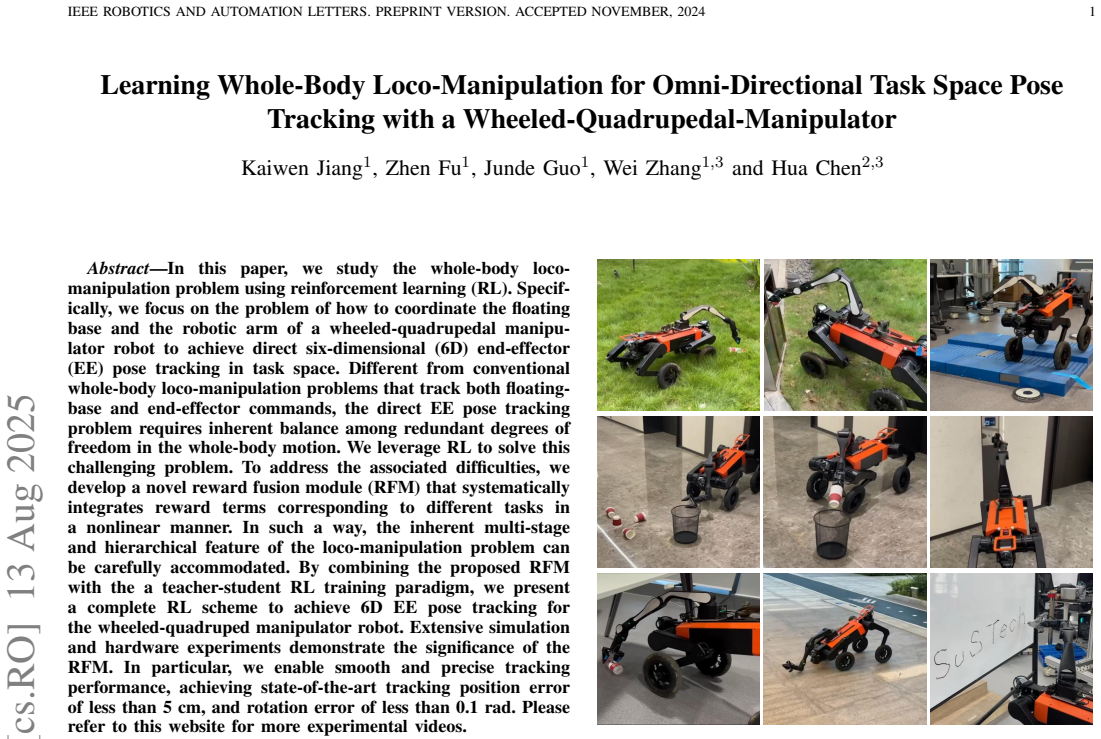
- The policy transfers from simulation to hardware with position errors at or below the 5 cm level on both fixed points and a spatial circle, so the 6D tracking claim is not confined to simulation.
- The same fusion recipe extends to tasks that also need base velocity commands, since the paper provides an explicit variant with a locomotion-command reward appended.
Reading between the lines
- A testable extension is to replace the time-based reference distance with a closed-loop reference that slows when the robot approaches its physical limits; if RFM's benefit comes from the phase structure rather than the fixed timetable, this should preserve success while removing the risk of an unreachable curriculum.
- Because RFM reduces the number of tuned weights compared with the weighted-sum baselines, which the paper reports tuning for two days, the module may make RL reward design for hierarchical robotics problems more reproducible across new platforms.
- The cumulative-penalty mechanism is analogous to integral action in feedback control, suggesting that RFM could be combined with classical error metrics to reduce steady-state tracking error in other whole-body tasks such as forceful manipulation or mobile welding.
- One could stress-test the priority claim by giving the robot a target that is simultaneously far away and orientation-critical; RFM predicts the policy will first reduce distance and only later correct orientation, which would appear as a two-stage error trajectory.
Signed reviews
Editorial analysis
A structured set of objections, weighed in public.
Referee Report
Summary. The paper proposes a reinforcement-learning approach for whole-body loco-manipulation of a wheeled-quadrupedal manipulator (WQM) in which a single policy maps a 6D end-effector (EE) target pose (world-fixed, expressed in body frame) directly to whole-body joint-position and wheel-velocity commands. The main methodological contribution is a Reward Fusion Module (RFM) that replaces weighted-sum reward composition with three nonlinear mechanisms: reward prioritization (Eqs. (3)-(5)), micro-enhancement with a cumulative error penalty (Eqs. (7)-(9)), and a phase-variable 'loco-mani fusion' that blends locomotion and manipulation reward groups according to a time-decreasing SE(3) distance reference (Eqs. (10)-(13)). The policy is trained with a teacher-student (RMA-style) PPO scheme in Isaac Gym and deployed in MuJoCo and on hardware. The experiments include ablation studies in simulation with 1000 trials per variant and real-world tests with fixed points and circular trajectories. The paper reports 99.0% simulation success, simulated EE position/orientation errors of 0.022 m / 0.041 rad, and hardware errors of 0.028-0.048 m and 0.085-0.089 rad, claiming state-of-the-art tracking.
Significance. If the reported accuracy were established against independent ground truth, the work would be a useful advance: it demonstrates that a single RL policy can coordinate wheels, legs, and a 6-DoF arm for direct EE pose tracking without base-velocity commands or manual mode switching, and the ablations give evidence that each RFM component contributes. The RFM idea—nonlinear reward composition with multiplicative prioritization and a phase-variable task blending—is simple and potentially transferable to other multi-stage mobile manipulation problems. The paper also includes a reasonably complete sim-to-real pipeline with domain randomization, teacher-student adaptation, 1000-trial ablations, and hardware demos. However, the load-bearing quantitative claims are weakened by evaluation issues: metrics are computed only on successful trials, hardware errors are measured in the same LIO-estimated frame used for control, and key reward terms and parameters are omitted. These issues are fixable but currently prevent the 'state-of-the-art' claim from being fully supported.
major comments (5)
- [V-B, Table III] The ablation metrics are computed after excluding failure trials from all metrics except Success Rate. Because the compared policies have very different success rates (99.0%, 82.1%, 93.0%, 98.7%, 92.9%), the reported mean EE error, power, acceleration, and nominal deviation are conditional on survival and are not comparable across rows. A policy that fails often may appear to have lower mean power or lower tracking error simply because high-error or high-power episodes are discarded. Report metrics over all trials with a clearly defined penalty for failures, or restrict the comparison to a matched set of successful episodes, and provide variance across trials or seeds.
- [V-A, Table IV] Hardware tracking error is computed from the LIO-estimated base pose, and the same estimate is used as the policy's feedback. No external ground truth (motion capture, total station, or an independently validated reference) is provided, and no LIO drift characterization is reported. If LIO drifts, the error in Table IV partly measures odometry drift rather than physical EE tracking error. Please provide external validation on at least a subset of trials, or quantify the expected LIO drift over the trial duration and show that it is small relative to the claimed 5 cm / 0.1 rad.
- [IV-A, Eq. (5), Table II, Eq. (14)] r_mani_reg and r_loco_reg are load-bearing gating terms in the final reward (Eq. (14)) and in the prioritization in Eq. (5), yet their functional forms are not given; the text states that the customized definition is omitted. In addition, sigma, sigma_s, M, a1, a2, v, gamma, and the static-arm weight are not reported. The statement in Section IV-A that the priority in Eq. (3) has 'no any parameter to be fine-tuned' therefore refers only to the multiplicative structure and not to the overall reward design, which still contains many user-set constants. Please define all reward terms and report all parameter values used in the experiments.
- [V-C, Table IV] The claim that the hardware results outperform [16] and [1] is not substantiated: no quantitative results or experimental protocols from those works are given, and the tasks, robots, and evaluation frames differ. Please either provide a direct comparison under a matched protocol or qualify the claim as an informal comparison.
- [IV-C, Eq. (11)] The loco-mani fusion relies on a time-based reference epsilon_ref_t = max{epsilon_0 - v t, 0} (Eq. (11)). If v exceeds the robot's achievable whole-body speed, the locomotion reward r_dw in Eq. (13) becomes unreachable regardless of the agent's behavior, and no sensitivity analysis over v is reported. Please report the chosen v and show that the results are robust to this user-set rate, or modify the reference to adapt to the robot's demonstrated capability.
minor comments (6)
- [III-C, Eq. (2)] Equation (2) appears to contain a sign or notation error: tau^nw_t = K^nw_p (a^nw_t - q^n + q_t) - K^nw_d qdot^nw_t. Clarify whether q^n is a nominal offset and whether the position error should be (a^nw_t - q_t) or (a^nw_t - q^n - q_t).
- [IV-A, after Eq. (3)] The sentence 'rt reaches its maximum if both rep and rep equal one' should read 'rep and reo'.
- [IV-D and V-B] The heading 'Summery' and the phrase 'followwing' are typos; please correct them.
- [V-B, Table III] Table III reports single scalar values without standard deviations or confidence intervals; even beyond the failure-exclusion issue, this makes it impossible to judge whether differences between ablations are significant. Add variance across seeds or trial batches.
- [IV-B, Eq. (9)] The weighting parameters a1 and a2 are introduced but their values are not given; specify them for both simulation and hardware error metrics, since the SE(3) column in Table IV depends on this choice.
- [III-B] The loss expression 'Mean(||z_hat - sg[z]||^2)' uses 'sg' for stop-gradient; define this notation in the text.
Circularity Check
Hardware tracking errors are computed in the same LIO-estimated frame that defines the body-frame command, making the <5 cm / <0.1 rad headline partly self-referential.
-
self definitional
[Section III-A Eq. (1) and Section V-A 'Training and Platform Setup'; Table IV]
"our unified policy only needs a 6D target pose command BT ∗ ee ∈ SE(3) from the user. ... Then the command is represented in body frame since the agent should be agnostic to the inertial frame [16]. To track the EE 6D world frame target in an outdoor setting, the base position in world frame is estimated by Lidar Inertial Odometry (LIO). Then, the forward kinematics is utilized to compute the EE position in world frame."
The user's world-frame target is converted to a body-frame command using the LIO base pose (Eq. 1 and surrounding text), and the reported world-frame EE error is computed from the same LIO base pose via forward kinematics. If the policy drives the body-frame EE pose to the body-frame target, the LIO-frame world error is approximately zero by construction regardless of LIO drift relative to the true world frame. Table IV's 0.028-0.048 m position and 0.085-0.089 rad orientation errors therefore measure consistency with the LIO estimate, not independently verified world-frame tracking. Without motion capture or another external reference, the headline '<5 cm / <0.1 rad' is a self-referential measurement loop rather than a falsifiable world-frame result.
full rationale
The paper's core methodological claim - that the Reward Fusion Module integrates locomotion and manipulation rewards to enable a single policy for 6D end-effector tracking - is not circular: it is supported by ablations in simulation against a standard weighted-sum baseline, and the RFM equations (3)-(14) do not assume the reported tracking errors. Self-citations (e.g., RMA [20] for teacher-student training, [1] for comparison) are used as ordinary references and are not load-bearing. The reward terms rep and reo are the same quantities later reported as tracking errors, but that is standard RL objective alignment, not a derivation or prediction. The one significant self-referential element is the hardware evaluation: both the body-frame command and the world-frame error are defined through the same LIO base-pose estimate, so the hardware error numbers in Table IV can be small by construction even if the true world-frame error is large. This affects the headline accuracy claim but not the independent simulation evidence for RFM.
Assumptions & free parameters
free parameters (7)
- sigma =
not reported
- sigma_s =
not reported
- M =
not reported (stated M > 1)
- a1, a2 =
not reported
- v =
not reported
- gamma =
not reported
- basic and static-arm reward weights =
Table II: 0.003, 0.001, 5, 2.0, 3.3e-4, 4e-5, 0.1, 0.15 (magnitudes)
assumptions (6)
- domain assumption RMA teacher-student assumption: a history of proprioceptive observations is sufficient to estimate the privilege latent z (contact forces, friction, EE twist) for sim-to-real transfer.
- domain assumption The Park SE(3) distance metric with fixed user weights a1, a2 (Eq. 9, ref [24]) is a valid criterion for tracking quality and for the curriculum reference.
- ad hoc to paper The sigmoid phase-variable parameters follow the 'principle of armspan': mu = 2*l_a and l = 2*l_a.
- ad hoc to paper The regularization rewards r_mani_reg and r_loco_reg, which gate the entire tracking reward structure in Eqs. (5) and (14), exist and produce smooth stable motion.
- domain assumption The cumulative penalty with clipping at 20 is stable and helps the agent escape local minima.
- domain assumption LIO provides an unbiased world-frame base pose for computing the reported hardware tracking errors.
Cite this review
Pith. "Pith review of Learning Whole-Body Loco-Manipulation for Omni-Directional Task Space Pose Tracking with a Wheeled-Quadrupedal-Manipulator." pith.science (2026). https://pith.science/paper/SICXKSRH
@misc{pith2026241203012,
  author       = {Pith},
  title        = {Pith review of: Learning Whole-Body Loco-Manipulation for Omni-Directional Task Space Pose Tracking with a Wheeled-Quadrupedal-Manipulator},
  year         = {2026},
  howpublished = {\url{https://pith.science/paper/SICXKSRH}},
  note         = {Machine review of arXiv:2412.03012}
}
read the original abstract
In this paper, we study the whole-body loco-manipulation problem using reinforcement learning (RL). Specifically, we focus on the problem of how to coordinate the floating base and the robotic arm of a wheeled-quadrupedal manipulator robot to achieve direct six-dimensional (6D) end-effector (EE) pose tracking in task space. Different from conventional whole-body loco-manipulation problems that track both floating-base and end-effector commands, the direct EE pose tracking problem requires inherent balance among redundant degrees of freedom in the whole-body motion. We leverage RL to solve this challenging problem. To address the associated difficulties, we develop a novel reward fusion module (RFM) that systematically integrates reward terms corresponding to different tasks in a nonlinear manner. In such a way, the inherent multi-stage and hierarchical feature of the loco-manipulation problem can be carefully accommodated. By combining the proposed RFM with the a teacher-student RL training paradigm, we present a complete RL scheme to achieve 6D EE pose tracking for the wheeled-quadruped manipulator robot. Extensive simulation and hardware experiments demonstrate the significance of the RFM. In particular, we enable smooth and precise tracking performance, achieving state-of-the-art tracking position error of less than 5 cm, and rotation error of less than 0.1 rad. Please refer to https://clearlab-sustech.github.io/RFM_loco_mani/ for more experimental videos.
Figures


Figures from the paper (3 more)


Reference graph
Works this paper leans on
-
[16]
Pedipulate: Enabling Manipulation Skills using a Quadruped Robot’s Leg,
P. Arm, M. Mittal, H. Kolvenbach, and M. Hutter, “Pedipulate: Enabling Manipulation Skills using a Quadruped Robot’s Leg,” 2024
work page 2024
-
[1]
Deep whole-body control: Learning a unified policy for manipulation and locomotion,
Z. Fu, X. Cheng, and D. Pathak, “Deep whole-body control: Learning a unified policy for manipulation and locomotion,” in Conference on Robot Learning . PMLR, 2023, pp. 138–149
2023
-
[2]
Arm-Constrained Curriculum Learning for Loco- Manipulation of the Wheel-Legged Robot,
Z. Wang, Y . Jia, L. Shi, H. Wang, H. Zhao, X. Li, J. Zhou, J. Ma, and G. Zhou, “Arm-Constrained Curriculum Learning for Loco- Manipulation of the Wheel-Legged Robot,” 2024
work page 2024
-
[3]
Learning Force Control for Legged Manipulation,
T. Portela, G. B. Margolis, Y . Ji, and P. Agrawal, “Learning Force Control for Legged Manipulation,” 2024
work page 2024
-
[4]
Asc: Adaptive skill coordination for robotic mobile manipulation,
N. Yokoyama, A. Clegg, J. Truong, E. Undersander, T.-Y . Yang, S. Ar- naud, S. Ha, D. Batra, and A. Rai, “Asc: Adaptive skill coordination for robotic mobile manipulation,” IEEE Robotics and Automation Letters , vol. 9, no. 1, pp. 779–786, 2023
work page 2023
-
[5]
F. Jenelten, J. He, F. Farshidian, and M. Hutter, “DTC: Deep Tracking Control,” Science Robotics , vol. 9, no. 86, p. eadh5401, 2024
work page 2024
-
[6]
ANYmal parkour: Learning agile navigation for quadrupedal robots,
D. Hoeller, N. Rudin, D. Sako, and M. Hutter, “ANYmal parkour: Learning agile navigation for quadrupedal robots,” Science Robotics , vol. 9, no. 88, p. eadi7566, 2024. 8 IEEE ROBOTICS AND AUTOMATION LETTERS. PREPRINT VERSION. ACCEPTED NOVEMBER, 2024 TABLE III: Ablation study results for our method, without Loco-Mani Fusion, without RP, without enhancement...
work page 2024
-
[7]
Learning quadrupedal locomotion over challenging terrain,
J. Lee, J. Hwangbo, L. Wellhausen, V . Koltun, and M. Hutter, “Learning quadrupedal locomotion over challenging terrain,” Science Robotics , vol. 5, no. 47, p. eabc5986, 2020
2020
Show all 31 references
-
[8]
RoLoMa: Robust loco-manipulation for quadruped robots with arms,
H. Ferrolho, V . Ivan, W. Merkt, I. Havoutis, and S. Vijayakumar, “RoLoMa: Robust loco-manipulation for quadruped robots with arms,” Autonomous Robots , vol. 47, no. 8, pp. 1463–1481, 2023
2023
-
[9]
Bayesian multi-task learning mpc for robotic mobile manipulation,
E. Arcari, M. V . Minniti, A. Scampicchio, A. Carron, F. Farshidian, M. Hutter, and M. N. Zeilinger, “Bayesian multi-task learning mpc for robotic mobile manipulation,” IEEE Robotics and Automation Letters , vol. 8, no. 6, pp. 3222–3229, 2023
2023
-
[10]
Learning arm-assisted fall damage reduction and recovery for legged mobile manipulators,
Y . Ma, F. Farshidian, and M. Hutter, “Learning arm-assisted fall damage reduction and recovery for legged mobile manipulators,” in 2023 IEEE International Conference on Robotics and Automation (ICRA) . IEEE, 2023, pp. 12 149–12 155
2023
-
[11]
Learning robust autonomous navigation and locomotion for wheeled- legged robots,
J. Lee, M. Bjelonic, A. Reske, L. Wellhausen, T. Miki, and M. Hutter, “Learning robust autonomous navigation and locomotion for wheeled- legged robots,” Science Robotics , vol. 9, no. 89, p. eadi9641, 2024
2024
-
[12]
Rolling in the deep–hybrid locomotion for wheeled-legged robots using online trajectory optimization,
M. Bjelonic, P. K. Sankar, C. D. Bellicoso, H. Vallery, and M. Hutter, “Rolling in the deep–hybrid locomotion for wheeled-legged robots using online trajectory optimization,” IEEE Robotics and Automation Letters , vol. 5, no. 2, pp. 3626–3633, 2020
2020
-
[13]
Combined sampling and optimization based planning for legged-wheeled robots,
E. Jelavic, F. Farshidian, and M. Hutter, “Combined sampling and optimization based planning for legged-wheeled robots,” in 2021 IEEE International Conference on Robotics and Automation (ICRA) . IEEE, 2021, pp. 8366–8372
2021
-
[14]
Whole-body mpc and online gait sequence generation for wheeled-legged robots,
M. Bjelonic, R. Grandia, O. Harley, C. Galliard, S. Zimmermann, and M. Hutter, “Whole-body mpc and online gait sequence generation for wheeled-legged robots,” in 2021 IEEE/RSJ International Conference on Intelligent Robots and Systems (IROS) . IEEE, 2021, pp. 8388–8395
2021
-
[15]
Legs as manipulator: Pushing quadrupedal agility beyond locomotion,
X. Cheng, A. Kumar, and D. Pathak, “Legs as manipulator: Pushing quadrupedal agility beyond locomotion,” in 2023 IEEE International Conference on Robotics and Automation (ICRA) . IEEE, 2023, pp. 5106–5112
2023
-
[17]
Combining learning-based locomotion policy with model-based manipulation for legged mobile manipulators,
Y . Ma, F. Farshidian, T. Miki, J. Lee, and M. Hutter, “Combining learning-based locomotion policy with model-based manipulation for legged mobile manipulators,” IEEE Robotics and Automation Letters , vol. 7, no. 2, pp. 2377–2384, 2022
2022
-
[18]
Penalized Proximal Policy Optimization for Safe Reinforcement Learn- ing,
L. Zhang, L. Shen, L. Yang, S. Chen, B. Yuan, X. Wang, and D. Tao, “Penalized Proximal Policy Optimization for Safe Reinforcement Learn- ing,” 2022
2022
-
[19]
Vi- sual whole-body control for legged loco-manipulation,
M. Liu, Z. Chen, X. Cheng, Y . Ji, R. Yang, and X. Wang, “Vi- sual whole-body control for legged loco-manipulation,” arXiv preprint arXiv:2403.16967, 2024
2024 arXiv
-
[20]
RMA: Rapid Motor Adaptation for Legged Robots,
A. Kumar, Z. Fu, D. Pathak, and J. Malik, “RMA: Rapid Motor Adaptation for Legged Robots,” 2021
2021
-
[21]
Proximal Policy Optimization Algorithms,
J. Schulman, F. Wolski, P. Dhariwal, A. Radford, and O. Klimov, “Proximal Policy Optimization Algorithms,” 2017
2017
-
[22]
Perception-less terrain adaptation through whole body control and hier- archical optimization,
C. D. Bellicoso, C. Gehring, J. Hwangbo, P. Fankhauser, and M. Hutter, “Perception-less terrain adaptation through whole body control and hier- archical optimization,” in 2016 IEEE-RAS 16th International Conference on Humanoid Robots (Humanoids) . IEEE, 2016, pp. 558–564
2016
-
[23]
Per- ceptive locomotion through nonlinear model-predictive control,
R. Grandia, F. Jenelten, S. Yang, F. Farshidian, and M. Hutter, “Per- ceptive locomotion through nonlinear model-predictive control,” IEEE Transactions on Robotics , vol. 39, no. 5, pp. 3402–3421, 2023
2023
-
[24]
Distance metrics on the rigid-body motions with applications to mechanism design,
F. C. Park, “Distance metrics on the rigid-body motions with applications to mechanism design,” 1995
1995
-
[25]
Benchmarking poten- tial based rewards for learning humanoid locomotion,
S. H. Jeon, S. Heim, C. Khazoom, and S. Kim, “Benchmarking poten- tial based rewards for learning humanoid locomotion,” in 2023 IEEE International Conference on Robotics and Automation (ICRA) . IEEE, 2023, pp. 9204–9210
2023
-
[26]
Soft actor-critic: Off- policy maximum entropy deep reinforcement learning with a stochastic actor,
T. Haarnoja, A. Zhou, P. Abbeel, and S. Levine, “Soft actor-critic: Off- policy maximum entropy deep reinforcement learning with a stochastic actor,” in International Conference on Machine Learning . PMLR, 2018, pp. 1861–1870
2018
-
[27]
Isaac Gym: High Performance GPU-Based Physics Simulation For Robot Learning,
V . Makoviychuk, L. Wawrzyniak, Y . Guo, M. Lu, K. Storey, M. Macklin, D. Hoeller, N. Rudin, A. Allshire, A. Handa, and G. State, “Isaac Gym: High Performance GPU-Based Physics Simulation For Robot Learning,” 2021
2021
-
[28]
Mujoco: A physics engine for model-based control,
E. Todorov, T. Erez, and Y . Tassa, “Mujoco: A physics engine for model-based control,” in 2012 IEEE/RSJ International Conference on Intelligent Robots and Systems . IEEE, 2012, pp. 5026–5033
2012
-
[29]
Curriculum learning for reinforcement learning domains: A framework and survey,
S. Narvekar, B. Peng, M. Leonetti, J. Sinapov, M. E. Taylor, and P. Stone, “Curriculum learning for reinforcement learning domains: A framework and survey,” Journal of Machine Learning Research , vol. 21, no. 181, pp. 1–50, 2020
2020
-
[30]
Evaluation of Constrained Reinforcement Learning Algorithms for Legged Locomotion,
J. Lee, L. Schroth, V . Klemm, M. Bjelonic, A. Reske, and M. Hutter, “Evaluation of Constrained Reinforcement Learning Algorithms for Legged Locomotion,” 2023
2023
-
[31]
Learning to walk in minutes using massively parallel deep reinforcement learning,
N. Rudin, D. Hoeller, P. Reist, and M. Hutter, “Learning to walk in minutes using massively parallel deep reinforcement learning,” in Conference on Robot Learning . PMLR, 2022, pp. 91–100
2022
Reviewed August 11, 2026 · model on record in the stance chip above.
Discussion (0). Continue with ORCID to comment.