REVIEW 3 major objections 5 minor 1 cited by
NinjaSat: Astronomical X-ray CubeSat Observatory
T0 review · 3 major / 5 minor · reviewed 2026-08-11 · deepseek-v4-flash
Pith's one-line read A 6U CubeSat with two gas X-ray detectors achieved pointed observations of 21 X-ray sources, including the Crab pulsar, demonstrating that small satellites can do time-domain X-ray astronomy.
desk verdict Real on-orbit demonstration of CubeSat X-ray pointing and timing, but the headline 32 cm^2 area is not actually operational—simultaneous detector operation is disabled by CAN-bus noise. read the letter →
The pith
A machine-rendered reading of the paper's core claim, the machinery that carries it, and where it could break.
The reading
What carries the argument
The load-bearing elements are the two Gas Multiplier Counters (GMCs): non-imaging Xe/Ar/DME gas proportional counters that use a Gas Electron Multiplier for about 500x charge amplification, a 2.1-degree field of view defined by a hexagonal collimator, and a GPS-disciplined timing system with 61 microsecond resolution. The satellite's attitude control, using a star tracker, reaction wheels, and magnetorquers on the commercial 6U bus, keeps the boresight within 0.094 degrees of target, while the two GMCs together provide the 32 $cm^{2}$ effective area at 6 keV. An onboard 55Fe source continuously monitors the gas gain, and two radiation belt monitors protect the detectors by alerting when proton or electron fluxes rise.
What would settle it
A decisive test is to continue monthly 55Fe calibration-peak monitoring and to attempt simultaneous GMC operation: continued gain drift beyond the reported 12–13% saturation, or permanent inability to run both detectors, would falsify the claimed stable 32 $cm^{2}$ sensitivity for the full mission.
Extended reading notes
Core claim
The central claim is that a 6U CubeSat using a commercially available satellite bus and two GEM-based gas proportional counters can meet the pointing, timing, and sensitivity requirements for pointed X-ray observations of bright sources. Pointing accuracy was measured at 0.094 degrees (2-$\sigma$), better than the 0.1-degree requirement; absolute timing from GPS-synchronized clocks matches the Crab pulsar ephemeris to about 10 ns in period and sub-millisecond in phase; and the 32 $cm^{2}$ effective area detects sources at roughly $10^{-10}$ erg $cm^{-2}$ $s^{-1}$. The paper demonstrates this by detecting the Crab pulsar at 33.8262 ms and by observing 21 sources, with light curves and Crab-ratio spectra of Her X-1 consistent with data from the all-sky monitor MAXI. It argues that NinjaSat is the first observatory-type scientific CubeSat and that such platforms can fill gaps in monitoring bright, time-variable X-ray sources.
Load-bearing premise
The on-orbit performance measured during the first year is assumed to be stable or manageable enough for the remaining mission, even though the gas gain rose 12–13% after launch for an unknown reason and a CAN-bus noise problem prevents simultaneous operation of the two detectors.
Editorial extensions
If this is right
- If the demonstrated performance holds, CubeSats can be used for long, uninterrupted monitoring of bright X-ray sources, complementing all-sky monitors that see each source for only about a minute per orbit.
- The sub-millisecond absolute timing, verified with the Crab pulsar, means small satellites can participate in pulsar timing and multi-wavelength or multi-messenger campaigns.
- The ability to slew at about 5 degrees per second and repoint within roughly an hour enables quick follow-up of newly discovered transients, as shown by the first-light observation of SRGA J144459.2-604207.
- A combined effective area of 32 cm^2 at 6 keV extends CubeSat reach to fluxes around 10^-10 erg cm^-2 s^-1, enough to study dozens of persistently bright X-ray binaries and active galactic nuclei.
Reading between the lines
- If the CAN-bus interference that currently prevents simultaneous GMC1 and GMC2 operation is resolved, the effective area available for science would double from the 16 cm^2 that single-detector operations effectively provided; this is an extrapolation from the paper's account, not a promise it makes.
- The 12–13% post-launch gas gain increase, whose cause remains unknown, could be turned into a calibration experiment by correlating the drift with in-orbit temperature and pressure telemetry; the paper does not do this.
- A constellation of several NinjaSat-like CubeSats could provide near-continuous monitoring of bright X-ray sources, but the paper reports only a single satellite; extending the time-domain argument to a fleet is an inference.
Editorial analysis
A structured set of objections, weighed in public.
Referee Report
Summary. This paper presents the NinjaSat 6U CubeSat X-ray observatory: its science goals, commercial-bus design, two gas-proportional-counter payloads (GMCs), radiation-belt monitors, ground calibration, launch and commissioning, and first on-orbit verification results. It reports a pointing accuracy of 0.094 degrees (95 percent containment), sub-millisecond absolute timing verified with the Crab pulsar (period 33.8262 ms, pulse phase aligned with the JBO radio ephemeris at 0.99), a Her X-1 Crab-ratio spectrum consistent with MAXI, and a list of 21 X-ray sources observed by end of November 2024. The paper concludes that a CubeSat with a commercial bus can perform pointed, time-domain X-ray observations.
Significance. The core demonstration is valuable: a 6U CubeSat achieved pointed X-ray observations, detected Crab pulsations, and produced scientifically useful light curves and spectra comparable to MAXI data. The strengths are the direct on-orbit measurements cross-checked against external standards (JBO ephemeris, MAXI, 55Fe source), and the transparent reporting of in-flight anomalies, including the CAN-bus interference and the post-launch gas-gain increase. The main caveat is that the headline 32 cm^2 effective area and ~1e-10 erg cm^-2 s^-1 sensitivity are design values for two simultaneously operating GMCs, whereas on-orbit operations are currently limited to one GMC at a time. This does not invalidate the pointing, timing, or Crab-results, but it does mean the abstract overstates the demonstrated capability and must be corrected before acceptance.
major comments (3)
- [Abstract; §4.1.2, Table 2, Fig. 8; §5.2.1] The abstract states a total effective area of 32 cm^2 at 6 keV and a sensitivity of approximately 1e-10 erg cm^-2 s^-1. However, §5.2.1 reports that turning on high voltage for both GMC1 and GMC2 caused CAN-bus noise and artificial triggers, so operations are limited to one GMC at a time, with no mitigation described. Table 2 and Fig. 8 give 16 cm^2 per GMC, so the on-orbit demonstrated effective area is about 16 cm^2, not 32 cm^2, and the quoted sensitivity has not been verified in the mode actually used. The text should either state explicitly that the 32 cm^2 and 1e-10 erg cm^-2 s^-1 values are design specifications contingent on restoring simultaneous operation, or quantify the achieved sensitivity with a single GMC using the Crab and the faintest detected sources.
- [§5.2.3, §4.4] The 12-13 percent post-launch gas-gain increase is reported with the exact cause uncertain, and the temperature-corrected energy response model is stated to be currently under development. Because this gain drift directly affects the energy scale used in spectral products, including the Her X-1 Crab-ratio spectrum in Fig. 17b that is presented as validation, the paper should specify the current systematic uncertainty in absolute energy calibration, state whether the gain has indeed saturated at the 12-13 percent level, and describe how the temperature dependence is handled in the presented spectra. Without this, the spectral verification for the 21-source program is weaker than claimed.
- [§5.3, last paragraph] The statement that 21 X-ray sources were observed is ambiguous. The list includes faint targets such as NGC 4151 and NGC 4388 at a few mCrab. If 'observed' means detected, the paper should give detection significance or net count rates for the faintest sources and the exposure time; if it means only that pointing observations were scheduled, the wording should be changed to 'targeted' or 'scheduled.' This distinction matters because the faint-end sensitivity is part of the central capability claim.
minor comments (5)
- [Table 1 and §5.3] The ground station name is given as 'Awaruwa' in Table 1 and 'Awarua' in the text; please standardize to the correct spelling used elsewhere.
- [§5.2.2] The period difference from the JBO radio value is reported as 'approximately 10 ns' without an uncertainty; since this is a verification number, please provide a statistical and systematic uncertainty for the measured period.
- [Concluding remarks] The reference to 'sub-subsection 5.2.2' should be 'Section 5.2.2'.
- [Fig. 9] The state name 'HYBER' appears to be a typo for 'HIBERNATE' or an acronym that should be defined in the caption or text.
- [Fig. 16 caption] The caption states that the conversion from pulse-height invariant channels to energy is approximately 0.1 keV per channel, but the term 'pulse height invariant' is not defined; please define it in the text or caption.
Circularity Check
No circularity: the paper's central claims are on-orbit measurements verified against external standards and independent benchmarks.
full rationale
The paper's central claims are measurements and instrument performance reports, not predictions derived from fitted parameters. Pointing accuracy is computed directly from ADCS separation angles relative to target coordinates; timing accuracy is verified by comparing the Crab pulsar period and phase with the Jodrell Bank radio ephemeris and the known X-ray phase offset; energy response is checked with the onboard 55Fe calibration source and by comparing a Crab-ratio spectrum of Her X-1 with MAXI/GSC. The 32 cm^2 effective area is a design value derived from simulations incorporating measured efficiencies, and the reported CAN-bus noise that limits operation to one GMC at a time is an openly disclosed operational constraint, not a definitional circular step. Self-citations to Takeda et al. 2023a/b, Kato et al. 2023, and Enoto et al. 2020 are references to prior instrument development and calibration work, not load-bearing citations invoked to establish the present results. No equation in the paper fits a parameter and then re-predicts a quantity identical to that fit, and no uniqueness theorem or ansatz is imported from the authors' prior work to force a conclusion. The paper is self-contained as a hardware verification report, so the circularity burden is minimal.
Assumptions & free parameters
assumptions (4)
- domain assumption The GEM gas detector's energy response can be calibrated in orbit with the 55Fe source and Crab ratio method despite gain drift.
- domain assumption The JBO radio ephemeris for the Crab pulsar is sufficiently accurate and contemporaneous for absolute timing verification.
- domain assumption The ADCS attitude solution, including star tracker boresight alignment, correctly represents the X-ray detector line of sight.
- domain assumption The Crab Nebula can be used as a stable spectral reference for the Crab ratio method.
Cite this review
Pith. "Pith review of NinjaSat: Astronomical X-ray CubeSat Observatory." pith.science (2026). https://pith.science/paper/XNAFUB7C
@misc{pith2026241203016,
  author       = {Pith},
  title        = {Pith review of: NinjaSat: Astronomical X-ray CubeSat Observatory},
  year         = {2026},
  howpublished = {\url{https://pith.science/paper/XNAFUB7C}},
  note         = {Machine review of arXiv:2412.03016}
}
abstract
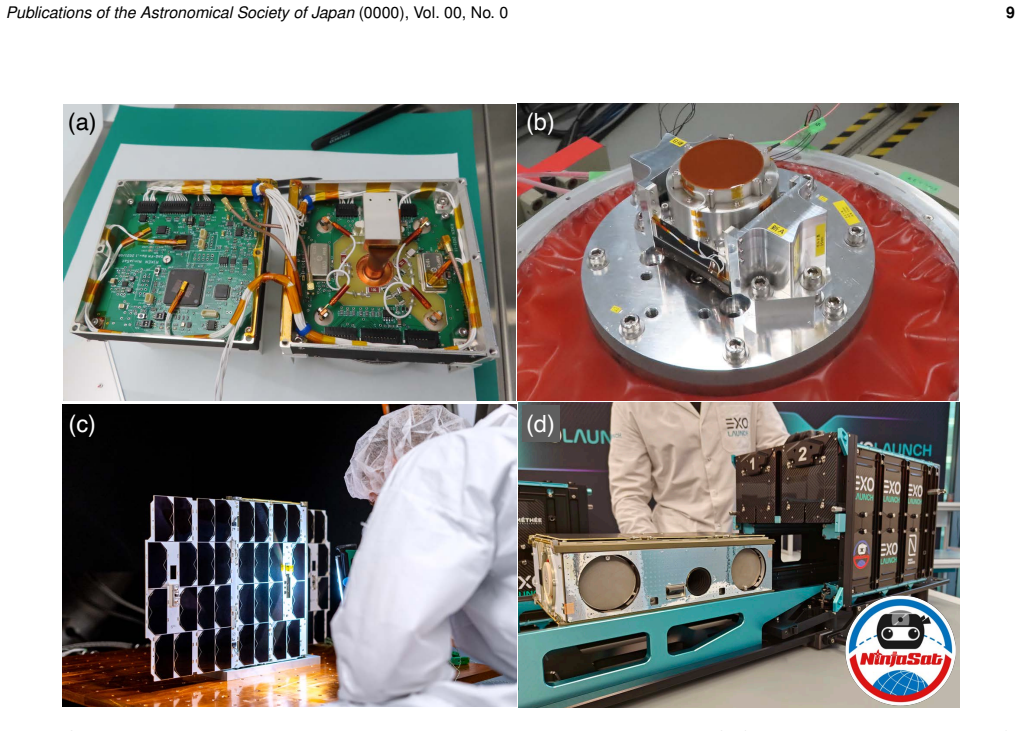
NinjaSat is an X-ray CubeSat designed for agile, long-term continuous observations of bright X-ray sources, with the size of 6U ($100\times200\times300$ mm$^3$) and a mass of 8 kg. NinjaSat is capable of pointing at X-ray sources with an accuracy of less than $0^{\circ}\hspace{-1.0mm}.1$ (2$\sigma$ confidence level) with 3-axis attitude control. The satellite bus is a commercially available NanoAvionics M6P, equipped with two non-imaging gas X-ray detectors covering an energy range of 2-50 keV. A total effective area of 32 cm$^2$ at 6 keV is capable of observing X-ray sources with a flux of approximately 10$^{-10}$ erg cm$^{-2}$ s$^{-1}$. The arrival time of each photon can be tagged with a time resolution of 61 $\mu$s. The two radiation belt monitors continuously measure the fluxes of protons above 5 MeV and electrons above 200 keV trapped in the geomagnetic field, alerting the X-ray detectors when the flux exceeds a threshold. The NinjaSat project started in 2020. Fabrication of the scientific payloads was completed in August 2022, and satellite integration and tests were completed in July 2023. NinjaSat was launched into a Sun-synchronous polar orbit at an altitude of about 530 km on 2023 November 11 by the SpaceX Transporter-9 mission. After about three months of satellite commissioning and payload verification, we observed the Crab Nebula on February 9, 2024, and successfully detected the 33.8262 ms pulsation from the neutron star. With this observation, NinjaSat met the minimum success criterion and stepped forward to scientific observations as initially planned. By the end of November 2024, we successfully observed 21 X-ray sources using NinjaSat. This achievement demonstrates that, with careful target selection, we can conduct scientific observations effectively using CubeSats, contributing to time-domain astronomy.
Figures


Figures from the paper (11 more)




Forward citations
Cited by 1 Pith paper
-
Searching for Dark Matter with MeVCube
Using Fisher forecasting, the author shows that a 2U to 12U MeVCube CubeSat could probe new dark matter parameter space for evaporating primordial black holes and MeV-scale decaying or annihilating dark matter.
Reference graph
Works this paper leans on
-
[1]
Abbott, B. P., Abbott, R., Abbott, T. D., et al. 2017, Phys. Rev. D, 95, 122003
work page 2017
-
[2]
2024, The Astronomer’s Telegram, 16678
Aoyama, A., Watanabe, S., Iwata, S., et al. 2024, The Astronomer’s Telegram, 16678
work page 2024
-
[3]
Arnaud, K. A. 1996, Astronomical Data Analysis Software and Systems V , ASP Conf Ser., 101, 17
work page 1996
- [4]
-
[5]
Enoto, T., Makishima, K., Terada, Y ., et al. 2008, PASJ, 60, S57
work page 2008
-
[6]
Enoto, T., Tamagawa, T., Kitaguchi, T., et al. 2020, Proc. SPIE, 11444, 114441V
work page 2020
-
[7]
Enoto, T., Terasawa, T., Kisaka, S., et al. 2021, Science, 372, 187
work page 2021
- [8]
Show all 24 references
-
[9]
2019, Proc
Funase, R., Ikari, S., Suzumoto, R., et al. 2019, Proc. Small Sat. Conf., SSC19-WKIII-09
2019
-
[10]
M., et al
Kaaret, P., Zajczyk, A., LaRocca, D. M., et al. 2019, ApJ, 884, 162
2019
-
[11]
2023, Proc
Kato, Y ., Tamagawa, T., Kitaguchi, T., et al. 2023, Proc. Small Sat. Conf., SSC23-WIII-08
2023
-
[12]
G., Jordan, C
Lyne, A. G., Jordan, C. A., Graham-Smith, F., et al. 2014, MNRAS, 446, 857
2014
-
[13]
P., Woods, T
Mason, J. P., Woods, T. N., Caspi, A., et al. 2016, Journal of Spacecraft and Rockets, 53, 328
2016
-
[14]
2009, PASJ, 61, 999
Matsuoka, M., Kawasaki, K., Ueno, S., et al. 2009, PASJ, 61, 999
2009
-
[15]
A., Semena, A
Mereminskiy, I. A., Semena, A. N., Molkov, S. V ., et al. 2024, The Astronomer’s Telegram, 16464
2024
-
[16]
2011, PASJ, 63, S623
Mihara, T., Nakajima, M., Sugizaki, M., et al. 2011, PASJ, 63, S623
2011
-
[17]
2003, AIAA, 2003, 2388 Pál, András, Ohno, Masanori, Mészáros, László, et al
Nakaya, K., Konoue, K., Sawada, H., et al. 2003, AIAA, 2003, 2388 Pál, András, Ohno, Masanori, Mészáros, László, et al. 2023, A&A, 677, A40
2003
-
[18]
2024, The Astronomer’s Telegram, 16903
Takahashi, T., Watanabe, S., Iwata, S., et al. 2024, The Astronomer’s Telegram, 16903
2024
-
[19]
2024b, PASJ submitted, (arXiv:2411.10992)
Takeda, T., Tamagawa, T., Enoto, T., et al. 2024b, PASJ submitted, (arXiv:2411.10992)
-
[20]
2009, Nucl
Tamagawa, T., Hayato, A., Asami, F., et al. 2009, Nucl. Instrum. Meth. A, 608, 390
2009
-
[21]
2023, Proc
Tamagawa, T., Enoto, T., Kitaguchi, T., et al. 2023, Proc. Small Sat. Conf., SSC23-WIV-06
2023
-
[22]
2008, PASJ, 60, S25 van der Klis, M., Swank, J
Terada, Y ., Enoto, T., Miyawaki, R., et al. 2008, PASJ, 60, S25 van der Klis, M., Swank, J. H., Zhang, W., et al. 1996, ApJL, 469, L1
2008
-
[23]
Wagoner, R. V . 1984, ApJ, 278, 345 14 Publications of the Astronomical Society of Japan (0000), Vol. 00, No. 0
1984
-
[24]
A., Krishnan, B., & Watts, A
Zhang, Y ., Papa, M. A., Krishnan, B., & Watts, A. L. 2021, ApJL, 906, L14
2021
Reviewed August 11, 2026 · model on record in the stance chip above.
Discussion (0). Continue with ORCID to comment.