REVIEW 3 major objections 4 minor 49 references
Utilizing redundancies in Qubit Hilbert Space to reduce entangling gate counts in the Unitary Vibrational Coupled-Cluster Method
T0 review · 3 major / 4 minor · reviewed 2026-08-11 · deepseek-v4-flash
Pith's one-line read The paper claims that the $m$-excitation UVCC unitary can be implemented with $(8m-6)$ CNOT gates plus one $m$-controlled Y-rotation, roughly halving the entangling-gate count by dropping controls that only act on unphysical states.
desk verdict The half-control construction is internally inconsistent: the S_j gate does not match the claimed transformations, so the gate-count savings are for a circuit that does not implement the intended excitation unitary. read the letter →
The pith
A machine-rendered reading of the paper's core claim, the machinery that carries it, and where it could break.
The reading
What carries the argument
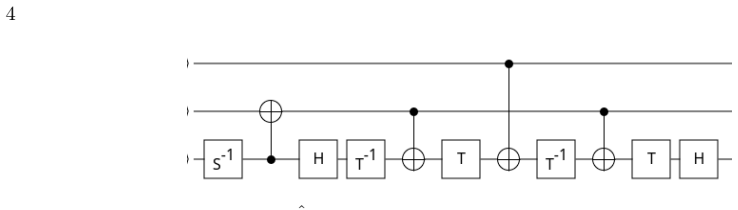
The load-bearing object is the $\hat S_j$ gate defined in Eq. 14: a three-qubit gate made of one CNOT and one relative-phase Toffoli acting on the first qubit $q_0$ and the two qubits of mode $j$. It maps both physical occupation patterns $|01\rangle_j$ and $|10\rangle_j$ onto the marker state $|11\rangle_j$ (Eqs. 15-17), so that the Y-rotation needs to be controlled by only one qubit per mode, $q_{2j+1}$, rather than by every qubit. The relative-phase Toffoli's 3-CNOT decomposition is what pins the CNOT count to $(8m-6)$, because each of the $m-1$ $\hat S_j$ gates costs three CNOTs plus one CX.
What would settle it
On a noiseless simulator, run the full $\hat U_m(\theta)$ circuit of Eq. 12 on every physical basis state for a small case such as $m=3$ and check that states other than $|g_3\rangle$ and $|e_3\rangle$ return to themselves exactly, including phases; any residual amplitude or phase on a spectator state, or any deviation from Eqs. 8-10 on the excitation pair, would falsify the half-control construction.
Extended reading notes
Core claim
On the paper's own terms, the central discovery is that the unary encoding's forbidden $|11\rangle$ states are not merely wasted space but a resource: because direct mapping uses only single-occupancy states of each mode, the excitation unitary only needs to act correctly on the physical subspace. The paper therefore replaces the standard decomposition, which controls the Y-rotation on all $2m-1$ relevant qubits, with Eq. 12, which controls on only every other qubit. Each mode's two allowed patterns $|01\rangle$ and $|10\rangle$ are mapped by the $\hat S_j$ gate into a common $|11\rangle$ pattern, up to phase, so the controlled rotation sees a single marker qubit. The paper claims this implements exactly the same $\hat U_m(\theta)$ on the physical subspace as Eqs. 8-10, with circuit cost $(8m-6)$ CNOTs plus one $m$-controlled rotation, and confirms numerically and experimentally that the shorter circuits prepare UVCCSDT states with lower total variation distance.
Load-bearing premise
The load-bearing premise is that the single-mode transformation rules in Eqs. 15-17 force the full circuit to act as identity on every allowed multi-mode state outside the two-state excitation subspace, even though the paper does not derive that behavior for arbitrary allowed inputs.
Editorial extensions
If this is right
- For $m=3$ and $m=4$, the method's CNOT counts of 25 and 42 beat the Givens-rotation counts of 41 and 142 under the exponential $2n$-CNOT decomposition of controlled rotations.
- For the UVCCSDT ansatz on 6 and 8 qubits, the paper reports total variation distances of 0.050 and 0.240 versus 0.136 and 0.320 for the Givens baseline, so the gate-count reduction carries through to measured fidelity.
- Compared with the ancilla-assisted $C^nX$ decomposition used as a practical baseline, the method retains a 28% CNOT reduction, so the advantage is not simply an artifact of a weak baseline.
- In fault-tolerant settings, halving the controls shifts cost into an $O(m)$ Toffoli overhead, so the final advantage depends on how $n$-controlled rotations are decomposed.
Reading between the lines
- The same 'forbidden subspace' principle might be exploitable in other sparse encodings of bosonic or fermionic modes, though the paper notes the construction does not transfer straightforwardly to electronic structure.
- Because the paper reports only total variation distance and not circuit depth, a natural next test is to scale to $m=4$ or larger and check whether the fidelity gap over the Givens baseline grows with the $(8m-6)$ gate-count advantage.
- One could also insert the half-control excitation into quantum phase estimation trial-state preparation, not just VQE; the paper's argument applies to any use of the UVCC unitary.
Editorial analysis
A structured set of objections, weighed in public.
Referee Report
Summary. The manuscript proposes a new circuit decomposition for the m-fold excitation unitary U_m(θ) used in Unitary Vibrational Coupled-Cluster (UVCC) state preparation under unary (direct) encoding of vibrational modes. The key idea is to exploit the fact that only a small subspace of the qubit Hilbert space is physical, allowing the usual (2m−1)-controlled Y-rotation in the Givens-type decomposition to be replaced by an m-controlled Y-rotation. The authors claim that the intermediate unitary U_m can be built from CX gates and relative-phase Toffoli gates at a cost of (8m−6) CNOTs, yielding up to 50% reduction in entangling gates versus standard decompositions and an asymptotic 28% reduction versus ancilla-based methods such as Khattar-Gidney. They also report quantum-hardware experiments on Quantinuum H1-1 for 6- and 8-qubit UVCCSDT state preparation, with improved total variation distance compared with the Givens-rotation implementation.
Significance. If the central construction were correct, the paper would provide a simple and practically useful constant-factor reduction in two-qubit gate counts for UVCC state preparation in unary encoding, with a clear information-theoretic rationale. The improvement is analytic rather than fitted, and the authors are transparent about the fault-tolerant Toffoli overhead and about the method's restriction to vibrational, rather than electronic, unitary coupled cluster. The hardware demonstration, though small, is a concrete test of the proposed circuits. However, the printed derivation of the key unitary action is internally inconsistent, and the cost tables contain arithmetic errors. Since these issues are load-bearing, the claimed gate-count advantages and the hardware interpretation are not currently established.
major comments (3)
- [Section III, Eqs. (13)-(19)] The proof that U_m maps |g_m> and |e_m> to states differing only in q0 is not valid as printed. Under the standard convention CX(a,b) = control a, target b, Eq. (17) gives S_j|10>_j|1>_0 = |01>_j|1>_0; applied to |e_m>, the modes j=1,...,m-1 become |01> while q0 remains 1, after which the trailing CX(q0,q1) flips q1 to 1, producing |11>_0, not the |10>_0 printed in Eq. (19). If CX(q0,q1) is instead read with q0 as target, Eq. (19) is satisfied for mode 0, but modes j>=1 remain |01>, not |11>. Similarly, Eq. (18) cannot follow from Eq. (16) for |g_m>, because Eq. (16) leaves |01>_j unchanged when q0=0, so U_m|g_m> would remain |g_m>, not become all-|11>. In addition, the unitary action of the relative-phase Toffoli in Eq. (14) is never defined, so Eqs. (15)-(17) cannot be independently checked. Since the m-controlled RY in Eq. (12) acts correctly only if the odd control qubits are in |1> for both |g_m> and |e_m>, and only for those states, the central gate-count claim is unsupported until a complete and consistent truth-table derivation for the physical subspace is supplied.
- [Section IV, Tables I and II] The reported CNOT counts are internally inconsistent. For the proposed method, U_m+U_m^dagger costs (8m-6) CNOTs with the stated 3-CNOT relative-phase Toffoli; adding an m-controlled rotation decomposed as 2m CNOTs, as the Table I caption says, gives 14 CNOTs for m=2 and 24 for m=3, whereas Table I lists 13 and 25. Table II's formula for the proposed method with A=2, B=3, namely 20m-32, gives 8 CNOTs for m=2, which is less than the (8m-6)=10 CNOTs needed for U_m and U_m^dagger alone, and the same formula is negative for m=1. The reduction implied by the Table II formulas is also m-dependent (50% at m=2, 36% at m=3, asymptotically 28%), which contradicts the unqualified '28% reduction' statement in Section IV. The exact counts in Tables I and II should be re-derived with an explicit, consistently applied decomposition rule, and the valid range of m should be stated.
- [Section V, hardware demonstration] The hardware comparison rests on single total-variation-distance values obtained from 220 and 512 shots, with no error bars or repeated runs. For the S-8 system the difference is 0.240 versus 0.320, but the sampling uncertainty in TVD at 512 shots is not negligible, so the claim of 'significantly higher fidelities' cannot be assessed from the data as presented. The authors should report shot-noise confidence intervals, repeated calibration runs, or a statistical test comparing the two circuits.
minor comments (4)
- [Appendix A] The angle-state correspondence for system S-8 lists states such as |2,1,1> and |3,0,1>, although the text states that modes M0 and M1 have only two basis states each; this makes the experimental specification ambiguous and needs correction.
- [Eq. (13) and Fig. 2] The order of the gates in the product in Eq. (13) should be stated explicitly (left-to-right versus right-to-left application); currently the circuit order must be inferred from the figure, which is not sufficient for reproducibility.
- [Section IV, abstract] The abstract's 'up to 28% reduction' is in tension with the larger small-m reductions implied by Table II; the wording should be qualified as an asymptotic statement.
- [Global notation] The convention for CX(a,b) should be defined once and used consistently; the paper appears to switch between control-target and target-control readings, which contributes to the inconsistency of Eqs. (15)-(19).
Circularity Check
No circularity: the gate-count reduction is an analytic consequence of a concrete circuit construction, and the hardware test uses arbitrary angles rather than fitted parameters.
full rationale
The derivation chain is not circular in any of the senses listed. The central construction, Eq. 12 with U_m defined in Eqs. 13-14, is a concrete gate sequence: U_m = CX(q0,q1) times a product of S_j gates, where each S_j is composed of CX and relative-phase Toffoli gates. The claim that this sequence realizes the m-excitation unitary of Eq. 6 is a mathematical statement about the circuit action on the direct-mapping subspace. Whether Eqs. 18-19 are algebraically correct is a correctness/completeness question, not a circularity: the equations are not used as both input and output of the derivation. The CNOT-count reductions in Tables I and II are arithmetic consequences of the chosen decompositions and of stated assumptions about multi-controlled-rotation costs; no parameter is fitted to the count being advertised. The hardware comparison is also non-circular: the angles specified in Appendix A are chosen arbitrarily to spread excitation amplitudes, and the TVD values are computed against a noiseless simulator, so the experimental advantage is not manufactured by fitting the circuit to the hardware outcomes. There is no load-bearing self-citation: the authors cite external work [42-44] for the Givens-style baseline and [41] for the ancilla-based decomposition, and the paper does not invoke a uniqueness theorem from prior work by the same authors. Consequently, the central claim has independent content and the paper receives a circularity score of 0.
Assumptions & free parameters
assumptions (3)
- domain assumption Direct/unary encoding: each vibrational mode's state is represented by one |1> among the mode's qubits, so states with extra |1>s are unphysical and can be ignored.
- domain assumption The relative-phase Toffoli gate can be decomposed into 3 CNOTs and 4 T-gates and can replace a full Toffoli inside S_j without breaking the physical-subspace action.
- standard math Standard Trotterization of the UVCC operator into products of m-excitation unitaries is valid.
Cite this review
Pith. "Pith review of Utilizing redundancies in Qubit Hilbert Space to reduce entangling gate counts in the Unitary Vibrational Coupled-Cluster Method." pith.science (2026). https://pith.science/paper/O4BYHWF5
@misc{pith2026241203955,
  author       = {Pith},
  title        = {Pith review of: Utilizing redundancies in Qubit Hilbert Space to reduce entangling gate counts in the Unitary Vibrational Coupled-Cluster Method},
  year         = {2026},
  howpublished = {\url{https://pith.science/paper/O4BYHWF5}},
  note         = {Machine review of arXiv:2412.03955}
}
read the original abstract
We present a new method for state preparation using the Unitary Vibrational Coupled-Cluster (UVCC) technique. Our approach utilizes redundancies in the Hilbert space in the direct mapping of vibrational modes into qubits. By eliminating half of the qubit controls required in the Trotterized UVCC ansatz, our method achieves up to a 50% theoretical reduction in the entangling gate count compared to other methods and up to a 28% reduction compared practically useful approaches. This improvement enhances the fidelity of UVCC state preparation, enabling more efficient and earlier implementation of complex quantum vibrational structure calculations on near-term quantum devices. We experimentally demonstrate our method on Quantinuum's H1-1 quantum hardware, achieving significantly higher fidelities for 6- and 8-qubit systems compared to existing implementations. For fault-tolerant architectures, eliminating half of the control qubits in multi-controlled rotations incurs an additional Toffoli gate overhead elsewhere in the circuit. Thus, the overall performance gain depends on the specific decomposition method used for multi-controlled gates.
Figures


Figures from the paper (7 more)


Reference graph
Works this paper leans on
-
[1]
P. R. Bunker, P. Jensen, and C. Jungen, Molecular symmetry and spectroscopy, Physics Today 52, 63–64 (1999)
work page 1999
-
[2]
J. M. Bowman, T. Carrington, and H.-D. Meyer, Variational quantum approaches for computing vibrational energies of polyatomic molecules, Molecular Physics 106, 2145–2182 (2008)
work page 2008
-
[3]
T. Carrington, Perspective: Computing (ro-)vibrational spectra of molecules with more than four atoms, The Journal of Chemical Physics 146, 10.1063/1.4979117 (2017)
-
[4]
G. Avila and E. M´ atyus, Toward breaking the curse of dimensionality in (ro)vibrational computations of molec- ular systems with multiple large-amplitude motions, The Journal of Chemical Physics 150, 10.1063/1.5090846 (2019)
-
[5]
N. P. D. Sawaya, F. Paesani, and D. P. Tabor, Near- and long-term quantum algorithmic approaches for vibrational spectroscopy, Physical Review A 104, 10.1103/physreva.104.062419 (2021)
-
[6]
P. J. Ollitrault, A. Baiardi, M. Reiher, and I. Tavernelli, Hardware efficient quantum algorithms for vibrational structure calculations, Chem. Sci. 11, 6842 (2020)
work page 2020
-
[7]
R. J. Barber, J. Tennyson, G. J. Harris, and R. N. Tolchenov, A high-accuracy computed water line list, Monthly Notices of the Royal Astronomical Society 368, 1087–1094 (2006)
work page 2006
-
[8]
R. A. Motiyenko, B. Tercero, J. Cernicharo, and L. Margules, Rotational spectrum of formamide up to 1 thz and first ism detection of itsv12 vibrational state, Astronomy & Astrophysics 548, A71 (2012)
work page 2012
Show all 49 references
-
[9]
Madhusudhan, Atmospheric retrieval of exoplanets, in Handbook of Exoplanets (Springer International Publishing, 2018) p
N. Madhusudhan, Atmospheric retrieval of exoplanets, in Handbook of Exoplanets (Springer International Publishing, 2018) p. 2153–2182
2018
-
[10]
Tennyson, S
J. Tennyson, S. N. Yurchenko, J. Zhang, C. A. Bowesman, R. P. Brady, J. Buldyreva, K. L. Chubb, R. R. Gamache, M. N. Gorman, E. R. Guest, C. Hill, K. Kefala, A. Lynas-Gray, T. M. Mellor, L. K. McKemmish, G. B. Mitev, I. I. Mizus, A. Owens, Z. Peng, A. N. Perri, M. Pezzella, O....
2024
-
[11]
Erpenbeck, R
A. Erpenbeck, R. Hartle, M. Bockstedte, and M. Thoss, Vibrationally dependent electron-electron interactions in resonant electron transport through single-molecule junctions, Physical Review B 93, 10.1103/phys- revb.93.115421 (2016)
2016 doi
-
[12]
Y. Ke, J. Dvoˇ r´ ak, M.ˇC ´ ıˇ zek, R. Borrelli, and M. Thoss, Current-induced bond rupture in single-molecule junctions: Effects of multiple electronic states and vibrational modes, The Journal of Chemical Physics 159, 10.1063/5.0155290 (2023)
2023 doi
-
[13]
Meyer, F
H.-D. Meyer, F. L. Qu´ er´ e, C. L´ eonard, and F. Gatti, Calculation and selective population of vibrational levels with the multiconfiguration time-dependent hartree (mctdh) algorithm, Chemical Physics 329, 179–192 (2006)
2006
-
[14]
W. Chen, J. Gan, J.-N. Zhang, D. Matuskevich, and K. Kim, Quantum computation and simulation with vibrational modes of trapped ions, Chinese Physics B 30, 060311 (2021)
2021
-
[15]
Hucul, I
D. Hucul, I. V. Inlek, G. Vittorini, C. Crocker, S. Debnath, S. M. Clark, and C. Monroe, Modular entanglement of atomic qubits using photons and phonons, Nature Physics 11, 37–42 (2014)
2014
-
[16]
C. D. Bruzewicz, J. Chiaverini, R. McConnell, and J. M. Sage, Trapped-ion quantum computing: Progress and challenges, Applied Physics Reviews 6, 10.1063/1.5088164 (2019)
2019 doi
-
[17]
Strohm, K
T. Strohm, K. Wintersperger, F. Dommert, D. Basilewitsch, G. Reuber, A. Hoursanov, T. Ehmer, D. Vodola, and S. Luber, Ion-based quantum computing hardware: Performance and end-user perspective (2024)
2024
-
[18]
J. M. Kitzman, J. R. Lane, C. Undershute, P. M. Harrington, N. R. Beysengulov, C. A. Mikolas, K. W. Murch, and J. Pollanen, Phononic bath engineering of a superconducting qubit, Nature Communications 14, 10.1038/s41467-023-39682-0 (2023)
2023 doi
-
[19]
Y. J. Rosen, M. A. Horsley, S. E. Harrison, E. T. Holland, A. S. Chang, T. Bond, and J. L. DuBois, Protecting superconducting qubits from phonon mediated decay, Applied Physics Letters 114, 10.1063/1.5096182 (2019)
2019 doi
-
[20]
Peruzzo, J
A. Peruzzo, J. McClean, P. Shadbolt, M.-H. Yung, X.-Q. Zhou, P. J. Love, A. Aspuru-Guzik, and J. L. O’Brien, A variational eigenvalue solver on a photonic quantum processor, Nature Communications 5, 10.1038/ncomms5213 (2014)
2014 doi
-
[21]
Romero, R
J. Romero, R. Babbush, J. R. McClean, C. Hempel, P. J. Love, and A. Aspuru-Guzik, Strategies for quantum computing molecular energies using the unitary coupled cluster ansatz, Quantum Science and Technology 4, 014008 (2018)
2018
-
[22]
Tilly, H
J. Tilly, H. Chen, S. Cao, D. Picozzi, K. Setia, Y. Li, E. Grant, L. Wossnig, I. Rungger, G. H. Booth, and J. Tennyson, The variational quantum eigensolver: A review of methods and best practices, Physics Reports 986, 1–128 (2022)
2022
-
[23]
D. S. Abrams and S. Lloyd, Simulation of many-body fermi systems on a universal quantum computer, Physical Review Letters 79, 2586–2589 (1997)
1997
-
[24]
D. S. Abrams and S. Lloyd, Quantum algorithm providing exponential speed increase for finding eigenvalues and eigenvectors, Physical Review Letters 83, 5162–5165 (1999)
1999
-
[25]
Aspuru-Guzik, A
A. Aspuru-Guzik, A. D. Dutoi, P. J. Love, and M. Head-Gordon, Simulated quantum computation of molecular energies, Science 309, 1704–1707 (2005)
2005
-
[26]
Chakraborty, A
S. Chakraborty, A. Gilyen, and S. Jeffery, The power of block-encoded matrix powers: Improved regression techniques via faster hamiltonian simulation (Schloss Dagstuhl - Leibniz-Zentrum fur Informatik, 2019). 11
2019
-
[27]
Gily´ en, Y
A. Gily´ en, Y. Su, G. H. Low, and N. Wiebe, Quantum singular value transformation and beyond: exponential improvements for quantum matrix arithmetics, in Proceedings of the 51st Annual ACM SIGACT Symposium on Theory of Computing , STOC ’19 (ACM, 2019)
2019
-
[28]
G. H. Low and I. L. Chuang, Hamiltonian simulation by qubitization, Quantum 3, 163 (2019)
2019
-
[29]
D’Cunha, M
R. D’Cunha, M. Otten, M. R. Hermes, L. Gagliardi, and S. K. Gray, State preparation in quantum algorithms for fragment-based quantum chemistry, Journal of Chemical Theory and Computation 20, 3121–3130 (2024)
2024
-
[30]
Fomichev, K
S. Fomichev, K. Hejazi, M. S. Zini, M. Kiser, J. F. Morales, P. A. M. Casares, A. Delgado, J. Huh, A.-C. Voigt, J. E. Mueller, and J. M. Arrazola, Initial state preparation for quantum chemistry on quantum computers (2023)
2023
-
[31]
Mathea and G
T. Mathea and G. Rauhut, Advances in vibrational configuration interaction theory - part 1: Efficient calculation of vibrational angular momentum terms, Journal of Computational Chemistry 42, 2321–2333 (2021)
2021
-
[32]
Christiansen, Vibrational coupled cluster theory, The Journal of Chemical Physics 120, 2149–2159 (2004)
O. Christiansen, Vibrational coupled cluster theory, The Journal of Chemical Physics 120, 2149–2159 (2004)
2004
-
[33]
McArdle, A
S. McArdle, A. Mayorov, X. Shan, S. Benjamin, and X. Yuan, Digital quantum simulation of molecular vibrations, Chem. Sci. 10, 5725 (2019)
2019
-
[34]
N. P. D. Sawaya, T. Menke, T. H. Kyaw, S. Johri, A. Aspuru-Guzik, and G. G. Guerreschi, Resource-efficient digital quantum simulation of d-level systems for photonic, vibrational, and spin-s hamiltonians, npj Quantum Information 6, 10.1038/s41534-020-0278-0 (2020)
2020 doi
-
[35]
Lin and Y
L. Lin and Y. Tong, Near-optimal ground state preparation, Quantum 4, 372 (2020)
2020
-
[36]
Halder, S
D. Halder, S. P. V., V. Agarawal, and R. Maitra, Digital quantum simulation of strong correlation effects with iterative quantum phase estimation over the variational quantum eigensolver algorithm: H4 on a circle as a case study (2021)
2021
-
[37]
J. M. Bowman, S. Carter, and X. Huang, Multimode: A code to calculate rovibrational energies of polyatomic molecules, International Reviews in Physical Chemistry 22, 533–549 (2003)
2003
-
[38]
Lotstedt, K
E. Lotstedt, K. Yamanouchi, and Y. Tachikawa, Evaluation of vibrational energies and wave functions of co2 on a quantum computer, A VS Quantum Science 4, 10.1116/5.0091144 (2022)
2022 doi
-
[39]
Delgado, J
A. Delgado, J. M. Arrazola, S. Jahangiri, Z. Niu, J. Izaac, C. Roberts, and N. Killoran, Variational quantum algorithm for molecular geometry optimization, Physical Review A 104, 10.1103/physreva.104.052402 (2021)
2021 doi
-
[40]
J. M. Arrazola, O. Di Matteo, N. Quesada, S. Jahangiri, A. Delgado, and N. Killoran, Universal quantum circuits for quantum chemistry, Quantum 6, 742 (2022)
2022
-
[41]
Khattar and C
T. Khattar and C. Gidney, Rise of conditionally clean ancillae for optimizing quantum circuits (2024), arXiv:2407.17966 [quant-ph]
2024 arXiv
-
[42]
Y. S. Yordanov, D. R. M. Arvidsson-Shukur, and C. H. W. Barnes, Efficient quantum circuits for quantum computational chemistry, Phys. Rev. A 102, 062612 (2020)
2020
-
[43]
G.-L. R. Anselmetti, D. Wierichs, C. Gogolin, and R. M. Parrish, Local, expressive, quantum-number-preserving vqe ans¨ atze for fermionic systems, New Journal of Physics23, 113010 (2021)
2021
-
[44]
Nam, J.-S
Y. Nam, J.-S. Chen, N. Pisenti, K. Wright, C. Delaney, D. Maslov, K. Brown, S. Allen, J. Amini, J. Apisdorf, K. Beck, A. Blinov, V. Chaplin, M. Chmielewski, C. Collins, S. Debnath, K. Hudek, A. Ducore, M. Keesan, and J. Kim, Ground-state energy estimation of the water molecule...
2020
-
[45]
Maslov, On the advantages of using relative phase toffolis with an application to multiple control toffoli optimization, Physical Review A 93 (2015)
D. Maslov, On the advantages of using relative phase toffolis with an application to multiple control toffoli optimization, Physical Review A 93 (2015)
2015
-
[46]
M. A. Nielsen and I. L. Chuang, Quantum Computation and Quantum Information: 10th Anniversary Edition (Cambridge University Press, 2010)
2010
-
[47]
Barenco, C
A. Barenco, C. H. Bennett, R. Cleve, D. P. DiVincenzo, N. Margolus, P. Shor, T. Sleator, J. A. Smolin, and H. Weinfurter, Elementary gates for quantum computation, Phys. Rev. A 52, 3457 (1995)
1995
-
[48]
J. D. S. Silva, T. M. D. Azevedo, I. F. Araujo, and A. J. da Silva, Linear decomposition of approximate multi-controlled single qubit gates, ArXiv abs/2310.14974 (2023)
2023 arXiv
-
[49]
A. B. Tsybakov, Introduction to Nonparametric Estimation (Springer, 2009)
2009
Reviewed August 11, 2026 · model on record in the stance chip above.
Discussion (0). Continue with ORCID to comment.