REVIEW 4 major objections 6 minor 43 references
UNCOVER: Unknown Class Object Detection for Autonomous Vehicles in Real-time
T0 review · 4 major / 6 minor · reviewed 2026-08-11 · deepseek-v4-flash
Pith's one-line read A real-time detector can be taught a class-agnostic sense of objectness from occupancy and flag unknown road hazards with it.
desk verdict Solid real-time unknown-object detector with a new occupancy signal and useful depth filter, but the headline recall gains don't isolate true novelty because test unknowns overlap with the training auxiliaries. read the letter →
The pith
A machine-rendered reading of the paper's core claim, the machinery that carries it, and where it could break.
The reading
What carries the argument
The central object is the occupancy prediction defined by the training target in Eq. (1): for a predicted box $b_{\text{pred}}$ and the union of all ground-truth boxes $\cup_i b_{gt_i}$, the target is $t_{occ} = |b_{\text{pred}} \cap (\cup_i b_{gt_i})|\,/\,|b_{\text{pred}}|$, trained with binary cross-entropy. Unlike the YOLOX objectness score or the IoU score, this target does not require the predicted box to match a single ground-truth box of the correct class; any overlap with any object counts, which makes the score class-agnostic and tolerant of poor localization. At inference, the occupancy output is used as a second filter: detections with classification score below threshold but occupancy above $\mu_{occ}$ are kept as OOD objects. The other load-bearing pieces are Mosaic+, which takes two of the four mosaic tiles from COCO/LVIS so the model sees objects outside the AD label space (with Mixup blending the composed image with an AD image to reduce the domain gap), and the depth-based post-filter (Algorithm 1), which applies morphological closing followed by a Sobel gradient in the y-direction to the depth map and keeps a detection when the fraction $c$ of low-depth-change pixels in its box is at least $\mu$.
What would settle it
Train UNCOVER on Cityscapes plus COCO/LVIS, then test on a set of driving images into which objects from classes absent from all four datasets (for example, furniture or office items) have been composited with ground-truth boxes. Measure R@100 with the paper's thresholds; if recall collapses to near zero on these truly novel classes while staying high on COCO/LVIS-style unknowns, the claimed transfer of occupancy to novel objects is not supported.
Extended reading notes
Core claim
The paper's central claim is that predicting occupancy—the ratio of the predicted box's area covered by the union of all ground-truth boxes—teaches a detector a generic objectness that survives class boundaries. The standard YOLOX objectness score and the IoU score are supervised by box matching and therefore reward precise localization of known classes; the occupancy target instead rewards boxes that simply contain object pixels, known or not. With this target, an extra OOD class, and COCO/LVIS data mixed in via Mosaic+ and Mixup, UNCOVER reports unknown-object recall of 15.71% on Cityscapes, 39.42% on BDD100k, 58.56% on Fishyscapes Lost & Found, and 93.75%/77.78% on the Anomaly/Obstacle tracks, compared with 12.23%, 29.24%, 33.70%, 100%/62.22% for YOLO-World. It also preserves known-class mAP, and the depth-change post-filter improves FPR@100 by 18.4% and R@100 by 4.1% on average.
Load-bearing premise
The claim depends on occupancy learned from the union of AD and COCO/LVIS boxes transferring to objects unlike anything in those sets, yet the evaluation's 'unknown' classes, such as traffic signs, animals, and lost cargo, largely appear in the very COCO/LVIS boxes used for training.
Editorial extensions
If this is right
- Autonomous-driving detectors can gain unknown-object awareness with only one extra classification logit and one occupancy regression output, keeping real-time throughput (about 26 FPS on a V100 in the paper's measurements).
- The occupancy score works as a class-agnostic second filter, so detections with low classification confidence but high occupancy are kept as OOD rather than discarded.
- The depth-based post-filter reduces near-range false positives from shadows and flat-surface markings, and it can be attached to any existing detector that has access to a depth map.
- Anomaly segmentation benchmarks can be converted to box-level evaluation, giving object-detection researchers a way to measure unknown recall on Fishyscapes and SegmentMeIfYouCan.
Reading between the lines
- A limitation the paper itself notes: many benchmark 'unknowns' (traffic signs, animals, lost cargo) also occur in the COCO/LVIS training boxes, so the reported recall may overstate transfer to genuinely novel categories; a test set whose classes are provably absent from all training data would settle this.
- The same occupancy target could be applied to mask-based heads, replacing box overlap with mask overlap to give an instance-aware objectness signal for unknown-instance segmentation without a heavy decoder.
- Because the depth filter only removes detections, its recall gains are partly a reallocation of the top-100 budget; a system with a larger budget or different ranking would likely see different FPR/R trade-offs, so the filter should be re-tuned at the system level.
Editorial analysis
A structured set of objections, weighed in public.
Referee Report
Summary. The paper proposes UNCOVER, an extension of a real-time one-stage object detector (YOLOX) for detecting unknown-class objects in autonomous driving scenes. The two main contributions are (i) an extra OOD class trained on auxiliary data from COCO and LVIS using a modified Mosaic/Mixup augmentation, together with a regression-head "occupancy" score that predicts the fraction of a predicted bounding box covered by any ground-truth box, and (ii) a post-hoc depth-based filtering step (DFR) that uses morphological operations and Sobel gradients on depth maps to reject detections whose boxes lack geometric consistency. The method is evaluated on Cityscapes, BDD100k, Fishyscapes Lost & Found, and the SMIYC Anomaly/Obstacle tracks, reporting recall improvements over YOLO-World (up to 25%), competitive results against anomaly segmentation baselines at much higher throughput, and an average 18.4% FPR reduction with 4.1% recall improvement when applying DFR.
Significance. If the central claim holds, UNCOVER is a practically valuable contribution: it adds unknown-object awareness to a real-time detector with only a small complexity increase, introduces an interpretable depth-based false-positive filter, and provides a convenient evaluation protocol by converting anomaly-segmentation masks to bounding boxes. The paper is also transparent in several ways: Table 6 ablates both the OOD class and the occupancy head, Appendix A.3 and C.7 give threshold-sweep and reproducibility tables, and the supplementary material documents dataset preprocessing in detail. However, the evaluation has a load-bearing blind spot: the benchmark "unknown" categories substantially overlap with the COCO/LVIS data used to train the OOD class, so the reported recall gains do not cleanly demonstrate that the occupancy score transfers to genuinely novel objects.
major comments (4)
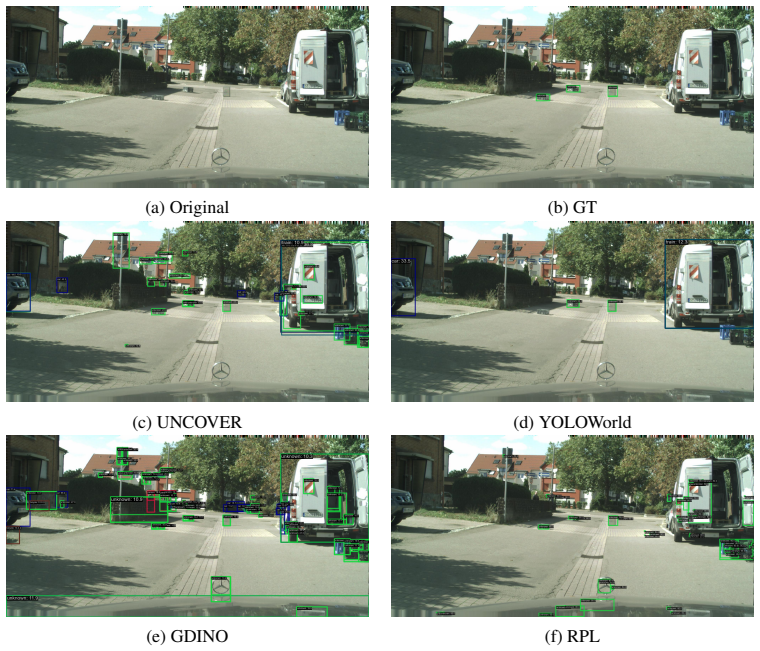
- [§4.1, Appendix B.1, Table 4] The central claim that the occupancy head learns a generic, class-agnostic objectness that transfers to objects outside all training data is not cleanly tested. Appendix B.1 explicitly removes traffic sign and traffic light from the known classes during training and treats them as unknowns on BDD100k, but both classes appear in COCO and LVIS, which are used as auxiliary OOD training data. Likewise, many other benchmark unknowns (animals, bags, buggies, trash bins, the Anomaly giraffe) are present in COCO/LVIS. Consequently, the Table 4 recall improvements (e.g., up to 25% over YOLO-World) could be driven by recognition of seen OOD categories rather than by the occupancy score's generic objectness. Please re-evaluate with a hold-out split that excludes all test categories (and their near variants) from COCO/LVIS, or at least report recall separately for categories that are present versus absent in the auxiliary training data.
- [§4, Evaluation Metrics; Figure 9 caption] The recall metric R@100 is computed without exhaustive unknown-object annotations, which makes the headline recall numbers difficult to interpret. The paper itself states in the Figure 9 caption that "Average precision would penalize the right object detections due to lack of exhaustive object annotations," confirming that many true unknowns are unlabeled. Without exhaustive annotations, unlabeled objects can be counted as false positives, and the denominator for recall (the number of ground-truth unknowns) is underestimated, so the reported R@100 is at best an approximation rather than a true recall. Please either construct an evaluation set with exhaustive per-frame unknown annotations (for example, using only categories with full instance-level annotation) or report precision/F1 alongside recall and quantify the estimated proportion of unannotated unknowns.
- [Table 3, Abstract] The abstract claims that DFR "reduces false positive rate by 18.4% while boosting recall by 4.1%," but this is an average over a heterogeneous set of methods and datasets, and several individual cells show the opposite behavior. For example, UNCOVER (BDD) on Cityscapes has FPR@100 increase from 2.2 to 2.5 (+13.6%), and the same row on Fishyscapes L&F shows FPR rising from 0.5 to 2.8 despite the parenthetical in the table. The average improvement is thus not a consistent effect. Please report per-configuration changes, use a more robust summary statistic, and reconcile the negative cells with the abstract's claim.
- [§4, Implementation Details] All results are reported from a single run with no error bars or multiple seeds, even though several key comparisons are within a few percentage points (e.g., Table 1: Obj. score 13.21 vs. IoU 11.70 vs. Occ 15.71 for Cityscapes R@100). In addition, the thresholds µocc and µ are grid-searched on the evaluation benchmarks (Appendix A.2, A.3). Without variance estimates or a clearer separation between validation and test thresholds, the robustness of the reported improvements is uncertain. Please provide mean±std over at least three seeds for the central comparisons, or a per-dataset threshold-sensitivity analysis with thresholds selected on held-out data only.
minor comments (6)
- [Abstract] There is a typo: "reduce false the positive rate" should be "reduce the false positive rate."
- [§3.2.2, Eq. (1)] The notation "$S^n_{i=0} bgti$" is nonstandard; it should be "$\bigcup_{i=0}^n bgti$" for the union of ground-truth boxes.
- [Algorithm 1] The bounding-box slicing "bbox ← C[x1 : y1, x2 : y2]" appears to use x and y inconsistently with the argument order (x1, x2, y1, y2); please clarify the coordinate conventions.
- [Table 3] The parenthetical relative changes are confusing, especially for UNCOVER (BDD) on FS L&F where the FPR increases from 0.5 to 2.8 but the table lists "-44.0%"; please correct the sign or explain what is being computed.
- [References] References [2] and [3] are duplicates of the same YOLOv4 citation and should be merged.
- [Appendix B.1] Typo: "auxilary" should be "auxiliary."
Circularity Check
No circular derivation: the occupancy score is a defined training target used as an empirical objectness measure, and the COCO/LVIS overlap is a benchmark-validity limitation, not an input-output equivalence.
full rationale
The paper contains no formal derivation chain that reduces a prediction to its own inputs. Equation (1) defines the occupancy training target as the fraction of the predicted box covered by the union of ground-truth boxes; using the learned occupancy score at inference as an objectness filter is an empirical design decision, not a tautology, because the network must still generalize the score from training boxes to new boxes. The extra OOD class is trained on COCO/LVIS, and Appendix B.1 confirms that traffic signs and traffic lights are removed from the AD known classes and used as unknowns even though traffic light, stop sign, and related categories appear in COCO/LVIS; similarly, many Cityscapes 'dynamic' objects and the Anomaly giraffe appear in COCO/LVIS. This overlap is a real threat to the external-validity claim that the results isolate transfer to truly novel object categories, and the paper itself concedes that 'the OOD class overfits to those specific classes in both datasets.' However, that is a limitation of the evaluation design, not circularity in the derivation: the reported recall and FPR numbers are not equal by construction to the training targets, and the ablation in Table 6 shows the occupancy prediction adds signal beyond the OOD-class head alone. The self-citations [18,40] are background references for IoU-based objectness and domain gap and are not load-bearing, and no uniqueness theorem, fitted-parameter-as-prediction, or renaming of a known result is used to force the conclusions. Under the strict circularity taxonomy, no circular step is present.
Assumptions & free parameters
free parameters (6)
- OOD class loss weight =
10
- Occupancy threshold µocc =
0.01
- DFR threshold µ =
0.3
- Morphological kernel size =
10
- Sobel kernel size =
5
- Occupancy loss weight wo =
1.0
assumptions (5)
- domain assumption COCO/LVIS annotations are a sufficiently diverse and representative set of non-AD objects.
- ad hoc to paper The occupancy target, i.e., the fraction of the predicted box covered by the union of GT boxes, is a valid class-agnostic objectness signal.
- domain assumption Depth-change proportion (Sobel y-gradient below 10) inside a bounding box is a reliable geometric cue for objectness.
- domain assumption The road-mask region of interest has exhaustive per-pixel annotations for reliable FPR computation.
- standard math The YOLOX base detector and mmdetection framework provide correct gradients and default hyperparameters.
Cite this review
Pith. "Pith review of UNCOVER: Unknown Class Object Detection for Autonomous Vehicles in Real-time." pith.science (2026). https://pith.science/paper/G6O2OROR
@misc{pith2026241203986,
  author       = {Pith},
  title        = {Pith review of: UNCOVER: Unknown Class Object Detection for Autonomous Vehicles in Real-time},
  year         = {2026},
  howpublished = {\url{https://pith.science/paper/G6O2OROR}},
  note         = {Machine review of arXiv:2412.03986}
}
read the original abstract
Autonomous driving (AD) operates in open-world scenarios, where encountering unknown objects is inevitable. However, standard object detectors trained on a limited number of base classes tend to ignore any unknown objects, posing potential risks on the road. To address this, it is important to learn a generic rather than a class specific objectness from objects seen during training. We therefore introduce an occupancy prediction together with bounding box regression. It learns to score the objectness by calculating the ratio of the predicted area occupied by actual objects. To enhance its generalizability, we increase the object diversity by exploiting data from other domains via Mosaic and Mixup augmentation. The objects outside the AD training classes are classified as a newly added out-of-distribution (OOD) class. Our solution UNCOVER, for UNknown Class Object detection for autonomous VEhicles in Real-time, excels at achieving both real-time detection and high recall of unknown objects on challenging AD benchmarks. To further attain very low false positive rates, particularly for close objects, we introduce a post-hoc filtering step that utilizes geometric cues extracted from the depth map, typically available within the AD system.
Figures


Figures from the paper (16 more)




Reference graph
Works this paper leans on
-
[1]
International Journal of Computer Vision 129(11), 3119–3135 (2021)
Blum, H., Sarlin, P.E., Nieto, J., Siegwart, R., Cadena, C.: The Fishyscapes Bench- mark: Measuring Blind Spots in Semantic Segmentation. International Journal of Computer Vision 129(11), 3119–3135 (2021). https://doi.org/10.1007/s11263-021-01511-6, https:// doi.org/10.1007/s11263-021-01511-6
-
[2]
arXiv preprint arXiv:2004.10934 (2020)
Bochkovskiy, A., Wang, C.Y ., Liao, H.Y .M.: Yolov4: Optimal speed and accuracy of object detection. arXiv preprint arXiv:2004.10934 (2020)
arXiv 2020
-
[3]
Bochkovskiy, A., Wang, C.Y ., Liao, H.Y .M.: Yolov4: Optimal speed and accuracy of object detection (2020)
work page 2020
-
[4]
In: European conference on computer vision
Carion, N., Massa, F., Synnaeve, G., Usunier, N., Kirillov, A., Zagoruyko, S.: End-to-end object detection with transformers. In: European conference on computer vision. pp. 213–229. Springer (2020)
2020
-
[5]
Chan, R., Lis, K., Uhlemeyer, S., Blum, H., Honari, S., Siegwart, R., Fua, P., Salzmann, M., Rottmann, M.: SegmentMeIfYouCan: A Benchmark for Anomaly Segmentation (NeurIPS), 1–13 (2021), http://arxiv.org/abs/2104.14812
arXiv 2021
-
[6]
Cheng, T., Song, L., Ge, Y ., Liu, W., Wang, X., Shan, Y .: YOLO-World: Real-Time Open- V ocabulary Object Detection (2024),http://arxiv.org/abs/2401.17270
arXiv 2024
-
[7]
Cordts, M., Omran, M., Ramos, S., Rehfeld, T., Enzweiler, M., Benenson, R., Franke, U., Roth, S., Schiele, B.: The Cityscapes Dataset for Semantic Urban Scene Understanding. Proc. of the IEEE Conference on Computer Vision and Pattern Recognition (CVPR) 2016-Decem, 3213–3223 (2016)
work page 2016
-
[8]
In: Proceedings of the IEEE/CVF Winter Conference on Applications of Computer Vision
Dhamija, A., Gunther, M., Ventura, J., Boult, T.: The overlooked elephant of object detection: Open set. In: Proceedings of the IEEE/CVF Winter Conference on Applications of Computer Vision. pp. 1021–1030 (2020)
work page 2020
Show all 43 references
-
[9]
In: Advances in Neural Information Processing Systems
Du, X., Gozum, G., Ming, Y ., Li, Y .: Siren: Shaping representations for detecting out-of- distribution objects. In: Advances in Neural Information Processing Systems. vol. 35, pp. 20434–20449 (2022)
2022
-
[10]
arXiv preprint arXiv:2202.01197 (2022)
Du, X., Wang, Z., Cai, M., Li, Y .: V os: Learning what you don’t know by virtual outlier synthesis. arXiv preprint arXiv:2202.01197 (2022)
2022 arXiv
-
[11]
Eng- land: John Wiley & Sons Ltd pp
Fisher, R., Perkins, S., Walker, A., Wolfart, E.: Hypermedia image processing reference. Eng- land: John Wiley & Sons Ltd pp. 118–130 (1996)
1996
-
[12]
ICCV (2023)
Galesso, S., Argus, M., Brox, T.: Far away in the deep space: Dense nearest-neighbor-based out-of-distribution detection appendix. ICCV (2023)
2023
-
[13]
IEEE Internet of Things Journal 9(10), 7572–7595 (2021)
Gao, C., Wang, G., Shi, W., Wang, Z., Chen, Y .: Autonomous driving security: State of the art and challenges. IEEE Internet of Things Journal 9(10), 7572–7595 (2021)
2021
-
[14]
arXiv preprint arXiv:2107.08430 (jul 2021), http://arxiv.org/abs/2107.08430
Ge, Z., Liu, S., Wang, F., Li, Z., Sun, J.: YOLOX: Exceeding YOLO Series in 2021. arXiv preprint arXiv:2107.08430 (jul 2021), http://arxiv.org/abs/2107.08430
2021 arXiv
-
[15]
Proceedings of the IEEE Computer Society Conference on Computer Vision and Pattern Recognition 2019-June, 5351–5359 (2019)
Gupta, A., Dollar, P., Girshick, R.: Lvis: A dataset for large vocabulary instance segmenta- tion. Proceedings of the IEEE Computer Society Conference on Computer Vision and Pattern Recognition 2019-June, 5351–5359 (2019). https://doi.org/10.1109/CVPR.2019.00550
2019
-
[16]
In: Proceedings of the IEEE/CVF Conference on Computer Vision and Pattern Recognition
Gupta, A., Narayan, S., Joseph, K.J., Khan, S., Shahbaz Khan, F., Shah, M., Khan, F.S., Shah, M., Shahbaz Khan, F., Shah, M., Khan, F.S., Shah, M., Shahbaz Khan, F., Shah, M., Khan, F.S., Shah, M.: OW-DETR: Open-world Detection Transformer. In: Proceedings of the IEEE/CVF Conf...
2022
-
[17]
Huang, H., Geiger, A., Zhang, D.: GOOD: Exploring Geometric Cues for Detecting Objects in an Open World (2022)
2022
-
[18]
In: The Eleventh International Conference on Learning Representations (ICLR) (2023), https://openreview.net/forum?id=W-nZDQyuy8D
Huang, H., Geiger, A., Zhang, D.: GOOD: Exploring geometric cues for detecting objects in an open world. In: The Eleventh International Conference on Learning Representations (ICLR) (2023), https://openreview.net/forum?id=W-nZDQyuy8D
2023
-
[19]
Jocher, G., Chaurasia, A., Qiu, J.: Ultralytics YOLO (Jan 2023), https://github.com/ ultralytics/ultralytics 10
2023
-
[20]
In: Proceedings of the IEEE/CVF conference on computer vision and pattern recognition
Joseph, K., Khan, S., Khan, F.S., Balasubramanian, V .N.: Towards open world object detec- tion. In: Proceedings of the IEEE/CVF conference on computer vision and pattern recognition. pp. 5830–5840 (2021)
2021
-
[21]
IEEE Robotics and Automation Letters7, 5453–5460 (2021)
Kim, D., Lin, T.Y ., Angelova, A., Kweon, I.S., Kuo, W.: Learning Open-World Object Propos- als without Learning to Classify. IEEE Robotics and Automation Letters7, 5453–5460 (2021)
2021
-
[22]
Kim, D., Ka, W., Ahn, P., Joo, D., Chun, S., Kim, J.: Global-Local Path Networks for Monoc- ular Depth Estimation with Vertical CutDepth (jan 2022), http://arxiv.org/abs/2201. 07436
2022
-
[23]
arXiv preprint arXiv:2201.02302 (jan 2022), http://arxiv.org/abs/2201.02302
Konan, S., Liang, K.J., Yin, L.: Extending One-Stage Detection with Open-World Proposals. arXiv preprint arXiv:2201.02302 (jan 2022), http://arxiv.org/abs/2201.02302
2022 arXiv
-
[24]
In: Experimental Robotics: The 10th International Symposium on Experimental Robotics
Konolige, K., Agrawal, M., Bolles, R.C., Cowan, C., Fischler, M., Gerkey, B.: Outdoor map- ping and navigation using stereo vision. In: Experimental Robotics: The 10th International Symposium on Experimental Robotics. pp. 179–190. Springer (2008)
2008
-
[25]
In: Proceedings of the IEEE/CVF Conference on Computer Vision and Pattern Recognition
Liang, W., Xue, F., Liu, Y ., Zhong, G., Ming, A.: Unknown Sniffer for Object Detection: Don’t Turn a Blind Eye to Unknown Objects. In: Proceedings of the IEEE/CVF Conference on Computer Vision and Pattern Recognition. pp. 3230–3239 (2023), https://github
2023
-
[26]
European conference on computer vision pp
Lin, T.y., Maire, M., Belongie, S., Bourdev, L., Girshick, R., Hays, J., Perona, P., Ramanan, D., Zitnick, C.L., Doll´ar, P.: Microsoft COCO: Common Objects in Context. European conference on computer vision pp. 740–755 (2014)
2014
-
[27]
arXiv preprint arXiv:2303.05499 (mar 2023), http://arxiv.org/abs/2303.05499
Liu, S., Zeng, Z., Ren, T., Li, F., Zhang, H., Yang, J.J.J., Li, C., Yang, J.J.J., Su, H., Zhu, J., Zhang, L., Others, Zhang, L., Others: Grounding DINO: Marrying DINO with Grounded Pre-Training for Open-Set Object Detection. arXiv preprint arXiv:2303.05499 (mar 2023), http://...
2023 arXiv
-
[28]
In: Pro- ceedings of the IEEE/CVF International Conference on Computer Vision
Liu, Y ., Ding, C., Tian, Y ., Pang, G., Belagiannis, V ., Reid, I., Carneiro, G.: Residual Pat- tern Learning for Pixel-wise Out-of-Distribution Detection in Semantic Segmentation. In: Pro- ceedings of the IEEE/CVF International Conference on Computer Vision. pp. 1151–1161 (n...
2023 arXiv
-
[29]
Blog Entry (2022)
OpenAI: Introducing ChatGPT. Blog Entry (2022)
2022
-
[30]
Proceedings of the IEEE/CVF International Conference on Computer Vi- sion pp
Rai, S.N., Cermelli, F., Fontanel, D., Masone, C., Caputo, B.: Unmasking anomalies in road- scene segmentation. Proceedings of the IEEE/CVF International Conference on Computer Vi- sion pp. 4037–4046 (jul 2023), http://arxiv.org/abs/2307.13316
2023 arXiv
-
[31]
IEEE transactions on pattern analysis and machine intelli- gence 39(6), 1137–1149 (2015)
Ren, S., He, K., Girshick, R., Sun, J.: Faster R-CNN: Towards Real-Time Object Detection with Region Proposal Networks. IEEE transactions on pattern analysis and machine intelli- gence 39(6), 1137–1149 (2015)
2015
-
[32]
ECCV’12: Proceedings of the 12th European conference on Computer Vision - V olume Part V Part V (Chapter 54), 746–760 (2012)
Silberman, N., Hoiem, D., Kohli, P., Fergus, R.: Indoor segmentation and support inference from RGBD images Lecture Notes in Computer Science. ECCV’12: Proceedings of the 12th European conference on Computer Vision - V olume Part V Part V (Chapter 54), 746–760 (2012)
2012
-
[33]
a talk at the Stanford Artificial Project in pp
Sobel, I., Feldman, G., Others: A 3x3 isotropic gradient operator for image processing. a talk at the Stanford Artificial Project in pp. 271–272 (1968)
1968
-
[34]
In: European Conference on Computer Vision
Tian, Y ., Liu, Y ., Pang, G., Liu, F., Chen, Y ., Carneiro, G.: Pixel-wise energy-biased abstention learning for anomaly segmentation on complex urban driving scenes. In: European Conference on Computer Vision. pp. 246–263 (nov 2022), http://arxiv.org/abs/2111.12264
2022 arXiv
-
[35]
In: Proceedings of the IEEE/CVF international conference on computer vision
Tian, Z., Shen, C., Chen, H., He, T.: FCOS: Fully Convolutional One-Stage Object Detection. In: Proceedings of the IEEE/CVF international conference on computer vision. pp. 9627–9636 (apr 2019), http://arxiv.org/abs/1904.01355
2019 arXiv
-
[36]
Proceedings of the IEEE/CVF International Conference on Computer Vision pp
Wang, Y ., Yue, Z., Hua, X.S., Zhang, H.: Random Boxes Are Open-world Object Detectors. Proceedings of the IEEE/CVF International Conference on Computer Vision pp. 6233–6243 (2023), https://github.com/scuwyh2000/RandBox
2023
-
[37]
Machine Intelligence Research pp
Wu, D., Liao, M.W., Zhang, W.T., Wang, X.G., Bai, X., Cheng, W.Q., Liu, W.Y .: Yolop: You only look once for panoptic driving perception. Machine Intelligence Research pp. 1–13 (2022) 11
2022
-
[38]
Proceedings of the IEEE Computer Society Conference on Computer Vision and Pattern Recognition pp
Yu, F., Chen, H., Wang, X., Xian, W., Chen, Y ., Liu, F., Madhavan, V ., Darrell, T.: BDD100K: A Diverse Driving Dataset for Heterogeneous Multitask Learning. Proceedings of the IEEE Computer Society Conference on Computer Vision and Pattern Recognition pp. 2633–2642 (2020). h...
2020
-
[39]
Pattern Recognition 148, 110152 (2024)
Zhan, J., Luo, Y ., Guo, C., Wu, Y ., Meng, J., Liu, J.: Yolopx: Anchor-free multi-task learning network for panoptic driving perception. Pattern Recognition 148, 110152 (2024). https://doi.org/https://doi.org/10.1016/j.patcog.2023.110152, https://www. sciencedirect.com/scienc...
2024
-
[40]
In: Proceedings of the IEEE/CVF International Conference on Computer Vision (ICCV) Workshops
Zhang, D., Sakmann, K., Beluch, W., Hutmacher, R., Li, Y .: Anomaly-aware semantic seg- mentation via style-aligned ood augmentation. In: Proceedings of the IEEE/CVF International Conference on Computer Vision (ICCV) Workshops. pp. 4065–4073 (October 2023)
2023
-
[41]
In: International Conference on Learning Representations (2018), https: //openreview.net/forum?id=r1Ddp1-Rb
Zhang, H., Cisse, M., Dauphin, Y .N., Lopez-Paz, D.: mixup: Beyond empirical risk minimization. In: International Conference on Learning Representations (2018), https: //openreview.net/forum?id=r1Ddp1-Rb
2018
-
[42]
Zhao, X., Chen, Y ., Xu, S., Li, X., Wang, X., Li, Y ., Huang, H.: An Open and Comprehen- sive Pipeline for Unified Object Grounding and Detection (2024), http://arxiv.org/abs/ 2401.02361
2024 arXiv
-
[43]
In: Proceedings of the IEEE/CVF Conference on Computer Vision and Pattern Recogni- tion
Zohar, O., Wang, K.C., Yeung, S.: Prob: Probabilistic objectness for open world object detec- tion. In: Proceedings of the IEEE/CVF Conference on Computer Vision and Pattern Recogni- tion. pp. 11444–11453 (2023) 12 Appendix / supplemental material The supplementary material of...
2023
Reviewed August 11, 2026 · model on record in the stance chip above.
Discussion (0). Continue with ORCID to comment.