REVIEW 3 major objections 7 minor 1 cited by
DEIM: DETR with Improved Matching for Fast Convergence
T0 review · 3 major / 7 minor · reviewed 2026-08-11 · deepseek-v4-flash
Pith's one-line read DEIM claims the slow convergence of DETR detectors is caused by sparse supervision, and that increasing the number of targets per image through mosaic and mixup augmentation, together with a matchability-aware loss, can halve training…
desk verdict Solid empirical recipe that halves real-time DETR training cost with zero inference overhead, but the claimed dense-supervision mechanism is never isolated from plain augmentation effects. read the letter →
The pith
A machine-rendered reading of the paper's core claim, the machinery that carries it, and where it could break.
The reading
What carries the argument
The central mechanism is Dense O2O matching, which keeps the one-to-one assignment of Hungarian matching but raises the number of targets per image via mosaic and mixup augmentations, thereby increasing the positive-sample count in the supervision loss. The second mechanism is the Matchability-Aware Loss (MAL), defined as MAL(p,q,y) = -q^γ log(p) - (1 - q^γ) log(1-p) for foreground and -p^γ log(1-p) for background, which reweights the loss by the predicted IoU so that low-quality matches are still optimized rather than discarded.
What would settle it
Train the same DEIM recipe but replace mosaic and mixup with an augmentation that increases object count without mixing content, such as pasting arbitrary object crops, and compare AP; if the gains disappear when the augmentations' regularization is removed, the dense-supervision explanation fails. A complementary control would apply mosaic and mixup while keeping the matched-target count fixed, which would isolate the augmentation effect.
Extended reading notes
Core claim
Dense O2O increases the number of ground-truth targets N in each training image, by stitching mosaic views and mixing images, so that the existing Hungarian one-to-one assignment yields several times more positive samples per image without altering the one-to-one structure or adding decoders. The Matchability-Aware Loss replaces VFL with a form that scales the target label by q^γ (the IoU raised to a power), so low-quality matches receive a meaningful gradient instead of a near-flat loss. The paper claims that combining these two changes halves the training epochs needed to match or beat the baseline, and that the resulting real-time models set a new state of the art on COCO.
Load-bearing premise
The load-bearing premise is that the gains of Dense O2O come from more positive samples per image, not from the regularization and data-diversity effects of mosaic and mixup augmentations, and the paper does not run a control that separates these two effects.
Editorial extensions
If this is right
- Existing real-time DETRs such as RT-DETRv2 and D-FINE can be trained in roughly half the epochs with equal or better AP, reducing GPU-hours and making high-accuracy detection more accessible.
- Small-object detection consistently improves, with reported gains of 1.3 to 2.1 AP on RT-DETRv2 backbones, which the paper attributes to denser supervision helping small targets.
- DEIM-trained models outperform recent YOLO detectors on COCO at comparable or better latency, without additional training data.
- The method transfers to crowded scenes (CrowdHuman) and to fine-tuning from Object365 pretrained weights, indicating it is not tied to one dataset or training regime.
Reading between the lines
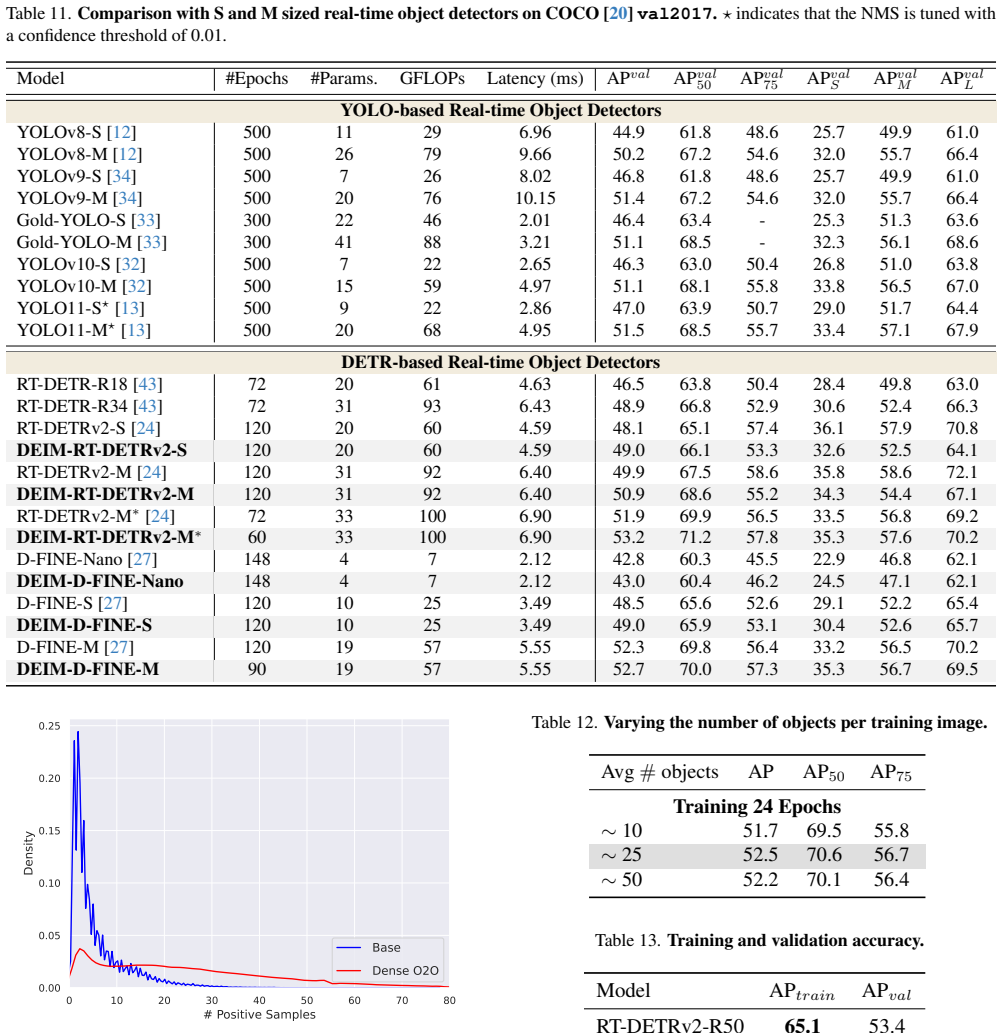
- The paper's evidence for Dense O2O's mechanism is correlational: Figure 6 and Table 12 show that more targets per image help, but no control separates denser supervision from the well-known regularization effects of mosaic and mixup, so an augmentation-regularization account of the gains is not ruled out.
- MAL's q^γ reweighting is a loss-level change that could plausibly transfer to one-to-many detectors or other sparse-supervision tasks such as instance segmentation, since it only alters the gradient surface for low-IoU matches.
- The data-augmentation warmup and the disabling of Dense O2O after half the training suggest a curriculum effect; testing when dense targets matter most could turn the current heuristic schedule into a principled one.
- If denser supervision is truly the driver, the recipe generalizes beyond mosaic and mixup to any cheap way of increasing targets per image, such as copy-paste augmentation, which would be a direct testable extension.
Signed reviews
Editorial analysis
A structured set of objections, weighed in public.
Referee Report
Summary. The paper proposes DEIM, a training framework for DETR-based real-time object detectors. It combines Dense O2O matching, which uses mosaic and mixup augmentations to increase the number of ground-truth targets per image and thereby the number of positive samples under one-to-one matching, with a Matchability-Aware Loss (MAL) that reweights classification loss for low-quality matches. Experiments on COCO, CrowdHuman, and Object365 fine-tuning show consistent improvements in detection accuracy and convergence speed over RT-DETRv2 and D-FINE baselines, with reduced training epochs. Code and pretrained models are promised.
Significance. If the empirical results hold, DEIM is a simple and practical training recipe that improves the accuracy/latency trade-off of real-time DETRs while cutting training epochs roughly in half for some configurations. The paper's strengths include broad ablations across model sizes and backbones, a separate dense-crowd dataset, wall-clock training-time measurements, and a clear hypothesis about sparse supervision in DETR. The main weakness is that the central mechanistic claim—that increased positive-sample density, not augmentation regularization, drives the gains—is not cleanly isolated. This is load-bearing for the conceptual novelty of Dense O2O, although the empirical recipe may remain useful regardless. The training-time claim also needs clarification because the reported wall-clock reductions are inconsistent with the '50%' headline.
major comments (3)
- [Sec. 3.2 and 4.1; Tables 4, 6, 12; Fig. 6] The paper attributes the gains of Dense O2O to increased positive-sample density, but the experimental manipulation is confounded with augmentation regularization. Dense O2O is implemented exclusively via mosaic and mixup (Sec. 3.2, Sec. 4.1), and the baselines RT-DETRv2 and D-FINE appear not to use these augmentations; therefore, the improvements in Table 6 could equally be explained by the well-known regularization and data-diversity effects of mosaic/mixup. Table 12 varies the average number of objects per image, but it does so by changing the Dense O2O configuration, which also alters the augmentation mixture and intensity. The statement in Sec. 4.1 that 'Disabling Dense O2O after 50% of training epochs leads to better results' further suggests an early-training curriculum or regularization effect rather than a sustained dense-supervision mechanism. A control that applies mosaic/mixup with the same probability and intensity while holding the target count at the baseline level (for example, by replacing mixed-in object patches with non-object patches) is needed to support the claim that supervisory density is the active ingredient. Without such a control, the conceptual novelty of Dense O2O is not established.
- [Abstract; Sec. 4.1; Table 7] The headline claim of 'reducing training time by 50%' is not consistently supported by the reported numbers. Table 2 shows DEIM-RT-DETRv2 reaching 53.9 AP in 36 epochs versus 53.4 AP for the 72-epoch baseline, which is indeed a 50% epoch reduction. However, Table 1 uses 50 epochs for DEIM-D-FINE-L/X versus 72 for D-FINE (about a 30% epoch reduction), and Table 7 reports 71 versus 85 GPU hours for RT-DETRv2-R50 with DEIM, which is only a 16% wall-clock reduction. The abstract's blanket '50%' statement overstates some of the reported configurations. Please clarify which specific comparison supports the 50% claim and report wall-clock training time for the final models listed in Table 1.
- [Supplementary Table 11] Several rows in Supplementary Table 11 appear to contain transcription errors. For example, the baseline RT-DETRv2-S row reports AP75=57.4, APs=36.1, APm=57.9, and APl=70.8, values that are far outside the range of other S-scale detectors in the same table (e.g., YOLOv8-S AP75=48.6, RT-DETR-R18 AP75=50.4). Similarly, the DEIM-RT-DETRv2-S row shows AP75=53.3, APs=32.6, APm=52.5, and APl=64.1, which are implausibly high for a model with AP=49.0. These entries suggest errors in data transcription and should be verified before publication.
minor comments (7)
- [References] Reference [31] is incorrect: the text cites FCOS, but the reference given is a 3D lidar detection paper. The citation should be to Tian et al., 'FCOS: Fully Convolutional One-Stage Object Detection,' ICCV 2019.
- [Sec. 4.1] The statement that disabling Dense O2O after 50% of training epochs leads to better results is made without a supporting ablation. Please report the experiment or explicitly label this as a design choice inherited from the scheduler.
- [Sec. 4.5, Table 5] The hyperparameter gamma in MAL is tuned on COCO val2017. Please acknowledge this as validation-based selection or evaluate on a held-out split to avoid optimistic bias.
- [Sec. 3.1, Eq. (1)] The summation notation in Eq. (1) appears corrupted in the text ('NX' and 'MiX'). Please ensure the equation is rendered with proper summation limits.
- [Sec. 4.3, Table 2] The model name 'DEIM-RT-DETRv2' is used twice with different epoch counts (36 and 60). Use distinct names or a footnote to make the rows clear.
- [Abstract and footnote] The code URL differs between the abstract (https://github.com/ShihuaHuang95/DEIM) and the footnote/website (https://www.shihuahuang.cn/DEIM/). Please unify the URLs.
- [Figure 3] The caption 'Ratios between O2M and O2O' does not explain what ratio is plotted. Please specify the exact quantity, e.g., per-image positive match count or its histogram.
Circularity Check
No significant circularity: DEIM's claims are empirical results measured against the external COCO benchmark; the mosaic/mixup attribution confound is a mechanism question, not a derivation that reduces to its own inputs.
full rationale
The paper's argument is empirical rather than formal. Dense O2O is a training configuration that increases per-image targets through mosaic and mixup (Section 3.2, Section 4.1), and MAL is a defined loss (Eq. 4); neither is defined in terms of the reported AP values. Faster-convergence claims are supported by comparisons to externally trained RT-DETRv2 and D-FINE baselines on COCO (Tables 1, 2, 6), so the results are not fitted parameters renamed as predictions. The gamma hyperparameter is selected from Table 5, but this is ordinary validation-set tuning rather than a constructed equality. The skeptical concern, that Dense O2O gains may be due to augmentation regularization rather than denser supervision, is a valid attribution/confound issue and is even suggested by the paper's own supplementary Table 13, where DEIM has lower training accuracy and higher validation accuracy; however, this does not make any stated derivation equivalent to its input by construction. There is no load-bearing self-citation or imported uniqueness theorem. Accordingly, no circular step is present and the score is 0.
Assumptions & free parameters
free parameters (5)
- gamma in MAL =
1.5
- Mosaic probability =
0.5
- Mixup probability =
0.5
- DataAug warmup epochs =
4
- Dense O2O disable epoch =
50% of total epochs
assumptions (3)
- domain assumption Increasing ground-truth targets per image increases positive matches under one-to-one assignment, and denser positive supervision accelerates convergence.
- domain assumption The IoU between the matched prediction and the target, q, is a suitable continuous label, and replacing q by q^gamma in the positive term improves optimization of low-quality matches.
- ad hoc to paper Data augmentation should be warmed up and Dense O2O should be disabled halfway through training for best accuracy.
Cite this review
Pith. "Pith review of DEIM: DETR with Improved Matching for Fast Convergence." pith.science (2026). https://pith.science/paper/EIK4GDGT
@misc{pith2026241204234,
  author       = {Pith},
  title        = {Pith review of: DEIM: DETR with Improved Matching for Fast Convergence},
  year         = {2026},
  howpublished = {\url{https://pith.science/paper/EIK4GDGT}},
  note         = {Machine review of arXiv:2412.04234}
}
read the original abstract
We introduce DEIM, an innovative and efficient training framework designed to accelerate convergence in real-time object detection with Transformer-based architectures (DETR). To mitigate the sparse supervision inherent in one-to-one (O2O) matching in DETR models, DEIM employs a Dense O2O matching strategy. This approach increases the number of positive samples per image by incorporating additional targets, using standard data augmentation techniques. While Dense O2O matching speeds up convergence, it also introduces numerous low-quality matches that could affect performance. To address this, we propose the Matchability-Aware Loss (MAL), a novel loss function that optimizes matches across various quality levels, enhancing the effectiveness of Dense O2O. Extensive experiments on the COCO dataset validate the efficacy of DEIM. When integrated with RT-DETR and D-FINE, it consistently boosts performance while reducing training time by 50%. Notably, paired with RT-DETRv2, DEIM achieves 53.2% AP in a single day of training on an NVIDIA 4090 GPU. Additionally, DEIM-trained real-time models outperform leading real-time object detectors, with DEIM-D-FINE-L and DEIM-D-FINE-X achieving 54.7% and 56.5% AP at 124 and 78 FPS on an NVIDIA T4 GPU, respectively, without the need for additional data. We believe DEIM sets a new baseline for advancements in real-time object detection. Our code and pre-trained models are available at https://github.com/ShihuaHuang95/DEIM.
Figures


Figures from the paper (4 more)



Forward citations
Cited by 1 Pith paper
-
Dome-DETR: DETR with Density-Oriented Feature-Query Manipulation for Efficient Tiny Object Detection
A density-guided DETR variant improves tiny object detection by 3.3 AP on AI-TOD-V2 and 2.5 AP on VisDrone over the D-FINE baseline.
Reference graph
Works this paper leans on
-
[1]
Yolov4: Optimal speed and accuracy of object detection
Alexey Bochkovskiy, Chien-Yao Wang, and Hong- Yuan Mark Liao. Yolov4: Optimal speed and accuracy of object detection. arXiv, 2020. 1, 2, 5, 7
work page 2020
-
[2]
Align-detr: Improving detr with sim- ple iou-aware bce loss
Zhi Cai, Songtao Liu, Guodong Wang, Zheng Ge, Xiangyu Zhang, and Di Huang. Align-detr: Improving detr with sim- ple iou-aware bce loss. In BMVC, 2024. 5
work page 2024
-
[3]
End-to- end object detection with transformers
Nicolas Carion, Francisco Massa, Gabriel Synnaeve, Nicolas Usunier, Alexander Kirillov, and Sergey Zagoruyko. End-to- end object detection with transformers. In ECCV, 2020. 2, 3, 4, 7
work page 2020
-
[4]
Group detr: Fast detr training with group-wise one-to-many assignment
Qiang Chen, Xiaokang Chen, Jian Wang, Shan Zhang, Kun Yao, Haocheng Feng, Junyu Han, Errui Ding, Gang Zeng, and Jingdong Wang. Group detr: Fast detr training with group-wise one-to-many assignment. In ICCV, 2023. 2, 3
work page 2023
-
[5]
Monocular 3d object de- tection for autonomous driving
Xiaozhi Chen, Kaustav Kundu, Ziyu Zhang, Huimin Ma, Sanja Fidler, and Raquel Urtasun. Monocular 3d object de- tection for autonomous driving. In CVPR, 2016. 1
work page 2016
-
[6]
Multi-view 3d object detection network for autonomous driving
Xiaozhi Chen, Huimin Ma, Ji Wan, Bo Li, and Tian Xia. Multi-view 3d object detection network for autonomous driving. In CVPR, 2017. 1
work page 2017
-
[7]
Dynamic detr: End-to- end object detection with dynamic attention
Xiyang Dai, Yinpeng Chen, Jianwei Yang, Pengchuan Zhang, Lu Yuan, and Lei Zhang. Dynamic detr: End-to- end object detection with dynamic attention. In ICCV, 2021. 4
work page 2021
-
[8]
Imagenet: A large-scale hierarchical image database
Jia Deng, Wei Dong, Richard Socher, Li-Jia Li, Kai Li, and Li Fei-Fei. Imagenet: A large-scale hierarchical image database. In CVPR, 2009. 6
2009
Show all 50 references
-
[9]
Object detection and tracking for autonomous navigation in dynamic environments
Andreas Ess, Konrad Schindler, Bastian Leibe, and Luc Van Gool. Object detection and tracking for autonomous navigation in dynamic environments. The International Journal of Robotics Research, 2010. 1
2010
-
[10]
Tood: Task-aligned one-stage object de- tection
Chengjian Feng, Yujie Zhong, Yu Gao, Matthew R Scott, and Weilin Huang. Tood: Task-aligned one-stage object de- tection. In ICCV, 2021. 4
2021
-
[11]
Fast convergence of detr with spatially modulated co-attention
Peng Gao, Minghang Zheng, Xiaogang Wang, Jifeng Dai, and Hongsheng Li. Fast convergence of detr with spatially modulated co-attention. In ICCV, 2021. 7
2021
-
[12]
Jocher Glenn. Yolov8. https://docs.ultralytics. com/models/yolov8/, 2023. 6, 2
2023
-
[13]
Jocher Glenn. Yolo11. https://docs.ultralytics. com/models/yolo11/, 2024. 2, 6
2024
-
[14]
Deep residual learning for image recognition
Kaiming He, Xiangyu Zhang, Shaoqing Ren, and Jian Sun. Deep residual learning for image recognition. In CVPR,
-
[15]
Detrs with hybrid matching
Ding Jia, Yuhui Yuan, Haodi He, Xiaopei Wu, Haojun Yu, Weihong Lin, Lei Sun, Chao Zhang, and Han Hu. Detrs with hybrid matching. In CVPR, 2023. 3
2023
-
[16]
The hungarian method for the assignment problem
Harold W Kuhn. The hungarian method for the assignment problem. Naval research logistics quarterly, 1955. 2, 3, 4
1955
-
[17]
Lite detr: An interleaved multi-scale encoder for efficient detr
Feng Li, Ailing Zeng, Shilong Liu, Hao Zhang, Hongyang Li, Lei Zhang, and Lionel M Ni. Lite detr: An interleaved multi-scale encoder for efficient detr. In CVPR, 2023. 4
2023
-
[18]
Dn-detr: Accelerate detr training by intro- ducing query denoising
Feng Li, Hao Zhang, Shilong Liu, Jian Guo, Lionel M Ni, and Lei Zhang. Dn-detr: Accelerate detr training by intro- ducing query denoising. In CVPR, 2022. 2, 3, 7
2022
-
[19]
Focal loss for dense object detection
Tsung-Yi Lin, Priya Goyal, Ross Girshick, Kaiming He, and Piotr Doll´ar. Focal loss for dense object detection. In ICCV,
-
[20]
Microsoft coco: Common objects in context
Tsung-Yi Lin, Michael Maire, Serge Belongie, James Hays, Pietro Perona, Deva Ramanan, Piotr Doll´ar, and C Lawrence Zitnick. Microsoft coco: Common objects in context. In ECCV, 2014. 1, 2, 4, 5, 6, 7, 8
2014
-
[21]
Dab-detr: Dynamic an- chor boxes are better queries for detr
Shilong Liu, Feng Li, Hao Zhang, Xiao Yang, Xianbiao Qi, Hang Su, Jun Zhu, and Lei Zhang. Dab-detr: Dynamic an- chor boxes are better queries for detr. In ICLR, 2022. 3, 7
2022
-
[22]
Detection transformer with stable matching
Shilong Liu, Tianhe Ren, Jiayu Chen, Zhaoyang Zeng, Hao Zhang, Feng Li, Hongyang Li, Jun Huang, Hang Su, Jun Zhu, et al. Detection transformer with stable matching. In ICCV, 2023. 4
2023
-
[23]
Decoupled weight decay regularization
Ilya Loshchilov and Frank Hutter. Decoupled weight decay regularization. In ICLR, 2017. 5
2017
-
[24]
Rt-detrv2: Improved base- line with bag-of-freebies for real-time detection transformer
Wenyu Lv, Yian Zhao, Qinyao Chang, Kui Huang, Guanzhong Wang, and Yi Liu. Rt-detrv2: Improved base- line with bag-of-freebies for real-time detection transformer. arXiv, 2024. 2, 4, 5, 6, 7, 8, 1
2024
-
[25]
Rtmdet: An empirical study of designing real-time object detectors
Chengqi Lyu, Wenwei Zhang, Haian Huang, Yue Zhou, Yudong Wang, Yanyi Liu, Shilong Zhang, and Kai Chen. Rtmdet: An empirical study of designing real-time object detectors. arXiv, 2022. 5, 1
2022
-
[26]
Conditional detr for fast training convergence
Depu Meng, Xiaokang Chen, Zejia Fan, Gang Zeng, Houqiang Li, Yuhui Yuan, Lei Sun, and Jingdong Wang. Conditional detr for fast training convergence. In ICCV,
-
[27]
D-fine: Redefine regression task in detrs as fine-grained distribution refinement
Yansong Peng, Hebei Li, Peixi Wu, Yueyi Zhang, Xiaoyan Sun, and Feng Wu. D-fine: Redefine regression task in detrs as fine-grained distribution refinement. arXiv, 2024. 2, 4, 5, 6, 8, 1
2024
-
[28]
You only look once: Unified, real-time object detection
J Redmon. You only look once: Unified, real-time object detection. In CVPR, 2016. 1
2016
-
[29]
Faster r-cnn: Towards real-time object detection with region proposal networks
Shaoqing Ren, Kaiming He, Ross Girshick, and Jian Sun. Faster r-cnn: Towards real-time object detection with region proposal networks. TPAMI, 2016. 2, 3
2016
-
[30]
Crowdhuman: A benchmark for detecting human in a crowd
Shuai Shao, Zijian Zhao, Boxun Li, Tete Xiao, Gang Yu, Xiangyu Zhang, and Jian Sun. Crowdhuman: A benchmark for detecting human in a crowd. arXiv, 2018. 7
2018
-
[31]
Fully convolutional one-stage 3d object detection on lidar range images
Zhi Tian, Xiangxiang Chu, Xiaoming Wang, Xiaolin Wei, and Chunhua Shen. Fully convolutional one-stage 3d object detection on lidar range images. In NIPS, 2022. 2, 3
2022
-
[32]
Yolov10: Real-time end-to- end object detection
Ao Wang, Hui Chen, Lihao Liu, Kai Chen, Zijia Lin, Jun- gong Han, and Guiguang Ding. Yolov10: Real-time end-to- end object detection. 2024. 1, 2, 6
2024
-
[33]
Gold-yolo: Ef- ficient object detector via gather-and-distribute mechanism
Chengcheng Wang, Wei He, Ying Nie, Jianyuan Guo, Chuanjian Liu, Yunhe Wang, and Kai Han. Gold-yolo: Ef- ficient object detector via gather-and-distribute mechanism. NeurIPS, 2023. 6, 2
2023
-
[34]
Yolov9: Learning what you want to learn using pro- grammable gradient information
Chien-Yao Wang, I-Hau Yeh, and Hong-Yuan Mark Liao. Yolov9: Learning what you want to learn using pro- grammable gradient information. arXiv, 2024. 1, 6, 2
2024
-
[35]
Anchor detr: Query design for transformer-based detector
Yingming Wang, Xiangyu Zhang, Tong Yang, and Jian Sun. Anchor detr: Query design for transformer-based detector. In AAAI, 2022. 3, 7
2022
-
[36]
Efficient detr: improving end-to-end object detector with dense prior
Zhuyu Yao, Jiangbo Ai, Boxun Li, and Chi Zhang. Efficient detr: improving end-to-end object detector with dense prior. arXiv, 2021. 3, 7
2021
-
[37]
Cascade-detr: delv- 9 ing into high-quality universal object detection
Mingqiao Ye, Lei Ke, Siyuan Li, Yu-Wing Tai, Chi-Keung Tang, Martin Danelljan, and Fisher Yu. Cascade-detr: delv- 9 ing into high-quality universal object detection. In ICCV,
-
[38]
mixup: Beyond empirical risk minimization
Hongyi Zhang. mixup: Beyond empirical risk minimization. In ICLR, 2017. 2, 5, 7
2017
-
[39]
Dino: Detr with improved denoising anchor boxes for end-to-end object detection
Hao Zhang, Feng Li, Shilong Liu, Lei Zhang, Hang Su, Jun Zhu, Lionel M Ni, and Heung-Yeung Shum. Dino: Detr with improved denoising anchor boxes for end-to-end object detection. In ICLR, 2023. 2, 3, 4, 6, 7
2023
-
[40]
Varifocalnet: An iou-aware dense object detector
Haoyang Zhang, Ying Wang, Feras Dayoub, and Niko Sun- derhauf. Varifocalnet: An iou-aware dense object detector. In CVPR, 2021. 2, 3, 5
2021
-
[41]
Dense distinct query for end-to-end object detection
Shilong Zhang, Xinjiang Wang, Jiaqi Wang, Jiangmiao Pang, Chengqi Lyu, Wenwei Zhang, Ping Luo, and Kai Chen. Dense distinct query for end-to-end object detection. In CVPR, 2023. 3
2023
-
[42]
Ms-detr: Efficient detr training with mixed supervision
Chuyang Zhao, Yifan Sun, Wenhao Wang, Qiang Chen, Er- rui Ding, Yi Yang, and Jingdong Wang. Ms-detr: Efficient detr training with mixed supervision. In CVPR, 2024. 4
2024
-
[43]
Detrs beat yolos on real-time object detection
Yian Zhao, Wenyu Lv, Shangliang Xu, Jinman Wei, Guanzhong Wang, Qingqing Dang, Yi Liu, and Jie Chen. Detrs beat yolos on real-time object detection. In CVPR,
-
[44]
Yolox: Exceeding yolo series in 2021
Ge Zheng, Liu Songtao, Wang Feng, Li Zeming, and Sun Jian. Yolox: Exceeding yolo series in 2021. arXiv, 2021. 1, 2, 4
2021
-
[45]
Deformable detr: Deformable transformers for end-to-end object detection
Xizhou Zhu, Weijie Su, Lewei Lu, Bin Li, Xiaogang Wang, and Jifeng Dai. Deformable detr: Deformable transformers for end-to-end object detection. In ICLR, 2021. 2, 3, 4, 7
2021
-
[46]
Detrs with col- laborative hybrid assignments training
Zhuofan Zong, Guanglu Song, and Yu Liu. Detrs with col- laborative hybrid assignments training. In ICCV, 2023. 2, 3 10 DEIM: DETR with Improved Matching for Fast Convergence Supplementary Material
2023
-
[47]
We evaluate our method on the COCO [20] dataset, training DEIM on train2017 and validating it on val2017
Experimental Settings Dataset and metric. We evaluate our method on the COCO [20] dataset, training DEIM on train2017 and validating it on val2017. Standard COCO metrics are re- ported, including AP (averaged over IoU thresholds from 0.50 to 0.95 with a step size of 0.05), AP ...
-
[48]
Based on the strong real-time detectors RT- DETRv2 [24] and D-FINE [27], our DEIM achieves sig- nificant improvements across the board
Comparison with Lighter YOLO Detectors We present the results of comparisons with more lightweight real-time models (S and M sizes) in the Ta- ble 11. Based on the strong real-time detectors RT- DETRv2 [24] and D-FINE [27], our DEIM achieves sig- nificant improvements across t...
-
[49]
Additional Results Effectiveness of the minor modifications. We incorpo- rate minor modifications, including unfreezing the BN lay- ers in the Backbone, adopting the FlatCosine LR scheduler, and replacing the Decoder activation function with SiLU, into both D-FINE-L and D-FINE...
-
[50]
Visualizations We present the qualitative comparison results in Fig. 7. These results demonstrate that DEIM effectively addresses two critical issues faced by D-FINE-L: high-confidence du- plicated predictions and false positives. For example, in the top row, a single kite is ...
Reviewed August 11, 2026 · model on record in the stance chip above.
Discussion (0). Continue with ORCID to comment.