Beta delayed neutron emission of N=84 ¹³²Cd
Pith reviewed 2026-05-23 08:17 UTC · model grok-4.3
The pith
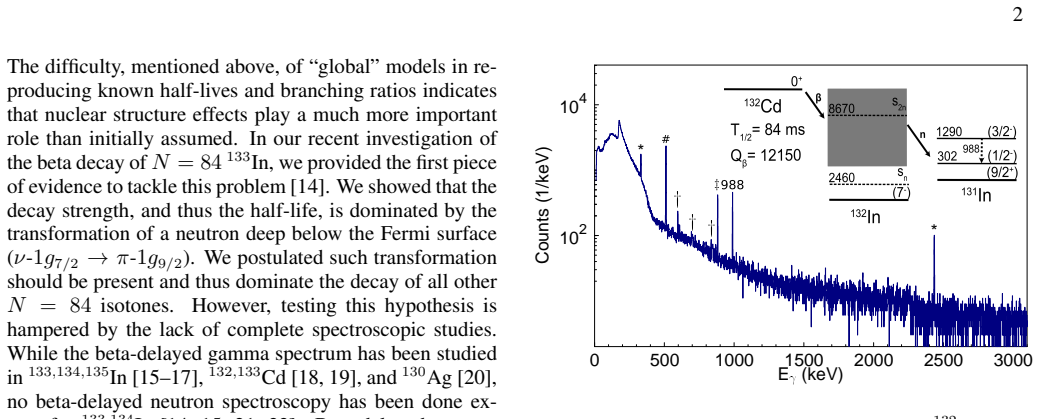
Beta decay of 132Cd is dominated by a neutron in the g7/2 orbital transforming into a proton in the g9/2 orbital.
A machine-rendered reading of the paper's core claim, the machinery that carries it, and where it could break.
Core claim
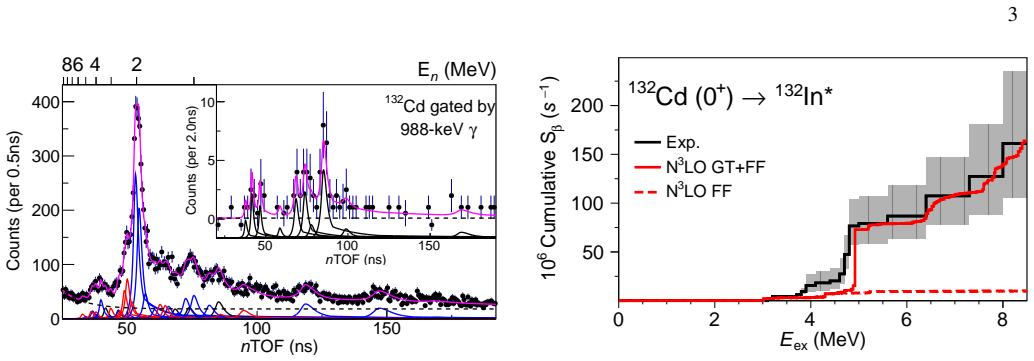
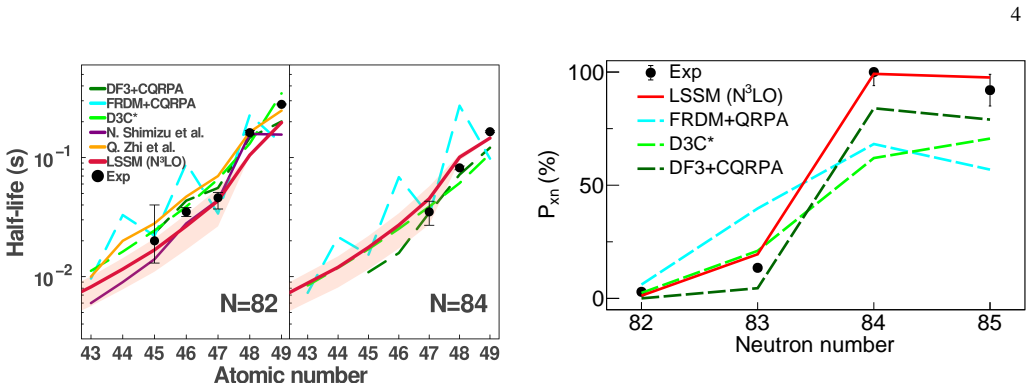
From the LSSM calculation using the N3LO interaction, the decay is dominated by the transformation of a neutron in the g7/2 orbital, deep below the Fermi surface, into a proton in the g9/2 orbital. The calculations match known half-lives and neutron branching ratios well and suggest that current leading models overestimate the yet-to-be-measured half-lives. The model, backed by the 132Cd decay data, offers predictive power for nuclei of astrophysical interest such as r-process waiting points.
What carries the argument
Large-scale shell model (LSSM) with the N3LO interaction, which isolates the dominant single-particle neutron-to-proton orbital transformation driving the beta decay.
If this is right
- The LSSM calculations reproduce experimental half-lives and neutron branching ratios for nuclei with Z less than 50 and N at least 82.
- Leading global models such as FRDM overestimate the half-lives of yet-to-be-measured nuclei in this region.
- The model supplies improved predictive power for r-process waiting points.
Where Pith is reading between the lines
- The same orbital transformation may control beta decays in neighboring nuclei near the N=82 shell closure.
- Targeted half-life measurements on additional r-process nuclei could directly test the N3LO interaction's accuracy in this mass region.
- Revised half-life values would alter the calculated abundances of elements produced in astrophysical r-process sites.
Load-bearing premise
The N3LO interaction correctly identifies the dominant single-particle orbitals and configurations for beta decay in the N=84 region without substantial mixing from other states or collective effects that would alter the branching ratios.
What would settle it
A direct measurement of the beta-decay half-life for an unmeasured nucleus with Z less than 50 and N at least 82 that matches the FRDM prediction but deviates from the LSSM result would falsify the dominance of the g7/2 to g9/2 transition.
Figures
read the original abstract
Using the time-of-flight technique, we measured the beta-delayed neutron emission of $^{132}$Cd. From our large-scale shell model (LSSM) calculation using the N$^3$LO interaction [Z.Y. Xu et al., Phys. Rev. Lett. 131, 022501 (2023)], we suggest the decay is dominated by the transformation of a neutron in the $g_{7/2}$ orbital, deep below the Fermi surface, into a proton in the $g_{9/2}$ orbital. We compare the beta-decay half-lives and neutron branching ratios of nuclei with $Z<50$ and $N\geq82$ obtained with our LSSM with those of leading "global" models such as Finite-Range Droplet Model (FRDM). Our calculations match known half-lives and neutron branching ratios well and suggest that current leading models overestimate the yet-to-be-measured half-lives. Our model, backed by the $^{132}$Cd decay data presented here, offers robust predictive power for nuclei of astrophysical interest such as $r$-process waiting points.
Editorial analysis
A structured set of objections, weighed in public.
Referee Report
Summary. The manuscript reports a time-of-flight measurement of beta-delayed neutron emission from ^{132}Cd. Large-scale shell model calculations with the N^{3}LO interaction are used to suggest that the decay is dominated by a neutron in the g_{7/2} orbital transforming to a proton in the g_{9/2} orbital. The LSSM results for half-lives and neutron branching ratios (Pn) of Z<50, N≥82 nuclei are compared to known data and to the FRDM, with the claim that the LSSM matches experiment well and that FRDM overestimates unmeasured half-lives; the model is presented as offering improved predictive power for r-process nuclei.
Significance. If the LSSM orbital-dominance interpretation and its agreement with the new ^{132}Cd data hold, the work supplies a useful experimental anchor for shell-model calculations near N=84 and strengthens predictions for beta-decay properties of astrophysically relevant nuclei. The direct comparison to a leading global model (FRDM) and the reproduction of existing half-lives and Pn values for the region constitute concrete strengths.
major comments (2)
- [Abstract] Abstract: the central interpretive claim that the decay 'is dominated by the transformation of a neutron in the g_{7/2} orbital... into a proton in the g_{9/2} orbital' follows solely from the LSSM; the manuscript provides no quantitative breakdown (e.g., fractional Gamow-Teller strength or branching contributions) from individual orbitals or configurations for ^{132}Cd itself.
- [LSSM calculations] LSSM results and discussion: while the model is stated to reproduce known half-lives and Pn values for Z<50, N≥82 nuclei, no test is shown of the robustness of the g_{7/2} dominance conclusion against reasonable variations of the N^{3}LO interaction or against enlargement of the valence space to include additional configurations that could alter mixing.
minor comments (2)
- [Abstract] Abstract: measured quantities (half-life, Pn) are presented without reported uncertainties, efficiency corrections, or explicit data-selection cuts from the time-of-flight experiment.
- [Throughout] Notation for single-particle orbitals is inconsistent (g7/2 vs. g_{7/2}); a uniform subscript style should be adopted throughout.
Simulated Author's Rebuttal
We thank the referee for the constructive report and positive assessment of the work's significance. We address each major comment below and will revise the manuscript accordingly to improve clarity and transparency.
read point-by-point responses
-
Referee: [Abstract] Abstract: the central interpretive claim that the decay 'is dominated by the transformation of a neutron in the g_{7/2} orbital... into a proton in the g_{9/2} orbital' follows solely from the LSSM; the manuscript provides no quantitative breakdown (e.g., fractional Gamow-Teller strength or branching contributions) from individual orbitals or configurations for ^{132}Cd itself.
Authors: We agree that the abstract presents the orbital-dominance interpretation without explicit quantitative support from the LSSM for ^{132}Cd. While the full manuscript describes the LSSM framework and its application, we will revise the abstract to reference the underlying Gamow-Teller strength distribution and add the relevant fractional contributions (e.g., percentage of strength from g_{7/2} to g_{9/2}) to the results section or a supplementary table in the revised version. revision: yes
-
Referee: [LSSM calculations] LSSM results and discussion: while the model is stated to reproduce known half-lives and Pn values for Z<50, N≥82 nuclei, no test is shown of the robustness of the g_{7/2} dominance conclusion against reasonable variations of the N^{3}LO interaction or against enlargement of the valence space to include additional configurations that could alter mixing.
Authors: The referee correctly notes the absence of explicit robustness tests. The N^{3}LO interaction was selected due to its prior validation in the region (Xu et al., PRL 2023), and the model's agreement with measured half-lives and Pn values across the known Z<50, N≥82 nuclei provides indirect support. However, we will add a dedicated paragraph in the discussion section qualifying the g_{7/2} dominance claim, noting the computational cost of interaction variations or valence-space enlargements, and stating that such tests are beyond the present scope but would be valuable in future studies. This addresses the concern without altering the core conclusions. revision: partial
Circularity Check
No circularity: LSSM orbital interpretation uses external prior interaction validated on independent data
full rationale
The paper presents new experimental time-of-flight measurements of beta-delayed neutron emission from 132Cd. Its interpretive claim that the decay is dominated by g7/2 neutron to g9/2 proton transformation is obtained from an LSSM calculation employing the N3LO interaction published in a 2023 PRL by a co-author. This step is self-contained because the experimental dataset is independent of the model, the framework is stated to reproduce known half-lives and Pn values for other Z<50, N≥82 nuclei (external to the present measurements), and no equation, fit, or prediction within the manuscript reduces the orbital-dominance suggestion to a parameter or input derived from the 132Cd data itself. The self-citation supplies the effective interaction but does not create a definitional loop or fitted-input prediction.
Axiom & Free-Parameter Ledger
axioms (1)
- domain assumption The N3LO interaction accurately describes beta-decay matrix elements for N=84 nuclei near Z=50.
Reference graph
Works this paper leans on
-
[1]
(purple) and Zhi et al. [34] (orange). Right panel: same for N = 84 isotones. Note that prior to our model no other LSSM calculations were available. ν0g7/21d5/21d3/22s1/20h11/21f7/2 single particle orbitals (see Z. Xu et al. [14] for more details). Our LSSM calculation predicts that 17.1% of the strength populates states through FF transitions, within tw...
work page 2020
-
[2]
M. R. Mumpower, T. Kawano, and P. Moller, Physical Re- view C 94 (2016)
work page 2016
-
[3]
K. L. Jones, A. S. Adekola, D. W. Bardayan, J. C. Black- mon, K. Y . Chae, K. A. Chipps, J. A. Cizewski, L. Erikson, C. Harlin, R. Hatarik, R. Kapler, R. L. Kozub, J. F. Liang, R. Livesay, Z. Ma, B. H. Moazen, C. D. Nesaraja, F. M. Nunes, S. D. Pain, N. P. Patterson, D. Shapira, J. F. Shriner, M. S. Smith, T. P. Swan, and J. S. Thomas, Nature465, 454 (2010)
work page 2010
-
[4]
F. Nowacki, A. Obertelli, and A. Poves, The neutron-rich edge of the nuclear landscape: Experiment and theory. (2021)
work page 2021
-
[5]
H. Watanabe, G. Lorusso, S. Nishimura, Z. Y . Xu, T. Sumikama, P.-A. S¨oderstr¨om, P. Doornenbal, F. Browne, G. Gey, H. S. Jung, J. Taprogge, Z. Vajta, J. Wu, A. Yagi, H. Baba, G. Benzoni, K. Y . Chae, F. C. L. Crespi, N. Fukuda, R. Gernh¨auser, N. Inabe, T. Isobe, A. Jungclaus, D. Kameda, G. D. Kim, Y . K. Kim, I. Kojouharov, F. G. Kondev, T. Kubo, N. Ku...
work page 2013
-
[6]
V . H. Phong, G. Lorusso, T. Davinson, A. Estrade, O. Hall, J. Liu, K. Matsui, F. Montes, S. Nishimura, A. Boso, P. H. Regan, R. Shearman, Z. Y . Xu, J. Agramunt, J. M. Allmond, D. S. Ahn, A. Algora, H. Baba, N. T. Brewer, C. G. Bruno, R. Caballero-Folch, F. Calvino, M. Woli ´nska Cichocka, G. Cortes, I. Dillmann, C. Domingo-Pardo, A. Gargano, S. Go, C. J...
work page 2019
-
[7]
J. M. Allmond, A. E. Stuchbery, C. Baktash, A. Gargano, A. Galindo-Uribarri, D. C. Radford, C. R. Bingham, B. A. Brown, L. Coraggio, A. Covello, M. Danchev, C. J. Gross, P. A. Hausladen, N. Itaco, K. Lagergren, E. Padilla-Rodal, J. Pavan, M. A. Riley, N. J. Stone, D. W. Stracener, R. L. Varner, and C.-H. Yu, Phys. Rev. Lett.118, 092503 (2017)
work page 2017
-
[8]
T. J. Gray, J. M. Allmond, A. E. Stuchbery, C.-H. Yu, C. Baktash, A. Gargano, A. Galindo-Uribarri, D. C. Rad- ford, J. C. Batchelder, J. R. Beene, C. R. Bingham, L. Cor- aggio, A. Covello, M. Danchev, C. J. Gross, P. A. Haus- laden, N. Itaco, W. Krolas, J. F. Liang, E. Padilla-Rodal, J. Pavan, D. W. Stracener, and R. L. Varner, Phys. Rev. Lett. 124, 032502 (2020)
work page 2020
- [9]
-
[10]
I. N. Borzov, Physics of Atomic Nuclei 79, 910 (2016)
work page 2016
-
[11]
G. Lorusso, S. Nishimura, Z. Y . Xu, A. Jungclaus, Y . Shimizu, G. S. Simpson, P. A. Soderstrom, H. Watanabe, F. Browne, P. Doornenbal, G. Gey, H. S. Jung, B. Meyer, T. Sumikama, J. Taprogge, Z. Vajta, J. Wu, H. Baba, G. Ben- 6 zoni, K. Y . Chae, F. C. Crespi, N. Fukuda, R. Gernhauser, N. Inabe, T. Isobe, T. Kajino, D. Kameda, G. D. Kim, Y . K. Kim, I. Ko...
- [12]
-
[13]
O. Hall, T. Davinson, A. Estrade, J. Liu, G. Lorusso, F. Montes, S. Nishimura, V . Phong, P. Woods, J. Agramunt, D. Ahn, A. Algora, J. Allmond, H. Baba, S. Bae, N. Brewer, C. Bruno, R. Caballero-Folch, F. Calvino, P. Coleman- Smith, G. Cortes, I. Dillmann, C. Domingo-Pardo, A. Fi- jalkowska, N. Fukuda, S. Go, C. Griffin, R. Grzywacz, J. Ha, L. Harkness-Br...
work page 2021
-
[14]
V . H. Phong, S. Nishimura, G. Lorusso, T. Davinson, A. Estrade, O. Hall, T. Kawano, J. Liu, F. Montes, N. Nishimura, R. Grzywacz, K. P. Rykaczewski, J. Agra- munt, D. S. Ahn, A. Algora, J. M. Allmond, H. Baba, S. Bae, N. T. Brewer, C. G. Bruno, R. Caballero-Folch, F. Calvi ˜no, P. J. Coleman-Smith, G. Cortes, I. Dillmann, C. Domingo-Pardo, A. Fijalkowska...
work page 2022
-
[15]
Z. Xu, M. Madurga, R. Grzywacz, T. King, A. Algora, A. Andreyev, J. Benito, T. Berry, M. Borge, C. Costache, H. D. Witte, A. Fijalkowska, L. Fraile, H. Fynbo, A. Got- tardo, C. Halverson, L. Harkness-Brennan, J. Heideman, M. Huyse, A. Illana, Z. Janiak, D. Judson, A. Korgul, T. Kurtukian-Nieto, I. Lazarus, R. Licƒ ´E, R. Lozeva, N. Marginean, R. Marginean...
work page 2023
-
[16]
P. Hoff, P. Baumann, A. Huck, A. Knipper, G. Wal- ter, G. Marguier, B. Fogelberg, A. Lindroth, H. Mach, M. Sanchez-Vega, R. B. E. Taylor, P. Van Duppen, A. Joki- nen, M. Lindroos, M. Ramdhane, W. Kurcewicz, B. Jonson, G. Nyman, Y . Jading, K.-L. Kratz, A. W¨ohr, G. Løvhøiden, T. F. Thorsteinsen, and J. Blomqvist (ISOLDE Collabora- tion), Phys. Rev. Lett. ...
work page 1996
-
[17]
M. Piersa, A. Korgul, L. M. Fraile, J. Benito, E. Adamska, A. N. Andreyev, R. ´Alvarez-Rodr´ıguez, A. E. Barzakh, G. Benzoni, T. Berry, M. J. G. Borge, M. Carmona, K. Chrysalidis, J. G. Correia, C. Costache, J. G. Cubiss, T. Day Goodacre, H. De Witte, D. V . Fedorov, V . N. Fe- dosseev, G. Fern ´andez-Mart´ınez, A. Fijałkowska, M. Fila, H. Fynbo, D. Galav...
work page 2019
-
[18]
M. Piersa-Siłkowska, A. Korgul, J. Benito, L. M. Fraile, E. Adamska, A. N. Andreyev, R. ´Alvarez-Rodr´ıguez, A. E. Barzakh, G. Benzoni, T. Berry, M. J. G. Borge, M. Car- mona, K. Chrysalidis, J. G. Correia, C. Costache, J. G. Cubiss, T. Day Goodacre, H. De Witte, D. V . Fedorov, V . N. Fedosseev, G. Fern´andez-Mart´ınez, A. Fijałkowska, H. Fynbo, D. Galav...
work page 2021
-
[19]
J. Taprogge, A. Jungclaus, H. Grawe, S. Nishimura, P. Door- nenbal, G. Lorusso, G. S. Simpson, P. A. Soderstrom, T. Sumikama, Z. Y . Xu, H. Baba, F. Browne, N. Fukuda, R. Gernhauser, G. Gey, N. Inabe, T. Isobe, H. S. Jung, D. Kameda, G. D. Kim, Y . K. Kim, I. Kojouharov, T. Kubo, N. Kurz, Y . K. Kwon, Z. Li, H. Sakurai, H. Schaffner, K. Steiger, H. Suzuki...
work page 2014
-
[20]
A. Jungclaus, A. Gargano, H. Grawe, J. Taprogge, S. Nishimura, P. Doornenbal, G. Lorusso, Y . Shimizu, G. S. Simpson, P. A. Soderstrom, T. Sumikama, Z. Y . Xu, 7 H. Baba, F. Browne, N. Fukuda, R. Gernhauser, G. Gey, N. Inabe, T. Isobe, H. S. Jung, D. Kameda, G. D. Kim, Y . K. Kim, I. Kojouharov, T. Kubo, N. Kurz, Y . K. Kwon, Z. Li, H. Sakurai, H. Schaffn...
work page 2016
-
[21]
T. Kautzsch, W. B. Walters, M. Hannawald, K. L. Kratz, V . I. Mishin, V . N. Fedoseyev, W. B ¨ohmer, Y . Jading, P. Van Duppen, B. Pfeiffer, A. W ¨ohr, P. M¨oller, I. Kl ¨ockl, V . Sebastian, U. K¨oster, M. Koizumi, J. Lettry, H. L. Ravn, and the ISOLDE Collaboration, The European Physical Journal A - Hadrons and Nuclei 9, 201 (2000)
work page 2000
-
[22]
P. Hoff, P. Baumann, A. Huck, A. Knipper, G. Wal- ter, G. Marguier, B. Fogelberg, A. Lindroth, H. Mach, M. Sanchez-Vega, R. B. E. Taylor, P. van Duppen, A. Joki- nen, M. Lindroos, M. Ramdhane, W. Kurcewicz, B. Jonson, G. Nyman, Y . Jading, K. L. Kratz, A. W¨ohr, G. Løvhøiden, T. F. Thorsteinsen, and J. Blomqvist, Hyperfine Interactions 129, 141 (2000)
work page 2000
-
[23]
J. Heideman, R. Grzywacz, Z. Y . Xu, M. Madurga, J. E. Escher, T. Kawano, A. Algora, A. N. Andreyev, J. Ben- ito, T. Berry, M. J. G. Borge, C. Costache, H. De Witte, A. Fijalkowska, L. M. Fraile, H. O. U. Fynbo, A. Gottardo, C. Halverson, L. J. Harkness-Brennan, A. Illana, L. Ja- niak, D. S. Judson, T. T. King, A. Korgul, T. Kurtukian- Nieto, I. Lazarus, ...
work page 2023
- [24]
-
[25]
W. A. Peters, S. Ilyushkin, M. Madurga, C. Matei, S. V . Paulauskas, R. K. Grzywacz, D. W. Bardayan, C. R. Brune, J. Allen, J. M. Allen, Z. Bergstrom, J. Blackmon, N. T. Brewer, J. A. Cizewski, P. Copp, M. E. Howard, R. Ikeyama, R. L. Kozub, B. Manning, T. N. Massey, M. Matos, E. Merino, P. D. O’Malley, F. Raiola, C. S. Reingold, F. Sarazin, I. Spassova, ...
work page 2016
-
[26]
M. Baginova, P. V ojtyla, and P. P. Povinec, Nuclear Instru- ments and Methods in Physics Research, Section A: Ac- celerators, Spectrometers, Detectors and Associated Equip- ment 897, 22 (2018)
work page 2018
-
[27]
B. Fogelberg, M. Hellstrom, D. Jerrestam, H. Mach, J. Blomqvist, A. Kerek, L. O. Norlin, and J. P. Omtvedt, Physical Review Letters 73 (1994)
work page 1994
-
[28]
H. Ohm, W. Rudolph, and K.-L. Kratz, Nuclear Physics A 274, 45 (1976)
work page 1976
- [29]
-
[30]
M. Wang, W. J. Huang, F. G. Kondev, G. Audi, and S. Naimi, Chinese Physics C 45 (2021)
work page 2021
-
[31]
D. R. Entem and R. Machleidt, Physical Review C - Nuclear Physics 68, 5 (2003)
work page 2003
-
[32]
National Nuclear Data Center, information extracted from the NuDat database, https://www.nndc.bnl.gov/ nudat/
-
[33]
T. Marketin, L. Huther, and G. Martinez-Pinedo, Physical Review C 93 (2016)
work page 2016
-
[34]
N. Shimizu, T. Togashi, and Y . Utsuno, Progress of Theo- retical and Experimental Physics 2021 (2021)
work page 2021
-
[35]
Q. Zhi, E. Caurier, J. J. Cuenca-Garcia, K. Langanke, G. Martinez-Pinedo, and K. Sieja, Physical Review C - Nu- clear Physics 87 (2013)
work page 2013
-
[36]
C. Izzo, J. Bergmann, K. A. Dietrich, E. Dunling, D. Fusco, A. Jacobs, B. Kootte, G. Kripk ´o-Koncz, Y . Lan, E. Leis- tenschneider, E. M. Lykiardopoulou, I. Mukul, S. F. Paul, M. P. Reiter, J. L. Tracy, C. Andreoiu, T. Brunner, T. Dickel, J. Dilling, I. Dillmann, G. Gwinner, D. Lascar, K. G. Leach, W. R. Plaß, C. Scheidenberger, M. E. Wieser, and A. A. K...
work page 2021
-
[37]
I. N. Borzov, Nuclear Physics A 777, 645 (2006)
work page 2006
-
[38]
M. Hannawald, K.-L. Kratz, B. Pfeiffer, W. B. Walters, V . N. Fedoseyev, V . I. Mishin, W. F. Mueller, H. Schatz, J. Van Roosbroeck, U. K¨oster, V . Sebastian, and H. L. Ravn (ISOLDE Collaboration), Physical Review C 62, 054301 (2000)
work page 2000
-
[39]
N. Shimizu, T. Mizusaki, Y . Utsuno, and Y . Tsunoda, Com- puter Physics Communications 244, 372 (2019)
work page 2019
discussion (0)
Sign in with ORCID, Apple, or X to comment. Anyone can read and Pith papers without signing in.