REVIEW 4 major objections 5 minor 1 cited by
Text Is Not All You Need: Multimodal Prompting Helps LLMs Understand Humor
T0 review · 4 major / 5 minor · reviewed 2026-08-12 · deepseek-v4-flash
Pith's one-line read This paper claims that adding synthesized speech to an LLM's prompt improves its humor explanations over text-only prompting.
desk verdict A cheap and plausible trick—adding TTS audio to prompts—yields small, consistent win rates in LLM humor explanation, but the LLM-as-judge evaluation is too weak to establish the claim. read the letter →
The pith
A machine-rendered reading of the paper's core claim, the machinery that carries it, and where it could break.
The reading
What carries the argument
The load-bearing mechanism is a multimodal prompt that concatenates the joke's text with an audio clip generated by an off-the-shelf text-to-speech model, sent together to an LLM that accepts audio input. Because heterographs are distinct tokens in text but identical in pronunciation, the speech track carries the ambiguity that the text-only prompt loses; the prompt instructs the model to reason from both channels and to produce an explanation that does not mention the modalities. Evaluation runs through a separate LLM judge that performs pairwise comparisons with swapped order to cancel positional bias. Two auxiliary checks complete the mechanism: an ablation shows audio-only prompting is far worse than text-only, and transcription logits show both homophones of a pun word receive high probability, indicating that the phonetic cue enters the model's representation.
What would settle it
Run the same pairwise comparisons with human raters on a sample of the SemEval outputs, or bootstrap the win rates across the dataset; if the multimodal advantage disappears or falls within sampling noise, the central claim is not supported.
Extended reading notes
Core claim
On the paper's own terms, the central discovery is that adding synthesized speech to the prompt gives LLMs a consistent edge in explaining humor. In the head-to-head comparison against human explanations in SemEval, the multimodal condition is preferred more often than the text-only condition for both homographic and heterographic puns, with win rates rising by about four percentage points in each case. For Context-Situated Puns and ExplainTheJoke, where no human-explanation baseline exists, the author compares the two prompting strategies directly and reports the audio-augmented version winning more often. A logit-based analysis of a transcription task shows that the model assigns high probability to both spellings of the pun word (e.g., "weight" and "wait"), which the author interprets as evidence that the phonetic ambiguity survives in the model's internal representations. The paper frames this as a demonstration that multimodal prompts are a straightforward way to improve humor understanding without retraining.
Load-bearing premise
The load-bearing premise is that an LLM judge's pairwise preference is a valid measure of explanation quality, since no human ratings or significance tests back the roughly four-point gaps.
Editorial extensions
If this is right
- If the central claim holds, any LLM with audio support can improve humor explanation quality by generating speech from the joke text before prompting, with no fine-tuning or dataset collection.
- The phonetic-ambiguity mechanism implies that tasks involving homophones—pun detection, transcription, speech disambiguation—are natural beneficiaries of the same multimodal prompting recipe.
- The win-rate gains on non-pun jokes (ExplainTheJoke) suggest audio conveys prosodic or rhythmic cues beyond spelling ambiguity, pointing toward a broader role for speech in humor understanding.
- The absence of voice-dependent effects in the ablations supports the interpretation that the benefit comes from the audio channel itself rather than from a particular TTS voice.
- A direct corollary is that text-only benchmark results for humor explanation may understate what LLMs can do once auditory information is available.
Reading between the lines
- Because the judge is itself an LLM and the reported gains are a few percentage points, a human-preference study on the same output pairs is the natural next test; if human raters do not reproduce the ordering, the advantage is likely judge style rather than humor understanding.
- The transcription-logit result suggests a cheap diagnostic for any text task: if adding a TTS reading changes performance, part of the task's difficulty lives in sound rather than text.
- The method could be inverted to test causality: degrading the audio channel—by removing prosody or normalizing pitch—should shrink the gap if the auditory features genuinely carry humor.
- Because no confidence intervals or repeated-seed runs are reported, the stability of the roughly four-point effect across samples is untested; bootstrapping the win rate would settle that question.
Editorial analysis
A structured set of objections, weighed in public.
Referee Report
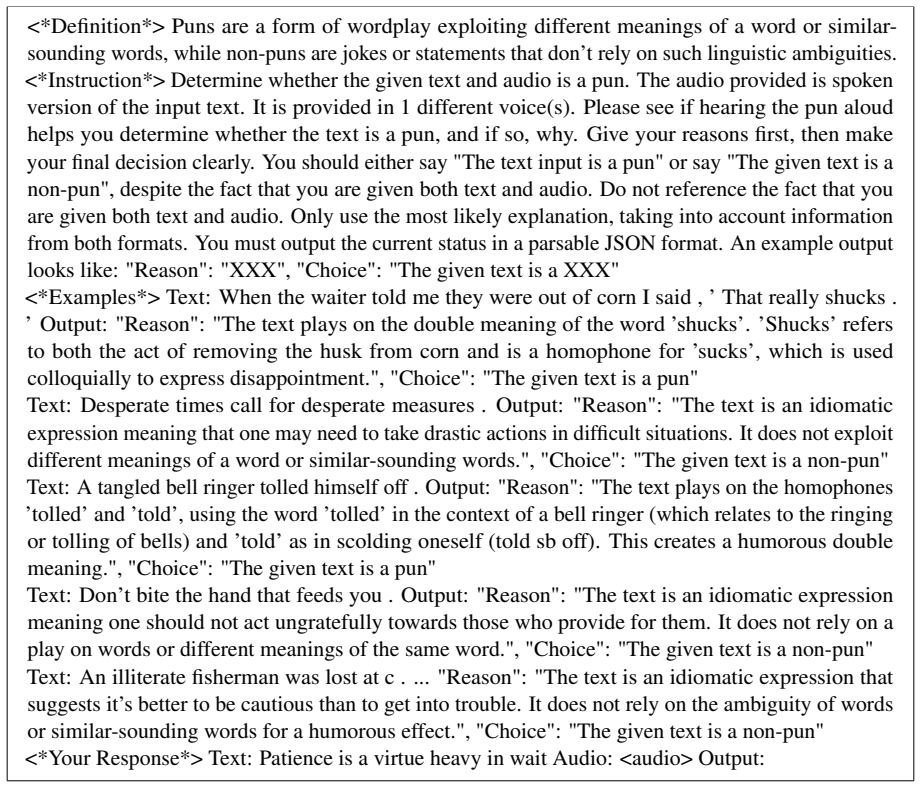
Summary. The paper proposes a multimodal prompting approach for LLM humor explanation: in addition to the joke text, the model receives an audio rendering generated by an off-the-shelf TTS system (OpenAI tts-1-hd). The method is evaluated on three datasets—SemEval 2017 Task 7, Context-Situated Puns, and ExplainTheJoke—using GPT-4o as an LLM judge to compare explanations from text-only prompts against those from text+audio prompts. The paper reports consistent win-rate improvements of roughly 2–4 percentage points across all datasets, an ablation study, a voice-sensitivity analysis, and a small logit-based analysis of phonetic ambiguity in TTS audio.
Significance. If the reported improvements are real, the paper offers a simple, training-free method that could improve humor understanding in LLMs and serve as a building block for multimodal reasoning. The approach is reproducible : it uses off-the-shelf TTS, publicly available datasets, and fully specified prompts in the appendix. The paper also makes a useful mechanistic observation in Appendix A.2 that TTS audio preserves homophone ambiguity, and it reports an ablation showing that audio-only input degrades performance. However, the significance is currently undermined by the evaluation methodology: the central claim rests on small win-rate differences that are not accompanied by significance tests or confidence intervals, and two of the three datasets lack any human baseline or human validation of the LLM judge.
major comments (4)
- [Section 5, Tables 1–3] The central claim that multimodal prompting 'significantly improves' humor explanations (Section 6) is not supported by the reported statistics. The win-rate differences are small: for SemEval heterographs, 47.76% to 51.74% (n=647); for homographs, 68.89% to 72.59% (n=810); for Context-Situated Puns, 33.87% to 36.49% (heterographs) and 35.08% to 36.85% (homographs); and for ExplainTheJoke, 12.81% to 15.44% (n=350). No confidence intervals, p-values, or effect sizes are reported anywhere in the manuscript. Assuming independent two-proportion comparisons, these differences are within the approximate 95% sampling error band (e.g., the heterograph difference of 3.98 points has a standard error of about 2.8 points). The authors should report paired analyses (e.g., McNemar's test if each joke is evaluated under both conditions) or at least confidence intervals, and should qualify the abstract and conclusion accordingly if the differences are not statistically significant.
- [Section 4.2 and Section 5.2–5.3] The evaluation relies entirely on GPT-4o pairwise preference as a proxy for explanation quality. For Context-Situated Puns and ExplainTheJoke, there is no human-written reference: the judge compares two LLM-generated explanations (baseline vs. audio-conditioned). This makes the quality signal partly self-referential, especially because the generation prompt (Figure 5) explicitly instructs the model to consider the audio and to check if hearing it aloud helps, which can systematically alter response length, framing, or content in ways that a stylistic-preference judge might reward regardless of actual humor understanding. The paper cites Zheng et al. (2024) for the validity of LLM judges, but that work addresses general chat response quality, not humor explanation quality. The authors should validate the judge against human ratings on a sample of this task, or at minimum report agreement between GPT-4o and human annotators on the SemEval subset where human explanations exist.
- [Appendix A.3, Table 4] The ablation results indicate that the multimodal gain is highly sensitive to prompt wording. Removing the instruction to avoid discussing the input modality reduces the heterograph win rate from 51.74% to 48.61%, which is only 0.85 points above the text-only baseline of 47.76%. The audio-only condition performs far worse (25.50% heterographs, 55.86% homographs). This pattern suggests that a substantial part of the reported improvement may come from the added instruction or prompt complexity rather than from the acoustic information itself. The paper should control for this confound, for example by adding an equivalent 'read aloud' instruction to the text-only condition or by measuring whether the audio condition produces longer or differently structured explanations, and then analyzing whether those features account for the judge's preference.
- [Appendix A.2, Figures 3–4] The logit analysis intended to demonstrate that audio preserves phonetic ambiguity is anecdotal and uses a different model (Gazelle v0.2) than the generation model used in the main experiments (Gemini-1.5-Flash). It is based on a single word ('Where') and a single pun ('Patience is a heavy weight'), so it does not establish that the TTS audio in the actual test set preserves the relevant homophone distinctions for the model being evaluated. The authors should either run this analysis systematically across a sample of the test puns using the actual model, or clearly label the result as a preliminary illustration and remove the claim that it explains the main results.
minor comments (5)
- [Tables 2 and 3] Table 2 omits tie percentages for the 'with audio' rows, and Table 3 omits the tie percentage for the 'with audio' row, making it impossible to infer the full ternary distribution. Please report tie rates for all conditions.
- [Section 5.1] The text says performance increased 'by approximately 4%' in both cases, but the exact increases are 3.98 and 3.70 percentage points. Use exact figures or percentage-point terminology to avoid ambiguity.
- [References] The reference 'Chris Hua. 2024. Gazelle v0.2' lacks a venue, version, or access URL; if this is a model or repository, please provide a citation or a footnote description.
- [Section 8] The Ethics Statement begins with 'Large Large Language Models', which appears to be a typo for 'Large Language Models'.
- [Section 3.2] The claim that including few-shot examples 'ensured a consistent output tone' is plausible but not verified; please either provide evidence (e.g., output length statistics) or soften the claim.
Circularity Check
No significant circularity: the central comparison is anchored to human explanations on SemEval, and no fitted parameters or self-citation chains carry the derivation.
full rationale
The paper proposes a prompting method and evaluates it empirically. There is no derivation chain in which a predicted quantity reduces to an input by construction. The SemEval evaluation compares generated explanations against human-written explanations, which is an external benchmark rather than a circular target. The Context-Situated Puns and ExplainTheJoke comparisons are LLM-vs-LLM preference evaluations, but that is an evaluation-validity limitation, not a definitional circularity; the paper itself concedes that LLM-based judging may not fully capture explanation quality. The use of GPT-4o as judge is attributed to prior work and is not a self-citation, and no parameter is fitted to the test data. The prompt explicitly instructs the model to consider the audio, but that is part of the intervention being tested, not a hidden encoding of the outcome. Concerns about small win-rate differences, missing significance tests, and possible prompt-selection effects are legitimate scientific criticisms, but they do not amount to the claim being equivalent to its inputs by definition.
Assumptions & free parameters
free parameters (3)
- TTS voice (Alloy) =
Alloy
- Prompt aggregation strategy =
combined audio+text
- Few-shot example content and count =
six examples per dataset
assumptions (4)
- domain assumption TTS-generated audio preserves phonetic ambiguity relevant to humor.
- domain assumption LLM-as-judge pairwise preference is a valid measure of explanation quality.
- domain assumption The instruction not to reference modality is effective and does not bias outputs.
- domain assumption Swapping pair order and averaging win rates removes judge positional bias.
Cite this review
Pith. "Pith review of Text Is Not All You Need: Multimodal Prompting Helps LLMs Understand Humor." pith.science (2026). https://pith.science/paper/JNILS2ZJ
@misc{pith2026241205315,
  author       = {Pith},
  title        = {Pith review of: Text Is Not All You Need: Multimodal Prompting Helps LLMs Understand Humor},
  year         = {2026},
  howpublished = {\url{https://pith.science/paper/JNILS2ZJ}},
  note         = {Machine review of arXiv:2412.05315}
}
read the original abstract
While Large Language Models (LLMs) have demonstrated impressive natural language understanding capabilities across various text-based tasks, understanding humor has remained a persistent challenge. Humor is frequently multimodal, relying on phonetic ambiguity, rhythm and timing to convey meaning. In this study, we explore a simple multimodal prompting approach to humor understanding and explanation. We present an LLM with both the text and the spoken form of a joke, generated using an off-the-shelf text-to-speech (TTS) system. Using multimodal cues improves the explanations of humor compared to textual prompts across all tested datasets.
Figures



Figures from the paper (3 more)


Forward citations
Cited by 1 Pith paper
-
VAGUE: Visual Contexts Clarify Ambiguous Expressions
A new 1,677-item benchmark shows that vision-language models struggle to resolve ambiguous indirect expressions even when they are given the visual context that makes the intent clear.
Reference graph
Works this paper leans on
-
[1]
Sajal Aggarwal, Ananya Pandey, and Dinesh Kumar Vishwakarma. 2023. https://doi.org/10.1109/WCONF58270.2023.10235179 Multimodal sarcasm recognition by fusing textual, visual and acoustic content via multi-headed attention for video dataset . In 2023 World Conference on Communication & Computing (WCONF), pages 1--5
-
[2]
Salvatore Attardo and Lucy Pickering. 2011. https://doi.org/doi:10.1515/HUMR.2011.015 Timing in the performance of jokes . HUMOR, 24(2):233--250
-
[3]
Tom Brown, Benjamin Mann, Nick Ryder, Melanie Subbiah, Jared D Kaplan, Prafulla Dhariwal, Arvind Neelakantan, Pranav Shyam, Girish Sastry, Amanda Askell, Sandhini Agarwal, Ariel Herbert-Voss, Gretchen Krueger, Tom Henighan, Rewon Child, Aditya Ramesh, Daniel Ziegler, Jeffrey Wu, Clemens Winter, Chris Hesse, Mark Chen, Eric Sigler, Mateusz Litwin, Scott Gr...
2020
-
[4]
Chiara Bucaria. 2004. https://doi.org/doi:10.1515/humr.2004.013 Lexical and syntactic ambiguity as a source of humor: The case of newspaper headlines . HUMOR, 17(3):279--309
-
[5]
Wei-Lin Chiang, Lianmin Zheng, Ying Sheng, Anastasios Nikolas Angelopoulos, Tianle Li, Dacheng Li, Hao Zhang, Banghua Zhu, Michael Jordan, Joseph E. Gonzalez, and Ion Stoica. 2024. https://arxiv.org/abs/2403.04132 Chatbot arena: An open platform for evaluating llms by human preference . Preprint, arXiv:2403.04132
arXiv 2024
-
[6]
Gemini Team . 2024. https://arxiv.org/abs/2403.05530 Gemini 1.5: Unlocking multimodal understanding across millions of tokens of context . Preprint, arXiv:2403.05530
arXiv 2024
-
[7]
Md Kamrul Hasan, Sangwu Lee, Wasifur Rahman, Amir Zadeh, Rada Mihalcea, Louis-Philippe Morency, and Ehsan Hoque. 2021. Humor knowledge enriched transformer for understanding multimodal humor. In Proceedings of the AAAI conference on artificial intelligence, volume 35, pages 12972--12980
work page 2021
-
[8]
Dan Hendrycks, Collin Burns, Steven Basart, Andrew Critch, Jerry Li, Dawn Song, and Jacob Steinhardt. 2021 a . Aligning ai with shared human values. Proceedings of the International Conference on Learning Representations (ICLR)
2021
Show all 25 references
-
[9]
Dan Hendrycks, Collin Burns, Steven Basart, Andy Zou, Mantas Mazeika, Dawn Song, and Jacob Steinhardt. 2021 b . Measuring massive multitask language understanding. Proceedings of the International Conference on Learning Representations (ICLR)
2021
-
[10]
Chris Hua. 2024. https://tincans.ai/slm3 Gazelle v0.2
2024
-
[11]
Haotian Liu, Chunyuan Li, Qingyang Wu, and Yong Jae Lee. 2023. Visual instruction tuning. In NeurIPS
2023
-
[12]
Tristan Miller, Christian Hempelmann, and Iryna Gurevych. 2017. https://doi.org/10.18653/v1/S17-2005 S em E val-2017 task 7: Detection and interpretation of E nglish puns . In Proceedings of the 11th International Workshop on Semantic Evaluation ( S em E val-2017) , pages 58--...
2017 doi
-
[13]
OpenAI. 2024. https://arxiv.org/abs/2410.21276 Gpt-4o system card . Preprint, arXiv:2410.21276
2024 arXiv
-
[14]
Minghao Shao, Abdul Basit, Ramesh Karri, and Muhammad Shafique. 2024. https://doi.org/10.1109/ACCESS.2024.3482107 Survey of different large language model architectures: Trends, benchmarks, and challenges . IEEE Access, pages 1--1
2024
-
[15]
Jiao Sun, Anjali Narayan-Chen, Shereen Oraby, Shuyang Gao, Tagyoung Chung, Jing Huang, Yang Liu, and Nanyun Peng. 2022. https://doi.org/10.18653/v1/2022.emnlp-main.306 Context-situated pun generation . In Proceedings of the 2022 Conference on Empirical Methods in Natural Langu...
2022 doi
-
[16]
https://huggingface.co/datasets/theblackcat102/joke_explaination Theblackcat102/joke\_explaination - datasets at hugging face
theblackcat102. https://huggingface.co/datasets/theblackcat102/joke_explaination Theblackcat102/joke\_explaination - datasets at hugging face
-
[17]
Peiyi Wang, Lei Li, Liang Chen, Zefan Cai, Dawei Zhu, Binghuai Lin, Yunbo Cao, Lingpeng Kong, Qi Liu, Tianyu Liu, and Zhifang Sui. 2024. https://doi.org/10.18653/v1/2024.acl-long.511 Large language models are not fair evaluators . In Proceedings of the 62nd Annual Meeting of t...
2024 doi
-
[18]
Peter McGraw
Caleb Warren, Adam Barsky, and A. Peter McGraw. 2021. https://doi.org/10.1177/1088868320961909 What makes things funny? an integrative review of the antecedents of laughter and amusement . Personality and Social Psychology Review, 25(1):41--65. PMID: 33342368
2021 doi
-
[19]
Colin White, Samuel Dooley, Manley Roberts, Arka Pal, Ben Feuer, Siddhartha Jain, Ravid Shwartz-Ziv, Neel Jain, Khalid Saifullah, Siddartha Naidu, Chinmay Hegde, Yann LeCun, Tom Goldstein, Willie Neiswanger, and Micah Goldblum. 2024. https://arxiv.org/abs/2406.19314 Livebench:...
2024 arXiv
-
[20]
Shih-Hung Wu, Yu-Feng Huang, and Tsz-Yeung Lau. 2024. Humour classification by fine-tuning llms: Cyut at clef 2024 joker lab subtask humour classification according to genre and technique. In Working Notes of the Conference and Labs of the Evaluation Forum (CLEF 2024). CEUR Wo...
2024
-
[21]
a good pun is its own reword
Zhijun Xu, Siyu Yuan, Lingjie Chen, and Deqing Yang. 2024. https://arxiv.org/abs/2404.13599 "a good pun is its own reword": Can large language models understand puns? Preprint, arXiv:2404.13599
2024 arXiv
-
[22]
Rowan Zellers, Ari Holtzman, Yonatan Bisk, Ali Farhadi, and Yejin Choi. 2019. Hellaswag: Can a machine really finish your sentence? In Proceedings of the 57th Annual Meeting of the Association for Computational Linguistics
2019
-
[23]
Xing, Hao Zhang, Joseph E
Lianmin Zheng, Wei-Lin Chiang, Ying Sheng, Siyuan Zhuang, Zhanghao Wu, Yonghao Zhuang, Zi Lin, Zhuohan Li, Dacheng Li, Eric P. Xing, Hao Zhang, Joseph E. Gonzalez, and Ion Stoica. 2024. Judging llm-as-a-judge with mt-bench and chatbot arena. In Proceedings of the 37th Internat...
2024
-
[24]
online" 'onlinestring :=
ENTRY address archivePrefix author booktitle chapter edition editor eid eprint eprinttype howpublished institution journal key month note number organization pages publisher school series title type volume year doi pubmed url lastchecked label extra.label sort.label short.list...
-
[25]
write newline
" write newline "" before.all 'output.state := FUNCTION n.dashify 't := "" t empty not t #1 #1 substring "-" = t #1 #2 substring "--" = not "--" * t #2 global.max substring 't := t #1 #1 substring "-" = "-" * t #2 global.max substring 't := while if t #1 #1 substring * t #2 gl...
Reviewed August 12, 2026 · model on record in the stance chip above.
Discussion (0). Continue with ORCID to comment.