REVIEW 4 major objections 6 minor 40 references
On the effective transfer of knowledge from English to Hindi Wikipedia
T0 review · 4 major / 6 minor · reviewed 2026-08-11 · deepseek-v4-flash
Pith's one-line read A multistage pipeline called WikiTransfer automatically enriches Hindi Wikipedia biography sections with content translated or adapted from English, reporting 65% and 62% improvements in automatic and human evaluations.
desk verdict Useful pipeline for enriching Hindi Wikipedia sections, but the 65%/62% enhancement claims are not actually derived in the paper—the automatic metric is a length proxy and the human number can't be reconstructed. read the letter →
The pith
A machine-rendered reading of the paper's core claim, the machinery that carries it, and where it could break.
The reading
What carries the argument
The load-bearing mechanism is the WikiTransfer pipeline, a modular chain whose stages are: (1) semantic section mapping, which pairs Hindi and English section titles by embedding cosine similarity; (2) content augmentation, which translates English sentences with IndicTrans2 and filters out short or redundant translations; (3) external knowledge injection, which uses retrieval-augmented generation over a digital library of biographies to pull relevant chunks for English articles that are not yet comprehensive; and (4) point-of-view correction, which prompts Llama-3(70B) in a few-shot in-context learning setup to rewrite biased sentences as neutral encyclopedia prose. The key identity the argument depends on is the claim that a sentence which is relevant under retrieval, neutral under the language-model rewrite, and not redundant under the similarity filter will also be coherent and accurate once translated into Hindi.
What would settle it
Take 100 Hindi sentences added by the pipeline, back-translate them to English, and ask two bilingual fact-checkers to verify each factual claim against the source biography and the English Wikipedia article; if a substantial fraction (say, more than 5%) contains invented dates, places, or claims, the framework is filling gaps with plausible but unreliable content rather than trustworthy encyclopedia prose.
Extended reading notes
Core claim
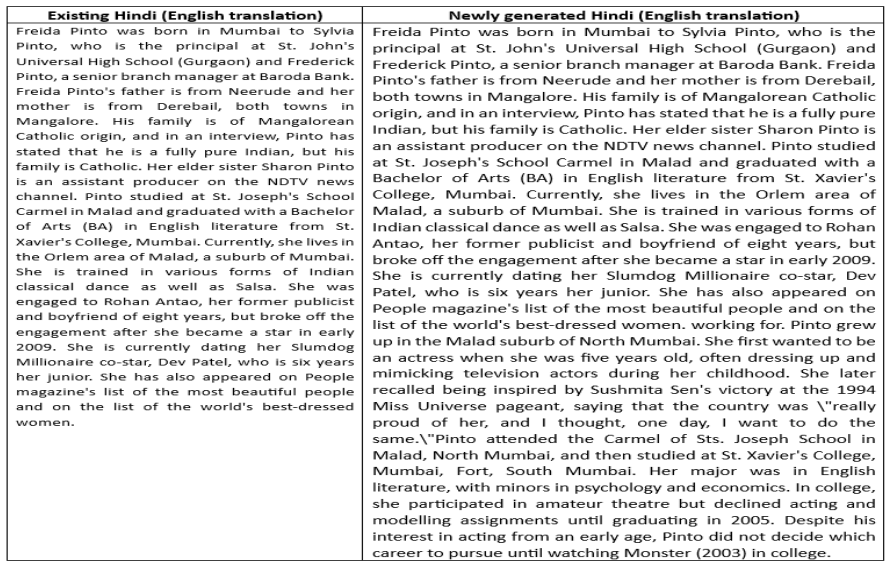
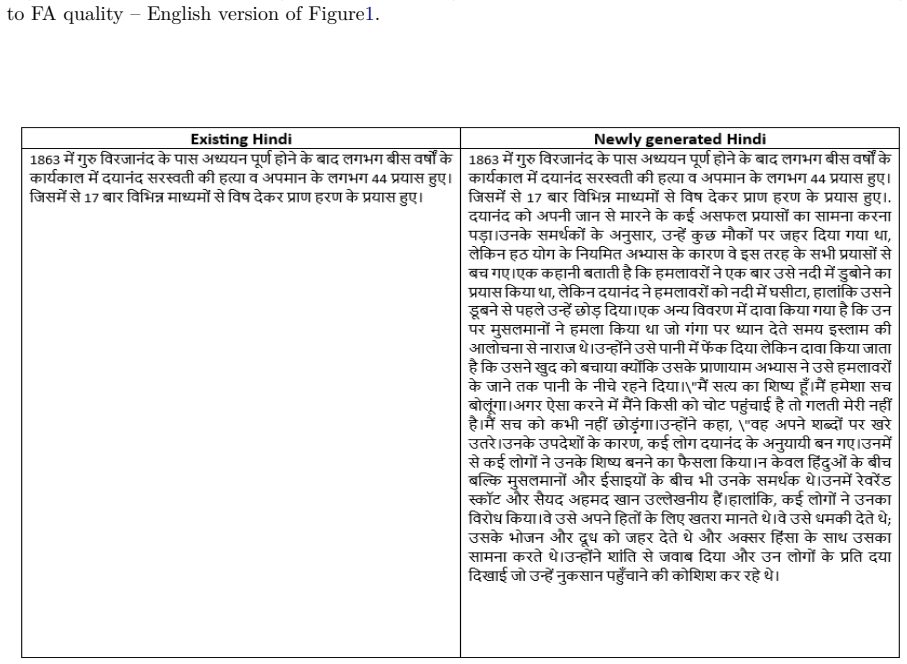
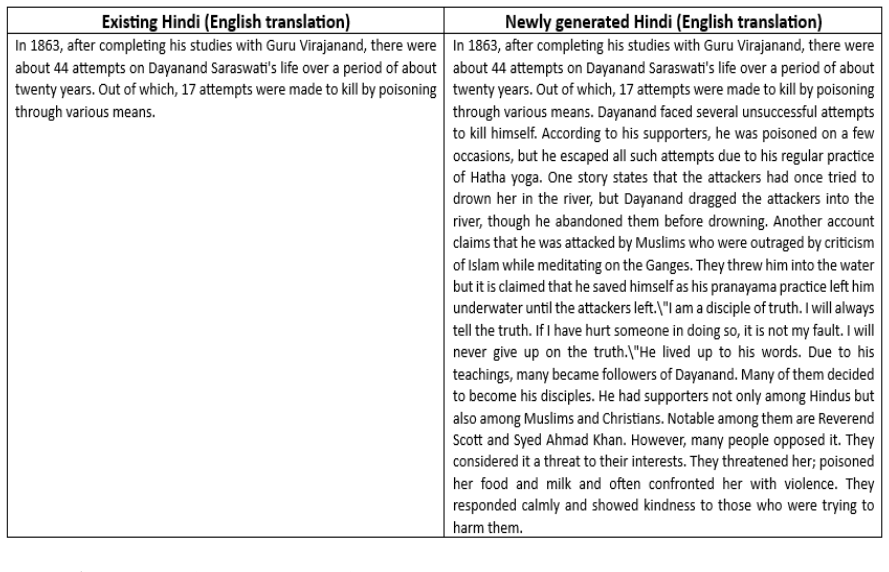
The central claim is that section-level knowledge transfer from English to Hindi Wikipedia works best as a modular pipeline rather than as from-scratch generation. For English articles already at featured-article quality, WikiTransfer translates matched sections directly with IndicTrans2; for lower-quality English articles, it first retrieves relevant chunks from external biographical writings using retrieval-augmented generation, then uses Llama-3(70B) with few-shot in-context learning to remove framing and epistemological bias, and only then translates. The paper argues that this two-path design lets high-quality English content be reused directly while lower-quality content is upgraded before transfer. The evidence offered is that the machine-generated Hindi sentences score higher than the existing Hindi sentences on informativeness, readability, coherence, and an automatic E-A-T based quality measure, with the headline gains of 65% (automatic) and 62% (human).
Load-bearing premise
The pipeline assumes that every sentence that survives retrieval, rewriting, and translation still states facts correctly, but it never checks this before inserting the text into Wikipedia.
Editorial extensions
If this is right
- Hindi Wikipedia editors can enrich underdeveloped biography sections by running the pipeline and lightly reviewing the output, rather than writing new prose from scratch.
- The framework transfers to other high-resource/low-resource language pairs whenever a digital corpus on the topic exists to feed the retrieval step.
- Because the pipeline appends new sentences and never overwrites human-authored text, it fits Wikipedia's collaborative editing model better than from-scratch article generation.
- External biographical books, not just the English Wikipedia article itself, are shown to be a viable source for closing low-resource content gaps.
Reading between the lines
- The paper does not verify the factual accuracy of the final Hindi text; a natural extension would be to add citation-backed fact-checking before insertion, which would also make the pipeline deployable on live Wikipedia.
- The section-mapping threshold and redundancy filter are tuned only for English-Hindi; the same pipeline may need recalibration for typologically distant language pairs, a testable question the paper leaves open.
- The neutrality evaluation measures whether bias is removed but not whether the rewrite preserves every factual detail, so the neutrality-rewriting step may sometimes drop nuances a human editor would keep.
- A baseline experiment not reported in the paper—comparing the full pipeline with direct translation of the English section alone—would isolate how much of the 65% gain comes from external knowledge retrieval versus translation.
Editorial analysis
A structured set of objections, weighed in public.
Referee Report
Summary. The paper proposes WikiTransfer, a pipeline that enriches Hindi Wikipedia biography sections by transferring content from English Wikipedia and external book biographies. For English articles of FA quality, relevant English sections are matched to Hindi sections and machine-translated with IndicTrans2; for lower-quality English articles, content is first extracted from external biographies using RAG, debiased to conform to Wikipedia's NPOV policy via Llama-3(70B) in-context learning, and then translated. The paper claims that the framework enhances Hindi Wikipedia articles by 65% and 62% according to automatic and human evaluations, respectively. Automatic evaluation uses the E-A-T framework's Quality score on reverse-translated Hindi text, and human evaluation uses seven annotators rating informativeness, readability, and coherence on a 1–3 improvement scale.
Significance. If the quantitative claims were supported, the paper would address a real and practical problem: reducing content gaps in low-resource Wikipedia editions while preserving existing human-authored text. The pipeline is lightweight, uses open-source components, and the authors provide a manually curated set of 103 biographical writings and a code repository. The human evaluation includes a moderate-to-substantial Fleiss kappa, and the NPOV debiasing is evaluated separately on a neutralization benchmark. These are useful resources. However, the central quantitative claims are not currently supported by the reported experiments: the automatic metric conflates content length with informativeness, and the human improvement percentage cannot be reconstructed from the reported scales. The paper's significance is therefore conditional on re-analysis and additional evaluation.
major comments (4)
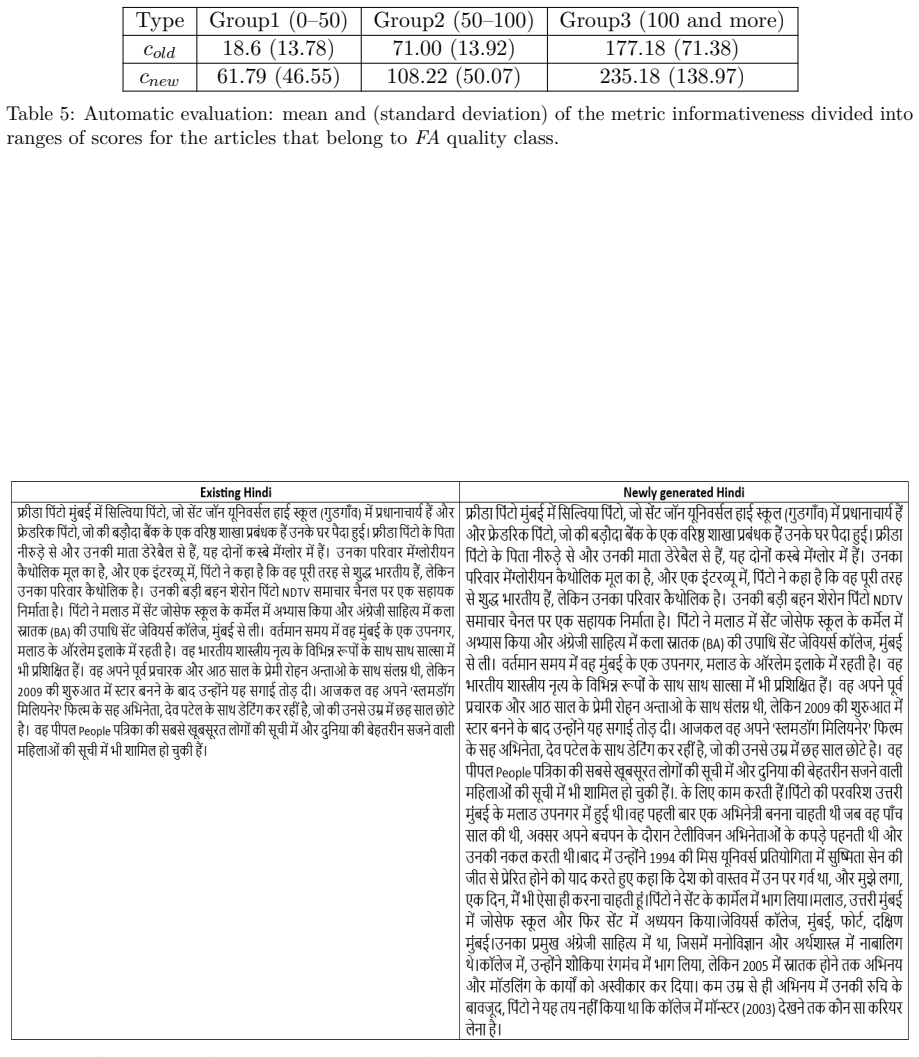
- [Abstract and §4.1] The headline 65% automatic improvement is not defined or computed anywhere. Table 4 reports mean E-A-T Quality scores for cold and cnew, but no formula or percentage is given; a reader who computes the ratio from the table obtains roughly 62% for FA articles and 67% for non-FA articles, while the abstract states 65%. More importantly, the automatic Quality score includes 0.255 × Informativeness, and Informativeness is defined as a weighted sum of page size, sentence count, word count, and complex-word count. Since cnew is constructed by appending translated sentences to cold, these counts must increase by construction, so a substantial part of the measured Quality gain is guaranteed regardless of the semantic value of the added content. The additional reverse-translation step also introduces machine-translation artifacts into the scores. Please report the exact calculation of the 65% figure and add length-controlled or per-sentence evaluation measures that do not reward added text volume alone.
- [§4.2] The headline 62% human-judgment improvement is not reproducible from the reported data. Evaluators used a 1–3 scale in which 1 means decline, 2 means no change, and 3 means improvement, and the paper reports only mean scores of 2.3–2.7 for the three metrics. No formula is given that maps these averages to 62%, and the distribution of ratings is not reported. Without the fraction of 'improvement' ratings, the statement 'enhancing ... by 62% according to ... human judgment-based evaluations' is unfalsifiable. Please report the percentage of sections rated 3 for each metric, or otherwise specify the exact transformation from the 1–3 ratings to the claimed percentage.
- [§3.3 and §4.2] Factual accuracy of the inserted content is never evaluated. The pipeline rephrases sentences from Archive.org biographies with Llama-3(70B) ICL and then translates them with IndicTrans2, but the paper does not check for hallucination, mistranslation, or outdated facts before insertion, and it does not report whether the added content is supported by citations. Section 6 acknowledges only that manual verification is subjective and related to relevance, not accuracy. Because inserting plausible but incorrect content can be more harmful to an encyclopedia than missing content, the paper should either measure the factuality and citation support of the generated text or explicitly scope the claims to style, coherence, and informativeness rather than to accurate knowledge transfer.
- [§3.1] The section-matching and content-matching thresholds are estimated on the same data to which they are applied: the title similarity threshold is set to the mean of the computed similarities, and the content threshold uses µ + σ of the same distribution. No held-out validation or error analysis of the mapping is reported. If these thresholds overfit the dataset, the section-pair selection and the subsequent augmentation could be biased. Please validate the mapping on a held-out set or report mapping accuracy based on human assessment.
minor comments (6)
- [§4.1, Table 4] The caption of Table 4 says 'Human evaluation on the generated machine-translated Hindi content', but the table reports automatic E-A-T scores; please retitle it as an automatic evaluation table.
- [Appendix C] The final sentence of Appendix C says 'mirroring the results shown in Table 5' but the intended cross-reference is Table 4; please correct the reference.
- [§4.1] The weights in the Quality formula sum to 1.466 (0.255 + 0.654 + 0.557), not to 1; please clarify whether the weights are copied from the original E-A-T paper or whether they should be normalized.
- [§3.3] The text says 'We have performed our experiments with LLama-3(8B) instruct model ... for both these setups' but later uses Llama-3(70B) for the ICL few-shot setup; please clarify which model is used in each configuration.
- [§2] The manual verification of Archive.org links was performed by a single post-graduate student; please report whether a second annotator was involved and provide inter-annotator agreement for this step.
- [§3.1] The paper uses 'IndicTrans' when translating section titles and 'IndicTrans2' for content translation; please disambiguate these two models explicitly.
Circularity Check
Automatic 65% enhancement is partly a length artifact by construction; human evaluation is independent but underreported.
-
self definitional
[Section 3.1 (Content augmentation) and Section 4.1 (Automatic evaluation, Informativeness formula; Table 4)]
""Translated sentences are appended to the existing content in the mapped Hindi section." (Sec. 3.1) "Informativeness (Info) = 0.12 * page-size + 0.151*#sentences + 0.154 * #words + 0.155 * #complex-words ... Informativeness represents the size of the textual content on the Wikipedia page." (Sec. 4.1)"
The new content cnew is defined as cold plus appended translated sentences, so every count in the Info formula—page-size, #sentences, #words, #complex-words—increases automatically whenever any translated sentence survives the filters. Since Quality = 0.255*Informativeness + 0.654*Readability + 0.557*Understandability, the automatic Qual gain (FA: 26.17->42.39, non-FA: 28.74->47.99, whose average is the abstract's ~65%) is inflated by a mechanically guaranteed Informativeness increase. Thus the headline automatic 'enhancement' is partly an arithmetic consequence of how cnew is constructed, not an independent measurement of knowledge gain, neutrality, or factual accuracy.
full rationale
The paper's pipeline is largely self-contained engineering: RAG retrieval, Llama-3 NPOV rewriting, and IndicTrans2 translation are evaluated against external data and human judgments, so there is no imported uniqueness theorem or ansatz hidden in a self-citation. The concrete circularity is confined to the automatic evaluation: Informativeness is defined as a size proxy, and cnew is built by appending translated sentences to cold, so the automatic improvement is partly true by construction. The human evaluation (average 2.3-2.7 on a 1-3 improvement scale) is independent evidence and prevents a higher circularity score, although the paper does not provide a reproducible mapping from those ratings to the claimed 62% figure; that is a reporting gap rather than circularity. The self-citation to (Das et al., 2024) for initial quality scores is not load-bearing in an argumentative sense. Overall the central claim retains independent human-judgment support, so the score is moderate rather than severe.
Assumptions & free parameters
free parameters (5)
- Section title matching threshold =
0.44 (mean similarity of the article set)
- Section content matching threshold =
mean + sigma, approximately 0.95
- RAG retrieval top-k =
3
- Sentence selection top-k =
3
- ICL few-shot examples =
5
assumptions (5)
- domain assumption English FA articles are comprehensive and up-to-date.
- domain assumption Archive.org biographical writings selected by one post-graduate annotator are relevant and accurate.
- domain assumption IndicTrans2 and the reverse translation used for evaluation preserve meaning.
- domain assumption LLM neutralization preserves factual content.
- ad hoc to paper Thresholds computed from the same data are valid for mapping.
Cite this review
Pith. "Pith review of On the effective transfer of knowledge from English to Hindi Wikipedia." pith.science (2026). https://pith.science/paper/FJRGHP7Y
@misc{pith2026241205708,
  author       = {Pith},
  title        = {Pith review of: On the effective transfer of knowledge from English to Hindi Wikipedia},
  year         = {2026},
  howpublished = {\url{https://pith.science/paper/FJRGHP7Y}},
  note         = {Machine review of arXiv:2412.05708}
}
read the original abstract
Although Wikipedia is the largest multilingual encyclopedia, it remains inherently incomplete. There is a significant disparity in the quality of content between high-resource languages (HRLs, e.g., English) and low-resource languages (LRLs, e.g., Hindi), with many LRL articles lacking adequate information. To bridge these content gaps, we propose a lightweight framework to enhance knowledge equity between English and Hindi. In case the English Wikipedia page is not up-to-date, our framework extracts relevant information from external resources readily available (such as English books) and adapts it to align with Wikipedia's distinctive style, including its \textit{neutral point of view} (NPOV) policy, using in-context learning capabilities of large language models. The adapted content is then machine-translated into Hindi for integration into the corresponding Wikipedia articles. On the other hand, if the English version is comprehensive and up-to-date, the framework directly transfers knowledge from English to Hindi. Our framework effectively generates new content for Hindi Wikipedia sections, enhancing Hindi Wikipedia articles respectively by 65% and 62% according to automatic and human judgment-based evaluations.
Figures
Figures from the paper (1 more)
Reference graph
Works this paper leans on
-
[1]
online" 'onlinestring :=
ENTRY address archivePrefix author booktitle chapter edition editor eid eprint eprinttype howpublished institution journal key month note number organization pages publisher school series title type volume year doi pubmed url lastchecked label extra.label sort.label short.list INTEGERS output.state before.all mid.sentence after.sentence after.block STRING...
-
[2]
write newline
" write newline "" before.all 'output.state := FUNCTION n.dashify 't := "" t empty not t #1 #1 substring "-" = t #1 #2 substring "--" = not "--" * t #2 global.max substring 't := t #1 #1 substring "-" = "-" * t #2 global.max substring 't := while if t #1 #1 substring * t #2 global.max substring 't := if while FUNCTION word.in bbl.in capitalize " " * FUNCT...
-
[3]
Eytan Adar, Michael Skinner, and Daniel S Weld. 2009. Information arbitrage across multi-lingual wikipedia. In Proceedings of the Second ACM International Conference on Web Search and Data Mining, pages 94--103
work page 2009
-
[4]
Pushkal Agarwal, Miriam Redi, Nishanth Sastry, Edward Wood, and Andrew Blick. 2020. Wikipedia and westminster: Quality and dynamics of wikipedia pages about uk politicians. In Proceedings of the 31st ACM Conference on Hypertext and Social Media, pages 161--166
work page 2020
-
[5]
AI@Meta. 2024. https://github.com/meta-llama/llama3/blob/main/MODEL_CARD.md Llama 3 model card
2024
-
[6]
Akhil Arora, Martin Gerlach, Tiziano Piccardi, Alberto Garc \' a-Dur \'a n, and Robert West. 2022. Wikipedia reader navigation: When synthetic data is enough. In Proceedings of the Fifteenth ACM International Conference on Web Search and Data Mining, pages 16--26
work page 2022
-
[7]
Satanjeev Banerjee and Alon Lavie. 2005. Meteor: An automatic metric for mt evaluation with improved correlation with human judgments. In Proceedings of the acl workshop on intrinsic and extrinsic evaluation measures for machine translation and/or summarization, pages 65--72
2005
-
[8]
Pablo Beytía, Pushkal Agarwal, Miriam Redi, and Vivek K. Singh. 2022. https://doi.org/10.1609/icwsm.v16i1.19271 Visual gender biases in wikipedia: A systematic evaluation across the ten most spoken languages . Proceedings of the International AAAI Conference on Web and Social Media, 16(1):43--54
Show all 40 references
-
[9]
Taryn Bipat, David W McDonald, and Mark Zachry. 2018. Do we all talk before we type? understanding collaboration in wikipedia language editions. In Proceedings of the 14th International Symposium on Open Collaboration, pages 1--11
2018
-
[10]
Paramita Das, Isaac Johnson, Diego Saez-Trumper, and Pablo Arag \'o n. 2024. Language-agnostic modeling of wikipedia articles for content quality assessment across languages. In Proceedings of the International AAAI Conference on Web and Social Media, volume 18, pages 1924--1934
2024
-
[11]
Joseph L Fleiss and Jacob Cohen. 1973. The equivalence of weighted kappa and the intraclass correlation coefficient as measures of reliability. Educational and psychological measurement, 33(3):613--619
1973
-
[12]
Jay Gala, Pranjal A Chitale, Raghavan AK, Varun Gumma, Sumanth Doddapaneni, Aswanth Kumar, Janki Nawale, Anupama Sujatha, Ratish Puduppully, Vivek Raghavan, et al. 2023. Indictrans2: Towards high-quality and accessible machine translation models for all 22 scheduled indian lan...
2023 arXiv
-
[13]
Ping Guo, Yubing Ren, Yue Hu, Yunpeng Li, Jiarui Zhang, Xingsheng Zhang, and He-Yan Huang. 2024. Teaching large language models to translate on low-resource languages with textbook prompting. In Proceedings of the 2024 Joint International Conference on Computational Linguistic...
2024
-
[14]
Brent Hecht and Darren Gergle. 2010. The tower of babel meets web 2.0: user-generated content and its applications in a multilingual context. In Proceedings of the SIGCHI conference on human factors in computing systems, pages 291--300
2010
-
[15]
Haoming Jiang, Pengcheng He, Weizhu Chen, Xiaodong Liu, Jianfeng Gao, and Tuo Zhao. 2019. Smart: Robust and efficient fine-tuning for pre-trained natural language models through principled regularized optimization. arXiv preprint arXiv:1911.03437
2019 arXiv
-
[16]
Isaac Johnson, Florian Lemmerich, Diego S \'a ez-Trumper, Robert West, Markus Strohmaier, and Leila Zia. 2021. Global gender differences in wikipedia readership. In Proceedings of the International AAAI Conference on Web and Social Media, volume 15, pages 254--265
2021
-
[17]
Florian Lemmerich, Diego S \'a ez-Trumper, Robert West, and Leila Zia. 2019. Why the world reads wikipedia: Beyond english speakers. In Proceedings of the twelfth ACM international conference on web search and data mining, pages 618--626
2019
-
[18]
W odzimierz Lewoniewski, Krzysztof W e cel, and Witold Abramowicz. 2017. Relative quality and popularity evaluation of multilingual wikipedia articles. In Informatics, volume 4, page 43. MDPI
2017
-
[19]
Mingjie Liu, Teodor-Dumitru Ene, Robert Kirby, Chris Cheng, Nathaniel Pinckney, Rongjian Liang, Jonah Alben, Himyanshu Anand, Sanmitra Banerjee, Ismet Bayraktaroglu, et al. 2023. Chipnemo: Domain-adapted llms for chip design. arXiv preprint arXiv:2311.00176
2023 arXiv
-
[20]
Kaushal Maurya and Maunendra Desarkar. 2023. Towards low-resource language generation with limited supervision. In Proceedings of the Big Picture Workshop, pages 80--92
2023
-
[21]
Marc Miquel-Rib \'e and David Laniado. 2018. Wikipedia culture gap: quantifying content imbalances across 40 language editions. Frontiers in physics, 6:54
2018
-
[22]
Marc Miquel-Rib \'e and David Laniado. 2020. The wikipedia diversity observatory: A project to identify and bridge content gaps in wikipedia. In Proceedings of the 16th International Symposium on Open Collaboration, pages 1--4
2020
-
[23]
Nikita Nangia, Clara Vania, Rasika Bhalerao, and Samuel R Bowman. 2020. Crows-pairs: A challenge dataset for measuring social biases in masked language models. arXiv preprint arXiv:2010.00133
2020 arXiv
-
[24]
Kishore Papineni, Salim Roukos, Todd Ward, and Wei-Jing Zhu. 2002. Bleu: a method for automatic evaluation of machine translation. In Proceedings of the 40th annual meeting of the Association for Computational Linguistics, pages 311--318
2002
-
[25]
Monica Lestari Paramita, Paul Clough, and Robert Gaizauskas. 2017. Using section headings to compute cross-lingual similarity of wikipedia articles. In Advances in Information Retrieval: 39th European Conference on IR Research, ECIR 2017, Aberdeen, UK, April 8-13, 2017, Procee...
2017
-
[26]
Archit Parnami and Minwoo Lee. 2022. Learning from few examples: A summary of approaches to few-shot learning. arXiv preprint arXiv:2203.04291
2022 arXiv
-
[27]
Reid Pryzant, Richard Diehl Martinez, Nathan Dass, Sadao Kurohashi, Dan Jurafsky, and Diyi Yang. 2020. Automatically neutralizing subjective bias in text. In Proceedings of the aaai conference on artificial intelligence, volume 34, pages 480--489
2020
-
[28]
Marta Recasens, Cristian Danescu-Niculescu-Mizil, and Dan Jurafsky. 2013. Linguistic models for analyzing and detecting biased language. In Proceedings of the 51st annual meeting of the Association for Computational Linguistics (volume 1: long papers), pages 1650--1659
2013
-
[29]
Miriam Redi, Martin Gerlach, Isaac Johnson, Jonathan Morgan, and Leila Zia. 2020. A taxonomy of knowledge gaps for wikimedia projects (second draft). arXiv preprint arXiv:2008.12314
2020 arXiv
-
[30]
Dwaipayan Roy, Sumit Bhatia, and Prateek Jain. 2020. A topic-aligned multilingual corpus of wikipedia articles for studying information asymmetry in low resource languages. In Proceedings of the Twelfth Language Resources and Evaluation Conference, pages 2373--2380
2020
-
[31]
Pranab Sahoo, Ayush Kumar Singh, Sriparna Saha, Vinija Jain, Samrat Mondal, and Aman Chadha. 2024. A systematic survey of prompt engineering in large language models: Techniques and applications. arXiv preprint arXiv:2402.07927
2024 arXiv
-
[32]
Yijia Shao, Yucheng Jiang, Theodore Kanell, Peter Xu, Omar Khattab, and Monica Lam. 2024. Assisting in writing wikipedia-like articles from scratch with large language models. In Proceedings of the 2024 Conference of the North American Chapter of the Association for Computatio...
2024
-
[33]
Subramanian Shivansh, Maity Ankita, Jain Aakash, Singh Bhavyajeet, Gupta Harshit, Khanna Lakshya, and Varma Vasudeva. 2023. Cross-lingual fact checking: Automated extraction and verification of information from wikipedia using references. In Proceedings of the 20th Internation...
2023
-
[34]
Chinthani Sugandhika and Supunmali Ahangama. 2022. Assessing information quality of wikipedia articles through google’s eat model. IEEE Access, 10:52196--52209
2022
-
[35]
Dhaval Taunk, Shivprasad Sagare, Anupam Patil, Shivansh Subramanian, Manish Gupta, and Vasudeva Varma. 2023. Xwikigen: Cross-lingual summarization for encyclopedic text generation in low resource languages. In Proceedings of the ACM Web Conference 2023, pages 1703--1713
2023
-
[36]
Wenxuan Wang, Zhaopeng Tu, Chang Chen, Youliang Yuan, Jen-tse Huang, Wenxiang Jiao, and Michael R Lyu. 2023. All languages matter: On the multilingual safety of large language models. arXiv preprint arXiv:2310.00905
2023 arXiv
-
[37]
Ellery Wulczyn, Robert West, Leila Zia, and Jure Leskovec. 2016. Growing wikipedia across languages via recommendation. In Proceedings of the 25th International Conference on World Wide Web, pages 975--985
2016
-
[38]
Jiebin Zhang, Eugene J Yu, Qinyu Chen, Chenhao Xiong, Dawei Zhu, Han Qian, Mingbo Song, Xiaoguang Li, Qun Liu, and Sujian Li. 2024. Retrieval-based full-length wikipedia generation for emergent events. arXiv preprint arXiv:2402.18264
2024 arXiv
-
[39]
Tianyi Zhang, Varsha Kishore, Felix Wu, Kilian Q Weinberger, and Yoav Artzi. 2019. Bertscore: Evaluating text generation with bert. arXiv preprint arXiv:1904.09675
2019 arXiv
-
[40]
Yang Zhong. 2021. Wikibias: Detecting multi-span subjective biases in language. Master's thesis, The Ohio State University
2021
Reviewed August 11, 2026 · model on record in the stance chip above.
Discussion (0). Continue with ORCID to comment.