REVIEW 5 major objections 5 minor 1 cited by
Integrating YOLO11 and Convolution Block Attention Module for Multi-Season Segmentation of Tree Trunks and Branches in Commercial Apple Orchards
T0 review · 5 major / 5 minor · reviewed 2026-08-11 · deepseek-v4-flash
Pith's one-line read A YOLO11-CBAM model trained on dormant and dense-canopy orchard images can segment tree trunks and branches in every tested season of the apple-growing year.
desk verdict Useful field data and a reasonable baseline, but the year-round claim outruns the evidence due to dataset-split ambiguity and missing metrics for four of six seasons. read the letter →
The pith
A machine-rendered reading of the paper's core claim, the machinery that carries it, and where it could break.
The reading
What carries the argument
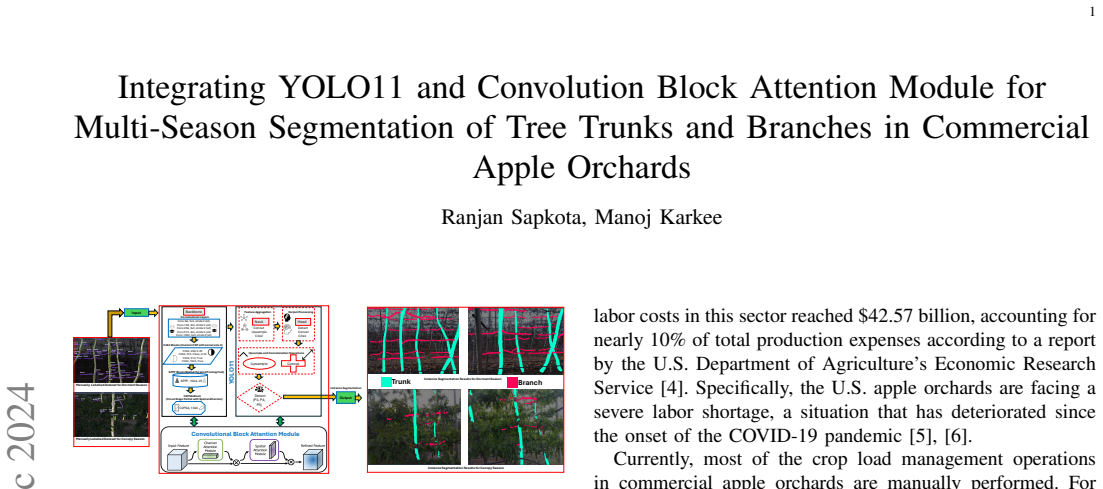
The load-bearing mechanism is the Convolutional Block Attention Module (CBAM), a two-stage attention module that first weights feature channels by global average and max pooling through a multi-layer perceptron, then weights spatial regions by pooling across channels and passing the result through a convolution. CBAM is inserted after each convolutional layer in all five YOLO11 configurations (n, s, m, l, x), with the intended effect of making the network concentrate on the channels and spatial areas that distinguish trunks and branches from training poles, trellis wires, and dense foliage. The mixed-season training set itself—859 images from January (leafless) and June (full canopy), augmented to 2070 training images—is the second piece of machinery, since the paper's hypothesis is that these two extremes bracket all other seasons.
What would settle it
Compute the overlap between the 859-image training pool and the two 78-image validation sets, then test the trained model on images from an orchard row or season that supplied no training images; if validation precision drops sharply under that fully held-out split, the claimed year-round generalization does not hold.
Extended reading notes
Core claim
On the paper's own terms, the central claim is that training on the two extreme seasonal states of an apple orchard—complete dormancy and high-density canopy—equips a YOLO11 instance-segmentation model to detect and segment trunks and branches across all intermediate seasonal conditions. The evidence is configuration-dependent: during training, YOLO11m-seg with CBAM achieves the highest mask precision of 0.83 for the trunk class; in dormant-season validation, YOLO11x-seg reaches 0.91 overall mask precision; and in canopy-season validation, YOLO11s-seg leads with 0.516 branch and 0.64 trunk mask precision. The paper presents these results as demonstrating 'potential' for year-round segmentation, with the CBAM integration consistently nudging precision upward compared to the same YOLO11 models without it.
Load-bearing premise
The result stands only if the 78 dormant-season and 78 canopy-season validation images were not also used in training and fairly represent what the model will see in other orchards and other years.
Editorial extensions
If this is right
- If the result holds, orchard robots can deploy one continuously running trunk-and-branch perception model instead of swapping season-specific detectors.
- CBAM's precision gains on trunks (0.83 vs 0.80) and branches (0.75 vs 0.73) in YOLO11m-seg indicate that attention modules give a low-cost accuracy boost without redesigning the detector.
- Reliable branch masks give robots the limb cross-sectional area needed for automated green-fruit-thinning decisions and for collision-free pruning and harvesting navigation.
- Small configurations such as YOLO11n-seg, with about 3.0 ms inference time, suggest real-time operation is within reach for field robots.
- Testing across pre-bloom, bloom, thinning, and harvest seasons, even if qualitative, supports the claim that mixed-season training transfers to conditions unseen during training.
Reading between the lines
- Beyond the paper: the strongest test of the extreme-season training hypothesis would be a two-sided ablation—training on each season alone and showing that performance drops on the other season—which is not reported here.
- Beyond the paper: Section II-B reports an 84-image validation and 85-image test split, while Section II-E uses 78-image seasonal validation sets; the paper never states how those sets relate to the 859-image training pool, so a reader should treat the reported generalization numbers as upper bounds until the disjointness of validation from training is demonstrated.
- Beyond the paper: the paper's own future direction of registering dormant-season images to canopy-season counterparts for each tree could turn the model from a trunk-and-branch segmenter into an always-available structural map of the orchard, making thinning and harvesting decisions possible even when foliage hides branches.
- Beyond the paper: a direct field test on an entirely new orchard row or a different commercial orchard, with images that were never part of training or validation, would settle whether the reported precision reflects season generalization rather than orchard-specific memorization.
Signed reviews
Editorial analysis
A structured set of objections, weighed in public.
Referee Report
Summary. The manuscript reports an instance segmentation system for apple tree trunks and branches, built by inserting Convolutional Block Attention Modules after each convolutional layer of five YOLO11 configurations. The authors train on a mixed dataset of dormant and canopy season images (reported as 859 images before augmentation), validate on 78 images from each of those two seasons, and show example segmentation outputs for four additional seasons. They report precision, recall, and mAP@50 for all configurations and claim the YOLO11-CBAM approach 'demonstrated the potential... to effectively detect and segment tree trunks and branches year-round across all seasonal variations.'
Significance. If the central claim were supported, the work would be a useful application result for orchard robotics, since a single model that works across seasons would reduce the need for season-specific training. The paper's strengths are the real-world data collection in a commercial orchard, the systematic comparison across five YOLO11 sizes, and the inclusion of inference-speed measurements. However, the manuscript does not provide code, data, error bars, or statistical tests, and the quantitative evidence is limited to two seasons; the four additional seasons are only discussed qualitatively. The record is not sufficient to establish the claimed year-round generalization.
major comments (5)
- [Section II-B and II-E] The dataset description is internally inconsistent. Section II-B states that 859 images (553 canopy and the remainder dormant) were augmented and that 'each training example [was] outputted thrice,' yielding 2070 training images; 859 × 3 = 2577, not 2070. The same section reports 84 validation and 85 test images (169 total), while Section II-E states that validation used 78 dormant and 78 canopy images (156 total). The manuscript never states whether the 78+78 validation images are disjoint from the 859-image training set. The sentence in Section II that validation images 'had been previously labeled' is consistent with overlap with the annotated training pool. If any validation images come from the same trees, the same imaging passes, or the same annotated pool as training, then Tables II and III are not unbiased estimates of generalization, and the central claim of the paper is not supported. The split arithmetic and the disjointness condition must be resolved before the reported metrics can be trusted.
- [Section III-C, Table III] The canopy-season validation, one of only two quantitative seasonal evaluations, shows weak performance. For YOLO11s-seg, branch mask mAP@50 is 0.34 and trunk mask mAP@50 is 0.525; for YOLO11m-seg, all-class mask mAP@50 is 0.319. These numbers are substantially below the dormant-season values in Table II (for example, YOLO11m-seg all-class mask mAP@50 is 0.886 there). The abstract's phrase 'effectively detect and segment ... year-round' is not quantitatively supported by these canopy results, which are also reported without confidence intervals or error bars. A claim of year-round efficacy needs either a much stronger canopy result or an explicit discussion of why these lower values still count as effective for the intended robotic tasks.
- [Section II-F and Figures 16-17] The four additional seasons (pre-bloom, flower bloom, green fruit thinning, harvest) are evaluated only descriptively. No precision, recall, or mAP values are reported for these seasons anywhere in Section IV; the evidence consists of example images in Figures 16 and 17. Qualitative examples cannot establish the 'across all seasonal variations' portion of the abstract's claim. The authors should either supply quantitative metrics for these four seasons or substantially scale back the generalization claim to two-season validation plus qualitative exploration.
- [Section III-A and Figure 14] The headline CBAM benefit, 0.83 versus 0.80 trunk mask precision for YOLO11m-seg, comes from the training-validation phase (Table I), not from the held-out seasonal validation sets in Tables II and III. No standard deviation, confidence interval, or significance test is reported for this comparison or for any other CBAM versus non-CBAM comparison. The differences are as small as 0.02-0.03, and Figure 14 only shows YOLO11m-seg; there is no evidence that CBAM consistently improves the other configurations. Without repeated runs or cross-validation, the paper does not establish that CBAM provides a reliable improvement.
- [Section V, Conclusion] The conclusion concedes that the dataset is 'relatively modest' and recommends substantial expansion plus image registration between seasons as future work. This concession is in tension with the abstract's assertion of demonstrated year-round potential. At best, the study is a proof-of-concept on two seasons with qualitative examples from four others. The central claim must be reworded to match the evidence, or the missing quantitative multi-season results must be supplied.
minor comments (5)
- [Section II-D, Eqs. (1)-(4)] Equation (3) is labeled MIoU and is not used in the results; mAP@50 is never formally defined, and Equation (4) writes '109' where it should be 10^9, given the surrounding text about giga floating-point operations.
- [Table III] In the YOLO11x-seg row for the Branch class, box precision is reported as 0.1066 and mask precision as 0.199; these values are far out of line with all other rows and appear to be typographical errors that must be corrected.
- [Section IV] The paragraph beginning 'This model was further subjected to testing across four distinct seasonal variations...' appears twice verbatim, once before Section IV-A and once near the end of the Discussion; one copy should be removed.
- [Abstract] The abstract states that 'the highest recall and precision metrics were observed in the YOLO11x-seg-CBAM and YOLO11m-seg-CBAM respectively' without specifying whether these are training-phase or validation-phase results; this ambiguity should be resolved in the abstract.
- [General] The manuscript does not include a data or code availability statement, which makes it difficult for readers to verify the dataset split and the reported single-run metrics; adding such a statement would improve reproducibility.
Circularity Check
No significant circularity: the YOLO11-CBAM comparison is an empirical train/validate study with no derivation reducing to its inputs.
full rationale
The paper's central claims are empirical rather than derivational: it trains YOLO11 variants with and without CBAM on a mixed dormant/canopy dataset and reports precision, recall, and mAP computed from the standard definitions in Section II-D. The headline result (0.83 vs 0.80 mask precision for the Trunk class with YOLO11m-seg) is an observed training-validation metric, not a quantity derived from or equivalent to the model's definition or the data split. The 'year-round' generalization claim is supported by validation on separate dormant and canopy image sets plus qualitative tests in four additional seasons; even if the disjointness of those validation images is not fully documented, that is a data-validity or experimental-design concern, not circularity, because the reported metrics are not constructed to equal the training labels. Self-citations [56]-[58] describe YOLO11 architecture details and are implementation references; they are not used to assert a uniqueness theorem, to forbid alternative choices, or as the sole justification for the main empirical comparison. The CBAM component is cited to the original external source [59]. No equation, fitted parameter, or annotated quantity is renamed as a prediction, and no claim reduces by construction to its own input. Therefore no circular step is present.
Assumptions & free parameters
free parameters (5)
- Training dataset composition =
553 canopy, 306 dormant images (859 total)
- Augmentation magnitudes =
90° rotation, ±15° shear, ±15° hue, ±25% saturation, ±20% brightness/exposure
- Training schedule =
500 epochs max with early stopping (actual: 485, 427, 417, 500, 500)
- CBAM insertion points =
after each convolutional layer in all five YOLO11 configurations
- Validation set size =
78 images per season
assumptions (4)
- domain assumption Manual annotations of trunks and branches are accurate and consistent across seasons
- domain assumption Validation images are disjoint from training images
- ad hoc to paper Training on two extreme seasons (dormant and canopy) transfers to intermediate seasons
- ad hoc to paper CBAM insertion after each convolutional layer improves performance
Cite this review
Pith. "Pith review of Integrating YOLO11 and Convolution Block Attention Module for Multi-Season Segmentation of Tree Trunks and Branches in Commercial Apple Orchards." pith.science (2026). https://pith.science/paper/SLSTYBCQ
@misc{pith2026241205728,
  author       = {Pith},
  title        = {Pith review of: Integrating YOLO11 and Convolution Block Attention Module for Multi-Season Segmentation of Tree Trunks and Branches in Commercial Apple Orchards},
  year         = {2026},
  howpublished = {\url{https://pith.science/paper/SLSTYBCQ}},
  note         = {Machine review of arXiv:2412.05728}
}
read the original abstract
In this study, we developed a customized instance segmentation model by integrating the Convolutional Block Attention Module (CBAM) with the YOLO11 architecture. This model, trained on a mixed dataset of dormant and canopy season apple orchard images, aimed to enhance the segmentation of tree trunks and branches under varying seasonal conditions throughout the year. The model was individually validated across dormant and canopy season images after training the YOLO11-CBAM on the mixed dataset collected over the two seasons. Additional testing of the model during pre-bloom, flower bloom, fruit thinning, and harvest season was performed. The highest recall and precision metrics were observed in the YOLO11x-seg-CBAM and YOLO11m-seg-CBAM respectively. Particularly, YOLO11m-seg with CBAM showed the highest precision of 0.83 as performed for the Trunk class in training, while without the CBAM, YOLO11m-seg achieved 0.80 precision score for the Trunk class. Likewise, for branch class, YOLO11m-seg with CBAM achieved the highest precision score value of 0.75 while without the CBAM, the YOLO11m-seg achieved a precision of 0.73. For dormant season validation, YOLO11x-seg exhibited the highest precision at 0.91. Canopy season validation highlighted YOLO11s-seg with superior precision across all classes, achieving 0.516 for Branch, and 0.64 for Trunk. The modeling approach, trained on two season datasets as dormant and canopy season images, demonstrated the potential of the YOLO11-CBAM integration to effectively detect and segment tree trunks and branches year-round across all seasonal variations. Keywords: YOLOv11, YOLOv11 Tree Detection, YOLOv11 Branch Detection and Segmentation, Machine Vision, Deep Learning, Machine Learning
Figures


Figures from the paper (13 more)


Forward citations
Cited by 1 Pith paper
-
Zero-Shot Automatic Annotation and Instance Segmentation using LLM-Generated Datasets: Eliminating Field Imaging and Manual Annotation for Deep Learning Model Development
Apple instance segmentation models trained solely on LLM-generated synthetic images with automatic SAM annotations transfer to real orchard images, though key reported metrics are inconsistent and no real-data baselin...
Reference graph
Works this paper leans on
-
[1]
Agricultural workforce crisis in light of the covid-19 pandemic,
D. Bochtis, L. Benos, M. Lampridi, V . Marinoudi, S. Pearson, and C. G. Sørensen, “Agricultural workforce crisis in light of the covid-19 pandemic,” Sustainability, vol. 12, no. 19, p. 8212, 2020
work page 2020
-
[2]
G. B. Gregorioa and R. C. Ancog, “Assessing the impact of the covid-19 pandemic on agricultural production in southeast asia: toward transformative change in agricultural food systems,” Asian Journal of Agriculture and Development , vol. 17, no. 1, pp. 1–13, 2020
work page 2020
-
[3]
Calvin, The US produce industry and labor: Facing the future in a global economy
L. Calvin, The US produce industry and labor: Facing the future in a global economy. No. 106, DIANE Publishing, 2010
work page 2010
-
[4]
Agricultural labor expenses forecast to increase by almost 2 percent in 2023,
A. Giri, D. Subedi, J. Law, T. Borisova, and M. Castillo, “Agricultural labor expenses forecast to increase by almost 2 percent in 2023,” Economic Research Service, U.S. Department of Agriculture , 2023
work page 2023
-
[5]
B. Larue, “Labor issues and covid-19,” Canadian Journal of Agricultural Economics/Revue canadienne d’agroeconomie, vol. 68, no. 2, pp. 231– 237, 2020
work page 2020
-
[6]
Essential agriculture, sacrificial labor, and the covid-19 pandemic in the us south,
C. Keegan, “Essential agriculture, sacrificial labor, and the covid-19 pandemic in the us south,” Journal of agrarian change , vol. 23, no. 3, pp. 611–621, 2023
work page 2023
-
[7]
Apple diseases and their management,
W. W. Turechek, “Apple diseases and their management,” Diseases of Fruits and Vegetables Volume I: Diagnosis and Management, pp. 1–108, 2004
work page 2004
-
[8]
Apple rootstocks: History, physiology, management, and breeding,
R. P. Marini and G. Fazio, “Apple rootstocks: History, physiology, management, and breeding,” Horticultural Reviews , vol. 45, pp. 197– 312, 2018
work page 2018
Show all 72 references
-
[9]
Effects of planting system, tree shape, and addi- tional summer pruning on growth, production and flowering of apple trees at high plant densities,
P. S. Wagenmakers, “Effects of planting system, tree shape, and addi- tional summer pruning on growth, production and flowering of apple trees at high plant densities,” Journal of horticultural science , vol. 63, no. 3, pp. 383–392, 1988
1988
-
[10]
Citrus pruning in the mediterranean climate: A review,
P. Matias, I. Barrote, G. Azinheira, A. Continella, and A. Duarte, “Citrus pruning in the mediterranean climate: A review,” Plants, vol. 12, no. 19, p. 3360, 2023
2023
-
[11]
Physiological responses of fruit trees to pruning,
A. Mika, “Physiological responses of fruit trees to pruning,” Hortic. Rev, vol. 8, pp. 337–378, 2011
2011
-
[12]
V-shaped apple planting systems,
T. Robinson, “V-shaped apple planting systems,” in XXV International Horticultural Congress, Part 3: Culture Techniques with Special Em- phasis on Environmental Implications, 513 , pp. 337–348, 1998
1998
-
[13]
Regulations of form-training and pruning,
M. Nasrabadi, M. Kordrostami, A. A. Ghasemi-Soloklui, M. Gararazhian, and A. Gharaghani, “Regulations of form-training and pruning,” in Apples, pp. 85–104, CRC Press, 2022
2022
-
[14]
Canopy management and effects of prun- ing on flowering tendencies in fruit trees,
W. Dhillon and A. Thakur, “Canopy management and effects of prun- ing on flowering tendencies in fruit trees,” in National Seminar-cum- Workshop on physiology of flowering in perennial fruit crops. Lucknow, India, pp. 182–201, 2014
2014
-
[15]
Training systems and sustainable orchard management for european pear (pyrus communis l.) in the mediterranean area: A review,
S. Musacchi, I. Iglesias, and D. Neri, “Training systems and sustainable orchard management for european pear (pyrus communis l.) in the mediterranean area: A review,” Agronomy, vol. 11, no. 9, p. 1765, 2021
2021
-
[16]
Deep learning based segmentation for automated training of apple trees on trellis wires,
Y . Majeed, J. Zhang, X. Zhang, L. Fu, M. Karkee, Q. Zhang, and M. D. Whiting, “Deep learning based segmentation for automated training of apple trees on trellis wires,” Computers and Electronics in Agriculture , vol. 170, p. 105277, 2020
2020
-
[17]
Significance of flower and fruit thinning on fruit quality,
H. Link, “Significance of flower and fruit thinning on fruit quality,” Plant growth regulation, vol. 31, pp. 17–26, 2000
2000
-
[18]
Immature green apple detection and sizing in commercial orchards using yolov8 and shape fitting techniques,
R. Sapkota, D. Ahmed, M. Churuvija, and M. Karkee, “Immature green apple detection and sizing in commercial orchards using yolov8 and shape fitting techniques,” IEEE Access, vol. 12, pp. 43436–43452, 2024
2024
-
[19]
Strategies to overcome biennial bearing in apple–a review,
T. Campbell and L. Kalcsits, “Strategies to overcome biennial bearing in apple–a review,”European Journal of Agronomy, vol. 158, p. 127213, 2024
2024
-
[20]
Alternate bearing in fruits trees: A review,
A. Kumar, B. Bhuj, and C. Singh, “Alternate bearing in fruits trees: A review,”Int. J. Curr. Microbiol. App. Sci, vol. 10, no. 01, pp. 1218–1235, 2021
2021
-
[21]
Fruit thinning: Advances and trends,
G. Costa, A. Botton, and G. Vizzotto, “Fruit thinning: Advances and trends,” Horticultural reviews, vol. 46, pp. 185–226, 2018
2018
-
[22]
Summer pruning of apple and peach trees,
R. P. Marini and J. A. Burden, “Summer pruning of apple and peach trees,” Horticultural Reviews, vol. 9, pp. 351–375, 1987
1987
-
[23]
The influence of protective netting on tree physiology and fruit quality of apple: A review,
G. Mupambi, B. M. Anthony, D. R. Layne, S. Musacchi, S. Serra, T. Schmidt, and L. A. Kalcsits, “The influence of protective netting on tree physiology and fruit quality of apple: A review,” Scientia Horticulturae, vol. 236, pp. 60–72, 2018
2018
-
[24]
Li, Physiological effects of summer pruning in apple trees
K.-T. Li, Physiological effects of summer pruning in apple trees. Cornell University, 2001
2001
-
[25]
B. J. Teskey, Tree fruit production. Springer Science & Business Media, 2012
2012
-
[26]
Occupational injury and illness in farmworkers in the eastern united states,
J. J. May and T. A. Arcury, “Occupational injury and illness in farmworkers in the eastern united states,” Latinx Farmworkers in the Eastern United States: Health, Safety, and Justice , pp. 41–81, 2020
2020
-
[27]
Musculoskeletal disorders in agricul- ture: A review from web of science core collection,
M. Barneo-Alc ´antara, M. D ´ıaz-P´erez, M. G ´omez-Gal´an, ´A. Carre ˜no- Ortega, and ´A.-J. Callej ´on-Ferre, “Musculoskeletal disorders in agricul- ture: A review from web of science core collection,” Agronomy, vol. 11, no. 10, p. 2017, 2021
2017
-
[28]
Agricultural injuries: risk factors and severity by affected body part among us (midwest) farmers,
B. S. Ouattara, C. L. Beseler, and R. H. Rautiainen, “Agricultural injuries: risk factors and severity by affected body part among us (midwest) farmers,” Journal of agromedicine , vol. 28, no. 2, pp. 214– 223, 2023
2023
-
[29]
Hard work and hazard: Young people and agricultural commercialisation in africa,
T. Yeboah, E. Chigumira, I. John, N. A. Anyidoho, V . Manyong, J. Flynn, and J. Sumberg, “Hard work and hazard: Young people and agricultural commercialisation in africa,” Journal of Rural Studies , vol. 76, pp. 142–151, 2020
2020
-
[30]
The future of australia’s agricultural workforce,
W. Wu, D. Dawson, D. Fleming-Mu ˜noz, E. Schleiger, and J. Hor- ton, “The future of australia’s agricultural workforce,” Retrieved from Canberra, Australia: https://www. qff. org. au/blog/future-australias- agricultural-workforce-report, 2019
2019
-
[31]
Multi-scalar labour agency in global production networks: Contestation and crisis in the south african fruit sector,
M. Alford, S. Barrientos, and M. Visser, “Multi-scalar labour agency in global production networks: Contestation and crisis in the south african fruit sector,” Development and Change , vol. 48, no. 4, pp. 721–745, 2017
2017
-
[32]
The future of work in agri-food,
L. Christiaensen, Z. Rutledge, and J. E. Taylor, “The future of work in agri-food,” Food Policy, vol. 99, p. 101963, 2021
2021
-
[33]
Agricultural crisis, refugee crisis, or health crisis? migrant seasonal workers in italian agriculture during the covid pandemic,
P. Cingolani, “Agricultural crisis, refugee crisis, or health crisis? migrant seasonal workers in italian agriculture during the covid pandemic,” International Migration, 2024
2024
-
[34]
Latinx farmworkers and farm work in the eastern united states: The context for health, safety, and justice,
T. A. Arcury and D. C. Mora, “Latinx farmworkers and farm work in the eastern united states: The context for health, safety, and justice,” Latinx Farmworkers in the Eastern United States: Health, Safety, and Justice, pp. 11–40, 2020
2020
-
[35]
A. L. Van Lanen, The Washington apple: orchards and the development of industrial agriculture , vol. 7. University of Oklahoma Press, 2022
2022
-
[36]
Overcoming the nursery industry labor shortage: A survey of strategies to adapt to a reduced workforce and automation and mechanization technology adoption levels,
A. Fulcher, A. L. Rihn, L. A. Warner, A. V . LeBude, S. Schexnayder, J. E. Altland, N. Bumgarner, S. C. Marble, L. Nackley, M. Palma, et al., “Overcoming the nursery industry labor shortage: A survey of strategies to adapt to a reduced workforce and automation and mechanizatio...
2023
-
[37]
Impact of the covid-19 pandemic on apple orchards in europe,
K. Tougeron and T. Hance, “Impact of the covid-19 pandemic on apple orchards in europe,” Agricultural Systems, vol. 190, p. 103097, 2021
2021
-
[38]
The effects of covid-19 on fruit and veg- etable production,
W. Ridley and S. Devadoss, “The effects of covid-19 on fruit and veg- etable production,” Applied Economic Perspectives and Policy , vol. 43, no. 1, pp. 329–340, 2021
2021
-
[39]
Yolov10 to its genesis: A decadal and comprehensive review of the you only look once (yolo) series,
R. Sapkota, R. Qureshi, M. F. Calero, C. Badjugar, U. Nepal, A. Poulose, P. Zeno, U. B. P. Vaddevolu, S. Khan, M. Shoman, et al., “Yolov10 to its genesis: A decadal and comprehensive review of the you only look once (yolo) series,” arXiv preprint arXiv:2406.19407 , 2024
2024 arXiv
-
[40]
Rapid growth of the world population and its socioe- conomic results,
R. Sadigov, “Rapid growth of the world population and its socioe- conomic results,” The Scientific World Journal , vol. 2022, no. 1, p. 8110229, 2022. 19
2022
-
[41]
Artificial intelligence to improve the food and agriculture sector,
R. Ben Ayed and M. Hanana, “Artificial intelligence to improve the food and agriculture sector,” Journal of Food Quality , vol. 2021, no. 1, p. 5584754, 2021
2021
-
[42]
An automated apple harvesting robot—from system design to field evaluation,
K. Zhang, K. Lammers, P. Chu, Z. Li, and R. Lu, “An automated apple harvesting robot—from system design to field evaluation,” Journal of Field Robotics, vol. 41, no. 7, pp. 2384–2400, 2024
2024
-
[43]
Apple tree trunk and branch segmentation for automatic trellis training using convolutional neural network based semantic segmenta- tion,
Y . Majeed, J. Zhang, X. Zhang, L. Fu, M. Karkee, Q. Zhang, and M. D. Whiting, “Apple tree trunk and branch segmentation for automatic trellis training using convolutional neural network based semantic segmenta- tion,” IFAC-PapersOnLine, vol. 51, no. 17, pp. 75–80, 2018
2018
-
[44]
Obscured tree branches segmentation and 3d reconstruction using deep learning and geometrical constraints,
E. Kok, X. Wang, and C. Chen, “Obscured tree branches segmentation and 3d reconstruction using deep learning and geometrical constraints,” Computers and electronics in agriculture , vol. 210, p. 107884, 2023
2023
-
[45]
Technological advancements towards developing a robotic pruner for apple trees: A review,
A. Zahid, M. S. Mahmud, L. He, P. Heinemann, D. Choi, and J. Schupp, “Technological advancements towards developing a robotic pruner for apple trees: A review,” Computers and Electronics in Agriculture , vol. 189, p. 106383, 2021
2021
-
[46]
Detection of fruit-bearing branches and localization of litchi clusters for vision-based harvesting robots,
J. Li, Y . Tang, X. Zou, G. Lin, and H. Wang, “Detection of fruit-bearing branches and localization of litchi clusters for vision-based harvesting robots,” IEEE Access, vol. 8, pp. 117746–117758, 2020
2020
-
[47]
A survey on instance segmentation: state of the art,
A. M. Hafiz and G. M. Bhat, “A survey on instance segmentation: state of the art,” International journal of multimedia information retrieval , vol. 9, no. 3, pp. 171–189, 2020
2020
-
[48]
Applications of deep learning for dense scenes analysis in agriculture: A review,
Q. Zhang, Y . Liu, C. Gong, Y . Chen, and H. Yu, “Applications of deep learning for dense scenes analysis in agriculture: A review,” Sensors, vol. 20, no. 5, p. 1520, 2020
2020
-
[49]
An efficient building extraction method from high spatial resolution remote sensing images based on improved mask r-cnn,
L. Zhang, J. Wu, Y . Fan, H. Gao, and Y . Shao, “An efficient building extraction method from high spatial resolution remote sensing images based on improved mask r-cnn,” Sensors, vol. 20, no. 5, p. 1465, 2020
2020
-
[50]
Crop load and thinning methods impact yield, nutrient content, fruit quality, and physiological disorders in ‘scilate’apples,
R. S. Sidhu, S. A. Bound, and I. Hunt, “Crop load and thinning methods impact yield, nutrient content, fruit quality, and physiological disorders in ‘scilate’apples,” Agronomy, vol. 12, no. 9, p. 1989, 2022
1989
-
[51]
Localised and tree total crop loads influence trunk growth, return fruit set, yield, and fruit quality in apples,
A. Scalisi, T. Plozza, P. Reddy, M. Peavey, L. McClymont, S. Rochfort, D. Stefanelli, and I. Goodwin, “Localised and tree total crop loads influence trunk growth, return fruit set, yield, and fruit quality in apples,” Horticulture Advances, vol. 2, no. 1, pp. 1–16, 2024
2024
-
[52]
Setting life cycle assessment (lca) in a future-oriented context: the combination of qualitative scenarios and lca in the agri-food sector,
A. V oglhuber-Slavinsky, A. Zicari, S. Smetana, B. Moller, E. D ¨onitz, L. Vranken, M. Zdravkovic, K. Aganovic, and E. Bahrs, “Setting life cycle assessment (lca) in a future-oriented context: the combination of qualitative scenarios and lca in the agri-food sector,” European ...
2022
-
[53]
Multi-feature fusion tree trunk detection and orchard mobile robot localization using camera/ultrasonic sensors,
X. Chen, B. Zhang, L. Luo, et al. , “Multi-feature fusion tree trunk detection and orchard mobile robot localization using camera/ultrasonic sensors,” Computers and Electronics in Agriculture , vol. 147, pp. 91– 108, 2018
2018
-
[54]
Tree detection and in-row localization for au- tonomous precision orchard management,
J. Brown, A. Paudel, D. Biehler, A. Thompson, M. Karkee, C. Grimm, and J. R. Davidson, “Tree detection and in-row localization for au- tonomous precision orchard management,” Computers and Electronics in Agriculture, vol. 227, p. 109454, 2024
2024
-
[55]
Orchard mapping and mobile robot localisation using on-board camera and laser scanner data fusion–part a: Tree detection,
N. Shalal, T. Low, C. McCarthy, and N. Hancock, “Orchard mapping and mobile robot localisation using on-board camera and laser scanner data fusion–part a: Tree detection,”Computers and Electronics in Agriculture, vol. 119, pp. 254–266, 2015
2015
-
[56]
Comparing yolo11 and yolov8 for instance segmentation of occluded and non-occluded immature green fruits in complex orchard environment,
R. Sapkota and M. Karkee, “Comparing yolo11 and yolov8 for instance segmentation of occluded and non-occluded immature green fruits in complex orchard environment,” arXiv preprint arXiv:2410.19869, 2024
2024 arXiv
-
[57]
Comprehensive performance evaluation of yolo11, yolov10, yolov9 and yolov8 on detecting and counting fruitlet in complex orchard environments,
R. Sapkota, Z. Meng, M. Churuvija, X. Du, Z. Ma, and M. Karkee, “Comprehensive performance evaluation of yolo11, yolov10, yolov9 and yolov8 on detecting and counting fruitlet in complex orchard environments,” arXiv preprint arXiv:2407.12040 , 2024
2024
-
[58]
Yolo11 and vision transformers based 3d pose estimation of immature green fruits in commercial apple orchards for robotic thinning,
R. Sapkota and M. Karkee, “Yolo11 and vision transformers based 3d pose estimation of immature green fruits in commercial apple orchards for robotic thinning,” arXiv preprint arXiv:2410.19846 , 2024
2024 arXiv
-
[59]
Cbam: Convolutional block attention module,
S. Woo, J. Park, J.-Y . Lee, and I. S. Kweon, “Cbam: Convolutional block attention module,” in Proceedings of the European conference on computer vision (ECCV) , pp. 3–19, 2018
2018
-
[60]
Broodstock breeding behaviour recognition based on resnet50-lstm with cbam attention mechanism,
L. Du, Z. Lu, and D. Li, “Broodstock breeding behaviour recognition based on resnet50-lstm with cbam attention mechanism,” Computers and Electronics in Agriculture, vol. 202, p. 107404, 2022
2022
-
[61]
Zero-shot automatic annotation and instance segmentation using llm-generated datasets: Eliminating field imaging and manual annotation for deep learning model devel- opment,
R. Sapkota, A. Paudel, and M. Karkee, “Zero-shot automatic annotation and instance segmentation using llm-generated datasets: Eliminating field imaging and manual annotation for deep learning model devel- opment,” arXiv preprint arXiv:2411.11285 , 2024
2024 arXiv
-
[62]
Ma- chine vision-based crop-load estimation using yolov8,
D. Ahmed, R. Sapkota, M. Churuvija, and M. Karkee, “Ma- chine vision-based crop-load estimation using yolov8,” arXiv preprint arXiv:2304.13282, 2023
2023 arXiv
-
[63]
Semiau- tonomous precision pruning of upright fruiting offshoot orchard systems: An integrated approach,
A. You, N. Parayil, J. G. Krishna, U. Bhattarai, R. Sapkota, D. Ahmed, M. Whiting, M. Karkee, C. M. Grimm, and J. R. Davidson, “Semiau- tonomous precision pruning of upright fruiting offshoot orchard systems: An integrated approach,” IEEE Robotics & Automation Magazine, 2023
2023
-
[64]
Sensing and automation in pruning of apple trees: A review,
L. He and J. Schupp, “Sensing and automation in pruning of apple trees: A review,” Agronomy, vol. 8, no. 10, p. 211, 2018
2018
-
[65]
De- velopment of a robotic end-effector for apple tree pruning,
A. Zahid, L. He, L. Zeng, D. Choi, J. Schupp, and P. Heinemann, “De- velopment of a robotic end-effector for apple tree pruning,” Transactions of the ASABE , vol. 63, no. 4, pp. 847–856, 2020
2020
-
[66]
Robotic pollination of apples in commercial orchards,
R. Sapkota, D. Ahmed, S. R. Khanal, U. Bhattarai, C. Mo, M. D. Whiting, and M. Karkee, “Robotic pollination of apples in commercial orchards,” arXiv preprint arXiv:2311.10755 , 2023
2023 arXiv
-
[67]
Robotics for crop pollination: recent advances and future direction,
R. Sapkota, M. D. Whiting, D. Ahmed, and M. Karkee, “Robotics for crop pollination: recent advances and future direction,” Authorea Preprints, 2024
2024
-
[68]
Edge ai-based tree trunk detection for forestry monitoring robotics,
D. Q. da Silva, F. N. dos Santos, V . Filipe, A. J. Sousa, and P. M. Oliveira, “Edge ai-based tree trunk detection for forestry monitoring robotics,” Robotics, vol. 11, no. 6, p. 136, 2022
2022
-
[69]
A novel tree trunk detection method for oil-palm plantation navigation,
M. A. Juman, Y . W. Wong, R. K. Rajkumar, and L. J. Goh, “A novel tree trunk detection method for oil-palm plantation navigation,” Computers and electronics in agriculture , vol. 128, pp. 172–180, 2016
2016
-
[70]
A pipeline for trunk detection in trellis structured apple orchards,
S. Bargoti, J. P. Underwood, J. I. Nieto, and S. Sukkarieh, “A pipeline for trunk detection in trellis structured apple orchards,” Journal of field robotics, vol. 32, no. 8, pp. 1075–1094, 2015
2015
-
[71]
atrunk—an als-based trunk detection algorithm,
S. Lamprecht, J. Stoffels, S. Dotzler, E. Haß, and T. Udelhoven, “atrunk—an als-based trunk detection algorithm,” Remote Sensing , vol. 7, no. 8, pp. 9975–9997, 2015
2015
-
[72]
Tree trunk detection in urban scenes using a multiscale attention-based deep learning method,
R. Li, G. Sun, S. Wang, T. Tan, and F. Xu, “Tree trunk detection in urban scenes using a multiscale attention-based deep learning method,” Ecological Informatics, vol. 77, p. 102215, 2023. Ranjan Sapkota Mr. Sapkota is a Ph.D. stu- dent at Washington State University in the De...
2023
Reviewed August 11, 2026 · model on record in the stance chip above.
Discussion (0). Continue with ORCID to comment.