REVIEW 6 major objections 6 minor 3 cited by
Zero-Shot Automatic Annotation and Instance Segmentation using LLM-Generated Datasets: Eliminating Field Imaging and Manual Annotation for Deep Learning Model Development
T0 review · 6 major / 6 minor · reviewed 2026-08-12 · deepseek-v4-flash
Pith's one-line read This paper claims that a YOLO11 instance-segmentation model for apples can be trained exclusively on LLM-generated synthetic images with zero-shot automatic annotations and still segment apples in a real commercial orchard.
desk verdict Real synthetic-to-real transfer result, but metric inconsistencies, a mislabeled 'zero-shot' framing, and a missing real-data baseline mean the paper needs major revision before it is citable. read the letter →
The pith
A machine-rendered reading of the paper's core claim, the machinery that carries it, and where it could break.
The reading
What carries the argument
The load-bearing mechanism is the YOLO11-to-SAMv2 annotation cascade. A COCO-pretrained YOLO11 model, run at confidence threshold 0.3, acts as a zero-shot apple proposal generator on synthetic images; each proposed bounding box is fed to SAMv2 as a prompt, and SAMv2's mask decoder outputs a per-instance mask. The masks are normalized to image dimensions and saved in YOLO label format, creating the training set that teaches the final YOLO11-seg models. The same cascade is then evaluated by comparing its annotations against manual masks and by the transfer performance of the trained segmenters on real orchard images.
What would settle it
A decisive check is to count missed apples and measure mask overlap on a held-out sample of the synthetic images against manual annotations: if the zero-shot detector at threshold 0.3 misses a large share of visible apples, or the SAMv2 masks overlap manual masks by less than roughly 0.9 IoU, then the training labels are systematically biased and the reported field mAP would not survive a recall-centered evaluation.
Extended reading notes
Core claim
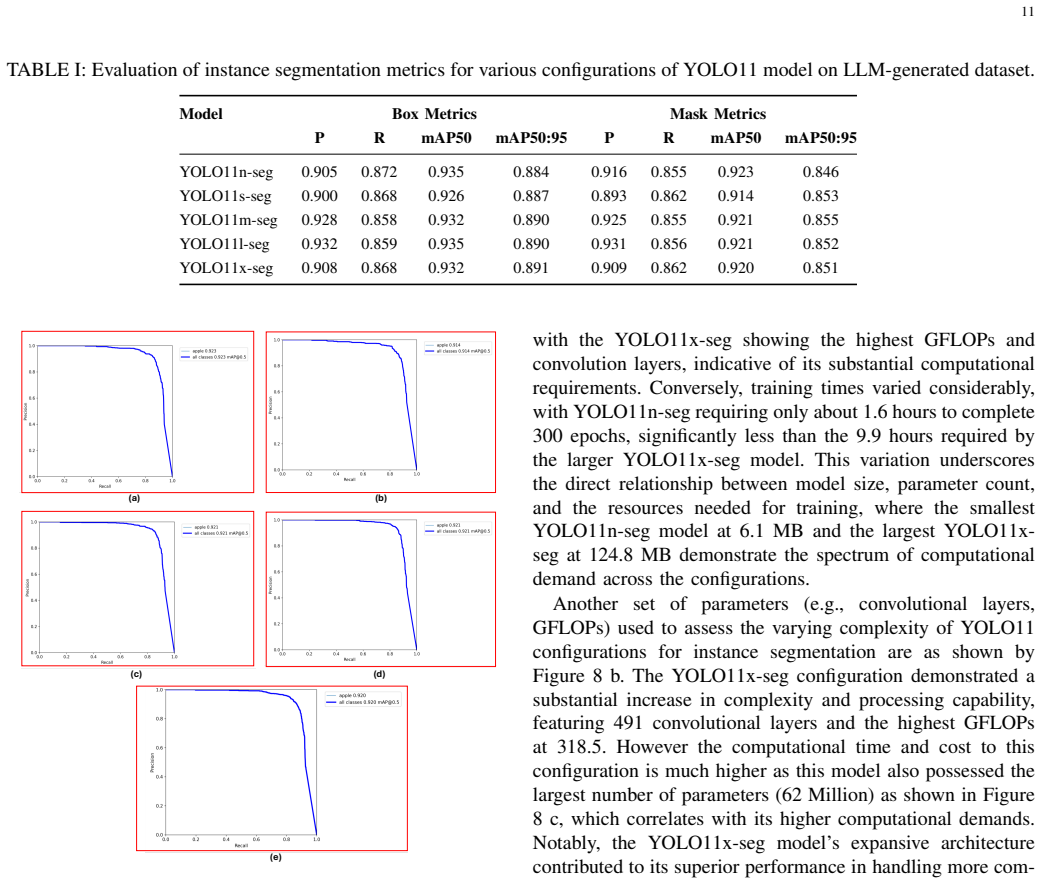
In the paper's own terms, the discovery is that a fully synthetic, fully automatic data pipeline is sufficient supervision for instance segmentation in a real agricultural scene. The zero-shot YOLO11 detector, run at confidence threshold 0.3, proposes apple boxes in LLM images; SAMv2 turns each box into a mask; and every YOLO11-seg configuration trained on those masks recognizes and delineates apples. YOLO11m-seg performs best on field data, achieving mask precision 0.902 and mask mAP@50 (mean average precision at 50% mask overlap) 0.833 on 42 commercial-orchard images, while the auto-annotation step itself matches manual labels with a Dice coefficient of 0.9513 and IoU of 0.9303.
Load-bearing premise
The pipeline assumes that a COCO-pretrained YOLO11 detector at confidence 0.3 finds almost all apples in DALL-E images, and that SAMv2's masks inside those boxes are clean enough to serve as training labels; missed apples or imprecise boxes would inject errors that the final model inherits.
Editorial extensions
If this is right
- Apple instance segmentation can be developed without any field imaging or manual labeling during training; the only real images needed are for validation.
- Because the pipeline uses a general-purpose detector and a promptable segmenter, the same recipe can be repeated for other fruits or objects by changing the text prompt and the target label.
- Automatic annotations are close enough to manual ones (Dice 0.9513, IoU 0.9303) to play the role of ground truth in training, so annotation cost collapses to inference cost.
- Even the smallest configuration, YOLO11n-seg, runs at 3.8 ms per image, which is fast enough for on-robot fruit perception if the quality holds in deployment.
Reading between the lines
- Beyond the paper, the method's transfer limit is probably set by the zero-shot detector: objects far from COCO categories would get few or no boxes, so SAM would never annotate them.
- The paper leaves implicit that its own failure images (occluded apples missed, foliage falsely masked) could be fed back as corrective examples in new text prompts to generate more realistic training data.
- A testable extension is to feed the trained segmenter's masks back into the annotation pipeline as proposals for a second round, which would scale the training data without any new labels.
Signed reviews
Editorial analysis
A structured set of objections, weighed in public.
Referee Report
Summary. The paper proposes an entirely synthetic pipeline for apple instance segmentation: DALL-E generates 524 (later stated as 501) orchard images; a COCO-pretrained YOLO11 detector proposes boxes at confidence 0.3; SAMv2 converts each box into a mask; the masks are saved as YOLO-format labels; and five YOLO11 instance-segmentation variants are trained on these labels. Performance is reported on 40 LLM-generated validation images and on 42 real images from a commercial orchard. The authors claim the auto-annotations reach Dice 0.9513 / IoU 0.9303, that all trained configurations segment apples accurately, and that the best field result is YOLO11m-seg with mask precision 0.902 and mask mAP@50 0.833, concluding that field imaging and manual annotation can be eliminated.
Significance. If the central claim were fully supported, the result would be practically valuable for agricultural AI and for other domains where labeled imagery is scarce, because a pipeline that generates and auto-labels training data at scale would reduce cost and accelerate deployment. The manuscript has concrete strengths: a reproducible recipe, a public dataset link, and an independent field-validation set of 42 real images collected with a Kinect camera. That field validation is the only non-circular evidence and should be preserved. However, the current quantitative claims are undermined by internal inconsistencies, a missing baseline, and an unmeasured detection recall in the auto-labeling step; these issues must be resolved before the central claim can be accepted.
major comments (6)
- [Abstract, §II.C, Fig. 3] The method is not zero-shot as claimed. The YOLO11 base model is pretrained on MS-COCO, whose 80 categories include 'apple', so apples are not an unseen class for the detector. The claimed 'zero-shot detection' is actually detection of a class already present in the pre-training vocabulary. This is load-bearing because the paper's framing and title rest on zero-shot generalization, and the experiment provides no evidence that the pipeline would work for a class absent from COCO. Please rename the approach (e.g., COCO-pretrained detection) or demonstrate genuine zero-shot behavior on a non-COCO class.
- [Abstract vs. §III and Fig. 5(c)] The abstract and conclusion report Dice 0.9513 and IoU 0.9303 for the automatically generated annotations, while Section III reports Dice 0.88 and IoU 0.86 for the synthetic dataset. These values are not reconciled anywhere. Since auto-annotation accuracy is the foundation for the training labels, the manuscript must state which numbers are final, which images they were computed on, and what matching protocol was used to compute them.
- [§II.E, Eqs. (5)-(8)] The evaluation of automatic versus manual masks never reports detection recall on the synthetic set. Equations (7) and (8) average Dice/IoU over mask pairs, but no matching rule is stated, and an apple missed at the 0.3 confidence threshold simply produces no mask and may therefore be excluded from the average. The training set thus contains an unknown number of false negatives, and the field mAP@50 of 0.833 cannot be attributed to complete supervision. The paper does report a real-image annotation recall of 0.61 in Section III, which shows that miss rates can be substantial outside the synthetic domain; the synthetic-set recall must be measured and reported.
- [Tables I-III, §III.C] No baseline model trained on real orchard images is included. Without a real-data-trained comparator, the field mask mAP@50 of 0.833 cannot be judged as 'accurate' or as evidence that synthetic-only training suffices. In addition, the 40-image synthetic test set is drawn from the same DALL-E distribution as the training images, and its pseudo-labels were generated by the same YOLO11/SAM pipeline used at training time, making the ~0.92 synthetic scores largely circular. The 42-image field set is the only independent evidence, and it is too small for reliable comparisons across five configurations without confidence intervals or statistical testing.
- [§II.B, §II.E, §IV] The dataset size and split are inconsistent and under-specified. Section II.B says 524 images were generated, while Section II.E and Section IV refer to 501 images; the manuscript never states how many images were used for training, validation, and testing, nor whether the 40 manually annotated images used in Tables I and II were held out from training. This ambiguity prevents interpretation of the reported numbers and makes the experiments difficult to reproduce. Please specify exact splits and reconcile the image counts.
- [Conclusion, 'Zero-Shot Base Model Performance' bullet] The conclusion bullet reports mask precision 0.92, recall 0.851, and mask mAP@50 0.92 for the 'zero-shot base model,' but these numbers match the trained YOLO11x-seg results in Table II rather than any zero-shot detector. A COCO-pretrained YOLO11 produces bounding boxes, not masks; the masks in the pipeline come from SAMv2. This conflates the detector, the annotator, and the trained segmenter, and it should be corrected for the results to be interpretable.
minor comments (6)
- [§II.A] Section II.A contains a duplicated verbatim paragraph describing the study site and data acquisition; remove one copy.
- [Eqs. (3), (12)] Equation (12) writes '109 per image' where 10^9 is intended, and Eq. (3) contains broken formatting in 'conf idencedetectionsi'; please fix the LaTeX and the notation.
- [§III, §III.A, Fig. 8, Fig. 10] Reported inference times are inconsistent: Section III says 1,986.4 ms (1.9 s) per image on average, while Section III.A and Fig. 8a state 4.4 seconds for YOLO11n-seg and Fig. 10 reports times in milliseconds. Clarify the units and whether these are per-image or per-batch measurements.
- [Throughout] There are several typos and style issues, e.g., 'techiques' (§I), 'deminstrating' (§I), 'innivation' (§I), and 'pf' for 'of' (§II.G); please correct them.
- [§II.D, Fig. 2a] The text alternates between 'SAM', 'SAMv2', and 'SAM 2'; use the official model name consistently and define it when first introduced.
- [Fig. 5(c)] The bar chart in Fig. 5(c) is difficult to read in the provided version; ensure the figure is legible and add numeric labels to the bars so the reported values can be checked against the text.
Circularity Check
The auto-annotation accuracy metric is defined over the detector's own outputs, so it cannot measure training-label recall; the field validation on 42 real images remains an independent check.
-
self definitional
[Section II.E, Eqs. (7)-(8); Section III]
"Average Dice Coefficient and Average IoU were calculated by averaging the respective metrics for each pair of predicted and ground truth masks across all images ... Average IoU = 1/N Σ |Ai ∩ Bi| / |Ai ∪ Bi| where Ai and Bi represent the automatic and manual mask areas for the ith image, respectively."
The automatic masks are produced by SAMv2 from YOLO11 zero-shot bounding boxes. Because the Dice/IoU comparison is defined over 'pairs' of predicted and ground-truth masks, an apple missed by the YOLO11 detector at the 0.3 confidence threshold has no predicted mask and therefore no pair to enter the average. The reported synthetic Dice/IoU values (0.88/0.86 in Section III, 0.9513/0.9303 in the abstract) can thus only measure mask quality for apples the detector happened to find; they cannot measure how many DALL-E apples were never labeled.
full rationale
The main field-transfer claim is supported by an independent benchmark: 42 real orchard images collected with an Azure camera and manually annotated were withheld from training, and the best configuration, YOLO11m-seg, reaches mask precision 0.902 and mask mAP@50 0.833 on that set. That real-image validation prevents the paper's central claim from reducing to the synthetic pipeline by construction and limits the circularity score. The partial circularity lies in the automatic-annotation validation: Eq. (8) is defined over pairs of automatic and manual masks, so any apple missed by the zero-shot YOLO11 detector is excluded from the reported Dice/IoU average; consequently the claimed annotation accuracy cannot verify the completeness of the labels used for training. The paper also reports a numerical inconsistency between the abstract's Dice/IoU (0.9513/0.9303) and Section III's values (0.88/0.86), which is a correctness/consistency concern rather than circularity. Self-citations, notably [69] for the DALL-E image set, supply the data source but are not the load-bearing proof of field transfer, since the current paper adds an independent real-orchard test.
Assumptions & free parameters
free parameters (3)
- YOLO detection confidence threshold =
0.3
- YOLO11 training hyperparameters =
lr 0.01, momentum 0.937, weight decay 0.0005, warmup 3, batch 8, 300 epochs, box loss 7.5, cls loss 0.5
- Validation/test split =
40 synthetic images held out
assumptions (5)
- domain assumption DALL-E generated images are realistic enough that apple appearance and orchard layout match real conditions for detection and segmentation.
- domain assumption A YOLO11 detector pretrained on COCO finds most apples in synthetic images at confidence threshold 0.3, and SAMv2 masks within the boxes are accurate training labels.
- domain assumption Manual annotations made by one annotator with Roboflow are treated as ground truth.
- domain assumption The 42-field-image validation set from one 'Scifresh' orchard in Prosser, WA, captured in October 2024, is representative of commercial orchard conditions.
- domain assumption The paper's framing assumes that the pretrained YOLO11 model generalizes to apples as a novel class, though apple is a COCO class.
Cite this review
Pith. "Pith review of Zero-Shot Automatic Annotation and Instance Segmentation using LLM-Generated Datasets: Eliminating Field Imaging and Manual Annotation for Deep Learning Model Development." pith.science (2026). https://pith.science/paper/WYJP7YTP
@misc{pith2026241111285,
  author       = {Pith},
  title        = {Pith review of: Zero-Shot Automatic Annotation and Instance Segmentation using LLM-Generated Datasets: Eliminating Field Imaging and Manual Annotation for Deep Learning Model Development},
  year         = {2026},
  howpublished = {\url{https://pith.science/paper/WYJP7YTP}},
  note         = {Machine review of arXiv:2411.11285}
}
read the original abstract
Currently, deep learning-based instance segmentation for various applications (e.g., Agriculture) is predominantly performed using a labor-intensive process involving extensive field data collection using sophisticated sensors, followed by careful manual annotation of images, presenting significant logistical and financial challenges to researchers and organizations. The process also slows down the model development and training process. In this study, we presented a novel method for deep learning-based instance segmentation of apples in commercial orchards that eliminates the need for labor-intensive field data collection and manual annotation. Utilizing a Large Language Model (LLM), we synthetically generated orchard images and automatically annotated them using the Segment Anything Model (SAM) integrated with a YOLO11 base model. This method significantly reduces reliance on physical sensors and manual data processing, presenting a major advancement in "Agricultural AI". The synthetic, auto-annotated dataset was used to train the YOLO11 model for Apple instance segmentation, which was then validated on real orchard images. The results showed that the automatically generated annotations achieved a Dice Coefficient of 0.9513 and an IoU of 0.9303, validating the accuracy and overlap of the mask annotations. All YOLO11 configurations, trained solely on these synthetic datasets with automated annotations, accurately recognized and delineated apples, highlighting the method's efficacy. Specifically, the YOLO11m-seg configuration achieved a mask precision of 0.902 and a mask mAP@50 of 0.833 on test images collected from a commercial orchard. Additionally, the YOLO11l-seg configuration outperformed other models in validation on 40 LLM-generated images, achieving the highest mask precision and mAP@50 metrics. Keywords: YOLO, SAM, SAMv2, YOLO11, YOLOv11, Segment Anything, YOLO-SAM
Figures


Figures from the paper (9 more)




Forward citations
Cited by 3 Pith papers
-
RF-DETR Object Detection vs YOLOv12 : A Study of Transformer-based and CNN-based Architectures for Single-Class and Multi-Class Greenfruit Detection in Complex Orchard Environments Under Label Ambiguity
On an 857-image orchard dataset, RF-DETR achieved the best mAP@50 for both single-class (0.9464) and multi-class (0.8298) greenfruit detection, while YOLOv12N and YOLOv12L led mAP@50:95 in the two settings.
-
Multimodal Large Language Models for Image, Text, and Speech Data Augmentation: A Survey
A literature review cataloging LLM-based augmentation methods across image, text, and speech, with a taxonomy of techniques, limitations, and suggested fixes.
-
Integrating YOLO11 and Convolution Block Attention Module for Multi-Season Segmentation of Tree Trunks and Branches in Commercial Apple Orchards
A YOLO11-CBAM model trained on mixed dormant and canopy season images segments apple tree trunks and branches, but year-round generalization is only qualitatively demonstrated.
Reference graph
Works this paper leans on
-
[69]
R. Sapkota, Z. Meng, and M. Karkee, “Synthetic meets authentic: Leveraging llm generated datasets for yolo11 and yolov10-based apple detection through machine vision sensors,” Smart Agricultural Tech- nology, p. 100614, 2024
work page 2024
-
[1]
A survey on instance segmentation: state of the art,
A. M. Hafiz and G. M. Bhat, “A survey on instance segmentation: state of the art,” International journal of multimedia information retrieval , vol. 9, no. 3, pp. 171–189, 2020
2020
-
[2]
Utilizing deep learning in medical image analysis for en- hanced diagnostic accuracy and patient care: Challenges, opportunities, and ethical implications,
A. S. Pillai, “Utilizing deep learning in medical image analysis for en- hanced diagnostic accuracy and patient care: Challenges, opportunities, and ethical implications,” Journal of Deep Learning in Genomic Data Analysis, vol. 1, no. 1, pp. 1–17, 2021
2021
-
[3]
Machine learning empowering personalized medicine: A comprehensive review of med- ical image analysis methods,
I. Gali ´c, M. Habijan, H. Leventi ´c, and K. Romi ´c, “Machine learning empowering personalized medicine: A comprehensive review of med- ical image analysis methods,” Electronics, vol. 12, no. 21, p. 4411, 2023
2023
-
[4]
Automatic tooth instance segmentation and identification from panoramic x-ray images using deep cnn,
W. Brahmi and I. Jdey, “Automatic tooth instance segmentation and identification from panoramic x-ray images using deep cnn,” Multime- dia Tools and Applications , vol. 83, no. 18, pp. 55565–55585, 2024
2024
-
[5]
Idd-net: A deep learning approach for early detection of dental diseases using x-ray imaging,
M. A. Hasnain, Z. Ali, K. U. Rehman, M. Ehtsham, and M. S. Maqbool, “Idd-net: A deep learning approach for early detection of dental diseases using x-ray imaging,” Journal of Computing & Biomedical Informatics, vol. 7, no. 02, 2024
2024
-
[6]
A traffic surveillance system for obtaining comprehensive information of the passing vehicles based on instance segmentation,
B. Zhang and J. Zhang, “A traffic surveillance system for obtaining comprehensive information of the passing vehicles based on instance segmentation,” IEEE Transactions on Intelligent Transportation Sys- tems, vol. 22, no. 11, pp. 7040–7055, 2020
2020
-
[7]
Edge computing enabled video segmentation for real-time traffic monitoring in internet of vehicles,
S. Wan, S. Ding, and C. Chen, “Edge computing enabled video segmentation for real-time traffic monitoring in internet of vehicles,” Pattern Recognition, vol. 121, p. 108146, 2022
2022
Show all 108 references
-
[8]
A virtual- real interaction approach to object instance segmentation in traffic scenes,
H. Zhang, G. Luo, Y . Tian, K. Wang, H. He, and F.-Y . Wang, “A virtual- real interaction approach to object instance segmentation in traffic scenes,” IEEE Transactions on Intelligent Transportation Systems , vol. 22, no. 2, pp. 863–875, 2020
2020
-
[9]
A review of mo- tion planning techniques for automated vehicles,
D. Gonz ´alez, J. P´erez, V . Milan´es, and F. Nashashibi, “A review of mo- tion planning techniques for automated vehicles,” IEEE Transactions on intelligent transportation systems , vol. 17, no. 4, pp. 1135–1145, 2015
2015
-
[10]
Perception, positioning and decision-making algorithms adaptation for an autonomous valet parking system based on infrastructure reference points using one single lidar,
F. Jim ´enez, M. Clavijo, and A. Cerrato, “Perception, positioning and decision-making algorithms adaptation for an autonomous valet parking system based on infrastructure reference points using one single lidar,” Sensors, vol. 22, no. 3, p. 979, 2022
2022
-
[11]
Automatic railroad track components inspection using real-time instance segmentation,
F. Guo, Y . Qian, Y . Wu, Z. Leng, and H. Yu, “Automatic railroad track components inspection using real-time instance segmentation,” Computer-Aided Civil and Infrastructure Engineering , vol. 36, no. 3, pp. 362–377, 2021
2021
-
[12]
Rtlseg: A novel multi-component inspection network for railway track line based on instance segmentation,
D. Wei, X. Wei, Q. Tang, L. Jia, X. Yin, and Y . Ji, “Rtlseg: A novel multi-component inspection network for railway track line based on instance segmentation,” Engineering Applications of Artificial Intelli- gence, vol. 119, p. 105822, 2023
2023
-
[13]
Valnet: Vision- based autonomous landing with airport runway instance segmentation,
Q. Wang, W. Feng, H. Zhao, B. Liu, and S. Lyu, “Valnet: Vision- based autonomous landing with airport runway instance segmentation,” Remote Sensing, vol. 16, no. 12, p. 2161, 2024
2024
-
[14]
Bars: a benchmark for airport runway segmentation,
W. Chen, Z. Zhang, L. Yu, and Y . Tai, “Bars: a benchmark for airport runway segmentation,” Applied Intelligence, vol. 53, no. 17, pp. 20485– 20498, 2023
2023
-
[15]
Automatic segmentation of airport pavement damage by am-mask r-cnn algorithm,
H. Zhang, J. Dong, and Z. Gao, “Automatic segmentation of airport pavement damage by am-mask r-cnn algorithm,” Engineering Reports, vol. 5, no. 8, p. e12628, 2023
2023
-
[16]
Revolutionizing retail: Iot applications for enhanced customer experience,
U. Gupta, P. Somani, N. Behare, R. Mahajan, M. Singh, and C. V . Iyer, “Revolutionizing retail: Iot applications for enhanced customer experience,” in Internet of Things Applications and Technology, pp. 60– 80, Auerbach Publications, 2024
2024
-
[17]
Using image analytics to monitor retail store shelves,
M. Marder, S. Harary, A. Ribak, Y . Tzur, S. Alpert, and A. Tzadok, “Using image analytics to monitor retail store shelves,” IBM Journal of Research and Development , vol. 59, no. 2/3, pp. 3–1, 2015
2015
-
[18]
A comprehensive survey on computer vision based approaches for automatic identification of products in retail store,
B. Santra and D. P. Mukherjee, “A comprehensive survey on computer vision based approaches for automatic identification of products in retail store,” Image and Vision Computing , vol. 86, pp. 45–63, 2019
2019
-
[19]
Retail business analytics: Customer visit segmentation using market basket data,
A. Griva, C. Bardaki, K. Pramatari, and D. Papakiriakopoulos, “Retail business analytics: Customer visit segmentation using market basket data,” Expert Systems with Applications , vol. 100, pp. 1–16, 2018
2018
-
[20]
Digital transformation of grocery in-store shopping-scanners, artificial intelligence, augmented reality and beyond: A review,
R. Wolniak, K. Stecuła, and B. Aydın, “Digital transformation of grocery in-store shopping-scanners, artificial intelligence, augmented reality and beyond: A review,” Foods, vol. 13, no. 18, p. 2948, 2024
2024
-
[21]
Detecting and preventing criminal activities in shopping malls using massive video surveillance based on deep learning models,
Z. Qin, H. Liu, B. Song, M. Alazab, and P. M. Kumar, “Detecting and preventing criminal activities in shopping malls using massive video surveillance based on deep learning models,” Annals of Operations Research, pp. 1–18, 2021
2021
-
[22]
A yolo algorithm-based visitor detection system for small retail stores using single board computer,
T. Erlina and M. Fikri, “A yolo algorithm-based visitor detection system for small retail stores using single board computer,” Journal of Applied Engineering and Technological Science (JAETS), vol. 4, no. 2, pp. 908– 920, 2023
2023
-
[23]
Deep learning and computer vision techniques for enhanced quality control in manufacturing processes,
M. R. Islam, M. Z. H. Zamil, M. E. Rayed, M. M. Kabir, M. Mridha, S. Nishimura, and J. Shin, “Deep learning and computer vision techniques for enhanced quality control in manufacturing processes,” IEEE Access, 2024
2024
-
[24]
Evaluation of image segmentation methods for in situ quality assessment in additive man- ufacturing,
T. Saini, P. S. Shiakolas, and C. McMurrough, “Evaluation of image segmentation methods for in situ quality assessment in additive man- ufacturing,” Metrology, vol. 4, no. 4, pp. 598–618, 2024
2024
-
[25]
Ar-assisted assembly method based on instance segmentation,
C. Lv, B. Liu, D. Wu, J. Lv, J. Li, and J. Bao, “Ar-assisted assembly method based on instance segmentation,” International Journal of Computer Integrated Manufacturing , pp. 1–17, 2024
2024
-
[26]
Instance segmentation algorithm for sorting dismantling components of end- 18 of-life vehicles,
B. Fan, X. Qin, Q. Wu, J. Fu, Z. Hu, and Z. Wang, “Instance segmentation algorithm for sorting dismantling components of end- 18 of-life vehicles,” Engineering Applications of Artificial Intelligence , vol. 133, p. 108318, 2024
2024
-
[27]
A novel mr remote collaborative assembly system using reconstructed attribute- enhanced product models,
Q. Yu, S. Wang, Q. Zhang, X. Zhang, Y . Yan, and L. Shao, “A novel mr remote collaborative assembly system using reconstructed attribute- enhanced product models,” The International Journal of Advanced Manufacturing Technology, pp. 1–38, 2024
2024
-
[28]
Dsn-br-based online inspection method and application for surface defects of pharmaceutical products in aluminum-plastic blister packages,
M. Liu, Y . Gong, X. Wang, C. Liu, and J. Hu, “Dsn-br-based online inspection method and application for surface defects of pharmaceutical products in aluminum-plastic blister packages,” Chinese Journal of Mechanical Engineering, vol. 37, no. 1, p. 86, 2024
2024
-
[29]
Segmentation-based deep-learning approach for surface-defect detection,
D. Tabernik, S. ˇSela, J. Skvar ˇc, and D. Sko ˇcaj, “Segmentation-based deep-learning approach for surface-defect detection,” Journal of Intel- ligent Manufacturing, vol. 31, no. 3, pp. 759–776, 2020
2020
-
[30]
Visual inspection of aircraft skin: Automated pixel-level defect detection by instance segmentation,
D. Meng, W. Boer, X. Juan, A. N. Kasule, and Z. Hongfu, “Visual inspection of aircraft skin: Automated pixel-level defect detection by instance segmentation,” Chinese Journal of Aeronautics, vol. 35, no. 10, pp. 254–264, 2022
2022
-
[31]
Review of surface defect detection of steel products based on machine vision,
B. Tang, L. Chen, W. Sun, and Z.-k. Lin, “Review of surface defect detection of steel products based on machine vision,” IET Image Processing, vol. 17, no. 2, pp. 303–322, 2023
2023
-
[32]
Vision guided robotic inspection for parts in manufacturing and remanufac- turing industry,
A. Khan, C. Mineo, G. Dobie, C. Macleod, and G. Pierce, “Vision guided robotic inspection for parts in manufacturing and remanufac- turing industry,” Journal of Remanufacturing, vol. 11, no. 1, pp. 49–70, 2021
2021
-
[33]
A review of robotic assem- bly strategies for the full operation procedure: planning, execution and evaluation,
Y . Jiang, Z. Huang, B. Yang, and W. Yang, “A review of robotic assem- bly strategies for the full operation procedure: planning, execution and evaluation,” Robotics and Computer-Integrated Manufacturing, vol. 78, p. 102366, 2022
2022
-
[34]
State of the art in defect detection based on machine vision,
Z. Ren, F. Fang, N. Yan, and Y . Wu, “State of the art in defect detection based on machine vision,” International Journal of Precision Engineering and Manufacturing-Green Technology , vol. 9, no. 2, pp. 661–691, 2022
2022
-
[35]
Automatic fault diagnosis of infrared insulator images based on image instance segmentation and temperature analysis,
B. Wang, M. Dong, M. Ren, Z. Wu, C. Guo, T. Zhuang, O. Pischler, and J. Xie, “Automatic fault diagnosis of infrared insulator images based on image instance segmentation and temperature analysis,” IEEE Transactions on Instrumentation and Measurement , vol. 69, no. 8, pp. 5345–...
2020
-
[36]
Person retrieval in video surveillance using deep learning– based instance segmentation,
C.-H. Tseng, C.-C. Hsieh, D.-J. Jwo, J.-H. Wu, R.-K. Sheu, and L.- C. Chen, “Person retrieval in video surveillance using deep learning– based instance segmentation,” Journal of Sensors , vol. 2021, no. 1, p. 9566628, 2021
2021
-
[37]
Appli- cation of one-stage instance segmentation with weather conditions in surveillance cameras at construction sites,
K.-S. Kang, Y .-W. Cho, K.-H. Jin, Y .-B. Kim, and H.-G. Ryu, “Appli- cation of one-stage instance segmentation with weather conditions in surveillance cameras at construction sites,”Automation in Construction, vol. 133, p. 104034, 2022
2022
-
[38]
Instance segmentation in carla: Methodology and analysis for pedestrian-oriented synthetic data generation in crowded scenes,
M. Lyssenko, C. Gladisch, C. Heinzemann, M. Woehrle, and R. Triebel, “Instance segmentation in carla: Methodology and analysis for pedestrian-oriented synthetic data generation in crowded scenes,” in Proceedings of the IEEE/CVF International Conference on Computer Vision, pp. ...
2021
-
[39]
Image segmentation using deep learning: A survey,
S. Minaee, Y . Boykov, F. Porikli, A. Plaza, N. Kehtarnavaz, and D. Ter- zopoulos, “Image segmentation using deep learning: A survey,” IEEE transactions on pattern analysis and machine intelligence , vol. 44, no. 7, pp. 3523–3542, 2021
2021
-
[40]
Real-world anomaly detection in surveillance videos,
W. Sultani, C. Chen, and M. Shah, “Real-world anomaly detection in surveillance videos,” in Proceedings of the IEEE conference on computer vision and pattern recognition , pp. 6479–6488, 2018
2018
-
[41]
Bounding box-free instance segmentation using semi-supervised iter- ative learning for vehicle detection,
O. L. F. de Carvalho, O. A. de Carvalho J ´unior, A. O. de Albuquerque, N. C. Santana, R. F. Guimar ˜aes, R. A. T. Gomes, and D. L. Borges, “Bounding box-free instance segmentation using semi-supervised iter- ative learning for vehicle detection,” IEEE Journal of Selected Topi...
2022
-
[42]
Applications of deep learning for dense scenes analysis in agriculture: A review,
Q. Zhang, Y . Liu, C. Gong, Y . Chen, and H. Yu, “Applications of deep learning for dense scenes analysis in agriculture: A review,” Sensors, vol. 20, no. 5, p. 1520, 2020
2020
-
[43]
An efficient building extraction method from high spatial resolution remote sensing images based on improved mask r-cnn,
L. Zhang, J. Wu, Y . Fan, H. Gao, and Y . Shao, “An efficient building extraction method from high spatial resolution remote sensing images based on improved mask r-cnn,” Sensors, vol. 20, no. 5, p. 1465, 2020
2020
-
[44]
Instance segmentation for the fine detection of crop and weed plants by precision agricultural robots,
J. Champ, A. Mora-Fallas, H. Go ¨eau, E. Mata-Montero, P. Bonnet, and A. Joly, “Instance segmentation for the fine detection of crop and weed plants by precision agricultural robots,” Applications in plant sciences , vol. 8, no. 7, p. e11373, 2020
2020
-
[45]
Comparing yolov8 and mask r-cnn for instance segmentation in complex orchard environments,
R. Sapkota, D. Ahmed, and M. Karkee, “Comparing yolov8 and mask r-cnn for instance segmentation in complex orchard environments,” Artificial Intelligence in Agriculture , vol. 13, pp. 84–99, 2024
2024
-
[46]
Cucumber fruits detection in greenhouses based on instance segmentation,
X. Liu, D. Zhao, W. Jia, W. Ji, C. Ruan, and Y . Sun, “Cucumber fruits detection in greenhouses based on instance segmentation,” IEEE Access, vol. 7, pp. 139635–139642, 2019
2019
-
[47]
Instance segmentation of root crops and simulation-based learning to estimate their physical dimensions for on-line machine vision yield monitoring,
P. Dolata, P. Wr ´oblewski, M. Mrzygł ´od, and J. Reiner, “Instance segmentation of root crops and simulation-based learning to estimate their physical dimensions for on-line machine vision yield monitoring,” Computers and Electronics in Agriculture , vol. 190, p. 106451, 2021
2021
-
[48]
A fast and accurate deep learning method for strawberry instance segmentation,
I. P ´erez-Borrero, D. Mar ´ın-Santos, M. E. Geg ´undez-Arias, and E. Cort ´es-Ancos, “A fast and accurate deep learning method for strawberry instance segmentation,” Computers and Electronics in Agri- culture, vol. 178, p. 105736, 2020
2020
-
[49]
Instance segmentation method for weed detection using uav imagery in soybean fields,
B. Xu, J. Fan, J. Chao, N. Arsenijevic, R. Werle, and Z. Zhang, “Instance segmentation method for weed detection using uav imagery in soybean fields,” Computers and Electronics in Agriculture, vol. 211, p. 107994, 2023
2023
-
[50]
Dealing with clouds and seasonal changes for center pivot irrigation systems detection using instance segmentation in sentinel-2 time series,
A. O. de Albuquerque, O. L. F. de Carvalho, C. R. e Silva, A. S. Luiz, P. P. de Bem, R. A. T. Gomes, R. F. Guimar ˜aes, and O. A. de Carvalho J ´unior, “Dealing with clouds and seasonal changes for center pivot irrigation systems detection using instance segmentation in sentin...
2021
-
[51]
Foveamask: A fast and accurate deep learning model for green fruit instance segmentation,
W. Jia, Z. Zhang, W. Shao, S. Hou, Z. Ji, G. Liu, and X. Yin, “Foveamask: A fast and accurate deep learning model for green fruit instance segmentation,” Computers and Electronics in Agriculture , vol. 191, p. 106488, 2021
2021
-
[52]
Deep learning-based instance seg- mentation architectures in agriculture: A review of the scopes and challenges,
C. Charisis and D. Argyropoulos, “Deep learning-based instance seg- mentation architectures in agriculture: A review of the scopes and challenges,” Smart Agricultural Technology, vol. 8, p. 100448, 2024
2024
-
[53]
Fgn: Fully guided network for few-shot instance segmentation,
Z. Fan, J.-G. Yu, Z. Liang, J. Ou, C. Gao, G.-S. Xia, and Y . Li, “Fgn: Fully guided network for few-shot instance segmentation,” in Proceedings of the IEEE/CVF conference on computer vision and pattern recognition, pp. 9172–9181, 2020
2020
-
[54]
Incremental few-shot instance segmentation,
D. A. Ganea, B. Boom, and R. Poppe, “Incremental few-shot instance segmentation,” in Proceedings of the IEEE/CVF conference on com- puter vision and pattern recognition , pp. 1185–1194, 2021
2021
-
[55]
Reference twice: A simple and unified baseline for few- shot instance segmentation,
Y . Han, J. Zhang, Y . Wang, C. Wang, Y . Liu, L. Qi, X. Li, and M.- H. Yang, “Reference twice: A simple and unified baseline for few- shot instance segmentation,” IEEE transactions on pattern analysis and machine intelligence, 2024
2024
-
[56]
Generalizing from a few examples: A survey on few-shot learning,
Y . Wang, Q. Yao, J. T. Kwok, and L. M. Ni, “Generalizing from a few examples: A survey on few-shot learning,” ACM computing surveys (csur), vol. 53, no. 3, pp. 1–34, 2020
2020
-
[57]
True few-shot learning with language models,
E. Perez, D. Kiela, and K. Cho, “True few-shot learning with language models,” Advances in neural information processing systems , vol. 34, pp. 11054–11070, 2021
2021
-
[58]
Research progress on few-shot learning for remote sensing image interpretation,
X. Sun, B. Wang, Z. Wang, H. Li, H. Li, and K. Fu, “Research progress on few-shot learning for remote sensing image interpretation,” IEEE Journal of Selected Topics in Applied Earth Observations and Remote Sensing, vol. 14, pp. 2387–2402, 2021
2021
-
[59]
Celltranspose: Few-shot domain adaptation for cellular instance segmentation,
M. R. Keaton, R. J. Zaveri, and G. Doretto, “Celltranspose: Few-shot domain adaptation for cellular instance segmentation,” in Proceedings of the IEEE/CVF Winter Conference on Applications of Computer Vision, pp. 455–466, 2023
2023
-
[60]
Dynamic transformer for few-shot instance segmentation,
H. Wang, J. Liu, Y . Liu, S. Maji, J.-J. Sonke, and E. Gavves, “Dynamic transformer for few-shot instance segmentation,” in Proceedings of the 30th ACM International Conference on Multimedia , pp. 2969–2977, 2022
2022
-
[61]
ifs-rcnn: An incremental few-shot instance segmenter,
K. Nguyen and S. Todorovic, “ifs-rcnn: An incremental few-shot instance segmenter,” in Proceedings of the IEEE/CVF conference on computer vision and pattern recognition , pp. 7010–7019, 2022
2022
-
[62]
Transfer and zero-shot learning for scalable weed detection and classification in uav images,
N. Belissent, J. M. Pe ˜na, G. A. Mes ´ıas-Ruiz, J. Shawe-Taylor, and M. P ´erez-Ortiz, “Transfer and zero-shot learning for scalable weed detection and classification in uav images,” Knowledge-Based Systems, vol. 292, p. 111586, 2024
2024
-
[63]
Alignzeg: Mitigating objective misalignment for zero-shot semantic segmentation,
J. Ge, L. Xie, H. Xie, P. Li, X. Zhang, Y . Zhang, and Q. Tian, “Alignzeg: Mitigating objective misalignment for zero-shot semantic segmentation,” in European Conference on Computer Vision, pp. 142– 161, Springer, 2025
2025
-
[64]
Generalized zero-shot learning for classifying unseen wafer map patterns,
H. K. Kim and J. Shim, “Generalized zero-shot learning for classifying unseen wafer map patterns,” Engineering Applications of Artificial Intelligence, vol. 133, p. 108476, 2024
2024
-
[65]
Zero-shot instance seg- mentation,
Y . Zheng, J. Wu, Y . Qin, F. Zhang, and L. Cui, “Zero-shot instance seg- mentation,” in Proceedings of the IEEE/CVF conference on computer vision and pattern recognition , pp. 2593–2602, 2021
2021
-
[66]
Zero-shot unsupervised transfer instance segmentation,
G. Shin, S. Albanie, and W. Xie, “Zero-shot unsupervised transfer instance segmentation,” in Proceedings of the IEEE/CVF Conference on Computer Vision and Pattern Recognition , pp. 4848–4858, 2023. 19
2023
-
[67]
Zero-shot semantic segmentation,
M. Bucher, T.-H. Vu, M. Cord, and P. P ´erez, “Zero-shot semantic segmentation,” Advances in Neural Information Processing Systems , vol. 32, 2019
2019
-
[68]
Visual se- mantic segmentation based on few/zero-shot learning: An overview,
W. Ren, Y . Tang, Q. Sun, C. Zhao, and Q.-L. Han, “Visual se- mantic segmentation based on few/zero-shot learning: An overview,” IEEE/CAA Journal of Automatica Sinica , 2023
2023
-
[70]
Text-to-image generation for abstract concepts,
J. Liao, X. Chen, Q. Fu, L. Du, X. He, X. Wang, S. Han, and D. Zhang, “Text-to-image generation for abstract concepts,” in Proceedings of the AAAI Conference on Artificial Intelligence , vol. 38, pp. 3360–3368, 2024
2024
-
[71]
Twigma: A dataset of ai-generated images with metadata from twitter,
Y . Chen and J. Y . Zou, “Twigma: A dataset of ai-generated images with metadata from twitter,” Advances in Neural Information Processing Systems, vol. 36, 2024
2024
-
[72]
Dall-eval: Probing the reasoning skills and social biases of text-to-image generation models,
J. Cho, A. Zala, and M. Bansal, “Dall-eval: Probing the reasoning skills and social biases of text-to-image generation models,” in Proceed- ings of the IEEE/CVF International Conference on Computer Vision , pp. 3043–3054, 2023
2023
-
[73]
Ai-based image generator web application using openai’s dall-e sys- tem,
K. Vayadande, S. Bhemde, V . Rajguru, P. Ugile, R. Lade, and N. Raut, “Ai-based image generator web application using openai’s dall-e sys- tem,” in 2023 International Conference on Recent Advances in Science and Engineering Technology (ICRASET) , pp. 1–5, IEEE, 2023
2023
-
[74]
Segment anything,
A. Kirillov, E. Mintun, N. Ravi, H. Mao, C. Rolland, L. Gustafson, T. Xiao, S. Whitehead, A. C. Berg, W.-Y . Lo, et al. , “Segment anything,” in Proceedings of the IEEE/CVF International Conference on Computer Vision , pp. 4015–4026, 2023
2023
-
[75]
Zero-shot object detection,
A. Bansal, K. Sikka, G. Sharma, R. Chellappa, and A. Divakaran, “Zero-shot object detection,” in Proceedings of the European confer- ence on computer vision (ECCV) , pp. 384–400, 2018
2018
-
[76]
Zero shot detection,
P. Zhu, H. Wang, and V . Saligrama, “Zero shot detection,” IEEE Transactions on Circuits and Systems for Video Technology , vol. 30, no. 4, pp. 998–1010, 2019
2019
-
[77]
A review of generalized zero-shot learning meth- ods,
F. Pourpanah, M. Abdar, Y . Luo, X. Zhou, R. Wang, C. P. Lim, X.-Z. Wang, and Q. J. Wu, “A review of generalized zero-shot learning meth- ods,” IEEE transactions on pattern analysis and machine intelligence , vol. 45, no. 4, pp. 4051–4070, 2022
2022
-
[78]
Zero-shot causal learning,
H. Nilforoshan, M. Moor, Y . Roohani, Y . Chen, A. ˇSurina, M. Ya- sunaga, S. Oblak, and J. Leskovec, “Zero-shot causal learning,” Ad- vances in Neural Information Processing Systems , vol. 36, pp. 6862– 6901, 2023
2023
-
[79]
Zero-shot learning by harnessing adversarial samples,
Z. Chen, P. Zhang, J. Li, S. Wang, and Z. Huang, “Zero-shot learning by harnessing adversarial samples,” in Proceedings of the 31st ACM International Conference on Multimedia , pp. 4138–4146, 2023
2023
-
[80]
Efficientsam: Leveraged masked image pretraining for efficient segment anything,
Y . Xiong, B. Varadarajan, L. Wu, X. Xiang, F. Xiao, C. Zhu, X. Dai, D. Wang, F. Sun, F. Iandola, et al., “Efficientsam: Leveraged masked image pretraining for efficient segment anything,” in Proceedings of the IEEE/CVF Conference on Computer Vision and Pattern Recognition , p...
2024
-
[81]
Segment anything model for med- ical image segmentation: Current applications and future directions,
Y . Zhang, Z. Shen, and R. Jiao, “Segment anything model for med- ical image segmentation: Current applications and future directions,” Computers in Biology and Medicine , p. 108238, 2024
2024
-
[82]
The segment anything model (sam) for remote sensing applications: From zero to one shot,
L. P. Osco, Q. Wu, E. L. de Lemos, W. N. Gonc ¸alves, A. P. M. Ramos, J. Li, and J. M. Junior, “The segment anything model (sam) for remote sensing applications: From zero to one shot,” International Journal of Applied Earth Observation and Geoinformation , vol. 124, p. 103540, 2023
2023
-
[83]
Zero-shot segmentation of eye features using the segment anything model (sam),
V . Maquiling, S. A. Byrne, D. C. Niehorster, M. Nystr ¨om, and E. Kasneci, “Zero-shot segmentation of eye features using the segment anything model (sam),”Proceedings of the ACM on Computer Graphics and Interactive Techniques, vol. 7, no. 2, pp. 1–16, 2024
2024
-
[84]
An efficient segment anything model for the segmentation of medical images,
G. Dong, Z. Wang, Y . Chen, Y . Sun, H. Song, L. Liu, and H. Cui, “An efficient segment anything model for the segmentation of medical images,” Scientific Reports, vol. 14, no. 1, p. 19425, 2024
2024
-
[85]
Yolo11 and vision transformers based 3d pose estimation of immature green fruits in commercial apple orchards for robotic thinning,
R. Sapkota and M. Karkee, “Yolo11 and vision transformers based 3d pose estimation of immature green fruits in commercial apple orchards for robotic thinning,” arXiv preprint arXiv:2410.19846 , 2024
2024 arXiv
-
[86]
Comprehensive performance evaluation of yolo11, yolov10, yolov9 and yolov8 on detecting and counting fruitlet in complex orchard environments,
R. Sapkota, Z. Meng, M. Churuvija, X. Du, Z. Ma, and M. Karkee, “Comprehensive performance evaluation of yolo11, yolov10, yolov9 and yolov8 on detecting and counting fruitlet in complex orchard environments,” arXiv preprint arXiv:2407.12040 , 2024
2024
-
[87]
Improving deep learning with generic data augmentation,
L. Taylor and G. Nitschke, “Improving deep learning with generic data augmentation,” in 2018 IEEE symposium series on computational intelligence (SSCI), pp. 1542–1547, IEEE, 2018
2018
-
[88]
A survey on image data augmen- tation for deep learning,
C. Shorten and T. M. Khoshgoftaar, “A survey on image data augmen- tation for deep learning,” Journal of big data , vol. 6, no. 1, pp. 1–48, 2019
2019
-
[89]
Data augmentation: A comprehensive survey of modern approaches,
A. Mumuni and F. Mumuni, “Data augmentation: A comprehensive survey of modern approaches,” Array, vol. 16, p. 100258, 2022
2022
-
[90]
Multi-modal llms in agriculture: A comprehensive review,
R. Sapkota, R. Qureshi, S. Z. Hassan, J. Shutske, M. Shoman, M. Saj- jad, F. A. Dharejo, A. Paudel, J. Li, Z. Meng, et al., “Multi-modal llms in agriculture: A comprehensive review,” Authorea Preprints, 2024
2024
-
[91]
Transforma- tive technologies in digital agriculture: Leveraging internet of things, remote sensing, and artificial intelligence for smart crop management,
F. Fuentes-Pe ˜nailillo, K. Gutter, R. Vega, and G. C. Silva, “Transforma- tive technologies in digital agriculture: Leveraging internet of things, remote sensing, and artificial intelligence for smart crop management,” Journal of Sensor and Actuator Networks , vol. 13, no. 4,...
2024
-
[92]
Mapping smart farming: Addressing agricultural challenges in data- driven era,
D. Huo, A. W. Malik, S. D. Ravana, A. U. Rahman, and I. Ahmedy, “Mapping smart farming: Addressing agricultural challenges in data- driven era,” Renewable and Sustainable Energy Reviews , vol. 189, p. 113858, 2024
2024
-
[93]
A farmer- centric agricultural decision support system for market dynamics in a volatile agricultural supply chain,
P. K. Tripathi, C. K. Singh, R. Singh, and A. K. Deshmukh, “A farmer- centric agricultural decision support system for market dynamics in a volatile agricultural supply chain,” Benchmarking: An International Journal, vol. 30, no. 10, pp. 3925–3952, 2023
2023
-
[94]
Climate-adaptive pest management for sustainable agriculture: Navigating temperature, precipitation, and evolving pest dynamics,
S. Shafiq, M. Z. U. Haq, S. Shafique, S. Khalid, M. Hamza, H. Ali, and W. Sarfaraz, “Climate-adaptive pest management for sustainable agriculture: Navigating temperature, precipitation, and evolving pest dynamics,” in Revolutionizing Pest Management for Sustainable Agri- cultu...
2024
-
[95]
The impact of climate change on insect pest biology and ecology: Implications for pest management strategies, crop production, and food security,
B. Subedi, A. Poudel, and S. Aryal, “The impact of climate change on insect pest biology and ecology: Implications for pest management strategies, crop production, and food security,” Journal of Agriculture and Food Research, vol. 14, p. 100733, 2023
2023
-
[96]
Immature green apple detection and sizing in commercial orchards using yolov8 and shape fitting techniques,
R. Sapkota, D. Ahmed, M. Churuvija, and M. Karkee, “Immature green apple detection and sizing in commercial orchards using yolov8 and shape fitting techniques,” IEEE Access, vol. 12, pp. 43436–43452, 2024
2024
-
[97]
Integrating yolo11 and convolu- tion block attention module for multi-season segmentation of tree trunks and branches in commercial apple orchards,
R. Sapkota and M. Karkee, “Integrating yolo11 and convolu- tion block attention module for multi-season segmentation of tree trunks and branches in commercial apple orchards,” arXiv preprint arXiv:2412.05728, 2024
2024 arXiv
-
[98]
Yolov10 to its genesis: A decadal and comprehensive review of the you only look once series,
R. Sapkota, R. Qureshi, M. Flores-Calero, C. Badgujar, U. Nepal, A. Poulose, P. Zeno, U. Bhanu Prakash Vaddevolu, P. Yan, M. Karkee, et al. , “Yolov10 to its genesis: A decadal and comprehensive review of the you only look once series,” Available at SSRN 4874098 , 2024
2024
-
[99]
Yolov10-pose and yolov9-pose: Real-time strawberry stalk pose detection models,
Z. Meng, X. Du, R. Sapkota, Z. Ma, and H. Cheng, “Yolov10-pose and yolov9-pose: Real-time strawberry stalk pose detection models,” Computers in Industry , vol. 165, p. 104231, 2025
2025
-
[100]
Creating image datasets in agricultural environments using dall. e: generative ai-powered large language model,
R. Sapkota and M. Karkee, “Creating image datasets in agricultural environments using dall. e: generative ai-powered large language model,” arXiv preprint arXiv:2307.08789 , 2023
2023 arXiv
-
[101]
A pose-versatile imaging system for comprehensive 3d modeling of planar-canopy fruit trees for automated orchard operations,
M. Churuvija, R. Sapkota, D. Ahmed, and M. Karkee, “A pose-versatile imaging system for comprehensive 3d modeling of planar-canopy fruit trees for automated orchard operations,” Computers and Electronics in Agriculture, vol. 230, p. 109899, 2025
2025
-
[102]
Machine vision system for early-stage apple flowers and flower clusters detection for precision thinning and pollination,
S. R. Khanal, R. Sapkota, D. Ahmed, U. Bhattarai, and M. Karkee, “Machine vision system for early-stage apple flowers and flower clusters detection for precision thinning and pollination,” IFAC- PapersOnLine, vol. 56, no. 2, pp. 8914–8919, 2023
2023
-
[103]
Image, text, and speech data augmentation using multimodal llms for deep learning: A survey,
R. Sapkota, S. Raza, M. Shoman, A. Paudel, and M. Karkee, “Image, text, and speech data augmentation using multimodal llms for deep learning: A survey,” arXiv preprint arXiv:2501.18648 , 2025
2025 arXiv
-
[104]
Comprehensive analysis of transparency and accessibility of chatgpt, deepseek, and other sota large language models,
R. Sapkota, S. Raza, and M. Karkee, “Comprehensive analysis of transparency and accessibility of chatgpt, deepseek, and other sota large language models,” Preprints. org DOI , vol. 10, 2025
2025
-
[105]
Comprehensive analysis of transparency and accessibility of chatgpt, deepseek, and other sota large language models,
R. Sapkota, S. Raza, and M. Karkee, “Comprehensive analysis of transparency and accessibility of chatgpt, deepseek, and other sota large language models,” 2025
2025
-
[106]
Yolov12 to its genesis: A decadal and comprehensive review of the you only look once (yolo) series,
R. Sapkota, R. Qureshi, M. F. Calero, C. Badjugar, U. Nepal, A. Poulose, P. Zeno, U. B. P. Vaddevolu, S. Khan, M. Shoman, H. Yan, and M. Karkee, “Yolov12 to its genesis: A decadal and comprehensive review of the you only look once (yolo) series,” 2025
2025
-
[107]
Improved yolov12 with llm- generated synthetic data for enhanced apple detection and bench- marking against yolov11 and yolov10,
R. Sapkota and M. Karkee, “Improved yolov12 with llm- generated synthetic data for enhanced apple detection and bench- marking against yolov11 and yolov10,” Authorea Preprints DOI: 10.36227/techrxiv.174063173.30775475/v1, 2025. 20 Ranjan Sapkota ( Member, IEEE) obtained his B....
-
[2002]
He pursued his MS in Remote Sensing and Geographic Information Systems at Asian Institute of Technology, Thailand, and earned his Doctorate in Agricultural Engineering and Human-Computer Interaction from Iowa State University in 2009. Dr. Karkee currently serves as the Profess...
2009
Reviewed August 12, 2026 · model on record in the stance chip above.
Discussion (0). Continue with ORCID to comment.