REVIEW 3 major objections 5 minor 1 cited by
Chaotic motion of the charged test particle in a Kerr-MOG black hole with explicit symplectic algorithms
T0 review · 3 major / 5 minor · reviewed 2026-08-11 · deepseek-v4-flash
Pith's one-line read This paper claims that in a magnetized Kerr-MOG black hole, charged-particle orbits become more chaotic as energy, magnetic field, or MOG parameter rise, while spin and angular momentum suppress chaos, and it maps this with new explicit…
desk verdict Useful incremental symplectic integrator for Kerr-MOG; chaos-trend claims rest on per-figure FLI thresholds and a single step size, and the 'a and L dominate' summary overreaches. read the letter →
The pith
A machine-rendered reading of the paper's core claim, the machinery that carries it, and where it could break.
The reading
What carries the argument
The central object is the five-term splitting of the time-transformed Hamiltonian $H = H_1+H_2+H_3+H_4+H_5$, where $H_1 = (\Sigma/r^2)(H_p+p_0)$, $H_2 = [a^2+\alpha(1+\alpha)]/(2r^2)\,p_r^2$, $H_3 = p_r^2/2$, $H_4 = -(1+\alpha)/r\,p_r^2$, and $H_5 = p_\theta^2/(2r^2)$. Each subsystem has an explicit analytic solution in the new time $w$, so composing their flows with symmetric coefficients yields the second-order S2, fourth-order S4, and optimized PRK64 integrators. The splitting is what converts a nonintegrable Hamiltonian into a sequence of exactly solvable kicks, and the PRK64 composition is what keeps the energy error small over long integrations.
What would settle it
Recompute the FLI maps for the $(\beta,E)$ and $(\alpha,a)$ planes with step sizes $h=0.1$ and $h=0.5$, and label orbits with a threshold-free measure such as the 0-1 test or by comparing Lyapunov exponents over two different time windows; if any claimed transition, such as chaos onset near $E\approx 0.9933$ at $r=11$ or the ordered region at $a>0.6$, moves or disappears, the qualitative claims are not robust.
Extended reading notes
Core claim
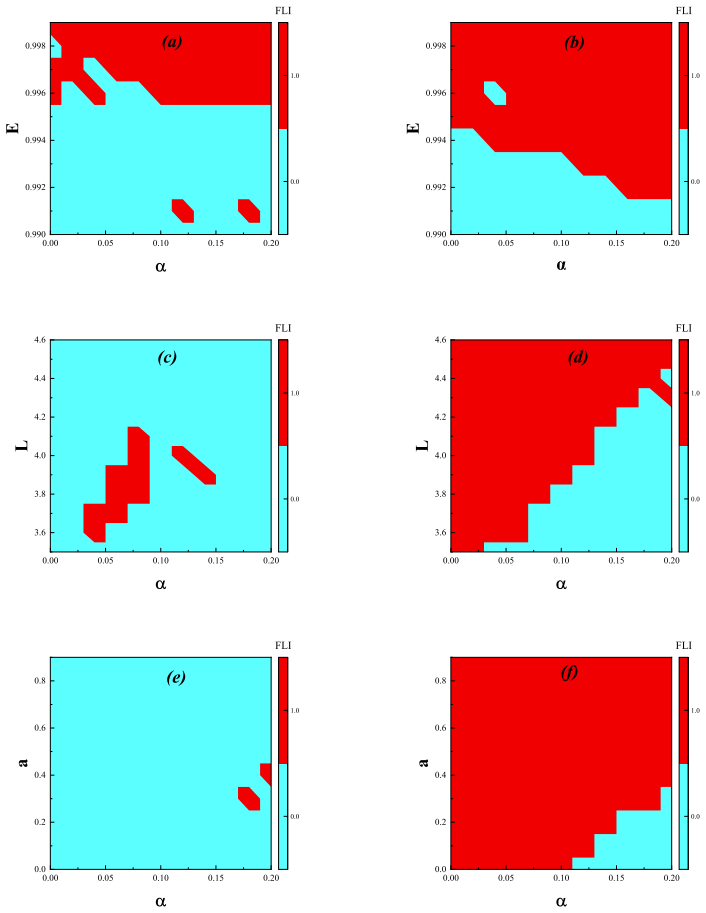
The central claim is that the magnetized Kerr-MOG Hamiltonian, after the time transformation $d\tau = (\Sigma/r^2)\,dw$, splits into five analytically solvable parts, so explicit symplectic integrators S2, S4, and PRK64 can be constructed; PRK64 preserves the Hamiltonian to roughly two orders of magnitude better than S4 over $10^7$ steps. With that integrator, the paper states that FLI and Poincaré sections show order-to-chaos transitions driven by $E$, $\beta$, and $\alpha$, and chaos-to-order transitions driven by $a$ and $L$. The main conclusions are qualitative: the chaotic area increases as $E$, $\beta$, or $\alpha$ increases, but $a$ and $L$ act in the opposite direction, and in two-parameter scans $a$ and $L$ play the major role.
Load-bearing premise
The conclusions rest on classifying each orbit by comparing its Fast Lyapunov Indicator to a threshold chosen separately for each figure (8, 10, 12, 20, 30, or 50) after a single run with step size $h=1$ and integration time $w=10^7$; if those thresholds or that step size mislabel even some orbits, the claimed monotonic trends in chaos could shift.
Editorial extensions
If this is right
- Long integrations of charged-particle motion around Kerr-MOG black holes can be performed explicitly and symplectically, avoiding the pseudo-chaos that energy drift causes in ordinary integrators.
- The claimed phase diagram predicts where regular and chaotic orbits sit as functions of $E$, $L$, $\beta$, $a$, and $\alpha$, so later studies can select parameter regions that isolate a single dynamical mechanism.
- Two-parameter scans imply that spin and angular momentum, rather than the MOG parameter, control whether simultaneous parameter changes suppress chaos.
- Because $\alpha$ affects chaos only mildly, orbital chaos is likely to be a weak probe of MOG compared with changes in spin and magnetic field strength.
- The same splitting-and-composition strategy should carry over to other stationary axisymmetric spacetimes whose Hamiltonians admit a similar time transformation.
Reading between the lines
- Editorial: applying a threshold-independent chaos indicator such as the 0-1 test or finite-time Lyapunov exponents to the same orbits could test whether the monotonic trends survive without the ad hoc FLI cutoffs of 8, 10, 12, 20, 30, and 50.
- Editorial: if the trends hold, one could try to connect the phase diagram to astrophysical observables such as variability of accretion flows or hotspots, where spin would dominate the chaotic signature and $\alpha$ would be hard to constrain.
- Editorial: the same five-term splitting with PRK64 coefficients could be reused for other modified-gravity or external-field backgrounds, provided their Hamiltonians reduce to the same split structure.
- Editorial: a step-size convergence study with $h<1$ would clarify whether the reported thresholds, such as $E\approx 0.9933$ at $r=11$, are physical boundaries or numerical artifacts of the single step size $h=1$.
Editorial analysis
A structured set of objections, weighed in public.
Referee Report
Summary. The paper constructs explicit symplectic integrators for a charged test particle around a magnetized Kerr-MOG black hole. The authors apply a time transformation to the Hamiltonian, split it into five integrable components, and build three explicit integrators (S2, S4, and PRK64), reporting that PRK64 has the smallest Hamiltonian error. They then use Poincar\'e sections and Fast Lyapunov Indicator (FLI) maps to classify orbits as regular or chaotic for various parameter values. The central physical claims are that the chaotic region expands with increasing energy E, magnetic field parameter β, and MOG parameter α, while it contracts with increasing angular momentum L and spin a, and that in simultaneous two-parameter scans a and L play the dominant role.
Significance. If the numerical evidence is sound, the paper would provide a useful explicit symplectic integrator for this modified-gravity spacetime and a first systematic phase-diagram study of its chaotic dynamics. The Hamiltonian splitting in Eqs. (43)-(48) is a nontrivial construction, and the explicit analytic solutions for the five sub-Hamiltonians are a genuine technical contribution. The energy-error comparison of S2, S4, and PRK64 at fixed step size is a useful benchmark. However, the paper does not ship code or machine-checked proofs, and its main qualitative conclusions rest on FLI threshold choices that are not justified or calibrated; the numerical robustness of the chaos trends is therefore not yet established.
major comments (3)
- [§IV.A, §IV.B, Figs. 3 and 6–8] The FLI thresholds are chosen separately for each figure (values 8, 10, 12, 20, 30, and 50) with no calibration to reference orbits and no fixed, universal criterion. Since the labels 'regular' and 'chaotic' are obtained by thresholding the FLI maps, and the paper's central conclusions are qualitative statements about the size and location of chaotic regions, a different threshold could reclassify marginal orbits and change the reported trends. Please provide a calibration procedure using reference regular and chaotic orbits, and add a robustness check showing that the conclusions are stable over a range of thresholds.
- [§III.B and §IV] All simulations use a single step size h=1 and an integration time of w=10^7, and no step-size convergence study or comparison with an independent integrator is reported. The FLI is a numerical quantity, so a smaller step size or a different integration method could reclassify weakly chaotic or sticky orbits. Please add convergence tests (for example h=0.5, 0.25 or energy-error scaling) and, where possible, an independent adaptive-integrator baseline for a representative subset of orbits.
- [§IV.B and §V] The conclusion that 'a and L play a major role' in the simultaneous variation case is not supported by the evidence shown. Fig. 7(b) reports that increasing L promotes chaos at r=110, which is opposite to the single-parameter conclusion of Fig. 5(b); the explanation that β dominates is asserted rather than derived. In addition, the two-parameter scans are compared only by visual inspection, with no quantitative measure of parameter influence, and the third parameters are fixed at nominal values without sensitivity analysis. Please quantify the sensitivity (for example, the fraction of chaotic grid points as a function of each parameter) and reconcile the L behavior before drawing the parameter-dominance conclusion.
minor comments (5)
- [§IV, Fig. 1(d)] With the definition FLI = log10(d(w)/d(0)), a regular orbit has d(w) growing at most linearly and hence FLI growing logarithmically with time, while a chaotic orbit has d(w) growing exponentially and FLI growing linearly. The text says the opposite; please correct this description.
- [Introduction and §III.A] The statement that symplectic algorithms 'rigorously preserve energy' is an overstatement; symplectic integrators preserve the symplectic form and have bounded energy error, not exact energy conservation. Please rephrase.
- [§IV.A, Fig. 3(a)] The thresholds quoted in the text are inconsistent: the values E≤0.993 and E≥0.9969 do not match the stated transition values E=0.9933 and E=0.9966. Please make these values consistent.
- [Throughout] The notation 'P RK64' appears with a space; use 'PRK64' consistently.
- [Data and Code Availability] Given the numerical nature of the claims, depositing the code used to produce the FLI maps and Poincar\'e sections would improve reproducibility; the current statement only promises availability on reasonable request.
Circularity Check
No circularity: the paper's results are numerical experiments on an externally sourced Hamiltonian; no fitted parameter is renamed as a prediction and no load-bearing self-citation chain forces the conclusions.
full rationale
The paper's derivation chain consists of importing the Kerr-MOG Hamiltonian and the Wald four-potential from prior literature ([21], [55], [56]), splitting the transformed Hamiltonian into five explicitly integrable parts, composing standard second- and fourth-order symplectic integrators, and then integrating orbits with the PRK64 coefficients taken from [60]. None of these inputs is defined in terms of the paper's output; the output is a set of numerical classifications (regular vs chaotic) obtained from Poincaré sections and FLIs. The accuracy comparison between S2, S4, and PRK64 is a direct numerical measurement of energy error on the same Hamiltonian, not a fit renamed as a prediction. The self-citations (e.g., [43], [47], [53], [61], [63]) are methodological references to earlier symplectic-integrator and chaos-indicator work; they are not invoked as a uniqueness theorem, and they do not by themselves force the qualitative conclusions about E, L, β, a, and α. The FLI thresholds do vary by figure (8, 10, 12, 20, 30, 50), and the two-parameter scan contains an apparent inconsistency between Fig. 5(b) and Fig. 7(b), but threshold choice and the absence of a step-size convergence study are robustness/correctness concerns, not circular reductions: the classification is not identically equal to its input by construction. No specific equation or fitted parameter can be exhibited as the same object as the claimed result, so the honest finding is no circularity.
Assumptions & free parameters
free parameters (3)
- FLI threshold =
8, 10, 12, 20, 30, 50 (per figure)
- Integration time w =
10^7 virtual-time steps
- Step size h =
1
assumptions (3)
- domain assumption The Kerr-MOG metric and the MOG vector field (Eqs. 13-15, 19) are the correct description of a rotating black hole in STVG/MOG theory.
- domain assumption The Wald electromagnetic four-potential (Eqs. 20-21) represents a physically valid asymptotically uniform magnetic field in the Kerr-MOG spacetime.
- standard math The time transformation dτ = (Σ/r^2) dw and the decomposition into five integrable subsystems exactly preserve the original Hamiltonian dynamics.
Cite this review
Pith. "Pith review of Chaotic motion of the charged test particle in a Kerr-MOG black hole with explicit symplectic algorithms." pith.science (2026). https://pith.science/paper/B2H4LBSV
@misc{pith2026241206122,
  author       = {Pith},
  title        = {Pith review of: Chaotic motion of the charged test particle in a Kerr-MOG black hole with explicit symplectic algorithms},
  year         = {2026},
  howpublished = {\url{https://pith.science/paper/B2H4LBSV}},
  note         = {Machine review of arXiv:2412.06122}
}
abstract
The Kerr-MOG black hole has recently attracted significant research attention and has been extensively applied in various fields. To accurately characterize the long-term dynamical evolution of charged particles around Kerr-MOG black hole, it is essential to utilize numerical algorithms that are high-precision, stable, and capable of preserving the inherent physical structural properties. In this study, we employ explicit symplectic algorithms combined with the Hamiltonian splitting technique to numerically solve the equations of motion for charged particles. Initially, by decomposing the Hamiltonian into five integrable components, three distinct explicit symplectic algorithms ($S2$, $S4$, and $PR{K_6}4$) are constructed. Numerical experiments reveal that the $PR{K_6}4$ algorithm achieves superior accuracy. Subsequently, we utilize Poincar\'e sections and the Fast Lyapunov Indicator (FLI) to investigate the dynamic evolution of the particle. Our numerical results demonstrate that the energy $E$, angular momentum $L$, magnetic field parameter $\beta$, black hole spin parameter $a$, and MOG parameter $\alpha$ all significantly influence the particle's motion. Specifically, the chaotic region expands with increases in $E$, $\beta$, or $\alpha$, but contracts with increases in $a$ or $L$. Furthermore, when any two of these five parameters are varied simultaneously, it becomes evident that $a$ and $L$ predominantly dictate the system's behavior. This study not only offers novel insights into the chaotic dynamics associated with Kerr-MOG black holes but also extends the application of symplectic algorithms in strong gravitational field.
Figures


Figures from the paper (5 more)


Forward citations
Cited by 1 Pith paper
-
Rational Orbits and Gravitational Waves in Static Spherical Spacetimes: An Open-Source Numerical Framework
Open-source numerical package for rational orbits and gravitational waves in static spherically symmetric spacetimes, validated on Schwarzschild and applied to an IMBH-Sgr A* EMRI.
Reference graph
Works this paper leans on
-
[1]
Blandford-Znajek jets in MOdified Gravity
F. Camilloni, T. Harmark, M. Orselli, and M. J. Rodriguez, “Blandford-Znajek jets in MOd- ified Gravity,” JCAP 01 (2024), 047, doi:10.1088/1475-7516/2024/01/047, [arXiv:2307.06878 [gr-qc]]
work page Pith review arXiv 2024
-
[2]
and δ = 1−2γ. Then, a fourth-order symplectic integrator is constructed as SH 4 (h) = SH 2 (γh) ◦ SH 2 (δh) ◦ SH 2 (γh). (52) By canceling lower-order error terms, this method reduces the global error to O(h4), making it suitable for medium-to-long-term high-precision simulations. For further error optimization, we adopt P RK64 algorithm proposed by Zhou ...
-
[3]
Black hole merger estimates in Einstein-Maxwell and Einstein-Maxwell-dilaton gravity
P. Jai-akson, A. Chatrabhuti, O. Evnin, and L. Lehner, “Black hole merger estimates in Einstein-Maxwell and Einstein-Maxwell-dilaton gravity,” Phys. Rev. D 96, no.4, 044031 (2017), doi:10.1103/PhysRevD.96.044031 [arXiv:1706.06519 [gr-qc]]
work page Pith review arXiv 2017
-
[4]
R. Caldwell and M. Kamionkowski, “Dark matter and dark energy,” Nature 458, 587–589 (2009), doi:10.1038/458587a
doi:10.1038/458587a 2009
-
[5]
The Cosmological Constant and Dark Energy,
P. J. E. Peebles and B. Ratra, “The Cosmological Constant and Dark Energy,” Rev. Mod. Phys. 75, 559–606 (2003), doi:10.1103/RevModPhys.75.559 [arXiv:astro-ph/0207347 [astro- ph]]
arXiv 2003
-
[6]
A Modification of the Newtonian dynamics as a possible alternative to the hidden mass hypothesis,
M. Milgrom, “A Modification of the Newtonian dynamics as a possible alternative to the hidden mass hypothesis,” Astrophys. J. 270, 365–370 (1983), doi:10.1086/161130
doi:10.1086/161130 1983
-
[7]
Scalar-tensor-vector gravity theory,
J. W. Moffat, “Scalar-tensor-vector gravity theory,” JCAP 03, 004 (2006), doi:10.1088/1475- 7516/2006/03/004 [arXiv:gr-qc/0506021 [gr-qc]]. 24
arXiv 2006
-
[8]
The MOG weak field approximation and observational test of galaxy rotation curves,
J. W. Moffat and S. Rahvar, “The MOG weak field approximation and observational test of galaxy rotation curves,” Mon. Not. Roy. Astron. Soc. 436, 1439–1451 (2013), doi:10.1093/mnras/stt1670 [arXiv:1306.6383 [astro-ph.GA]]
arXiv 2013
Show all 65 references
-
[9]
The MOG weak field approximation – II. Observational test of Chandra X-ray clusters,
J. W. Moffat and S. Rahvar, “The MOG weak field approximation – II. Observational test of Chandra X-ray clusters,” Mon. Not. Roy. Astron. Soc. 441, 3724–3732 (2014), doi:10.1093/mnras/stu855 [arXiv:1309.5077 [astro-ph.CO]]
2014 arXiv
-
[10]
Galaxy cluster masses without non-baryonic dark mat- ter,
J. R. Brownstein and J. W. Moffat, “Galaxy cluster masses without non-baryonic dark mat- ter,” Mon. Not. Roy. Astron. Soc. 367, 527–540 (2006), doi:10.1111/j.1365-2966.2006.09996.x [arXiv:astro-ph/0507222 [astro-ph]]
2006
-
[11]
Rotational velocity curves in the Milky Way as a test of modified gravity,
J. W. Moffat and V. T. Toth, “Rotational velocity curves in the Milky Way as a test of modified gravity,” Phys. Rev. D 91, 043004 (2015), doi:10.1103/PhysRevD.91.043004 [arXiv:1411.6701 [astro-ph.GA]]
2015 arXiv
-
[12]
Structure growth and the CMB in modified gravity (MOG),
J. W. Moffat, “Structure growth and the CMB in modified gravity (MOG),” [arXiv:1409.0853 [astro-ph.CO]]
-
[13]
Scalar and vector field constraints, deflection of light and lensing in modified gravity (MOG),
J. W. Moffat, “Scalar and vector field constraints, deflection of light and lensing in modified gravity (MOG),” [arXiv:1410.2464 [gr-qc]]
-
[14]
Modified gravity black holes and their observable shadows,
J. W. Moffat, “Modified gravity black holes and their observable shadows,” Eur. Phys. J. C 75, 130 (2015), doi:10.1140/epjc/s10052-015-3352-6 [arXiv:1502.01677 [gr-qc]]
2015 arXiv
-
[15]
Innermost stable circular orbit of Kerr-MOG black hole,
H. C. Lee and Y. J. Han, “Innermost stable circular orbit of Kerr-MOG black hole,”Eur. Phys. J. C 77 (2017) no.10, 655, doi:10.1140/epjc/s10052-017-5152-7 [arXiv:1704.02740 [gr-qc]]
2017 arXiv
-
[16]
Observational signatures of near-extremal Kerr-like black holes in a modified gravity theory at the Event Horizon Telescope,
M. Y. Guo, N. A. Obers, and H. P. Yan, “Observational signatures of near-extremal Kerr-like black holes in a modified gravity theory at the Event Horizon Telescope,” Phys. Rev. D 98, no. 8, 084063 (2018), doi:10.1103/PhysRevD.98.084063, [arXiv:1806.05249 [gr-qc]]
2018 arXiv
-
[17]
Image of a Kerr- Melvin black hole with a thin accretion disk,
Y. H. Hou, Z. Y. Zhang, H. P. Yan, M. Y. Guo, and B. Chen, “Image of a Kerr- Melvin black hole with a thin accretion disk,” Phys. Rev. D 106, no. 6, 064058 (2022), doi:10.1103/PhysRevD.106.064058, [arXiv:2206.13744 [gr-qc]]
2022 arXiv
-
[18]
Geodesic motion in Euclidean Schwarzschild geometry,
E. Battista and G. Esposito, “Geodesic motion in Euclidean Schwarzschild geometry,” Eur. Phys. J. C 82, no. 12, 1088 (2022), doi:10.1140/epjc/s10052-022-11070-w, [arXiv:2202.03763 [gr-qc]]
2022 arXiv
-
[19]
Chaos Bound and its violation in Black p-brane,
P. Dutta, K. L. Panigrahi, and B. Singh, “Chaos Bound and its violation in Black p-brane,” [arXiv:2408.14056 [hep-th]]. 25
-
[20]
Presence of horizon makes particle motion chaotic,
S. Dalui, B. R. Majhi, and P. Mishra, “Presence of horizon makes particle motion chaotic,” Phys. Lett. B 788 (2019), 486–493, doi:10.1016/j.physletb.2018.11.050, [arXiv:1803.06527 [gr- qc]]
2019 arXiv
-
[21]
Induction of chaotic fluctuations in particle dynam- ics in a uniformly accelerated frame,
S. Dalui, B. R. Majhi, and P. Mishra, “Induction of chaotic fluctuations in particle dynam- ics in a uniformly accelerated frame,” Int. J. Mod. Phys. A 35, no. 18, 2050081 (2020), doi:10.1142/S0217751X20500815, [arXiv:1904.11760 [gr-qc]]
2020 arXiv
-
[22]
Black Holes in Modified Gravity (MOG),
J. W. Moffat, “Black Holes in Modified Gravity (MOG),” Eur. Phys. J. C 75, 175 (2015), doi:10.1140/epjc/s10052-015-3405-x [arXiv:1412.5424 [gr-qc]]
2015 arXiv
-
[23]
Horizon-scale tests of gravity theories and fundamental physics from the Event Horizon Telescope image of Sagittarius A∗,
S. Vagnozzi, R. Roy, Y. D. Tsai, L. Visinelli, M. Afrin, A. Allahyari, P. Bambhaniya, D. Dey, S. G. Ghosh and P. S. Joshi, et al. “Horizon-scale tests of gravity theories and fundamental physics from the Event Horizon Telescope image of Sagittarius A∗,” Class. Quantum Grav. 40...
2023 arXiv
-
[24]
Velocity scaling method to correct individual Kepler energies,
D. Z. Ma, X. Wu, and J. F. Zhu, “Velocity scaling method to correct individual Kepler energies,” New Astron. 13, no. 4, 216–223 (2008), doi:10.1016/j.newast.2007.09.002
2008 doi
-
[25]
Symplectic integrators for Hamiltonian problems: an overview,
J. M. Sanz-Serna, “Symplectic integrators for Hamiltonian problems: an overview,” Acta Numer. 1, 243-286 (1992), doi:10.1017/S0962492900002282
1992 doi
-
[26]
Discrete mechanics and variational integrators,
J. E. Marsden and M. West, “Discrete mechanics and variational integrators,” Acta Numer. 10, 357-514 (2001), doi:10.1017/S096249290100006X
2001 doi
-
[27]
Numerical Hamiltonian Problems,
J. M. Sanz-Serna and M. P. Calvo, “Numerical Hamiltonian Problems,” Dover Publications, Inc. (1994)
1994
-
[28]
On difference schemes and symplectic geometry,
K. Feng, “On difference schemes and symplectic geometry,” in Proceedings of the 5th Inter- national Symposium on Differential Geometry and Differential Equations (1984)
1984
-
[29]
A Canonical Integration Technique,
R. D. Ruth, “A Canonical Integration Technique,” IEEE Trans. Nucl. Sci. 30, no. 4, 2669– 2671 (1983), doi:10.1109/TNS.1983.4332919
1983
-
[30]
Symplectic integrator for general near-integrable Hamiltonian system,
X. H. Liao, “Symplectic integrator for general near-integrable Hamiltonian system,” Celestial Mech. Dyn. Astron. 66, no. 3, 243–253 (1996), doi:10.1007/BF00049381
1996 doi
-
[31]
Fractal decomposition of exponential operators with applications to many- body theories and Monte Carlo simulations,
M. Suzuki, “Fractal decomposition of exponential operators with applications to many- body theories and Monte Carlo simulations,” Phys. Lett. A 146, no. 6, 319–323 (1990), doi:10.1016/0375-9601(90)90962-N
1990 doi
-
[32]
Symplectic structure of post-Newtonian Hamiltonian for spinning compact binaries,
X. Wu and Y. Xie, “Symplectic structure of post-Newtonian Hamiltonian for spinning compact binaries,” Phys. Rev. D 81, no. 8, 084045 (2010), doi:10.1103/PhysRevD.81.084045. 26
2010 doi
-
[33]
Manifold corrections on spinning compact binaries,
S. Y. Zhong and X. Wu, “Manifold corrections on spinning compact binaries,” Phys. Rev. D 81, no. 10, 104037 (2010), doi:10.1103/PhysRevD.81.104037
2010 doi
-
[34]
Global symplectic structure-preserving integrators for spinning compact binaries,
S. Y. Zhong, X. Wu, S. Q. Liu, and X. F. Deng, “Global symplectic structure-preserving integrators for spinning compact binaries,” Phys. Rev. D 82, no. 12, 124040 (2010), doi:10.1103/PhysRevD.82.124040
2010 doi
-
[35]
Regular dynamics of canonical post-Newtonian Hamiltonian for spinning compact binaries with next-to-leading order spin-orbit interactions,
X. Wu and S. Y. Zhong, “Regular dynamics of canonical post-Newtonian Hamiltonian for spinning compact binaries with next-to-leading order spin-orbit interactions,” Gen. Rel. Grav. 43, no. 8, 2185–2198 (2011), doi:10.1007/s10714-011-1171-0
2011 doi
-
[36]
Dynamics of spin effects of compact binaries,
L. J. Mei, M. J. Ju, X. Wu, and S. Q. Liu, “Dynamics of spin effects of compact binaries,” Mon. Not. R. Astron. Soc. 435, no. 3, 2246–2255 (2013), doi:10.1093/mnras/stt1441
2013 doi
-
[37]
On preference of Yoshida construction over Forest– Ruth fourth-order symplectic algorithm,
L. J. Mei, X. Wu, and F. Y. Liu, “On preference of Yoshida construction over Forest– Ruth fourth-order symplectic algorithm,” Eur. Phys. J. C 73, no. 5, 2413 (2013), doi:10.1140/epjc/s10052-013-2413-y
2013 doi
-
[38]
On post-Newtonian orbits and the Galactic-center stars,
M. Preto and P. Saha, “On post-Newtonian orbits and the Galactic-center stars,”Astrophys. J. 703, 1743–1751 (2009), doi:10.1088/0004-637X/703/2/1743 [arXiv:0906.2226 [astro-ph.GA]]
2009 arXiv
-
[39]
Splitting methods,
R. I. McLachlan and G. R. W. Quispel, “Splitting methods,” Acta Numer. 11, 341–434 (2002), doi:10.1017/S0962492902000053
2002 doi
-
[40]
Symplectic maps for the n-body problem,
J. Wisdom and M. Holman, “Symplectic maps for the n-body problem,” Astron. J. 102, 1528–1538 (1991), doi:10.1086/115978
1991 doi
-
[41]
Symplectic integrators from composite operator factorizations,
S. A. Chin, “Symplectic integrators from composite operator factorizations,” Phys. Lett. A 226, no. 6, 344–348 (1997), doi:10.1016/S0375-9601(97)00003-0
1997 doi
-
[42]
Forward Symplectic Integrators for Solving Gravitational Few- Body Problems,
S. A. Chin and C. R. Chen, “Forward Symplectic Integrators for Solving Gravitational Few- Body Problems,” Celest. Mech. Dyn. Astron. 91, no. 3-4, 301–322 (2005), doi:10.1007/s10569- 004-4622-z [arXiv:astro-ph/0304223 [astro-ph]]
2005 arXiv
-
[43]
Symplectic integrators with potential derivatives to third order,
W. Sun, X. Wu, and G. Q. Huang, “Symplectic integrators with potential derivatives to third order,” Res. Astron. Astrophys. 11, no. 3, 353–368 (2021), doi:10.1088/1674-4527/11/3/009
2021 doi
-
[44]
Explicit Symplectic Integrators with Adaptive Time Steps in Curved Spacetimes,
X. Wu, Y. Wang, W. Sun, F. Y. Liu, and D. Z. Ma, “Explicit Symplectic Integrators with Adaptive Time Steps in Curved Spacetimes,” Astrophys. J. Suppl. 275, no. 2, 31 (2024), doi:10.3847/1538-4365/ad8351 [arXiv:2412.01045 [gr-qc]]
2024 arXiv
-
[45]
Construction of Explicit Symplectic Integrators in General Relativity. I. Schwarzschild Black Holes,
Y. Wang, W. Sun, F. Y. Liu, and X. Wu, “Construction of Explicit Symplectic Integrators in General Relativity. I. Schwarzschild Black Holes,” Astrophys. J. 907, no. 2, 66 (2021), 27 doi:10.3847/1538-4357/abcb8d [arXiv:2102.00373 [gr-qc]]
2021 arXiv
-
[46]
Construction of Explicit Symplectic Integrators in General Relativity. II. Reissner–Nordstr¨ om Black Holes,
Y. Wang, W. Sun, F. Y. Liu, and X. Wu, “Construction of Explicit Symplectic Integrators in General Relativity. II. Reissner–Nordstr¨ om Black Holes,”Astrophys. J. 909, no. 1, 22 (2021), doi:10.3847/1538-4357/abd701 [arXiv:2103.02864 [gr-qc]]
2021 arXiv
-
[47]
Construction of Explicit Symplectic Integrators in General Relativity. III. Reissner–Nordstr¨ om-(anti)-de Sitter Black Holes,
Y. Wang, W. Sun, F. Y. Liu, and X. Wu, “Construction of Explicit Symplectic Integrators in General Relativity. III. Reissner–Nordstr¨ om-(anti)-de Sitter Black Holes,” Astrophys. J. Suppl. 254, no. 1, 8 (2021), doi:10.3847/1538-4365/abf116 [arXiv:2103.12272 [gr-qc]]
2021 arXiv
-
[48]
Construction of Explicit Symplectic Integra- tors in General Relativity. IV. Kerr Black Holes,
X. Wu, Y. Wang, W. Sun, and F. Y. Liu, “Construction of Explicit Symplectic Integra- tors in General Relativity. IV. Kerr Black Holes,” Astrophys. J. 914, no. 1, 63 (2021), doi:10.3847/1538-4357/abfc45 [arXiv:2106.12356 [gr-qc]]
2021 arXiv
-
[49]
Practical Symplectic Methods with Time Transformation for the Few-Body Prob- lem,
S. Mikkola, “Practical Symplectic Methods with Time Transformation for the Few-Body Prob- lem,” Celest. Mech. Dyn. Astron. 67, no. 2, 145–165 (1997), doi:10.1023/A:1008217427749
1997 doi
-
[50]
Chaos in a Magnetized Brane-World Spacetime Using Explicit Symplectic Integrators,
A. R. Hu and G. Q. Huang, “Chaos in a Magnetized Brane-World Spacetime Using Explicit Symplectic Integrators,” Universe 8, no. 7, 369 (2022), doi:10.3390/universe8070369
2022 doi
-
[51]
Chaotic Motion of Charged Test Particles in a Magnetized Schwarzschild Black Hole,
N. Y. Zhou, H. X. Zhang, X. Sun, W. F. Liu, and D. Li, “Chaotic Motion of Charged Test Particles in a Magnetized Schwarzschild Black Hole,” Acta Astron. Sin. 64, no. 4, 39 (2023), doi:10.15940/j.cnki.0001-5245.2023.04.002
2023
-
[52]
Electromagnetic field and chaotic charged-particle mo- tion around hairy black holes in Horndeski gravity,
W. F. Cao, X. Wu, and J. Lyu, “Electromagnetic field and chaotic charged-particle mo- tion around hairy black holes in Horndeski gravity,” Eur. Phys. J. C 84, no. 4, 435 (2024), doi:10.1140/epjc/s10052-024-12804-8 [arXiv:2404.19225 [gr-qc]]
2024 arXiv
-
[53]
Effects of Two Quantum Correction Parameters on Chaotic Dynamics of Particles near Renormalized Group Improved Schwarzschild Black Holes,
J. J. Lu and X. Wu, “Effects of Two Quantum Correction Parameters on Chaotic Dynamics of Particles near Renormalized Group Improved Schwarzschild Black Holes,”Universe 10, no. 7, 277 (2024), doi:10.3390/universe10070277 [arXiv:2406.18943 [gr-qc]]
2024 arXiv
-
[54]
Chaos from the ring string in a Gauss-Bonnet black hole in AdS5 space,
D. Z. Ma, J. P. Wu, and J. F. Zhang, “Chaos from the ring string in a Gauss-Bonnet black hole in AdS5 space,” Phys. Rev. D 89, no. 8, 086011 (2014), doi:10.1103/PhysRevD.89.086011 [arXiv:1405.3563 [hep-th]]
2014 arXiv
-
[55]
Black hole thermodynamics in Modified Gravity (MOG),
J. R. Mureika, J. W. Moffat, and M. Faizal, “Black hole thermodynamics in Modified Gravity (MOG),” Phys. Lett. B 757, 528-536 (2016), doi:10.1016/j.physletb.2016.04.041 [arXiv:1504.08226 [gr-qc]]
2016 arXiv
-
[56]
Charged particle motion and acceleration around Kerr-MOG black hole,
S. U. Khan, J. Rayimbaev, and Z. Stuchl ´ ık, “Charged particle motion and acceleration around Kerr-MOG black hole,” [arXiv:2311.16936 [gr-qc]]. 28
-
[57]
Black hole in a uniform magnetic field,
R. M. Wald, “Black hole in a uniform magnetic field,” Phys. Rev. D 10, no. 6, 1680–1685 (1974), doi:10.1103/PhysRevD.10.1680
1974 doi
-
[58]
On correctors of symplectic integrators,
X. Wu, T. Y. Huang, and X. S. Wan, “On correctors of symplectic integrators,” Chin. Astron. Astrophys. 27, no.1, 114–125 (2003) doi:10.1016/S0275-1062(03)80014-0
2003 doi
-
[59]
Symplectic Integration of Hamiltonian Systems,
E. Hairer, G. Wanner, and C. Lubich, “Symplectic Integration of Hamiltonian Systems,” In: Geometric Numerical Integration , Springer Series in Computational Mathematics, 31, Springer, Berlin, Heidelberg (2006), doi:10.1007/3-540-30666-8 6
2006 doi
-
[60]
Construction of higher order symplectic integrators,
H. Yoshida, “Construction of higher order symplectic integrators,” Phys. Lett. A 150, no. 5, 262–268 (1990), doi:10.1016/0375-9601(90)90092-3
1990 doi
-
[61]
A Note on the Construction of Explicit Symplectic Integrators for Schwarzschild Spacetimes,
N. Y. Zhou, H. X. Zhang, W. F. Liu, and X. Wu, “A Note on the Construction of Explicit Symplectic Integrators for Schwarzschild Spacetimes,” Astrophys. J. 927, no. 2, 160 (2022), doi:10.3847/1538-4357/ac497f
2022 doi
-
[62]
Chaotic dynamics of string around charged black brane with hyperscaling violation,
D. Z. Ma, D. Zhang, G. Y. Fu, and J. P. Wu, “Chaotic dynamics of string around charged black brane with hyperscaling violation,” JHEP 01, 103 (2020), doi:10.1007/JHEP01(2020)103 [arXiv:1911.09913 [hep-th]]
2020 arXiv
-
[63]
On the Structure of Symplectic Mappings. The Fast Lya- punov Indicator: a Very Sensitive Tool,
C. Froeschl´ e and E. Lega, “On the Structure of Symplectic Mappings. The Fast Lya- punov Indicator: a Very Sensitive Tool,” Celest. Mech. Dyn. Astron. 78, 167–195 (2000), doi:10.1023/A:1011141018230
2000 doi
-
[64]
Lyapunov indices with two nearby trajectories in a curved spacetime,
X. Wu, T. Y. Huang, and H. Zhang, “Lyapunov indices with two nearby trajectories in a curved spacetime,” Phys. Rev. D 74, 083001 (2006), doi:10.1103/PhysRevD.74.083001 [arXiv:1006.5251 [gr-qc]]
2006 arXiv
-
[65]
Secular dynamics of a planar model of the Sun-Jupiter-Saturn-Uranus system; effective stability in the light of Kolmogorov and Nekhoro- shev theories,
A. Giorgilli, U. Locatelli, and M. Sansottera, “Secular dynamics of a planar model of the Sun-Jupiter-Saturn-Uranus system; effective stability in the light of Kolmogorov and Nekhoro- shev theories,” Regul. Chaotic Dyn. 22, no. 1, 54–77 (2017), doi:10.1134/S156035471701004X [a...
2017 arXiv
Reviewed August 11, 2026 · model on record in the stance chip above.
Discussion (0). Continue with ORCID to comment.