REVIEW 2 major objections 5 minor 3 cited by
Nonrelativistic Proca stars: Spherical stationary and multi-frequency states
T0 review · 2 major / 5 minor · reviewed 2026-08-11 · deepseek-v4-flash
Pith's one-line read Proca star ground states are spherical and polarized.
desk verdict Solid variational ground-state theorem, honest mapping to known boson stars, but the multi-frequency continuum is confined to the λs=0 fine-tuned surface and not yet numerically verified. read the letter →
The pith
A machine-rendered reading of the paper's core claim, the machinery that carries it, and where it could break.
The reading
What carries the argument
The load-bearing object is the $s=1$ Gross-Pitaevskii-Poisson system, a nonlinear Schrodinger-type equation for a three-component complex vector field $\vec{\psi}(t,\vec{x})$ coupled to a Newtonian potential $U$ satisfying Poisson's equation, with two self-interaction parameters $\lambda_n$ (density-density) and $\lambda_s$ (spin-spin). The argument runs through the energy functional $E=T+\lambda_n F_n+\lambda_s F_s-D$, its behaviour under the scaling $\vec{\psi}\mapsto \nu^{3/2}\vec{\psi}(\nu\vec{x})$, and the effective coupling $\lambda_0$ defined in Eq. (32), which decides whether $E$ is bounded below at fixed $N$. For the minimizer claim, the paper uses a polarization decomposition with the inequality $\lambda_n F_n+\lambda_s F_s\ge \lambda_0 F_n$ and the symmetric decreasing rearrangement to reduce any minimizer to a spherical, constantly polarized profile. For the multi-frequency sector, the machinery is the accidental U(3) symmetry present when $\lambda_s=0$, with the conserved tensor $\hat{Q}=\int \vec{\psi}^*\otimes\vec{\psi}\,dV$, whose diagonalization turns the equilibrium equations into a nonlinear multi-eigenvalue problem with frequencies $E_\lambda$; the Sturm oscillation theorem then orders the radial components by node number and shows that components with equal node numbers are proportional, hence stationary.
What would settle it
Adapt the shooting code to a small nonzero $\lambda_s$ (for instance $\lambda_s=10^{-6}\lambda_n$) and search for a branch of multi-frequency solutions of Eq. (48) with distinct frequencies $E_x\neq E_y$; a persistent branch would falsify the claim that multi-frequency states require $\lambda_s=0$. Alternatively, find a global minimizer for $\lambda_0\ge 0$ that is not a stationary, spherically symmetric constant-polarization state, for example a multi-frequency or radially polarized configuration with energy below the constantly polarized nodeless state at the same $N$.
Extended reading notes
Core claim
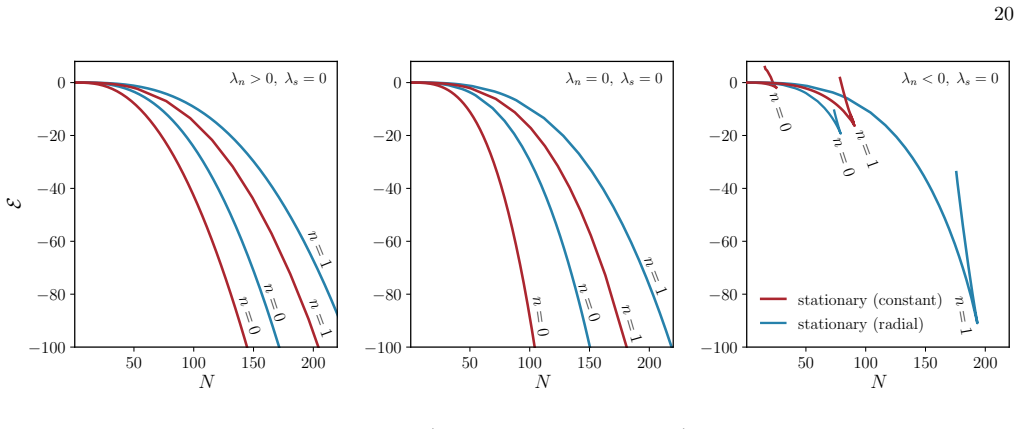
On the paper's own terms: for the $s=1$ Gross-Pitaevskii-Poisson system describing a nonrelativistic self-gravitating vector field, all equilibrium configurations in the generic sector ($\lambda_s\neq 0$) are stationary states $\vec{\psi}(t,\vec{x})=e^{-iEt}\sigma(r)\hat{\epsilon}$, while in the symmetry-enhanced sector ($\lambda_s=0$) there are also multi-frequency states $\vec{\psi}(t,\vec{x})=\sum_{\lambda=1}^3 e^{-iE_\lambda t}\sigma_\lambda(r)\hat{e}_\lambda$. The proof shows that when $\lambda_0\ge 0$ the energy functional at fixed $N$ is bounded below and attains its minimum at a stationary, spherically symmetric state of constant polarization with monotonically decreasing positive radial profile; for $\lambda_s>0$ the polarization is linear, for $\lambda_s<0$ it is circular, and in the free theory ($\lambda_n=\lambda_s=0$) this ground state is unique up to translations and rigid unitary transformations. In the symmetry-enhanced sector, multi-frequency solutions are shown to fill regions of the mass-radius and energy-particle-number diagrams, bounded by the $n=0$ and $n=1$ constant-polarization stationary states; the paper constructs examples numerically, computes their charges and energies, and verifies that the constantly polarized nodeless state has the lowest energy.
Load-bearing premise
The continuum of multi-frequency Proca stars rests on the spin-spin coupling $\lambda_s$ being exactly zero; any nonzero $\lambda_s$, no matter how small, breaks the U(3) symmetry and eliminates those states, although the ground-state theorem itself does not depend on this fine-tuning.
Editorial extensions
If this is right
- For $\lambda_0\ge 0$, a Proca star with fixed particle number always possesses a ground state, and that ground state is spherical, stationary, and constantly polarized with negative energy, providing a candidate stable endpoint for vector dark matter condensation.
- If spin-spin self-interactions are absent ($\lambda_s=0$), equilibrium solutions are not isolated: multi-frequency states form continuous families that interpolate between the $n=0$ and $n=1$ constant-polarization stationary states in the mass-radius and energy diagrams.
- Radially polarized Proca stars are excited states relative to constantly polarized ones when $\lambda_0\ge 0$, so the nonrelativistic limit of the original spherically symmetric relativistic Proca stars is an excited configuration rather than a ground state.
- In the generic sector $\lambda_s\neq 0$, no multi-frequency states exist; only stationary linear, circular, or radial polarizations are possible, and the degeneracy among constant-polarization states is broken.
- Circularly polarized Proca stars carry macroscopic spin angular momentum $\vec{S}=\alpha N\hat{e}_z$ despite a spherically symmetric density, implying the corresponding relativistic rotating stars should be non-spherical.
Reading between the lines
- Beyond the paper: if ultralight vector dark matter has any nonzero spin-spin coupling $\lambda_s$, multi-frequency halos are forbidden, so detecting a stably oscillating multi-frequency core would place an upper bound on $|\lambda_s|$ and effectively confirm an accidental U(3) symmetry in the low-energy theory.
- Beyond the paper: the continuous family of multi-frequency states that links ground and excited stationary states suggests that slow dynamical processes could drive a Proca star from one stationary branch to another; the announced linear-stability analysis should reveal whether these states are orbitally stable or decay toward the ground state.
- Beyond the paper: because constantly polarized Proca stars coincide with $\ell=0$ boson stars (with coupling $\lambda_0$) and radial Proca stars coincide with $\ell=1$ boson stars, existing results on scalar boson star stability, collisions, and gravitational-wave signals can be imported to the vector case at least in the free and $\lambda_s=0$ sectors.
- Beyond the paper: the proof leaves open whether the ground state is unique for $\lambda_0>0$; a systematic numerical search for minimizers with different radial profiles but the same particle number and energy would settle the uniqueness question left open in the paper.
Editorial analysis
A structured set of objections, weighed in public.
Referee Report
Summary. The paper develops a nonrelativistic effective field theory for a selfgravitating, selfinteracting massive vector field, the s=1 Gross-Pitaevskii-Poisson system, and studies its spherically symmetric equilibrium configurations. In the generic sector (λs≠0) the admissible equilibria are stationary, single-frequency states; in the symmetry-enhanced sector (λs=0) the theory acquires an accidental U(3) symmetry and admits, in addition, multi-frequency states whose components oscillate with two or three distinct frequencies. The authors prove that for λ0≥0 (λ0=λn for λs≥0 and λn−|λs| for λs<0) a global minimum of the energy at fixed particle number exists and is a stationary, spherically symmetric, constant-polarization state, linearly polarized for λs>0 and circularly polarized for λs<0. They then numerically construct stationary and multi-frequency solutions, reporting a one-parameter family of multi-frequency states with fixed particle number that fills a region in the mass-radius and energy diagrams, connecting the nodeless and first-excited linearly polarized stationary states.
Significance. The analytic ground-state theorem in Sec. III B is a rigorous, well-grounded result: it reduces the vector problem to the scalar Choquard functional, uses symmetric decreasing rearrangements to enforce spherical symmetry, and identifies the polarization through the equality conditions of the spin inequality. This is a genuine variational characterization, not a fit, and it yields a falsifiable prediction (linear versus circular polarization depending on the sign of λs). The multi-frequency states are novel and connect the Proca-star literature to multi-state boson stars; the numerical results suggest a rich solution space in the symmetry-enhanced sector. However, the existence of the multi-frequency continuum is established only numerically, and the continuum itself is confined to the exactly fine-tuned surface λs=0, which substantially limits its physical robustness. If the numerical evidence is validated and the fine-tuning caveat is made prominent, the paper would be a solid contribution to the nonrelativistic vector dark matter and soliton literature.
major comments (2)
- [Sec. V, Figs. 10 and 15] The existence of the one-parameter continuum of multi-frequency states is a central claim of the paper, but it is supported only by a shooting method. No residuals, convergence tests, mesh-dependence checks, or independent verification of the eigenvalues are reported, and the code is not made available. Since a shooting method can in principle produce spurious families near turning points or lose accuracy for large radii, please provide a quantitative accuracy assessment (for example, ODE residuals after the numerical solution, comparison of the energy eigenvalues computed from Eq. (E2a) with those obtained from the asymptotic fit, or a convergence study under increasing integration interval and decreasing step size). Without such validation, the existence of a genuine continuum rather than a discrete set of numerically connected points remains unsubstantiated.
- [Sec. II B (Eq. (12)) and Sec. III C] The multi-frequency equilibria and the continuum connecting stationary states require λs=0 exactly, because the tensor Q is conserved only in that case (Eq. (12)). The paper correctly restricts the symmetry-enhanced sector to λs=0, but the abstract and conclusions present the continuum as a headline result without emphasizing that any nonzero λs, no matter how small, destroys these states exactly, not perturbatively: the generic-sector argument in Sec. III implies that all fixed-N equilibria are single-frequency stationary states for λs≠0. Please add an explicit discussion of this fine-tuning issue in the abstract and conclusions, and either temper the claim or justify why the λs=0 surface is physically relevant (for example, by a symmetry-protection argument or by showing that the continuum approximately survives for small λs in a perturbative sense).
minor comments (5)
- [Sec. III C] The text contains two consecutive 'open question' passages at the end of the section that are redundant and could be merged into a single statement.
- [Fig. 2 caption] The time labels t1, t2, t3 are defined with E for the stationary rows but with Ex for the multi-frequency row; please use a consistent notation and clarify that E is the single frequency for stationary states.
- [Sec. I, Eq. (1)] The symbol 'i' is used both for the imaginary unit and as an index (e.g., ψi), which is occasionally confusing; consider using a roman upright i for the imaginary unit or a different index letter.
- [Sec. IV A, after Eq. (45)] The abbreviation 'c.f.' should be 'cf.' in several places (for example, 'c.f. Eqs. (32) in Ref. [45]').
- [Sec. V, Eq. (52a)] The '±' sign is introduced as referring to repulsive and attractive selfinteractions, but the relation to the earlier parameter λ0 in Eq. (32) and to λ* is not spelled out; a brief note connecting both would improve readability.
Circularity Check
No significant circularity: the ground-state theorem and multi-frequency construction are derived from the action plus external variational results, with self-citations only methodological.
full rationale
The central claims do not reduce to their inputs by construction. The ground-state theorem in Sec. III B is a genuine variational reduction: the identity |∇ψ|²=|∇f|²+n|∇ε|² and the spin bound |s|≤n give E[ψ]≥Escalar[f] with λ0 defined by Eq. (32), and equality conditions force constant linear/circular polarization; the existence of the minimizer of Escalar is imported from external results (Lieb [46], Lions [48,49]), not from the authors' own work. The multi-frequency states in Sec. III C are derived, not assumed: fixing the conserved tensor Q when λs=0 leads to the eigenvalue problem Êψ=Ĥψ (Eq. (25)), and allowing the commuting unitary to be time-dependent yields ψ(t)=e^{-iÊt}ψ(0) (Eq. (26)); no fitted parameter is relabeled as a prediction. The numerical shooting in Sec. V solves the resulting boundary-value problem forward; absence of residual and convergence data is a robustness concern, not circularity. Self-citations to Refs. [42] and [45] supply a shooting methodology and a scaling-argument template, but both arguments are reproduced in the text, so the citations are not load-bearing. The restriction to the exact λs=0 surface for multi-frequency states is a parametric sensitivity and fine-tuning limitation acknowledged by Eq. (12), not a circular step. Overall, the derivation chain is self-contained and independently supported.
Assumptions & free parameters
assumptions (5)
- standard math Lieb's theorem on existence (and uniqueness for the free case) of minimizers of the Choquard functional, plus concentration-compactness arguments.
- standard math Sturm oscillation (nodal) theorem for one-dimensional Schrödinger operators.
- domain assumption Effective field theory truncation at mass dimension 6 in the vector field.
- domain assumption Exact vanishing of the spin-spin coupling, λs=0, for the symmetry-enhanced sector.
- domain assumption Newtonian gravity and the nonrelativistic limit of the underlying vector field theory.
Cite this review
Pith. "Pith review of Nonrelativistic Proca stars: Spherical stationary and multi-frequency states." pith.science (2026). https://pith.science/paper/V4OLWWKB
@misc{pith2026241206901,
  author       = {Pith},
  title        = {Pith review of: Nonrelativistic Proca stars: Spherical stationary and multi-frequency states},
  year         = {2026},
  howpublished = {\url{https://pith.science/paper/V4OLWWKB}},
  note         = {Machine review of arXiv:2412.06901}
}
abstract
In this paper we follow an effective theory approach to study the nonrelativistic limit of a selfgravitating and selfinteracting massive vector field. Our effective theory is characterized by three parameters: the field's mass $m_0$ and the selfinteraction constants $\lambda_n$ and $\lambda_s$. For definiteness, we focus on a systematic study of the equilibrium configurations, commonly referred to as Proca stars when they have finite energy. We identify two different types of Proca stars, depending on the specific sector of the effective theory that we are exploring. In the generic sector, defined by $\lambda_s\neq 0$, all equilibrium configurations are stationary states described by wave functions that evolve harmonically in time. However, in the symmetry-enhanced sector, for which $\lambda_s=0$, there exist multi-frequency states whose wave functions oscillate with two or three distinct frequencies in addition to the stationary states. We determine the conditions under which a ground state configuration with fixed particle number exists. When these conditions are met, we prove that the lowest energy is reached by a stationary spherically symmetric configuration of constant polarization that is linear or circular depending on the sign of $\lambda_s$. We numerically construct some illustrative examples of spherical stationary and multi-frequency solutions, analyze their properties, and compare them with our analytical predictions. Unlike stationary states and other soliton configurations, which form a discrete set in the solution space associated with fixed particle number, the symmetry-enhanced sector exhibits a continuum of solutions with multi-frequency states connecting stationary states of constant polarization.
Figures


Figures from the paper (12 more)




Forward citations
Cited by 3 Pith papers
-
Generating Moving Field Initial Conditions with Spatially Varying Boost
A 'spatially varying boost' algorithm assigns arbitrary, position-dependent bulk velocities to field initial data by composing local Lorentz boosts, demonstrated on solitons, Proca fields, and spin-1 wave dark matter.
-
Extreme mass-ratio inspirals into Newtonian Proca stars
For Newtonian Proca stars, a perturbing object on a circular orbit loses nearly the same energy in the vector ground state as in the scalar boson-star ground state (within ~20%), while the spherical excited Proca stat...
-
The continuum spectrum of nonrelativistic multi-frequency Proca stars
At fixed particle number, spherical multi-frequency Proca stars form continuous 1- and 2-parameter families interpolating between discrete stationary states, and a subset with a nodeless component is linearly stable.
Reference graph
Works this paper leans on
-
[1]
F ree theory In absence of gravity, a non-selfinteracting complex- valued vector field Aµ(t, ⃗ x) of mass m0 is described in terms of the action S = Z d4x − 1 2 F ∗ µνF µν − m2 0A∗ µAµ . (B2) If we perform a 1 + 3 decomposition of the vector field Aµ = (A0, Ai) we can write this expression in the form: S = Z d4x ˙A∗ i ˙Ai + ∂iA∗ 0∂iA0 − ∂iA∗ j ∂iAj − ˙A∗ ...
-
[2]
Selfinteractions In presence of selfinteractions, Eq. (B5) requires the addition of the new terms: Z d4x λ1 4m2 0 −(a∗ 0a0)2 + 2a∗ 0a0ψ∗ i ψi − (ψ∗ i ψi)2 (B9) + λ2 4m2 0 −(a∗ 0a0)2 + a2 0ψ∗ i ψi∗ + a∗2 0 ψiψi − ψiψiψ∗ j ψj∗ . In the nonrelativistic limit, the third and seventh terms dominate over the other five, and hence the constraint in Eq. (B7) is un...
-
[3]
symmetric decreasing rearrangement
Discarding local minima of the energy functional Third, Eq. (31b) implies that a critical point at ν = 1 corresponds to a local minimum of E[ ⃗ψν] if T [ ⃗ψ] + 3 λnFn[n] + 3 λsFs[⃗ s] is positive and to a local maximum if it is negative. In particular, an equilibrium state ⃗ψ(t, ⃗ x) cannot be a (local) minimum of the en- ergy functional with respect to a...
-
[4]
Gravity Finally, we include the effects of gravity, which are cod- ified in the spacetime metric gµν(t, ⃗ x). For that purpose, it is convenient to decompose the spacetime line element in the form [45] ds2 = − [1 + 2Φ(t, ⃗ x)] dt2 + [1 − 2Ψ(t, ⃗ x)] δjk dxjdxk, (B11) which has been expressed in the Newtonian gauge and codifies only the scalar degrees of f...
-
[5]
In the first case, Eq. (C2) leads to ˆϵ = (ˆϵ · ˆϵ)ˆϵ∗, (C4) which, together with the condition ˆϵ∗ · ˆϵ = 1, implies that ˆϵ is real-valued up to a global phase factor. This is the condition for linear polarization. In the second case, if one writes ˆϵ = ˆϵR + iˆϵI (with ˆϵR and ˆϵI denoting the real 26 and imaginary parts of ˆϵ, respectively) then the e...
-
[6]
D. J. Kaup, Klein-Gordon Geon, Phys. Rev. 172, 1331 (1968)
work page 1968
-
[7]
R. Ruffini and S. Bonazzola, Systems of selfgravitating particles in general relativity and the concept of an equa- tion of state, Phys. Rev. 187, 1767 (1969). 22 Alternatively, one can use the asymptotic form described in Eq. (E1) to obtain Ei. This alternative form to compute the energy eigenvalue was used to check the validity of the results obtained f...
work page 1969
- [8]
Show all 69 references
-
[9]
A. R. Liddle and M. S. Madsen, The Structure and for- mation of boson stars, Int. J. Mod. Phys. D1, 101 (1992)
1992
-
[10]
F. E. Schunck and E. W. Mielke, General relativis- tic boson stars, Class. Quant. Grav. 20, R301 (2003), arXiv:0801.0307 [astro-ph]
2003 arXiv
-
[11]
S. L. Liebling and C. Palenzuela, Dynamical boson stars, Living Rev. Rel. 26, 1 (2023), arXiv:1202.5809 [gr-qc]
2023 arXiv
-
[12]
Zhang, Axion Stars, Symmetry 12, 25 (2019), arXiv:1810.11473 [hep-ph]
H. Zhang, Axion Stars, Symmetry 12, 25 (2019), arXiv:1810.11473 [hep-ph]. 27
2019 arXiv
-
[13]
Visinelli, Boson stars and oscillatons: A review, Int
L. Visinelli, Boson stars and oscillatons: A review, Int. J. Mod. Phys. D 30, 2130006 (2021), arXiv:2109.05481 [gr-qc]
2021 arXiv
-
[14]
Ch´ avez Nambo, A
E. Ch´ avez Nambo, A. Diez-Tejedor, E. Preciado-Govea, A. A. Roque, and O. Sarbach, (in preparation)
-
[15]
Brito, V
R. Brito, V. Cardoso, C. A. R. Herdeiro, and E. Radu, Proca stars: Gravitating Bose–Einstein condensates of massive spin 1 particles, Phys. Lett. B 752, 291 (2016), arXiv:1508.05395 [gr-qc]
2016 arXiv
-
[16]
Salazar Landea and F
I. Salazar Landea and F. Garc ´ ıa, Charged Proca Stars, Phys. Rev. D 94, 104006 (2016), arXiv:1608.00011 [hep- th]
2016 arXiv
-
[17]
Brihaye, T
Y. Brihaye, T. Delplace, and Y. Verbin, Proca Q Balls and their Coupling to Gravity, Phys. Rev. D 96, 024057 (2017), arXiv:1704.01648 [gr-qc]
2017 arXiv
-
[18]
Minamitsuji, Vector boson star solutions with a quar- tic order self-interaction, Phys
M. Minamitsuji, Vector boson star solutions with a quar- tic order self-interaction, Phys. Rev. D97, 104023 (2018), arXiv:1805.09867 [gr-qc]
2018 arXiv
-
[19]
C. A. R. Herdeiro, G. Panotopoulos, and E. Radu, Tidal Love numbers of Proca stars, JCAP 08, 029, arXiv:2006.11083 [gr-qc]
2006 arXiv
-
[20]
C. A. R. Herdeiro and E. Radu, Asymptotically flat, spherical, self-interacting scalar, Dirac and Proca stars, Symmetry 12, 2032 (2020), arXiv:2012.03595 [gr-qc]
2020 arXiv
-
[21]
C. A. R. Herdeiro, E. Radu, N. Sanchis-Gual, N. M. San- tos, and E. dos Santos Costa Filho, The non-spherical ground state of Proca stars, Phys. Lett. B 852, 138595 (2024), arXiv:2311.14800 [gr-qc]
2024 arXiv
-
[22]
Joaquin and M
C. Joaquin and M. Alcubierre, Proca stars in excited states, Gen. Rel. Grav. 57, 45 (2025), arXiv:2411.09032 [gr-qc]
2025 arXiv
-
[23]
Sanchis-Gual, C
N. Sanchis-Gual, C. Herdeiro, E. Radu, J. C. Degollado, and J. A. Font, Numerical evolutions of spherical Proca stars, Phys. Rev. D 95, 104028 (2017), arXiv:1702.04532 [gr-qc]
2017 arXiv
-
[24]
Sanchis-Gual, C
N. Sanchis-Gual, C. Herdeiro, J. A. Font, E. Radu, and F. Di Giovanni, Head-on collisions and orbital merg- ers of Proca stars, Phys. Rev. D 99, 024017 (2019), arXiv:1806.07779 [gr-qc]
2019 arXiv
-
[25]
Z. Wang, T. Helfer, and M. A. Amin, General relativistic polarized Proca stars, Phys. Rev. D 109, 024019 (2024), arXiv:2309.04345 [gr-qc]
2024 arXiv
-
[26]
Calder´ on Bustillo, N
J. Calder´ on Bustillo, N. Sanchis-Gual, A. Torres-Forn´ e, J. A. Font, A. Vajpeyi, R. Smith, C. Herdeiro, E. Radu, and S. H. W. Leong, GW190521 as a Merger of Proca Stars: A Potential New Vector Boson of 8 .7 × 10−13 eV, Phys. Rev. Lett. 126, 081101 (2021), arXiv:2009.05376 [gr-qc]
2021 arXiv
-
[27]
C. A. R. Herdeiro, A. M. Pombo, E. Radu, P. V. P. Cunha, and N. Sanchis-Gual, The imitation game: Proca stars that can mimic the Schwarzschild shadow, JCAP 04, 051, arXiv:2102.01703 [gr-qc]
-
[28]
Sanchis-Gual, J
N. Sanchis-Gual, J. Calder´ on Bustillo, C. Herdeiro, E. Radu, J. A. Font, S. H. W. Leong, and A. Torres- Forn´ e, Impact of the wavelike nature of Proca stars on their gravitational-wave emission, Phys. Rev. D 106, 124011 (2022), arXiv:2208.11717 [gr-qc]
2022 arXiv
-
[29]
J. a. L. Rosa and D. Rubiera-Garcia, Shadows of boson and Proca stars with thin accretion disks, Phys. Rev. D 106, 084004 (2022), arXiv:2204.12949 [gr-qc]
2022 arXiv
-
[30]
Sengo, P
I. Sengo, P. V. P. Cunha, C. A. R. Herdeiro, and E. Radu, The imitation game reloaded: effective shadows of dy- namically robust spinning Proca stars, JCAP 05, 054, arXiv:2402.14919 [gr-qc]
-
[31]
Su´ arez, V
A. Su´ arez, V. H. Robles, and T. Matos, A Review on the Scalar Field/Bose-Einstein Condensate Dark Mat- ter Model, Astrophys. Space Sci. Proc. 38, 107 (2014), arXiv:1302.0903 [astro-ph.CO]
2014 arXiv
-
[32]
D. J. E. Marsh, Axion Cosmology, Phys. Rept. 643, 1 (2016), arXiv:1510.07633 [astro-ph.CO]
2016 arXiv
-
[33]
L. A. Ure˜ na L´ opez, Brief Review on Scalar Field Dark Matter Models, Front. Astron. Space Sci. 6, 47 (2019)
2019
-
[34]
E. G. M. Ferreira, Ultra-light dark matter, Astron. Astro- phys. Rev. 29, 7 (2021), arXiv:2005.03254 [astro-ph.CO]
2021 arXiv
-
[35]
Antypas et al
D. Antypas et al. , New Horizons: Scalar and Vector Ul- tralight Dark Matter, (2022), arXiv:2203.14915 [hep-ex]
2022
-
[36]
Jain and M
M. Jain and M. A. Amin, Polarized solitons in higher- spin wave dark matter, Phys. Rev. D105, 056019 (2022), arXiv:2109.04892 [hep-th]
2022 arXiv
-
[37]
Zhang, M
H.-Y. Zhang, M. Jain, and M. A. Amin, Polarized vector oscillons, Phys. Rev. D 105, 096037 (2022), arXiv:2111.08700 [astro-ph.CO]
2022 arXiv
-
[38]
M. A. Amin, M. Jain, R. Karur, and P. Mocz, Small- scale structure in vector dark matter, JCAP08 (08), 014, arXiv:2203.11935 [astro-ph.CO]
-
[39]
Jain and M
M. Jain and M. A. Amin, i-SPin: an integrator for multicomponent Schr¨ odinger-Poisson systems with self- interactions, JCAP 04, 053, arXiv:2211.08433 [astro- ph.CO]
-
[40]
M. Jain, W. Wanichwecharungruang, and J. Thomas, Kinetic relaxation and nucleation of Bose stars in self- interacting wave dark matter, Phys. Rev. D 109, 016002 (2024), arXiv:2310.00058 [astro-ph.CO]
2024 arXiv
-
[41]
Adshead and K
P. Adshead and K. D. Lozanov, Self-gravitating Vec- tor Dark Matter, Phys. Rev. D 103, 103501 (2021), arXiv:2101.07265 [gr-qc]
2021 arXiv
-
[42]
Gorghetto, E
M. Gorghetto, E. Hardy, J. March-Russell, N. Song, and S. M. West, Dark photon stars: formation and role as dark matter substructure, JCAP 08 (08), 018, arXiv:2203.10100 [hep-ph]
-
[43]
J. Chen, L. H. Nguyen, and D. J. E. Marsh, Vector Dark Matter Halo: From Polarization Dynamics to Direct De- tection, (2024), arXiv:2407.17315 [astro-ph.CO]
2024 arXiv
-
[44]
Zhang, Probing ultralight dark fields in cosmological and astrophysical systems , Ph.D
H.-Y. Zhang, Probing ultralight dark fields in cosmological and astrophysical systems , Ph.D. thesis, Rice U. (2023), arXiv:2401.00043 [hep-ph]
2023 arXiv
-
[45]
Zhang, Unified view of scalar and vector dark mat- ter solitons, (2024), arXiv:2406.05031 [hep-ph]
H.-Y. Zhang, Unified view of scalar and vector dark mat- ter solitons, (2024), arXiv:2406.05031 [hep-ph]
2024
-
[46]
Movies showing the time evolution of the four Proca stars depicted in Fig 2, https://youtube.com/playlist? list=PLtSeM9Y95qPbmOVgqq1Gy0Kag8DJ7ZKZB&si=hg_ tYzoFmDI6KwGN (2024)
2024
-
[47]
A. A. Roque, E. Ch´ avez Nambo, and O. Sarbach, Radial linear stability of nonrelativisticℓ-boson stars, Phys. Rev. D 107, 084001 (2023), arXiv:2302.00717 [gr-qc]
2023 arXiv
-
[48]
E. Ch´ avez Nambo, Sobre la existencia de estrellas de bosones newtonianas con momento angular en simetr ´ ıa esf´ erica, Master’s thesis, Universidad Michoacana de San Nicol´ as de Hidalgo (2021)
2021
-
[49]
Matos and L
T. Matos and L. A. Urena-Lopez, Flat rotation curves in scalar field galaxy halos, Gen. Rel. Grav.39, 1279 (2007)
2007
-
[50]
Ch´ avez Nambo, A
E. Ch´ avez Nambo, A. Diez-Tejedor, A. A. Roque, and O. Sarbach, Linear stability of nonrelativistic self- interacting boson stars, Phys. Rev. D109, 104011 (2024), arXiv:2402.07998 [gr-qc]
2024 arXiv
-
[51]
E. H. Lieb, Existence and Uniqueness of the Minimizing Solution of Choquard’s Nonlinear Equation, Studies in Applied Mathematics 57, 93 (1977). 28
1977
-
[52]
Cazenave and P
T. Cazenave and P. L. Lions, Orbital stability of standing waves for some nonlinear Schr¨ odinger equations, Commu- nications in Mathematical Physics 85, 549–561 (2017)
2017
-
[53]
Lions, The concentration-compactness principle in the calculus of variations
P. Lions, The concentration-compactness principle in the calculus of variations. The locally compact case, part 1, Annales de l’Institut Henri Poincar´ e C, Analyse non lin´ eaire1, 109 (1984)
1984
-
[54]
Lions, The concentration-compactness principle in the calculus of variations
P. Lions, The concentration-compactness principle in the calculus of variations. The locally compact case, part 2, Annales de l’Institut Henri Poincar´ e C, Analyse non lin´ eaire1, 223 (1984)
1984
-
[55]
Simon, Sturm oscillation and comparison theorems, in Sturm-Liouville Theory: Past and Present , edited by W
B. Simon, Sturm oscillation and comparison theorems, in Sturm-Liouville Theory: Past and Present , edited by W. O. Amrein, A. M. Hinz, and D. P. Pearson (Birkh¨ auser Basel, Basel, 2005) pp. 29–43
2005
-
[56]
Chavanis, Mass-radius relation of Newtonian self- gravitating Bose-Einstein condensates with short-range interactions: I
P.-H. Chavanis, Mass-radius relation of Newtonian self- gravitating Bose-Einstein condensates with short-range interactions: I. Analytical results, Phys. Rev. D 84, 043531 (2011), arXiv:1103.2050 [astro-ph.CO]
2011 arXiv
-
[57]
P. H. Chavanis and L. Delfini, Mass-radius relation of Newtonian self-gravitating Bose-Einstein condensates with short-range interactions: II. Numerical results, Phys. Rev. D 84, 043532 (2011), arXiv:1103.2054 [astro- ph.CO]
2011 arXiv
-
[58]
Li, Y.-B
H.-B. Li, Y.-B. Zeng, Y. Song, and Y.-Q. Wang, Self-interacting multistate boson stars, JHEP 04, 042, arXiv:2006.11281 [gr-qc]
2006 arXiv
-
[59]
Virtanen, R
P. Virtanen, R. Gommers, and et al., SciPy 1.0: Funda- mental Algorithms for Scientific Computing in Python, Nature Methods 17, 261 (2020)
2020
-
[60]
Dormand and P
J. Dormand and P. Prince, A family of embedded Runge- Kutta formulae, Journal of Computational and Applied Mathematics 6, 19 (1980)
1980
-
[61]
F. S. Lawrence, Some practical Runge-Kutta formulas, Mathematics of Computation 46, 135 (1986)
1986
-
[62]
Merzbacher, Quantum Mechanics (Wiley, USA, 1998)
E. Merzbacher, Quantum Mechanics (Wiley, USA, 1998)
1998
-
[63]
Clough, T
K. Clough, T. Helfer, H. Witek, and E. Berti, Ghost In- stabilities in Self-Interacting Vector Fields: The Problem with Proca Fields, Phys. Rev. Lett. 129, 151102 (2022), arXiv:2204.10868 [gr-qc]
2022 arXiv
-
[64]
Mou and H.-Y
Z.-G. Mou and H.-Y. Zhang, Singularity Problem for In- teracting Massive Vectors, Phys. Rev. Lett. 129, 151101 (2022), arXiv:2204.11324 [hep-th]
2022 arXiv
-
[65]
Coates and F
A. Coates and F. M. Ramazano˘ glu, Intrinsic Pathology of Self-Interacting Vector Fields, Phys. Rev. Lett. 129, 151103 (2022), arXiv:2205.07784 [gr-qc]
2022 arXiv
-
[66]
Barausse, M
E. Barausse, M. Bezares, M. Crisostomi, and G. Lara, The well-posedness of the Cauchy problem for self- interacting vector fields, JCAP11, 050, arXiv:2207.00443 [gr-qc]
-
[67]
Aoki and M
K. Aoki and M. Minamitsuji, Resolving the pathologies of self-interacting Proca fields: A case study of Proca stars, Phys. Rev. D 106, 084022 (2022), arXiv:2206.14320 [gr- qc]
2022 arXiv
-
[68]
M. E. Rubio, G. Lara, M. Bezares, M. Crisostomi, and E. Barausse, Fixing the dynamical evolution of self-interacting vector fields, Phys. Rev. D 110, 063015 (2024), arXiv:2407.08774 [gr-qc]
2024 arXiv
-
[69]
Ch´ avez Nambo, A
E. Ch´ avez Nambo, A. A. Roque, and O. Sarbach, Are nonrelativistic ground state ℓ-boson stars only stable for ℓ=0 and ℓ=1?, Phys. Rev. D 108, 124065 (2023), arXiv:2310.18405 [gr-qc]
2023 arXiv
Reviewed August 11, 2026 · model on record in the stance chip above.
Discussion (0). Continue with ORCID to comment.