REVIEW 4 major objections 5 minor 56 references
X-ray magnetic circular dichroism and resonant inelastic X-ray scattering explained: role of many-body correlation and valence fluctuations
T0 review · 4 major / 5 minor · reviewed 2026-08-11 · deepseek-v4-flash
Pith's one-line read A single-site Anderson impurity model that includes the full charge-transfer series and core-valence exchange correlation reproduces the XMCD and RIXS-MCD spectra of La0.7Sr0.3MnO3, and shows that standard sum-rule spin and orbital…
desk verdict Solid spectroscopy paper with a genuinely new full-CT+CVEC result, but the sum-rule invalidation claim needs a direct test before it can carry the weight the authors put on it. read the letter →
The pith
A machine-rendered reading of the paper's core claim, the machinery that carries it, and where it could break.
The reading
What carries the argument
The carrying object is the Anderson impurity model Hamiltonian $H = H_d + H_c + H_{dc} + H_L + H_t$, composed of Mn 3d and 2p ionic terms with cubic crystal field, spin-orbit coupling, an exchange field of $\mu_B h = 0.01$ eV, Slater-Condon Coulomb integrals, and five identical ligand (bath) orbitals coupled by $\sigma$-type and pi-type hoppings. Full charge transfer means the Hilbert space contains all configurations from $d^3L^0$ to $d^{10}L^7$, not just the lowest $d^{n+1}L^1$ state, so the ground state becomes an admixture of roughly 30% $d^3L^0$, 49% $d^4L^1$, and 19% $d^5L^2$ configurations that reflects LSMO's valence fluctuations. Core-valence exchange correlation (CVEC) is the set of multipole Coulomb interactions between the 2p core hole and 3d valence electrons; it is inert in the ground and final states but restructures the intermediate states of XAS and RIXS, and the paper identifies which final multiplet configurations carry each dichroic peak using partial excitation densities.
What would settle it
A calculation with the same core-valence exchange parameters but with charge transfer truncated at the lowest $d^{n+1}L^1$ configuration that still reproduces the 644.6 eV L3 subpeak and the same-sign L2 feature would falsify the claim that full charge transfer is required; alternatively, comparing sum-rule-derived spin and orbital moments from these spectra with magnetometry or polarized neutron data on the same film would reveal whether the predicted systematic errors are real.
Extended reading notes
Core claim
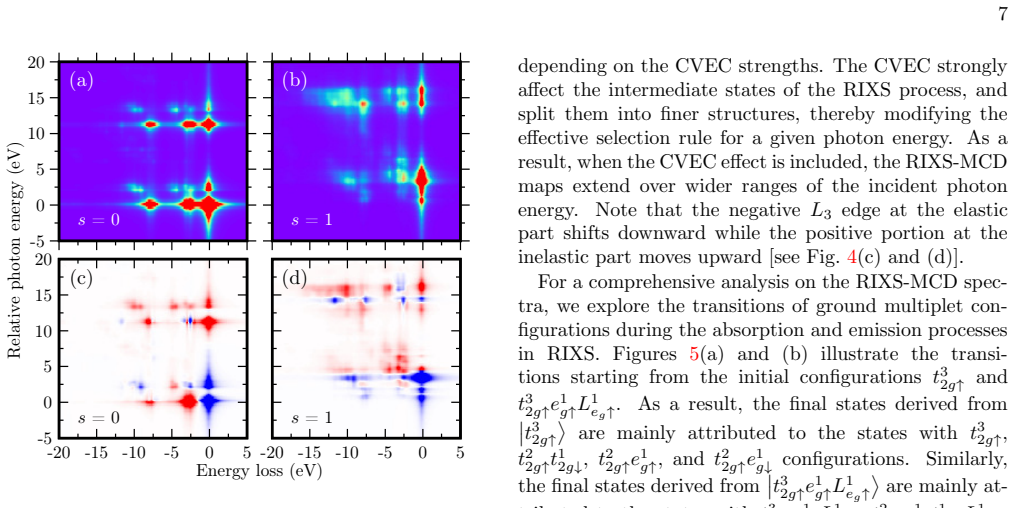
The central discovery is that the experimentally observed XMCD subpeak near 644.6 eV and the same-sign dichroism at the L2 edge do not originate from independent Mn3+ and Mn4+ ions combined in a fixed ratio. They emerge only when the Anderson impurity model allows dynamic charge fluctuations across the full configuration space $d^3L^0$ through $d^{10}L^7$ and includes the Slater-Condon core-valence exchange interactions $F_{pd}^2$, $G_{pd}^1$, and $G_{pd}^3$. Without CVEC, the L3 subpeak has the wrong sign and the distinctive positive L2 feature is absent, and the simple one-electron dipole picture of core-to-valence transitions remains adequate; with CVEC, intermediate-state multiplets mix p1/2 and p3/2 core holes with valence d excitations, changing the dichroic line shapes and breaking the assumptions behind the conventional sum rules.
Load-bearing premise
The argument leans on a single-site Anderson impurity model with five ligand orbitals and a static mean-field exchange field ($\mu_B h = 0.01$ eV) standing in for the metallic, band-like LSMO film over the roughly 10 eV window of the Mn L2,3 edges; the paper itself concedes that its density of states only qualitatively matches band structure near the Fermi level.
Editorial extensions
If this is right
- XMCD sum-rule spin and orbital moments extracted from L2,3 edges of mixed-valence 3d oxides can be systematically wrong; the same-sign subpeaks and overshoot cannot be interpreted with one-electron dipole transitions.
- Conventional weighted sums of Mn3+ and Mn4+ spectra, even when one charge-transfer state ($d^4L^1$ or $d^5L^1$) is included, cannot reproduce the LSMO XMCD, so full charge transfer is necessary.
- RIXS-MCD maps depend strongly on incident photon energy, and CVEC splits the intermediate states, so the signs and selection rules in RIXS-MCD cannot be read off from the XMCD alone.
- The recorded dd-excitation dichroic signal near 644.6 eV is tied to CVEC-modified intermediate states, making RIXS-MCD an element-specific route to orbital and charge excitations in correlated metals.
- The same full-CT/CVEC treatment is positioned as the practical interpretive model for dichroic x-ray spectroscopies in other mixed-valence transition-metal oxides.
Reading between the lines
- Beyond the paper's explicit claims, the CVEC-induced failure of sum rules likely extends to other light 3d mixed-valence oxides with published XMCD moments; a clean test would compare sum-rule-derived moments with magnetometry or polarized neutron data on the same films.
- The paper's mechanism suggests that DFT- or DMFT-derived one-particle parameters fed into the same impurity model should produce quantitative band effects, a route the authors themselves identify as future work.
- Because the fitted ground state contains a nontrivial 19% $d^5L^2$ weight, higher-order charge-transfer states may be generically important in metallic manganites; a natural extension is to test whether the 644.6 eV feature shifts or splits when the ligand bath is enlarged beyond five orbitals.
- One could make a predictive extension by applying the same full-CT/CVEC calculation to other doping levels of La1-xSrxMnO3 and checking whether the separation of the two XMCD subpeaks scales with doping as the model parameters imply.
Signed reviews
Editorial analysis
A structured set of objections, weighed in public.
Referee Report
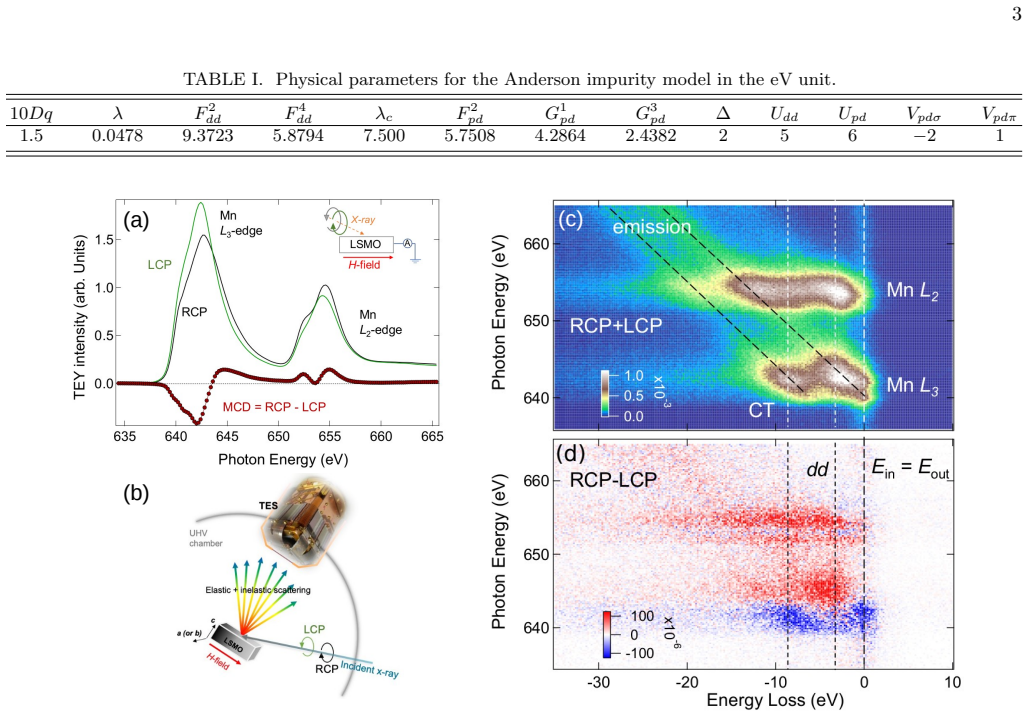
Summary. The paper reports XMCD and RIXS-MCD measurements on a thin film of the mixed-valence ferromagnet La0.7Sr0.3MnO3 and compares them with configuration-interaction Anderson impurity model (AIM) calculations that include full charge-transfer configurations (d3L0 through d10L7) and many-body core-valence exchange correlation (CVEC). The central claim is that only the combination of full CT and CVEC reproduces the experimentally observed subpeak structure, especially the same-sign XMCD features at the L3 and L2 edges, while conventional weighted sums of Mn3+/Mn4+ spectra with or without a single CT state do not. The paper further asserts that CVEC invalidates the standard XMCD sum rules for light 3d transition-metal systems. The theoretical analysis is backed by a controlled scaling scan (r for hopping, s for core-valence Slater parameters) and by a partial-excitation-density decomposition of the final/intermediate states.
Significance. If the central claim is correct, the paper offers a concrete, generalizable recipe for interpreting dichroic soft-x-ray spectra in mixed-valence 3d oxides and provides a cautionary message about sum-rule-based moment extraction. The strengths are the controlled r/s parameter scan, which cleanly isolates the CT and CVEC effects within the model, and the detailed PED analysis that connects spectral features to specific multiplet configurations. The experimental RIXS-MCD map obtained with a TES spectrometer is a valuable dataset in its own right. However, the most consequential practical conclusion, that CVEC invalidates the XMCD sum rules, is asserted rather than demonstrated; the manuscript needs an explicit numerical test before that conclusion can be accepted.
major comments (4)
- [XMCD SPECTRA (Fig. 2; supplementary XAS calculation)] The statement that CVEC invalidates the XMCD sum rules is a load-bearing non sequitur. The text says 'the conventional analysis on the XMCD sign, hence the sum-rule, is no longer valid in the presence of the CVEC,' but the Thole-Carra sum rules are integral relations over the L3 and L2 edges, not pointwise sign analyses. The paper never integrates the calculated XMCD spectra over the L3/L2 ranges, nor does it compare the resulting m_orb and m_spin with the exact ground-state expectation values of L_z, S_z, and T_z from the same AIM. A sign-reversed subpeak does not by itself imply that the integrated dichroism fails to encode the moments. The authors should apply the standard sum-rule formulas to their s=0 and s=1 theoretical spectra and compare with the model's ground-state moments; if the integral relations survive, the central practical conclusion must be withdrawn or sharply qualified.
- [Abstract and 'ANDERSON IMPURITY MODEL' (Eq. (1))] The abstract promises that the paper includes and discusses 'Jahn-Teller (JT) distortions,' and the introduction similarly says 'we discuss the role of the JT effect in Mn3+ ions,' but no JT term appears in the Hamiltonian H of Eq. (1) or anywhere in the main text or the supplementary material. The only structural ingredient is a static cubic crystal field 10Dq. Either add a JT calculation (for example, symmetry-lowering distortions of the eg orbitals) or remove all JT statements; as written, the abstract misrepresents the content of the paper.
- ['ANDERSON IMPURITY MODEL' and Table I; supplementary Fig. S2] The quantitative claim that the AIM 'successfully mirrors experimental results' is weakened by the fact that the model parameters are explicitly adjusted to fit the same experimental spectra that are then reproduced, and the experimental spectra are presented without error bars or a goodness-of-fit metric. The r/s scan does isolate the effect of CT and CVEC, and this part is not circular, but it does not validate the absolute parameter set. Please include a sensitivity analysis (for example, varying Udd, Delta, 10Dq, and h within realistic ranges) and compare with experimental uncertainties; at minimum, the text should state clearly that the agreement is a constrained fit rather than an ab initio prediction.
- [Supplementary Materials, Fig. S2 and 'ANDERSON IMPURITY MODEL'] The single-site AIM with five ligand orbitals and a static mean-field magnetic field mu_B h = 0.01 eV is a strong approximation for a metallic ferromagnet, and the authors themselves note that the AIM density of states only qualitatively captures the DFT result and that metallic bands at the Fermi level differ due to finite-size cluster limits. Because the 644.6 eV feature is assigned to CVEC-driven transitions in the intermediate state, the paper should demonstrate that this assignment is robust to (i) the number and energy distribution of the ligand orbitals, (ii) the value of h, and (iii) the inclusion of band-like continua. A concrete test would be to vary the bath representation while keeping the local multiplet parameters fixed and to show that the sign and position of the CVEC-induced subpeak survive.
minor comments (5)
- [EXPERIMENTAL RESUL TS] The sentence 'the XAS spectra of LSMO are measured with two orthogonal polarizations: right circular polarization (RCP) and left circular polarization (LCP)' is correct, but the parenthetical 'with RCP (µ+) and LCP (µ+)' contains a typo: the second polarization label should read µ−.
- [XMCD SPECTRA] There are typos in the text: '644.6 eV eV' should be '644.6 eV', and 'ranging form d4L1' should be 'ranging from d4L1'; in the RIXS-MCD section, 'RIXS-XMCD' should be 'RIXS-MCD' for consistency.
- [ANDERSON IMPURITY MODEL] The definitions of the Slater parameters and the charge-transfer energy should be given with explicit sign conventions; in particular, the relation Delta = E(d4L1) - E(d3) = 3Udd + 6Upd - epsL assumes a specific choice of ligand-hole energy, and the sign of epsL relative to the chemical potential should be stated.
- [Figures 1 and 4] The RIXS and RIXS-MCD maps are shown without a color scale, so the magnitude of the dichroic signal cannot be assessed from the figures; please add a common color bar or state the intensity normalization.
- [RIXS-MCD SPECTRA] The notation for configurations such as t^3_{2g up} e^1_{g up} L^1_{eg up} is difficult to follow in the printed text; a consistent typesetting convention with explicit subscripts for ligand orbitals would improve readability.
Circularity Check
No circular reduction: the CVEC comparison is parameter-free; the sum-rule claim is an unsupported inference, not circularity.
full rationale
I find no circular step in the derivation chain. The Anderson impurity model parameters in Table I are fitted to the experimental spectra, but fitting parameters to reproduce data is empirical modeling, not circularity. The load-bearing structural comparison is the s=0 versus s=1 sweep of the core-valence Slater-Condon parameters. These are fixed at 80% of atomic Hartree-Fock values (arithmetic mean of Mn3+ and Mn4+), not tuned to the 644.6 eV subpeak, so the emergence of the positive L3 subpeak under s=1 is a controlled consequence of the Hamiltonian rather than a refit of the target. The CT-necessity claim is weaker because r=1 corresponds to the fitted Vpd values in Table I, making 'full inclusion of CT is needed' partly a statement that the fitted model fits; however, the r-sweep is still a well-defined variation and the conventional weighted-sum model is shown to fail on the same experimental data, so this is post hoc model selection rather than a reduction by construction. The strongest claim, that CVEC invalidates the XMCD sum rules, is not circular but is an unsupported inference: the text equates a change in XMCD sign with sum-rule failure and never applies the Thole-Carra integral formulas to its own computed spectra. That is a correctness risk and an omitted proof, not a circularity. Minor self-citations in refs. [48,49] are used only as background examples of conventional weighted-sum successes and are not load-bearing. Overall, no circular step can be exhibited; the score of 2 reflects only the presence of minor non-load-bearing self-citations.
Assumptions & free parameters
free parameters (9)
- 10Dq (crystal field) =
1.5 eV
- lambda_c (core spin-orbit) =
7.5 eV
- Udd (d-d Coulomb repulsion) =
5 eV
- Upd (core-valence Coulomb repulsion) =
6 eV
- Delta (charge-transfer energy) =
2 eV
- Vpd_sigma, Vpd_pi (hopping) =
-2 eV, 1 eV
- F2_pd, G1_pd, G3_pd (core-valence Slater params) =
5.7508, 4.2864, 2.4382 eV
- magnetic field h =
mu_B h = 0.01 eV
- broadening delta_in, delta_b =
0.3 eV
assumptions (6)
- domain assumption Anderson impurity model with 5 ligand bath orbitals represents LSMO's Mn site and oxygen environment
- standard math Slater-Condon parameters are 80% of Hartree-Fock atomic values
- domain assumption Dipole approximation for X-ray absorption and emission
- domain assumption Static mean-field magnetic field captures the ferromagnetic ordering
- domain assumption q=0 for RIXS
- domain assumption Ground state is dominated by t2g^3 up-spin configurations and their CT partners
Cite this review
Pith. "Pith review of X-ray magnetic circular dichroism and resonant inelastic X-ray scattering explained: role of many-body correlation and valence fluctuations." pith.science (2026). https://pith.science/paper/WGKH56DZ
@misc{pith2026241207204,
  author       = {Pith},
  title        = {Pith review of: X-ray magnetic circular dichroism and resonant inelastic X-ray scattering explained: role of many-body correlation and valence fluctuations},
  year         = {2026},
  howpublished = {\url{https://pith.science/paper/WGKH56DZ}},
  note         = {Machine review of arXiv:2412.07204}
}
abstract
X-ray magnetic circular dichroism (XMCD) and resonant inelastic X-ray scattering with magnetic circular dichroism (RIXS-MCD) provide unparalleled insights into the electronic and magnetic dynamics of complex materials. However, interpreting their spectra in mixed-valence systems remains challenging due to intricate many-body interactions and enhanced charge fluctuations. In this study, by utilizing the Anderson impurity model with a full consideration of charge transfer (CT), many-body core-valence exchange correlation (CVEC) effects, and Jahn-Teller (JT) distortions, we systematically investigate the XMCD and RIXS-MCD spectra for a prototypical mixed-valence ferromagnet, La$_{0.7}$Sr$_{0.3}$MnO$_3$ film. We demonstrate that simple calculation with limited CT effects fails to capture characteristic substructures observed experimentally. In contrast, an adequate treatment of CT and CVEC effects yields a more consistent description of both XMCD and RIXS-MCD spectra, providing practical guidance for the interpretation of dichroic x-ray spectroscopies in mixed-valence transition-metal oxides. Furthermore, we discuss the role of the JT effect in Mn$^{3+}$ ions in the determination of their spectra.
Figures


Figures from the paper (2 more)

Reference graph
Works this paper leans on
-
[1]
Coey, Charge-ordering in oxides, Nature 430, 155 (2004)
M. Coey, Charge-ordering in oxides, Nature 430, 155 (2004)
work page 2004
-
[2]
J. M. D. Coey, M. Viret, and S. von Moln´ ar, Mixed- valence manganites, Adv. Phys. 48, 167 (1999)
work page 1999
-
[3]
S. Jin, T. H. Tiefel, M. McCormack, R. A. Fastnacht, R. Ramesh, and L. H. Chen, Thousandfold Change in Resistivity in Magnetoresistive La-Ca-Mn-O Films, Sci- ence 264, 413 (1994)
work page 1994
-
[4]
Y. Moritomo, A. Asamitsu, H. Kuwahara, and Y. Tokura, Giant magnetoresistance of manganese ox- ides with a layered perovskite structure, Nature 380, 141 (1996)
work page 1996
- [5]
- [6]
-
[7]
N. Hur, S. Park, P. A. Sharma, J. S. Ahn, S. Guha, and S. W. Cheong, Electric polarization reversal and mem- ory in a multiferroic material induced by magnetic fields, Nature 429, 392 (2004)
work page 2004
-
[8]
J. G. Bednorz and K. A. M¨ uller, Possible high Tc su- perconductivity in the Ba–La–Cu–O system, Z. Phys. B Condens. Matter 64, 189 (1986)
work page 1986
Show all 56 references
-
[9]
Keimer, S
B. Keimer, S. A. Kivelson, M. R. Norman, S. Uchida, and J. Zaanen, From quantum matter to high-temperature superconductivity in copper oxides, Nature 518, 179 (2015)
2015
-
[10]
B. J. Kim, H. Jin, S. J. Moon, J.-Y. Kim, B.-G. Park, C. S. Leem, J. Yu, T. W. Noh, C. Kim, S.-J. Oh, J.- H. Park, V. Durairaj, G. Cao, and E. Rotenberg, Novel Jeff = 1 /2 Mott State Induced by Relativistic Spin- Orbit Coupling in Sr2IrO4, Phys. Rev. Lett. 101, 076402 (2008)
2008
-
[11]
B. J. Kim, H. Ohsumi, T. Komesu, S. Sakai, T. Morita, H. Takagi, and T. Arima, Phase-Sensitive Observation of a Spin-Orbital Mott State in Sr 2IrO4, Science 323, 1329 (2009)
2009
-
[12]
A. M. Ole´ s, K. Wohlfeld, and G. Khaliullin, Orbital Sym- metry and Orbital Excitations in High- Tc Superconduc- tors, Condens. Matter 4, 46 (2019)
2019
-
[13]
J.-S. Lee, Y. W. Xie, H. K. Sato, C. Bell, Y. Hikita, H. Y. Hwang, and C.-C. Kao, Titanium dxy ferromag- netism at the LaAlO 3/SrTiO3 interface, Nat. Mater. 12, 703 (2013)
2013
-
[14]
Salluzzo, J
M. Salluzzo, J. C. Cezar, N. B. Brookes, V. Bisogni, G. M. De Luca, C. Richter, S. Thiel, J. Mannhart, M. Huijben, A. Brinkman, G. Rijnders, and G. Ghir- inghelli, Orbital Reconstruction and the Two- Dimensional Electron Gas at the LaAlO 3/SrTiO3 Interface, Phys. Rev. Lett. 10...
2009
-
[15]
van der Laan, B
G. van der Laan, B. T. Thole, G. A. Sawatzky, J. B. Goedkoop, J. C. Fuggle, J.-M. Esteva, R. Karnatak, J. P. Remeika, and H. A. Dabkowska, Experimental proof of magnetic x-ray dichroism, Phys. Rev. B 34, 6529 (1986)
1986
-
[16]
St¨ ohr, Exploring the microscopic origin of mag- netic anisotropies with X-ray magnetic circular dichroism (XMCD) spectroscopy, J Magn
J. St¨ ohr, Exploring the microscopic origin of mag- netic anisotropies with X-ray magnetic circular dichroism (XMCD) spectroscopy, J Magn. Magn. Mater. 200, 470 (1999)
1999
-
[17]
C. T. Chen, Y. U. Idzerda, H.-J. Lin, N. V. Smith, G. Meigs, E. Chaban, G. H. Ho, E. Pellegrin, and F. Sette, Experimental Confirmation of the X-Ray Mag- netic Circular Dichroism Sum Rules for Iron and Cobalt, Phys. Rev. Lett. 75, 152 (1995)
1995
-
[18]
B. T. Thole, P. Carra, F. Sette, and G. van der Laan, X-ray circular dichroism as a probe of orbital magnetiza- tion, Phys. Rev. Lett. 68, 1943 (1992)
1992
-
[19]
Carra, B
P. Carra, B. T. Thole, M. Altarelli, and X. Wang, X-ray circular dichroism and local magnetic fields, Phys. Rev. Lett. 70, 694 (1993)
1993
-
[20]
Kotani and S
A. Kotani and S. Shin, Resonant inelastic x-ray scatter- ing spectra for electrons in solids, Rev. Mod. Phys. 73, 203 (2001)
2001
-
[21]
L. J. P. Ament, M. van Veenendaal, T. P. Devereaux, 10 J. P. Hill, and J. van den Brink, Resonant inelastic x-ray scattering studies of elementary excitations, Rev. Mod. Phys. 83, 705 (2011)
2011
-
[22]
Strange, P
P. Strange, P. J. Durham, and B. L. Gyorffy, Dichroic x-ray fluorescence, Phys. Rev. Lett. 67, 3590 (1991)
1991
-
[23]
L.-C. Duda, J. St¨ ohr, D. C. Mancini, A. Nilsson, N. Wass- dahl, J. Nordgren, and M. G. Samant, Magnetic dichro- ism in L2,3 emission of Fe, Co, and Ni following energy- dependent excitation with circularly polarized x rays, Phys. Rev. B 50, 16758 (1994)
1994
-
[24]
M. V. Yablonskikh, Y. M. Yarmoshenko, V. I. Greben- nikov, E. Z. Kurmaev, S. M. Butorin, L.-C. Duda, J. Nordgren, S. Plogmann, and M. Neumann, Origin of magnetic circular dichroism in soft x-ray fluorescence of Heusler alloys at threshold excitation, Phys. Rev. B 63, 235117 (2001)
2001
-
[25]
Braicovich, G
L. Braicovich, G. van der Laan, G. Ghiringhelli, A. Tagli- aferri, M. A. van Veenendaal, N. B. Brookes, M. M. Chervinskii, C. Dallera, B. De Michelis, and H. A. D¨ urr, Magnetic Circular Dichroism in Resonant Raman Scat- tering in the Perpendicular Geometry at the L edge of 3d...
1999
-
[26]
Miyawaki, S
J. Miyawaki, S. Suga, H. Fujiwara, H. Niwa, H. Kiuchi, and Y. Harada, A compact permanent-magnet system for measuring magnetic circular dichroism in resonant inelastic soft X-ray scattering, J. Synchrotron Rad. 24, 449 (2017)
2017
-
[27]
Inami, Magnetic Circular Dichroism in X-Ray Emis- sion from Ferromagnets, Phys
T. Inami, Magnetic Circular Dichroism in X-Ray Emis- sion from Ferromagnets, Phys. Rev. Lett. 119, 137203 (2017)
2017
-
[28]
W. L. O’Brien and B. P. Tonner, Orbital and spin sum rules in x-ray magnetic circular dichroism, Phys. Rev. B 50, 12672 (1994)
1994
-
[29]
Weller, J
D. Weller, J. St¨ ohr, R. Nakajima, A. Carl, M. G. Samant, C. Chappert, R. M´ egy, P. Beauvillain, P. Veillet, and G. A. Held, Microscopic Origin of Magnetic Anisotropy in Au/Co/Au Probed with X-Ray Magnetic Circular Dichroism, Phys. Rev. Lett. 75, 3752 (1995)
1995
-
[30]
Y. Wu, J. St¨ ohr, B. D. Hermsmeier, M. G. Samant, and D. Weller, Enhanced orbital magnetic moment on Co atoms in Co/Pd multilayers: A magnetic circular x-ray dichroism study, Phys. Rev. Lett. 69, 2307 (1992)
1992
-
[31]
Nakajima, J
R. Nakajima, J. St¨ ohr, and Y. U. Idzerda, Electron- yield saturation effects in L-edge x-ray magnetic circular dichroism spectra of Fe, Co, and Ni, Phys. Rev. B 59, 6421 (1999)
1999
-
[32]
Jonker and J
G. Jonker and J. Van Santen, Ferromagnetic compounds of manganese with perovskite structure, Physica 16, 337 (1950)
1950
-
[33]
Tokura, A
Y. Tokura, A. Urushibara, Y. Moritomo, T. Arima, A. Asamitsu, G. Kido, and N. Furukawa, Giant Magne- totransport Phenomena in Filling-Controlled Kondo Lat- tice System: La 1−xSrxMnO3, J. Phys. Soc. Jpn. 63, 3931 (1994)
1994
-
[34]
J.-H. Park, E. Vescovo, H.-J. Kim, C. Kwon, R. Ramesh, and T. Venkatesan, Direct evidence for a half-metallic ferromagnet, Nature 392, 794 (1998)
1998
-
[35]
de Groot, Multiplet effects in X-ray spectroscopy, Co- ord
F. de Groot, Multiplet effects in X-ray spectroscopy, Co- ord. Chem. Rev. 249, 31 (2005)
2005
-
[36]
Stavitski and F
E. Stavitski and F. M. F. de Groot, The CTM4XAS pro- gram for EELS and XAS spectral shape analysis of tran- sition metal L edges, Micron 41, 687 (2010)
2010
-
[37]
Boca, Theoretical foundations of molecular magnetism (Elsevier, 1999)
R. Boca, Theoretical foundations of molecular magnetism (Elsevier, 1999)
1999
-
[38]
Wu and H
K. Wu and H. Simon, Thick-Restart Lanczos Method for Large Symmetric Eigenvalue Problems, SIAM J. Matrix Anal. Appl. 22, 602 (2000)
2000
-
[39]
Yu, J.-S
P. Yu, J.-S. Lee, S. Okamoto, M. D. Rossell, M. Hui- jben, C.-H. Yang, Q. He, J. X. Zhang, S. Y. Yang, M. J. Lee, Q. M. Ramasse, R. Erni, Y.-H. Chu, D. A. Arena, C.-C. Kao, L. W. Martin, and R. Ramesh, In- terface Ferromagnetism and Orbital Reconstruction in BiFeO3−La0.7Sr0.3M...
2010
-
[40]
J.-S. Lee, D. A. Arena, P. Yu, C. S. Nelson, R. Fan, C. J. Kinane, S. Langridge, M. D. Rossell, R. Ramesh, and C.-C. Kao, Hidden Magnetic Configuration in Epitax- ial La 1−xSrxMnO3 Films, Phys. Rev. Lett. 105, 257204 (2010)
2010
-
[41]
St¨ ohr and H
J. St¨ ohr and H. K¨ onig, Determination of Spin- and Orbital-Moment Anisotropies in Transition Metals by Angle-Dependent X-Ray Magnetic Circular Dichroism, Phys. Rev. Lett. 75, 3748 (1995)
1995
-
[42]
Wu and A
R. Wu and A. J. Freeman, Limitation of the Magnetic- Circular-Dichroism Spin Sum Rule for Transition Metals and Importance of the Magnetic Dipole Term, Phys. Rev. Lett. 73, 1994 (1994)
1994
-
[43]
van der Laan, K
G. van der Laan, K. T. Moore, J. G. Tobin, B. W. Chung, M. A. Wall, and A. J. Schwartz, Applicability of the Spin- Orbit Sum Rule for the Actinide 5 f States, Phys. Rev. Lett. 93, 097401 (2004)
2004
-
[44]
Piamonteze, P
C. Piamonteze, P. Miedema, and F. M. F. de Groot, Ac- curacy of the spin sum rule in XMCD for the transition- metal L edges from manganese to copper, Phys. Rev. B 80, 184410 (2009)
2009
-
[45]
Piamonteze, P
C. Piamonteze, P. Miedema, and F. M. F. de Groot, The accuracy of the spin sum rule in XMCD, J. Phys. Conf. Ser. 190, 012015 (2009)
2009
-
[46]
Ghiringhelli, N
G. Ghiringhelli, N. B. Brookes, E. Annese, H. Berger, C. Dallera, M. Grioni, L. Perfetti, A. Tagliaferri, and L. Braicovich, Low Energy Electronic Excitations in the Layered Cuprates Studied by Copper L3 Resonant In- elastic X-Ray Scattering, Phys. Rev. Lett. 92, 117406 (2004)
2004
-
[47]
Ghiringhelli, M
G. Ghiringhelli, M. Matsubara, C. Dallera, F. Fra- cassi, A. Tagliaferri, N. B. Brookes, A. Kotani, and L. Braicovich, Resonant inelastic x-ray scattering of MnO: L 2,3 edge measurements and assessment of their interpretation, Phys. Rev. B 73, 035111 (2006)
2006
-
[48]
H. J. Lee, G. Kim, D. H. Kim, J.-S. Kang, C. L. Zhang, S.-W. Cheong, J. H. Shim, S. Lee, H. Lee, J.-Y. Kim, B. H. Kim, and B. I. Min, Valence states and occupation sites in (fe,mn)3o4 spinel oxides investigated by soft x-ray absorption spectroscopy and magnetic circular dichro...
2008
-
[49]
J. Lee, B. Kim, B. H. Kim, B. I. Min, S. Kolesnik, O. Chmaissem, J. Mais, B. Dabrowski, H. J. Shin, D. H. Kim, H. J. Lee, and J.-S. Kang, Valence-state transition in SrMn 1−xMoxO3 (0 ≤ x ≤ 0.5) investigated by soft x-ray absorption spectroscopy, Phys. Rev. B 80, 205112 (2009)
2009
-
[50]
M. W. Haverkort, Quanty for core level spectroscopy - ex- citons, resonances and band excitations in time and fre- quency domain, J. Phys.: Conf. Ser. 712, 012001 (2016)
2016
-
[51]
Hariki, M
A. Hariki, M. Winder, and J. Kuneˇ s, Continuum Charge Excitations in High-Valence Transition-Metal Oxides Re- vealed by Resonant Inelastic X-Ray Scattering, Phys. 11 Rev. Lett. 121, 126403 (2018)
2018
-
[52]
Y. Wang, G. Fabbris, M. Dean, and G. Kotliar, EDRIXS: An open source toolkit for simulating spectra of resonant inelastic x-ray scattering, Comput. Phys. Commun. 243, 151 (2019)
2019
-
[53]
Hariki, M
A. Hariki, M. Winder, T. Uozumi, and J. Kuneˇ s, LDA + DMFT approach to resonant inelastic x-ray scattering in correlated materials, Phys. Rev. B 101, 115130 (2020)
2020
-
[54]
M. W. Haverkort, M. Zwierzycki, and O. K. Ander- sen, Multiplet ligand-field theory using Wannier orbitals, Phys. Rev. B 85, 165113 (2012)
2012
-
[55]
J. H. Song, T. Susaki, and H. Y. Hwang, Enhanced Thermodynamic Stability of Epitaxial Oxide Thin Films, Adv. Mater. 20, 2528 (2008)
2008
-
[56]
W. B. Doriese, P. Abbamonte, B. K. Alpert, D. A. Bennett, E. V. Denison, Y. Fang, D. A. Fischer, C. P. Fitzgerald, J. W. Fowler, J. D. Gard, J. P. Hays-Wehle, G. C. Hilton, C. Jaye, J. L. McChesney, L. Miaja- Avila, K. M. Morgan, Y. I. Joe, G. C. O’Neil, C. D. Reintsema, F. Ro...
2017
Reviewed August 11, 2026 · model on record in the stance chip above.
Discussion (0). Continue with ORCID to comment.