REVIEW 4 major objections 4 minor 47 references
A Dynamical Systems-Inspired Pruning Strategy for Addressing Oversmoothing in Graph Neural Networks
T0 review · 4 major / 4 minor · reviewed 2026-08-11 · deepseek-v4-flash
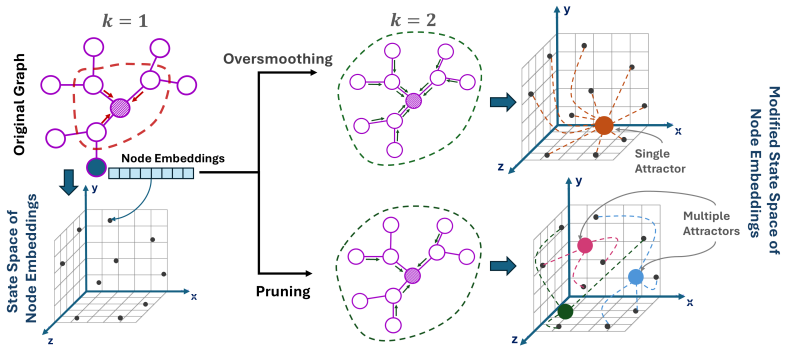
Pith's one-line read DYNAMO-GAT prunes attention edges between correlated nodes so that deep graph networks keep node features distinct instead of collapsing toward a uniform state.
desk verdict The pruning rule is genuinely new, but the theory has the sign backwards: Lemma 4 contradicts Lemma 3, so the central claim predicts the opposite of what the paper intends. read the letter →
The pith
A machine-rendered reading of the paper's core claim, the machinery that carries it, and where it could break.
The reading
What carries the argument
The load-bearing object is the Jacobian matrix of the GNN layer transformation at the uniform fixed point, together with the noise-injected covariance matrix of node features. The Jacobian supplies the paper's stability criterion: a fixed point is stable when the spectral radius of the Jacobian at that point is at most 1, and the paper claims pruning reduces that spectral radius. The covariance matrix identifies pairs of nodes whose features are drifting together, and the anti-Hebbian pruning probability pij = r(t)·|αij|/(τ(t)·(Cii + Cjj ∓ 2Cij)) weakens exactly those edges. Recalibration of the surviving attention weights keeps information flow balanced after pruning.
What would settle it
Compute the Jacobian of a trained GAT at a state where all nodes have identical features, apply DYNAMO-GAT pruning, and evaluate both spectral radii; if the pruned spectral radius falls below 1 while the network still converges to, or stays near, the uniform state, then the claimed destabilization is not what preserves diversity.
Extended reading notes
Core claim
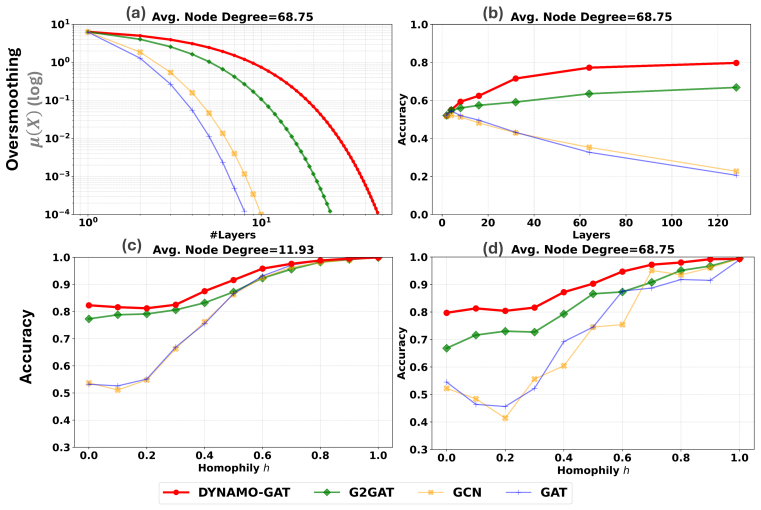
The paper's central claim is that oversmoothing can be treated as convergence to an unstable-to-be-disrupted fixed point of the GNN layer map, and that pruning one kind of attention edge alters the stability of that point. Formally, Lemma 4 states that for the oversmoothing fixed point X*, the pruned map FP satisfies ρ(JFP(X*)) < ρ(JF(X*)), where J denotes the Jacobian; the paper interprets this smaller spectral radius as reduced stability of the oversmoothing fixed point. Lemma 5 states that DYNAMO-GAT preserves rank(C(t)) = d at every layer, so node features never collapse into a subspace of dimension less than d. The paper presents these as theoretical support for its experimental finding that deep DYNAMO-GAT networks keep node representations diverse and accurate at 128 layers.
Load-bearing premise
The paper assumes that whenever the GAT update converges to a fixed point, the node features become identical; if a GAT can converge to a non-uniform equilibrium, then destabilizing the uniform fixed point is not the right objective and the pruning rule loses its theoretical justification.
Editorial extensions
If this is right
- A GNN built on this rule can be run to 128 layers without the accuracy drop that normally follows from oversmoothing, on the datasets tested.
- The pruning rule doubles as an efficiency mechanism: reported accuracy per floating-point operation is higher than GCN, GAT, and G2GAT because most attention edges are removed while accuracy stays near the best baselines.
- If Lemma 5 holds, feature covariance never loses rank, so no layer can project all node features into a subspace of dimension below the feature dimension d.
- Strong performance on dense, low-homophily synthetic graphs suggests the rule does not rely on homophily; it helps where neighbors are dissimilar.
Reading between the lines
- Read literally, Lemma 4 cuts against the paper's verbal claim: Lemma 3 defines the oversmoothing fixed point as stable exactly when the spectral radius is at most 1, so a smaller spectral radius after pruning would make that fixed point more stable, not less; the paper never reconciles this sign reversal.
- Because pruning changes the layer map itself, X* need not remain a fixed point of the pruned map; if it is not, comparing Jacobians at X* describes a state the dynamics no longer sit at, so the theorem's object may not be the right one.
- A natural testable extension is to check whether the covariance criterion actually removes the edges whose deletion changes the dominant eigenvector of the Jacobian, rather than only its spectral radius.
Editorial analysis
A structured set of objections, weighed in public.
Referee Report
Summary. The paper proposes a dynamical-systems analysis of oversmoothing in graph attention networks and introduces DYNAMO-GAT, a pruning strategy based on noise-driven covariance analysis and Anti-Hebbian principles. The theoretical part states three lemmas on fixed points, convergence, and stability of GAT updates, followed by two lemmas claiming that the pruning rule reduces the spectral radius of the Jacobian at the oversmoothing fixed point and preserves the full rank of the feature covariance matrix. Experiments on Cora, Citeseer, Cornell, and synthetic datasets compare accuracy, oversmoothing coefficient, and computational efficiency against GCN, GAT, and G2GAT.
Significance. If the theoretical claims were correct, the paper would offer a principled connection between attention pruning and oversmoothing, which is a relevant and timely topic. The empirical study is broad: it covers multiple real and synthetic datasets, reports the oversmoothing coefficient across depths, and evaluates the accuracy/GFLOPS trade-off, and it should be credited for comparing against a strong recent baseline (G2GAT). However, the central theoretical result contains a sign error that inverts the paper's main claim, and a second lemma makes an impossible rank assertion; as presented, the theoretical contribution is not valid. The empirical results may still be of interest, but they do not by themselves establish the claimed mechanism.
major comments (4)
- [Theoretical Results, Lemma 4] Lemma 4 states that rho(J_FP(X*)) < rho(J_F(X*)) and concludes that DYNAMO-GAT pruning reduces the stability of the oversmoothing fixed point. This is logically inverted relative to Lemma 3, which defines a fixed point as stable precisely when rho(J_f(X*)) <= 1 and unstable when rho > 1. Decreasing the spectral radius therefore makes the oversmoothing fixed point more stable, not less, so the stated lemma predicts the opposite of the abstract's claim that DYNAMO-GAT disrupts convergence to oversmoothed states. To support the claimed destabilization, the paper would need rho(J_FP(X*)) > rho(J_F(X*)) (or rho > 1), not the inequality proved.
- [Lemma 4, Short Proof] The proof asserts that pruning reduces the magnitudes of Jacobian entries and therefore reduces the spectral radius, but this is not derived from the pruning rule of Eqs. (4)-(5); it is essentially the lemma's conclusion restated as the proof's premise. In addition, the lemma assumes that the oversmoothing fixed point X* of F remains a point at which the pruned map FP is evaluated, but no argument shows that F(X*) = X* implies FP(X*) = X*. Since pruning changes the transformation, stability analysis of X* under FP requires FP(X*) = X*, and this is not established.
- [Lemma 5] The claim that rank(C(t)) = d for all t is impossible whenever the number of nodes n is smaller than the feature dimension d. For example, Cornell has n = 183 nodes and input feature dimension d = 1703, so rank(C(t)) <= n - 1 < d for any centered covariance matrix. The base case of the induction, rank(C(0)) = d, is therefore false for such datasets, and the proof cannot establish the claimed full-rank preservation.
- [Lemmas 1 and 2] These lemmas conflate convergence to a fixed point (or attractor) of the GAT update with oversmoothing, i.e., indistinguishability of all node representations. A contraction mapping on feature space can converge to a non-uniform fixed point; uniqueness of a fixed point does not imply that all nodes share the same feature vector. This conflation is load-bearing because it motivates the objective of destabilizing the uniform fixed point; if the fixed point reached under contraction is not necessarily the oversmoothed state, then the dynamical-systems rationale for the pruning criterion collapses.
minor comments (4)
- [Table 1 and Supplementary Experimental Section] The number of edges for Cornell is reported as 280 in Table 1 but as 295 in the supplementary experimental setup; these numbers should be reconciled.
- [Algorithm 1] The input list includes the initial pruning constant K0, but K0 is never used in the algorithm body; either use it or remove it from the requirements.
- [Related Works] The name 'DYNAMO-GAT' is misspelled as 'DYANMO-GAT' in the last two paragraphs of the Related Works section.
- [References] The GAT reference appears twice (Veličković et al., 2018), once with a full citation and once as Veličković et al. in the ICLR format; duplicate entries should be merged.
Circularity Check
The theoretical core is circular: Lemma 4 and Lemma 5 restate their conclusions as proofs, and the key anti-collapse claim is attributed to the authors' own prior work.
-
other
[Lemma 4 (main text) and Supplementary Section 'Lemma 4' (Lemma 9), proof]
"When pruning is applied via DYNAMO-GAT, the transformation matrix FP is obtained by removing certain edges or weights, effectively reducing the influence of weaker connections. This pruning reduces the entries in the Jacobian matrix JFP (X∗) compared to JF (X∗). Since the spectral radius is sensitive to the magnitudes of the matrix entries, pruning leads to a decrease in the spectral radius: ρ(JFP (X∗)) < ρ(JF (X∗))."
The lemma's conclusion is exactly the proof's premise: it asserts that pruning reduces the spectral radius and then concludes ρ(J_FP(X*)) < ρ(J_F(X*)). No derivation links the pruning probabilities p_ij of Eq. (4) or the gradual weight update of Eq. (5) to the entries or spectrum of J_FP. The short proof in the main text is even more direct: 'DYNAMO-GAT pruning reduces the magnitude of the dominant eigenvalue... Consequently, ρ(JFP) < ρ(JF)' — the consequence restates the assumed effect. Thus the central claim that DYNAMO-GAT 'reduces the stability' of the oversmoothing fixed point is not derived from the algorithm; it is assumed. Under the paper's own Lemma 3, a smaller ρ would actually make the fixed point more stable, so the stated conclusion is also internally inconsistent.
-
other
[Lemma 5 / Supplementary Section 'Lemma 5' (Lemma 10), proof by induction]
"Assume rank(C(t)) = d for some layer t. The DYNAMO-GAT pruning at layer t + 1 ensures that the dominant eigenvalues of C(t+1) do not collapse, preserving the rank at t + 1. Therefore, rank(C(t+1)) = d."
The inductive step assumes the very property being proved: that DYNAMO-GAT pruning 'ensures' the eigenvalues do not collapse and preserves rank. No formula from the algorithm (noise injection Eq. 1, covariance Eq. 2, pruning probability Eq. 4, or weight update Eq. 5) is used to show how pruning controls the spectrum of C(t+1). The base case assumes rank(C(0)) = d, which is already false for the Cornell dataset (n = 183 nodes, d = 1703 input features), since rank(C(0)) ≤ n - 1 < d. Thus the 'proof' is an assertion of the conclusion, and the claimed theorem is not derivable in the form stated.
1 more flagged steps
-
self citation load bearing
[Related Works, final paragraph, 'Learning as a Dynamical System']
"pruning based on noise-driven covariance analysis can ensure that the system does not collapse into a low-dimensional state, thus maintaining expressiveness across layers [Chakraborty and Mukhopadhyay, 2024b, 2022b]."
This sentence attributes the paper's central anti-collapse claim to the authors' own prior work. Lemma 5 then 'proves' the same rank-preservation claim by assertion rather than derivation from the algorithm. So the theoretical justification for DYNAMO-GAT is not an external mathematical result: it is a self-citation chain that carries the central conclusion. The cited works are not machine-checked or independently verified in this paper, and the current paper does not reduce the claim to any previously established theorem with stated assumptions that exclude the target result.
full rationale
The experimental comparison against GCN, GAT, and G2GAT is an independent empirical evaluation and is not circular. However, the paper's theoretical derivation chain is not self-contained. Lemma 4's 'proof' is the theorem restated: it asserts that pruning reduces the spectral radius and then concludes the inequality, without using Eqs. (1)-(5); it also draws a conclusion ('reduced stability') that contradicts its own Lemma 3, where ρ ≤ 1 means stable and ρ > 1 means unstable. Lemma 5's induction assumes rank preservation in the inductive step and assumes rank(C(0)) = d, which cannot hold when n < d (Cornell has 183 nodes and 1703 input features). The Related Works section supports the same anti-collapse claim by self-citations, making the central claim rest partly on a self-citation chain. Lemmas 1-2 additionally assume without proof that convergence to any fixed point or attractor equals oversmoothing (uniform node features), which is an unsupported conflation; this is a correctness problem rather than a definitional circularity, but it means the dynamical-systems framing does not independently establish the stated mechanism. Overall, the central theoretical claims reduce to assumptions and self-citations rather than derivations, so the circularity score is 7.
Assumptions & free parameters
free parameters (6)
- noise_level_sigma =
not reported
- pruning_rate_r0 =
not reported
- pruning_growth_gamma =
not reported
- threshold_beta =
not reported
- prune_threshold_epsilon =
not reported
- initial_pruning_constant_K0 =
not reported
assumptions (7)
- standard math Banach fixed-point theorem (contraction mapping principle) applies to the GAT update map f.
- domain assumption The GAT update f is a contraction with constant c < 1, or has effective adjacency spectral radius at most 1 with Lipschitz constant L < 1.
- domain assumption Convergence to a fixed point implies node representations become indistinguishable (oversmoothing).
- ad hoc to paper The oversmoothing fixed point X* of the unpruned map F remains a fixed point of the pruned map FP.
- ad hoc to paper Pruning reduces the magnitudes of Jacobian entries and therefore reduces the spectral radius.
- domain assumption Initial node features satisfy rank(C(0)) = d.
- ad hoc to paper The pruning rule preserves full rank of the covariance at every layer without collapsing features.
Cite this review
Pith. "Pith review of A Dynamical Systems-Inspired Pruning Strategy for Addressing Oversmoothing in Graph Neural Networks." pith.science (2026). https://pith.science/paper/LJ5ILQ45
@misc{pith2026241207243,
  author       = {Pith},
  title        = {Pith review of: A Dynamical Systems-Inspired Pruning Strategy for Addressing Oversmoothing in Graph Neural Networks},
  year         = {2026},
  howpublished = {\url{https://pith.science/paper/LJ5ILQ45}},
  note         = {Machine review of arXiv:2412.07243}
}
read the original abstract
Oversmoothing in Graph Neural Networks (GNNs) poses a significant challenge as network depth increases, leading to homogenized node representations and a loss of expressiveness. In this work, we approach the oversmoothing problem from a dynamical systems perspective, providing a deeper understanding of the stability and convergence behavior of GNNs. Leveraging insights from dynamical systems theory, we identify the root causes of oversmoothing and propose \textbf{\textit{DYNAMO-GAT}}. This approach utilizes noise-driven covariance analysis and Anti-Hebbian principles to selectively prune redundant attention weights, dynamically adjusting the network's behavior to maintain node feature diversity and stability. Our theoretical analysis reveals how DYNAMO-GAT disrupts the convergence to oversmoothed states, while experimental results on benchmark datasets demonstrate its superior performance and efficiency compared to traditional and state-of-the-art methods. DYNAMO-GAT not only advances the theoretical understanding of oversmoothing through the lens of dynamical systems but also provides a practical and effective solution for improving the stability and expressiveness of deep GNNs.
Figures

Reference graph
Works this paper leans on
-
[1]
Entrywise eigenvector analysis of random matrices with low expected rank
Emmanuel Abbe, Jianqing Fan, Kaizheng Wang, and Yiqiao Zhong. Entrywise eigenvector analysis of random matrices with low expected rank. The Annals of Statistics, 48 0 (3): 0 1452--1474, 2020
work page 2020
-
[2]
Convergence rates of neural networks for supervised learning on manifolds
Zeyuan Allen-Zhu, Yuanzhi Li, and Zhao Song. Convergence rates of neural networks for supervised learning on manifolds. In Advances in Neural Information Processing Systems, pages 6191--6201, 2019
work page 2019
-
[3]
Jimmy Lei Ba, Jamie Ryan Kiros, and Geoffrey E Hinton. Layer normalization. In arXiv preprint arXiv:1607.06450, 2016
arXiv 2016
-
[4]
A note on over-smoothing for graph neural networks
Chen Cai and Yusu Wang. A note on over-smoothing for graph neural networks. In ICML Graph Representation Learning and Beyond (GRL+) Workshop, 2020
work page 2020
-
[5]
Biswadeep Chakraborty and Saibal Mukhopadhyay. Characterization of generalizability of spike timing dependent plasticity trained spiking neural networks. Frontiers in Neuroscience, 15: 0 695357, 2021
work page 2021
-
[6]
Heterogeneous recurrent spiking neural network for spatio-temporal classification
Biswadeep Chakraborty and Saibal Mukhopadhyay. Heterogeneous recurrent spiking neural network for spatio-temporal classification. Frontiers in Neuroscience, 0 (https://doi.org/10.3389/fnins.2023.99451), 2022 a
arXiv 2023
-
[7]
darts: Model uncertainty-aware differentiable architecture search
Biswadeep Chakraborty and Saibal Mukhopadhyay. darts: Model uncertainty-aware differentiable architecture search. IEEE Access, 10: 0 98670--98682, 2022 b
work page 2022
-
[8]
Brain-inspired spiking neural network for online unsupervised time series prediction
Biswadeep Chakraborty and Saibal Mukhopadhyay. Brain-inspired spiking neural network for online unsupervised time series prediction. In 2023 International Joint Conference on Neural Networks (IJCNN), pages 1--8. IEEE, 2023 a
work page 2023
Show all 47 references
-
[9]
Heterogeneous recurrent spiking neural network for spatio-temporal classification
Biswadeep Chakraborty and Saibal Mukhopadhyay. Heterogeneous recurrent spiking neural network for spatio-temporal classification. Frontiers in Neuroscience, 17: 0 994517, 2023 b
2023
-
[10]
Heterogeneous neuronal and synaptic dynamics for spike-efficient unsupervised learning: Theory and design principles
Biswadeep Chakraborty and Saibal Mukhopadhyay. Heterogeneous neuronal and synaptic dynamics for spike-efficient unsupervised learning: Theory and design principles. arXiv preprint arXiv:2302.11618, 2023 c
2023 arXiv
-
[11]
Exploiting heterogeneity in timescales for sparse recurrent spiking neural networks for energy-efficient edge computing
Biswadeep Chakraborty and Saibal Mukhopadhyay. Exploiting heterogeneity in timescales for sparse recurrent spiking neural networks for energy-efficient edge computing. arXiv preprint arXiv:2407.06452, 2024 a
2024 arXiv
-
[12]
Topological representations of heterogeneous learning dynamics of recurrent spiking neural networks
Biswadeep Chakraborty and Saibal Mukhopadhyay. Topological representations of heterogeneous learning dynamics of recurrent spiking neural networks. arXiv preprint arXiv:2403.12462, 2024 b
2024 arXiv
-
[13]
A fully spiking hybrid neural network for energy-efficient object detection
Biswadeep Chakraborty, Xueyuan She, and Saibal Mukhopadhyay. A fully spiking hybrid neural network for energy-efficient object detection. IEEE Transactions on Image Processing, 30: 0 9014--9029, 2021
2021
-
[14]
Brain-inspired spatiotemporal processing algorithms for efficient event-based perception
Biswadeep Chakraborty, Uday Kamal, Xueyuan She, Saurabh Dash, and Saibal Mukhopadhyay. Brain-inspired spatiotemporal processing algorithms for efficient event-based perception. In 2023 Design, Automation & Test in Europe Conference & Exhibition (DATE), pages 1--6. IEEE, 2023
2023
-
[15]
Sparse spiking neural network: Exploiting heterogeneity in timescales for pruning recurrent snn
Biswadeep Chakraborty, Beomseok Kang, Harshit Kumar, and Saibal Mukhopadhyay. Sparse spiking neural network: Exploiting heterogeneity in timescales for pruning recurrent snn. arXiv preprint arXiv:2403.03409, 2024
2024 arXiv
-
[16]
Measuring and relieving the over-smoothing problem for graph neural networks from the topological view
Ming Chen, Zhewei Wei, Zengfeng Huang, Bolin Ding, and Yaliang Li. Measuring and relieving the over-smoothing problem for graph neural networks from the topological view. Proceedings of the AAAI Conference on Artificial Intelligence, 34 0 (04): 0 3438--3445, 2020
2020
-
[17]
How does over-squashing affect the power of gnns? arXiv preprint arXiv:2306.03589, 2023
Fabrizio Di Giovanni, Jack Rowbottom, Benjamin Paul Chamberlain, and Michael M Bronstein. How does over-squashing affect the power of gnns? arXiv preprint arXiv:2306.03589, 2023
2023 arXiv
-
[18]
Graph neural networks for social recommendation
Wenqi Fan, Yao Ma, Qing Li, Yuan He, Eric Zhao, Jiliang Tang, and Dawei Yin. Graph neural networks for social recommendation. In The world wide web conference, pages 417--426, 2019
2019
-
[19]
Gemnet: Universal directional graph neural networks for molecules
Johannes Gasteiger, Florian Becker, and Stephan G \"u nnemann. Gemnet: Universal directional graph neural networks for molecules. Advances in Neural Information Processing Systems, 34: 0 6790--6802, 2021
2021
-
[20]
Neural message passing for quantum chemistry
Justin Gilmer, Samuel S Schoenholz, Patrick F Riley, Oriol Vinyals, and George E Dahl. Neural message passing for quantum chemistry. International Conference on Machine Learning, pages 1263--1272, 2017
2017
-
[21]
Batch normalization: Accelerating deep network training by reducing internal covariate shift
Sergey Ioffe and Christian Szegedy. Batch normalization: Accelerating deep network training by reducing internal covariate shift. In International conference on machine learning, pages 448--456. PMLR, 2015
2015
-
[22]
Unsupervised 3d object learning through neuron activity aware plasticity
Beomseok Kang, Biswadeep Chakraborty, and Saibal Mukhopadhyay. Unsupervised 3d object learning through neuron activity aware plasticity. In 2023 International Conference on Learning Representations (ICLR), number arXiv preprint arXiv:2302.11622, 2023
2023 arXiv
-
[23]
Not too little, not too much: a theoretical analysis of graph (over)smoothing
Nicolas Keriven. Not too little, not too much: a theoretical analysis of graph (over)smoothing. In NeurIPS, volume 35, pages 2268--2281, 2022
2022
-
[24]
Semi-supervised classification with graph convolutional networks
Thomas Kipf and Max Welling. Semi-supervised classification with graph convolutional networks. In ICLR, 2017
2017
-
[25]
Deepgcns: Can gcns go as deep as cnns? Proceedings of the IEEE/CVF International Conference on Computer Vision, pages 9267--9276, 2019
Guohao Li, Matthias Muller, Ali Thabet, and Bernard Ghanem. Deepgcns: Can gcns go as deep as cnns? Proceedings of the IEEE/CVF International Conference on Computer Vision, pages 9267--9276, 2019
2019
-
[26]
Deeper insights into graph convolutional networks for semi-supervised learning
Qimai Li, Zhichao Han, and Xiao-Ming Wu. Deeper insights into graph convolutional networks for semi-supervised learning. Proceedings of the AAAI Conference on Artificial Intelligence, 32 0 (1), 2018
2018
-
[27]
Automating the construction of internet portals with machine learning
Andrew McCallum, Kamal Nigam, Jason Rennie, and Kristie Seymore. Automating the construction of internet portals with machine learning. Information Retrieval, 3 0 (2): 0 127--163, 2000
2000
-
[28]
Using noise to probe recurrent neural network structure and prune synapses
Eli Moore and Rishidev Chaudhuri. Using noise to probe recurrent neural network structure and prune synapses. Advances in neural information processing systems, 33: 0 14046--14057, 2020
2020
-
[29]
Graph neural networks exponentially lose expressive power for node classification
Kenta Oono and Taiji Suzuki. Graph neural networks exponentially lose expressive power for node classification. In ICLR, 2020
2020
-
[30]
Graph neural networks for materials science and chemistry
Patrick Reiser, Marlen Neubert, Andr \'e Eberhard, Luca Torresi, Chen Zhou, Chen Shao, Houssam Metni, Clint van Hoesel, Henrik Schopmans, Timo Sommer, et al. Graph neural networks for materials science and chemistry. Communications Materials, 3 0 (1): 0 93, 2022
2022
-
[31]
Simplifying the theory on over-smoothing
Andreas Roth and Thorben Liebig. Simplifying the theory on over-smoothing. arXiv preprint arXiv:2407.11876, 2024
2024 arXiv
-
[32]
Graph-coupled oscillator networks
T Konstantin Rusch, Michael M Bronstein, and Siddhartha Mishra. Graph-coupled oscillator networks. In International Conference on Machine Learning, pages 18888--18909. PMLR, 2022
2022
-
[33]
Rusch, M.M
T.K. Rusch, M.M. Bronstein, and S. Mishra. Gradient gating for deep multi-rate learning on graphs. International Conference on Learning Representations, 2023 a
2023
-
[34]
Bronstein, and Siddhartha Mishra
T.Konstantin Rusch, Michael M. Bronstein, and Siddhartha Mishra. A survey on oversmoothing in graph neural networks. ArXiv, abs/2303.10993, 2023 b
2023 arXiv
-
[35]
Collective classification in network data
Prithviraj Sen, Galileo Namata, Mustafa Bilgic, Lise Getoor, Brian Galligher, and Tina Eliassi-Rad. Collective classification in network data. In AI Magazine, volume 29, pages 93--93, 2008
2008
-
[36]
Webkb dataset
Cornell University. Webkb dataset. URL http://www.cs.cmu.edu/afs/cs.cmu.edu/project/theo-20/www/data/. Accessed: 2024-08-16
2024
-
[37]
Graph attention networks
Petar Velickovic, Guillem Cucurull, Arantxa Casanova, Adriana Romero, Pietro Li \`o , and Yoshua Bengio. Graph attention networks. In International Conference on Learning Representations, 2018
2018
-
[38]
Graph attention networks
Petar Veli c kovi\' c , Guillem Cucurull, Arantxa Casanova, Adriana Romero, Pietro Li\` o , and Yoshua Bengio. Graph attention networks. In ICLR, 2018
2018
-
[39]
Demystifying the weak performance of graph attention networks
Felix Wu, Alberto Gomez, Yuandong Tian, Jieyu Qiu, and Jian Tang. Demystifying the weak performance of graph attention networks. International Conference on Learning Representations, 2023
2023
-
[40]
Demystifying oversmoothing in attention-based graph neural networks
Xinyi Wu, Amir Ajorlou, Zihui Wu, and Ali Jadbabaie. Demystifying oversmoothing in attention-based graph neural networks. Advances in Neural Information Processing Systems, 36, 2024
2024
-
[41]
A comprehensive survey on graph neural networks
Zonghan Wu, Shirui Pan, Fengwen Chen, Guodong Long, Chengqi Zhang, and S Yu Philip. A comprehensive survey on graph neural networks. IEEE Transactions on Neural Networks and Learning Systems, 32 0 (1): 0 4--24, 2020
2020
-
[42]
Representation learning on graphs with jumping knowledge networks
Keyulu Xu, Chengtao Li, Yonglong Tian, Tomohiro Sonobe, Ken-ichi Kawarabayashi, and Stefanie Jegelka. Representation learning on graphs with jumping knowledge networks. Proceedings of the 35th International Conference on Machine Learning, 80: 0 5453--5462, 2018
2018
-
[43]
How powerful are graph neural networks? In International Conference on Learning Representations, 2019
Keyulu Xu, Weihua Hu, Jure Leskovec, and Stefanie Jegelka. How powerful are graph neural networks? In International Conference on Learning Representations, 2019
2019
-
[44]
Graph convolutional neural networks for web-scale recommender systems
Rex Ying, Ruining He, Kaifeng Chen, Pong Eksombatchai, William L Hamilton, and Jure Leskovec. Graph convolutional neural networks for web-scale recommender systems. Proceedings of the 24th ACM SIGKDD International Conference on Knowledge Discovery & Data Mining, pages 974--983, 2018
2018
-
[45]
Sparsity preserving low-rank decomposition for compression of deep networks
Ji Zhao, Dongho Park, Shenglong Zhang, Lee Lee, and Chao Yan. Sparsity preserving low-rank decomposition for compression of deep networks. In Proceedings of the IEEE/CVF Conference on Computer Vision and Pattern Recognition, pages 12123--12132, 2020
2020
-
[46]
Towards deeper graph neural networks with differentiable group normalization
Kaixiong Zhou, Xiao Huang, Yuening Li, Daochen Zha, Rui Chen, and Xia Hu. Towards deeper graph neural networks with differentiable group normalization. Advances in neural information processing systems, 33: 0 4917--4928, 2020
2020
-
[47]
Beyond homophily in graph neural networks: Current limitations and effective designs
Jiong Zhu, Yujun Yan, Lingxiao Zhao, Mark Heimann, Leman Akoglu, and Danai Koutra. Beyond homophily in graph neural networks: Current limitations and effective designs. Advances in neural information processing systems, 33: 0 7793--7804, 2020
2020
Reviewed August 11, 2026 · model on record in the stance chip above.
Discussion (0). Continue with ORCID to comment.