REVIEW 3 major objections 5 minor 1 cited by
Atomic-optical interferometry in fractured loops: a general solution for Rydberg radio frequency receivers
T0 review · 3 major / 5 minor · reviewed 2026-08-11 · deepseek-v4-flash
Pith's one-line read A Fourier expansion of the non-equilibrium steady state gives an efficient non-perturbative solution for fractured atomic loops, yielding the bandwidth, saturation, and linear range of a Rydberg superheterodyne receiver.
desk verdict FLSG is a genuinely useful method for fractured atomic loops, but Eq. (22) as printed contradicts Eq. (20) and the receiver numbers need re-verification. read the letter →
The pith
A machine-rendered reading of the paper's core claim, the machinery that carries it, and where it could break.
The reading
What carries the argument
The central object is the FLSG (Floquet-Liouville supermatrix with the ground-state repopulation separated for the $m=0$ mode): the block-tridiagonal system in Eq.~(22) obtained by expanding the periodic NESS as integer harmonics of the fracture frequency $\delta$ and moving the average repopulation of the ground state to the right-hand side. It turns the numerically ill-posed nullspace problem of the Floquet-Liouville matrix into an invertible linear equation, and its truncation dimension $N = 2|m_{\max}|+1$ controls accuracy, with convergence demonstrated in Appendix C.
What would settle it
Propagate the master equation for a four-level loop with two incommensurate fracture detunings $\delta_1$ and $\delta_2$, using a high-resolution Trotter or matrix-exponential integrator over many periods, and compare the resulting quasiperiodic coherence with the single-frequency FLSG prediction: a systematic mismatch would show that the 'arbitrary fracture' claim does not generalize. Alternatively, measure the modulation transfer $|\alpha^{(1)}_{01}|$ of a Rydberg superheterodyne receiver versus signal Rabi frequency; the model predicts saturation near $\Omega_{\mathrm{LS}} = 2.4\cdot 2\pi$ MHz and band splitting near $\Omega_{\mathrm{LS}} = 5.2\cdot 2\pi$ MHz for the stated parameters.
Extended reading notes
Core claim
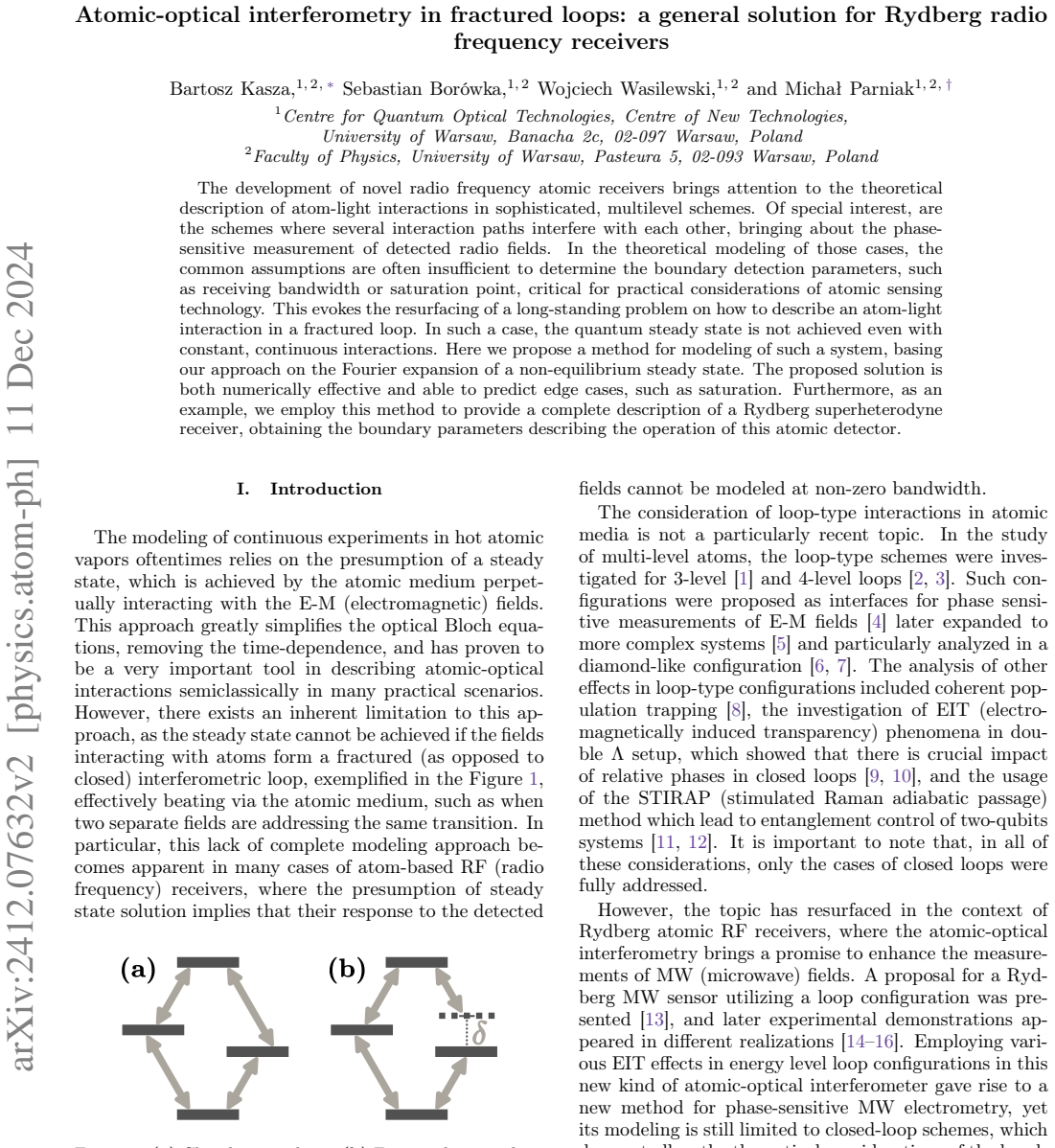
The central claim is that any fractured-loop atom-light system whose driving fields map uniquely to level transitions settles into a periodic non-equilibrium steady state with period $2\pi/\delta$, and that this state can be computed by Fourier-expanding the density matrix and solving a time-independent linear problem (FLSG, Eq.~22) rather than by integrating the master equation. The key step is separating the average repopulation of the ground state out of the $m=0$ Fourier mode, which converts the singular nullspace problem of the Floquet-Liouville supermatrix into a well-posed linear solve. For the 4-level Rydberg superheterodyne receiver, the method predicts a receiver bandwidth that broadens with signal strength, a saturation point at $\Omega_{\mathrm{LS}} = 2.4\cdot 2\pi$ MHz, a linear range ending near $\Omega_{\mathrm{LS}} = 1.5\cdot 2\pi$ MHz, and Autler-Townes band splitting at $\Omega_{\mathrm{LS}} = 5.2\cdot 2\pi$ MHz, all without small-detuning or weak-field approximations.
Load-bearing premise
The entire construction assumes the non-equilibrium steady state is periodic with a single frequency $\delta$, so a loop fractured by two incommensurate detunings, which would produce a quasiperiodic state, falls outside the Fourier ansatz.
Editorial extensions
If this is right
- Receiver performance maps (bandwidth, saturation, linear range) can be generated for any LO and signal Rabi frequencies without perturbative assumptions, guiding the choice of operating point in Rydberg superheterodyne sensing.
- The same FLSG method applies to other multi-level fractured-loop schemes, such as diamond loops and double-$\Lambda$ configurations, provided each driving field maps to a unique transition.
- For weak fields, a small number of Fourier modes suffices ($N_{\mathrm{opt}} = 2(m+1)+1$ for demodulation order $m$), giving a cheap numerical recipe for routine receiver modelling.
- Transit-time broadening dominates the hot-vapor response; the cold-atom variant ($\Gamma_{\mathrm{tr}} = 0$) yields a sharper, qualitatively different response regime, which the method captures without modification.
- The model's higher-order demodulation components predict that second-harmonic readout becomes relevant only for strong fields, which quantifies when simple first-harmonic demodulation is enough.
Reading between the lines
- The single-frequency ansatz suggests the 'any arbitrary loop fracture' claim will need a multi-frequency or quasiperiodic treatment for loops with two incommensurate detunings; this limitation is not discussed in the paper.
- Because the FLSG system is block-tridiagonal, sparse iterative solvers could scale it to larger level structures (e.g., Rydberg series with many coupled states) without dense inversion; the paper only reports dense linsolve.
- The paper reads out only $\mathrm{Im}\,\tilde{\rho}_{01}$, but the full complex $\tilde{\rho}_{01}$ computed by FLSG carries the phase of the modulation transfer, so the same solution directly predicts homodyne and interferometric signals.
- The predicted saturation and splitting points could serve as parameter-free calibration markers: a laboratory receiver that reproduces them would validate the model's parameter set, while one that does not would point to missing physics such as Doppler or dephasing.
Signed reviews
Editorial analysis
A structured set of objections, weighed in public.
Referee Report
Summary. The manuscript presents a method for computing the non-equilibrium steady state of an open quantum system driven by a periodically modulated field, with application to 'fractured-loop' atomic interferometry and Rydberg superheterodyne receivers. The authors derive a Floquet-Liouville supermatrix equation (FLSG) by Fourier-expanding the density matrix and separating the ground-state repopulation, thereby turning the nullspace problem into a linear solve. They apply the method to a four-level Rydberg superheterodyne scheme and report numerical predictions for receiver bandwidth, saturation point, and linear range as functions of the signal and local-oscillator Rabi frequencies.
Significance. If the numerical implementation is correct, the method would fill a practical gap: it goes beyond the small-detuning and weak-signal approximations commonly used for Rydberg superheterodyne receivers, and it provides quantitative predictions for device-level parameters. The derivation is self-contained, the convergence study in Appendix C is a useful check, and the data availability statement is a plus. However, two issues currently undercut the paper: the printed version of the central linear system in Eq. (22) does not match the derived Eq. (20), making the reported numbers unreproducible as written; and the 'general solution' claim is broader than the single-frequency Fourier ansatz can support. These need to be fixed before the contribution can be fully assessed.
major comments (3)
- [§III, Eqs. (20)-(22)] Section III, Eqs. (20)-(22): The matrix equation displayed as Eq. (22) does not follow from the derived condition in Eq. (20). Eq. (20) states that for each Fourier mode m, (L0 - imδ) ρ(m) + L+ ρ(m+1) + L- ρ(m-1) = 0. The diagonal blocks in Eq. (22) are written as L0 + 2δ, L0 + δ, L0 - δ, L0 - 2δ, i.e., real shifts +mδ, which differ from the required complex shifts -imδ. In addition, after the ground-state repopulation separation, Eq. (21) has RHS -Gρ(0) = -η |g⟩⟨g|, so the normalized source term should be -|g⟩⟨g|; Eq. (22) shows +|g⟩⟨g|. If a reader implements Eq. (22) as printed, the solved vector is not the NESS of the GKSL equation, and the quantitative predictions reported in Section IV (e.g., saturation at Ω_LS = 2.4·2π MHz and band split at Ω_LS = 5.2·2π MHz in Fig. 7) are not derivable from the paper. Please correct the signs and the imaginary unit, and state whether the reported figures were obtained with the corrected equations.
- [§III, Eq. (16) and §II.A] Section III, Eq. (16) and §II.A: The Fourier ansatz in Eq. (16) and the Lindbladian decomposition in Eq. (17) assume that all time dependence is characterized by a single frequency δ. The Introduction and Summary claim the method applies to 'any arbitrary loop fracture and energy level structure' (also reflected in the title). However, a loop with two or more incommensurate detunings produces a quasiperiodic NESS that cannot be represented by integer harmonics of a single δ. The example presented in the paper has only one δ; thus the 'general' claim is not demonstrated. I recommend either restricting the claim to single-fracture loops or outlining an extension to multi-frequency (multi-dimensional Fourier) decompositions.
- [§IV.A, Eq. (28)] Section IV.A, Eq. (28): The factor -1/2 in front of the RWA Hamiltonian is not consistent with the derivation leading to Eq. (4), which yields off-diagonal elements Ω (with ℏ=1) and diagonal elements -Δ_i. In Eq. (28) the off-diagonal elements are -Ω/2 and the diagonal elements -Δ_i/2. Unless the Rabi frequencies and detunings in Eq. (28) are redefined relative to Eq. (1), the effective couplings used in the numerical simulations are half the stated values. This would shift the predicted Autler-Townes splitting, saturation point, and bandwidth. Please clarify the convention and, if the factor is a typo, correct it.
minor comments (5)
- [§II.B, Eq. (14)] In Eq. (14), the expression is a first-order product of exponentials; this is usually called a Lie-Trotter product. The term 'first-order Suzuki-Trotter' is non-standard for this approximation.
- [§IV.B, Eq. (29)] In the displayed Eq. (29), the left-hand side 'Im ρ(t)' should specify the element, e.g., Im ρ_01(t), since the demodulation is defined on a particular coherence.
- [Figs. 6 and 10 captions] In the captions of Figs. 6 and 10, the demodulation order is typeset as 'd' rather than 'đ' used elsewhere; please unify the notation.
- [§III, paragraph after Eq. (20)] The phrase 'for larger matrix sizes' at the end of the paragraph following Eq. (20) appears to be a fragment; please integrate it into the preceding sentence.
- [Code availability] The code is available 'upon request' from B.K.; I recommend depositing the simulation code in a public repository (alongside the data in Ref. [44]) for full reproducibility.
Circularity Check
No significant circularity; the FLSG derivation is self-contained and the receiver predictions are genuine outputs of the solved equations.
full rationale
The central derivation is self-contained. The FLSG system (Eq. 22) follows from the GKSL master equation (8), the interaction-picture Hamiltonian (7), the Fourier ansatz (16), and the steady-state condition ˙ρ(m)=0, giving Eq. (20); the ground-state repopulation separation (21) turns the nullspace problem into a linear system with a known source term. The only numerical choice is the truncation order N, whose convergence is checked in Appendix C against the same equations rather than against the predicted receiver parameters. The quantitative predictions (saturation ΩLS=2.4·2π MHz, band split at 5.2·2π MHz, bandwidth curves) are outputs of the solved system for stated experimental parameters, not fitted inputs. Self-citations [16,39,43] appear only as context for related receiver work; no load-bearing premise is justified solely by a self-citation, and no uniqueness theorem from the authors is invoked. The single-frequency Fourier ansatz limits the 'arbitrary fracture' claim but is not circular. The possible sign and imaginary-unit discrepancy between Eqs. (20) and (22) is a correctness and consistency concern, not a circularity, because nothing in the derivation is defined in terms of the predicted outputs.
Assumptions & free parameters
free parameters (3)
- Fourier truncation order m_max (or N) =
N = 5 for d=1; N=7 for d=2; N=9 for d=3
- Transit-time broadening rate Γtr =
0.8·2π MHz
- Rabi frequencies (Ω_L01, Ω_L13, Ω_LO) =
1, 5, 2 (×2π MHz for the main results)
assumptions (6)
- standard math GKSL master equation with Markovian and secular approximations
- domain assumption Rotating wave approximation, neglecting fast-oscillating terms
- domain assumption Single-frequency periodic driving, allowing Fourier expansion
- domain assumption Neglect of Doppler broadening (single velocity class)
- domain assumption Fields can be uniquely mapped to energy-level transitions
- standard math Existence of a unique NESS for the periodic Lindblad equation
Cite this review
Pith. "Pith review of Atomic-optical interferometry in fractured loops: a general solution for Rydberg radio frequency receivers." pith.science (2026). https://pith.science/paper/VBVWLOEH
@misc{pith2026241207632,
  author       = {Pith},
  title        = {Pith review of: Atomic-optical interferometry in fractured loops: a general solution for Rydberg radio frequency receivers},
  year         = {2026},
  howpublished = {\url{https://pith.science/paper/VBVWLOEH}},
  note         = {Machine review of arXiv:2412.07632}
}
read the original abstract
The development of novel radio frequency atomic receivers brings attention to the theoretical description of atom-light interactions in sophisticated, multilevel schemes. Of special interest, are the schemes where several interaction paths interfere with each other, bringing about the phase-sensitive measurement of detected radio fields. In the theoretical modeling of those cases, the common assumptions are often insufficient to determine the boundary detection parameters, such as receiving bandwidth or saturation point, critical for practical considerations of atomic sensing technology. This evokes the resurfacing of a long-standing problem on how to describe an atom-light interaction in a fractured loop. In such a case, the quantum steady state is not achieved even with constant, continuous interactions. Here we propose a method for modeling of such a system, basing our approach on the Fourier expansion of a non-equilibrium steady state. The proposed solution is both numerically effective and able to predict edge cases, such as saturation. Furthermore, as an example, we employ this method to provide a complete description of a Rydberg superheterodyne receiver, obtaining the boundary parameters describing the operation of this atomic detector.
Figures


Figures from the paper (7 more)


Forward citations
Cited by 1 Pith paper
-
All-optical radio-frequency phase detection for Rydberg atom sensors using oscillatory dynamics
Under a finite laser detuning, a closed-loop Rydberg excitation makes probe transmission oscillate at the detuning frequency, encoding the radio-frequency phase, amplitude and detuning for all-optical readout.
Reference graph
Works this paper leans on
-
[1]
N. Tsukada, R. Tsujinishi, M. Nagano, and K. Tomishima, Physical Review A 21, 1281–1288 (1980)
work page 1980
-
[2]
M. P. Sharma and J. A. Roversi, Physical Review A29, 3264–3272 (1984)
work page 1984
-
[3]
S. P. Krinitzky and D. T. Pegg, Physical Review A33, 403–406 (1986). 10 2 4 6 8 10 12 14 LS [2 MHz] 6 4 2 0 2 4 6 [2 MHz] (a) d = 1 2 4 6 8 10 12 14 LS [2 MHz] (b) d = 2 2 4 6 8 10 12 14 LS [2 MHz] (c) d = 3 0.000 0.005 0.010 0.015 0.020 0.025 0.030 0.035 0.040 | (d) 01 | Figure 10. Comparison of absorption demodulation orders in superheterodyne 4-level s...
work page 1986
- [4]
-
[5]
D. V. Kosachiov, B. G. Matisov, and Y. V. Rozhdestven- sky, Journal of Physics B: Atomic, Molecular and Optical Physics 25, 2473–2488 (1992)
work page 1992
- [6]
-
[7]
S. Kajari-Schröder, G. Morigi, S. Franke-Arnold, and G.- L. Oppo, Physical Review A75, 042305 (2007)
work page 2007
-
[8]
W. Maichen, F. Renzoni, I. Mazets, E. Korsunsky, and L. Windholz, Physical Review A53, 3444–3448 (1996)
work page 1996
Show all 44 references
-
[9]
E. A. Korsunsky, N. Leinfellner, A. Huss, S. Baluschev, and L. Windholz, Physical Review A 59, 2302–2305 (1999). 1 3 5 7 9 11 13 15 N 0.0960 0.0962 0.0964 0.0966 0.0968 0.0970| (0) 10 | m = 0 1 3 5 7 9 11 13 15 N 0.012 0.014 0.016 0.018 0.020| (1) 10 | m = 1 1 3 5 7 9 11 13 15...
1999
-
[10]
E. A. Korsunsky and D. V. Kosachiov, Physical Review A 60, 4996–5009 (1999)
1999
-
[11]
V. S. Malinovsky and I. R. Sola, Physical Review A70, 042304 (2004)
2004
-
[12]
V. S. Malinovsky and I. R. Sola, Physical Review A70, 042305 (2004)
2004
-
[13]
Shylla, E
D. Shylla, E. O. Nyakang’o, and K. Pandey, Scientific Reports 8, 8692 (2018)
2018
-
[14]
Anderson, R
D. Anderson, R. Sapiro, L. Gonçalves, R. Cardman, and G. Raithel, Physical Review Applied17, 044020 (2022)
2022
-
[15]
Berweger, A
S. Berweger, A. B. Artusio-Glimpse, A. P. Rotunno, N. Prajapati, J. D. Christesen, K. R. Moore, M. T. Si- mons, and C. L. Holloway, Physical Review Applied20, 11 054009 (2023)
2023
-
[16]
Borówka, M
S. Borówka, M. Mazelanik, W. Wasilewski, and M. Par- niak, Optically-biased rydberg microwave receiver en- abled by hybrid nonlinear interferometry (2024)
2024
-
[17]
M. T. Simons, A. H. Haddab, J. A. Gordon, and C. L. Holloway, Applied Physics Letters114, 114101 (2019)
2019
-
[18]
J. A. Gordon, M. T. Simons, A. H. Haddab, and C. L. Holloway, AIP Advances9, 045030 (2019)
2019
-
[19]
M. Jing, Y. Hu, J. Ma, H. Zhang, L. Zhang, L. Xiao, and S. Jia, Nature Physics16, 911–915 (2020)
2020
-
[20]
T. N. Ikeda and M. Sato, Science Advances6, 10.1126/s- ciadv.abb4019 (2020)
2020 doi
-
[21]
Ho and S.-I
T.-S. Ho and S.-I. Chu, Chemical Physics Letters122, 327 (1985)
1985
-
[22]
T.-S. Ho, K. Wang, and S.-I. Chu, Physical Review A33, 1798–1816 (1986)
1986
-
[23]
Liu, K.-Y
X.-H. Liu, K.-Y. Liao, Z.-X. Zhang, H.-T. Tu, W. Bian, Z.-Q. Li, S.-Y. Zheng, H.-H. Li, W. Huang, H. Yan, and S.-L. Zhu, Physical Review Applied18, 054003 (2022)
2022
-
[24]
S. Ren, Y. Tang, C. Yang, H. Zhou, and S. Wang, Optics Express 32, 42397 (2024)
2024
-
[25]
S. Wu, C. Gong, S. Li, R. Ni, and J. Zhu, Theoretical analysis of heterodyne rydberg atomic receiver sensitivity based on transit relaxation effect and frequency detuning (2023)
2023
-
[26]
H. Fan, S. Kumar, J. Sedlacek, H. Kübler, S. Karimkashi, and J. P. Shaffer, Journal of Physics B: Atomic, Molecu- lar and Optical Physics48, 202001 (2015)
2015
-
[27]
Gorini, A
V. Gorini, A. Kossakowski, and E. C. G. Sudarshan, Journal of Mathematical Physics17, 821–825 (1976)
1976
-
[28]
Lindblad, Communications in Mathematical Physics 48, 119–130 (1976)
G. Lindblad, Communications in Mathematical Physics 48, 119–130 (1976)
1976
-
[29]
B. M. Fernengel and B. Drossel, Journal of Physics A: Mathematical and Theoretical56, 385205 (2023)
2023
-
[30]
Porrati and S
M. Porrati and S. Putterman, Physical Review A 39, 3010–3030 (1989)
1989
-
[31]
Chen, Y.-M
H. Chen, Y.-M. Hu, W. Zhang, M. A. Kurniawan, Y. Shao, X. Chen, A. Prem, and X. Dai, Physical Re- view B109, 184309 (2024)
2024
-
[32]
Ikeda, K
T. Ikeda, K. Chinzei, and M. Sato, SciPost Physics Core 4, 033 (2021)
2021
-
[33]
Kumar, H
S. Kumar, H. Fan, H. Kübler, J. Sheng, and J. P. Shaffer, Scientific Reports7, 42981 (2017)
2017
-
[34]
Berweger, N
S. Berweger, N. Prajapati, A. B. Artusio-Glimpse, A. P. Rotunno, R. Brown, C. L. Holloway, M. T. Simons, E. Imhof, S. R. Jefferts, B. N. Kayim, M. A. Viray, R. Wyllie, B. C. Sawyer, and T. G. Walker, Physical Re- view Applied19, 044049 (2023)
2023
-
[35]
P. K. Elgee, J. C. Hill, K.-J. E. LeBlanc, G. D. Ko, P. D. Kunz, D. H. Meyer, and K. C. Cox, Applied Physics Let- ters 123, 084001 (2023)
2023
-
[36]
Arumugam, J.-H
D. Arumugam, J.-H. Park, B. Feyissa, J. Bush, and S. P. Mysore Nagaraja, Scientific Reports14, 18025 (2024)
2024
-
[37]
Nowosielski, M
J. Nowosielski, M. Jastrzębski, P. Halavach, K. Łukanowski, M. Jarzyna, M. Mazelanik, W. Wasilewski, and M. Parniak, Optics Express 32, 30027 (2024)
2024
-
[38]
Legaie, G
R. Legaie, G. Raithel, and D. A. Anderson, AVS Quan- tum Science6, 024402 (2024)
2024
-
[39]
Borówka, W
S. Borówka, W. Krokosz, M. Mazelanik, W. Wasilewski, and M. Parniak, Physical Review Applied 22, 034067 (2024)
2024
-
[40]
A. B. Deb and N. Kjærgaard, Applied Physics Letters 112, 211106 (2018)
2018
-
[41]
Holloway, M
C. Holloway, M. Simons, A. H. Haddab, J. A. Gordon, D. A. Anderson, G. Raithel, and S. Voran, IEEE Anten- nas and Propagation Magazine63, 63–76 (2021)
2021
-
[42]
D. A. Anderson, R. E. Sapiro, and G. Raithel, IEEE Transactions on Antennas and Propagation 69, 2455–2462 (2021)
2021
-
[43]
Borówka, U
S. Borówka, U. Pylypenko, M. Mazelanik, and M. Par- niak, Applied Optics61, 8806 (2022)
2022
-
[44]
Kasza, S
B. Kasza, S. Borówka, M. Parniak, and W. Wasilewski, Replication Data for: Atomic-optical interferometry in fractured loops: a general solution for Rydberg radio fre- quency receivers (2024)
2024
Reviewed August 11, 2026 · model on record in the stance chip above.
Discussion (0). Continue with ORCID to comment.