REVIEW 4 major objections 7 minor 80 references
Diffusion-based Data Augmentation and Knowledge Distillation with Generated Soft Labels Solving Data Scarcity Problems of SAR Oil Spill Segmentation
T0 review · 4 major / 7 minor · reviewed 2026-08-11 · deepseek-v4-flash
Pith's one-line read This paper argues that a diffusion model trained to jointly generate SAR images and per-pixel soft labels, balanced by an SNR-based factor, can transfer knowledge to student segmentation models and significantly improve oil spill…
desk verdict Solid applied SAR augmentation paper with a genuine balancing-factor contribution; the soft-label knowledge claim needs calibration evidence but deserves review. read the letter →
The pith
A machine-rendered reading of the paper's core claim, the machinery that carries it, and where it could break.
The reading
What carries the argument
The machinery has three parts. The SNR-based balancing factor b, defined as $\sqrt$(P(x0)/P(y0)) using 2D DFT mean powers, scales the mask before noise is added so that the SAR image and mask have equal SNR at each timestep. The cross-entropy loss on the predicted mask turns the label decoder into a logit producer, yielding per-pixel class probability distributions instead of one-hot masks. The knowledge distillation loss Lkd = $T^{2}$ / N * sum Lce(q_t, p_s) with temperature-scaled soft labels transfers those probabilities to the student segmentation network. Together these parts convert a DDPM into a joint generator of image–soft-label pairs.
What would settle it
Take the DAKTer pipeline on the OSD dataset and train the same SegFormer student on the generated pairs but with the soft labels thresholded into one-hot masks (no KD loss), keeping the generated images and all hyperparameters fixed. If the mIoU gain over the no-augmentation baseline vanishes, the soft-label knowledge transfer is what carries the improvement; if the gain persists, the images alone are responsible and the paper's distillation claim is falsified.
Extended reading notes
Core claim
On the paper's own terms, the central claim is that a diffusion model trained to jointly denoise SAR images and segmentation masks can be converted into a data engine that supplies soft labels rich enough to boost downstream segmentation under data scarcity. The key move is to balance the joint noise corruption with a scalar b = sqrt(P(x0)/P(y0)) computed from frequency-domain mean powers, then train the model with an L2 loss on the image channel and a cross-entropy loss on the label channel so the label output behaves as logits rather than a one-hot reconstruction. At inference, DDIM sampling yields new image–logit pairs, and the logits are temperature-softened into soft labels for knowledge distillation. The paper claims this replaces the need for a same-task teacher: the diffusion model's semantic understanding, transferred through soft labels, is what improves the student.
Load-bearing premise
The method assumes that a single scalar b, computed from total frequency-domain mean power of the two modalities, is enough to keep the information loss of SAR images and masks aligned during diffusion corruption; if different spatial frequencies or boundary structures corrupt unevenly, the generated soft labels can drift out of alignment with the images.
Editorial extensions
If this is right
- On OSD, training SegFormer with DAKTer's augmented dataset and knowledge distillation raises mIoU from 67.46% to 70.74%, a gain of 3.28 points over the original-data baseline.
- The same strategy improves DeepLabV3+, CBDNet, and Mask2Former on OSD, and boosts all four tested models on SOS-Sentinel and SOS-ALOS, indicating the benefit is not tied to one architecture.
- Because the diffusion generator supplies the soft labels, no separately trained same-task teacher network is needed for distillation; the two-stage DA-plus-teacher baseline in the paper's Table 2 is outperformed.
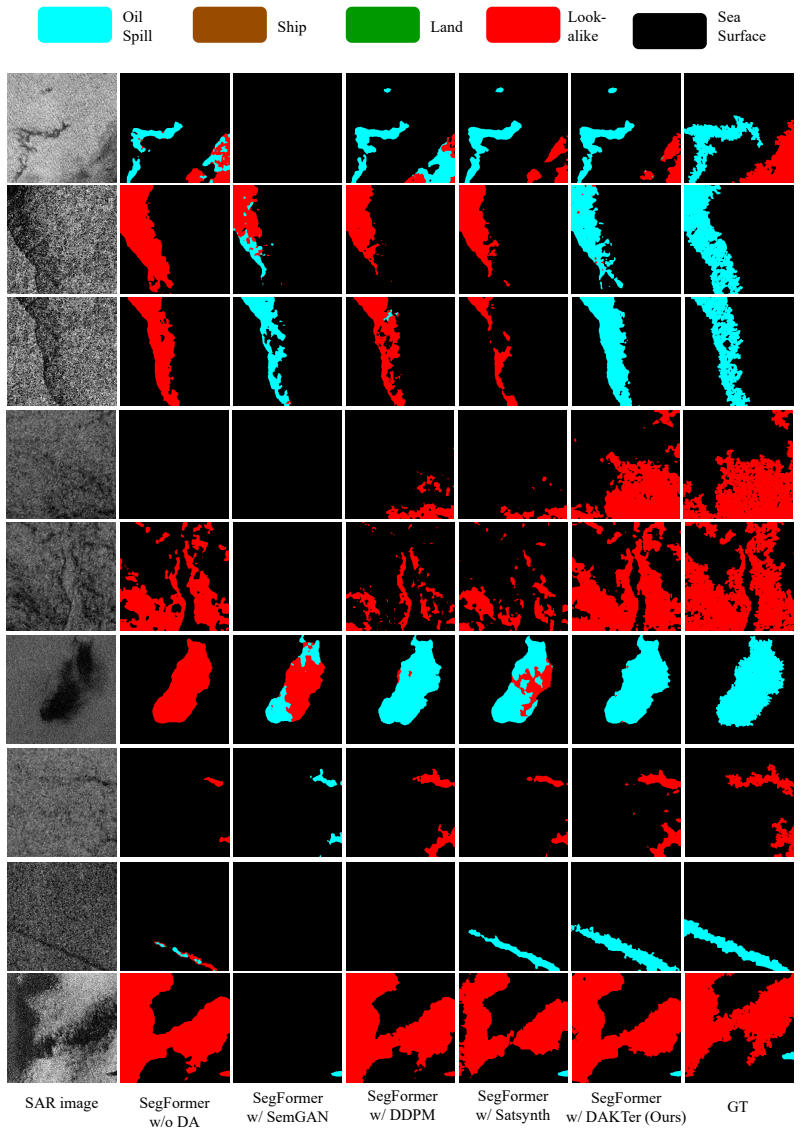
- Generated soft labels shift per-class IoU gains mainly to the 'oil-spill' and 'look-alike' classes, which appear as visually similar dark regions in SAR imagery and are the hardest to separate.
Reading between the lines
- Inference: the SNR-balancing factor is a dataset-level scalar derived from total frequency-domain power; a natural extension would make it band- or region-dependent, since SAR speckle and oil-spill boundaries occupy particular spatial frequencies that total power averages away.
- Inference: the same joint-generation-plus-soft-label scheme could transfer to other scarce-data remote sensing tasks, such as flood or iceberg segmentation, wherever a diffusion prior can learn the image–mask alignment.
- Inference: the paper tests the semantic understanding of diffusion models only indirectly through downstream mIoU; a direct evaluation of soft label calibration against held-out masks would isolate the source of the gain.
Editorial analysis
A structured set of objections, weighed in public.
Referee Report
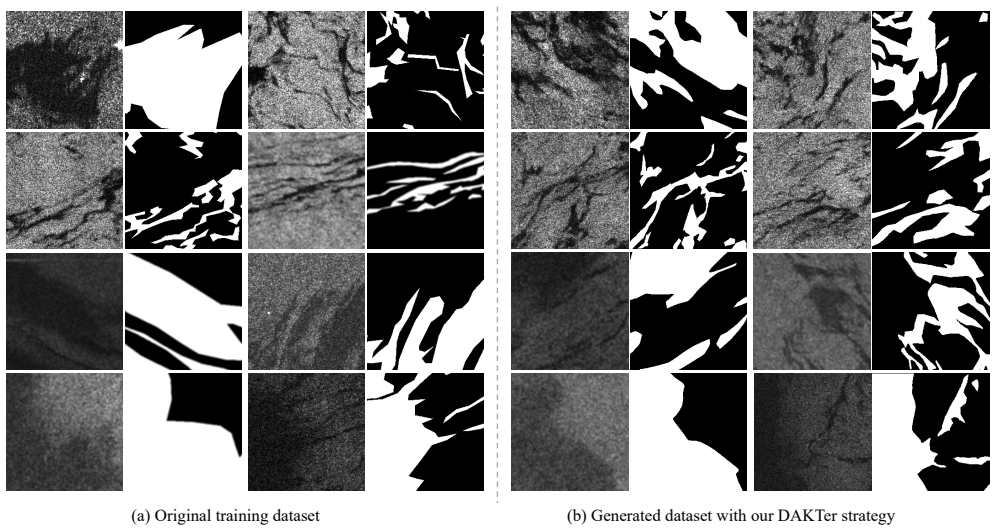
Summary. The paper proposes DAKTer, a three-stage strategy for SAR oil spill segmentation under labeled-data scarcity. First, a DDPM is trained to jointly generate SAR images and their corresponding soft-label maps, using a cross-entropy loss on the mask channel and an SNR-based balancing factor b that scales the mask signal to match the noise sensitivity of the image channel. Second, the trained DDPM synthesizes an augmented dataset of image-soft-label pairs. Third, a student segmentation model is trained on the original dataset plus the augmented dataset, using a knowledge-distillation loss for the generated soft labels. The authors evaluate the method on three datasets (OSD, SOS-Sentinel, SOS-ALOS) with four segmentation backbones, reporting consistent improvements in mIoU and F1, with the largest gain on OSD (SegFormer mIoU from 67.46% to 70.74%).
Significance. If the central claim is upheld, the paper makes a useful practical contribution to a domain with genuinely scarce annotations: it shows that a generative model can supply not only extra synthetic training pairs but also per-pixel class-probability supervision without a separately trained segmentation teacher. The SNR-based balancing factor is a simple and reasonable idea, and the paper provides an ablation (Table 3) showing that the derived value of b outperforms alternatives. The authors also include experiments across multiple datasets and architectures, and the qualitative visualizations in Fig. 2 and the supplementary material are informative. However, the scientific evidence for the specific claim that the soft labels transfer knowledge (rather than simply providing extra data or a label-smoothing effect) is not yet conclusive: the soft-label calibration is unverified, and the results lack statistical significance measures, especially on the two SOS datasets where gains are small.
major comments (4)
- [Sec. 3.3.2, Sec. 3.5, Eq. (3), Algorithm 2] The paper claims that the generated soft labels encode class probability distributions that transfer knowledge to the student, but the raw logits produced by the CE-trained DDPM are passed directly to the softmax with a fixed temperature T=2, without any analysis of their scale or calibration. Cross-entropy training does not constrain the absolute magnitude of the logits, so the resulting soft labels could be near one-hot (if the logits are overconfident) or near uniform (if underconfident), in which case the distillation loss in Eq. (4) either adds no probability information or acts only as label smoothing. To support the central knowledge-transfer claim, the authors should report the average entropy or confidence of the generated soft labels for each dataset, perform a sensitivity analysis over T, or apply post-hoc temperature calibration to the logits before computing qt.
- [Tables 1-3 and Fig. 5] All quantitative results are from single runs, and no variance or significance measures are reported. The improvements on SOS-Sentinel and SOS-ALOS are small (for example, several models in Table 1 show gains of only 0.5-1.1 mIoU), so without multiple seeds or confidence intervals we cannot determine whether the observed differences are statistically reliable. I recommend reporting mean and standard deviation over at least three independent training runs for the main comparisons, or a paired significance test.
- [Table 1] The comparison between DAKTer and the DDPM baseline in Table 1 is confounded: the two methods differ in the balancing factor b, the loss function for the mask channel (CE vs L2), and the use of knowledge distillation with soft labels. Figure 5 partially isolates the contribution of soft-label KD, but it does not separate the effect of the CE loss (soft-label generation) from the effect of the balancing factor. I recommend an additional ablation in which a DDPM with the SNR-based balancing factor is trained with the CE loss, but the generated labels are thresholded to hard labels and the student is trained with standard CE; this would directly quantify the benefit of using soft labels for supervision.
- [Supplementary Sec. C, Eqs. (12)-(16)] The derivation of the balancing factor b relies on the assumption that total frequency-domain mean power is a sufficient proxy for the semantic information content of each modality in the joint generation task. For binary segmentation masks, the power spectrum is concentrated at low frequencies, while boundary and alignment information resides at higher frequencies; a single scalar b may not equalize the corruption of these different components. This does not invalidate the method given the positive ablation of Table 3, but the derivation should be framed as an approximation, and a brief discussion of this limitation should be added.
minor comments (7)
- [Abstract] There is a typo: 'modalilties' should be 'modalities'.
- [Fig. 5 caption] The caption contains a typo: 'Comparsion' should be 'Comparison'.
- [References] Several reference entries contain stray numbers (e.g., entries for [8], [13], [62], and [75] end with '1, 3, 8, 9' or similar), which appear to be LaTeX citation artifacts. Please clean up the reference formatting.
- [Sec. 3.3.2] The sentence 'we firstly utilize the CE loss in the generative DA context to generate segmentation masks as soft labels' is an overclaim; prior works have used cross-entropy for mask prediction in diffusion models. Please soften the claim and cite relevant literature.
- [Sec. 4.2.1] The sentence explaining the DDPM result states that 'the superior segmentation performance from DDPM comes from the misalignment between the SAR images and the mask images'; this is unclear because the sentence follows a discussion of generation quality and could be misread as saying misalignment is beneficial. Please rephrase.
- [Supplementary Sec. B.1] The statement 'we used only 20% of the images in which all pixels belonged to the sea-surface class' is ambiguous; please clarify whether this filtering was applied to the OSD dataset only and how it affects the training distribution.
- [General] The paper does not include a code availability statement. Given the emphasis on reproducibility in current computer vision practice, a link to code or at least a clear statement about availability would strengthen the manuscript.
Circularity Check
No significant circularity: the DDPM generates soft labels from noise after training on the original masks, the balancing factor b is derived from dataset statistics and ablated, and all segmentation gains are measured on held-out test sets.
full rationale
The paper's derivation chain is not circular. The DDPM is trained on the original training pairs D (Algorithm 1) using an L2 image loss plus a cross-entropy loss against one-hot training masks, and the augmented dataset D_a is then synthesized from random noise (Algorithm 2), not by retrieving or copying training labels. Student segmentation models are trained on D ∪ D_a and evaluated on held-out test splits of OSD, SOS-Sentinel, and SOS-ALOS, so the reported mIoU gains are external benchmark results rather than quantities defined by the method's inputs. The SNR-based balancing factor b is computed a priori from the dataset's frequency-domain mean powers (Supplementary Eq. (16)) and is separately ablated in Table 3; it is not fitted to test segmentation performance. The claim that CE-trained diffusion logits provide informative soft labels is an empirical validity question about calibration and about whether the qualitative semantic alignment transfers, not a by-construction equivalence: nothing in the method defines the student's test prediction in terms of the training labels or in terms of the synthetic soft labels. The comparison in Fig. 5 (DAKTer with and without soft-label supervision) is an attempt to isolate the soft-label contribution, and even if the ablation is imperfect, the absence of a clean ablation is a correctness/evidence concern, not circularity. No load-bearing self-citations appear: references to diffusion models' semantic understanding [4, 51, 60] are to external prior work, and the paper invokes no author-specific uniqueness theorem. The stated resolution limitation (Supplementary D) is also not a circular step. Therefore no specific reduction of a prediction to an input, fitted parameter, or self-citation chain can be exhibited, and the appropriate finding is no significant circularity.
Assumptions & free parameters
free parameters (5)
- SNR-based balancing factor b =
0.5089 (OSD), 0.4370 (SOS-ALOS), 0.4655 (SOS-Sentinel)
- Temperature T for soft-label softening =
2
- Knowledge distillation loss weight lambda_kd =
0.1
- Soft Dice loss weight lambda_dice =
0.5
- Cross-entropy loss weight lambda_ce =
1
assumptions (5)
- domain assumption A pixel-domain DDPM trained jointly on SAR images and segmentation masks can learn the joint distribution needed for data augmentation.
- ad hoc to paper Equalizing total frequency-domain mean power SNR across modalities with a scalar b preserves the semantically relevant information of both modalities.
- domain assumption Cross-entropy loss on one-hot masks yields logits whose softmax values are meaningful per-pixel class probability distributions.
- domain assumption Soft labels generated by the DDPM are aligned with their synthetic SAR images well enough to serve as distillation targets.
- domain assumption The original dataset labels used to train the DDPM are sufficiently clean and representative.
Cite this review
Pith. "Pith review of Diffusion-based Data Augmentation and Knowledge Distillation with Generated Soft Labels Solving Data Scarcity Problems of SAR Oil Spill Segmentation." pith.science (2026). https://pith.science/paper/NAPOKDD6
@misc{pith2026241208116,
  author       = {Pith},
  title        = {Pith review of: Diffusion-based Data Augmentation and Knowledge Distillation with Generated Soft Labels Solving Data Scarcity Problems of SAR Oil Spill Segmentation},
  year         = {2026},
  howpublished = {\url{https://pith.science/paper/NAPOKDD6}},
  note         = {Machine review of arXiv:2412.08116}
}
read the original abstract
Oil spills pose severe environmental risks, making early detection crucial for effective response and mitigation. As Synthetic Aperture Radar (SAR) images operate under all-weather conditions, SAR-based oil spill segmentation enables fast and robust monitoring. However, when using deep learning models, SAR oil spill segmentation often struggles in training due to the scarcity of labeled data. To address this limitation, we propose a diffusion-based data augmentation with knowledge transfer (DAKTer) strategy. Our DAKTer strategy enables a diffusion model to generate SAR oil spill images along with soft label pairs, which offer richer class probability distributions than segmentation masks (i.e. hard labels). Also, for reliable joint generation of high-quality SAR images and well-aligned soft labels, we introduce an SNR-based balancing factor aligning the noise corruption process of both modalilties in diffusion models. By leveraging the generated SAR images and soft labels, a student segmentation model can learn robust feature representations without teacher models trained for the same task, improving its ability to segment oil spill regions. Extensive experiments demonstrate that our DAKTer strategy effectively transfers the knowledge of per-pixel class probabilities to the student segmentation model to distinguish the oil spill regions from other look-alike regions in the SAR images. Our DAKTer strategy boosts various segmentation models to achieve superior performance with large margins compared to other generative data augmentation methods.
Figures


Figures from the paper (9 more)




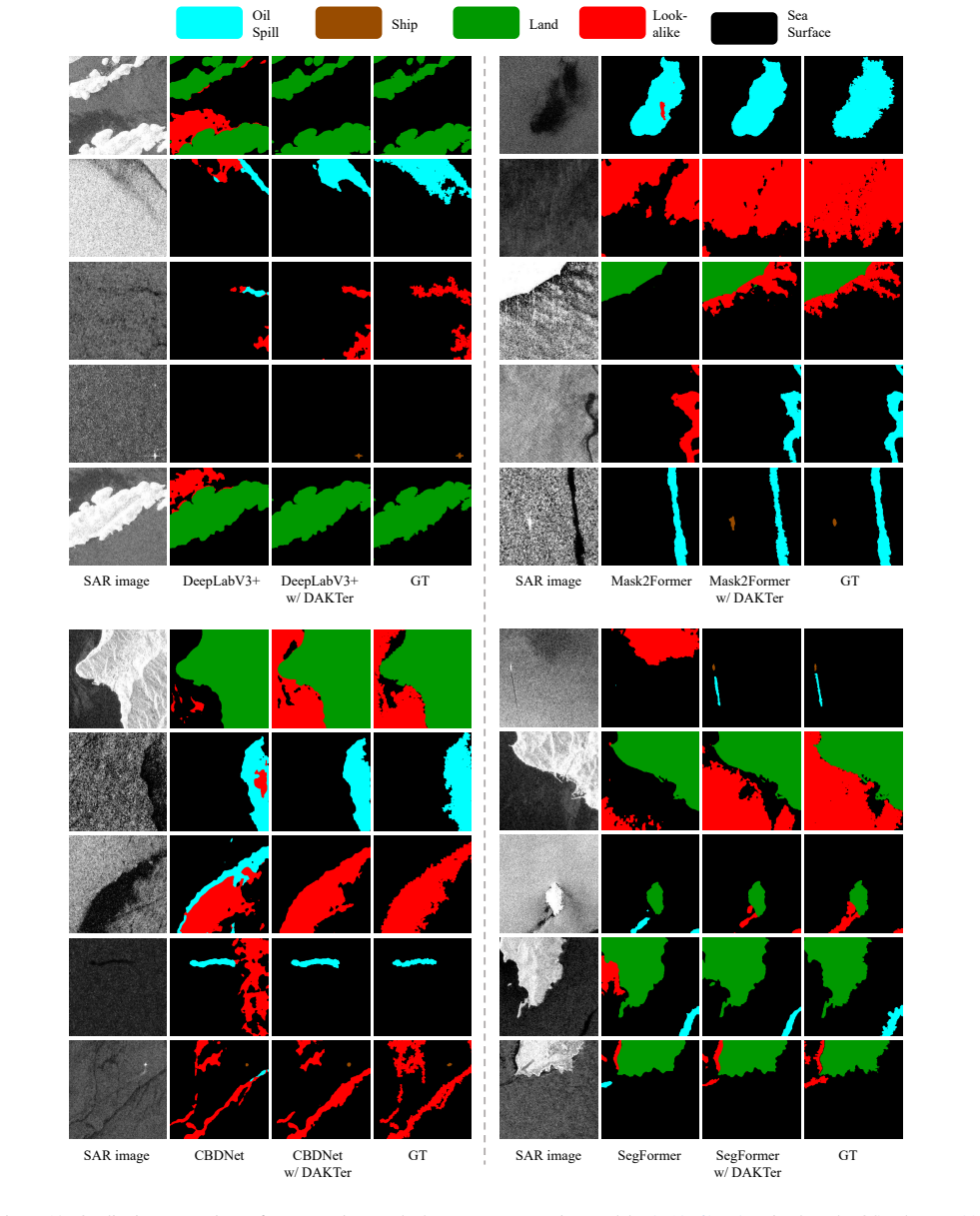


Reference graph
Works this paper leans on
-
[1]
Emotion recognition in speech using cross- modal transfer in the wild
Samuel Albanie, Arsha Nagrani, Andrea Vedaldi, and An- drew Zisserman. Emotion recognition in speech using cross- modal transfer in the wild. In Proceedings of the 26th ACM International Conference on Multimedia , page 292–301, New York, NY , USA, 2018. Association for Computing Ma- chinery. 3
work page 2018
-
[2]
Wasserstein generative adversarial networks
Martin Arjovsky, Soumith Chintala, and L ´eon Bottou. Wasserstein generative adversarial networks. In Interna- tional conference on machine learning , pages 214–223. PMLR, 2017. 7
work page 2017
-
[3]
Synthetic data from diffusion models improves imagenet classification
Shekoofeh Azizi, Simon Kornblith, Chitwan Saharia, Mo- hammad Norouzi, and David J Fleet. Synthetic data from diffusion models improves imagenet classification. arXiv preprint arXiv:2304.08466, 2023. 3
arXiv 2023
-
[4]
Label-efficient se- mantic segmentation with diffusion models
Dmitry Baranchuk, Ivan Rubachev, Andrey V oynov, Valentin Khrulkov, and Artem Babenko. Label-efficient se- mantic segmentation with diffusion models. arXiv preprint arXiv:2112.03126, 2021. 2, 3, 4
arXiv 2021
-
[5]
F. M. Bianchi, M. M. Espeseth, and N. Borch. Large-scale detection and categorization of oil spills from sar images with deep learning. Remote Sensing, 12(14):2260, 2020. 2, 3
work page 2020
-
[6]
Data-free learning of student networks
Hanting Chen, Yunhe Wang, Chang Xu, Zhaohui Yang, Chuanjian Liu, Boxin Shi, Chunjing Xu, Chao Xu, and Qi Tian. Data-free learning of student networks. InProceedings of the IEEE/CVF International Conference on Computer Vi- sion (ICCV), 2019. 3, 8
work page 2019
-
[7]
Geodiffusion: Text- prompted geometric control for object detection data gen- eration
Kai Chen, Enze Xie, Zhe Chen, Yibo Wang, Lanqing Hong, Zhenguo Li, and Dit-Yan Yeung. Geodiffusion: Text- prompted geometric control for object detection data gen- eration. arXiv preprint arXiv:2306.04607, 2023. 3
arXiv 2023
-
[8]
Encoder-decoder with atrous separable convolution for semantic image segmentation
Liang-Chieh Chen, Yukun Zhu, George Papandreou, Florian Schroff, and Hartwig Adam. Encoder-decoder with atrous separable convolution for semantic image segmentation. In Proceedings of the European conference on computer vision (ECCV), pages 801–818, 2018. 2, 5, 7, 1, 3, 8, 9
work page 2018
Show all 80 references
-
[9]
Distilling knowledge via knowledge review
Pengguang Chen, Shu Liu, Hengshuang Zhao, and Jiaya Jia. Distilling knowledge via knowledge review. InIEEE Confer- ence on Computer Vision and Pattern Recognition (CVPR) ,
-
[10]
On the importance of noise scheduling for diffu- sion models
Ting Chen. On the importance of noise scheduling for diffu- sion models. arXiv preprint arXiv:2301.10972, 2023. 4
2023 arXiv
-
[11]
A generalist framework for panoptic segmen- tation of images and videos
Ting Chen, Lala Li, Saurabh Saxena, Geoffrey Hinton, and David J Fleet. A generalist framework for panoptic segmen- tation of images and videos. InProceedings of the IEEE/CVF international conference on computer vision , pages 909– 919, 2023. 4
2023
-
[12]
Y . Chen, Y . Li, and J. Wang. An end-to-end oil-spill monitor- ing method for multisensory satellite images based on deep semantic segmentation. Sensors, 20(3):725, 2020. 2
2020
-
[13]
Masked-attention mask transformer for universal image segmentation
Bowen Cheng, Ishan Misra, Alexander G Schwing, Alexan- der Kirillov, and Rohit Girdhar. Masked-attention mask transformer for universal image segmentation. In Proceed- ings of the IEEE/CVF conference on computer vision and pattern recognition, pages 1290–1299, 2022. 2, 5, 7, 1...
2022
-
[14]
Speckle noise reduction technique for sar images using statistical characteristics of speckle noise and discrete wavelet transform
Hyunho Choi and Jechang Jeong. Speckle noise reduction technique for sar images using statistical characteristics of speckle noise and discrete wavelet transform. Remote Sens- ing, 11(10), 2019. 1
2019
-
[15]
MMYOLO: OpenMMLab YOLO series toolbox and benchmark
MMYOLO Contributors. MMYOLO: OpenMMLab YOLO series toolbox and benchmark. https://github.com/ open-mmlab/mmyolo, 2022. 2
2022
-
[16]
Tuong Do, Thanh-Toan Do, Huy Tran, Erman Tjiputra, and Quang D. Tran. Compact trilinear interaction for visual ques- tion answering. In Proceedings of the IEEE/CVF Interna- tional Conference on Computer Vision (ICCV), 2019. 3
2019
-
[17]
Oil-spill-response-oriented in- formation products derived from a rapid-repeat time series of sar images
Martine Espeseth, Cathleen Jones, Benjamin Holt, Camilla Brekke, and Stine Skrunes. Oil-spill-response-oriented in- formation products derived from a rapid-repeat time series of sar images. IEEE Journal of Selected Topics in Applied Earth Observations and Remote Sensing, PP:1–...
2020
-
[18]
Up to 100 × faster data-free knowledge distillation
Gongfan Fang, Kanya Mo, Xinchao Wang, Jie Song, Shi- tao Bei, Haofei Zhang, and Mingli Song. Up to 100 × faster data-free knowledge distillation. arXiv preprint arXiv:2112.06253, 2022. 3
2022 arXiv
-
[19]
Data augmentation for object detec- tion via controllable diffusion models
Haoyang Fang, Boran Han, Shuai Zhang, Su Zhou, Cuixiong Hu, and Wen-Ming Ye. Data augmentation for object detec- tion via controllable diffusion models. In Proceedings of the IEEE/CVF Winter Conference on Applications of Computer Vision (WACV), pages 1257–1266, 2024. 3
2024
-
[20]
Dreamda: Generative data augmentation with diffusion mod- els
Yunxiang Fu, Chaoqi Chen, Yu Qiao, and Yizhou Yu. Dreamda: Generative data augmentation with diffusion mod- els. arXiv preprint arXiv:2403.12803, 2024. 3
2024 arXiv
-
[21]
Gemme and S
L. Gemme and S. G. Dellepiane. An automatic data-driven method for sar image segmentation in sea surface analysis. IEEE Transactions on Geoscience and Remote Sensing , 56 (5):2633–2646, 2018. 2
2018
-
[22]
Generative adversarial networks
Ian Goodfellow, Jean Pouget-Abadie, Mehdi Mirza, Bing Xu, David Warde-Farley, Sherjil Ozair, Aaron Courville, and Yoshua Bengio. Generative adversarial networks. Commu- nications of the ACM, 63(11):139–144, 2020. 3, 4
2020
-
[23]
Class attention transfer based knowledge distillation
Ziyao Guo, Haonan Yan, Hui Li, and Xiaodong Lin. Class attention transfer based knowledge distillation. In Proceed- ings of the IEEE/CVF Conference on Computer Vision and Pattern Recognition, pages 11868–11877, 2023. 3
2023
-
[24]
Gans trained by a two time-scale update rule converge to a local nash equilib- rium
Martin Heusel, Hubert Ramsauer, Thomas Unterthiner, Bernhard Nessler, and Sepp Hochreiter. Gans trained by a two time-scale update rule converge to a local nash equilib- rium. Advances in neural information processing systems , 30, 2017. 6, 7
2017
-
[25]
Distill- ing the knowledge in a neural network
Geoffrey Hinton, Oriol Vinyals, and Jeff Dean. Distill- ing the knowledge in a neural network. arXiv preprint arXiv:1503.02531, 2015. 3, 4, 5, 7
2015 arXiv
-
[26]
Denoising dif- fusion probabilistic models
Jonathan Ho, Ajay Jain, and Pieter Abbeel. Denoising dif- fusion probabilistic models. Advances in neural information processing systems, 33:6840–6851, 2020. 2, 3, 4, 6, 7, 8, 1
2020
-
[27]
Segment any- thing
Alexander Kirillov, Eric Mintun, Nikhila Ravi, Hanzi Mao, Chloe Rolland, Laura Gustafson, Tete Xiao, Spencer White- head, Alexander C Berg, Wan-Yen Lo, et al. Segment any- thing. In Proceedings of the IEEE/CVF International Con- ference on Computer Vision, pages 4015–4026, 2023. 2 9
2023
-
[28]
Konik and K
M. Konik and K. Bradtke. Object-oriented approach to oil spill detection using envisat asar images. ISPRS Journal of Photogrammetry and Remote Sensing, 118:37–52, 2016. 1
2016
-
[29]
Anatomically-controllable medical image gen- eration with segmentation-guided diffusion models
Nicholas Konz, Yuwen Chen, Haoyu Dong, and Maciej A Mazurowski. Anatomically-controllable medical image gen- eration with segmentation-guided diffusion models. In International Conference on Medical Image Computing and Computer-Assisted Intervention, pages 88–98. Springer,
-
[30]
Krestenitis, G
M. Krestenitis, G. Orfanidis, K. Ioannidis, K. Avgerinakis, S. Vrochidis, and I. Kompatsiaris. Oil spill identification from satellite images using deep neural networks. Remote Sensing, 11(15):1762, 2019. 2, 5, 6, 7, 8, 1, 3, 4
2019
-
[31]
I. K. Lee, A. Shamsoddini, X. Li, J. C. Trinder, and Z. Li. Extracting hurricane eye morphology from spaceborne sar images using morphological analysis.ISPRS Journal of Pho- togrammetry and Remote Sensing, 117:115–125, 2016. 1
2016
-
[32]
Semantic segmentation with generative models: Semi-supervised learning and strong out-of-domain generalization
Daiqing Li, Junlin Yang, Karsten Kreis, Antonio Torralba, and Sanja Fidler. Semantic segmentation with generative models: Semi-supervised learning and strong out-of-domain generalization. In Proceedings of the IEEE/CVF Conference on Computer Vision and Pattern Recognition , pa...
2021
-
[33]
Online knowledge distillation for efficient pose estimation
Zheng Li, Jingwen Ye, Mingli Song, Ying Huang, and Zhi- geng Pan. Online knowledge distillation for efficient pose estimation. In Proceedings of the IEEE/CVF international conference on computer vision , pages 11740–11750, 2021. 3
2021
-
[34]
Is synthetic data from diffusion models ready for knowledge distillation? arXiv preprint arXiv:2305.12954, 2023
Zheng Li, Yuxuan Li, Penghai Zhao, Renjie Song, Xi- ang Li, and Jian Yang. Is synthetic data from diffusion models ready for knowledge distillation? arXiv preprint arXiv:2305.12954, 2023. 3
2023 arXiv
-
[35]
Structured knowledge distillation for semantic segmentation
Yifan Liu, Ke Chen, Chris Liu, Zengchang Qin, Zhenbo Luo, and Jingdong Wang. Structured knowledge distillation for semantic segmentation. In Proceedings of the IEEE/CVF conference on computer vision and pattern recognition , pages 2604–2613, 2019. 3
2019
-
[36]
Decoupled weight decay regularization
I Loshchilov. Decoupled weight decay regularization. arXiv preprint arXiv:1711.05101, 2017. 1
2017 arXiv
-
[37]
Nieto-Hidalgo, A
M. Nieto-Hidalgo, A. J. Gallego, P. Gil, and A. Pertusa. Two- stage convolutional neural network for ship and spill detec- tion using slar images. IEEE Transactions on Geoscience and Remote Sensing, 56(9):5217–5230, 2018. 2
2018
-
[38]
Relational knowledge distillation
Wonpyo Park, Dongju Kim, Yan Lu, and Minsu Cho. Relational knowledge distillation. In Proceedings of the IEEE/CVF conference on computer vision and pattern recognition, pages 3967–3976, 2019. 3
2019
-
[39]
High-resolution image synthesis with latent diffusion models
Robin Rombach, Andreas Blattmann, Dominik Lorenz, Patrick Esser, and Bj ¨orn Ommer. High-resolution image synthesis with latent diffusion models. In Proceedings of the IEEE/CVF conference on computer vision and pattern recognition, pages 10684–10695, 2022. 3, 4, 2
2022
-
[40]
Adriana Romero, Nicolas Ballas, Samira Ebrahimi Kahou, Antoine Chassang, Carlo Gatta, and Y . Bengio. Fitnets: Hints for thin deep nets. arXiv, 2014. 3
2014
-
[41]
Salberg, O
A.-B. Salberg, O. Rudjord, and A. H. S. Solberg. Oil spill detection in hybrid-polarimetric sar images. IEEE Trans- actions on Geoscience and Remote Sensing , 52(10):6521– 6533, 2014. 1
2014
-
[42]
Generative data augmentation improves scribble-supervised semantic segmentation
Jacob Schnell, Jieke Wang, Lu Qi, Vincent Tao Hu, and Meng Tang. Generative data augmentation improves scribble-supervised semantic segmentation. In CVPR 2024 Workshop SyntaGen: Harnessing Generative Models for Synthetic Visual Datasets, 2024. 3
2024
-
[43]
Enhancing oil spill detection using synthetic aperture radar with dual attention u-net model
M Phani Shanmukh and S Baghavathi Priya. Enhancing oil spill detection using synthetic aperture radar with dual attention u-net model. In 2024 15th International Confer- ence on Computing Communication and Networking Tech- nologies (ICCCNT), pages 1–6, 2024. 2, 3
2024
-
[44]
Y . Shu, J. Li, H. Yousif, and G. Gomes. Dark-spot detection from sar intensity imagery with spatial density thresholding for oil-spill monitoring. Remote Sensing of Environment, 114 (9):2026–2035, 2010. 2
2026
-
[45]
Analysis and effects of speckle noise in sar images
Prabhishek Singh and Raj Shree. Analysis and effects of speckle noise in sar images. In 2016 2nd International Con- ference on Advances in Computing, Communication, & Au- tomation (ICACCA) (Fall), pages 1–5, 2016. 2, 3
2016
-
[46]
Denoising diffusion implicit models
Jiaming Song, Chenlin Meng, and Stefano Ermon. Denoising diffusion implicit models. arXiv preprint arXiv:2010.02502, 2020. 5, 1
2010 arXiv
-
[47]
Sudre, Wenqi Li, Tom Vercauteren, Sebastien Ourselin, and M
Carole H. Sudre, Wenqi Li, Tom Vercauteren, Sebastien Ourselin, and M. Jorge Cardoso. Generalised Dice Overlap as a Deep Learning Loss Function for Highly Unbalanced Segmentations, page 240–248. Springer International Pub- lishing, 2017. 6
2017
-
[48]
Rethinking the inception ar- chitecture for computer vision
Christian Szegedy, Vincent Vanhoucke, Sergey Ioffe, Jon Shlens, and Zbigniew Wojna. Rethinking the inception ar- chitecture for computer vision. In Proceedings of the IEEE Conference on Computer Vision and Pattern Recognition (CVPR), 2016. 6, 7
2016
-
[49]
Wan Yusof
Shamsudeen Temitope Yekeen, Abdul-Lateef Balogun, and Khamaruzaman B. Wan Yusof. A novel deep learning in- stance segmentation model for automated marine oil spill detection. ISPRS Journal of Photogrammetry and Remote Sensing, 167:190–200, 2020. 2
2020
-
[50]
Cross-modal knowledge distillation for action recognition
Fida Mohammad Thoker and Juergen Gall. Cross-modal knowledge distillation for action recognition. 2019 IEEE In- ternational Conference on Image Processing (ICIP) , pages 6–10, 2019. 3
2019
-
[51]
Diffuse attend and segment: Un- supervised zero-shot segmentation using stable diffusion
Junjiao Tian, Lavisha Aggarwal, Andrea Colaco, Zsolt Kira, and Mar Gonzalez-Franco. Diffuse attend and segment: Un- supervised zero-shot segmentation using stable diffusion. In Proceedings of the IEEE/CVF Conference on Computer Vi- sion and Pattern Recognition, pages 3554–3563...
2024
-
[52]
Satsynth: Augmenting image-mask pairs through diffusion models for aerial semantic segmentation
Aysim Toker, Marvin Eisenberger, Daniel Cremers, and Laura Leal-Taix´e. Satsynth: Augmenting image-mask pairs through diffusion models for aerial semantic segmentation. In Proceedings of the IEEE/CVF Conference on Computer Vision and Pattern Recognition, pages 27695–27705, 202...
2024
-
[53]
Effective data augmentation with diffusion models
Brandon Trabucco, Kyle Doherty, Max Gurinas, and Ruslan Salakhutdinov. Effective data augmentation with diffusion models. arXiv preprint arXiv:2302.07944, 2023. 3 10
2023 arXiv
-
[54]
Similarity-preserving knowl- edge distillation
Frederick Tung and Greg Mori. Similarity-preserving knowl- edge distillation. In Proceedings of the IEEE/CVF Interna- tional Conference on Computer Vision (ICCV), pages 1365– 1374, 2019. 3
2019
-
[55]
Vespe and H
M. Vespe and H. Greidanus. Sar image quality assessment and indicators for vessel and oil spill detection. IEEE Trans- actions on Geoscience and Remote Sensing , 50(11):4726– 4734, 2012. 1
2012
-
[56]
What makes a ”good” data augmentation in knowledge dis- tillation - a statistical perspective
Huan Wang, Suhas Lohit, Michael N Jones, and Yun Fu. What makes a ”good” data augmentation in knowledge dis- tillation - a statistical perspective. In Advances in Neural In- formation Processing Systems, pages 13456–13469. Curran Associates, Inc., 2022. 3
2022
-
[57]
W. Wang, H. Sheng, S. Liu, Y . Chen, J. Wan, and J. Mao. An edge-preserving active contour model with bilateral fil- ter based on hyperspectral image spectral information for oil spill segmentation. In Proceedings of the Workshop on Hy- perspectral Image and Signal Processing:...
2019
-
[58]
Intra-class feature variation distillation for se- mantic segmentation
Yukang Wang, Wei Zhou, Tao Jiang, Xiang Bai, and Yongchao Xu. Intra-class feature variation distillation for se- mantic segmentation. In Computer Vision–ECCV 2020: 16th European Conference, Glasgow, UK, August 23–28, 2020, Proceedings, Part VII 16, pages 346–362. Springer, 2020. 3
2020
-
[59]
Scaled decoupled distillation
Shicai Wei, Chunbo Luo, and Yang Luo. Scaled decoupled distillation. In Proceedings of the IEEE/CVF Conference on Computer Vision and Pattern Recognition (CVPR), pages 15975–15983, 2024. 3
2024
-
[60]
Diffumask: Synthesizing images with pixel-level annotations for semantic segmentation using dif- fusion models
Weijia Wu, Yuzhong Zhao, Mike Zheng Shou, Hong Zhou, and Chunhua Shen. Diffumask: Synthesizing images with pixel-level annotations for semantic segmentation using dif- fusion models. In Proceedings of the IEEE/CVF Interna- tional Conference on Computer Vision , pages 1206–1217,
-
[61]
Compositional oil spill detection based on object detector and adapted segment anything model from sar images
Wenhui Wu, Man Sing Wong, Xinyu Yu, Guoqiang Shi, Coco Yin Tung Kwok, and Kang Zou. Compositional oil spill detection based on object detector and adapted segment anything model from sar images. IEEE Geoscience and Re- mote Sensing Letters, 2024. 2
2024
-
[62]
Segformer: Simple and efficient design for semantic segmentation with transform- ers
Enze Xie, Wenhai Wang, Zhiding Yu, Anima Anandkumar, Jose M Alvarez, and Ping Luo. Segformer: Simple and efficient design for semantic segmentation with transform- ers. Advances in neural information processing systems, 34: 12077–12090, 2021. 2, 5, 7, 8, 1, 3, 4, 9
2021
-
[63]
Data-free knowledge amalgamation via group-stack dual- gan
Jun Ye, Yang Ji, Xiaoyu Wang, Xin Gao, and Mingli Song. Data-free knowledge amalgamation via group-stack dual- gan. In Proceedings of the IEEE/CVF Conference on Com- puter Vision and Pattern Recognition (CVPR), pages 14745– 14754, 2020. 3
2020
-
[64]
Diffusion-based data augmentation for nuclei image segmentation
Xinyi Yu, Guanbin Li, Wei Lou, Siqi Liu, Xiang Wan, Yan Chen, and Haofeng Li. Diffusion-based data augmentation for nuclei image segmentation. In International Conference on Medical Image Computing and Computer-Assisted Inter- vention, pages 592–602. Springer, 2023. 2, 3
2023
-
[65]
Paying more at- tention to attention: Improving the performance of convolu- tional neural networks via attention transfer
Sergey Zagoruyko and Nikos Komodakis. Paying more at- tention to attention: Improving the performance of convolu- tional neural networks via attention transfer. InInternational Conference on Learning Representations, 2017. 3
2017
-
[66]
Fast human pose estimation
Feng Zhang, Xiatian Zhu, and Mao Ye. Fast human pose estimation. In Proceedings of the IEEE/CVF conference on computer vision and pattern recognition, pages 3517–3526,
-
[67]
Oil spill detection in quad-polarimetric sar images using an advanced convolutional neural network based on super- pixel model
Jin Zhang, Hao Feng, Qingli Luo, Yu Li, Jujie Wei, and Jian Li. Oil spill detection in quad-polarimetric sar images using an advanced convolutional neural network based on super- pixel model. Remote Sensing, 12(6), 2020. 2
2020
-
[68]
Joint- net: Extending text-to-image diffusion for dense distribution modeling
Jingyang Zhang, Shiwei Li, Yuanxun Lu, Tian Fang, David McKinnon, Yanghai Tsin, Long Quan, and Yao Yao. Joint- net: Extending text-to-image diffusion for dense distribution modeling. International Conference on Learning Represen- tations (ICLR), 2024. 3
2024
-
[69]
Diffusionengine: Diffusion model is scalable data engine for object detection
Manlin Zhang, Jie Wu, Yuxi Ren, Ming Li, Jie Qin, Xue- feng Xiao, Wei Liu, Rui Wang, Min Zheng, and Andy J Ma. Diffusionengine: Diffusion model is scalable data engine for object detection. arXiv preprint arXiv:2309.03893, 2023. 3
2023 arXiv
-
[70]
Decoupled knowledge distillation
Borui Zhao, Quan Cui, Renjie Song, Yiyu Qiu, and Jiajun Liang. Decoupled knowledge distillation. In Proceedings of the IEEE/CVF Conference on Computer Vision and Pattern Recognition (CVPR), pages 11953–11962, 2022. 3
2022
-
[71]
Through-wall human pose estimation using radio signals
Mingmin Zhao, Tianhong Li, Mohammad Abu Alsheikh, Yonglong Tian, Hang Zhao, Antonio Torralba, and Dina Katabi. Through-wall human pose estimation using radio signals. In 2018 IEEE/CVF Conference on Computer Vision and Pattern Recognition, pages 7356–7365, 2018. 3
2018
-
[72]
Build- ing extraction from high spatial resolution remote sensing images via multiscale-aware and segmentation-prior condi- tional random fields
Qiqi Zhu, Zhen Li, Yanan Zhang, and Qingfeng Guan. Build- ing extraction from high spatial resolution remote sensing images via multiscale-aware and segmentation-prior condi- tional random fields. Remote Sensing, 12(23):3983, 2020. 2
2020
-
[73]
A spectral-spatial-dependent global learning framework for insufficient and imbalanced hyperspectral image classi- fication
Qiqi Zhu, Weihuan Deng, Zhuo Zheng, Yanfei Zhong, Qingfeng Guan, Weihua Lin, Liangpei Zhang, and Deren Li. A spectral-spatial-dependent global learning framework for insufficient and imbalanced hyperspectral image classi- fication. IEEE Transactions on Cybernetics, 52(11):1170...
2021
-
[74]
A global context-aware and batch-independent network for road extraction from vhr satellite imagery
Qiqi Zhu, Yanan Zhang, Lizeng Wang, Yanfei Zhong, Qingfeng Guan, Xiaoyan Lu, Liangpei Zhang, and Deren Li. A global context-aware and batch-independent network for road extraction from vhr satellite imagery. ISPRS Journal of Photogrammetry and Remote Sensing , 175:353–365, 2021. 2
2021
-
[75]
Oil spill contextual and boundary-supervised detection network based on marine sar images
Qiqi Zhu, Yanan Zhang, Ziqi Li, Xiaorui Yan, Qingfeng Guan, Yanfei Zhong, Liangpei Zhang, and Deren Li. Oil spill contextual and boundary-supervised detection network based on marine sar images. IEEE Transactions on Geo- science and Remote Sensing, 60:1–10, 2022. 2, 5, 6, 7, 1...
2022
-
[76]
We utilize a linear noise sched- uler with 1, 000 steps for training, while we use the DDIM
with a learning rate of 2e−5 in the first stage, and 1e−5 for the next stage. We utilize a linear noise sched- uler with 1, 000 steps for training, while we use the DDIM
-
[77]
Training is con- ducted on a Nvidia A6000 GPU
scheduler with 200 steps for inference. Training is con- ducted on a Nvidia A6000 GPU. In the OSD dataset [30], we cropped images into non-overlapping256×256 patches, except for the final section, where we applied overlapping cropping to ensure full coverage of the image. Addi...
-
[79]
8 SAR image GTDeepLabV3+ DeepLabV3+ w/ DAKTer SAR image GTMask2Former Mask2Former w/ DAKTer SAR image GTCBDNet CBDNet w/ DAKTer SAR image GTSegFormer SegFormer w/ DAKTer Figure 12
without DA model against the models trained with the augmented dataset from our DAKTer strategy. 8 SAR image GTDeepLabV3+ DeepLabV3+ w/ DAKTer SAR image GTMask2Former Mask2Former w/ DAKTer SAR image GTCBDNet CBDNet w/ DAKTer SAR image GTSegFormer SegFormer w/ DAKTer Figure 12....
-
[80]
without DA model against the models trained with the augmented dataset from our DAKTer strategy. 9
-
[256]
Extending DDPM, a pixel-domain diffusion model, to generate spatially larger images, such as 512 × 512 or 1024 × 1024, requires significantly more computational re- sources. Recently, the latent diffusion model (LDM) [39] has demonstrated successful generation capability for h...
Reviewed August 11, 2026 · model on record in the stance chip above.
Discussion (0). Continue with ORCID to comment.