REVIEW 3 major objections 5 minor 1 cited by
SAFIRE: Segment Any Forged Image Region
T0 review · 3 major / 5 minor · reviewed 2026-08-11 · deepseek-v4-flash
Pith's one-line read SAFIRE claims point-prompt source segmentation can partition a forged image into every originating source region, a first, while also setting new binary forgery localization results.
desk verdict A genuinely new task formulation with strong binary results, but the multi-source evaluation has an unaddressed train/test overlap question. read the letter →
The pith
A machine-rendered reading of the paper's core claim, the machinery that carries it, and where it could break.
The reading
What carries the argument
The central object is the point prompt as a source reference. Given a point, the mask decoder is trained to segment exactly the connected source region containing it; the training signal is an area-adaptive source segmentation loss on point masks built from binary ground truths by labeling the prompted connected component 1, neighboring components 0, and ignoring the rest. Around this, region-to-region contrastive pretraining pulls image embeddings from the same source region together, and grid-based inference aggregates per-point masks by clustering representative features, with the most confident mask per cluster forming the final partition.
What would settle it
Take an image from one camera, paste the same donor patch into two separate non-adjacent locations, and present it to SAFIRE with binary ground truth; if the two pasted patches are placed in different clusters or only one is localized, the connected-component source assumption fails.
Extended reading notes
Core claim
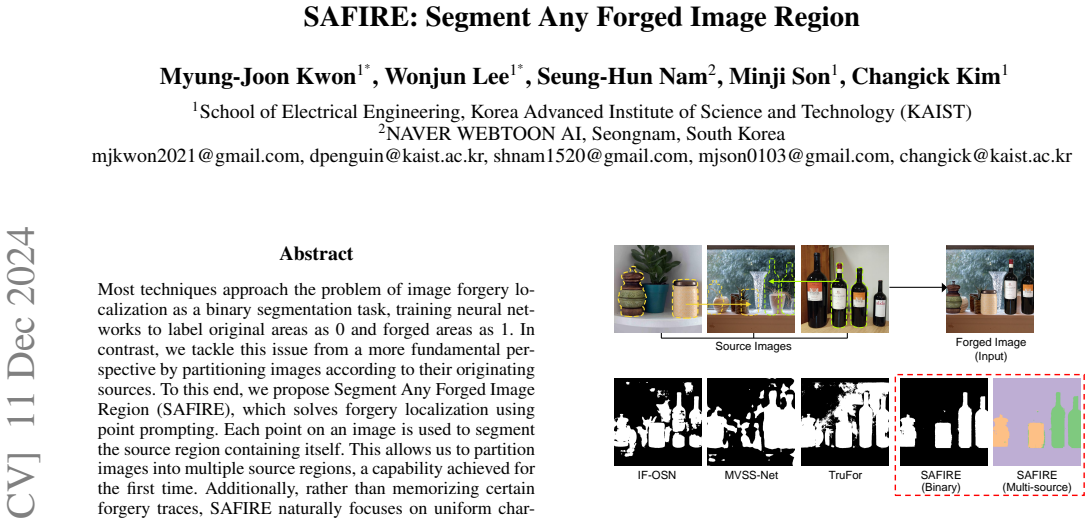
The central claim is that point-prompt source segmentation is a better formulation of forgery localization than binary segmentation. SAFIRE feeds an image plus a grid of point prompts into a Segment Anything-style image encoder, mask decoder, and prompt encoder; each prompt returns the region sharing the source of that point, and the per-point prediction maps are clustered by their representative image embeddings to partition the image into source regions. Trained with a connected-component-derived point mask that labels only the prompted region and its immediate neighbors, the model learns label-agnostic source consistency rather than memorized forgery traces. The paper reports that this achieves state-of-the-art binary F1 scores and, uniquely, multi-source partitioning with up to four sources in its constructed expert dataset.
Load-bearing premise
The method assumes that in a binary forgery mask, each connected component corresponds to exactly one source region, so the training signal cannot express a source that appears as two disconnected patches or two sources fused into one component.
Editorial extensions
If this is right
- Forensic analysis can answer 'how many sources and where' without retraining on multi-source labels.
- Binary localization gains from the relational formulation, with the paper reporting the highest average F1 fixed and F1 best among compared methods.
- Training on binary masks transfers to multi-source inference, so existing labeled datasets remain usable.
- The approach opens a route to provenance filtering, since each partitioned region can be matched to candidate donor images.
Reading between the lines
- The connected-component premise implies that a source split into two disconnected patches, or two sources touching in a way that merges components, will be mis-partitioned; a direct stress test would forge an image by pasting the same donor twice in two places and check whether both patches land in one cluster.
- The clustering stage suggests that the method's upper bound is set by how well embedding averages separate sources, so unusually small donor regions may be lost even when the mask decoder is correct.
- Because partition quality depends on grid density, adaptive point placement near region boundaries could improve results relative to a fixed grid with the same compute.
Signed reviews
Editorial analysis
A structured set of objections, weighed in public.
Referee Report
Summary. The paper introduces SAFIRE, a point-prompt-based image forgery localization method built on the Segment Anything Model (SAM). The method has three phases: region-to-region contrastive pretraining on a large synthetic dataset (SafireMS-Auto), training on binary forgery masks converted into point masks via Eq. (3), and inference by aggregating grid-prompt predictions through clustering of representative embedding features. The paper reports state-of-the-art binary IFL results on five public datasets and introduces a new multi-source partitioning task evaluated on a 238-image author-created dataset (SafireMS-Expert), claiming to be the first method that can distinguish multiple source regions in a forged image.
Significance. If the results hold, SAFIRE makes a useful contribution by reframing IFL as source-region partitioning and showing that a SAM-based point-prompting model can be trained on binary labels to produce multi-source partitions. The binary IFL results are strong and consistent across five external datasets, and the authors provide a clear pipeline with a released-code commitment and a large synthetic pretraining dataset. The main caveat is that the multi-source novelty claim rests on a single author-created dataset with a potential overlap with the pretraining data, and the entire empirical evaluation lacks error bars.
major comments (3)
- [Appendix, SafireMS-Auto and SafireMS-Expert] The pretraining corpus for the image encoder is built from 30,244 DPReview photographs, and the multi-source test set SafireMS-Expert uses original images from DPReview and COCO 2017. The paper does not report any check for overlap between the DPReview images used in SafireMS-Expert and those used to create SafireMS-Auto. Since the pretraining phase performs contrastive learning on these images, any overlap would give the encoder direct exposure to the test images, and the multi-source scores in Table 3 (e.g., 2-source pmIoU 90.3, ARI 80.7) could partly reflect memorization rather than generalizable partitioning. This is load-bearing because Table 3 is the sole quantitative support for the paper's central claim of being "the first method capable of distinguishing each source." Please include an overlap analysis (exact-match or perceptual-hash) and, if overlap exists, retrain with a disjoint pretraining pool or exclude overlapping test images.
- [Appendix, Experimental Environment; Reproducibility Checklist] All results are measured once, with no error bars or statistical significance tests, as stated in the appendix ("All results of the proposed method and comparison techniques were measured once identically") and confirmed by the reproducibility checklist entries. The paper's claims of "superior performance" and "top performance" in Tables 1 and 3 are therefore unsupported by any measure of variance. Given that the improvements over prior methods are large in most cases this is not disqualifying, but the absence of distributional information makes it impossible to assess the reliability of the smaller differences and the stability of the multi-source results. Please report multiple runs with means and standard deviations (or confidence intervals) and apply appropriate significance tests for the key comparisons.
- [Eq. (3), Point Mask Creation] The point-mask construction assumes that a source region is exactly a connected component of the binary forgery mask. If a single source region appears as two disconnected patches (e.g., two separate pasted objects from the same donor image, or a copy-move where the original and the duplicate belong to the same source), the training label in Eq. (3) cannot express the true source partition and will actively teach the model to split the source. The paper does not discuss this assumption or scope the method accordingly. Please clarify the definition of "source region," state the connectedness assumption explicitly, and discuss or evaluate how the method behaves when source regions are disconnected. If the SafireMS-Expert benchmark contains only connected source regions, the claim "capable of distinguishing each source" should be limited to connected-source scenarios.
minor comments (5)
- [Title page, affiliations] The affiliation "NA VER WEBTOON AI" appears to be a typo for "NAVER WEBTOON AI."
- [Eq. (1)-(2)] Eq. (1) contains "Inf oN CE" with unusual spacing, and the description in Eq. (2) that "· returns the average over all elements" is unclear since no averaging symbol is visible in the equation.
- [Appendix, Metrics for Multi-source Partitioning] The generalized pmIoU in Eq. (13) is not fully specified for the case where the predicted number of clusters N_pred is less than the ground-truth number of sources N; the text only explains the case N_pred > N.
- [Reproducibility Checklist] The checklist states that "All novel datasets introduced in this paper are included in a data appendix" with answer "partial," but the appendix contains only statistics and examples, not the actual dataset; please clarify how this item is satisfied.
- [Experimental Settings, Implementation Details] Training hyperparameters such as learning rate, number of epochs, optimizer, batch size, and adapter dimensions are not reported in the main text or in the appendix excerpt; please include them for reproducibility.
Circularity Check
No significant circularity: SAFIRE's reported predictions are not equivalent to its training inputs; the main derivation is an empirical pipeline validated on external benchmarks.
full rationale
SAFIRE's central claims rest on an empirical training/inference pipeline, not on a chain of equations that reinstates its inputs. The point-mask construction (Eq. 3) converts binary ground-truth masks into per-point targets by connected components and neighbor relations, but this is a training heuristic; the final multi-source result comes from clustering representative image embeddings (Eqs. 8-10) and is evaluated against the separately hand-constructed SafireMS-Expert labels, which are not the same labels used in pretraining or in Eq. 3. The contrastive pretraining loss (Eq. 2) uses source-region partitions from the auto-generated SafireMS-Auto corpus, and the final evaluation is on external binary IFL benchmarks (Columbia, COVERAGE, CocoGlide, RealisticTampering, NC16) that are disjoint from the training datasets, so the binary localization results are not fitted inputs renamed as predictions. The self-citations (Kwon et al. 2021/2022 for the CAT-Net training setting and permuted mIoU) are methodological references, not load-bearing arguments that force the outcome. The main legitimate concerns are experimental rather than circular: the SafireMS-Expert benchmark was constructed by the authors and no overlap analysis is reported between its DPReview/COCO source images and the DPReview images used for SafireMS-Auto pretraining, and the connected-component assumption in Eq. 3 cannot represent disconnected same-source regions; the reproducibility checklist also acknowledges partial dataset appendix inclusion and no statistical tests. These are validity and robustness limitations, not circular reductions, so no circular step is exhibited.
Assumptions & free parameters
free parameters (6)
- InfoNCE temperature tau =
0.1
- Area-adaptive loss weight cap C_AASS =
10
- Confidence loss weight lambda_conf =
0.1
- Point grid density =
16x16
- Number of clusters M for binary inference =
2
- Adapter architecture hyperparameters =
not reported
assumptions (5)
- domain assumption Pixels originating from the same source region share uniform low-level characteristics, and different source regions are separable in the learned embedding space.
- domain assumption In binary forgery masks, each connected component corresponds to exactly one source region, so point masks can be derived by labeling only the prompt's component and its neighbors.
- domain assumption Global post-processing (blur, noise, contrast) can be made invariant via probabilistic augmentation, so the encoder focuses on local source-distinguishing features.
- domain assumption Clustering representative features (mean embeddings over predicted masks) groups masks from the same source.
- ad hoc to paper SafireMS-Auto is a noise-free large-scale proxy for real forgeries, with masks generated by SAM semantic regions and automatically composed copy-move, splicing, and inpainting.
Cite this review
Pith. "Pith review of SAFIRE: Segment Any Forged Image Region." pith.science (2026). https://pith.science/paper/W6AITLID
@misc{pith2026241208197,
  author       = {Pith},
  title        = {Pith review of: SAFIRE: Segment Any Forged Image Region},
  year         = {2026},
  howpublished = {\url{https://pith.science/paper/W6AITLID}},
  note         = {Machine review of arXiv:2412.08197}
}
read the original abstract
Most techniques approach the problem of image forgery localization as a binary segmentation task, training neural networks to label original areas as 0 and forged areas as 1. In contrast, we tackle this issue from a more fundamental perspective by partitioning images according to their originating sources. To this end, we propose Segment Any Forged Image Region (SAFIRE), which solves forgery localization using point prompting. Each point on an image is used to segment the source region containing itself. This allows us to partition images into multiple source regions, a capability achieved for the first time. Additionally, rather than memorizing certain forgery traces, SAFIRE naturally focuses on uniform characteristics within each source region. This approach leads to more stable and effective learning, achieving superior performance in both the new task and the traditional binary forgery localization.
Figures


Figures from the paper (12 more)





Forward citations
Cited by 1 Pith paper
-
Survey on AI-Generated Media Detection: From Non-MLLM to MLLM
A survey organizing AI-generated media detection into Non-MLLM and MLLM based methods, with task and benchmark taxonomies.
Reference graph
Works this paper leans on
-
[1]
Baevski, A.; Zhou, Y.; Mohamed, A.; and Auli, M. 2020. wav2vec 2.0: A framework for self-supervised learning of speech representations. Advances in neural information processing systems, 33: 12449--12460
2020
-
[2]
Bammey, Q.; Gioi, R. G. v.; and Morel, J.-M. 2020. An adaptive neural network for unsupervised mosaic consistency analysis in image forensics. In Proceedings of the IEEE/CVF Conference on Computer Vision and Pattern Recognition, 14194--14204
work page 2020
-
[3]
A.; Adeli, E.; Altman, R.; Arora, S.; von Arx, S.; Bernstein, M
Bommasani, R.; Hudson, D. A.; Adeli, E.; Altman, R.; Arora, S.; von Arx, S.; Bernstein, M. S.; Bohg, J.; Bosselut, A.; Brunskill, E.; et al. 2021. On the opportunities and risks of foundation models. arXiv preprint arXiv:2108.07258
arXiv 2021
-
[4]
Chen, T.; Zhu, L.; Deng, C.; Cao, R.; Wang, Y.; Zhang, S.; Li, Z.; Sun, L.; Zang, Y.; and Mao, P. 2023. Sam-adapter: Adapting segment anything in underperformed scenes. In Proceedings of the IEEE/CVF International Conference on Computer Vision, 3367--3375
2023
-
[5]
Chen, Z.; Duan, Y.; Wang, W.; He, J.; Lu, T.; Dai, J.; and Qiao, Y. 2022. Vision transformer adapter for dense predictions. arXiv preprint arXiv:2205.08534
arXiv 2022
-
[6]
Cozzolino, D.; and Verdoliva, L. 2019. Noiseprint: A CNN-Based Camera Model Fingerprint. IEEE Transactions on Information Forensics and Security, 15: 144--159
work page 2019
-
[7]
Dong, C.; Chen, X.; Hu, R.; Cao, J.; and Li, X. 2022. Mvss-net: Multi-view multi-scale supervised networks for image manipulation detection. IEEE Transactions on Pattern Analysis and Machine Intelligence, 45(3): 3539--3553
2022
-
[8]
Dong, J.; Wang, W.; and Tan, T. 2013. Casia image tampering detection evaluation database. In 2013 IEEE China Summit and International Conference on Signal and Information Processing, 422--426. IEEE
work page 2013
Show all 60 references
-
[9]
Y.; Yang, Y.; and Gan, Z
Fu, T.-J.; Hu, W.; Du, X.; Wang, W. Y.; Yang, Y.; and Gan, Z. 2023. Guiding instruction-based image editing via multimodal large language models. arXiv preprint arXiv:2309.17102
2023 arXiv
-
[10]
N.; Delgado, A.; Zhou, D.; Kheyrkhah, T.; Smith, J.; and Fiscus, J
Guan, H.; Kozak, M.; Robertson, E.; Lee, Y.; Yates, A. N.; Delgado, A.; Zhou, D.; Kheyrkhah, T.; Smith, J.; and Fiscus, J. 2019. MFC datasets: Large-scale benchmark datasets for media forensic challenge evaluation. In 2019 IEEE Winter Applications of Computer Vision Workshops ...
2019
-
[11]
Guillaro, F.; Cozzolino, D.; Sud, A.; Dufour, N.; and Verdoliva, L. 2023. TruFor: Leveraging all-round clues for trustworthy image forgery detection and localization. In Proceedings of the IEEE/CVF Conference on Computer Vision and Pattern Recognition, 20606--20615
2023
-
[12]
Hao, J.; Zhang, Z.; Yang, S.; Xie, D.; and Pu, S. 2021. Transforensics: image forgery localization with dense self-attention. In Proceedings of the IEEE/CVF International Conference on Computer Vision, 15055--15064
2021
-
[13]
Ho, J.; Jain, A.; and Abbeel, P. 2020. Denoising diffusion probabilistic models. Advances in neural information processing systems, 33: 6840--6851
2020
-
[14]
Houlsby, N.; Giurgiu, A.; Jastrzebski, S.; Morrone, B.; De Laroussilhe, Q.; Gesmundo, A.; Attariyan, M.; and Gelly, S. 2019. Parameter-efficient transfer learning for NLP. In International Conference on Machine Learning, 2790--2799. PMLR
2019
-
[15]
Hu, X.; Zhang, Z.; Jiang, Z.; Chaudhuri, S.; Yang, Z.; and Nevatia, R. 2020. SPAN: Spatial pyramid attention network for image manipulation localization. In Computer Vision--ECCV 2020: 16th European Conference, Glasgow, UK, August 23--28, 2020, Proceedings, Part XXI 16, 312--3...
2020
-
[16]
Huh, M.; Liu, A.; Owens, A.; and Efros, A. A. 2018. Fighting fake news: Image splice detection via learned self-consistency. In Proceedings of the European Conference on Computer Vision (ECCV), 101--117
2018
-
[17]
Ji, K.; Chen, F.; Guo, X.; Xu, Y.; Wang, J.; and Chen, J. 2023 a . Uncertainty-guided Learning for Improving Image Manipulation Detection. In Proceedings of the IEEE/CVF International Conference on Computer Vision, 22456--22465
2023
-
[18]
Ji, W.; Li, J.; Bi, Q.; Li, W.; and Cheng, L. 2023 b . Segment anything is not always perfect: An investigation of sam on different real-world applications. arXiv preprint arXiv:2304.05750
2023 arXiv
-
[19]
Karageorgiou, D.; Kordopatis-Zilos, G.; and Papadopoulos, S. 2024. Fusion Transformer with Object Mask Guidance for Image Forgery Analysis. In Proceedings of the IEEE/CVF Conference on Computer Vision and Pattern Recognition, 4345--4355
2024
-
[20]
C.; Lo, W.-Y.; et al
Kirillov, A.; Mintun, E.; Ravi, N.; Mao, H.; Rolland, C.; Gustafson, L.; Xiao, T.; Whitehead, S.; Berg, A. C.; Lo, W.-Y.; et al. 2023. Segment anything. arXiv preprint arXiv:2304.02643
2023 arXiv
-
[21]
V.; Knyaz, V.; and Remondino, F
Kniaz, V. V.; Knyaz, V.; and Remondino, F. 2019. The point where reality meets fantasy: Mixed adversarial generators for image splice detection. In Advances in Neural Information Processing Systems, 215--226
2019
-
[22]
Korus, P.; and Huang, J. 2016. Multi-scale analysis strategies in PRNU-based tampering localization. IEEE Transactions on Information Forensics and Security, 12(4): 809--824
2016
-
[23]
Kwon, M.-J.; Nam, S.-H.; Yu, I.-J.; Lee, H.-K.; and Kim, C. 2022. Learning JPEG compression artifacts for image manipulation detection and localization. International Journal of Computer Vision, 130(8): 1875--1895
2022
-
[24]
Kwon, M.-J.; Yu, I.-J.; Nam, S.-H.; and Lee, H.-K. 2021. CAT-Net: Compression Artifact Tracing Network for Detection and Localization of Image Splicing. In Proceedings of the IEEE/CVF Winter Conference on Applications of Computer Vision, 375--384
2021
-
[25]
Li, D.; Zhu, J.; Wang, M.; Liu, J.; Fu, X.; and Zha, Z.-J. 2023. Edge-Aware Regional Message Passing Controller for Image Forgery Localization. In Proceedings of the IEEE/CVF Conference on Computer Vision and Pattern Recognition, 8222--8232
2023
-
[26]
Li, Y.; Hu, M.; and Yang, X. 2023. Polyp-sam: Transfer sam for polyp segmentation. arXiv preprint arXiv:2305.00293
2023 arXiv
-
[27]
Li, Y.; Mao, H.; Girshick, R.; and He, K. 2022. Exploring plain vision transformer backbones for object detection. In European Conference on Computer Vision, 280--296. Springer
2022
-
[28]
Lin, L.; Gupta, N.; Zhang, Y.; Ren, H.; Liu, C.-H.; Ding, F.; Wang, X.; Li, X.; Verdoliva, L.; and Hu, S. 2024. Detecting Multimedia Generated by Large AI Models: A Survey. arXiv preprint arXiv:2402.00045
2024 arXiv
-
[29]
Lin, T.-Y.; Maire, M.; Belongie, S.; Hays, J.; Perona, P.; Ramanan, D.; Doll \'a r, P.; and Zitnick, C. L. 2014. Microsoft coco: Common objects in context. In European conference on computer vision, 740--755. Springer
2014
-
[30]
Liu, W.; Shen, X.; Pun, C.-M.; and Cun, X. 2023. Explicit visual prompting for low-level structure segmentations. In Proceedings of the IEEE/CVF Conference on Computer Vision and Pattern Recognition, 19434--19445
2023
-
[31]
Liu, X.; Liu, Y.; Chen, J.; and Liu, X. 2022. PSCC-Net: Progressive spatio-channel correlation network for image manipulation detection and localization. IEEE Transactions on Circuits and Systems for Video Technology, 32(11): 7505--7517
2022
-
[32]
W.; Flynn, P
Moreira, D.; Bharati, A.; Brogan, J.; Pinto, A.; Parowski, M.; Bowyer, K. W.; Flynn, P. J.; Rocha, A.; and Scheirer, W. J. 2018. Image provenance analysis at scale. IEEE Transactions on Image Processing, 27(12): 6109--6123
2018
-
[33]
Ng, T.-T.; Chang, S.-F.; and Sun, Q. 2004. A data set of authentic and spliced image blocks. Columbia University, ADVENT Technical Report 203-2004-3
2004
-
[34]
F.; Bhaumik, K
Niloy, F. F.; Bhaumik, K. K.; and Woo, S. S. 2023. CFL-Net: Image forgery localization using contrastive learning. In Proceedings of the IEEE/CVF Winter Conference on Applications of Computer Vision, 4642--4651
2023
-
[35]
Novozamsky, A.; Mahdian, B.; and Saic, S. 2020. IMD2020: A Large-Scale Annotated Dataset Tailored for Detecting Manipulated Images. In Proceedings of the IEEE Winter Conference on Applications of Computer Vision Workshops, 71--80
2020
-
[36]
Oord, A. v. d.; Li, Y.; and Vinyals, O. 2018. Representation learning with contrastive predictive coding. arXiv preprint arXiv:1807.03748
2018 arXiv
-
[37]
Pinto, A.; Moreira, D.; Bharati, A.; Brogan, J.; Bowyer, K.; Flynn, P.; Scheirer, W.; and Rocha, A. 2017. Provenance filtering for multimedia phylogeny. In 2017 IEEE international conference on image processing (ICIP), 1502--1506. IEEE
2017
-
[38]
W.; Hallacy, C.; Ramesh, A.; Goh, G.; Agarwal, S.; Sastry, G.; Askell, A.; Mishkin, P.; Clark, J.; et al
Radford, A.; Kim, J. W.; Hallacy, C.; Ramesh, A.; Goh, G.; Agarwal, S.; Sastry, G.; Askell, A.; Mishkin, P.; Clark, J.; et al. 2021. Learning transferable visual models from natural language supervision. In International conference on machine learning, 8748--8763. PMLR
2021
-
[39]
Rao, Y.; and Ni, J. 2021. Self-supervised domain adaptation for forgery localization of JPEG compressed images. In Proceedings of the IEEE/CVF international conference on computer vision, 15034--15043
2021
-
[40]
Rombach, R.; Blattmann, A.; Lorenz, D.; Esser, P.; and Ommer, B. 2022. High-resolution image synthesis with latent diffusion models. In Proceedings of the IEEE/CVF conference on computer vision and pattern recognition, 10684--10695
2022
-
[41]
Sabir, E.; Nandi, S.; Abd-Almageed, W.; and Natarajan, P. 2021. Biofors: A large biomedical image forensics dataset. In Proceedings of the IEEE/CVF International Conference on Computer Vision, 10963--10973
2021
-
[42]
Su, Y.; Tan, S.; and Huang, J. 2024. A Novel Universal Image Forensics Localization Model Based on Image Noise and Segment Anything Model. In Proceedings of the 2024 ACM Workshop on Information Hiding and Multimedia Security, 149--158
2024
-
[43]
Sun, Z.; Jiang, H.; Wang, D.; Li, X.; and Cao, J. 2023. Safl-net: Semantic-agnostic feature learning network with auxiliary plugins for image manipulation detection. In Proceedings of the IEEE/CVF International Conference on Computer Vision, 22424--22433
2023
-
[44]
Tang, L.; Xiao, H.; and Li, B. 2023. Can sam segment anything? when sam meets camouflaged object detection. arXiv 2023. arXiv preprint arXiv:2304.04709
2023 arXiv
-
[45]
Verdoliva, L. 2020. Media forensics and deepfakes: an overview. IEEE Journal of Selected Topics in Signal Processing, 14(5): 910--932
2020
-
[46]
Wang, J.; Sun, K.; Cheng, T.; Jiang, B.; Deng, C.; Zhao, Y.; Liu, D.; Mu, Y.; Tan, M.; Wang, X.; et al. 2020. Deep high-resolution representation learning for visual recognition. IEEE transactions on pattern analysis and machine intelligence
2020
-
[47]
Wang, J.; Wu, Z.; Chen, J.; Han, X.; Shrivastava, A.; Lim, S.-N.; and Jiang, Y.-G. 2022. Objectformer for image manipulation detection and localization. In Proceedings of the IEEE/CVF Conference on Computer Vision and Pattern Recognition, 2364--2373
2022
-
[48]
Wen, B.; Zhu, Y.; Subramanian, R.; Ng, T.-T.; Shen, X.; and Winkler, S. 2016. COVERAGE—A novel database for copy-move forgery detection. In 2016 IEEE international conference on image processing (ICIP), 161--165. IEEE
2016
-
[49]
Wu, H.; Chen, Y.; and Zhou, J. 2023. Rethinking Image Forgery Detection via Contrastive Learning and Unsupervised Clustering. arXiv preprint arXiv:2308.09307
2023 arXiv
-
[50]
Wu, H.; Zhou, J.; Tian, J.; and Liu, J. 2022. Robust image forgery detection over online social network shared images. In Proceedings of the IEEE/CVF Conference on Computer Vision and Pattern Recognition, 13440--13449
2022
-
[51]
Wu, Y.; AbdAlmageed, W.; and Natarajan, P. 2019. ManTra-Net: Manipulation tracing network for detection and localization of image forgeries with anomalous features. In Proceedings of the IEEE Conference on Computer Vision and Pattern Recognition, 9543--9552
2019
-
[52]
Yu, T.; Feng, R.; Feng, R.; Liu, J.; Jin, X.; Zeng, W.; and Chen, Z. 2023. Inpaint anything: Segment anything meets image inpainting. arXiv preprint arXiv:2304.06790
2023 arXiv
-
[53]
Zeng, K.; Cheng, R.; Tan, W.; and Yan, B. 2024. MGQFormer: Mask-Guided Query-Based Transformer for Image Manipulation Localization. In Proceedings of the AAAI Conference on Artificial Intelligence, volume 38, 6944--6952
2024
-
[54]
Zhang, L.; Rao, A.; and Agrawala, M. 2023. Adding conditional control to text-to-image diffusion models. In Proceedings of the IEEE/CVF International Conference on Computer Vision, 3836--3847
2023
-
[55]
Y.; and Feng, W
Zhou, J.; Ma, X.; Du, X.; Alhammadi, A. Y.; and Feng, W. 2023 a . Pre-training-free Image Manipulation Localization through Non-Mutually Exclusive Contrastive Learning. In Proceedings of the IEEE/CVF International Conference on Computer Vision, 22346--22356
2023
-
[56]
I.; and Davis, L
Zhou, P.; Han, X.; Morariu, V. I.; and Davis, L. S. 2018. Learning rich features for image manipulation detection. In Proceedings of the IEEE Conference on Computer Vision and Pattern Recognition, 1053--1061
2018
-
[57]
Zhou, T.; Zhang, Y.; Zhou, Y.; Wu, Y.; and Gong, C. 2023 b . Can sam segment polyps? arXiv preprint arXiv:2304.07583
2023 arXiv
-
[58]
Zhu, J.; Li, D.; Fu, X.; Yang, G.; Huang, J.; Liu, A.; and Zha, Z.-J. 2024. Learning Discriminative Noise Guidance for Image Forgery Detection and Localization. In Proceedings of the AAAI Conference on Artificial Intelligence, volume 38, 7739--7747
2024
-
[59]
, " * write output.state after.block = add.period write newline
ENTRY address archivePrefix author booktitle chapter edition editor eid eprint howpublished institution isbn journal key month note number organization pages publisher school series title type volume year label extra.label sort.label short.list INTEGERS output.state before.all...
-
[60]
write newline
" write newline "" before.all 'output.state := FUNCTION n.dashify 't := "" t empty not t #1 #1 substring "-" = t #1 #2 substring "--" = not "--" * t #2 global.max substring 't := t #1 #1 substring "-" = "-" * t #2 global.max substring 't := while if t #1 #1 substring * t #2 gl...
Reviewed August 11, 2026 · model on record in the stance chip above.
Discussion (0). Continue with ORCID to comment.