REVIEW 3 major objections 4 minor 48 references
Koopman Theory-Inspired Method for Learning Time Advancement Operators in Unstable Flame Front Evolution
T0 review · 3 major / 4 minor · reviewed 2026-08-11 · deepseek-v4-flash
Pith's one-line read Learning several future flame states in latent space outperforms one-step operator rollouts.
desk verdict Useful empirical extension with open code, but the headline superiority claim is undercut by post-hoc variant selection in the DL beta=40 case. read the letter →
The pith
A machine-rendered reading of the paper's core claim, the machinery that carries it, and where it could break.
The reading
What carries the argument
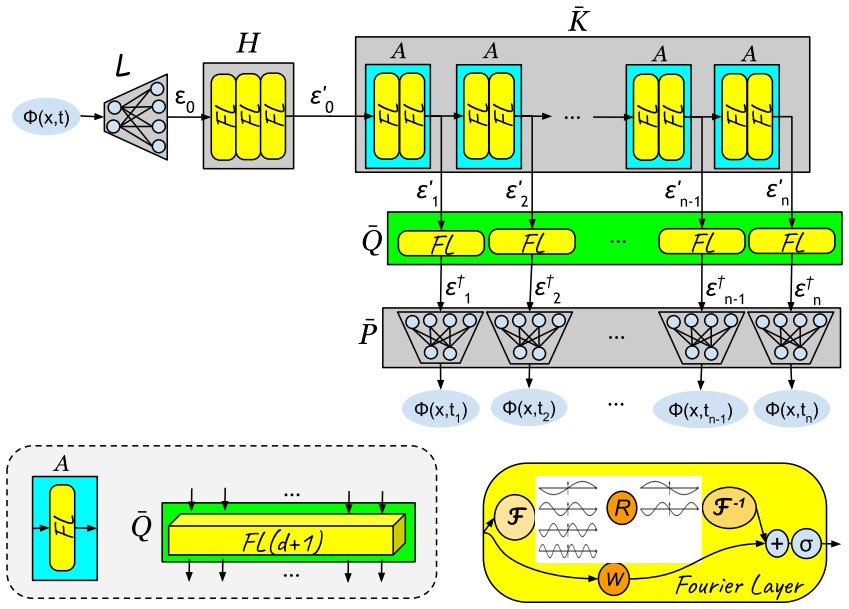
The central object is the latent advancement operator $A$, used inside the network as $\varepsilon'_j = A^j \varepsilon'_0$. In kFNO, $A$ is a Fourier layer (either linear, in the kFNO* variant, or nonlinear with two stacked Fourier layers); in kCNN, it is a set of convolutional layers applied at each encoder level. This operator carries the repeated temporal advancement inside the high-dimensional latent space, so one forward pass yields $n$ future states and no project-down/lift-back step is needed between time increments. Variants also vary the refinement map $\bar{Q}$ and whether skip connections are present in the Fourier layers; the default nonlinear $A$ with skip connections gives the best short-term errors, while the noise-sensitive DL $\beta=40$ case requires removing skip connections to keep long-term statistics stable.
What would settle it
On the held-out 2D DL $\beta=15$ data, compute the composition mismatch $\|\bar{P} A^j \varepsilon_0 - \bar{P} A^{j-1}(A \varepsilon_0)\|$ for $j=2,\ldots,20$; if this mismatch is comparable to or larger than the reported error reduction, then the $A^j$ composition assumption is not what produces the gain. Alternatively, replace the shared $A$ with $n$ independent per-step operators under the same loss and compare long-term autocorrelation: if the statistics are unchanged, the Koopman-style sharing of one operator is unnecessary.
Extended reading notes
Core claim
The central discovery is that the time-advancement operator for unstable flame fronts is better learned as an $n$-step map $\bar{G}: \phi(x,t) \mapsto (\phi(x,t_1), \ldots, \phi(x,t_n))$ than as a one-step map rolled out recursively. In kFNO and kCNN, after the input is lifted and passed through hidden layers, a Koopman-like operator $A$ produces the latent states $\varepsilon'_j = A^j \varepsilon'_0$ for $j=1,\ldots,n$, and a shared projection maps all $n$ latent states back to physical fronts. On the DL and DT fronts represented by the MS and KS equations, this reduces short-term relative $L^2$ errors by roughly a factor of three in 1D and two in 2D compared with the same architecture used one step at a time, while long-term autocorrelation and total front area stay close to the reference spectral solver. The baseline FNO is recovered by setting $n=1$, so the improvement is tied to generating several future states in latent space rather than to extra network capacity.
Load-bearing premise
The load-bearing premise is that a single learned advancement operator $A$, applied over and over in the hidden space, reliably produces the latent representations of all future states; the paper does not directly test whether $A^j$ agrees with composing $A$ with itself, so if repeated application drifts, the multi-step architecture would lose its claimed advantage.
Editorial extensions
If this is right
- Any existing FNO or CNN operator learner can be converted to the multi-step latent form by changing only the output head and loss; the paper's baselines are recovered at $n=1$, so extra benefit is attributable to the design, not to larger networks.
- Long-horizon rollouts become cheaper because the learned advancement happens in latent space, avoiding the project-down/lift-back cost that one-step recurrent baselines pay at every time step.
- The kFNO* result, with a single linear advancement operator, still beats the baseline FNO, supporting the Koopman intuition that chaotic flame fronts become more nearly linear in a well-chosen observable space.
- In noise-sensitive cases such as DL at $\beta=40$, long-term statistical fidelity and short-term accuracy trade off; removing skip connections restores long-term statistics at the cost of higher short-term error.
- Because the same architecture transfers from 1D to 2D with the same hyperparameters and still improves over FNO, the effect is not specific to one-dimensional toy problems.
Reading between the lines
- The paper leaves an explicit consistency test undone: compare $A^j$ with $A^{j-1}\circ A$ on validation data; if they disagree noticeably, the Koopman-style composition property is not what carries the gain, and the architecture would be better described as a multi-task decoder.
- A natural extension is to apply the same latent multi-step design to other chaotic PDEs such as Navier-Stokes or reaction-diffusion systems; the latent operator $A$ would need to stay nearly linear there, which is not guaranteed.
- The DL $\beta=40$ flip in behaviour suggests users will need a regime-dependent regularity choice (skip connections on or off), so a single configuration will not dominate everywhere even inside one equation family.
- Because the paper compares against baselines recovered with $n=1$, the reported factor-of-two/three gains are a clean measurement of multi-step latent output; anyone with an existing FNO/CNN implementation can reproduce the comparison without new training data.
Editorial analysis
A structured set of objections, weighed in public.
Referee Report
Summary. This paper proposes two operator-learning architectures, kFNO and kCNN, that extend FNO/CNN by learning a multi-step advancement operator in a latent space, with the kFNO architecture parameterized as ε'_j = A^j ε'_0. The models are trained and evaluated on one- and two-dimensional Sivashinsky-type equations for Darrieus-Landau and diffusive-thermal flame instabilities, and are compared with baseline FNO and CNN models on short-term relative L2 errors and long-term statistical diagnostics (front geometry, autocorrelation). The central claim is that the Koopman-inspired models 'outperform baseline methods in short term prediction accuracy and long-term statistical fidelity' (Section V), with reported error reductions of two to three times in several cases.
Significance. If the central claim holds, the paper contributes a simple architectural modification—multi-step output in a latent space—that improves both short-term accuracy and long-term statistical stability for chaotic flame-front evolution, and it does so with a fairly designed baseline in which FNO is recovered by setting n=1 and with openly available code and data. However, the paper's unconditional superiority claim is weakened by configuration switching in one test case and by the absence of direct validation of the latent advancement operator; these points need to be resolved before the broad claim is acceptable.
major comments (3)
- [IV.C, Table II, Abstract, Section V] The unconditional claim in the Abstract and Section V that kFNO provides both short-term accuracy and long-term statistical fidelity is not supported for the 1D DL β=40 case. Section IV.C states that the default kFNO with skip connections diverges in long-term recurrent predictions for this case and that kFNO then refers to the model without skip connections. According to Table II, that stable variant has training/validation L2 errors of 0.024/0.025, only marginally better than FNO's 0.028/0.028, whereas the low errors of 0.0045/0.0063 advertised in Fig. 3 belong to the variant that fails long-term. Thus no single kFNO configuration attains the claimed conjunction in this case; the paper should qualify the superiority claim per variant and per case and should explicitly disclose the model-selection protocol as a priori or post-hoc.
- [III.B, Eq. (9)] The mechanism attributed to Koopman theory—that a single latent advancement operator A satisfies ε'_j = A^j ε'_0—is not validated. For the nonlinear variant of A, the map is not a linear Koopman operator, and the paper reports no consistency check between A^j ε'_0 and sequential application of A, no spectral analysis, and no ablation in which the same multi-step loss is trained without sharing A. A concrete test would be to compare the current architecture with one using independent per-step output heads; if the advantage persists, the Koopman framing should be presented as a design heuristic rather than as a mechanism, and the paper's claimed connection to Koopman theory would need to be softened.
- [IV.C/D, Figs. 8 and 11] The long-term statistical superiority is supported mainly by visual comparison of front snapshots and by autocorrelation curves, without a scalar discrepancy metric or uncertainty quantification. The L2-error trajectories in Figs. 7 and 12 are also point estimates from single trained models, so the claimed robustness across random initial conditions is not quantitatively established. Please add scalar measures of autocorrelation mismatch (e.g., L2 or Kolmogorov-Smirnov distance between R(r) curves) and, ideally, report results over multiple training seeds or restarts.
minor comments (4)
- [IV.C] The sentence 'For the two DT cases as well as the DT case with small β = 10' appears to be a typo: the paper considers both DL and DT cases, and the intended meaning is likely 'for the two DL cases as well as the DT case with small β = 10' or 'for the DL and DT cases with small β = 10'.
- [Table II / Fig. 3] The conventions for values in parentheses and underlined values in Table II should match the marker convention in Fig. 3 (diamonds) more explicitly, since the current presentation makes it difficult to tell which variant is being compared for the DL β=40 case.
- [IV.C, 'Computation speedup'] The claimed computational speedup for long-term predictions is not supported by any inference-time measurements; the only reported timing is 2D training time in Appendix A. Please either provide wall-clock rollout timings or qualify the claim.
- [Eqs. (7) and (8)] The notation G^1, ..., G^n in Eq. (7) is ambiguous: it should be made explicit whether the superscript denotes composition powers of the learned operator or the components of the output tuple, since Eq. (8) uses a different object, ¯G, for the multi-step output.
Circularity Check
No significant circularity: kFNO/kCNN superiority is an empirical benchmark against recovered baselines; self-citations are motivational, not load-bearing.
full rationale
The derivation chain is an empirical end-to-end training benchmark. The extended operator \bar G is defined in Eq. (4) as (G, G^2, ..., G^n), and kFNO is trained with objective Eq. (8) directly on the n-step output tuple; the baseline FNO is explicitly recovered by setting n=1 and merging \bar K and \bar Q into H ("To ensure a fair comparison, the baseline FNO model is recovered from the kFNO architecture by setting n = 1..."), so the comparison is not constructed to force the reported advantage. No fitted constant is later renamed as a prediction: all short-term errors are reported on held-out validation data, and long-term statistics are computed by recurrent application of the trained operator and compared against independent spectral-solver references. Prior self-citations (refs 15, 16, 20) are invoked only as motivation for the one-to-many training setup and as sources of dataset-generation precedent; they do not supply a uniqueness theorem or ansatz that the paper's conclusions depend on. The latent-space advancement assumption \epsilon'_j = A^j \epsilon'_0 is a modeling hypothesis rather than a definition of the measured outputs, and its validity is tested through rollout errors and autocorrelation. The only substantive concern, namely that the DL beta=40 case switches kFNO variants between short-term and long-term claims ("...when we refer to kFNO for the challenging DL case (beta = 40) without additional clarification, we are referring to the model without skip connections..."), is an evaluation-consistency issue rather than a reduction of any prediction to its input, and therefore does not constitute circularity.
Assumptions & free parameters
free parameters (2)
- Number of output steps n =
20
- Skip connection alpha for DL beta=40 kFNO =
0 (disabled)
assumptions (4)
- domain assumption The Sivashinsky equation models the relevant flame front instabilities (DL and DT) in the parameter regimes studied.
- domain assumption The pseudo-spectral solver produces accurate reference solutions.
- ad hoc to paper There exists a latent space in which a single learned operator A, applied repeatedly, advances the solution by multiple time steps.
- domain assumption The baseline FNO recovered from the kFNO architecture with n=1 has equivalent expressive power to a standard FNO.
Cite this review
Pith. "Pith review of Koopman Theory-Inspired Method for Learning Time Advancement Operators in Unstable Flame Front Evolution." pith.science (2026). https://pith.science/paper/ZNK72NX7
@misc{pith2026241208426,
  author       = {Pith},
  title        = {Pith review of: Koopman Theory-Inspired Method for Learning Time Advancement Operators in Unstable Flame Front Evolution},
  year         = {2026},
  howpublished = {\url{https://pith.science/paper/ZNK72NX7}},
  note         = {Machine review of arXiv:2412.08426}
}
read the original abstract
Predicting the evolution of complex systems governed by partial differential equations (PDEs) remains challenging, especially for nonlinear, chaotic behaviors. This study introduces Koopman-inspired Fourier Neural Operators (kFNO) and Convolutional Neural Networks (kCNN) to learn solution advancement operators for flame front instabilities. By transforming data into a high-dimensional latent space, these models achieve more accurate multi-step predictions compared to traditional methods. Benchmarking across one- and two-dimensional flame front scenarios demonstrates the proposed approaches' superior performance in short-term accuracy and long-term statistical reproduction, offering a promising framework for modeling complex dynamical systems.
Figures


Figures from the paper (9 more)


Reference graph
Works this paper leans on
-
[1]
author author X. Guo , author W. Li ,\ and\ author F. Iorio ,\ title title Convolutional neural networks for steady flow approximation , \ in\ @noop booktitle Proceedings of the 22nd ACM SIGKDD International Conference on Knowledge Discovery and Data Mining \ ( year 2016 ) NoStop
work page 2016
-
[2]
author author Y. Zhu \ and\ author N. Zabaras ,\ title title Bayesian deep convolutional encoder–decoder networks for surrogate modeling and uncertainty quantification , \ @noop journal journal Journal of Computational Physics \ volume 366 ,\ pages 415--447 ( year 2018 ) NoStop
work page 2018
-
[3]
author author J. Adler \ and\ author O. Öktem ,\ title title Solving ill-posed inverse problems using iterative deep neural networks , \ @noop journal journal Inverse Problems \ volume 33 ,\ pages 124007 ( year 2017 ) NoStop
work page 2017
-
[4]
author author S. Bhatnagar , author Y. Afshar , author S. Pan , author K. Duraisamy ,\ and\ author S. Kaushik ,\ title title Prediction of aerodynamic flow fields using convolutional neural networks , \ @noop journal journal Computational Mechanics \ volume 64 ,\ pages 525--545 ( year 2019 ) NoStop
work page 2019
-
[5]
author author Y. Khoo , author J. Lu ,\ and\ author L. Ying ,\ title title Solving parametric pde problems with artificial neural networks , \ https://doi.org/10.1017/S0956792520000182 journal journal European Journal of Applied Mathematics \ volume 32 ,\ pages 421–435 ( year 2021 ) NoStop
-
[7]
author author N. Winovich , author K. Ramani ,\ and\ author G. Lin ,\ title title Convpde-uq: Convolutional neural networks with quantified uncertainty for heterogeneous elliptic partial differential equations on varied domains , \ https://doi.org/https://doi.org/10.1016/j.jcp.2019.05.026 journal journal Journal of Computational Physics \ volume 394 ,\ pa...
-
[8]
author author Z. Li , author N. Kovachki , author K. Azizzadenesheli , author B. Liu , author K. Bhattacharya , author A. Stuart ,\ and\ author A. Anandkumar ,\ @noop title Neural operator: Graph kernel network for partial differential equations , \ ( year 2020 a ),\ https://arxiv.org/abs/2003.03485 arXiv:2003.03485 [cs.LG] NoStop
arXiv 2020
-
[9]
author author N. Kovachki , author Z. Li , author B. Liu , author K. Azizzadenesheli , author K. Bhattacharya , author A. Stuart ,\ and\ author A. Anandkumar ,\ title title Neural operator: Learning maps between function spaces , \ @noop journal journal arXiv preprint arXiv:2108.08481 \ ( year 2021 ) NoStop
arXiv 2021
Show all 48 references
-
[10]
Lu , author P
author author L. Lu , author P. Jin ,\ and\ author G. Karniadakis ,\ @noop title Deeponet: Learning nonlinear operators for identifying differential equations based on the universal approximation theorem of operators , \ ( year 2019 ),\ https://arxiv.org/abs/1910.03193 arXiv:1...
2019 arXiv
-
[11]
Li , author N
author author Z. Li , author N. Kovachki , author K. Azizzadenesheli , author B. Liu , author K. Bhattacharya , author A. Stuart ,\ and\ author A. Anandkumar ,\ @noop title Fourier neural operator for parametric partial differential equations , \ ( year 2020 b ),\ https://arxi...
2020 arXiv
-
[12]
Gupta , author X
author author G. Gupta , author X. Xiao ,\ and\ author P. Bogdan ,\ title title Multiwavelet-based operator learning for differential equations , \ @noop journal journal Advances in neural information processing systems \ volume 34 ,\ pages 24048--24062 ( year 2021 ) NoStop
2021
-
[13]
Tripura \ and\ author S
author author T. Tripura \ and\ author S. Chakraborty ,\ title title Wavelet neural operator for solving parametric partial differential equations in computational mechanics problems , \ @noop journal journal Computer Methods in Applied Mechanics and Engineering \ volume 404 ,...
2023
-
[14]
Chen , author X
author author G. Chen , author X. Liu , author Y. Li , author Q. Meng ,\ and\ author L. Chen ,\ title title Laplace neural operator for complex geometries , \ @noop journal journal arXiv preprint arXiv:2302.08166 \ ( year 2023 ) NoStop
2023 arXiv
-
[15]
Yu \ and\ author E
author author R. Yu \ and\ author E. Hodzic ,\ title title Parametric learning of time-advancement operators for unstable flame evolution , \ @noop journal journal Physics of Fluids \ volume 36 ,\ pages 044109 ( year 2024 ) NoStop
2024
-
[16]
author author R. Yu ,\ title title Deep learning of nonlinear flame fronts development due to darrieus–landau instability , \ @noop journal journal APL Machine Learning \ volume 1 ,\ pages 026106 ( year 2023 ) NoStop
2023
-
[17]
author author B. O. \ Koopman ,\ title title Hamiltonian systems and transformation in hilbert space , \ @noop journal journal Proceedings of the National Academy of Sciences \ volume 17 ,\ pages 315--318 ( year 1931 ) NoStop
1931
-
[18]
author author I. Mezi \'c ,\ title title Analysis of fluid flows via spectral properties of the koopman operator , \ @noop journal journal Annual review of fluid mechanics \ volume 45 ,\ pages 357--378 ( year 2013 ) NoStop
2013
-
[19]
author author S. L. \ Brunton \ and\ author J. N. \ Kutz ,\ @noop title Data-driven science and engineering: Machine learning, dynamical systems, and control \ ( publisher Cambridge University Press ,\ year 2022 ) NoStop
2022
-
[20]
Yu , author E
author author R. Yu , author E. Hodzic ,\ and\ author K.-J. \ Nogenmyr ,\ title title Learning flame evolution operator under hybrid darrieus landau and diffusive thermal instability , \ @noop journal journal Energies \ volume 17 ,\ pages 3097 ( year 2024 ) NoStop
2024
-
[21]
Darrieus ,\ title title Propagation d’un front de flamme , \ @noop journal journal Unpublished work presented at La Technique Moderne \ ( year 1938 ) NoStop
author author G. Darrieus ,\ title title Propagation d’un front de flamme , \ @noop journal journal Unpublished work presented at La Technique Moderne \ ( year 1938 ) NoStop
1938
-
[22]
Landau ,\ title title On the theory of slow combustion , \ in\ @noop booktitle Dynamics of curved fronts \ ( publisher Elsevier ,\ year 1988 )\ pp.\ pages 403--411 NoStop
author author L. Landau ,\ title title On the theory of slow combustion , \ in\ @noop booktitle Dynamics of curved fronts \ ( publisher Elsevier ,\ year 1988 )\ pp.\ pages 403--411 NoStop
1988
-
[23]
author author Y. Zeldovich ,\ title title Theory of combustion and detonation of gases , \ in\ @noop booktitle Selected Works of Yakov Borisovich Zeldovich, Volume I: Chemical Physics and Hydrodynamics \ ( publisher Princeton University Press ,\ year 1944 ) NoStop
1944
-
[24]
author author G. Sivashinsky ,\ title title Diffusional-thermal theory of cellular flames , \ @noop journal journal Combustion Science and Technology \ volume 15 ,\ pages 137--145 ( year 1977 ) NoStop
1977
-
[25]
author author D. M. \ Michelson \ and\ author G. I. \ Sivashinsky ,\ title title Nonlinear analysis of hydrodynamic instability in laminar flames—ii. numerical experiments , \ @noop journal journal Acta astronautica \ volume 4 ,\ pages 1207--1221 ( year 1977 ) NoStop
1977
-
[26]
author author Y. Kuramoto ,\ title title Diffusion-induced chaos in reaction systems , \ @noop journal journal Progress of Theoretical Physics Supplement \ volume 64 ,\ pages 346--367 ( year 1978 ) NoStop
1978
-
[27]
derivation of basic equations , \ @noop journal journal Acta Astronautica \ volume 4 ,\ pages 1177--1206 ( year 1977 ) NoStop
author author G.I.Sivashinsky ,\ title title Nonlinear analysis of hydrodynamic instability in laminar flames—i. derivation of basic equations , \ @noop journal journal Acta Astronautica \ volume 4 ,\ pages 1177--1206 ( year 1977 ) NoStop
1977
-
[28]
Thual , author U
author author O. Thual , author U. Frisch ,\ and\ author M. Hénon ,\ title title Application of pole decomposition to an equation governing the dynamics of wrinkled flame fronts , \ @noop journal journal Journal de Physique \ volume 46 ,\ pages 1485--1494 ( year 1985 ) NoStop
1985
-
[29]
Vaynblat \ and\ author M
author author D. Vaynblat \ and\ author M. Matalon ,\ title title Stability of pole solutions for planar propagating flames: I. exact eigenvalues and eigenfunctions , \ @noop journal journal SIAM J. Appl. Math. \ volume 60 ,\ pages 679--702 ( year 2000 a ) NoStop
2000
-
[30]
Vaynblat \ and\ author M
author author D. Vaynblat \ and\ author M. Matalon ,\ title title Stability of pole solutions for planar propagating flames: Ii. properties of eigenvalues/eigenfunctions and implications to stability , \ @noop journal journal SIAM J. Appl. Math. \ volume 60 ,\ pages 703--728 (...
2000
-
[31]
Olami , author B
author author Z. Olami , author B. Galanti , author O. Kupervasser ,\ and\ author I. Procaccia ,\ title title Random noise and pole dynamics in unstable front propagation , \ @noop journal journal Physical Review E \ volume 55 ,\ pages 2649 ( year 1997 ) NoStop
1997
-
[32]
author author B. Denet ,\ title title Stationary solutions and neumann boundary conditions in the sivashinsky equation , \ @noop journal journal Physical Review E \ volume 74 ,\ pages 036303 ( year 2006 ) NoStop
2006
-
[33]
Kupervasser ,\ @noop title Pole Solutions for Flame Front Propagation \ ( publisher Springer International Publishing ,\ year 2015 ) NoStop
author author O. Kupervasser ,\ @noop title Pole Solutions for Flame Front Propagation \ ( publisher Springer International Publishing ,\ year 2015 ) NoStop
2015
-
[34]
author author V. Karlin ,\ title title Cellular flames may exhibit a non-modal transient instability , \ @noop journal journal Proceedings of the Combustion Institute \ volume 29 ,\ pages 1537--1542 ( year 2002 ) NoStop
2002
-
[35]
Creta , author P
author author F. Creta , author P. E. \ Lapenna , author R. Lamioni , author N. Fogla ,\ and\ author M. Matalon ,\ title title Propagation of premixed flames in the presence of darrieus--landau and thermal diffusive instabilities , \ @noop journal journal Combustion and Flame ...
2020
-
[36]
Creta , author N
author author F. Creta , author N. Fogla ,\ and\ author M. Matalon ,\ title title Turbulent propagation of premixed flames in the presence of darrieus–landau instability , \ @noop journal journal Combustion Theory and Modelling \ volume 15 ,\ pages 267--298 ( year 2011 ) NoStop
2011
-
[37]
Rasool , author N
author author R. Rasool , author N. Chakraborty ,\ and\ author M. Klein ,\ title title Effect of non-ambient pressure conditions and lewis number variation on direct numerical simulation of turbulent bunsen flames at low turbulence intensity , \ @noop journal journal Combustio...
2021
-
[38]
Yu , author X
author author R. Yu , author X. S. \ Bai ,\ and\ author V. Bychkov ,\ title title Fractal flame structure due to the hydrodynamic darrieus-landau instability , \ @noop journal journal Phys. Rev. E \ volume 92 ,\ pages 063028 ( year 2015 ) NoStop
2015
-
[39]
\ Kassam \ and\ author L
author author A.-K. \ Kassam \ and\ author L. N. \ Trefethen ,\ title title Fourth-order time-stepping for stiff pdes , \ @noop journal journal SIAM Journal on Scientific Computing \ volume 26 ,\ pages 1214--1233 ( year 2005 ) NoStop
2005
-
[40]
Herbert , author N
author author M. Herbert , author N. Chakraborty ,\ and\ author M. Klein ,\ title title A comparison of evaluation methodologies of the fractal dimension of premixed turbulent flames in 2d and 3d using direct numerical simulation data , \ @noop journal journal Flow, Turbulence...
2024
-
[41]
Hodzic , author E
author author E. Hodzic , author E. Alenius , author C. Duwig , author R. Szasz ,\ and\ author L. Fuchs ,\ title title A large eddy simulation study of bluff body flame dynamics approaching blow-off , \ @noop journal journal Combustion Science and Technology \ volume 189 ,\ pa...
2017
-
[42]
Hodzic , author M
author author E. Hodzic , author M. Jangi , author R.-Z. \ Szasz , author C. Duwig , author M. Geron , author J. Early , author L. Fuchs ,\ and\ author X.-S. \ Bai ,\ title title Large eddy simulation of bluff-body flame approaching blow-off: A sensitivity study , \ @noop jour...
2018
-
[43]
Yu , author X
author author R. Yu , author X. S. \ Bai ,\ and\ author A. N. \ Lipatnikov ,\ title title A direct numerical simulation study of interface propagation in homogeneous turbulence , \ @noop journal journal J. Fluid Mech. \ volume 772 ,\ pages 127--164 ( year 2015 ) NoStop
2015
-
[44]
Yu , author R
author author J. Yu , author R. Yu , author X. Bai , author M. Sun ,\ and\ author J.-G. \ Tan ,\ title title Nonlinear evolution of 2d cellular lean hydrogen/air premixed flames with varying initial perturbations in the elevated pressure environment , \ @noop journal journal I...
2017
-
[45]
Yu , author T
author author R. Yu , author T. Nillson , author X. Bai ,\ and\ author A. N. \ Lipatnikov ,\ title title Evolution of averaged local premixed flame thickness in a turbulent flow , \ @noop journal journal Combust. Flame \ volume 207 ,\ pages 232--249 ( year 2019 ) NoStop
2019
-
[46]
Yu \ and\ author A
author author R. Yu \ and\ author A. N. \ Lipatnikov ,\ title title Surface-averaged quantities in turbulent reacting flows and relevant evolution equations , \ @noop journal journal Phys. Rev. E \ volume 100 ,\ pages 013107 ( year 2019 ) NoStop
2019
-
[47]
Yu , author T
author author R. Yu , author T. Nilsson , author C. Fureby ,\ and\ author A. Lipatnikov ,\ title title Evolution equations for the decomposed components of displacement speed in a reactive scalar field , \ @noop journal journal Journal of Fluid Mechanics \ volume 911 ( year 20...
2021
-
[48]
Bychkov, O
V. Bychkov, O. Jukimenko, M. Modestov, @article Garanin-2013, author = D.A. Garanin , title = Turbulent fronts of quantum detonation in molecular magnets , journal = Phys. Rev. B , pages = 064413 , year = 2013 , volume = 88 , @article Jukimenko-et-al-2014, author = O. Jukimenk...
2013
-
[49]
+ z( 8c\.p8B,鿹zUu9r8sh` ( Y LZh )HvxUՒeIt gC5 ѤikNVo )DM?<? ۓ< 8lV źwȴykMoL E USvj2kihݐq OVkOS ayVϑxX|#cXL绀I s +@X n m1_
@InProceedings CNN1, author = X. Guo and W. Li and F. Iorio , title = Convolutional neural networks for steady flow approximation , booktitle= Proceedings of the 22nd ACM SIGKDD International Conference on Knowledge Discovery and Data Mining , year = 2016 , @article CNN2, autho...
2016 arXiv
Reviewed August 11, 2026 · model on record in the stance chip above.
Discussion (0). Continue with ORCID to comment.