REVIEW 4 major objections 5 minor 39 references
GMem: A Modular Approach for Ultra-Efficient Generative Models
T0 review · 4 major / 5 minor · reviewed 2026-08-11 · deepseek-v4-flash
Pith's one-line read GMem claims diffusion training can be cut from 1,400 to 28 epochs by moving semantic memory into an external bank of DINOv2 feature snippets, reaching FID 1.53 on ImageNet in 160 epochs.
desk verdict The memory-bank idea has real legs, but the training algorithm as written never pairs snippets with images, and the abstract's timing numbers are off by ~7x — fix both before anyone trusts the headline. read the letter →
The pith
A machine-rendered reading of the paper's core claim, the machinery that carries it, and where it could break.
The reading
What carries the argument
The load-bearing object is the external memory bank $M \in \mathbb{R}^{n \times m}$: a matrix of unit-norm DINOv2-B feature vectors, one per training image, that supplies semantic content to the denoiser while the network only learns to generalize. A random zero-masking strategy (mask ratio 0.4) is what stops the conditional network from overfitting to individual snippets. To keep storage manageable, the bank is compressed by SVD into a coefficient matrix $C$ and a basis $B$, so snippet $i$ is reconstructed as $s_i = c_i B^\top + \mu$ with storage cost $O(nr + dr)$ instead of $O(nd)$; new snippets are inserted training-free by projecting features onto the same basis, and new concepts are created by linearly interpolating coefficient vectors. This machinery shifts the memorization burden from learned parameters to retrievable data.
What would settle it
Use a fixed GMem checkpoint and swap the memory bank for a bank of random unit vectors; then, separately, for a bank of interpolated snippets from distant classes. The central claim fails if random snippets still generate recognizable, diverse ImageNet images (proving the bank is not doing the work) or if interpolated snippets generate only near-duplicates of training images (proving generalization is absent).
Extended reading notes
Core claim
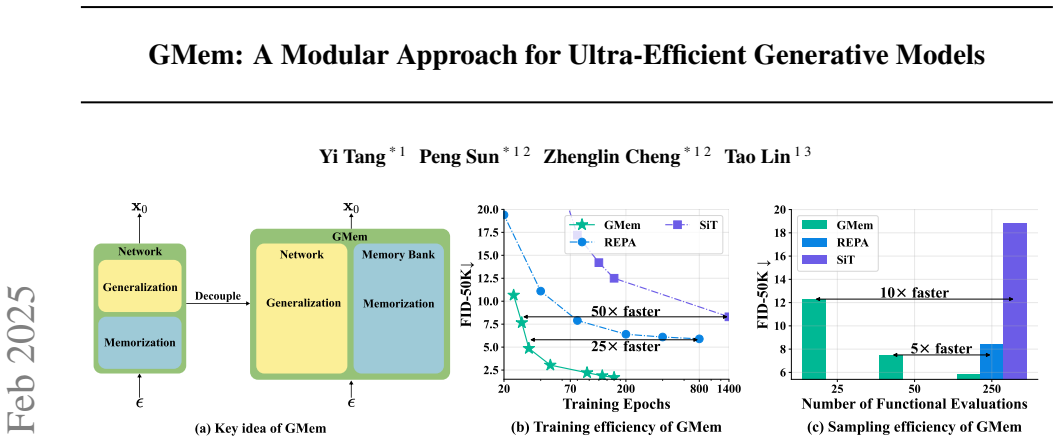
On the paper's own terms, the discovery is that diffusion models can be decomposed into memorization and generalization, and that the memorization half can be externalized. GMem builds a memory bank $M$ of $n$ unit-norm snippets, each the normalized DINOv2-B feature of a training image, and trains a SiT/LightningDiT backbone to predict the flow velocity $v_\theta(x_t, s, t)$ under the loss $\mathcal{L} = \int_0^T \mathbb{E}\|v_\theta(x_t,s,t) - \dot\alpha_t x_0 - \dot\sigma_t \epsilon\|^2 dt$. Randomly zeroing 40% of each snippet's entries prevents the network from treating the bank as a lookup table and is credited with preserving generalization. The authors report that this scheme achieves FID 1.53 on ImageNet 256×256 in 160 epochs (~20 hours on 8 H800 GPUs) without classifier-free guidance, a 50× training speedup at FID 7.66 relative to SiT's 1,400 epochs, and a 10× sampling speedup, plus training-free insertion of new images via SVD-projected coefficients and compositional interpolation of existing snippets.
Load-bearing premise
The load-bearing premise is that a unit-norm DINOv2-B feature vector with 40% of its dimensions zeroed still carries enough layout and detail for the denoiser to reconstruct the image, and that the same conditioning generalizes to interpolated or projected snippets that never appeared in training.
Editorial extensions
If this is right
- On ImageNet 256×256, GMem reaches FID 7.66 in fewer than 28 epochs (~4 hours on 8 H800 GPUs), a 50× training speedup over SiT's 1,400 epochs, and FID 4.86 in 32 epochs, a 25× speedup over REPA.
- Without classifier-free guidance, GMem attains FID 1.53 in 160 epochs (~20 hours), better than LightningDiT's FID 2.17 at 800 epochs (~95 hours), and FID 1.89 on ImageNet 512×512 in 400 epochs.
- Sampling is also cheaper: with only 25 steps GMem reaches FID 12.3, matching or beating SiT at 250 steps, a 10× reduction in function evaluations.
- The memory bank supports training-free adaptation: projecting a new image's feature into the SVD coefficient space adds a snippet without retraining, and interpolating between coefficient vectors creates hybrids such as a dog wearing a hat.
- Compressing the bank by SVD does not hurt: halving the effective bank size improves FID slightly (5.85 to 5.70 in the 64-epoch ablation), because the compression acts as mild noise that increases diversity.
Reading between the lines
- Editorial inference: if the decoupling holds, the scaling law for image generation changes shape—dataset complexity becomes a storage cost rather than a training-cost term, so one could in principle train once and grow the bank without ever fine-tuning the backbone.
- Editorial inference: the interpolation results in Appendix C suggest the coefficient space is semantically smooth; a natural test is whether Euclidean interpolation between any pair of snippets yields perceptually monotonic transitions, which would make the bank a controllable latent generative space.
- Editorial inference: the 40% masking ratio acts as an information bottleneck that enforces generalization, so an obvious extension is to make the mask ratio adaptive per snippet or per training phase, potentially trading a bit of FID for much stronger robustness to bank noise.
- Editorial inference: because a bank trained on CIFAR-10 can guide an ImageNet model and text features can be mapped into snippet space, the same modular design could be reused as a plug-in condition for other generative backbones, with the mapping function as the only trainable part.
Editorial analysis
A structured set of objections, weighed in public.
Referee Report
Summary. GMem proposes to split diffusion-model functionality into an external memory bank of normalized DINOv2-B feature snippets and a neural network that handles generalization. The velocity network is conditioned on a masked memory snippet during training via Eq. (7), with a REPA-style alignment loss added in all experiments, and at sampling time a memory snippet is retrieved and fed to the network along with noise. The paper reports 50x training speedup over SiT on ImageNet 256x256, 10x sampling speedup, FID=1.53 in 160 epochs without classifier-free guidance, and training-free novel/compositional generation through SVD projection and interpolation of memory snippets.
Significance. The core idea of offloading memorization of semantic information from a diffusion backbone to an external, immutable memory bank is appealing and could be practically impactful if the mechanism is genuinely responsible for the reported gains. The controlled comparison in Table 3 (SiT-L at the same 20-epoch budget: REPA FID 8.4 vs GMem FID 5.8) suggests that adding the memory bank helps beyond the REPA baseline. The paper also provides code, reports wall-clock timings, and includes ablations over masking ratios, bank size, solver type, backbones, and tokenizers. However, the manuscript currently has three load-bearing gaps: the joint distribution of the conditioning snippet and the target is never specified, the reported per-step training time contradicts the abstract's wall-clock claims, and the headline speedup numbers are not cleanly attributed relative to the REPA alignment loss that GMem always includes. These issues must be resolved before the efficiency and mechanism claims are supported.
major comments (4)
- [Algorithm 1 / Eq. (7)] The training objective is not fully specified because the dependence of s on (x0, epsilon) is never stated. Algorithm 1 samples s ~ M independently of x0 and epsilon, and Eq. (7) averages over x0 ~ D, epsilon ~ N(0,I), and s without any pairing. If s is independent of (x0, epsilon), then E[x0 | xt, s] = E[x0 | xt], so the Bayes-optimal velocity for every s is the unconditional velocity and the memory bank cannot influence generation at all; any measured gain would then come from the REPA alignment loss and the added projection MLP. If, instead, the actual implementation pairs s with x0 (e.g., s = f(x0)/||f(x0)||), then the test-time protocol in Section 4.3 and Figure 3—where sampled noise indexes a memory snippet—feeds random, independent snippets to the network, which is a distribution shift from the paired training objective. The interpolation and novel-image results in Section 5.3 and Appendix C are only meaningful if the network learned a conditional mapping from s to content, which requires paired training. Please state the exact joint distribution used in training, and include an ablation with unpaired s to verify that the memory bank is not inert.
- [Appendix B.2 / Tables 6-7] The reported training-time arithmetic is internally inconsistent. Appendix B.2 states that GMem-XL trains at approximately 2.71 seconds per step, and Table 7 reports 200K training iterations for ImageNet 256x256 XL, which corresponds to 160 epochs at batch size 1024. Multiplying gives roughly 150 hours of wall-clock training, whereas the abstract claims approximately 20 hours for 160 epochs and approximately 4 hours for fewer than 28 epochs. These claims differ by roughly a factor of seven. Please report measured wall-clock training time for the exact configurations in Tables 1-3, or correct the per-step speed figure, since the training-efficiency claims are central to the paper.
- [Section 5.1 / Tables 1-2] The headline speedup claims attribute to GMem gains that include the REPA representation alignment loss, which the paper says is added in all experiments ('we add representation alignment loss introduced from REPA ... across all experiments'). Table 2 shows REPA alone already reaches FID=5.90 in 800 epochs, so comparing GMem at 28 epochs (FID=7.66) against SiT at 1400 epochs (FID=8.61) conflates REPA's contribution with the memory-bank contribution. The abstract's '50x training speedup compared to SiT' is therefore overstated as an attribution to GMem's decoupled-memory design. Please compare GMem against REPA at matched epochs and step budgets, and report GMem without the alignment loss, so that the marginal effect of the memory bank is isolated.
- [Section 5.4 / Table 4] The ablation paragraph on the SVD decomposition and bank-size reduction does not match Table 4. The text says 'applying the decomposing strategy ... while halving the memory bank size reduces FID by approximately 0.15,' but in Table 4 the SVD decomposition at fixed bank size changes FID from 5.85 to 5.70, while halving the bank size (from 1.2B/1.2M to 640K) changes FID from 5.70 to 5.72. This discrepancy makes the sensitivity analysis difficult to interpret. Please rewrite the paragraph so that each claim is traceable to a specific row of Table 4.
minor comments (5)
- [Table 4 / Appendix B.2] The bank size is listed as '1.2B' in Table 4 but as '1.2M' in Appendix B.2; the units should be made consistent.
- [Section 5.2 / Table 1] The statement that GMem 'matches REPA's performance in just 450 epochs' on CIFAR-10 is confusing: Table 1 shows GMem at 52 epochs (FID 4.08) already better than REPA at 200 epochs (FID 4.52), and GMem at 450 epochs reaches FID 1.22. Please reword to match the table.
- [Section 5.3] There is a typo 'Figure Figure 5' that should be corrected.
- [Eq. (7)] Equation (7) integrates over t without specifying the time-sampling distribution or the weighting function; please state the measure explicitly.
- [References] The reference list contains duplicate entries for the same RCG paper (Li et al. 2023b, 2023d, and 2024b); these should be consolidated.
Circularity Check
No significant circularity: the headline FID and speedup numbers are external benchmark measurements, and the only self-citation is a minor, non-load-bearing justification for the encoder choice.
full rationale
GMem's central claims are empirical: FID scores on CIFAR-10 and ImageNet, together with epoch and NFE comparisons, are measured against external reference sets and baseline models, so they are not derived from the memory bank by construction. The memory bank stores normalized DINOv2 features, and Eq. (7) is a standard conditional velocity objective; no fitted parameter is later relabeled as a prediction. The paper cites its own prior work, Sun et al. (2024), to justify the choice of self-supervised representations, but this citation is one of three supporting citations (Bordes et al., 2022; Zimmermann et al., 2021; Sun et al., 2024), and the same design choice is independently motivated by the external REPA line (Yu et al., 2024); it is not a load-bearing uniqueness argument and does not force any FID outcome. The apparent mismatch between Algorithm 1, which samples s ~ M independently, and Eq. (7), where s appears as a conditioning variable, is a potentially serious implementation and reporting gap: if s is truly independent, the Bayes-optimal velocity is unconditional and the memory mechanism would be vacuous. That is a correctness and reproducibility concern, not a circularity, because the paper's reported FID results are not defined as consequences of the memory-bank equations. No equation in the paper reduces to its own input by definition, and no benchmark number is forced by the stated construction.
Assumptions & free parameters
free parameters (6)
- Memory bank size (ImageNet) =
1.2M snippets
- Mask ratio =
0.4 (40% dimensions zeroed)
- Mask strategy =
Zero masking
- SVD target rank r =
not stated
- Solver choice =
SDE (Heun/Euler)
- Feature encoder =
DINOv2-B
assumptions (5)
- domain assumption Diffusion/flow models can be decomposed into distinct memorization and generalization components (Section 1, 'novel conjecture').
- domain assumption The memory bank 'fully captures the semantic information of D' after optimization (Section 4.1).
- domain assumption Self-supervised features capture semantic information better than supervised ones (Section 4.1).
- standard math Standard stochastic interpolant / flow-matching objective (Eqs. 1-7, Appendix F).
- standard math SVD low-rank factorization preserves the semantic content of the bank (Section 4.3).
invented entities (2)
-
External memory bank M of unit-norm feature snippets
independent evidence
-
Memorization vs generalization decomposition of diffusion models
Cite this review
Pith. "Pith review of GMem: A Modular Approach for Ultra-Efficient Generative Models." pith.science (2026). https://pith.science/paper/2E6HAYER
@misc{pith2026241208781,
  author       = {Pith},
  title        = {Pith review of: GMem: A Modular Approach for Ultra-Efficient Generative Models},
  year         = {2026},
  howpublished = {\url{https://pith.science/paper/2E6HAYER}},
  note         = {Machine review of arXiv:2412.08781}
}
abstract
Recent studies indicate that the denoising process in deep generative diffusion models implicitly learns and memorizes semantic information from the data distribution. These findings suggest that capturing more complex data distributions requires larger neural networks, leading to a substantial increase in computational demands, which in turn become the primary bottleneck in both training and inference of diffusion models. To this end, we introduce GMem: A Modular Approach for Ultra-Efficient Generative Models. Our approach GMem decouples the memory capacity from model and implements it as a separate, immutable memory set that preserves the essential semantic information in the data. The results are significant: GMem enhances both training, sampling efficiency, and diversity generation. This design on one hand reduces the reliance on network for memorize complex data distribution and thus enhancing both training and sampling efficiency. On ImageNet at $256 \times 256$ resolution, GMem achieves a $50\times$ training speedup compared to SiT, reaching FID $=7.66$ in fewer than $28$ epochs ($\sim 4$ hours training time), while SiT requires $1400$ epochs. Without classifier-free guidance, GMem achieves state-of-the-art (SoTA) performance FID $=1.53$ in $160$ epochs with only $\sim 20$ hours of training, outperforming LightningDiT which requires $800$ epochs and $\sim 95$ hours to attain FID $=2.17$.
Figures


Figures from the paper (8 more)




Reference graph
Works this paper leans on
-
[1]
Albergo, M. S., Boffi, N. M., and Vanden-Eijnden, E. Stochastic interpolants: A unifying framework for flows and diffusions. arXiv preprint arXiv:2303.08797,
-
[4]
Chen, J., Cai, H., Chen, J., Xie, E., Yang, S., Tang, H., Li, M., Lu, Y ., and Han, S. Deep compression autoen- coder for efficient high-resolution diffusion models.arXiv preprint arXiv:2410.10733, 2024a. Chen, J., Ge, C., Xie, E., Wu, Y ., Yao, L., Ren, X., Wang, Z., Luo, P., Lu, H., and Li, Z. Pixart-\sigma: Weak-to-strong training of diffusion transfor...
-
[5]
Deconstructing denoising diffusion models for self-supervised learning
Chen, X., Liu, Z., Xie, S., and He, K. Deconstructing denoising diffusion models for self-supervised learning. arXiv preprint arXiv:2401.14404, 2024c. Choi, J., Kim, S., Jeong, Y ., Gwon, Y ., and Yoon, S. Ilvr: Conditioning method for denoising diffusion probabilistic models. arXiv preprint arXiv:2108.02938,
-
[7]
We randomly select two memory snippets s1 and s2 from the memory bank M. We then create nine interpolated snippets ˆsi by linearly interpolating between s1 and s2 with interpolation coefficients αi ranging from 0.1 to 0.9 in increments of 0.1. The interpolated snippets are defined as: ˆsi = (1 − αi)s1 + αis2, α i = 0.1i, i = 1, 2, . . . ,9. Each interpola...
work page 2021
-
[9]
Kadkhodaie, Z., Guth, F., Simoncelli, E. P., and Mal- lat, S. Generalization in diffusion models arises from geometry-adaptive harmonic representation. arXiv preprint arXiv:2310.02557,
-
[10]
Kingma, D. P. Auto-encoding variational bayes. arXiv preprint arXiv:1312.6114,
-
[12]
C., Prabhudesai, M., Duggal, S., Brown, E., and Pathak, D
Li, A. C., Prabhudesai, M., Duggal, S., Brown, E., and Pathak, D. Your diffusion model is secretly a zero-shot classifier. In ICCV, 2023a. Li, B., Torr, P. H., and Lukasiewicz, T. Memory-driven text- to-image generation. arXiv preprint arXiv:2208.07022,
-
[13]
Self-conditioned image gen- eration via generating representations
Li, T., Katabi, D., and He, K. Self-conditioned image gen- eration via generating representations. arXiv preprint arXiv:2312.03701, 2023b. Li, T., Katabi, D., and He, K. Self-conditioned image gen- eration via generating representations. arXiv preprint arXiv:2312.03701, 2023c. Li, T., Katabi, D., and He, K. Return of unconditional generation: A self-super...
Show all 39 references
-
[14]
Dream: Efficient dataset distillation by representative matching
Liu, Y ., Gu, J., Wang, K., Zhu, Z., Jiang, W., and You, Y . Dream: Efficient dataset distillation by representative matching. arXiv preprint arXiv:2302.14416,
-
[15]
and Song, Y
Lu, C. and Song, Y . Simplifying, stabilizing and scal- ing continuous-time consistency models. arXiv preprint arXiv:2410.11081,
-
[16]
S., Boffi, N
Ma, N., Goldstein, M., Albergo, M. S., Boffi, N. M., Vanden- Eijnden, E., and Xie, S. Sit: Exploring flow and diffusion- based generative models with scalable interpolant trans- formers. arXiv preprint arXiv:2401.08740,
-
[17]
Dinov2: Learning robust visual features without supervision
Oquab, M., Darcet, T., Moutakanni, T., V o, H., Szafraniec, M., Khalidov, V ., Fernandez, P., Haziza, D., Massa, F., El- Nouby, A., et al. Dinov2: Learning robust visual features without supervision. arXiv preprint arXiv:2304.07193,
-
[18]
SDXL: Im- proving latent diffusion models for high-resolution image synthesis
Podell, D., English, Z., Lacey, K., Blattmann, A., Dockhorn, T., Müller, J., Penna, J., and Rombach, R. SDXL: Im- proving latent diffusion models for high-resolution image synthesis. arXiv preprint arXiv:2307.01952,
-
[19]
Stylegan-xl: Scaling stylegan to large diverse datasets
Sauer, A., Schwarz, K., and Geiger, A. Stylegan-xl: Scaling stylegan to large diverse datasets. In ACM SIGGRAPH 2022 conference proceedings, pp. 1–10,
2022
-
[20]
Knn-diffusion: Im- age generation via large-scale retrieval
Sheynin, S., Ashual, O., Polyak, A., Singer, U., Gafni, O., Nachmani, E., and Taigman, Y . Knn-diffusion: Im- age generation via large-scale retrieval. arXiv preprint arXiv:2204.02849,
-
[21]
Denoising diffusion im- plicit models
Song, J., Meng, C., and Ermon, S. Denoising diffusion im- plicit models. arXiv preprint arXiv:2010.02502, 2020a. Song, Y . and Ermon, S. Improved techniques for train- ing score-based generative models. Advances in neural information processing systems, 33:12438–12448,
2010 arXiv
-
[23]
Diffusion-gan: Training gans with diffusion
Wang, Z., Zheng, H., He, P., Chen, W., and Zhou, M. Diffusion-gan: Training gans with diffusion. arXiv preprint arXiv:2206.02262,
-
[24]
Tackling the generative learning trilemma with denoising diffusion gans
Xiao, Z., Kreis, K., and Vahdat, A. Tackling the generative learning trilemma with denoising diffusion gans. arXiv preprint arXiv:2112.07804,
-
[25]
and Wang, X
Yao, J. and Wang, X. Reconstruction vs. generation: Taming optimization dilemma in latent diffusion models. arXiv preprint arXiv:2501.01423,
-
[27]
Yin, T., Gharbi, M., Park, T., Zhang, R., Shechtman, E., Du- rand, F., and Freeman, W. T. Improved distribution match- ing distillation for fast image synthesis. arXiv preprint arXiv:2405.14867,
-
[28]
B., Versari, L., Sohn, K., Minnen, D., Cheng, Y ., Birodkar, V ., Gupta, A., Gu, X., et al
Yu, L., Lezama, J., Gundavarapu, N. B., Versari, L., Sohn, K., Minnen, D., Cheng, Y ., Birodkar, V ., Gupta, A., Gu, X., et al. Language model beats diffusion–tokenizer is key 12 GMem: A Modular Approach for Ultra-Efficient Generative Models to visual generation. arXiv preprin...
-
[29]
Representation alignment for generation: Training diffusion transformers is easier than you think
Yu, S., Kwak, S., Jang, H., Jeong, J., Huang, J., Shin, J., and Xie, S. Representation alignment for generation: Training diffusion transformers is easier than you think. arXiv preprint arXiv:2410.06940,
-
[30]
Therefore, we adopted Zero mask for all major experiments
We found that zeroing out part of the snippet (the Zero mask strategy) consistently performed best across all experiments. Therefore, we adopted Zero mask for all major experiments. SDE solver is superior. SDE solvers consistently outperform ODE solvers, reducing FID by 1.0 ( ...
2024
-
[32]
and SiT (Ma et al., 2024). Similar to a Vision Transformer (Dosovitskiy et al., 2021), In this architecture, the input image is divided into patches, reshaped into a one- dimensional sequence of length N, and then processed by the model. Unlike the original SiT, REPA includes ...
2024
-
[33]
In contrast, for pixel space generation, we directly use the raw pixel data as input
and utilize these latent vectors as input. In contrast, for pixel space generation, we directly use the raw pixel data as input. Although we experimented with data augmentations such as flipping, we found that they did not significantly improve performance. Therefore, we do no...
2024
-
[34]
Dinov2-B offers superior performance, making it an ideal choice for facilitating the efficient training for constructing the memory bank
as the encoder across all experiments, as it has been shown to significantly enhance the learning of better representations in diffusion models (Yu et al., 2024). Dinov2-B offers superior performance, making it an ideal choice for facilitating the efficient training for constr...
2024
-
[36]
In the DDPM framework introduced by Ho et al
are small, predefined hyperparameters. In the DDPM framework introduced by Ho et al. (2020), the reverse process p(xt−1|xt) is parameterized as: p(xt−1|xt) = N xt−1; 1√αt xt − βt√1 − ¯αt εθ(xt, t) , Σθ(xt, t) ! where αt = 1 − βt, ¯αt = Qt i=1 αi, εθ(xt, t) is a neural network ...
2020
-
[37]
The process is formulated as: xt = αtx0 + σtε, with α0 = σ1 = 1, α 1 = σ0 = 0, where αt decreases and σt increases as functions of t
address continuous time-dependent processes involving data samples x∗ ∼ p(x) and Gaussian noise ε ∼ N(0, I) over the interval t ∈ [0, 1]. The process is formulated as: xt = αtx0 + σtε, with α0 = σ1 = 1, α 1 = σ0 = 0, where αt decreases and σt increases as functions of t. There...
2023
-
[38]
Consequently, simple interpolants can be utilized by defining αt and σt as straightforward functions during training and inference
These conditions ensure an unbiased interpolation between x0 and ε. Consequently, simple interpolants can be utilized by defining αt and σt as straightforward functions during training and inference. Examples include linear interpolants with αt = 1 − t and σt = t, or variance-...
2020
-
[256]
↓ means lower is better and all results reported are without classifier-free guidance
For a fair comparison, we train all models for 64 epochs. ↓ means lower is better and all results reported are without classifier-free guidance. Backbone Tokenizer #Params Epoch FID ↓ SiT-B SD-V AE 130M 64 22.25 SiT-L SD-V AE 458M 64 6.49 SiT-XL SD-V AE 675M 64 6.31 LightningD...
2025
-
[1000]
Generation involves solving the corresponding reverse SDE, starting from random Gaussian noise xT ∼ N(0, I)
to ensure that p(xT ) approximates an isotropic Gaussian. Generation involves solving the corresponding reverse SDE, starting from random Gaussian noise xT ∼ N(0, I). In this context, αt, σt, and the diffusion coefficient wt are implicitly defined by the forward diffusion proc...
2022
-
[2009]
Bert: Pre-training of deep bidirectional trans- formers for language understanding
Devlin, J. Bert: Pre-training of deep bidirectional trans- formers for language understanding. arXiv preprint arXiv:1810.04805,
-
[2013]
Kingma, D. P. and Ba, J. Adam: A method for stochastic optimization. arXiv preprint arXiv:1412.6980,
-
[2020]
P., Kumar, A., Er- mon, S., and Poole, B
Song, Y ., Sohl-Dickstein, J., Kingma, D. P., Kumar, A., Er- mon, S., and Poole, B. Score-based generative modeling through stochastic differential equations. arXiv preprint arXiv:2011.13456, 2020b. Sun, P., Jiang, Y ., and Lin, T. Efficiency for free: Ideal data are transport...
2011 arXiv
-
[2021]
Imagenet: A large-scale hierarchical image database
Deng, J., Dong, W., Socher, R., Li, L.-J., Li, K., and Fei-Fei, L. Imagenet: A large-scale hierarchical image database. In 2009 IEEE conference on computer vision and pattern recognition, pp. 248–255. Ieee,
2009
-
[2022]
Brock, A
ISSN 2835-8856. Brock, A. Large scale gan training for high fidelity natural image synthesis. arXiv preprint arXiv:1809.11096,
-
[2023]
Semi-parametric neural image synthesis
Blattmann, A., Rombach, R., Oktay, K., Müller, J., and Om- mer, B. Semi-parametric neural image synthesis. arXiv preprint arXiv:2204.11824,
-
[2024]
S., Hu, V
Fuest, M., Ma, P., Gui, M., Fischer, J. S., Hu, V . T., and Ommer, B. Diffusion models and representation learning: A survey. arXiv preprint arXiv:2407.00783,
-
[2025]
Fasterdit: To- wards faster diffusion transformers training without archi- tecture modification
Yao, J., Cheng, W., Liu, W., and Wang, X. Fasterdit: To- wards faster diffusion transformers training without archi- tecture modification. arXiv preprint arXiv:2410.10356,
Reviewed August 11, 2026 · model on record in the stance chip above.
Discussion (0). Continue with ORCID to comment.