REVIEW 4 major objections 5 minor 1 cited by
Nonlinear Hall Effect in Two-dimensional Materials
T0 review · 4 major / 5 minor · reviewed 2026-08-11 · deepseek-v4-flash
Pith's one-line read Nonlinear Hall effect in two-dimensional materials is governed by four mechanisms—quantum metric dipole, Berry curvature dipole, side-jump, and skew scattering—each with distinct symmetry and relaxation-time signatures.
desk verdict A useful review that organizes a fast-moving field, but its scaling-law mechanism assignments are presented as more settled than the evidence supports. read the letter →
The pith
A machine-rendered reading of the paper's core claim, the machinery that carries it, and where it could break.
The reading
What carries the argument
The load-bearing objects are the second-order conductivity tensor $\sigma_{\alpha\beta\gamma}$ (defined by $J^\alpha = \sum_{\beta,\gamma}\sigma_{\alpha\beta\gamma}E^\beta E^\gamma$), the Berry connection polarizability $G^{jk}_n$ whose real part is built from the quantum metric, the Berry curvature dipole $D_{ab}=\int_k f_0\,\partial_a\Omega_b$, and the disorder-scattering rates for side-jump and skew scattering. These are connected by scaling laws in $\tau$—Eqs. (24)–(26) relate the normalized nonlinear Hall field to powers of the longitudinal conductivity—so that a measurement of the $\sigma$ dependence separates the intrinsic geometric contributions from the extrinsic scattering contributions.
What would settle it
A decisive test is to take one of the materials listed in Table II, tune its disorder level—for example by electron irradiation without changing the band structure—and check whether the intercept $\eta$ in Eq. (24) stays fixed while the slope $\xi$ changes. If the $\tau$-independent term shifts with disorder, the clean separation between the quantum metric dipole and the scattering mechanisms would be falsified; a calculation that includes an energy-dependent $\tau$ and yields mixed $\tau$ powers would also undercut the classification.
Extended reading notes
Core claim
The central claim, stated on the paper's own terms, is that the nonlinear Hall effect arises from diverse mechanisms—the quantum metric dipole, the Berry curvature dipole, skew scattering, and side-jump effects—and that each is governed by a distinct symmetry condition and a distinct dependence on the relaxation time. The quantum metric dipole is the intrinsic, $\tau$-independent channel and flows from broken parity ($P$) and time-reversal ($T$) symmetries; it is cleanly isolated when $PT$ is preserved because that symmetry kills the Berry curvature dipole. The Berry curvature dipole is linear in $\tau$ and requires only broken $P$, while the disorder channels enter at higher powers of $\tau$. The paper compiles the experimental evidence, attributes each measured material in Table II to one or more of these four mechanisms, and argues that the scaling laws of Eqs. (24)–(26) make the attribution possible from transport measurements alone.
Load-bearing premise
The whole classification rests on assuming that the relaxation time $\tau$ enters each mechanism through the simple power laws in Eqs. (24)–(26), so the scaling of the nonlinear Hall signal with conductivity cleanly separates intrinsic from extrinsic contributions.
Editorial extensions
If this is right
- A transport measurement alone can identify the mechanism: fit $E^{2\omega}_\perp/(E^\omega_\parallel)^2$ versus $\sigma$ and read off the $\tau$ power, which is 0 for the quantum metric dipole, 1 for the Berry curvature dipole, 1 or 2 for side-jump, and 2 or 3 for skew scattering.
- Broken parity inversion is required for the nonlinear Hall effect; when threefold rotational symmetry is present the Berry curvature dipole is forbidden, so any observed signal must come from the quantum metric dipole or from disorder.
- In magnetic materials that break both $P$ and $T$ but preserve $PT$, the nonlinear Hall effect is a direct probe of the quantum metric rather than the Berry curvature.
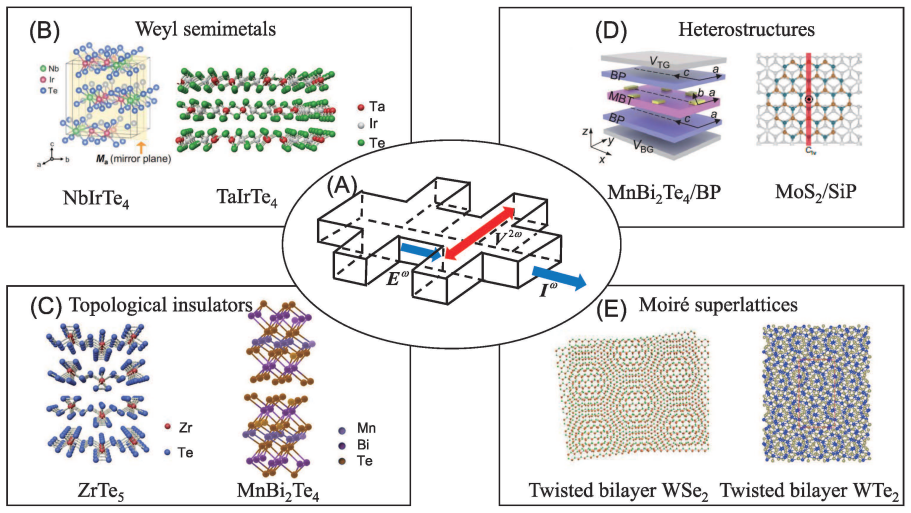
- Heterostructures and moiré superlattices can create the needed symmetry breaking on demand, as in BP/MnBi$_2$Te$_4$ and twisted bilayer graphene, where strain or gate voltage tunes the response.
- The same second-order response enables zero-bias radiofrequency rectification without a magnetic field, with demonstrated cutoffs near 5 GHz—covering the 2.4 GHz Wi-Fi band—and sensitivity starting near ambient RF power levels.
Reading between the lines
- The authors leave implicit that the third-order Hall formulas, including Eq. (29), could be used the same way: measuring the third-order coefficient as a function of $\tau$ in samples with controlled disorder would isolate the Berry connection polarizability from quadrupole contributions, extending the Table II taxonomy to third order.
- Because the quantum metric dipole is the only $\tau$-independent channel, the review's own frequency-rolloff caveat suggests that RF rectifiers should operate best in quantum-metric-dominated materials; comparing cutoff frequencies across the rows of Table II would test this ranking.
- The symmetry rules suggest a systematic materials search: non-centrosymmetric magnetic 2D compounds with $PT$ symmetry and small band gaps should have the largest quantum metric dipole, so a high-throughput first-principles screen is a natural next step.
Editorial analysis
A structured set of objections, weighed in public.
Referee Report
Summary. The manuscript is a review of the nonlinear Hall effect in two-dimensional materials. It introduces the symmetry constraints for second-order nonlinear transport, describes four contributing mechanisms (quantum metric dipole, Berry curvature dipole, side-jump scattering, and skew scattering), surveys recent experimental observations in 2D materials, assigns mechanisms to individual materials in Table II, and discusses third-order effects and device applications. The central assertion is that these four mechanisms, distinguished by their scattering-time scaling and symmetry properties, account for the observed nonlinear Hall responses in the surveyed systems.
Significance. If its taxonomy and Table II assignments can be trusted, the review would serve as a useful organized reference for a rapidly growing field. The paper explicitly builds on independently published results and does not claim new calculations or fits, which is appropriate for a review. Its strengths include a broad literature coverage and a compact tabular summary of experiments. However, the mathematical summaries of the mechanisms contain several errors, and the scaling-law logic used to assign mechanisms in Table II relies on assumptions that are not stated. These issues currently limit the review's reliability as a guide for readers.
major comments (4)
- [Section III.B, Eq. (16)] The Berry curvature dipole response tensor is written as χ_abc = ε_abc e^3τ / [2(1+iωτ)] ∫ f0(∂_b Ω_d), which has inconsistent indices: the left side has a, b, c, while the right side has b and d with d undefined and c absent from the integrand. As printed, the expression cannot be evaluated. Because this equation is the central quantitative statement of the Berry curvature dipole mechanism, it should be corrected to a standard form, for example with the Levi-Civita symbol contracting the Berry curvature index, and the derivation should be made internally consistent.
- [Section III.A, Eqs. (5) and (13)] The velocity formula in Eq. (5) contains the term '(e/ħ) × E × ∇_k × G(k)E', which is dimensionally malformed and not written as a well-defined vector expression; the cross products are not applied in a clear order. In Eq. (13), the second-order distribution function f_2^{2ω} is written with E_a E_a while the derivative is ∂_{ab}, so the indices are inconsistent; it should be E_a E_b. These errors make the derivations of the quantum metric dipole and Berry curvature dipole contributions non-reproducible as printed and should be corrected.
- [Section IV.A, Eq. (24)] The text states that because σ is linearly dependent on τ, the ξσ^2 term in Eq. (24) scales as τ^3 (skew scattering) and the η term as τ (Berry curvature dipole or side-jump), and this reasoning is used to assign mechanisms for WTe2, BiTeBr, and other materials. This inference does not follow from Eq. (24) alone: the fit establishes a relation between E_⊥^{2ω}/(E_∥)^2 and σ^2, but converting that into τ^3 and τ behavior assumes a single Drude-type relaxation time with constant carrier density and effective mass. Moreover, Table I lists side-jump as τ^2 or τ^1, so the η term cannot uniquely identify side-jump. The assumptions behind the power-law separation should be stated explicitly, or the mechanism assignments should be softened.
- [Section IV.A, Eqs. (26)-(28)] The scaling law in Eq. (26) is written with E_{xxx}^ω in the denominator and terms such as σ_{x0}^{-1} σ_a^2, which is not the published form and is notationally inconsistent. Eq. (27) shows that the Berry curvature dipole coefficient C^in appears in C2, C3, and C4, so a fit of Eq. (26) cannot separate C^in from side-jump and skew-scattering contributions without additional assumptions. The paper then uses the fitted values C1 = -1.6 × 10^-15 m^2V^-1 and C2 = 2.6 × 10^-8 m^2V^-1 to conclude that skew scattering is small in TaIrTe4, but the degenerate structure of Eq. (27) means that conclusion depends on unstated constraints. Please provide the correct equation and describe the identification procedure.
minor comments (5)
- [Table I and Section IV.A] Table I contains the typo 'sacttering' for 'scattering', and the entry 'τ^2 or τ^1' for side-jump is ambiguous; the text should clarify which power is the leading contribution.
- [Section IV.A, BiTeBr discussion] The text first says the nonlinear Hall effect in BiTeBr is attributed to skew scattering and side-jump, then concludes it is 'primarily dominated by skew scattering'; these statements should be reconciled.
- [Table II, TaIrTe4 row] Table II lists only 'Berry curvature dipole' for TaIrTe4, whereas the text concludes that extrinsic skew scattering is smaller than the Berry curvature dipole and static disorder scattering; the table should either state the dominant mechanism with qualifying language or include the additional contribution.
- [Section III.B, Eqs. (9)-(13)] The steps from Eq. (9) to Eq. (13) are not fully explained; in particular, the retention and omission of terms at different orders in the electric field should be stated so that the expansion is clear.
- [General notation] The notation for the electric field in Eqs. (26) and (28) (E_{xxx}^ω, E_{yxx}^{2ω}) is confusing; conventional notation such as E_x^ω and E_{yxx}^{2ω} or an explicit component definition would improve readability.
Circularity Check
No circularity: this review re-presents external results and performs no fits or self-referential derivations of its own.
full rationale
This is a review article whose load-bearing content is a taxonomy of nonlinear Hall mechanisms and the Table II assignment of specific experiments to those mechanisms. The paper performs no new fits: Eq. (24)'s ξ and η values, Eq. (25)'s η2 and η0, and Eq. (26)'s C1–C4 coefficients are all imported from externally published papers by Kang et al., Du et al., Kumar et al., Wang et al., and Lu et al., rather than fitted within this manuscript. The scaling-law interpretations (τ^3 for skew scattering, τ for Berry curvature dipole and side-jump, τ^0 for quantum metric dipole) are likewise taken from the cited theoretical and experimental literature, not re-derived by the authors as a novel prediction. The symmetry arguments connecting P breaking to a finite χ_abc, PT symmetry to the quantum metric dipole, and C3 symmetry to suppression of the Berry curvature dipole are standard external results. The only notable self-citation is reference [85], used as one example of chemical doping in the perspective section; it is not load-bearing for any central claim. No equation in the paper is defined in terms of the paper's own conclusion, and no fitted parameter is renamed as a prediction. Concerns about the reliability of the τ-separation, such as energy-dependent relaxation times or multi-band effects mixing C^in into several coefficients, are interpretational or correctness risks originating in the underlying cited works, not circularity in this review.
Assumptions & free parameters
free parameters (3)
- C1 and C2 coefficients in TaIrTe4 scaling law =
C1 = -1.6e-15 m^2/V; C2 = 2.6e-8 m^2/V
- xi and eta coefficients in BiTeBr scaling law =
xi = 6.9e-15 m^3 V^-1 S^-2 for the 4-nm film; eta changes sign with thickness
- eta_0 and eta_2 in Eq. (25) for MnBi2Te4 =
Not given numerically; eta_0 is the tau-independent offset attributed to the quantum metric dipole
assumptions (5)
- standard math Maxwell-type symmetry properties of electric and magnetic fields under parity and time reversal
- domain assumption Boltzmann equation in the constant relaxation time approximation
- standard math Quantum geometry decomposition Q = -i/2 Omega + g and the Berry connection polarizability formula
- domain assumption Scattering-time scaling laws separate intrinsic and extrinsic nonlinear Hall mechanisms
- domain assumption Cited experimental papers correctly interpret their own measurements
Cite this review
Pith. "Pith review of Nonlinear Hall Effect in Two-dimensional Materials." pith.science (2026). https://pith.science/paper/TEK72J6S
@misc{pith2026241209298,
  author       = {Pith},
  title        = {Pith review of: Nonlinear Hall Effect in Two-dimensional Materials},
  year         = {2026},
  howpublished = {\url{https://pith.science/paper/TEK72J6S}},
  note         = {Machine review of arXiv:2412.09298}
}
read the original abstract
Symmetry is a cornerstone of condensed matter physics, fundamentally shaping the behavior of electronic systems and inducing the emergence of novel phenomena. The Hall effect, a key concept in this field, demonstrates how symmetry breaking, particularly of time-reversal symmetry, influences electronic transport properties. Recently, the nonlinear Hall effect has extended this understanding by generating a transverse voltage that modulates at twice the frequency of the driving alternating current without breaking time-reversal symmetry. This effect is closely tied to the symmetry and quantum geometric properties of materials, offering a new approach to probing the Berry curvature and quantum metric. Here, we provide a review of the theoretical insights and experimental advancements in the nonlinear Hall effect, particularly focusing on its realization in two-dimensional materials. We discuss the challenges still ahead, look at potential applications for devices, and explore how these ideas might apply to other nonlinear transport phenomena. By elucidating these aspects, this review aims to advance the understanding of nonlinear transport effects and their broader implications for future technologies.
Figures


Figures from the paper (3 more)


Forward citations
Cited by 1 Pith paper
-
Geometric curvature driven by many-body collective fluctuations
Many-body collective fluctuations generate a dynamical Berry curvature that is invisible to optics but isolable in antisymmetric RIXS channels of P-T-symmetric systems.
Reference graph
Works this paper leans on
-
[1]
C. E. R¨ uter, K. G. Makris, R. El-Ganainy, D. N. Christodoulides, M. Segev, and D. Kip, Observation of parity–time symmetry in optics, Nature physics 6, 192 (2010). 27
2010
-
[2]
L. Liu, T. Zhao, W. Lin, X. Shu, J. Zhou, Z. Zheng, H. Chen, L. Jia, and J. Chen, Sym- metry breaking for current-induced magnetization switching, Applied Physics Reviews 10, 10.1063/5.0149290 (2023)
-
[3]
Dembowski, B
C. Dembowski, B. Dietz, H.-D. Gr¨ af, H. Harney, A. Heine, W. Heiss, and A. Richter, Obser- vation of a chiral state in a microwave cavity, Physical Review Letters 90, 034101 (2003)
2003
-
[4]
Zhang, T
X. Zhang, T. Zhu, S. Zhang, Z. Chen, A. Song, C. Zhang, R. Gao, W. Niu, Y. Chen, F. Fei, et al., Light-induced giant enhancement of nonreciprocal transport at ktao3-based interfaces, Nature Communications 15, 2992 (2024)
2024
-
[5]
C.-N. Li, H.-P. Liang, B.-Q. Zhao, S.-H. Wei, and X. Zhang, Machine learning assisted crystal structure prediction made simple, Journal of Materials Informatics 4, 10.20517/jmi.2024.18 (2024)
-
[6]
Ji and X.-G
W. Ji and X.-G. Wen, Categorical symmetry and noninvertible anomaly in symmetry- breaking and topological phase transitions, Physical Review Research 2, 033417 (2020)
2020
-
[7]
C. M. Bender, Introduction to pt-symmetric quantum theory, Contemporary physics 46, 277 (2005)
2005
-
[8]
C. Li, R. Wang, S. Zhang, Y. Qin, Z. Ying, B. Wei, Z. Dai, F. Guo, W. Chen, R. Zhang, et al., Observation of giant non-reciprocal charge transport from quantum hall states in a topological insulator, Nature Materials , 1 (2024)
2024
Show all 139 references
-
[9]
H. J. Zhao, P. Chen, C. Paillard, R. Arras, Y.-W. Fang, X. Li, J. Gosteau, Y. Yang, and L. Bellaiche, Large spin splittings due to the orbital degree of freedom and spin textures in a ferroelectric nitride perovskite, Phys. Rev. B 102, 041203 (2020)
2020
-
[10]
B. S. Brunschwig, C. Creutz, and N. Sutin, Optical transitions of symmetrical mixed-valence systems in the class ii–iii transition regime, Chemical Society Reviews 31, 168 (2002)
2002
-
[11]
Z. Chen, H. Qiu, X. Cheng, J. Cui, Z. Jin, D. Tian, X. Zhang, K. Xu, R. Liu, W. Niu, et al., Defect-induced helicity dependent terahertz emission in dirac semimetal ptte2 thin films, Nature Communications 15, 2605 (2024)
2024
-
[12]
Niu, Y.-W
W. Niu, Y.-W. Fang, R. Liu, Z. Wu, Y. Chen, Y. Gan, X. Zhang, C. Zhu, L. Wang, Y. Xu, Y. Pu, Y. Chen, and X. Wang, Fully optical modulation of the two-dimensional electron gas at the γ-al2o3/srtio3 interface, The Journal of Physical Chemistry Letters 13, 2976 (2022), pMID: 353...
2022
-
[13]
W. Niu, Y. Zhang, Y. Gan, D. V. Christensen, M. V. Soosten, E. J. Garcia-Suarez, A. Ri- isager, X. Wang, Y. Xu, R. Zhang, N. Pryds, and Y. Chen, Giant tunability of the two- dimensional electron gas at the interface of γ-al2o3/srtio3, Nano Letters 17, 6878 (2017), pMID: 28968124
2017
-
[14]
L. Hu, Y. Luo, Y. Fang, F. Qin, X. Cao, H. Xie, J. Liu, J. Dong, A. Sanson, M. Giarola, X. Tan, Y. Zheng, A. Suwardi, Y. Huang, K. Hippalgaonkar, J. He, W. Zhang, J. Xu, Q. Yan, and M. G. Kanatzidis, High thermoelectric performance through crystal symmetry enhancement in tripl...
2021
-
[15]
Hu, Y.-W
L. Hu, Y.-W. Fang, F. Qin, X. Cao, X. Zhao, Y. Luo, D. V. M. Repaka, W. Luo, A. Suwardi, T. Soldi, U. Aydemir, Y. Huang, Z. Liu, K. Hippalgaonkar, G. J. Snyder, J. Xu, and Q. Yan, High thermoelectric performance enabled by convergence of nested conduction bands in pb7bi4se13 w...
2021
-
[16]
Zheng, Y.-W
D. Zheng, Y.-W. Fang, S. Zhang, P. Li, Y. Wen, B. Fang, X. He, Y. Li, C. Zhang, W. Tong, W. Mi, H. Bai, H. N. Alshareef, Z. Q. Qiu, and X. Zhang, Berry phase engineering in srruo3/sriro3/srtio3 superlattices induced by band structure reconstruction, ACS Nano 15, 5086 (2021), p...
2021
-
[17]
H. L. Stormer, Nobel lecture: the fractional quantum hall effect, Reviews of Modern Physics 71, 875 (1999)
1999
-
[18]
Popovi´ c, Hall-effect devices, Sensors and Actuators 17, 39 (1989)
R. Popovi´ c, Hall-effect devices, Sensors and Actuators 17, 39 (1989)
1989
-
[19]
Nagaosa, J
N. Nagaosa, J. Sinova, S. Onoda, A. H. MacDonald, and N. P. Ong, Anomalous hall effect, Reviews of modern physics 82, 1539 (2010)
2010
-
[20]
Sinova, S
J. Sinova, S. O. Valenzuela, J. Wunderlich, C. Back, and T. Jungwirth, Spin hall effects, Reviews of modern physics 87, 1213 (2015)
2015
-
[21]
Sodemann and L
I. Sodemann and L. Fu, Quantum nonlinear hall effect induced by berry curvature dipole in time-reversal invariant materials, Physical review letters 115, 216806 (2015)
2015
-
[22]
K. Kang, T. Li, E. Sohn, J. Shan, and K. F. Mak, Nonlinear anomalous hall effect in few-layer wte2, Nature materials 18, 324 (2019)
2019
-
[23]
Ma, S.-Y
Q. Ma, S.-Y. Xu, H. Shen, D. MacNeill, V. Fatemi, T.-R. Chang, A. M. Mier Valdivia, S. Wu, Z. Du, C.-H. Hsu, et al., Observation of the nonlinear hall effect under time-reversal- symmetric conditions, Nature 565, 337 (2019). 29
2019
-
[24]
Tiwari, F
A. Tiwari, F. Chen, S. Zhong, E. Drueke, J. Koo, A. Kaczmarek, C. Xiao, J. Gao, X. Luo, Q. Niu, et al., Giant c-axis nonlinear anomalous hall effect in td-mote2 and wte2, Nature communications 12, 2049 (2021)
2021
-
[25]
Kumar, C.-H
D. Kumar, C.-H. Hsu, R. Sharma, T.-R. Chang, P. Yu, J. Wang, G. Eda, G. Liang, and H. Yang, Room-temperature nonlinear hall effect and wireless radiofrequency rectification in weyl semimetal tairte4, Nature Nanotechnology 16, 421 (2021)
2021
-
[26]
N. Wang, D. Kaplan, Z. Zhang, T. Holder, N. Cao, A. Wang, X. Zhou, F. Zhou, Z. Jiang, C. Zhang, et al., Quantum-metric-induced nonlinear transport in a topological antiferromag- net, Nature 621, 487 (2023)
2023
-
[27]
Gao, Y.-F
A. Gao, Y.-F. Liu, J.-X. Qiu, B. Ghosh, T. V. Trevisan, Y. Onishi, C. Hu, T. Qian, H.-J. Tien, S.-W. Chen, et al., Quantum metric nonlinear hall effect in a topological antiferromagnetic heterostructure, Science 381, 181 (2023)
2023
-
[28]
Rostami and V
H. Rostami and V. Juriˇ ci´ c, Probing quantum criticality using nonlinear hall effect in a metal- lic dirac system, Physical Review Research 2, 013069 (2020)
2020
-
[29]
He and K
W.-Y. He and K. T. Law, Nonlinear hall effect in insulators (2024), arXiv:2411.07456 [cond- mat.mes-hall]
2024
-
[30]
J.-E. Lee, A. Wang, S. Chen, M. Kwon, J. Hwang, M. Cho, K.-H. Son, D.-S. Han, J. W. Choi, Y. D. Kim, et al., Spin-orbit-splitting-driven nonlinear hall effect in nbirte4, Nature Communications 15, 3971 (2024)
2024
-
[31]
S. Duan, F. Qin, P. Chen, X. Yang, C. Qiu, J. Huang, G. Liu, Z. Li, X. Bi, F. Meng, et al., Berry curvature dipole generation and helicity-to-spin conversion at symmetry-mismatched heterointerfaces, Nature Nanotechnology 18, 867 (2023)
2023
-
[32]
He and H
Z. He and H. Weng, Giant nonlinear hall effect in twisted bilayer wte2, npj Quantum Mate- rials 6, 101 (2021)
2021
-
[33]
Hu, C.-P
J.-X. Hu, C.-P. Zhang, Y.-M. Xie, and K. Law, Nonlinear hall effects in strained twisted bilayer wse2, Communications Physics 5, 255 (2022)
2022
-
[34]
Gao, Y.-F
A. Gao, Y.-F. Liu, C. Hu, J.-X. Qiu, C. Tzschaschel, B. Ghosh, S.-C. Ho, D. B´ erub´ e, R. Chen, H. Sun, et al., Layer hall effect in a 2d topological axion antiferromagnet, Nature 595, 521 (2021)
2021
-
[35]
Du, H.-Z
Z. Du, H.-Z. Lu, and X. Xie, Nonlinear hall effects, Nature Reviews Physics 3, 744 (2021). 30
2021
-
[36]
K. v. Klitzing, G. Dorda, and M. Pepper, New method for high-accuracy determination of the fine-structure constant based on quantized hall resistance, Physical review letters 45, 494 (1980)
1980
-
[37]
Yasuda, R
K. Yasuda, R. Wakatsuki, T. Morimoto, R. Yoshimi, A. Tsukazaki, K. Takahashi, M. Ezawa, M. Kawasaki, N. Nagaosa, and Y. Tokura, Geometric hall effects in topological insulator heterostructures, Nature Physics 12, 555 (2016)
2016
-
[38]
Y. Gao, S. A. Yang, and Q. Niu, Field induced positional shift of bloch electrons and its dynamical implications, Physical review letters 112, 166601 (2014)
2014
-
[39]
C. Wang, Y. Gao, and D. Xiao, Intrinsic nonlinear hall effect in antiferromagnetic tetragonal cumnas, Physical Review Letters 127, 277201 (2021)
2021
-
[40]
Z. Du, C. Wang, S. Li, H.-Z. Lu, and X. Xie, Disorder-induced nonlinear hall effect with time-reversal symmetry, Nature Communications 10, 3047 (2019)
2019
-
[41]
Z. Du, C. Wang, H.-P. Sun, H.-Z. Lu, and X. Xie, Quantum theory of the nonlinear hall effect, Nature communications 12, 5038 (2021)
2021
-
[42]
Tokura and N
Y. Tokura and N. Nagaosa, Nonreciprocal responses from non-centrosymmetric quantum materials, Nature communications 9, 3740 (2018)
2018
-
[43]
Provost and G
J. Provost and G. Vallee, Riemannian structure on manifolds of quantum states, Communi- cations in Mathematical Physics 76, 289 (1980)
1980
-
[44]
Tsirkin and I
S. Tsirkin and I. Souza, On the separation of hall and ohmic nonlinear responses, SciPost Physics Core 5, 039 (2022)
2022
-
[45]
Holder, D
T. Holder, D. Kaplan, and B. Yan, Consequences of time-reversal-symmetry breaking in the light-matter interaction: Berry curvature, quantum metric, and diabatic motion, Physical Review Research 2, 033100 (2020)
2020
-
[46]
Watanabe and Y
H. Watanabe and Y. Yanase, Nonlinear electric transport in odd-parity magnetic multipole systems: Application to mn-based compounds, Physical Review Research 2, 043081 (2020)
2020
-
[47]
H. Liu, J. Zhao, Y.-X. Huang, W. Wu, X.-L. Sheng, C. Xiao, and S. A. Yang, Intrinsic second- order anomalous hall effect and its application in compensated antiferromagnets, Physical Review Letters 127, 277202 (2021)
2021
-
[48]
J. Han, T. Uchimura, Y. Araki, J.-Y. Yoon, Y. Takeuchi, Y. Yamane, S. Kanai, J. Ieda, H. Ohno, and S. Fukami, Room-temperature flexible manipulation of the quantum-metric structure in a topological chiral antiferromagnet, Nature Physics , 1 (2024). 31
2024
-
[49]
Isobe, S.-Y
H. Isobe, S.-Y. Xu, and L. Fu, High-frequency rectification via chiral bloch electrons, Science advances 6, eaay2497 (2020)
2020
-
[50]
M. V. Berry, Quantal phase factors accompanying adiabatic changes, Proceedings of the Royal Society of London. A. Mathematical and Physical Sciences 392, 45 (1984)
1984
-
[51]
Xiao, M.-C
D. Xiao, M.-C. Chang, and Q. Niu, Berry phase effects on electronic properties, Reviews of modern physics 82, 1959 (2010)
2010
-
[52]
A. Bohm, A. Mostafazadeh, H. Koizumi, Q. Niu, and J. Zwanziger, The Geometric phase in quantum systems: foundations, mathematical concepts, and applications in molecular and condensed matter physics(Springer Science & Business Media, 2013)
2013
-
[53]
Karplus and J
R. Karplus and J. Luttinger, Hall effect in ferromagnetics, Physical Review 95, 1154 (1954)
1954
-
[54]
T. Low, Y. Jiang, and F. Guinea, Topological currents in black phosphorus with broken inversion symmetry, Physical Review B 92, 235447 (2015)
2015
-
[55]
N. B. Joseph, A. Bandyopadhyay, and A. Narayan, Chirality-tunable nonlinear hall effect, Chemistry of Materials 36, 8602 (2024)
2024
-
[56]
Zhu and B
H. Zhu and B. I. Yakobson, Creating chirality in the nearly two dimensions, Nature Materials 23, 316 (2024)
2024
-
[57]
Peshcherenko, C
N. Peshcherenko, C. Felser, and Y. Zhang, Quantized nonlinear hall effect from chiral monopole, Physical Review B 110, 155143 (2024)
2024
-
[58]
H. Li, C. Zhang, C. Zhou, C. Ma, X. Lei, Z. Jin, H. He, B. Li, K. T. Law, and J. Wang, Quantum geometry quadrupole-induced third-order nonlinear transport in antiferromagnetic topological insulator mnbi2te4, Nature Communications 15, 7779 (2024)
2024
-
[59]
Sankar, R
S. Sankar, R. Liu, C.-P. Zhang, Q.-F. Li, C. Chen, X.-J. Gao, J. Zheng, Y.-H. Lin, K. Qian, R.-P. Yu, et al., Experimental evidence for a berry curvature quadrupole in an antiferromag- net, Physical Review X 14, 021046 (2024)
2024
-
[60]
K. F. Mak, K. L. McGill, J. Park, and P. L. McEuen, The valley hall effect in mos2 transistors, Science 344, 1489 (2014)
2014
-
[61]
Xu and J
C. Xu and J. E. Moore, Stability of the quantum spin hall effect: Effects of interactions, disorder, and z 2 topology, Physical Review B—Condensed Matter and Materials Physics 73, 045322 (2006)
2006
-
[62]
Berger, Side-jump mechanism for the hall effect of ferromagnets, Physical Review B 2, 4559 (1970)
L. Berger, Side-jump mechanism for the hall effect of ferromagnets, Physical Review B 2, 4559 (1970). 32
1970
-
[63]
Smit, The spontaneous hall effect in ferromagnetics i, Physica 21, 877 (1955)
J. Smit, The spontaneous hall effect in ferromagnetics i, Physica 21, 877 (1955)
1955
-
[64]
Smit, The spontaneous hall effect in ferromagnetics ii, Physica 24, 39 (1958)
J. Smit, The spontaneous hall effect in ferromagnetics ii, Physica 24, 39 (1958)
1958
-
[65]
Cheng, Y
B. Cheng, Y. Gao, Z. Zheng, S. Chen, Z. Liu, L. Zhang, Q. Zhu, H. Li, L. Li, and C. Zeng, Giant nonlinear hall and wireless rectification effects at room temperature in the elemental semiconductor tellurium, Nature Communications 15, 5513 (2024)
2024
-
[66]
X. F. Lu, C.-P. Zhang, N. Wang, D. Zhao, X. Zhou, W. Gao, X. H. Chen, K. Law, and K. P. Loh, Nonlinear transport and radio frequency rectification in bitebr at room temperature, Nature communications 15, 245 (2024)
2024
-
[67]
P. He, H. Isobe, D. Zhu, C.-H. Hsu, L. Fu, and H. Yang, Quantum frequency doubling in the topological insulator bi2se3, Nature Communications 12, 698 (2021)
2021
-
[68]
K. S. Novoselov, A. K. Geim, S. V. Morozov, D.-e. Jiang, Y. Zhang, S. V. Dubonos, I. V. Grigorieva, and A. A. Firsov, Electric field effect in atomically thin carbon films, science306, 666 (2004)
2004
-
[69]
H. Yang, S. O. Valenzuela, M. Chshiev, S. Couet, B. Dieny, B. Dlubak, A. Fert, K. Garello, M. Jamet, D.-E. Jeong, et al., Two-dimensional materials prospects for non-volatile spintronic memories, Nature 606, 663 (2022)
2022
-
[70]
X. Li, L. Tao, Z. Chen, H. Fang, X. Li, X. Wang, J.-B. Xu, and H. Zhu, Graphene and related two-dimensional materials: Structure-property relationships for electronics and op- toelectronics, Applied Physics Reviews 4, 10.1063/1.4983646 (2017)
2017 doi
-
[71]
Chia and M
X. Chia and M. Pumera, Characteristics and performance of two-dimensional materials for electrocatalysis, Nature Catalysis 1, 909 (2018)
2018
-
[72]
Zhang, N
Z. Zhang, N. Wang, N. Cao, A. Wang, X. Zhou, K. Watanabe, T. Taniguchi, B. Yan, and W.- b. Gao, Controlled large non-reciprocal charge transport in an intrinsic magnetic topological insulator mnbi2te4, Nature communications 13, 6191 (2022)
2022
-
[73]
Yasuda, T
K. Yasuda, T. Morimoto, R. Yoshimi, M. Mogi, A. Tsukazaki, M. Kawamura, K. S. Taka- hashi, M. Kawasaki, N. Nagaosa, and Y. Tokura, Large non-reciprocal charge transport mediated by quantum anomalous hall edge states, Nature Nanotechnology 15, 831 (2020)
2020
-
[74]
C. R. Dean, L. Wang, P. Maher, C. Forsythe, F. Ghahari, Y. Gao, J. Katoch, M. Ishigami, P. Moon, M. Koshino, et al., Hofstadter’s butterfly and the fractal quantum hall effect in moir´ e superlattices, Nature497, 598 (2013). 33
2013
-
[75]
K. S. Novoselov, A. Mishchenko, A. Carvalho, and A. Castro Neto, 2d materials and van der waals heterostructures, Science 353, aac9439 (2016)
2016
-
[76]
Q. Tong, H. Yu, Q. Zhu, Y. Wang, X. Xu, and W. Yao, Topological mosaics in moir´ e superlattices of van der waals heterobilayers, Nature Physics 13, 356 (2017)
2017
-
[77]
N. R. Finney, M. Yankowitz, L. Muraleetharan, K. Watanabe, T. Taniguchi, C. R. Dean, and J. Hone, Tunable crystal symmetry in graphene–boron nitride heterostructures with coexisting moir´ e superlattices, Nature nanotechnology14, 1029 (2019)
2019
-
[78]
K. Meng, Z. Li, Z. Gao, X. Bi, P. Chen, F. Qin, C. Qiu, L. Xu, J. Huang, J. Wu, F. Luo, and H. Yuan, Gate-tunable berry curvature in van der waals itinerant ferromagnetic crte, InfoMat 6, e12524 (2024), https://onlinelibrary.wiley.com/doi/pdf/10.1002/inf2.12524
2024 doi
-
[79]
Y. Tian, L. Ye, and X. Jin, Proper scaling of the anomalous hall effect, Phys. Rev. Lett. 103, 087206 (2009)
2009
-
[80]
E. Liu, Y. Sun, N. Kumar, L. Muechler, A. Sun, L. Jiao, S.-Y. Yang, D. Liu, A. Liang, Q. Xu, et al., Giant anomalous hall effect in a ferromagnetic kagome-lattice semimetal, Nature physics 14, 1125 (2018)
2018
-
[81]
Y. Deng, Y. Yu, M. Z. Shi, Z. Guo, Z. Xu, J. Wang, X. H. Chen, and Y. Zhang, Quantum anomalous hall effect in intrinsic magnetic topological insulator mnbi2te4, Science 367, 895 (2020)
2020
-
[82]
Gao, S.-W
A. Gao, S.-W. Chen, B. Ghosh, J.-X. Qiu, Y.-F. Liu, Y. Onishi, C. Hu, T. Qian, D. B´ erub´ e, T. Dinh, et al., An antiferromagnetic diode effect in even-layered mnbi2te4, Nature Electron- ics , 1 (2024)
2024
-
[83]
P. He, G. K. W. Koon, H. Isobe, J. Y. Tan, J. Hu, A. H. C. Neto, L. Fu, and H. Yang, Graphene moir´ e superlattices with giant quantum nonlinearity of chiral bloch electrons, Na- ture nanotechnology 17, 378 (2022)
2022
-
[84]
Zhang, H
K.-X. Zhang, H. Ju, H. Kim, J. Cui, J. Keum, J.-G. Park, and J. S. Lee, Broken inver- sion symmetry in van der waals topological ferromagnetic metal iron germanium telluride, Advanced Materials 36, 2312824 (2024)
2024
-
[85]
S. Wang, X. Li, H. Zhang, B. Chen, H. Xie, C. Li, F. Fei, S. Zhang, and F. Song, Nonlinear hall effect and scaling law in sb-doped topological insulator mnbi4te7, Applied Physics Letters 124, 10.1063/5.0202692 (2024). 34
2024 doi
-
[86]
Lesne, Y
E. Lesne, Y. G. Saˇ glam, R. Battilomo, M. T. Mercaldo, T. C. van Thiel, U. Filippozzi, C. Noce, M. Cuoco, G. A. Steele, C. Ortix, et al., Designing spin and orbital sources of berry curvature at oxide interfaces, Nature Materials 22, 576 (2023)
2023
-
[87]
Trama, V
M. Trama, V. Cataudella, C. Perroni, F. Romeo, and R. Citro, Gate tunable anomalous hall effect: Berry curvature probe at oxides interfaces, Physical Review B 106, 075430 (2022)
2022
-
[88]
D. J. Groenendijk, C. Autieri, T. C. van Thiel, W. Brzezicki, J. Hortensius, D. Afanasiev, N. Gauquelin, P. Barone, K. Van den Bos, S. van Aert, et al., Berry phase engineering at oxide interfaces, Physical Review Research 2, 023404 (2020)
2020
-
[89]
Yankowitz, Q
M. Yankowitz, Q. Ma, P. Jarillo-Herrero, and B. J. LeRoy, van der waals heterostructures combining graphene and hexagonal boron nitride, Nature Reviews Physics 1, 112 (2019)
2019
-
[90]
Z. Li, J. Huang, L. Zhou, Z. Xu, F. Qin, P. Chen, X. Sun, G. Liu, C. Sui, C. Qiu, et al., An anisotropic van der waals dielectric for symmetry engineering in functionalized heterointer- faces, Nature Communications 14, 5568 (2023)
2023
-
[91]
L. Wang, I. Meric, P. Huang, Q. Gao, Y. Gao, H. Tran, T. Taniguchi, K. Watanabe, L. Cam- pos, D. Muller, et al., One-dimensional electrical contact to a two-dimensional material, Science 342, 614 (2013)
2013
-
[92]
Kinoshita, R
K. Kinoshita, R. Moriya, M. Onodera, Y. Wakafuji, S. Masubuchi, K. Watanabe, T. Taniguchi, and T. Machida, Dry release transfer of graphene and few-layer h-bn by uti- lizing thermoplasticity of polypropylene carbonate, npj 2D Materials and Applications 3, 22 (2019)
2019
-
[93]
Huang, Z
M. Huang, Z. Wu, X. Zhang, X. Feng, Z. Zhou, S. Wang, Y. Chen, C. Cheng, K. Sun, Z. Y. Meng, et al., Intrinsic nonlinear hall effect and gate-switchable berry curvature sliding in twisted bilayer graphene, Physical Review Letters 131, 066301 (2023)
2023
-
[94]
K. Kim, M. Yankowitz, B. Fallahazad, S. Kang, H. C. Movva, S. Huang, S. Larentis, C. M. Corbet, T. Taniguchi, K. Watanabe,et al., van der waals heterostructures with high accuracy rotational alignment, Nano letters 16, 1989 (2016)
2016
-
[95]
Saito, J
Y. Saito, J. Ge, K. Watanabe, T. Taniguchi, and A. F. Young, Independent superconductors and correlated insulators in twisted bilayer graphene, Nature Physics 16, 926 (2020)
2020
-
[96]
H. Tian, X. Gao, Y. Zhang, S. Che, T. Xu, P. Cheung, K. Watanabe, T. Taniguchi, M. Ran- deria, F. Zhang, et al., Evidence for dirac flat band superconductivity enabled by quantum geometry, Nature 614, 440 (2023). 35
2023
-
[97]
J. M. Park, Y. Cao, K. Watanabe, T. Taniguchi, and P. Jarillo-Herrero, Tunable strongly coupled superconductivity in magic-angle twisted trilayer graphene, Nature 590, 249 (2021)
2021
-
[98]
L. J. McGilly, A. Kerelsky, N. R. Finney, K. Shapovalov, E.-M. Shih, A. Ghiotto, Y. Zeng, S. L. Moore, W. Wu, Y. Bai, et al., Visualization of moir´ e superlattices, Nature Nanotech- nology 15, 580 (2020)
2020
-
[99]
D. Qiu, C. Gong, S. Wang, M. Zhang, C. Yang, X. Wang, and J. Xiong, Recent advances in 2d superconductors, Advanced Materials 33, 2006124 (2021)
2021
-
[100]
Balents, C
L. Balents, C. R. Dean, D. K. Efetov, and A. F. Young, Superconductivity and strong correlations in moir´ e flat bands, Nature Physics16, 725 (2020)
2020
-
[101]
K. F. Mak and J. Shan, Semiconductor moir´ e materials, Nature Nanotechnology 17, 686 (2022)
2022
-
[102]
Y. Xu, S. Liu, D. A. Rhodes, K. Watanabe, T. Taniguchi, J. Hone, V. Elser, K. F. Mak, and J. Shan, Correlated insulating states at fractional fillings of moir´ e superlattices, Nature587, 214 (2020)
2020
-
[103]
Huang, T
X. Huang, T. Wang, S. Miao, C. Wang, Z. Li, Z. Lian, T. Taniguchi, K. Watanabe, S. Okamoto, D. Xiao, et al., Correlated insulating states at fractional fillings of the ws2/wse2 moir´ e lattice, Nature Physics17, 715 (2021)
2021
-
[104]
E. Y. Andrei, D. K. Efetov, P. Jarillo-Herrero, A. H. MacDonald, K. F. Mak, T. Senthil, E. Tutuc, A. Yazdani, and A. F. Young, The marvels of moir´ e materials, Nature Reviews Materials 6, 201 (2021)
2021
-
[105]
T. Ma, H. Chen, K. Yananose, X. Zhou, L. Wang, R. Li, Z. Zhu, Z. Wu, Q.-H. Xu, J. Yu, et al., Growth of bilayer mote2 single crystals with strong non-linear hall effect, Nature communications 13, 5465 (2022)
2022
-
[106]
Su´ arez-Rodr ´ ıguez, B
M. Su´ arez-Rodr ´ ıguez, B. Mart ´ ın-Garc ´ ıa, W. Skowro´ nski, F. Calavalle, S. S. Tsirkin, I. Souza, F. De Juan, A. Chuvilin, A. Fert, M. Gobbi, et al., Odd nonlinear conductivity under spatial inversion in chiral tellurium, Physical Review Letters 132, 046303 (2024)
2024
-
[107]
Makushko, S
P. Makushko, S. Kovalev, Y. Zabila, I. Ilyakov, A. Ponomaryov, A. Arshad, G. L. Prajapati, T. V. de Oliveira, J.-C. Deinert, P. Chekhonin, et al., A tunable room-temperature nonlinear hall effect in elemental bismuth thin films, Nature Electronics 7, 207 (2024)
2024
-
[108]
L. Min, H. Tan, Z. Xie, L. Miao, R. Zhang, S. H. Lee, V. Gopalan, C.-X. Liu, N. Alem, B. Yan, et al., Strong room-temperature bulk nonlinear hall effect in a spin-valley locked 36 dirac material, Nature communications 14, 364 (2023)
2023
-
[109]
Huang, Z
M. Huang, Z. Wu, J. Hu, X. Cai, E. Li, L. An, X. Feng, Z. Ye, N. Lin, K. T. Law, et al., Giant nonlinear hall effect in twisted bilayer wse2, National Science Review 10, nwac232 (2023)
2023
-
[110]
J. Duan, Y. Jian, Y. Gao, H. Peng, J. Zhong, Q. Feng, J. Mao, and Y. Yao, Giant second- order nonlinear hall effect in twisted bilayer graphene, Physical Review Letters 129, 186801 (2022)
2022
-
[111]
Sinha, P
S. Sinha, P. C. Adak, A. Chakraborty, K. Das, K. Debnath, L. V. Sangani, K. Watanabe, T. Taniguchi, U. V. Waghmare, A. Agarwal, et al., Berry curvature dipole senses topological transition in a moir´ e superlattice, Nature Physics18, 765 (2022)
2022
-
[112]
Wang, J.-Y
N. Wang, J.-Y. You, A. Wang, X. Zhou, Z. Zhang, S. Lai, Y.-P. Feng, H. Lin, G. Chang, and W.-b. Gao, Non-centrosymmetric topological phase probed by non-linear hall effect, National Science Review 11, nwad103 (2024)
2024
-
[113]
Qin, P.-F
M.-S. Qin, P.-F. Zhu, X.-G. Ye, W.-Z. Xu, Z.-H. Song, J. Liang, K. Liu, and Z.-M. Liao, Strain tunable berry curvature dipole, orbital magnetization and nonlinear hall effect in wse2 monolayer, Chinese Physics Letters 38, 017301 (2021)
2021
-
[114]
S. Lai, H. Liu, Z. Zhang, J. Zhao, X. Feng, N. Wang, C. Tang, Y. Liu, K. Novoselov, S. A. Yang, et al., Third-order nonlinear hall effect induced by the berry-connection polarizability tensor, Nature Nanotechnology 16, 869 (2021)
2021
-
[115]
Wang, R.-C
C. Wang, R.-C. Xiao, H. Liu, Z. Zhang, S. Lai, C. Zhu, H. Cai, N. Wang, S. Chen, Y. Deng, et al., Room-temperature third-order nonlinear hall effect in weyl semimetal tairte4, National Science Review 9, nwac020 (2022)
2022
-
[116]
P. He, H. Isobe, G. K. W. Koon, J. Y. Tan, J. Hu, J. Li, N. Nagaosa, and J. Shen, Third-order nonlinear hall effect in a quantum hall system, Nature Nanotechnology , 1 (2024)
2024
-
[117]
Ye, P.-F
X.-G. Ye, P.-F. Zhu, W.-Z. Xu, Z. Zang, Y. Ye, and Z.-M. Liao, Orbital polarization and third-order anomalous hall effect in w te 2, Physical Review B 106, 045414 (2022)
2022
-
[118]
Z.-H. Chen, X. Liao, J.-W. Dong, X.-Y. Liu, T.-Y. Zhao, D. Li, A.-Q. Wang, and Z.-M. Liao, Charge density wave modulated third-order nonlinear hall effect in 1 t-vse 2 nanosheets, Physical Review B 110, 235135 (2024)
2024
-
[119]
S. Li, X. Wang, Z. Yang, L. Zhang, S. L. Teo, M. Lin, R. He, N. Wang, P. Song, W. Tian, et al., Giant third-order nonlinear hall effect in misfit layer compound (sns) 1.17 (nbs2) 3, 37 ACS Applied Materials & Interfaces 16, 11043 (2024)
2024
-
[120]
Xiao, D.-F
R.-C. Xiao, D.-F. Shao, Z.-Q. Zhang, and H. Jiang, Two-dimensional metals for piezoelectri- clike devices based on berry-curvature dipole, Physical Review Applied 13, 044014 (2020)
2020
-
[121]
Hamamoto, M
K. Hamamoto, M. Ezawa, K. W. Kim, T. Morimoto, and N. Nagaosa, Nonlinear spin current generation in noncentrosymmetric spin-orbit coupled systems, Physical Review B 95, 224430 (2017)
2017
-
[122]
Araki, Strain-induced nonlinear spin hall effect in topological dirac semimetal, Scientific reports 8, 15236 (2018)
Y. Araki, Strain-induced nonlinear spin hall effect in topological dirac semimetal, Scientific reports 8, 15236 (2018)
2018
-
[123]
C. Zeng, S. Nandy, A. Taraphder, and S. Tewari, Nonlinear nernst effect in bilayer wte 2, Physical Review B 100, 245102 (2019)
2019
-
[124]
C. Zeng, S. Nandy, and S. Tewari, Fundamental relations for anomalous thermoelectric trans- port coefficients in the nonlinear regime, Physical Review Research 2, 032066 (2020)
2020
-
[125]
Nakai and N
R. Nakai and N. Nagaosa, Nonreciprocal thermal and thermoelectric transport of electrons in noncentrosymmetric crystals, Physical Review B 99, 115201 (2019)
2019
-
[126]
Yu, Z.-G
X.-Q. Yu, Z.-G. Zhu, J.-S. You, T. Low, and G. Su, Topological nonlinear anomalous nernst effect in strained transition metal dichalcogenides, Physical Review B 99, 201410 (2019)
2019
-
[127]
Kumar, S
N. Kumar, S. N. Guin, C. Felser, and C. Shekhar, Planar hall effect in the weyl semimetal gdptbi, Physical Review B 98, 041103 (2018)
2018
-
[128]
Burkov, Giant planar hall effect in topological metals, Physical Review B 96, 041110 (2017)
A. Burkov, Giant planar hall effect in topological metals, Physical Review B 96, 041110 (2017)
2017
-
[129]
H. Tang, R. Kawakami, D. Awschalom, and M. Roukes, Giant planar hall effect in epitaxial (ga, mn) as devices, Physical review letters 90, 107201 (2003)
2003
-
[130]
P. He, S. S.-L. Zhang, D. Zhu, S. Shi, O. G. Heinonen, G. Vignale, and H. Yang, Nonlinear planar hall effect, Physical review letters 123, 016801 (2019)
2019
-
[131]
Rao, Y.-L
W. Rao, Y.-L. Zhou, Y.-j. Wu, H.-J. Duan, M.-X. Deng, and R.-Q. Wang, Theory for linear and nonlinear planar hall effect in topological insulator thin films, Physical Review B 103, 155415 (2021)
2021
-
[132]
J. Xiao, Y. Wang, H. Wang, C. Pemmaraju, S. Wang, P. Muscher, E. J. Sie, C. M. Nyby, T. P. Devereaux, X. Qian,et al., Berry curvature memory through electrically driven stacking transitions, Nature Physics 16, 1028 (2020). 38
2020
-
[133]
Shao, S.-H
D.-F. Shao, S.-H. Zhang, G. Gurung, W. Yang, and E. Y. Tsymbal, Nonlinear anomalous hall effect for n´ eel vector detection, Physical Review Letters124, 067203 (2020)
2020
-
[134]
Zhang and L
Y. Zhang and L. Fu, Terahertz detection based on nonlinear hall effect without magnetic field, Proceedings of the National Academy of Sciences 118, e2100736118 (2021)
2021
-
[135]
Su´ arez-Rodr ´ ıguez, B
M. Su´ arez-Rodr ´ ıguez, B. Mart ´ ın-Garc ´ ıa, W. Skowro´ nski, K. Staszek, F. Calavalle, A. Fert, M. Gobbi, F. Casanova, and L. E. Hueso, Microscale chiral rectennas for energy harvesting, Advanced Materials , 2400729 (2024)
2024
-
[136]
Muhammad, J
S. Muhammad, J. J. Tiang, S. K. Wong, A. H. Rambe, I. Adam, A. Smida, M. I. Waly, A. Iqbal, A. S. Abubakar, and M. N. Mohd Yasin, Harvesting systems for rf energy: trends, challenges, techniques, and tradeoffs, Electronics 11, 959 (2022)
2022
-
[137]
Su´ arez-Rodr ´ ıguez, F
M. Su´ arez-Rodr ´ ıguez, F. D. Juan, I. Souza, M. Gobbi, F. Casanova, and L. E. Hueso, Non- linear transport in non-centrosymmetric systems: From fundamentals to applications (2024), arXiv:2412.05253 [cond-mat.mes-hall]
2024
-
[138]
F. Qin, R. Chen, and C. H. Lee, Light-enhanced nonlinear hall effect, Communications Physics 7, 368 (2024)
2024
- [139]
Reviewed August 11, 2026 · model on record in the stance chip above.
Discussion (0). Continue with ORCID to comment.