REVIEW 4 major objections 6 minor 58 references
Advancing Attribution-Based Neural Network Explainability through Relative Absolute Magnitude Layer-Wise Relevance Propagation and Multi-Component Evaluation
T0 review · 4 major / 6 minor · reviewed 2026-08-11 · deepseek-v4-flash
Pith's one-line read This paper claims that changing one denominator in layer-wise relevance propagation—normalizing by the absolute total pre-activation of each neuron rather than by the sum of its positive contributions—fixes misattributions between neurons…
desk verdict A plausible but unproven LRP variant with a self-proposed metric; the algorithm/equation mismatch and non-conservation need fixing before the claims hold. read the letter →
The pith
A machine-rendered reading of the paper's core claim, the machinery that carries it, and where it could break.
The reading
What carries the argument
The load-bearing object is the absLRP rule in Eq. (12), which redistributes neuron $j$'s relevance to input $i$ as $(x_i w_{ij})_+ / (|\sum_k x_k w_{kj}| + \epsilon) R_j^l$: positive contributions in the numerator, absolute pre-activation magnitude in the denominator. It is implemented through automatic differentiation, where the ratio of incoming relevance to the absolute output of a layer is used as the gradient scaling, so the same code works for convolutions, residual branches, normalizations, and attention blocks with only layer-specific bookkeeping. The second mechanism is the Global Attribution Evaluation (GAE) metric, which multiplies a local consistency score—obtained by correlating MoRF/LeRF output-drop curves with attribution-map similarity curves, plus a faithfulness term from gradient-based impact maps—by a contrastiveness score derived from four-image mosaics.
What would settle it
Build two small networks with identical input–output behavior, one obtained from the other by scaling a hidden neuron's incoming weights and compensating in the next layer; if absLRP assigns different attribution maps to the two (as Figure 1's toy example suggests it would), then the method tracks parameter magnitude rather than functional importance, and the claimed 'correction' becomes a design choice that a reader can test in minutes.
Extended reading notes
Core claim
The central discovery on the paper's own terms is that existing LRP rules misallocate relative relevance when neurons in the same layer have different absolute activation magnitudes, and that replacing the denominator with the absolute value of the whole pre-activation corrects this. Concretely, LRP-$\alpha_1\beta_0$ uses $\sum_k (x_k w_{kj})_+$ as the normalizer, so two toy networks that share the same input, hidden, and output values but differ in the magnitude of one hidden neuron's incoming weights receive identical attributions $[0.5, 0.5]$; absLRP, defined by $R_i^{l-1} = \sum_j (x_i w_{ij})_+ / (|\sum_k x_k w_{kj}| + \epsilon) R_j^l$, changes the split to $[0.25, 0.75]$, which the paper argues better reflects the network's internal dynamics. From there the paper builds a full recipe for convolutional, residual, batch-normalized, layer-normalized, and self-attention layers, seeds the top layer with contrastive relevance (1 for the target class, $-1/N$ for the others), and reports that the resulting maps are the top-scoring ones under its GAE metric on VGG and ViT-Base, tying contrastive LRP on ResNet50.
Load-bearing premise
Everything rests on the premise that the absolute magnitude of a neuron's total incoming signal is the right yardstick for splitting credit among its inputs; the paper motivates this with a toy example but supplies no conservation, axiomatic, or independent empirical justification for that particular denominator.
Editorial extensions
If this is right
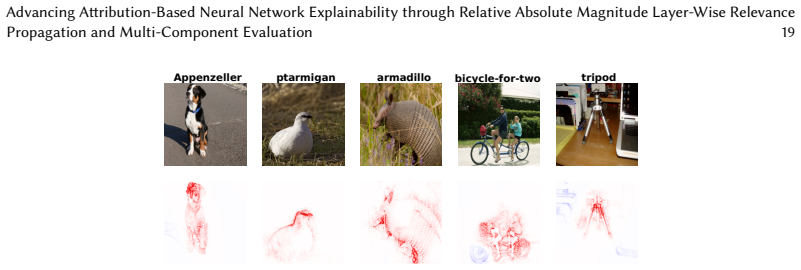
- If absLRP's advantage holds, Vision Transformer explanations need no longer be upscaled from patch resolution: the method delivers sparse pixel-level maps even for a model with 49 patches.
- The same rule transfers to non-image domains without modification; the authors demonstrate BERT sentiment attributions, so text and other discrete-input models inherit the recipe.
- GAE offers a single-number ranking that unifies faithfulness, robustness, and localization, replacing the common practice of reporting several possibly conflicting metrics.
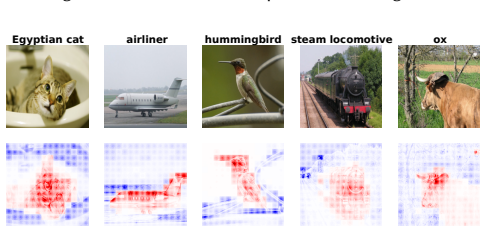
- Because the last-layer seed is contrastive (target class positive, all others negative), the maps change with the queried class, making multi-class image analysis practical.
- The ResNet50 tie with contrastive LRP implies the new denominator matters most in architectures with less normalized activation scales, which is consistent with the smaller margins the authors report for ViT-Base.
Reading between the lines
- AbsLRP does not conserve total relevance across layers, because its numerator sums only positive contributions while its denominator is the absolute total; the paper does not discuss this departure from LRP's conservation tradition.
- The motivating toy example changes the network's weights without changing its input–output function; an alternative reading is that a good attribution should be invariant to such re-parameterizations, which would make absLRP's sensitivity to weight scale a testable weakness rather than a clear correction.
- Because GAE's faithfulness term is built from gradient-based impact maps, the metric systematically favors methods whose maps align with input-gradients; attention-only methods such as Rollout are disadvantaged by construction, so GAE is best read as a comparison within gradient-aligned families.
- The ViT results suggest a testable extension: on models with stronger normalization of internal activations the new denominator should matter less, so one could predict smaller absLRP gains on other LayerNorm-heavy transformer variants beyond ViT.
Editorial analysis
A structured set of objections, weighed in public.
Referee Report
Summary. The paper proposes a new layer-wise relevance propagation rule, absLRP, defined in Eq. (12) as propagating relevance through a layer by normalizing each positive contribution (x_i w_ij)_+ by the absolute value of the total pre-activation |\sum_k x_k w_kj| + epsilon. The authors argue this corrects a relative-attribution issue in LRP-\alpha1\beta0 when neurons differ in absolute activation magnitude, and they apply the rule to VGG, ResNet50, and ViT-Base using a contrastive output initialization. They also introduce a new evaluation metric, Global Attribution Evaluation (GAE), which combines a local-consistency score (robustness plus faithfulness via gradient-guided masking) with a contrastiveness score based on mosaics, and they report large GAE improvements for absLRP over many baselines on ImageNet and PascalVOC. The paper additionally reports ROAD, Lipschitz, and Focus scores, and performs ablations and qualitative comparisons for Transformers.
Significance. If the proposed rule is taken at face value, absLRP is an attractively simple and architecture-agnostic LRP variant, and the paper deserves credit for tackling Vision Transformer explainability at pixel level and for attempting a multi-component evaluation metric. The authors provide code, compare a large set of attribution methods, and include ablation studies. However, the central quantitative claim rests mainly on GAE, a metric introduced in the same paper, and the independent standard metrics give only mixed support, especially for ViT. The manuscript contains no conservation or axiomatic analysis of Eq. (12), and there is an apparent mismatch between the formal rule and the provided pseudocode. These issues currently leave the headline contribution under-supported, although the core idea is plausible and the requested fixes appear addressable.
major comments (4)
- [Section 3.1, Eq. (12) and Algorithm 1] Algorithm 1 does not implement Eq. (12). For a linear or convolutional layer, the gradient of h + ha with respect to x_i is w_ij + sign(x_i)|w_ij|, and after multiplication by x_i and rel_scaling this yields 2 (x_i w_ij)_+ R_j^l / (|s_j| + epsilon), not (x_i w_ij)_+ R_j^l / (|s_j| + epsilon). Each layer processed by Algorithm 1 therefore introduces an extra factor of 2, and across a deep network the implemented rule differs from the defined rule by a factor exponential in depth. Because all experiments, ablations, and qualitative figures are produced with the implementation, the paper must reconcile Eq. (12), Algorithm 1, and the released code; as written, the claim that absLRP is the rule in Eq. (12) is not supported.
- [Section 3.1, Eq. (12)] Eq. (12) does not conserve relevance. Summing R_i^{l-1} over i gives sum_j [ (sum_i (x_i w_ij)_+) / (|sum_k x_k w_kj| + epsilon) ] R_j^l. The numerator equals |sum_k x_k w_kj| only when all contributions x_i w_ij have the same sign; in general sum_i (x_i w_ij)_+ differs from |sum_k x_k w_kj|, so relevance is systematically amplified or suppressed layer by layer. The paper motivates LRP through the redistribution property in Eq. (1) but never states whether absLRP is intended to be conservative, and the toy example in Figure 1 involves only positive contributions and cannot reveal this behavior. The authors should prove conservation under stated conditions, add a normalization that restores it, or explicitly characterize and justify the non-conservation.
- [Section 4.1, Tables 7-9 and 11-13] The claim of consistent superiority is not supported by the external metrics. On ViT-Base/ImageNet (Table 9), absLRP has lower Focus (0.826) than GradCAM and HiResCAM (0.913) and worse ROAD_MoRF (0.457 vs 0.317); on ViT-Base/PascalVOC (Table 13) the same pattern holds (Focus 0.689 vs 0.800/0.785; ROAD_MoRF 0.195 vs 0.131). On VGG and ResNet absLRP is competitive, but the "significant margin" claimed in the abstract appears only on GAE, a metric defined by the same authors. Since GAE is also aligned with the method's design goals (sparse, contrastive, pixel-level maps), the paper should provide a sensitivity analysis of GAE to its parameters and normalization choices, and should either temper the abstract or justify why GAE should override the standard metrics where they disagree.
- [Section 3.2, Local consistency definition] The GAE metric is incompletely specified. Section 3.2 states that "we select the top k percent of input features" but neither the value of k nor the feature-block granularity (pixel-wise versus patch-wise) is given anywhere in the paper or appendices; only T=10 is reported in Section 4.1. Without k and the masking implementation, the experiments are not reproducible, and the metric's sensitivity to these choices is unknown. Given that GAE carries the paper's main quantitative conclusion, this omission blocks verification of the primary result.
minor comments (6)
- [Section 2.1, Eq. (5)] The definition of R^{l-1}_{i in P,N} is hard to parse, and the sentence "where Psi^{l-1}_i is the mean value of non-zero-neurons in the layer l-1" does not explain how a per-neuron subtraction term is computed from a mean; please clarify the notation.
- [Table 8] The GradCAM++ Focus score is printed as "747" rather than "0.747", which appears to be a typographical error.
- [References] References [46] and [47] are the same paper (Smilkov et al. 2017); please remove the duplicate.
- [Section 4.1] The paragraph following Table 9 contains the doubled phrase "Additionally, Additionally".
- [Figure 1 caption] The caption uses the acronym "RAMP" while the text and the rest of the paper use "absLRP"; the shorter acronym is never defined.
- [Algorithm 1] In the pseudocode, the variable x is used both as the function input and inside autograd.grad(ha + h, x, rel_scaling), while the parameter is named input; this makes the intended dependence of rel on the layer's input ambiguous.
Circularity Check
No circular step: absLRP and GAE are defined independently, and external ROAD/Lipschitz/Focus results provide non-circular corroboration.
full rationale
The absLRP rule in Eq. (12) is a direct definition in terms of the layer's pre-activations and weights; it is not defined in terms of GAE, nor is any parameter fitted to the evaluation data. GAE's local-consistency and contrastiveness components are constructed from model outputs, input×gradient impact maps, and a mosaic scoring map; none of these components presuppose the absLRP rule, and the same protocol is applied to all baseline methods. The paper also reports independent external metrics (ROAD, Local Lipschitz, Focus) from prior work, and absLRP is top or near-top on several of them, so the central claim does not reduce to a self-defined score. There are no self-citations or imported uniqueness theorems in the reference list. A separate, non-circular correctness concern exists: Algorithm 1's autograd of h+ha yields twice the Eq. (12) contribution per linear layer, so the experiments may implement a scaled variant; this affects validity but not circularity.
Assumptions & free parameters
free parameters (3)
- GAE masking step count T =
10
- GAE top-k percent for gradient masking =
unspecified
- absLRP epsilon =
1e-9
assumptions (5)
- ad hoc to paper Relevance should be proportional to (x_i w_ij)_+ normalized by |sum_k x_k w_kj|
- domain assumption Gradient-based masking selects features whose removal changes model output most/least
- domain assumption Attribution maps should change in step with model output under perturbation
- domain assumption Softmax scores in the mosaic define class similarity for contrastiveness
- domain assumption Self-attention softmax denominator can be detached and treated as constant
Cite this review
Pith. "Pith review of Advancing Attribution-Based Neural Network Explainability through Relative Absolute Magnitude Layer-Wise Relevance Propagation and Multi-Component Evaluation." pith.science (2026). https://pith.science/paper/G7YKEMDB
@misc{pith2026241209311,
  author       = {Pith},
  title        = {Pith review of: Advancing Attribution-Based Neural Network Explainability through Relative Absolute Magnitude Layer-Wise Relevance Propagation and Multi-Component Evaluation},
  year         = {2026},
  howpublished = {\url{https://pith.science/paper/G7YKEMDB}},
  note         = {Machine review of arXiv:2412.09311}
}
read the original abstract
Recent advancement in deep-neural network performance led to the development of new state-of-the-art approaches in numerous areas. However, the black-box nature of neural networks often prohibits their use in areas where model explainability and model transparency are crucial. Over the years, researchers proposed many algorithms to aid neural network understanding and provide additional information to the human expert. One of the most popular methods being Layer-Wise Relevance Propagation (LRP). This method assigns local relevance based on the pixel-wise decomposition of nonlinear classifiers. With the rise of attribution method research, there has emerged a pressing need to assess and evaluate their performance. Numerous metrics have been proposed, each assessing an individual property of attribution methods such as faithfulness, robustness or localization. Unfortunately, no single metric is deemed optimal for every case, and researchers often use several metrics to test the quality of the attribution maps. In this work, we address the shortcomings of the current LRP formulations and introduce a novel method for determining the relevance of input neurons through layer-wise relevance propagation. Furthermore, we apply this approach to the recently developed Vision Transformer architecture and evaluate its performance against existing methods on two image classification datasets, namely ImageNet and PascalVOC. Our results clearly demonstrate the advantage of our proposed method. Furthermore, we discuss the insufficiencies of current evaluation metrics for attribution-based explainability and propose a new evaluation metric that combines the notions of faithfulness, robustness and contrastiveness. We utilize this new metric to evaluate the performance of various attribution-based methods. Our code is available at: https://github.com/davor10105/relative-absolute-magnitude-propagation
Figures


Figures from the paper (12 more)



Reference graph
Works this paper leans on
-
[1]
Samira Abnar and Willem Zuidema. 2020. Quantifying Attention Flow in Transformers. In Proceedings of the 58th Annual Meeting of the Association for Computational Linguistics . Association for Computational Linguistics, Online, 4190–4197. https://doi.org/10.18653/v1/2020.acl-main.385
-
[2]
Ameen Ali, Thomas Schnake, Oliver Eberle, Grégoire Montavon, Klaus-Robert Müller, and Lior Wolf. 2022. XAI for Transformers: Better Explanations through Conservative Propagation. In International Conference on Machine Learning, ICML 2022 (Proceedings of Machine Learning Research, Vol. 162) . PMLR, Baltimore, Maryland, USA, 435–451. https://proceedings.mlr...
work page 2022
-
[3]
David Alvarez Melis and Tommi Jaakkola. 2018. Towards Robust Interpretability with Self-Explaining Neural Networks. In Advances in Neural Information Processing Systems, S. Bengio, H. Wallach, H. Larochelle, K. Grauman, N. Cesa-Bianchi, and R. Garnett (Eds.), Vol. 31. Curran Associates, Inc., Montréal, Canada. https://proceedings.neurips.cc/paper/2018/ fi...
work page 2018
- [4]
-
[5]
Marco Ancona, Enea Ceolini, Cengiz Öztireli, and Markus Gross. 2018. Towards better understanding of gradient-based attribution methods for Deep Neural Networks . ICLR, Vancouver, BC, Canada. https://openreview.net/forum?id= Sy21R9JAW
work page 2018
-
[6]
Anna Arias-Duart, Ferran Parés, Dario Garcia-Gasulla, and Victor Giménez-Ábalos. 2022. Focus! Rating XAI Methods and Finding Biases. In 2022 IEEE International Conference on Fuzzy Systems . IEEE, FUZZ-IEEE, Padua, Italy, 1–8
work page 2022
-
[7]
Leila Arras, Grégoire Montavon, Klaus-Robert Müller, and Wojciech Samek. 2017. Explaining Recurrent Neural Network Predictions in Sentiment Analysis. In Proceedings of the 8th Workshop on Computational Approaches to Subjectivity, Sentiment and Social Media Analysis . Association for Computational Linguistics, Copenhagen, Denmark, 159–168. https://doi.org/...
-
[8]
Leila Arras, Ahmed Osman, and Wojciech Samek. 2020. Ground Truth Evaluation of Neural Network Explanations with CLEVR-XAI. Information Fusion 81, 3 (2020), 14–40. https://doi.org/10.48550/ARXIV.2003.07258
work page Pith review arXiv doi:10.48550/arxiv.2003.07258 2020
Show all 58 references
-
[9]
Vijay Arya, Rachel K. E. Bellamy, Pin-Yu Chen, Amit Dhurandhar, Michael Hind, Samuel C. Hoffman, Stephanie Houde, Q. Vera Liao, Ronny Luss, Aleksandra Mojsilovic, Sami Mourad, Pablo Pedemonte, Ramya Raghavendra, John T. Richards, Prasanna Sattigeri, Karthikeyan Shanmugam, Moni...
2019 arXiv
-
[10]
Sebastian Bach, Alexander Binder, Grégoire Montavon, Frederick Klauschen, Klaus-Robert Müller, and Wojciech Samek
- [11]
-
[12]
Nicolas Carion, Francisco Massa, Gabriel Synnaeve, Nicolas Usunier, Alexander Kirillov, and Sergey Zagoruyko. 2020. End-to-End Object Detection with Transformers. In Computer Vision - ECCV 2020 - 16th European Conference, Glasgow, UK (Lecture Notes in Computer Science, Vol. 12...
2020 doi
-
[13]
Aditya Chattopadhay, Anirban Sarkar, Prantik Howlader, and Vineeth N Balasubramanian. 2018. Grad-cam++: Generalized gradient-based visual explanations for deep convolutional networks. In 2018 IEEE winter conference on applications of computer vision (W ACV). IEEE, IEEE Worksho...
2018
-
[14]
Hila Chefer, Shir Gur, and Lior Wolf. 2021. Transformer Interpretability Beyond Attention Visualization. In IEEE Conference on Computer Vision and Pattern Recognition, CVPR 2021 . Computer Vision Foundation / IEEE, Virtual Event, 782–791. https://doi.org/10.1109/CVPR46437.2021.00084
2021
-
[15]
Lili Chen, Kevin Lu, Aravind Rajeswaran, Kimin Lee, Aditya Grover, Michael Laskin, Pieter Abbeel, Aravind Srinivas, and Igor Mordatch. 2021. Decision Transformer: Reinforcement Learning via Sequence Modeling. In Advances in Neural Information Processing Systems 34: Annual Conf...
2021
- [16]
-
[17]
Jia Deng, Wei Dong, Richard Socher, Li-Jia Li, Kai Li, and Li Fei-Fei. 2009. Imagenet: A large-scale hierarchical image database. In 2009 IEEE conference on computer vision and pattern recognition . Ieee, Conference on Computer Vision and Pattern Recognition, Miami, Florida, U...
2009
-
[18]
Jacob Devlin, Ming-Wei Chang, Kenton Lee, and Kristina Toutanova. 2019. BERT: Pre-training of Deep Bidirectional Transformers for Language Understanding. In Proceedings of the 2019 Conference of the North American Chapter of the Association for Computational Linguistics: Human...
2019 doi
-
[19]
Alexey Dosovitskiy, Lucas Beyer, Alexander Kolesnikov, Dirk Weissenborn, Xiaohua Zhai, Thomas Unterthiner, Mostafa Dehghani, Matthias Minderer, Georg Heigold, Sylvain Gelly, Jakob Uszkoreit, and Neil Houlsby. 2021. An Image is Worth 16x16 Words: Transformers for Image Recognit...
2021
-
[20]
Rachel Lea Draelos and Lawrence Carin. 2021. Use HiResCAM instead of Grad-CAM for faithful explanations of convolutional neural networks. CoRR. arXiv:2011.08891 [eess.IV]
2021 arXiv
-
[21]
Everingham, L
M. Everingham, L. Van Gool, C. K. I. Williams, J. Winn, and A. Zisserman. 2010. The Pascal Visual Object Classes (VOC) Challenge. International Journal of Computer Vision 88, 2 (June 2010), 303–338
2010
-
[22]
Jindong Gu, Yinchong Yang, and Volker Tresp. 2019. Understanding individual decisions of CNNs via contrastive backpropagation. In Computer Vision–ACCV 2018: 14th Asian Conference on Computer Vision . Springer, ACCV, Perth, Australia, 119–134
2019
-
[23]
Kaiming He, Xiangyu Zhang, Shaoqing Ren, and Jian Sun. 2016. Deep residual learning for image recognition. In Proceedings of the IEEE conference on computer vision and pattern recognition . CVPR, Las Vegas, Nevada, 770–778
2016
-
[24]
Pengcheng He, Xiaodong Liu, Jianfeng Gao, and Weizhu Chen. 2021. Deberta: decoding-Enhanced Bert with Disentan- gled Attention. In 9th International Conference on Learning Representations, ICLR 2021, Virtual Event, Austria, May 3-7,
2021
-
[25]
Peng-Tao Jiang, Chang-Bin Zhang, Qibin Hou, Ming-Ming Cheng, and Yunchao Wei. 2021. Layercam: Exploring hierarchical class activation maps for localization. IEEE Transactions on Image Processing 30 (2021), 5875–5888
2021
-
[26]
Yiming Ju, Yuanzhe Zhang, Zhao Yang, Zhongtao Jiang, Kang Liu, and Jun Zhao. 2022. Logic traps in evaluating attribution scores. In Proceedings of the 60th Annual Meeting of the Association for Computational Linguistics (Volume 1: Long Papers). Association for Computational Li...
2022
-
[27]
Pang Wei Koh and Percy Liang. 2017. Understanding Black-box Predictions via Influence Functions. In Proceedings of the 34th International Conference on Machine Learning, ICML 2017 (Proceedings of Machine Learning Research, Vol. 70) . PMLR, Sydney, NSW, Australia, 1885–1894. ht...
2017
-
[28]
Maximilian Kohlbrenner, Alexander Bauer, Shinichi Nakajima, Alexander Binder, Wojciech Samek, and Sebastian Lapuschkin. 2020. Towards best practice in explaining neural network decisions with LRP. In 2020 International Joint Conference on Neural Networks (IJCNN) . IEEE, IJCNN,...
2020
-
[29]
Alex Krizhevsky, Ilya Sutskever, and Geoffrey E Hinton. 2012. ImageNet Classification with Deep Convolutional Neural Networks. In Advances in Neural Information Processing Systems , F. Pereira, C.J. Burges, L. Bottou, and K.Q. Weinberger (Eds.), Vol. 25. Curran Associates, Inc...
2012 doi
-
[30]
Junhee Lee, Hyeonseong Cho, Yun Jang Pyun, Suk Ju Kang, and Hyoungsik Nam. 2022. Heatmap Assisted Accuracy Score Evaluation Method for Machine-Centric Explainable Deep Neural Networks. IEEE Access 10 (2022), 64832–64849. https://doi.org/10.1109/ACCESS.2022.3184453
2022
-
[31]
Yibing Liu, Haoliang Li, Yangyang Guo, Chenqi Kong, Jing Li, and Shiqi Wang. 2022. Rethinking attention-model explainability through faithfulness violation test. In International Conference on Machine Learning . PMLR, ICML, 1 W Pratt St, Baltimore, MD 21201, USA, 13807–13824
2022
-
[32]
Grégoire Montavon, Wojciech Samek, and Klaus-Robert Müller. 2018. Methods for interpreting and understanding deep neural networks. Digital Signal Processing 73 (feb 2018), 1–15. https://doi.org/10.1016/j.dsp.2017.10.011
2018 doi
-
[33]
Woo-Jeoung Nam, Shir Gur, Jaesik Choi, Lior Wolf, and Seong-Whan Lee. 2020. Relative Attributing Propagation: Interpreting the Comparative Contributions of Individual Units in Deep Neural Networks. In The Thirty-Fourth AAAI Conference on Artificial Intelligence, AAAI 2020, The...
2020 arXiv
-
[34]
An-phi Nguyen and María Rodríguez Martínez. 2020. On quantitative aspects of model interpretability. CoRR abs/2007.07584 (2020). arXiv:2007.07584 https://arxiv.org/abs/2007.07584
2020 arXiv
-
[35]
Vitali Petsiuk, Abir Das, and Kate Saenko. 2018. RISE: Randomized Input Sampling for Explanation of Black-box Models. In British Machine Vision Conference 2018, BMVC 2018 . BMVA Press, Newcastle, UK, 151. http://bmvc2018.org/ contents/papers/1064.pdf ACM Trans. Intell. Syst. T...
2018
-
[36]
Aditya Ramesh, Mikhail Pavlov, Gabriel Goh, Scott Gray, Chelsea Voss, Alec Radford, Mark Chen, and Ilya Sutskever
-
[37]
Why Should I Trust You?
Marco Túlio Ribeiro, Sameer Singh, and Carlos Guestrin. 2016. "Why Should I Trust You?": Explaining the Predictions of Any Classifier. In Proceedings of the 22nd ACM SIGKDD International Conference on Knowledge Discovery and Data Mining. ACM, San Francisco, CA, USA, 1135–1144....
2016
-
[38]
Laura Rieger and Lars Kai Hansen. 2020. IROF: a low resource evaluation metric for explanation methods. CoRR abs/2003.08747 (2020). arXiv:2003.08747 https://arxiv.org/abs/2003.08747
2020 arXiv
-
[39]
In Proceedings of the 38th International Conference on Machine Learning, ICML 2021 (Proceedings of Machine Learning Research, Vol
Zero-Shot Text-to-Image Generation. In Proceedings of the 38th International Conference on Machine Learning, ICML 2021 (Proceedings of Machine Learning Research, Vol. 139) , Marina Meila and Tong Zhang (Eds.). PMLR, Virtual Event, 8821–8831. http://proceedings.mlr.press/v139/r...
2021
-
[40]
Berg, and Li Fei-Fei
Olga Russakovsky, Jia Deng, Hao Su, Jonathan Krause, Sanjeev Satheesh, Sean Ma, Zhiheng Huang, Andrej Karpathy, Aditya Khosla, Michael Bernstein, Alexander C. Berg, and Li Fei-Fei. 2015. ImageNet Large Scale Visual Recognition Challenge. International Journal of Computer Visio...
2015 doi
-
[41]
Wojciech Samek, Alexander Binder, Grégoire Montavon, Sebastian Lapuschkin, and Klaus-Robert Müller. 2016. Evalu- ating the visualization of what a deep neural network has learned. IEEE transactions on neural networks and learning systems 28, 11 (2016), 2660–2673
2016
-
[42]
Yao Rong, Tobias Leemann, Vadim Borisov, Gjergji Kasneci, and Enkelejda Kasneci. 2022. A Consistent and Efficient Evaluation Strategy for Attribution Methods. In Proceedings of Machine Learning Research . PMLR, Baltimore, Maryland, USA, 18770–18795. arXiv:arXiv:2202.00449
2022 arXiv
-
[43]
Avanti Shrikumar, Peyton Greenside, Anna Shcherbina, and Anshul Kundaje. 2016. Not Just a Black Box: Learning Important Features Through Propagating Activation Differences. CoRR abs/1605.01713 (2016). arXiv:1605.01713 http://arxiv.org/abs/1605.01713
2016 arXiv
-
[44]
David Silver, Aja Huang, Chris J. Maddison, Arthur Guez, Laurent Sifre, George van den Driessche, Julian Schrittwieser, Ioannis Antonoglou, Veda Panneershelvam, Marc Lanctot, Sander Dieleman, Dominik Grewe, John Nham, Nal Kalch- brenner, Ilya Sutskever, Timothy Lillicrap, Made...
-
[45]
Selvaraju, Michael Cogswell, Abhishek Das, Ramakrishna Vedantam, Devi Parikh, and Dhruv Batra
Ramprasaath R. Selvaraju, Michael Cogswell, Abhishek Das, Ramakrishna Vedantam, Devi Parikh, and Dhruv Batra
-
[47]
Viégas, and Martin Wattenberg
Daniel Smilkov, Nikhil Thorat, Been Kim, Fernanda B. Viégas, and Martin Wattenberg. 2017. SmoothGrad: removing noise by adding noise. CoRR abs/1706.03825 (2017). arXiv:1706.03825 http://arxiv.org/abs/1706.03825
2017 arXiv
-
[48]
Mukund Sundararajan, Ankur Taly, and Qiqi Yan. 2017. Axiomatic Attribution for Deep Networks. In Proceedings of the 34th International Conference on Machine Learning, ICML 2017 (Proceedings of Machine Learning Research, Vol. 70) . PMLR, Sydney, NSW, Australia, 3319–3328. http:...
2017
-
[49]
Gomez, Lukasz Kaiser, and Illia Polosukhin
Ashish Vaswani, Noam Shazeer, Niki Parmar, Jakob Uszkoreit, Llion Jones, Aidan N. Gomez, Lukasz Kaiser, and Illia Polosukhin. 2017. Attention is All you Need. InAdvances in Neural Information Processing Systems 30: Annual Conference on Neural Information Processing Systems 201...
2017
-
[50]
Karen Simonyan, Andrea Vedaldi, and Andrew Zisserman. 2014. Deep Inside Convolutional Networks: Visualising Image Classification Models and Saliency Maps. In 2nd International Conference on Learning Representations, ICLR 2014 , Yoshua Bengio and Yann LeCun (Eds.). ICLR, Banff,...
2014 arXiv
-
[51]
Courville, Ruslan Salakhutdinov, Richard S
Kelvin Xu, Jimmy Ba, Ryan Kiros, Kyunghyun Cho, Aaron C. Courville, Ruslan Salakhutdinov, Richard S. Zemel, and Yoshua Bengio. 2015. Show, Attend and Tell: Neural Image Caption Generation with Visual Attention. In Proceedings of the 32nd International Conference on Machine Lea...
2015
-
[52]
Chih-Kuan Yeh, Cheng-Yu Hsieh, Arun Suggala, David I Inouye, and Pradeep K Ravikumar. 2019. On the (in) fidelity and sensitivity of explanations. Advances in Neural Information Processing Systems 32 (2019), 10967–10978
2019
-
[53]
Zeiler and Rob Fergus
Matthew D. Zeiler and Rob Fergus. 2014. Visualizing and Understanding Convolutional Networks. In Computer Vision - ECCV 2014 - 13th European Conference (Lecture Notes in Computer Science, Vol. 8689) . Springer, Zurich, Switzerland, 818–833. https://doi.org/10.1007/978-3-319-10590-1_53
2014 doi
-
[54]
Jianming Zhang, Sarah Adel Bargal, Zhe Lin, Jonathan Brandt, Xiaohui Shen, and Stan Sclaroff. 2018. Top-down neural attention by excitation backprop. International Journal of Computer Vision 126, 10 (2018), 1084–1102. ACM Trans. Intell. Syst. Technol., Vol. 1, No. 1, Article ....
2018
-
[55]
Sandra Wachter, Brent Mittelstadt, and Chris Russell. 2017. Counterfactual explanations without opening the black box: Automated decisions and the GDPR. Harv. JL & Tech. 31 (2017), 841
2017
-
[2015]
PLOS ONE 10, 7 (jul 2015), e0130140
On Pixel-Wise Explanations for Non-Linear Classifier Decisions by Layer-Wise Relevance Propagation. PLOS ONE 10, 7 (jul 2015), e0130140. https://doi.org/10.1371/journal.pone.0130140
2015 doi
-
[2016]
Nature 529, 7587 (Jan
Mastering the game of Go with deep neural networks and tree search. Nature 529, 7587 (Jan. 2016), 484–489. https://doi.org/10.1038/nature16961
2016 doi
-
[2019]
International Journal of Computer Vision 128, 2 (oct 2019), 336–359
Grad-CAM: Visual Explanations from Deep Networks via Gradient-Based Localization. International Journal of Computer Vision 128, 2 (oct 2019), 336–359. https://doi.org/10.1007/s11263-019-01228-7
2019 doi
-
[2021]
https://openreview.net/forum?id=XPZIaotutsD
OpenReview.net, Virtual Event, Austria. https://openreview.net/forum?id=XPZIaotutsD
Reviewed August 11, 2026 · model on record in the stance chip above.
Discussion (0). Continue with ORCID to comment.