REVIEW 4 major objections 5 minor 51 references
CP-DETR: Concept Prompt Guide DETR Toward Stronger Universal Object Detection
T0 review · 4 major / 5 minor · reviewed 2026-08-11 · deepseek-v4-flash
Pith's one-line read A single pre-trained detector can set zero-shot records and match fully fine-tuned specialists by switching among text, visual, and optimized concept prompts.
desk verdict Solid engineering with a genuinely new combination—visual prompts inside an early-fusion DETR—but the headline SOTA claim over Grounding DINO is confounded by training data and unverifiable without code. read the letter →
The pith
A machine-rendered reading of the paper's core claim, the machinery that carries it, and where it could break.
The reading
What carries the argument
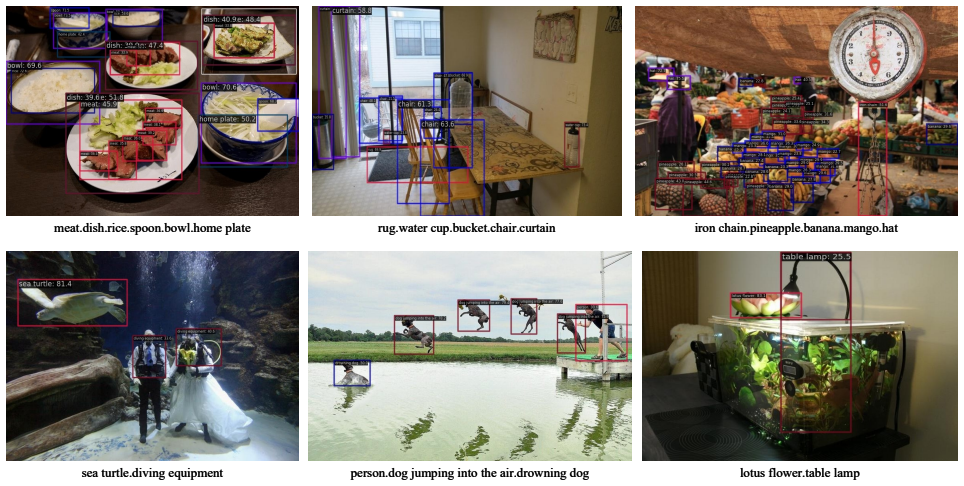
Concept prompts unify the three input modalities: text, box coordinates, and tuned embeddings all become high-dimensional vectors in one space. The load-bearing mechanism is the prompt visual hybrid encoder, made of progressive single-scale fusion (PSF) and multi-scale fusion gating (MFG): PSF starts from the deepest feature map so low-level features with weak semantics are not fused prematurely, while MFG flattens all scales and uses cross-modal attention plus deformable self-attention to gate information into the final concept prompts. A visual prompt encoder turns box coordinates into queries that aggregate concept vectors from multi-scale features, and an optimized prompt is a learnable embedding layer that represents each category with several vectors (ten by default) so that one category can absorb variation across datasets.
What would settle it
Train CP-DETR-T and Grounding DINO-T on the identical Objects365+GoldG data with no V3Det and the same schedule, and compare LVIS zero-shot AP; if the gap shrinks toward the 0.6 AP level of DetCLIPv3-T, the headline +20.2 AP is explained by data, not design.
Extended reading notes
Core claim
The paper's central claim is that effective cross-modal interaction is the missing ingredient in universal object detection: prior early-fusion models update all visual scales with prompts at once and ignore the semantic gaps between feature levels. CP-DETR's prompt visual hybrid encoder instead fuses the deepest feature map with prompts first, propagates that interaction top-down and bottom-up through single fusion layers, and then applies multi-scale fusion gating with deformable self-attention to gather critical information. Two auxiliary losses, a prompt multi-label loss and an anchor-based auxiliary detection head, give the hybrid encoder dense supervision during pre-training. The result, as reported, is a detector that with one fixed weight outperforms similarly sized universal detectors on zero-shot benchmarks and, when prompts are optimized, matches or beats fully fine-tuned specialist models.
Load-bearing premise
The load-bearing premise is that the reported benchmark gaps come from the proposed architecture rather than from the extra training data that only CP-DETR-T was given; if that data difference explains most of the gain, the architecture's superiority is not established.
Editorial extensions
If this is right
- Universal detection gains can come from how prompts are fused rather than only from larger pre-training corpora: CP-DETR-T uses public O365, V3Det, and GoldG data and still beats DetCLIPv3-T, which adds 50M private captions, on LVIS zero-shot AP.
- A single frozen weight can be specialized to a downstream dataset by optimizing only prompt embeddings, reaching 73.1 AP on ODinW13 and matching or exceeding full-model fine-tuning baselines.
- Interactive detection with box visual prompts outperforms text prompts by 18.4 AP on ODinW35 for CP-DETR-L, giving users a practical way to remove alignment bias by pointing at examples.
- The architecture keeps inference cost nearly flat as the number of categories grows (12.2 to 11.2 FPS at 1 to 80 classes for CP-DETR-T), whereas the main baseline's cost rises sharply.
- Because the detector and the concept prompt generator are separate parts, a new prompt modality can be added without retraining the detector.
Reading between the lines
- Beyond the paper: the +20.2 AP over Grounding DINO-T on LVIS is confounded by training data, since CP-DETR-T uses V3Det while the baseline does not; DetCLIPv3-T, which uses V3Det, trails by only 0.6 AP, so the architecture-specific gain is not yet isolated.
- Beyond the paper: if prompt-only tuning closes most of the gap to full fine-tuning, then text-image alignment bias, not detector capacity, is the main barrier to downstream specialization, and other deep-fusion open-vocabulary detectors should show similar prompt-tuning gains.
- Beyond the paper: the super-class representation may also absorb annotation noise and label ambiguity within a single dataset, which could be tested by increasing the number of prompt vectors per category on noisy labels.
- Beyond the paper: the visual prompt encoder suggests that box-conditioned queries could transfer to open-vocabulary segmentation or referring-expression grounding with the same frozen detector.
Signed reviews
Editorial analysis
A structured set of objections, weighed in public.
Referee Report
Summary. The paper proposes CP-DETR, a DETR-based universal object detector that conditions detection on concept prompts in a unified vector space. The detector uses a prompt-visual hybrid encoder built from progressive single-scale fusion (PSF) and multi-scale fusion gating (MFG), with auxiliary supervision from a prompt multi-label loss and an anchor-based detection head. Three concept-prompt generators are presented: text prompts, visual prompts, and optimized prompts via super-class prompt tuning. The authors report strong empirical results with a single pre-trained weight: 47.6 zero-shot AP on LVIS with Swin-T, 32.2 zero-shot AP on ODinW35 with Swin-L, 68.4 AP on COCO val for interactive visual prompting, and 73.1 AP on ODinW13 with optimized prompts. The paper also includes ablations, efficiency comparisons, and a limitation section.
Significance. If the reported results are controlled and reproducible, the paper makes a useful contribution to universal object detection: it demonstrates a computationally efficient cross-modal fusion design, introduces a unified concept-prompt formulation covering text, visual, and optimized prompts, and achieves competitive numbers without private pseudo-labeled data. The ablation study and the appendix's efficiency analysis are informative, and the paper is transparent about several limitations. However, the central state-of-the-art claim is weakened by training-data confounds in the headline comparisons, an ablation baseline that does not correspond to the main competitor's fusion module, and an unspecified ODinW35 evaluation protocol. The absence of release code or model weights further prevents independent verification. The significance is therefore conditional on addressing these control issues.
major comments (4)
- [Table 1, 'Comparison with Universal Detectors'] The headline LVIS comparison is confounded by training data: CP-DETR-T is pre-trained on O365+V3Det+GoldG, whereas Grounding DINO-T uses O365+GoldG+Cap4M and never sees V3Det's extra categories. The +20.2 AP difference on LVIS minival therefore mixes architectural gains with a large vocabulary/data difference. This is made more acute by the fact that DetCLIPv3-T, which also trains on V3Det plus additional private data, is only 0.6 AP behind CP-DETR-T. A data-controlled comparison is needed to support the claim of architectural superiority.
- [Table 4, 'Ablation'] The ablation row labeled 'replaced by DINO encoder' is not a control for Grounding DINO's cross-modal feature enhancement: it replaces the hybrid encoder with the closed-set DINO encoder, so the comparison measures early fusion against a non-cross-modal encoder rather than against the specific fusion design of the main competitor. The gains reported for the hybrid encoder (LVIS 42.2 to 44.3, ODinW13 58.5 to 64.0) are internally consistent but do not establish superiority over existing early-fusion encoders such as GLIP-style or Grounding DINO-style fusion under identical data.
- ['Evaluation Benchmark' and 'Comparison with Universal Detectors'] The paper states that ODinW35 evaluation 'followed the APE evaluation setup' without specifying what that setup changes relative to the standard ELEVATER protocol. If class-name corrections or resolution settings differ, the reported 32.2 AP is not directly comparable with the other numbers in Table 1. The exact modified protocol, including which categories were renamed and how images were resized, must be stated so the zero-shot ODinW35 claim can be verified.
- [Appendix, Figure 3, and Table 2] The super-class representation length M is selected by evaluating on ODinW13, which is the same benchmark used to report the headline 73.1 AP for optimized prompts. Tuning this hyperparameter on the evaluation benchmark can inflate the reported result; the paper should report the selection procedure, and ideally validate M on a held-out split or show sensitivity across benchmarks.
minor comments (5)
- ['Text Prompt Direct Evaluation'] The terms 'zero-shot' and 'full-shot' are used for Table 1, but the table does not explicitly mark which benchmarks were included in pre-training for each model; the gray/black color convention is helpful but should be stated in the caption and also applied to the LVIS columns for CP-DETR-L.
- [Equation (8)] The visual prompt training objective uses K and P_i^v / P_i^t, but the meaning of P_i is not fully defined; clarify that P_i is the i-th positive category's concept prompt and specify the alignment between P_v and P_t.
- [Equation (4)] The formula for P_end uses the dot product of P^{l+1} and P^l followed by Linear and ReLU, but the intended gating operation and normalization order are not entirely clear; adding a short explanation or a diagram of the tensor shapes would help.
- [Table 4] The row labels 'add row3 and super-class' are confusing because row 4 already includes row 3 plus the auxiliary head; rephrasing the rows as incremental additions would make the ablation easier to read.
- ['About Code'] The statement that code release requires internal permission is understandable, but given the empirical nature of the claims, the paper should at least provide a detailed evaluation configuration and, if possible, release feature visualizations or checkpoints through an institutional review process.
Circularity Check
Only minor circularity: the optimized-prompt ODinW13 record is tuned on that benchmark; the zero-shot claims remain independent external measurements.
-
fitted input called prediction
[Appendix, 'Additional Experiment' (Figure 3) and Experiments, Table 2]
"As shown in figure 3, the performance on the downstream task gradually improves as the representation length increases, approaching saturation at 10, so we use 10 as the default length for optimized prompts."
The same benchmark that anchors the headline optimized-prompt result (ODinW13, 73.1 AP in Table 2) is also the benchmark used to select the super-class representation length. Figure 3 ablates the representation length on ODinW13 full-shot AP and chooses M=10 based on that metric; the selected configuration is then reported as the optimized-prompt record. The reported 73.1 AP is therefore not an independent evaluation of a fixed method: a hyperparameter of the proposed 'super-class representation' was chosen by optimizing the very benchmark on which the method is then declared state-of-the-art. This is a mild in-sample selection effect, not a derivation from first principles, and it does not affect the zero-shot text-prompt results.
full rationale
CP-DETR's central zero-shot claims (47.6 AP on LVIS, 32.2 AP on ODinW35) are external benchmark measurements with a fixed pre-trained weight; they are not derived from any fitted parameter of the paper, and no equation reduces a claimed prediction to its own input. The only circular step I can exhibit is the super-class representation length for optimized prompts: the appendix ablates this length on ODinW13 and selects 10 on the basis of full-shot AP on that benchmark, and the same ODinW13 benchmark then anchors the headline 73.1 AP record in Table 2. That number is therefore in-sample with respect to hyperparameter selection and is not an independent confirmation of the method; however, it affects only the fully-shot optimized-prompt claim and does not infect the zero-shot comparisons. The remaining concerns—uncontrolled V3Det training data versus Grounding DINO, the 'DINO encoder' ablation row, and the unspecified APE-modified ODinW35 setup—are benchmark-control and correctness issues, not circularity. The paper's self-citation to Chen et al. 2024 is used only as a related baseline/prompt-learning reference and is not load-bearing. No uniqueness theorem, imported ansatz, or renaming of a known result is present.
Assumptions & free parameters
free parameters (5)
- Super-class representation length M =
10 (per category, by ablation on ODinW13)
- Number of negative text samples per batch =
80
- Memory bank length for text dictionary =
1000
- Auxiliary loss weights =
prompt multi-label 6, aux class 6, centerness 6, IoU 12
- Training data composition and sampling ratios =
see Table 6
assumptions (5)
- domain assumption CLIP/EVA-02 text encoder provides a semantic space that supports open-set concept generalization.
- domain assumption DETR with language-guided query selection and cross-modality decoder provides a sound detection backbone.
- domain assumption Public datasets with region-text annotations are sufficient for universal detection pre-training.
- ad hoc to paper Auxiliary supervision (multi-label loss and anchor head) improves the hybrid encoder's fusion learning.
- ad hoc to paper The APE-adjusted ODinW35 evaluation setup is a fair measure of zero-shot performance.
Cite this review
Pith. "Pith review of CP-DETR: Concept Prompt Guide DETR Toward Stronger Universal Object Detection." pith.science (2026). https://pith.science/paper/476RYVLU
@misc{pith2026241209799,
  author       = {Pith},
  title        = {Pith review of: CP-DETR: Concept Prompt Guide DETR Toward Stronger Universal Object Detection},
  year         = {2026},
  howpublished = {\url{https://pith.science/paper/476RYVLU}},
  note         = {Machine review of arXiv:2412.09799}
}
read the original abstract
Recent research on universal object detection aims to introduce language in a SoTA closed-set detector and then generalize the open-set concepts by constructing large-scale (text-region) datasets for training. However, these methods face two main challenges: (i) how to efficiently use the prior information in the prompts to genericise objects and (ii) how to reduce alignment bias in the downstream tasks, both leading to sub-optimal performance in some scenarios beyond pre-training. To address these challenges, we propose a strong universal detection foundation model called CP-DETR, which is competitive in almost all scenarios, with only one pre-training weight. Specifically, we design an efficient prompt visual hybrid encoder that enhances the information interaction between prompt and visual through scale-by-scale and multi-scale fusion modules. Then, the hybrid encoder is facilitated to fully utilize the prompted information by prompt multi-label loss and auxiliary detection head. In addition to text prompts, we have designed two practical concept prompt generation methods, visual prompt and optimized prompt, to extract abstract concepts through concrete visual examples and stably reduce alignment bias in downstream tasks. With these effective designs, CP-DETR demonstrates superior universal detection performance in a broad spectrum of scenarios. For example, our Swin-T backbone model achieves 47.6 zero-shot AP on LVIS, and the Swin-L backbone model achieves 32.2 zero-shot AP on ODinW35. Furthermore, our visual prompt generation method achieves 68.4 AP on COCO val by interactive detection, and the optimized prompt achieves 73.1 fully-shot AP on ODinW13.
Figures


Figures from the paper (2 more)

Reference graph
Works this paper leans on
-
[1]
Chen, K.; Wang, J.; Pang, J.; Cao, Y.; Xiong, Y.; Li, X.; Sun, S.; Feng, W.; Liu, Z.; Xu, J.; et al. 2019. MMDetection: Open mmlab detection toolbox and benchmark. arXiv:1906.07155
arXiv 2019
-
[2]
Chen, Q.; Jin, W.; Li, S.; Liu, M.; Yu, L.; Jiang, J.; and Wang, X. 2024. Exploration of visual prompt in Grounded pre-trained open-set detection. In ICASSP, 6115--6119. IEEE
work page 2024
-
[3]
Cheng, T.; Song, L.; Ge, Y.; Liu, W.; Wang, X.; and Shan, Y. 2024. Yolo-world: Real-time open-vocabulary object detection. In CVPR, 16901--16911
work page 2024
-
[4]
Devlin, J.; Chang, M.-W.; Lee, K.; and Toutanova, K. 2018. Bert: Pre-training of deep bidirectional transformers for language understanding. arXiv:1810.04805
arXiv 2018
-
[5]
Ding, X.; Zhang, X.; Ma, N.; Han, J.; Ding, G.; and Sun, J. 2021. Repvgg: Making vgg-style convnets great again. In CVPR, 13733--13742
work page 2021
-
[6]
Fang, Y.; Sun, Q.; Wang, X.; Huang, T.; Wang, X.; and Cao, Y. 2024. Eva-02: A visual representation for neon genesis. Image and Vision Computing, 105171
work page 2024
-
[7]
Feng, C.; Zhong, Y.; Jie, Z.; Chu, X.; Ren, H.; Wei, X.; Xie, W.; and Ma, L. 2022. Promptdet: Towards open-vocabulary detection using uncurated images. In ECCV, 701--717. Springer
work page 2022
-
[8]
Gu, X.; Lin, T.-Y.; Kuo, W.; and Cui, Y. 2022. Open-vocabulary Object Detection via Vision and Language Knowledge Distillation. In ICLR
2022
Show all 51 references
-
[9]
Gupta, A.; Dollar, P.; and Girshick, R. 2019. Lvis: A dataset for large vocabulary instance segmentation. In CVPR, 5356--5364
2019
-
[10]
Jiang, Q.; Li, F.; Zeng, Z.; Ren, T.; Liu, S.; and Zhang, L. 2024. T-Rex2: Towards Generic Object Detection via Text-Visual Prompt Synergy. arXiv:2403.14610
2024 arXiv
-
[11]
Kamath, A.; Singh, M.; LeCun, Y.; Synnaeve, G.; Misra, I.; and Carion, N. 2021. Mdetr-modulated detection for end-to-end multi-modal understanding. In ICCV, 1780--1790
2021
-
[12]
A.; et al
Krishna, R.; Zhu, Y.; Groth, O.; Johnson, J.; Hata, K.; Kravitz, J.; Chen, S.; Kalantidis, Y.; Li, L.-J.; Shamma, D. A.; et al. 2017. Visual genome: Connecting language and vision using crowdsourced dense image annotations. International journal of computer vision, 123: 32--73
2017
-
[13]
Kuznetsova, A.; Rom, H.; Alldrin, N.; Uijlings, J.; Krasin, I.; Pont-Tuset, J.; Kamali, S.; Popov, S.; Malloci, M.; Kolesnikov, A.; et al. 2020. The open images dataset v4: Unified image classification, object detection, and visual relationship detection at scale. Internationa...
2020
-
[14]
J.; and Gao, J
Li, C.; Liu, H.; Li, L.; Zhang, P.; Aneja, J.; Yang, J.; Jin, P.; Hu, H.; Liu, Z.; Lee, Y. J.; and Gao, J. 2022 a . ELEVATER: A Benchmark and Toolkit for Evaluating Language-Augmented Visual Models. In NeurIPS, 9287--9301
2022
-
[15]
H.; Zhang, P.; Zhang, H.; Yang, J.; Li, C.; Zhong, Y.; Wang, L.; Yuan, L.; Zhang, L.; Hwang, J.-N.; et al
Li, L. H.; Zhang, P.; Zhang, H.; Yang, J.; Li, C.; Zhong, Y.; Wang, L.; Yuan, L.; Zhang, L.; Hwang, J.-N.; et al. 2022 b . Grounded language-image pre-training. In CVPR, 10965--10975
2022
-
[16]
Li, X.; Wang, W.; Wu, L.; Chen, S.; Hu, X.; Li, J.; Tang, J.; and Yang, J. 2020. Generalized Focal Loss: Learning Qualified and Distributed Bounding Boxes for Dense Object Detection. In NeurIPS, 21002--21012
2020
-
[17]
Li, Z.; Yao, L.; Zhang, X.; Wang, X.; Kanhere, S.; and Zhang, H. 2019. Zero-shot object detection with textual descriptions. In AAAI, 8690--8697
2019
-
[18]
Lin, T.-Y.; Maire, M.; Belongie, S.; Hays, J.; Perona, P.; Ramanan, D.; Doll \'a r, P.; and Zitnick, C. L. 2014. Microsoft coco: Common objects in context. In ECCV, 740--755. Springer
2014
-
[19]
Liu, S.; Qi, L.; Qin, H.; Shi, J.; and Jia, J. 2018. Path aggregation network for instance segmentation. In CVPR, 8759--8768
2018
-
[20]
Liu, S.; Zeng, Z.; Ren, T.; Li, F.; Zhang, H.; Yang, J.; Li, C.; Yang, J.; Su, H.; Zhu, J.; et al. 2023. Grounding dino: Marrying dino with grounded pre-training for open-set object detection. arXiv:2303.05499
2023 arXiv
-
[21]
Liu, Z.; Lin, Y.; Cao, Y.; Hu, H.; Wei, Y.; Zhang, Z.; Lin, S.; and Guo, B. 2021. Swin transformer: Hierarchical vision transformer using shifted windows. In ICCV, 10012--10022
2021
-
[22]
L.; and Murphy, K
Mao, J.; Huang, J.; Toshev, A.; Camburu, O.; Yuille, A. L.; and Murphy, K. 2016. Generation and comprehension of unambiguous object descriptions. In CVPR, 11--20
2016
-
[23]
Minderer, M.; Gritsenko, A.; Houlsby, N.; et al. 2023. Scaling Open-Vocabulary Object Detection. In NeurIPS, 72983--73007
2023
-
[24]
Minderer, M.; Gritsenko, A.; Stone, A.; Neumann, M.; Weissenborn, D.; Dosovitskiy, A.; Mahendran, A.; Arnab, A.; Dehghani, M.; Shen, Z.; et al. 2022. Simple open-vocabulary object detection. In ECCV, 728--755. Springer
2022
-
[25]
W.; Hallacy, C.; Ramesh, A.; Goh, G.; Agarwal, S.; Sastry, G.; Askell, A.; Mishkin, P.; Clark, J.; et al
Radford, A.; Kim, J. W.; Hallacy, C.; Ramesh, A.; Goh, G.; Agarwal, S.; Sastry, G.; Askell, A.; Mishkin, P.; Clark, J.; et al. 2021. Learning transferable visual models from natural language supervision. In ICML, 8748--8763. PMLR
2021
-
[26]
Rezatofighi, H.; Tsoi, N.; Gwak, J.; Sadeghian, A.; Reid, I.; and Savarese, S. 2019. Generalized intersection over union: A metric and a loss for bounding box regression. In CVPR, 658--666
2019
-
[27]
Shao, S.; Li, Z.; Zhang, T.; Peng, C.; Yu, G.; Zhang, X.; Li, J.; and Sun, J. 2019. Objects365: A large-scale, high-quality dataset for object detection. In ICCV, 8430--8439
2019
-
[28]
Shen, Y.; Fu, C.; Chen, P.; Zhang, M.; Li, K.; Sun, X.; Wu, Y.; Lin, S.; and Ji, R. 2024. Aligning and prompting everything all at once for universal visual perception. In CVPR, 13193--13203
2024
-
[29]
Wang, J.; Zhang, P.; Chu, T.; Cao, Y.; Zhou, Y.; Wu, T.; Wang, B.; He, C.; and Lin, D. 2023. V3det: Vast vocabulary visual detection dataset. In ICCV, 19844--19854
2023
-
[30]
Wu, C.; Lin, Z.; Cohen, S.; Bui, T.; and Maji, S. 2020. Phrasecut: Language-based image segmentation in the wild. In CVPR, 10216--10225
2020
-
[31]
Wu, J.; Jiang, Y.; Liu, Q.; Yuan, Z.; Bai, X.; and Bai, S. 2024. General object foundation model for images and videos at scale. In CVPR, 3783--3795
2024
-
[32]
Xiao, B.; Wu, H.; Xu, W.; Dai, X.; Hu, H.; Lu, Y.; Zeng, M.; Liu, C.; and Yuan, L. 2024. Florence-2: Advancing a unified representation for a variety of vision tasks. In CVPR, 4818--4829
2024
-
[33]
Xu, Y.; Zhang, M.; Fu, C.; Chen, P.; Yang, X.; Li, K.; and Xu, C. 2023. Multi-modal queried object detection in the wild. In NeurIPS, 4452--4469
2023
-
[34]
Yan, B.; Jiang, Y.; Wu, J.; Wang, D.; Luo, P.; Yuan, Z.; and Lu, H. 2023. Universal instance perception as object discovery and retrieval. In CVPR, 15325--15336
2023
-
[35]
Yao, L.; Han, J.; Liang, X.; Xu, D.; Zhang, W.; Li, Z.; and Xu, H. 2023. Detclipv2: Scalable open-vocabulary object detection pre-training via word-region alignment. In CVPR, 23497--23506
2023
-
[36]
Yao, L.; Han, J.; Wen, Y.; Liang, X.; Xu, D.; Zhang, W.; Li, Z.; XU, C.; and Xu, H. 2022. DetCLIP: Dictionary-Enriched Visual-Concept Paralleled Pre-training for Open-world Detection. In NeurIPS, 9125--9138
2022
-
[37]
Yao, L.; Pi, R.; Han, J.; Liang, X.; Xu, H.; Zhang, W.; Li, Z.; and Xu, D. 2024. DetCLIPv3: Towards Versatile Generative Open-vocabulary Object Detection. In CVPR, 27391--27401
2024
-
[38]
C.; and Berg, T
Yu, L.; Poirson, P.; Yang, S.; Berg, A. C.; and Berg, T. L. 2016. Modeling context in referring expressions. In ECCV, 69--85. Springer
2016
-
[39]
Zang, Y.; Li, W.; Zhou, K.; Huang, C.; and Loy, C. C. 2022. Open-vocabulary detr with conditional matching. In ECCV, 106--122. Springer
2022
-
[40]
Zhang, H.; Li, F.; Liu, S.; Zhang, L.; Su, H.; Zhu, J.; Ni, L.; and Shum, H.-Y. 2023. DINO : DETR with Improved DeNoising Anchor Boxes for End-to-End Object Detection. In ICLR
2023
-
[41]
Zhang, H.; Zhang, P.; Hu, X.; Chen, Y.-C.; Li, L.; Dai, X.; Wang, L.; Yuan, L.; Hwang, J.-N.; and Gao, J. 2022. GLIPv2: Unifying Localization and Vision-Language Understanding. In NeurIPS, 36067--36080
2022
-
[42]
Zhang, S.; Chi, C.; Yao, Y.; Lei, Z.; and Li, S. Z. 2020. Bridging the gap between anchor-based and anchor-free detection via adaptive training sample selection. In CVPR, 9759--9768
2020
-
[43]
Zhao, T.; Liu, P.; He, X.; Zhang, L.; and Lee, K. 2024 a . Real-time Transformer-based Open-Vocabulary Detection with Efficient Fusion Head. arXiv:2403.06892
2024 arXiv
-
[44]
Zhao, T.; Liu, P.; Lu, X.; and Lee, K. 2022. Omdet: Language-aware object detection with large-scale vision-language multi-dataset pre-training. arXiv:2209.05946
2022 arXiv
-
[45]
Zhao, Y.; Lv, W.; Xu, S.; Wei, J.; Wang, G.; Dang, Q.; Liu, Y.; and Chen, J. 2024 b . Detrs beat yolos on real-time object detection. In CVPR, 16965--16974
2024
-
[46]
H.; Zhou, L.; Dai, X.; Yuan, L.; Li, Y.; et al
Zhong, Y.; Yang, J.; Zhang, P.; Li, C.; Codella, N.; Li, L. H.; Zhou, L.; Dai, X.; Yuan, L.; Li, Y.; et al. 2022. Regionclip: Region-based language-image pretraining. In CVPR, 16793--16803
2022
-
[47]
C.; and Liu, Z
Zhou, K.; Yang, J.; Loy, C. C.; and Liu, Z. 2022. Learning to prompt for vision-language models. International Journal of Computer Vision, 130(9): 2337--2348
2022
-
[48]
Zhu, X.; Su, W.; Lu, L.; Li, B.; Wang, X.; and Dai, J. 2021. Deformable DETR: Deformable Transformers for End-to-End Object Detection. In ICLR
2021
-
[49]
Zong, Z.; Song, G.; and Liu, Y. 2023. Detrs with collaborative hybrid assignments training. In ICCV, 6748--6758
2023
-
[50]
, " * write output.state after.block = add.period write newline
ENTRY address archivePrefix author booktitle chapter edition editor eid eprint howpublished institution isbn journal key month note number organization pages publisher school series title type volume year label extra.label sort.label short.list INTEGERS output.state before.all...
-
[51]
write newline
" write newline "" before.all 'output.state := FUNCTION n.dashify 't := "" t empty not t #1 #1 substring "-" = t #1 #2 substring "--" = not "--" * t #2 global.max substring 't := t #1 #1 substring "-" = "-" * t #2 global.max substring 't := while if t #1 #1 substring * t #2 gl...
Reviewed August 11, 2026 · model on record in the stance chip above.
Discussion (0). Continue with ORCID to comment.