REVIEW 3 major objections 7 minor 147 references
Magnetic and electronic properties of 1D hybrid nanoobjects composed of alternating polycyclic hydrocarbon regions and double carbon chains
T0 review · 3 major / 7 minor · reviewed 2026-08-11 · deepseek-v4-flash
Pith's one-line read By changing the parity of a carbon chain, the same 1D nanoobject can switch between metallic, semiconducting, and spin-polarized behavior.
desk verdict A systematic DFT mapping of hypothetical carbon nanoobjects with one genuinely new HSE-induced even-chain magnetism, but that central claim sits on single-point PBE geometries and needs a relaxation check before being sold as a magnetic semiconductor. read the letter →
The pith
A machine-rendered reading of the paper's core claim, the machinery that carries it, and where it could break.
The reading
What carries the argument
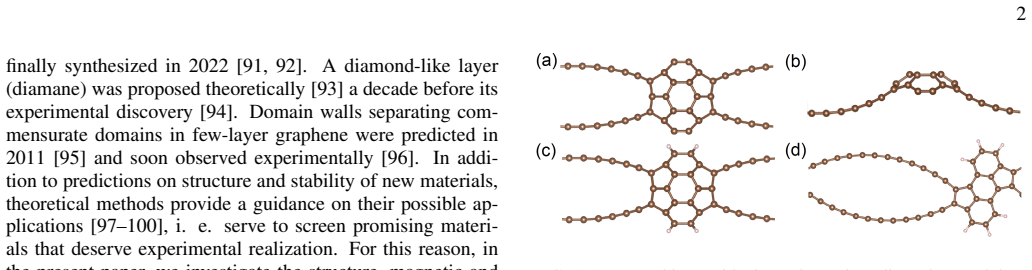
The load-bearing object is the repeating unit cell of the hybrid nanoobject: a polycyclic hydrocarbon region—either the fullerene-like F cap with no dangling bonds or the flat D1 region with dangling bonds—joined to a linear carbon chain of n atoms. The argument runs on two coupled mechanisms: the one-dimensional band filling of the chain, where even chains are polyyne-like with fully paired bands and odd chains are cumulene-like with half-filled bands and intrinsic magnetic moments, and the presence or absence of dangling-bond edge states in the polycyclic region, which can feed electrons and spins into the chain bands. The hybrid HSE exchange-correlation functional supplies the non-local exchange that stabilizes the magnetic solutions and opens the band gaps; the bond-length alternation amplitude $\delta$ along the chain serves as the structural readout of polyyne versus cumulene character.
What would settle it
A decisive test would be to fabricate a D1-12 nanoobject and measure its spin-resolved conductance or scanning tunneling spectra: the predicted magnetic-semiconductor behavior requires an indirect HSE gap of about 0.36 eV in the antiferromagnetic ground state and spin-split bands that become half-metallic when the Fermi level shifts by about 0.2 eV; absence of those features, or observation that the D1 edges reconstruct into F-like caps, would falsify the central claim.
Extended reading notes
Core claim
The central claim is that the electronic ground state of a 1D nanoobject formed by alternating a polycyclic carbon region with a double carbon chain is controlled by the parity of the chain and the edge chemistry of the polycyclic region. For the D1 polycyclic region, whose edges carry dangling bonds, even chains such as D1-12 are predicted to be magnetic semiconductors: the HSE band structure opens a gap of about 0.36 eV in the antiferromagnetic state and 0.30 eV in the ferromagnetic state, with spin-up and spin-down bands split so that shifting the Fermi level by about 0.2 eV, through doping or gating, could make the system metallic for one spin and semiconducting for the other. For odd chains such as F-11 and D1-11, the antiferromagnetic ground state is semiconducting while the ferromagnetic state is metallic or nearly so at the PBE level and has a much smaller gap at the HSE level, so switching the magnetic order should change conductance substantially. The paper also claims that the commonly used PBE functional misses the most interesting behavior: with HSE, even chains attached to the F region acquire magnetism with zero total magnetic moment, and magnetic ordering energies rise to roughly 0.7–1.8 eV per unit cell, indicating robust magnetic order.
Load-bearing premise
The whole prediction rests on the assumption that these alternating polycyclic/chain nanoobjects can actually be fabricated and stay intact: the proposed electron-irradiation route is supported only by molecular dynamics simulations, and the paper explicitly says such a process has not yet been realized experimentally.
Editorial extensions
If this is right
- D1-type nanoobjects with even chains are predicted to be magnetic semiconductors: shifting the Fermi level by doping or gating should produce half-metallic behavior, making them a potential source of spin-polarized currents.
- Odd-chain nanoobjects such as F-11 and D1-11 should show strong magnetoresistance because the antiferromagnetic ground state is semiconducting while the ferromagnetic state is metallic or narrow-gap, so switching magnetic order changes resistance substantially.
- Hydrogen termination of polycyclic edges suppresses the edge magnetization and moves flat bands away from the Fermi level, giving a chemical switch between magnetic and non-magnetic regimes.
- The PBE-only picture is insufficient: hybrid-functional calculations predict magnetism in even chains and F-region nanoobjects that PBE sees as non-magnetic, so earlier PBE-based screening of similar carbon hybrids may have missed the most interesting states.
- The predicted magnetic interaction energies are far larger than those estimated for zigzag graphene nanoribbons, which gives hope that the magnetic order in these nanoobjects could persist at room temperature.
Reading between the lines
- Beyond the paper, the parity-and-edge design rule could be transferred to other carbon backbones, such as chains of varying length or heteroatom-terminated polycyclic regions, to search for room-temperature spin filters without magnetic dopants.
- A natural next step is transport modeling: Landauer transmission across a nanoobject between metallic leads would quantify the magnetoresistance ratio of an odd-chain magnetic tunnel junction, which the present static band-structure calculation does not provide.
- The synthesis bottleneck is the real test: if electron irradiation of width-alternating graphene nanoribbons produces mainly the most stable F region rather than the kinetically favored D1 region, the promising even-chain D1 magnetic semiconductor may require an alternative fabrication route such as on-surface chemistry.
- The predicted zero-total-moment ferromagnetic state in F-even-chain nanoobjects is unusual; if realized, it could behave as a spin-polarized current source without net magnetization, which merits device-level modeling.
Editorial analysis
A structured set of objections, weighed in public.
Referee Report
Summary. This paper presents spin-polarized density functional theory calculations for one-dimensional periodic hybrid nanoobjects formed by alternating polycyclic hydrocarbon regions (labelled F and D1, with and without hydrogen termination) and double carbon chains of 10-13 atoms. The PBE functional is used for geometry optimization and initial electronic structure, and the HSE hybrid functional is used for refined band structures and magnetic-state energies. The main claims are: (i) with HSE, even-chain nanoobjects containing the F region develop magnetism with parallel spin alignment at opposite edges and zero total moment, opening a band gap of about 1.2 eV; (ii) odd-chain nanoobjects show large band-gap differences between AFM and FM states (e.g., 0.76 eV vs 0.19 eV for F-11), making them candidates for magnetic tunnel junctions; (iii) D1-region nanoobjects with dangling bonds and even chains have close-lying AFM and FM states, small indirect gaps, and spin-split bands that could, with doping or gating, yield spin-polarized currents; and (iv) the hybrid functional is essential for magnetism in even chains and for quantitative gaps. The structures are hypothetical but motivated by earlier molecular dynamics simulations of electron-irradiated graphene nanoribbons (reference [85]).
Significance. If the results are valid, this is a useful computational screen for a structurally tunable family of 1D carbon spintronic materials: chain parity and edge termination control the magnetic ground state and band gap, with falsifiable predictions such as the HSE-induced ~1.2 eV gap in F-even systems. The calculations are standard and internally consistent, the paper reports a data availability deposit, and the authors explicitly flag convergence problems where they occurred (e.g., the D1-12 HSE NM state). The main significance is as a theoretical prediction, not an experimental demonstration, and it rests on two assumptions that need to be clearly bounded: the realizability of the F/D1 nanoobjects, and the adequacy of PBE-relaxed nonmagnetic geometries for HSE magnetic states.
major comments (3)
- [Table I, footnote a; Sections II and III.B] The central claim that even-chain F-region nanoobjects (F-10, F-10H, F-12H) become magnetic semiconductors with ~1.2 eV gaps rests on HSE spin-polarized single-point calculations performed at PBE-relaxed, spin-restricted (NM) geometries, as stated in Table I, footnote a. This is not a neutral frozen-geometry approximation: Section III.B shows for F-11 that spin-polarized relaxation changes the structure qualitatively (perfectly parallel chains in the NM state become spatially separated chains). Because the HSE-induced magnetism is driven by exact-exchange admixture, which couples to the bond-length alternation along the chains, the PBE-NM geometry could substantially bias the magnetic stabilization energies (0.1-0.2 eV in Table II) and the 1.19-1.25 eV gaps. I request that the authors relax the even-chain FM states with spin polarization (at least at the PBE level, ideally with HSE) and recompute these quantities, or, if that is too costly, report the forces in the HSE FM state at the frozen geometry and estimate the geometry correction.
- [Table II and Section II (D1-12 rows)] The FM-AFM competition for D1-12 is resolved at the level of 17 meV per unit cell in PBE (ΔE_FM = -0.017 eV) and 3 meV in HSE (ΔE_FM = +0.003 eV), with no reported numerical uncertainty. With the computational settings in Section II (6-8 k-points along the chain, 0.07 eV Methfessel-Paxton smearing, geometry forces converged to 0.05 eV/Å, and a reported convergence failure for the D1-12 HSE NM state), a 17 meV difference is within plausible numerical noise. The qualitative near-degeneracy of FM and AFM is likely robust, but the sign of ΔE_FM should not be used to claim a specific ground state. Please provide convergence tests with respect to k-point sampling and smearing width for the energies in Table II, or state explicitly that only the near-degeneracy is established.
- [Abstract and Section IV] The statement that nanoobjects with dangling-bond polycyclic regions and even chains 'can generate spin-polarized currents' is an extrapolation from band structures. For D1-12, the HSE AFM and FM states have small gaps of 0.36 and 0.30 eV, and spin-split bands become half-metallic only after shifting the Fermi level by ~0.2 eV via doping or gating (Section III.C). No transport calculation, spin-polarized density of states at the Fermi level, or half-metallic band structure is presented. Please either soften the claim to 'may be tunable to a half-metallic state by doping or gating' or add a minimal transport estimate (e.g., constant-relaxation-time or Landauer-type) to justify the current-generation statement.
minor comments (7)
- [Throughout (e.g., Sections III.B and IV)] The word 'polycylic' appears in place of 'polycyclic' in several places (e.g., 'polycylic regions' in Sections III.B and IV); please correct the spelling throughout.
- [Section III.C] The notation 'F13-H' is used in the text while Table I and the rest of the paper use 'F-13H'; please unify the naming convention.
- [Table II] For D1-12 the HSE ΔE_NM is listed as 'NA' because of convergence problems; this should be acknowledged in the main text wherever relative NM energies are discussed, since D1-12 is one of the key systems.
- [Section II] The transverse supercell dimensions (vacuum gap) used to isolate the 1D nanoobjects are not reported; this information is needed to assess spurious periodic-image interactions, which are relevant for the meV-scale energy differences in Table II.
- [Section II and reference [125]] Reference [125] for Quantum ESPRESSO is incomplete and contains an unexplained phrase 'for BLAS technical forum'; please provide the full code reference or a proper URL.
- [Conclusions] The term 'FM' for the even-chain F-region states, which carry zero total magnetic moment, is defined in Section III.A but should be restated in the Conclusions so that readers do not interpret 'magnetic semiconductor' as implying a net ferromagnetic moment.
- [Figures 4 and 5] The PBE and HSE results are both shown as spin-resolved lines, but the figures do not contain a legend; please add a clear key for line styles and spin channels, especially in Fig. 5(e,f) where the two functionals are distinguished only by solid/dashed lines.
Circularity Check
No fitted parameters or post hoc exclusions: the band gaps and magnetic energies are direct DFT outputs, and the only notable self-citation is the prior proposal of the nanoobjects' existence, which is a premise rather than a derived result.
full rationale
The paper's central claims—magnetic semiconductor behavior in even-chain D1/F structures and large AFM/FM band-gap differences in odd chains—are obtained by solving the Kohn-Sham equations with PBE and HSE functionals; no parameter is fitted to the target quantities and no equation is defined in terms of the result it is said to predict. The main self-citation is to the authors' earlier work [85] for the proposal, MD formation pathway, and relative stability of the F and D1 polycyclic regions. This is load-bearing for the premise that the nanoobjects can exist, and it is acknowledged that the process 'has not been yet realized experimentally.' However, this is not a circular loop: the present property calculations do not feed back into the stability argument, and the paper supplements [85] with independent experimental observations of double carbon chains and pentagon-containing polyaromatic hydrocarbons. The HSE single-point magnetic results for F-10, F-10H and F-12H are computed at the PBE nonmagnetic geometry (Table I footnote a), and the paper's own F-11 example shows spin polarization can qualitatively change the geometry; this is a genuine robustness concern for the predicted 1.19–1.25 eV gaps, but it is a methodological limitation rather than an equivalence-by-construction. Consequently, no circular step meeting the quoted-evidence standard is present; the score of 2 reflects only the minor self-citation for the structural premise.
Assumptions & free parameters
assumptions (4)
- domain assumption DFT with PBE and HSE functionals gives reliable relative energies, magnetic moments, and band gaps for carbon nanostructures.
- domain assumption The unit cell containing one polycyclic region and one double chain is a valid representation of the infinite 1D nanoobject.
- domain assumption The F and D1 polycyclic regions are the relevant metastable structures formed under electron irradiation.
- ad hoc to paper PBE-optimized geometries are adequate for HSE electronic-structure and magnetic-state calculations.
invented entities (1)
-
1D hybrid nanoobjects consisting of alternating polycyclic hydrocarbon regions (F, D1) and double carbon chains
Cite this review
Pith. "Pith review of Magnetic and electronic properties of 1D hybrid nanoobjects composed of alternating polycyclic hydrocarbon regions and double carbon chains." pith.science (2026). https://pith.science/paper/QN2IJWXL
@misc{pith2026241210015,
  author       = {Pith},
  title        = {Pith review of: Magnetic and electronic properties of 1D hybrid nanoobjects composed of alternating polycyclic hydrocarbon regions and double carbon chains},
  year         = {2026},
  howpublished = {\url{https://pith.science/paper/QN2IJWXL}},
  note         = {Machine review of arXiv:2412.10015}
}
read the original abstract
It has been proposed recently that 1D hybrid nanoobjects consisting of alternating double carbon chains and polycyclic carbon regions can be obtained from graphene nanoribbons of alternating width by electron irradiation. Here, based on density functional theory calculations, we show that magnetic and electronic properties of such nanoobjects can be changed dramatically by modifying the chain length and edge structure of polycyclic regions and this opens wide possibilities for spintronic applications. Nanoobjects composed of polycyclic regions with dangling bonds and even chains are found to behave as magnetic semiconductors that can generate spin-polarized currents. Band gaps of nanoobjects with odd chains change considerably upon switching between magnetic states making them promising for magnetic tunnel junctions. We also demonstrate that use of a hybrid exchange-correlation functional is important to properly describe stability of magnetic states, band gaps and synergistic effects of nanoobject components leading, for example, to magnetism in even chains.
Figures


Figures from the paper (3 more)


Reference graph
Works this paper leans on
-
[85]
A. S. Sinitsa, I. V . Lebedeva, Y . G. Polynskaya, D. G. de Oteyza, S. V . Ratkevich, A. A. Knizhnik, A. M. Popov, N. A. Poklonski, Y . E. Lozovik, Transformation of a graphene nanoribbon into a hybrid 1D nanoobject with alternating dou- ble chains and polycyclic regions, Phys. Chem. Chem. Phys. 23 (2021) 425–441. doi:https://doi.org/10.1039/ D0CP04090H
2021
-
[1]
A. K. Geim, K. S. Novoselov, The rise of graphene, Word Scientific: Singapore, 2009, pp. 11–19. doi:https://doi. org/10.1142/9789814287005_0002
-
[2]
A. K. Geim, Graphene: Status and prospects, Science 324 (2009) 1530–1534. doi:https://doi.org/10.1126/ science.1158877
2009
-
[3]
Sato, Graphene for nanoelectronics, Japanese Journal of Applied Physics 54 (2015) 040102
S. Sato, Graphene for nanoelectronics, Japanese Journal of Applied Physics 54 (2015) 040102. doi:https://doi.org/ 10.7567/JJAP.54.040102
-
[4]
R. M. Westervelt, Graphene nanoelectronics, Science 320 (2008) 324–325. doi:https://doi.org/10.1126/ science.1156936. 11
2008
-
[5]
Banhart, J
F. Banhart, J. Kotakoski, A. V . Krasheninnikov, Structural de- fects in graphene, ACS Nano 5 (2011) 26–41. doi:10.1021/ nn102598m
2011
-
[6]
H. Terrones, R. Lv, M. Terrones, M. S. Dresselhaus, The role of defects and doping in 2D graphene sheets and 1D nanorib- bons, Rep. Prog. Phys. 75 (2012) 062501. doi:https:// doi.org/10.1088/0034-4885/75/6/062501
-
[7]
S. T. Skowron, I. V . Lebedeva, A. M. Popov, E. Bichoutskaia, Energetics of atomic scale structure changes in graphene, Chem. Soc. Rev. 44 (2015) 3143–3176. doi:https://doi. org/10.1039/C4CS00499J
Show all 147 references
-
[8]
M. D. Bhatt, H. Kim, G. Kim, Various defects in graphene: a review, RSC Adv. 12 (2022) 21520–21547. doi:https: //doi.org/10.1039/D2RA01436J
2022 doi
-
[9]
M. Y . Han, B. ¨Ozyilmaz, Y . Zhang, P. Kim, Energy band-gap engineering of graphene nanoribbons, Phys. Rev. Lett. 98 (2007) 206805. doi:https://doi.org/10.1103/ PhysRevLett.98.206805
2007
-
[10]
K. A. Ritter, J. W. Lyding, The influence of edge struc- ture on the electronic properties of graphene quantum dots and nanoribbons, Nature Materials 8 (2009) 235–242. doi: https://doi.org/10.1038/nmat2378
2009 doi
-
[11]
Y .-W. Son, M. L. Cohen, S. G. Louie, Energy gaps in graphene nanoribbons, Phys. Rev. Lett. 97 (2006) 216803.doi:https: //doi.org/10.1103/PhysRevLett.97.216803
2006 doi
-
[12]
Fujita, K
M. Fujita, K. Wakabayashi, K. Nakada, K. Kusakabe, Pecu- liar localized state at zigzag graphite edge, J. Phys. Soc. Jpn. 65 (1996) 1920–1923. doi:https://doi.org/10.1143/ JPSJ.65.1920
1996
-
[13]
Kobayashi, K.-i
Y . Kobayashi, K.-i. Fukui, T. Enoki, K. Kusakabe, Y . Kaburagi, Observation of zigzag and armchair edges of graphite using scanning tunneling microscopy and spec- troscopy, Phys. Rev. B 71 (2005) 193406. doi:https:// doi.org/10.1103/PhysRevB.71.193406
2005 doi
-
[14]
Niimi, T
Y . Niimi, T. Matsui, H. Kambara, K. Tagami, M. Tsukada, H. Fukuyama, Scanning tunneling microscopy and spec- troscopy of the electronic local density of states of graphite surfaces near monoatomic step edges, Phys. Rev. B 73 (2006) 085421. doi:https://doi.org/10.1103/PhysRevB...
2006 doi
-
[15]
C. Tao, L. Jiao, O. V . Yazyev, Y .-C. Chen, J. Feng, X. Zhang, R. B. Capaz, J. M. Tour, A. Zettl, S. G. Louie, H. Dai, M. F. Crommie, Spatially resolving edge states of chiral graphene nanoribbons, Nature Physics 7 (2011) 616–620. doi:https: //doi.org/10.1038/nphys1991
2011 doi
-
[17]
J. Li, Z. Li, G. Zhou, Z. Liu, J. Wu, B.-L. Gu, J. Ihm, W. Duan, Spontaneous edge-defect formation and defect-induced con- ductance suppression in graphene nanoribbons, Phys. Rev. B 82 (2010) 115410. doi:https://doi.org/10.1103/ PhysRevB.82.115410
2010
-
[18]
Gunlycke, J
D. Gunlycke, J. Li, J. W. Mintmire, C. T. White, Altering low- bias transport in zigzag-edge graphene nanostrips with edge chemistry, Appl. Phys. Lett. 91 (2007) 112108. doi:https: //doi.org/10.1063/1.2783196
2007 doi
-
[19]
Bhandary, O
S. Bhandary, O. Eriksson, B. Sanyal, M. I. Katsnelson, Com- plex edge e ffects in zigzag graphene nanoribbons due to hy- drogen loading, Phys. Rev. B 82 (2010) 165405. doi:https: //doi.org/10.1103/PhysRevB.82.165405
2010 doi
-
[20]
G. Lee, K. Cho, Electronic structures of zigzag graphene nanoribbons with edge hydrogenation and oxidation, Phys. Rev. B 79 (2009) 165440. doi:https://doi.org/10. 1103/PhysRevB.79.165440
2009
-
[21]
Kunstmann, C
J. Kunstmann, C. ¨Ozdo˘gan, A. Quandt, H. Fehske, Stability of edge states and edge magnetism in graphene nanoribbons, Phys. Rev. B 83 (2011) 045414.doi:https://doi.org/10. 1103/PhysRevB.83.045414
2011
-
[22]
Nakada, M
K. Nakada, M. Fujita, G. Dresselhaus, M. S. Dresselhaus, Edge state in graphene ribbons: Nanometer size e ffect and edge shape dependence, Phys. Rev. B 54 (1996) 17954–17961. doi:https://doi.org/10.1103/PhysRevB.54.17954
1996 doi
-
[23]
I. V . Lebedeva, A. M. Popov, A. A. Knizhnik, A. N. Khlobystov, B. V . Potapkin, Chiral graphene nanoribbon inside a carbon nanotube: ab initio study, Nanoscale 4 (2012) 4522–4529. doi:https://doi.org/10.1039/ C2NR30144J
2012
-
[24]
Cantele, Y .-S
G. Cantele, Y .-S. Lee, D. Ninno, N. Marzari, Spin channels in functionalized graphene nanoribbons, Nano Letters 9 (2009) 3425–3429. doi:https://doi.org/10.1021/nl901557x
2009 doi
-
[25]
Y .-W. Son, M. L. Cohen, S. G. Louie, Half-metallic graphene nanoribbons, Nature 444 (2006) 347–349. doi:https:// doi.org/10.1038/nature05180
2006 doi
-
[26]
O. Hod, V . Barone, J. E. Peralta, G. E. Scuseria, Enhanced half-metallicity in edge-oxidized zigzag graphene nanorib- bons, Nano Letters 7 (2007) 2295–2299. doi:https://doi. org/10.1021/nl0708922
2007 doi
-
[27]
A. P. Seitsonen, A. M. Saitta, T. Wassmann, M. Lazzeri, F. Mauri, Structure and stability of graphene nanoribbons in oxygen, carbon dioxide, water, and ammonia, Phys. Rev. B 82 (2010) 115425. doi:https://doi.org/10.1103/ PhysRevB.82.115425
2010
-
[28]
G. Z. Magda, X. Jin, I. Hagym ´asi, P. Vancs ´o, Z. Osv ´ath, P. Nemes-Incze, C. Hwang, L. P. Bir ´o, L. Tapaszt ´o, Room- temperature magnetic order on zigzag edges of narrow graphene nanoribbons, Nature 514 (2014) 608–611. doi: https://doi.org/10.1038/nature13831
2014 doi
-
[29]
Y . C. Cheng, Z. Y . Zhu, U. Schwingenschl ¨ogl, Mechan- ical failure of zigzag graphene nanoribbons under tensile strain induced by edge reconstruction, J. Mater. Chem. 22 (2012) 24676–24680. doi:https://doi.org/10.1039/ C2JM34068B
2012
-
[30]
Y . C. Cheng, H. T. Wang, Z. Y . Zhu, Y . H. Zhu, Y . Han, X. X. Zhang, U. Schwingenschl ¨ogl, Strain-activated edge re- construction of graphene nanoribbons, Phys. Rev. B 85 (2012) 073406. doi:https://doi.org/10.1103/PhysRevB.85. 073406
2012 doi
-
[31]
C. K. Gan, D. J. Srolovitz, First-principles study of graphene edge properties and flake shapes, Phys. Rev. B 81 (2010) 125445. doi:https://doi.org/10.1103/PhysRevB.81. 125445
2010 doi
-
[32]
L. L. Song, X. H. Zheng, R. L. Wang, Z. Zeng, Dangling bond states, edge magnetism, and edge reconstruction in pristine and B/N-terminated zigzag graphene nanoribbons, J. Phys. Chem. C 114 (2010) 12145–12150. doi:https://doi.org/10. 1021/jp1040025
2010
-
[33]
S. Wang, L. Talirz, C. A. Pignedoli, X. Feng, K. M ¨ullen, R. Fasel, P. Ru ffieux, Giant edge state splitting at atom- ically precise graphene zigzag edges, Nature Communica- tions 7 (2016) 11507. doi:https://doi.org/10.1038/ ncomms11507
2016
-
[34]
Brede, N
J. Brede, N. Merino-D ´ıez, A. Berdonces-Layunta, S. Sanz, A. Dom ´ınguez-Celorrio, J. Lobo-Checa, M. Vilas-Varela, D. Pe˜na, T. Frederiksen, J. I. Pascual, D. G. de Oteyza, D. Ser- rate, Detecting the spin-polarization of edge states in graphene nanoribbons, Nature Communicat...
2023 doi
-
[35]
J. J. Palacios, J. Fern´andez-Rossier, L. Brey, H. A. Fertig, Elec- tronic and magnetic structure of graphene nanoribbons, Semi- conductor Science and Technology 25 (2010) 033003. doi: https://doi.org/10.1088/0268-1242/25/3/033003
2010 doi
-
[36]
Zhang, V oltage-driven spintronic logic gates in graphene nanoribbons, Scientific Reports 4 (2014) 6320
W. Zhang, V oltage-driven spintronic logic gates in graphene nanoribbons, Scientific Reports 4 (2014) 6320. doi:https: //doi.org/10.1038/srep06320
2014 doi
-
[37]
M. Zeng, L. Shen, M. Zhou, C. Zhang, Y . Feng, Graphene- based bipolar spin diode and spin transistor: Rectification and amplification of spin-polarized current, Phys. Rev. B 83 (2011) 115427. doi:https://doi.org/10.1103/PhysRevB.83. 115427
2011 doi
-
[38]
Zhang, J
L. Zhang, J. Zhou, H. Li, L. Shen, Y . P. Feng, Recent progress and challenges in magnetic tunnel junctions with 2D materials for spintronic applications, Appl. Phys. Rev. 8 (2021) 021308. doi:https://doi.org/10.1063/5.0032538
2021 doi
-
[39]
D. Kang, B. Wang, C. Xia, H. Li, Perfect spin filter in a tailored zigzag graphene nanoribbon, Nanoscale Research Letters 12 (2017) 357. doi:https://doi.org/10.1186/ s11671-017-2132-7
2017
-
[40]
M. R. Rezapour, G. Lee, K. S. Kim, A high performance N- doped graphene nanoribbon based spintronic device applicable with a wide range of adatoms, Nanoscale Adv. 2 (2020) 5905–
2020
-
[41]
W. Han, R. K. Kawakami, M. Gmitra, J. Fabian, Graphene spintronics, Nature Nanotechnology 9 (2014) 794–807. doi: https://doi.org/10.1038/nnano.2014.214
2014 doi
-
[43]
O. V . Yazyev, M. I. Katsnelson, Magnetic correlations at graphene edges: Basis for novel spintronics devices, Phys. Rev. Lett. 100 (2008) 047209. doi:https://doi.org/10. 1103/PhysRevLett.100.047209
2008
-
[44]
O. V . Yazyev, Emergence of magnetism in graphene materials and nanostructures, Rep. Prog. Phys. 73 (2010) 056501. doi: https://doi.org/10.1088/0034-4885/73/5/056501
2010 doi
-
[45]
Mu ˜noz-Rojas, J
F. Mu ˜noz-Rojas, J. Fern ´andez-Rossier, J. J. Palacios, Giant magnetoresistance in ultrasmall graphene based devices, Phys. Rev. Lett. 102 (2009) 136810. doi:https://doi.org/10. 1103/PhysRevLett.102.136810
2009
-
[46]
W. Y . Kim, K. S. Kim, Prediction of very large values of mag- netoresistance in a graphene nanoribbon device, Nature Nan- otechnology 3 (2008) 408–412. doi:https://doi.org/10. 1038/nnano.2008.163
2008
-
[47]
Zhang, S.-H
D.-B. Zhang, S.-H. Wei, Inhomogeneous strain-induced half- metallicity in bent zigzag graphene nanoribbons, npj Compu- tational Materials 3 (2017) 32. doi:https://doi.org/10. 1038/s41524-017-0036-9
2017
-
[48]
Soriano, F
D. Soriano, F. Mu ˜noz Rojas, J. Fern ´andez-Rossier, J. J. Pala- cios, Hydrogenated graphene nanoribbons for spintronics, Phys. Rev. B 81 (2010) 165409. doi:https://doi.org/ 10.1103/PhysRevB.81.165409
2010 doi
-
[49]
Ravagnan, N
L. Ravagnan, N. Manini, E. Cinquanta, G. Onida, D. San- galli, C. Motta, M. Devetta, A. Bordoni, P. Piseri, P. Milani, Effect of axial torsion on sp carbon atomic wires, Phys. Rev. Lett. 102 (2009) 245502. doi:https://doi.org/10.1103/ PhysRevLett.102.245502
2009
-
[50]
N. A. Poklonski, A. T. Vlassov, S. A. Vyrko, E. F. Kislyakov, S. V . Ratkevich, A. I. Siahlo, Induction: Soliton-like motion of one electron in one-dimensional wire with inductance of environment, Word Scientific, 2013, pp. 36–39. doi:https: //doi.org/10.1142/9789814460187_0007
2013 doi
-
[51]
Zanolli, G
Z. Zanolli, G. Onida, J.-C. Charlier, Quantum spin transport in carbon chains, ACS Nano 4 (2010) 5174–5180. doi:https: //doi.org/10.1021/nn100712q
2010 doi
-
[52]
M. Liu, V . I. Artyukhov, H. Lee, F. Xu, B. I. Yakobson, Car- byne from first principles: Chain of C atoms, a nanorod or a nanorope, ACS Nano 7 (2013) 10075–10082. doi:https: //doi.org/10.1021/nn404177r
2013 doi
-
[53]
V . I. Artyukhov, M. Liu, B. I. Yakobson, Mechanically induced metal–insulator transition in carbyne, Nano Letters 14 (2014) 4224–4229. doi:https://doi.org/10.1021/nl5017317
2014 doi
-
[54]
La Torre, A
A. La Torre, A. Botello-Mendez, W. Baaziz, J.-C. Char- lier, F. Banhart, Strain-induced metal–semiconductor transi- tion observed in atomic carbon chains, Nature Communi- cations 6 (2015) 6636. doi:https://doi.org/10.1038/ ncomms7636
2015
-
[55]
B ¨orrnert, C
F. B ¨orrnert, C. B ¨orrnert, S. Gorantla, X. Liu, A. Bach- matiuk, J.-O. Joswig, F. R. Wagner, F. Sch¨affel, J. H. Warner, R. Sch ¨onfelder, B. Rellinghaus, T. Gemming, J. Thomas, M. Knupfer, B. B¨uchner, M. H. R¨ummeli, Single-wall-carbon- nanotube/single-carbon-chain molecu...
2010
-
[56]
Crljen, G
ˇZ. Crljen, G. Baranovi ´c, Unusual conductance of polyyne- based molecular wires, Phys. Rev. Lett. 98 (2007) 116801. doi:https://doi.org/10.1103/PhysRevLett.98. 116801
2007 doi
-
[57]
N. D. Lang, P. Avouris, Oscillatory conductance of carbon- atom wires, Phys. Rev. Lett. 81 (1998) 3515–3518. doi: https://doi.org/10.1103/PhysRevLett.81.3515
1998 doi
-
[58]
M. G. Zeng, L. Shen, Y . Q. Cai, Z. D. Sha, Y . P. Feng, Perfect spin-filter and spin-valve in carbon atomic chains, Appl. Phys. Lett. 96 (2010) 042104. doi:https://doi.org/10.1063/ 1.3299264
2010
-
[59]
Y . Zhou, Y . Li, J. Li, J. Dong, H. Li, Electronic transport properties of carbon and boron nitride chain heterojunctions, J. Mater. Chem. C 5 (2017) 1165–1178. doi:https://doi. org/10.1039/C6TC04936B
2017 doi
-
[60]
Liang, X
Z. Liang, X. Xu, Y . Jiang, W. Li, Q. Wang, G. Zhang, W. Q. Tian, Y . Jiang, The influence of coupling between chains on the conductivity of atomic carbon chains, Phys. Lett. A 383 (20) (2019) 2409–2415. doi:https://doi.org/10.1016/j. physleta.2019.04.053
2019 doi
-
[61]
Cretu, A
O. Cretu, A. R. Botello-Mendez, I. Janowska, C. Pham-Huu, J.-C. Charlier, F. Banhart, Electrical transport measured in atomic carbon chains, Nano Letters 13 (2013) 3487–3493. doi:https://doi.org/10.1021/nl4018918
2013 doi
-
[62]
W. Chen, A. V . Andreev, G. F. Bertsch, Conductance of a single-atom carbon chain with graphene leads, Phys. Rev. B 80 (2009) 085410. doi:https://doi.org/10.1103/ PhysRevB.80.085410
2009
-
[63]
X. Liu, G. Zhang, Y .-W. Zhang, Tunable mechanical and thermal properties of one-dimensional carbyne chain: Phase transition and microscopic dynamics, J. Phys. Chem. C 119 (2015) 24156–24164. doi:https://doi.org/10.1021/ acs.jpcc.5b08026
2015
-
[64]
Cahangirov, M
S. Cahangirov, M. Topsakal, S. Ciraci, Long-range interactions in carbon atomic chains, Phys. Rev. B 82 (2010) 195444.doi: https://doi.org/10.1103/PhysRevB.82.195444
2010 doi
-
[65]
N. A. Poklonski, S. A. Vyrko, A. I. Siahlo, O. N. Poklon- skaya, S. V . Ratkevich, N. N. Hieu, A. A. Kocherzhenko, Syn- ergy of physical properties of low-dimensional carbon-based systems for nanoscale device design, Materials Research Ex- press 6 (2019) 042002. doi:https://do...
2019
-
[66]
K. Xia, H. Zhan, Y . Gu, Graphene and carbon nanotube hybrid structure: A review, Procedia IUTAM 21 (2017) 94–101, 2016 IUTAM Symposium on Nanoscale Physical Mechanics. doi: https://doi.org/10.1016/j.piutam.2017.03.042
2017 doi
-
[67]
V . T. Dang, D. D. Nguyen, T. T. Cao, P. H. Le, D. L. Tran, N. M. Phan, V . C. Nguyen, Recent trends in preparation and application of carbon nanotube–graphene hybrid thin films, Adv. Nat. Sci: Nanosci. Nanotechnol. 7 (2016) 033002. doi: https://doi.org/10.1088/2043-6262/7/3/033002
2016 doi
-
[68]
B. P. Vinayan, R. Nagar, V . Raman, N. Rajalakshmi, K. S. Dhathathreyan, S. Ramaprabhu, Synthesis of graphene- multiwalled carbon nanotubes hybrid nanostructure by strengthened electrostatic interaction and its lithium ion bat- tery application, J. Mater. Chem. 22 (2012) 9949–...
2012 doi
-
[69]
Laurila, S
T. Laurila, S. Sainio, M. A. Caro, Hybrid carbon based nanomaterials for electrochemical detection of biomolecules, Progress in Materials Science 88 (2017) 499–594. doi: https://doi.org/10.1016/j.pmatsci.2017.04.012
2017 doi
-
[70]
A. G. Navrotskaya, D. D. Aleksandrova, E. F. Krivoshapkina, M. Sillanp ¨a¨a, P. V . Krivoshapkin, Hybrid materials based on carbon nanotubes and nanofibers for environmental applica- tions, Frontiers in Chemistry 8 (2020). doi:https://doi. org/10.3389/fchem.2020.00546
2020
-
[71]
R. H. Baughman, H. Eckhardt, M. Kertesz, Structure-property predictions for new planar forms of carbon: Layered phases containing sp2 and sp atoms, J. Chem. Phys. 87 (1987) 6687–
1987
-
[72]
C. S. Casari, M. Tommasini, R. R. Tykwinski, A. Milani, Carbon-atom wires: 1-D systems with tunable properties, Nanoscale 8 (2016) 4414–4435. doi:10.1039/C5NR06175J. URL http://dx.doi.org/10.1039/C5NR06175J
2016 doi
-
[73]
Srinivasu, S
K. Srinivasu, S. K. Ghosh, Graphyne and graphdiyne: Promis- ing materials for nanoelectronics and energy storage applica- tions, J. Phys. Chem. C 116 (2012) 5951–5956. doi:https: //doi.org/10.1021/jp212181h
2012 doi
-
[74]
Ivanovskii, Graphynes and graphdyines, Progress in Solid State Chemistry 41 (2013) 1–19
A. Ivanovskii, Graphynes and graphdyines, Progress in Solid State Chemistry 41 (2013) 1–19. doi:https://doi.org/ 10.1016/j.progsolidstchem.2012.12.001
2013 doi
-
[75]
Y . Li, L. Xu, H. Liu, Y . Li, Graphdiyne and graphyne: from theoretical predictions to practical construction, Chem. Soc. Rev. 43 (2014) 2572–2586. doi:http://dx.doi.org/10. 1039/C3CS60388A
2014
-
[76]
B. Song, G. F. Schneider, Q. Xu, G. Pandraud, C. Dekker, H. Zandbergen, Atomic-scale electron-beam sculpting of near- defect-free graphene nanostructures, Nano Letters 11 (2011) 2247–2250. doi:https://doi.org/10.1021/nl200369r
2011 doi
-
[77]
A. S. Sinitsa, Y . G. Polynskaya, I. V . Lebedeva, A. A. Knizh- nik, A. M. Popov, Precise graphene cutting using a catalyst at a probe tip under an electron beam, Phys. Chem. Chem. Phys. 25 (2023) 20715–20727. doi:https://doi.org/10.1039/ D3CP00361B
2023
-
[78]
N. A. Matsokin, A. S. Sinitsa, Y . G. Polynskaya, I. V . Lebe- deva, A. A. Knizhnik, A. M. Popov, Formation of carbon propeller-like molecules from starphenes under electron irra- diation, Phys. Chem. Chem. Phys. 25 (2023) 27027–27033. doi:https://doi.org/10.1039/D3CP03611A
2023 doi
-
[79]
Chuvilin, J
A. Chuvilin, J. C. Meyer, G. Algara-Siller, U. Kaiser, From graphene constrictions to single carbon chains, New J. Phys. 11 (2009) 083019. doi:https://doi.org/10.1088/ 1367-2630/11/8/083019
2009
-
[80]
Chuvilin, U
A. Chuvilin, U. Kaiser, E. Bichoutskaia, N. A. Besley, A. N. Khlobystov, Direct transformation of graphene to fullerene, Nature Chemistry 2 (2010) 450–453. doi:https://doi. org/10.1038/nchem.644
2010 doi
-
[81]
Sloan, R
J. Sloan, R. E. Dunin-Borkowski, J. L. Hutchison, K. S. Cole- man, V . Clifford Williams, J. B. Claridge, A. P. E. York, C. Xu, S. R. Bailey, G. Brown, S. Friedrichs, M. L. H. Green, The size distribution, imaging and obstructing properties of C60 and higher fullerenes formed ...
2000 doi
-
[82]
A. S. Sinitsa, I. V . Lebedeva, A. M. Popov, A. A. Knizh- nik, Long triple carbon chains formation by heat treatment of graphene nanoribbon: Molecular dynamics study with revised Brenner potential, Carbon 140 (2018) 543–556. doi:https: //doi.org/10.1016/j.carbon.2018.08.022
2018 doi
-
[83]
A. S. Sinitsa, T. W. Chamberlain, T. Zoberbier, I. V . Lebedeva, A. M. Popov, A. A. Knizhnik, R. L. McSweeney, J. Bisku- pek, U. Kaiser, A. N. Khlobystov, Formation of nickel clusters wrapped in carbon cages: Toward new endohedral metallo- fullerene synthesis, Nano Letters 17 ...
2017 doi
-
[84]
C. Jin, H. Lan, L. Peng, K. Suenaga, S. Iijima, Deriving car- bon atomic chains from graphene, Phys. Rev. Lett. 102 (2009) 205501. doi:https://doi.org10.1103/PhysRevLett. 102.205501
2009
-
[86]
Tanuma, P
Y . Tanuma, P. Dunk, T. Maekawa, C. P. Ewels, Chain for- mation during hydrogen loss and reconstruction in carbon nanobelts, Nanomaterials 12 (2022) 2073. doi:https:// doi.org/10.3390/nano12122073
2022 doi
-
[87]
J. Cai, P. Ru ffieux, R. Jaafar, M. Bieri, T. Braun, S. Blanken- burg, M. Muoth, A. P. Seitsonen, M. Saleh, X. Feng, K. M ¨ullen, R. Fasel, Atomically precise bottom-up fabrica- tion of graphene nanoribbons, Nature 466 (2010) 470–473. doi:https://doi.org/10.1038/nature09211
2010 doi
-
[88]
X. Zhou, G. Yu, Modified engineering of graphene nanorib- bons prepared via on-surface synthesis, Advanced Materi- als 32 (2020) 1905957. doi:https://doi.org/10.1002/ adma.201905957
2020
-
[89]
Lieske, M
L.-A. Lieske, M. Commodo, J. W. Martin, K. Kaiser, V . Benekou, P. Minutolo, A. D’Anna, L. Gross, Portraits of soot molecules reveal pathways to large aromatics, five- /seven-membered rings, and inception through π-radical lo- calization, ACS Nano 17 (2023) 13563–13574. doi:ht...
2023 doi
-
[90]
J. W. Martin, K. Bowal, A. Menon, R. I. Slavchov, J. Akroyd, S. Mosbach, M. Kraft, Polar curved polycyclic aromatic hy- drocarbons in soot formation, Proceedings of the Combustion Institute 37 (2019) 1117–1123. doi:https://doi.org/10. 1016/j.proci.2018.05.046
2019
-
[91]
V . G. Desyatkin, W. B. Martin, A. E. Aliev, N. E. Chap- man, A. F. Fonseca, D. S. Galv ˜ao, E. R. Miller, K. H. Stone, Z. Wang, D. Zakhidov, F. T. Limpoco, S. R. Almahdali, S. M. Parker, R. H. Baughman, V . O. Rodionov, Scalable synthe- sis and characterization of multilayerγ...
2022 doi
-
[92]
S. He, B. Wu, Z. Xia, P. Guo, Y . Li, S. Song, One-pot syn- thesis of gamma-graphyne supported Pd nanoparticles with high catalytic activity, Nanoscale Adv. 5 (2023) 2487–2492. doi:https://doi.org/10.1039/D3NA00096F. 14
2023 doi
-
[93]
L. A. Chernozatonskii, P. B. Sorokin, A. G. Kvashnin, D. G. Kvashnin, Diamond-like C2H nanolayer, diamane: Simulation of the structure and properties, JETP Letters 90 (2009) 134–138. doi:https://doi.org/10.1134/ S0021364009140112
2009
-
[94]
P. V . Bakharev, M. Huang, M. Saxena, S. W. Lee, S. H. Joo, S. O. Park, J. Dong, D. C. Camacho-Mojica, S. Jin, Y . Kwon, M. Biswal, F. Ding, S. K. Kwak, Z. Lee, R. S. Ruoff, Chemically induced transformation of chemical vapour depo- sition grown bilayer graphene into fluorinat...
2020 doi
-
[95]
A. M. Popov, I. V . Lebedeva, A. A. Knizhnik, Y . E. Lozovik, B. V . Potapkin, Commensurate-incommensurate phase tran- sition in bilayer graphene, Phys. Rev. B 84 (2011) 045404. doi:https://doi.org/10.1103/PhysRevB.84.045404
2011 doi
-
[96]
J. S. Alden, A. W. Tsen, P. Y . Huang, R. Hovden, L. Brown, J. Park, D. A. Muller, P. L. McEuen, Strain solitons and topo- logical defects in bilayer graphene, Proceedings of the Na- tional Academy of Sciences 110 (2013) 11256–11260. doi: https://doi.org/10.1073/pnas.1309394110
2013 doi
-
[97]
Z. Li, J. Han, S. Cao, Z. Zhang, X. Deng, Physical properties of monolayer Mn(BiTeS) 2 and its applications in sub–3 nm spintronic devices, Phys. Rev. B 108 (2023) 184413. doi: https://doi.org/10.1103/PhysRevB.108.184413
2023 doi
-
[98]
F. H. Davies, C. J. Price, N. T. Taylor, S. G. Davies, S. P. Hep- plestone, Band alignment of transition metal dichalcogenide heterostructures, Phys. Rev. B 103 (2021) 045417. doi: https://doi.org/10.1103/PhysRevB.103.045417
2021 doi
-
[99]
Gopalan, M
S. Gopalan, M. L. Van de Put, G. Gaddemane, M. V . Fischetti, Theoretical study of electronic transport in two-dimensional transition metal dichalcogenides: E ffects of the dielectric en- vironment, Phys. Rev. Appl. 18 (2022) 054062. doi:https: //doi.org/10.1103/PhysRevApplied...
2022 doi
-
[100]
A. C. Dias, H. Braganc ¸a, J. P. A. de Mendonc ¸a, J. L. F. Da Silva, Excitonic e ffects on two-dimensional transition- metal dichalcogenide monolayers: Impact on solar cell e ffi- ciency, ACS Applied Energy Materials 4 (2021) 3265–3278. doi:https://doi.org/10.1021/acsaem.0c03039
2021 doi
-
[101]
I. V . Lebedeva, A. A. Knizhnik, A. A. Bagatur’yants, B. V . Potapkin, Kinetics of 2D–3D transformations of carbon nanos- tructures, Physica E: Low-dimensional Systems and Nanos- tructures 40 (2008) 2589–2595. doi:https://doi.org/10. 1016/j.physe.2007.09.155
2008
-
[102]
S. T. Skowron, I. V . Lebedeva, A. M. Popov, E. Bichoutskaia, Approaches to modelling irradiation-induced processes in transmission electron microscopy, Nanoscale 5 (2013) 6677–
2013
-
[103]
K. He, A. W. Robertson, Y . Fan, C. S. Allen, Y .-C. Lin, K. Suenaga, A. I. Kirkland, J. H. Warner, Temperature de- pendence of the reconstruction of zigzag edges in graphene, ACS Nano 9 (2015) 4786–4795. doi:https://doi.org/ 10.1021/acsnano.5b01130
2015 doi
-
[104]
Y . G. Polynskaya, I. V . Lebedeva, A. A. Knizhnik, A. M. Popov, Optimal model of semi-infinite graphene for ab ini- tio calculations of reactions at graphene edges by the example of zigzag edge reconstruction, Computational and Theoreti- cal Chemistry 1214 (2022) 113755.doi:h...
2022
-
[105]
Y . G. Polynskaya, I. V . Lebedeva, A. A. Knizhnik, A. M. Popov, Reconstruction of zigzag graphene edges: Energet- ics, kinetics, and residual defects, J. Phys. Chem. Lett. 13 (2022) 10326–10330. doi:https://doi.org/10.1021/ acs.jpclett.2c02706
2022
-
[106]
Wassmann, A
T. Wassmann, A. P. Seitsonen, A. M. Saitta, M. Lazzeri, F. Mauri, Structure, stability, edge states, and aromaticity of graphene ribbons, Phys. Rev. Lett. 101 (2008) 096402. doi: https://doi.org/10.1103/PhysRevLett.101.096402
2008 doi
-
[107]
Tommasini, A
M. Tommasini, A. Milani, D. Fazzi, A. Lucotti, C. Cas- tiglioni, J. A. Januszewski, D. Wendinger, R. R. Tykwin- ski, π-conjugation and end group e ffects in long cumulenes: Raman spectroscopy and DFT calculations, J. Phys. Chem. C 118 (2014) 26415–26425. doi:https://doi.org/10...
2014
-
[108]
X. Gu, R. I. Kaiser, A. M. Mebel, Chemistry of energetically activated cumulenes – from allene (H 2CCCH2) to hexapen- taene (H 2CCCCCCH2), Chem. Phys. Chem. 9 (2008) 350–
2008
-
[109]
S. Hino, Y . Okada, K. Iwasaki, M. Kijima, H. Shirakawa, Elec- tronic structures of cumulene type carbyne model compounds: a typical example of one-dimensional quantum well, Chem. Phys. Lett. 372 (2003) 59–65. doi:https://doi.org/10. 1016/S0009-2614(03)00360-9
2003
-
[110]
Eisler, A
S. Eisler, A. D. Slepkov, E. Elliott, T. Luu, R. McDonald, F. A. Hegmann, R. R. Tykwinski, Polyynes as a model for carbyne: synthesis, physical properties, and nonlinear optical response, J. Am. Chem. Soc. 127 (2005) 2666–2676. doi:https:// doi.org/10.1021/ja044526l
2005 doi
-
[111]
Y . Gao, R. R. Tykwinski, Advances in polyynes to model car- byne, Acc. Chem. Res. 55 (2022) 3616–3630. doi:https: //doi.org/10.1021/acs.accounts.2c00662
2022 doi
-
[112]
N. R. Agarwal, A. Lucotti, M. Tommasini, W. A. Chalifoux, R. R. Tykwinski, Nonlinear optical properties of polyynes: An experimental prediction for carbyne, J. Phys. Chem. C 120 (2016) 11131–11139. doi:https://doi.org/10.1021/ acs.jpcc.6b03071
2016
-
[113]
Kertesz, J
M. Kertesz, J. Koller, A. A ˇzman, Ab initio Hartree-Fock crys- tal orbital studies. II. Energy bands of an infinite carbon chain, J. Chem. Phys. 68 (1978) 2779–2782. doi:https://doi. org/10.1063/1.436070
1978 doi
-
[114]
M. Jain, J. R. Chelikowsky, S. G. Louie, Reliability of hy- brid functionals in predicting band gaps, Phys. Rev. Lett. 107 (2011) 216806. doi:https://doi.org/10.1103/ PhysRevLett.107.216806
2011
-
[115]
Borlido, J
P. Borlido, J. Schmidt, A. W. Huran, F. Tran, M. A. L. Mar- ques, S. Botti, Exchange-correlation functionals for band gaps of solids: benchmark, reparametrization and machine learn- ing, npj Computational Materials 6 (2020) 96. doi:https: //doi.org/10.1038/s41524-020-00360-0
2020 doi
-
[116]
J. Heyd, G. E. Scuseria, E fficient hybrid density functional calculations in solids: Assessment of the Heyd–Scuseria–Ernzerhof screened Coulomb hybrid functional, J. Chem. Phys. 121 (2004) 1187–1192. doi:https://doi.org/10.1063/1.1760074
2004 doi
-
[118]
Kur- chatov Institute
(PBE) for geometry optimization of the nanoobjects and preliminary analysis of their magnetic and electronic proper- ties. The latter were then refined using the screened exchange hybrid density functional of Heyd, Scuseria and Ernzerhof (HSE) [119, 120], which reproduces expe...
2024
-
[119]
J. Heyd, G. E. Scuseria, M. Ernzerhof, Hybrid functionals based on a screened Coulomb potential, J. Chem. Phys. 118 (2003) 8207–8215. doi:https://doi.org/10.1063/1. 1564060
2003 doi
-
[120]
Hybrid functionals based on a screened Coulomb potential
J. Heyd, G. E. Scuseria, M. Ernzerhof, Erratum: “Hybrid functionals based on a screened Coulomb potential” [J. Chem. 15 Phys. 118, 8207 (2003)], J. Chem. Phys. 124 (2006) 219906. doi:https://doi.org/10.1063/1.2204597
2003 doi
-
[121]
Barone, J
V . Barone, J. E. Peralta, G. E. Scuseria, Optical transitions in metallic single-walled carbon nanotubes, Nano Letters 5 (2005) 1830–1833. doi:https://doi.org/10.1021/ nl0509733
2005
-
[122]
Barone, J
V . Barone, J. E. Peralta, M. Wert, J. Heyd, G. E. Scuse- ria, Density functional theory study of optical transitions in semiconducting single-walled carbon nanotubes, Nano Letters 5 (2005) 1621–1624. doi:https://doi.org/10.1021/ nl0506352
2005
-
[123]
J. P. Perdew, K. Burke, M. Ernzerhof, Generalized gradient approximation made simple, Phys. Rev. Lett. 77 (1996) 3865–
1996
-
[124]
Giannozzi, S
P. Giannozzi, S. Baroni, N. Bonini, M. Calandra, R. Car, C. Cavazzoni, D. Ceresoli, G. L. Chiarotti, M. Cococcioni, I. Dabo, A. D. Corso, S. de Gironcoli, S. Fabris, G. Fratesi, R. Gebauer, U. Gerstmann, C. Gougoussis, A. Kokalj, M. Lazzeri, L. Martin-Samos, N. Marzari, F. Mau...
2009
-
[125]
Quantum ESPRESSO code: http: //www.quantum- espresso.org for BLAS technical forum, 2020
2020
-
[126]
Methfessel, A
M. Methfessel, A. T. Paxton, High-precision sampling for Brillouin-zone integration in metals, Phys. Rev. B 40 (1989) 3616–3621. doi:https://doi.org/10.1103/PhysRevB. 40.3616
1989 doi
-
[127]
Dal Corso, Pseudopotentials periodic table: From H to Pu, Computational Materials Science 95 (2014) 337–
A. Dal Corso, Pseudopotentials periodic table: From H to Pu, Computational Materials Science 95 (2014) 337–
2014
-
[128]
Hartwigsen, S
C. Hartwigsen, S. Goedecker, J. Hutter, Relativistic separa- ble dual-space Gaussian pseudopotentials from H to Rn, Phys. Rev. B 58 (1998) 3641–3662. doi:https://doi.org/10. 1103/PhysRevB.58.3641
1998
-
[129]
Giannozzi, O
P. Giannozzi, O. Andreussi, T. Brumme, O. Bunau, M. B. Nardelli, M. Calandra, R. Car, C. Cavazzoni, D. Ceresoli, M. Cococcioni, N. Colonna, I. Carnimeo, A. D. Corso, S. de Gironcoli, P. Delugas, R. A. DiStasio, A. Ferretti, A. Floris, G. Fratesi, G. Fugallo, R. Gebauer, U. Ger...
2017
-
[130]
Momma, F
K. Momma, F. Izumi, VESTA 3 for three-dimensional visual- ization of crystal, volumetric and morphology data, J. Appl. Crystallogr. 44 (2011) 1272–1276. doi:https://doi.org/ 10.1107/S0021889811038970
2011 doi
-
[131]
Pisani, J
L. Pisani, J. A. Chan, B. Montanari, N. M. Harrison, Elec- tronic structure and magnetic properties of graphitic ribbons, Phys. Rev. B 75 (2007) 064418.doi:https://doi.org/10. 1103/PhysRevB.75.064418
2007
-
[132]
S. A. Vyrko, Y . G. Polynskaya, N. A. Matsokin, A. M. Popov, A. A. Knizhnik, N. A. Poklonski, Y . E. Lozovik, Carbon nanobracelets, Chem. Phys. Lett. 835 (2024) 140999. doi: https://doi.org/10.1016/j.cplett.2023.140999
2024
-
[133]
N. A. Poklonski, S. V . Ratkevich, S. A. Vyrko, E. F. Kislyakov, O. N. Bubel’, A. M. Popov, Y . E. Lozovik, N. N. Hieu, N. A. Viet, Structural phase transition and band gap of uniax- ially deformed (6,0) carbon nanotube, Chemical Physics Let- ters 545 (2012) 71–77. doi:https:/...
2012
-
[134]
Methfessel, D
S. Methfessel, D. C. Mattis, Magnetic Semiconductors, Hand- buch der Physik 4 (1968) 389–562. doi:https://doi.org/ 10.1007/978-3-642-46132-3_5
1968 doi
-
[135]
S. D. Pappas, P. Poulopoulos, B. Lewitz, A. Straub, A. Goschew, V . Kapaklis, F. Wilhelm, A. Rogalev, P. Fu- magalli, Direct evidence for significant spin-polarization of EuS in Co /EuS multilayers at room temperature, Scientific Reports 3 (2013) 1333. doi:https://doi.org/10.1...
2013
-
[136]
Simune Atomistics, S.L., ASAP-2024.0 — Atomistic Simula- tion Advanced Platform, https: //www.simuneatomistics.com, accessed: 23.04.2024 (2024)
2024
-
[137]
Kalita, M
H. Kalita, M. Bhushan, L. Robindro Singh, A comprehensive review on theoretical concepts, types and applications of mag- netic semiconductors, Materials Science and Engineering: B 288 (2023) 116201. doi:https://doi.org/10.1016/j. mseb.2022.116201
2023
-
[138]
Cheng, L
R. Cheng, L. Yin, Y . Wen, B. Zhai, Y . Guo, Z. Zhang, W. Liao, W. Xiong, H. Wang, S. Yuan, J. Jiang, C. Liu, J. He, Ultrathin ferrite nanosheets for room-temperature two- dimensional magnetic semiconductors, Nature Communica- tions 13 (2022) 5241. doi:https://doi.org/10.1038/...
2022
-
[139]
S. A. Wolf, D. D. Awschalom, R. A. Buhrman, J. M. Daughton, S. von Moln ´ar, M. L. Roukes, A. Y . Chtchelkanova, D. M. Treger, Spintronics: A spin-based electronics vision for the future, Science 294 (5546) (2001) 1488–1495. doi:https: //doi.org/10.1126/science.1065389
2001 doi
-
[140]
Kioseoglou, A
G. Kioseoglou, A. T. Hanbicki, J. M. Sullivan, O. M. J. van ’t Erve, C. H. Li, S. C. Erwin, R. Mallory, M. Yasar, A. Petrou, B. T. Jonker, Electrical spin injection from an n-type ferromag- netic semiconductor into a III–V device heterostructure, Na- ture Materials 3 (2004) 79...
2004 doi
-
[141]
Telegin, Y
A. Telegin, Y . Sukhorukov, Magnetic semiconduc- tors as materials for spintronics, Magnetochemistry 8 (12) (2022) 173. doi:https://doi.org/10.3390/ magnetochemistry8120173
2022
-
[142]
ˇZuti´c, J
I. ˇZuti´c, J. Fabian, S. Das Sarma, Spintronics: Fundamentals and applications, Rev. Mod. Phys. 76 (2004) 323–410. doi: https://doi.org/10.1103/RevModPhys.76.323
2004 doi
-
[143]
H. Ohno, A. Shen, F. Matsukura, A. Oiwa, A. Endo, S. Kat- sumoto, Y . Iye, (Ga,Mn)As: A new diluted magnetic semicon- ductor based on GaAs, Appl. Phys. Lett. 69 (1996) 363–365. doi:https://doi.org/10.1063/1.118061
1996 doi
-
[150]
S. Peng, Y . Zhang, M. Wang, Y . Zhang, W. Zhao, Magnetic Tunnel Junctions for Spintronics: Principles and Applications, John Wiley & Sons, Ltd., 2014, pp. 1–16. doi:https:// doi.org/10.1002/047134608X.W8231
2014 doi
- [350]
-
[369]
doi:https://doi.org/10.1002/cphc.200700609
-
[3868]
doi:https://doi.org/10.1103/PhysRevLett. 77.3865
-
[5911]
doi:https://doi.org/10.1039/D0NA00652A
-
[6692]
doi:https://doi.org/10.1039/C3NR02130K
-
[6699]
doi:10.1063/1.453405
Reviewed August 11, 2026 · model on record in the stance chip above.
Discussion (0). Continue with ORCID to comment.