REVIEW 4 major objections 5 minor 6 references
Seeking the Casimir Energy
T0 review · 4 major / 5 minor · reviewed 2026-08-11 · deepseek-v4-flash
Pith's one-line read A chip-scale experiment finds no change in the superconducting critical temperature of a lead film larger than 12 microkelvin as the Casimir gap is tuned, while theory predicts 0.025 microkelvin.
desk verdict A proceedings-style recap of the authors' own earlier MEMS work, with a plausible null result that lacks an error budget and a wrong '1000x' ratio; it is a status report, not a primary paper. read the letter →
The pith
A machine-rendered reading of the paper's core claim, the machinery that carries it, and where it could break.
The reading
What carries the argument
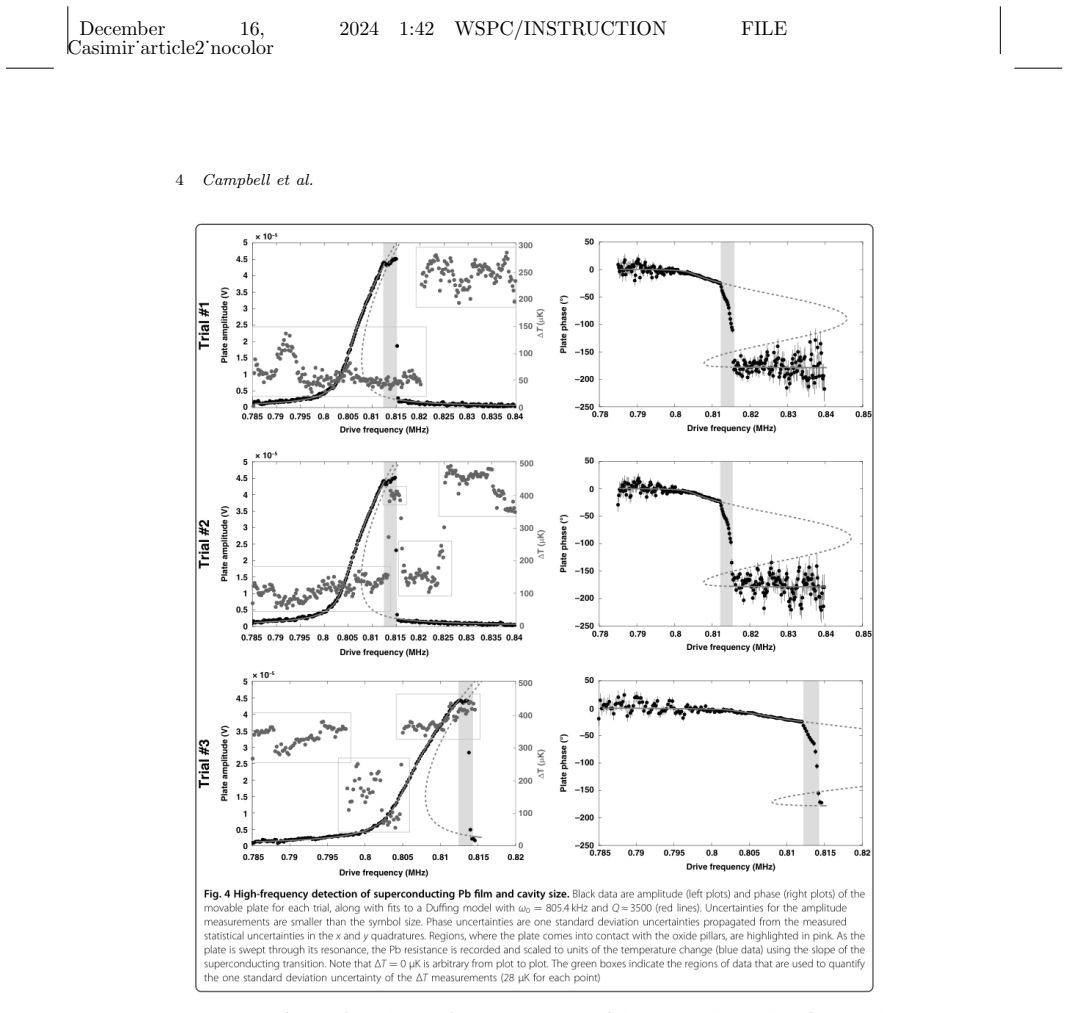
The carrying mechanism is the chip-scale tunable Casimir cavity. One wall is a lead film quench-condensed onto a cryogenically cooled substrate through a shadow mask, which produces a smooth amorphous film thin enough to remain superconducting; the other wall is a gold plate moved by MEMS actuation. The film's resistance is read with four leads while the plate oscillates at resonance, and the resistance trace through the transition is converted to a temperature scale using the measured transition slope. Finite-element analysis of the deformed mode shape supplies the gap values (63–73 nm at closest approach, about 256 nm at maximum), and the Casimir-energy difference between those two geometries is the quantity whose predicted effect on $T_c$ the experiment seeks.
What would settle it
Apply a known 12 $μ$K temperature step to the lead film while the cavity gap is held fixed and confirm that the four-terminal resistance readout registers the step; and separately measure the actual gap by an independent method, such as optical interferometry. If the readout cannot resolve 12 $μ$K or the measured gap differs from the simulated 63–73 nm and 256 nm values enough to change the Casimir-energy calculation, the paper's upper bound is invalidated.
Extended reading notes
Core claim
The central claim is that the critical temperature of a quenched-condensed lead film does not change by more than 12 $μ$K when the separation of the Casimir cavity walls is tuned from a minimum of roughly 63–73 nm to a maximum of roughly 256 nm. The experiment reaches this bound by monitoring the four-terminal resistance of the Pb film as a movable gold plate is driven through its mechanical resonance, then converting resistance changes into temperature changes using the slope of the superconducting transition. The expected shift, taken from a prior theoretical calculation for a 25 nm Pb film and an 80 nm Au plate at these separations, is about 0.025 $μ$K, which the paper estimates as roughly 1000 times below the achieved sensitivity. The paper therefore claims that the Casimir-energy correction to $T_c$ is not excluded by experiment, only bounded from above.
Load-bearing premise
The reported 12 $μ$K upper bound assumes that the computer-simulated cavity gap (63–73 nm to about 256 nm) and the conversion of resistance readings into temperature changes via the transition slope are both accurate; if either is wrong enough to shift the inferred temperature scale, the bound is not established.
Editorial extensions
If this is right
- The null result places an upper bound of 12 $μ$K on any Casimir-induced change in the critical temperature of a lead film for gap swings between about 63 nm and 256 nm.
- Because the predicted shift is about 0.025 $μ$K, roughly 1000 times smaller, the theoretical effect is neither confirmed nor ruled out.
- The in situ deposition and resonant-gap-modulation technique can be extended, as the paper plans, to include applied magnetic fields for direct magnetic-field measurements.
- A null result at this level is consistent with standard Casimir theory; no new vacuum-energy mechanism is required to explain it.
Reading between the lines
- A sharper superconducting transition or a material with a more sensitive $T_c$ could reduce the experimental gap without changing the cavity design, since the measurement converts resistance to temperature through the transition slope.
- The same apparatus could search for Casimir corrections in other observables, such as condensation energy or kinetic inductance, where the fractional effect might be larger than on $T_c$.
- An independent, in-situ measurement of the cavity gap would be the single most valuable calibration for any future version of this experiment.
Editorial analysis
A structured set of objections, weighed in public.
Referee Report
Summary. The paper reports a search for a shift in the superconducting critical temperature Tc of a thin Pb film placed inside a tunable Casimir cavity formed by the Pb film and a movable Au plate in a MEMS device. The authors measure the resistance of the Pb film across its superconducting transition while the cavity gap is modulated by driving the Au plate at mechanical resonance. They report no detected change in Tc larger than 12 microkelvin, while citing a theoretical prediction of about 0.025 microkelvin for the Casimir-energy correction to Tc. The manuscript reproduces figures and methods from previous work (Refs. 4 and 6), discusses the experimental challenges, and outlines future directions including adding a magnetic field.
Significance. If the reported 12 microkelvin upper bound is reliable, the paper provides a null result for Casimir-energy corrections to the superconducting condensation energy at the sub-microkelvin level. However, because the cited theoretical prediction (0.025 microkelvin) is roughly 480 times smaller than the experimental bound, the measurement does not actually test the predicted effect; it only places a weaker limit. The experimental technique—quenched-condensed Pb film integrated into a tunable MEMS Casimir cavity—is potentially valuable, but the manuscript presents no new data beyond what was published in Ref. 4 and provides no error budget, raw data, or systematic-uncertainty analysis. The central quantitative claim therefore cannot be independently assessed from this paper alone.
major comments (4)
- [Section 2 (Fig. 2 and Fig. 3) and Section 3] The central claim of the paper—the 12 microkelvin upper bound on any change in Tc—is not accompanied by an error budget or a stated confidence level. The resistance change of the Pb film is converted to a temperature change using the slope of the superconducting transition, but no uncertainty is quoted for that slope, for the linear fit used to determine it, for the baseline resistance noise, or for possible parasitic resistance changes induced by plate motion. Without these uncertainties, the reported upper bound cannot be verified or compared meaningfully to the theoretical prediction.
- [Section 3] The theoretical expectation of 0.025 microkelvin is cited from Refs. 4 and 6 but not derived or even briefly summarized in this manuscript. Since the comparison between this value and the experimental bound is the paper's main scientific conclusion, the reader needs at least the key assumptions (film thickness, gap range, material parameters, and the form of the Casimir-energy correction) and an estimate of the theoretical uncertainty. As written, the 0.025 microkelvin value is an unsupported input to the central comparison.
- [Section 3 (cavity geometry)] The cavity separation is estimated by finite element analysis of the deformed MEMS mode shape, giving a minimum separation between 63 and 73 nm and a maximum of about 256 nm, but no uncertainty is stated for this FEA calculation. The validity of the result as a Casimir probe depends directly on these gap values, as does the theoretical prediction of 0.025 microkelvin. A sensitivity analysis or an error bar on the gap is needed to determine whether the experiment actually explores the intended Casimir configuration.
- [Sections 2 and 3 (data provenance)] Figures 2 and 3 are explicitly taken from Ref. 4, and the text repeatedly refers to Ref. 4 for experimental details. The paper therefore does not stand alone as a self-contained report of the measurement. If this is intended as a proceedings or summary article, that framing should be stated explicitly in the title or abstract; otherwise, the central experimental claim is not independently verifiable from the material presented here.
minor comments (5)
- [Abstract and Section 3] The text states that the predicted 0.025 microkelvin effect is 'roughly 1000 times' lower than the 12 microkelvin sensitivity, but 12/0.025 = 480, not 1000. This numerical inconsistency should be corrected.
- [Figure 2 caption] The caption contains a typo, 'FIg. 2', and the caption text 'From Fig 3 of Ref. 4' should be rephrased to make clear that the data are reproduced from the earlier reference.
- [Section 3 (last paragraph)] There is a duplicated word in the sentence 'stabilizing the existence of wormholes and and an explanation of the dark energy of the universe'—remove the repeated 'and'.
- [References] Reference 6 combines several distinct papers into one entry; it would be clearer to cite them separately, especially since the theoretical prediction (Ref. 4 and Bimonte et al.) and the earlier result (Allocca et al.) are different works.
- [Figure 3] The figure is described as relying on color that 'could not be reproduced in this journal'. In the printed grayscale version, the data from the two trial runs may be indistinguishable; adding distinct markers or line styles would improve readability.
Circularity Check
No significant circularity: the null result is an independent experimental bound; the cited theoretical 0.025 µK is not used to fit or define the data.
full rationale
The experimental claim (no change in Tc larger than 12 µK) is an upper bound set by resistance noise divided by the fitted slope of the superconducting transition (Section 2 and Fig. 2); that slope is a calibration, not a fitted parameter designed to reproduce the null result, so the bound is not forced by construction. The theoretical expectation of 0.025 µK is imported from Refs. 4 and 6 rather than derived in this paper, but it is not used to calibrate the MEMS device, to select data, or to define the transition slope; the comparison between 0.025 µK and 12 µK therefore does not reduce to an identity. The FEA gap estimates (63–73 nm to 256 nm) are inputs to both the Casimir-energy calculation and the interpretation, but they are external geometric parameters, not outputs of the measurement. No equation in the paper is defined in terms of the quantity it is said to predict, and no fit is renamed as a prediction. The fact that Refs. 4 and 6 are from the same collaboration does not make the reasoning circular, because the null result stands on its own and the theory is not used to set any experimental parameter. The noted numerical ratio error (12/0.025 = 480, not 'roughly 1000') is a correctness concern, not circularity.
Assumptions & free parameters
free parameters (2)
- Cavity separation range from FEA =
63-73 nm minimum, ~256 nm maximum
- Resistance-to-temperature calibration slope =
not stated numerically
assumptions (4)
- domain assumption The Casimir energy difference between two conducting surfaces is correctly described by Lifshitz theory and can be converted into a change in superconducting condensation energy.
- domain assumption The quenched-condensed Pb film behaves as a homogeneous superconductor whose bulk BCS relation between condensation energy and Tc applies at roughly 10 nm thickness.
- domain assumption The cavity separation is correctly inferred from the MEMS resonance mode shape via finite element analysis, with acceptable parallelism and no large systematic error.
- domain assumption The measured resistance of the Pb film is a pure function of its temperature over the measurement window, with no significant contact, magnetoresistance, or strain contributions.
Cite this review
Pith. "Pith review of Seeking the Casimir Energy." pith.science (2026). https://pith.science/paper/5A53RFLG
@misc{pith2026241210179,
  author       = {Pith},
  title        = {Pith review of: Seeking the Casimir Energy},
  year         = {2026},
  howpublished = {\url{https://pith.science/paper/5A53RFLG}},
  note         = {Machine review of arXiv:2412.10179}
}
abstract
Since its first description in 1948, the Casimir effect has been studied extensively. Standard arguments for its existence hinge on the elimination of certain modes of the electromagnetic field because of the boundary conditions in the Casimir cavity. As such, it has been suggested that the ground state energy of the vacuum within the cavity may be reduced compared to the value outside. Could this have an effect on physical phenomena within the cavity? We study this Casimir energy and probe whether the critical temperature $T_c$ of a superconductor is altered when it is placed in the cavity. We do not detect any change in $T_c$ larger than 12 microKelvin, but theoretically expect a change on the order of 0.025 microKelvin, roughly 1000 times lower than our achieved sensitivity.
Figures


Figures from the paper (1 more)

Reference graph
Works this paper leans on
-
[1]
H. B. Casimir, ”On the attraction between two perfectly conducting plates,” Proc. K. Ned. Akad. Wet.51, 150 (1948)
work page 1948
-
[2]
Lamoreaux, ”Demonstration of the Casimir force in the 0.6 to 6.0 µm range,” Phys
S.K. Lamoreaux, ”Demonstration of the Casimir force in the 0.6 to 6.0 µm range,” Phys. Rev. Lett.78, 5-8 (1997)
work page 1997
-
[3]
U. Mohideen and R. Roy, ”Precision measurement of the Casimir force from 0.1 to 0.9 µm, Phys. Rev. Lett.81 4549 (1998)
work page 1998
-
[4]
Diego Perez-Morelo et al., ”A system for probing Casimir energy corrections to the condensation energy,” Microsystems and Nanoengineering6 115 (2020)
work page 2020
-
[5]
Alexander Stange, David K. Cambpell, and David J. Bishop, ”Science and Technology of the Casimir effect,” Physics Today 74, 1 (January), 42-47 (2021)
work page 2021
-
[6]
Bimonte et al., ”Towards measuring variations of Casimir energy by a supercon- ducting cavity,” Phys
G. Bimonte et al., ”Towards measuring variations of Casimir energy by a supercon- ducting cavity,” Phys. Rev. Lett.94 180402 (2005). See also A.Allocca et. al., Results of measuring the influences of Casimir energy on superconducting phase transitions,” J. Supercond. Nov, Mag. 25 2557-2565 (2012), I. E. Dzyaloshiinskii, E. M. Lifshitz, and L. P. Pitaevski...
work page 2005
Reviewed August 11, 2026 · model on record in the stance chip above.
Discussion (0). Continue with ORCID to comment.