REVIEW 4 major objections 6 minor 1 cited by
SymPT: a comprehensive tool for automating effective Hamiltonian derivations
T0 review · 4 major / 6 minor · reviewed 2026-08-11 · deepseek-v4-flash
Pith's one-line read SymPT automates Schrieffer-Wolff transformations to yield operator-level effective Hamiltonians for arbitrary perturbative systems.
desk verdict SymPT is a genuinely useful automation tool for time-independent SWT and the Appendix A LA recursion is new, but the headline time-periodic capability is undermined by a missing gauge term; it deserves a serious referee only after major revision. read the letter →
The pith
A machine-rendered reading of the paper's core claim, the machinery that carries it, and where it could break.
The reading
What carries the argument
The central object is the anti-Hermitian generator $S=\sum_j S^{(j)}$ of the unitary $U=e^{-S}$, together with a universal closed-form solution for $S^{(n)}$ from Ref. [25] that converts each order's commutator condition, such as $[H^{(0)},S^{(1)}]=-V^{(1)}$, into an explicit operator expression without matrix truncation. For the least-action multi-block routine, the paper adds a bookkeeping apparatus: the sets $T(j,n)$ and $P(j)$ of integer-tuple partitions classify every term of a given perturbative order in the expansion of $U^\dagger = X^\dagger B(X)(B(X^\dagger)B(X))^{-1/2}$, and the recursion in Eq. (38) produces $S^{(j)}$ from $U^{(j)}$ by subtracting all previously computed lower-length contributions. This generator construction carries the argument because all four routines reduce to solving for $S^{(n)}$ and then reading off the effective Hamiltonian from the Baker-Campbell-Hausdorff expansion.
What would settle it
Compute the effective Hamiltonian for a small finite-dimensional Hamiltonian whose exact block diagonalization is known, run SymPT's least-action routine to high order, and check whether the spectral distance $\|H_{\mathrm{exact}}-H^{(n)}_{\mathrm{LA}}\|$ decreases with $n$ as in Fig. 3; a single instance where the distance plateaus above zero or increases would falsify the claim of a closed-form generator to arbitrary order. A sharper test is a Hamiltonian with a degeneracy inside the blocks or a resonant time-periodic drive, where the formal order-by-order reorganization in Appendix A has no convergent meaning.
Extended reading notes
Core claim
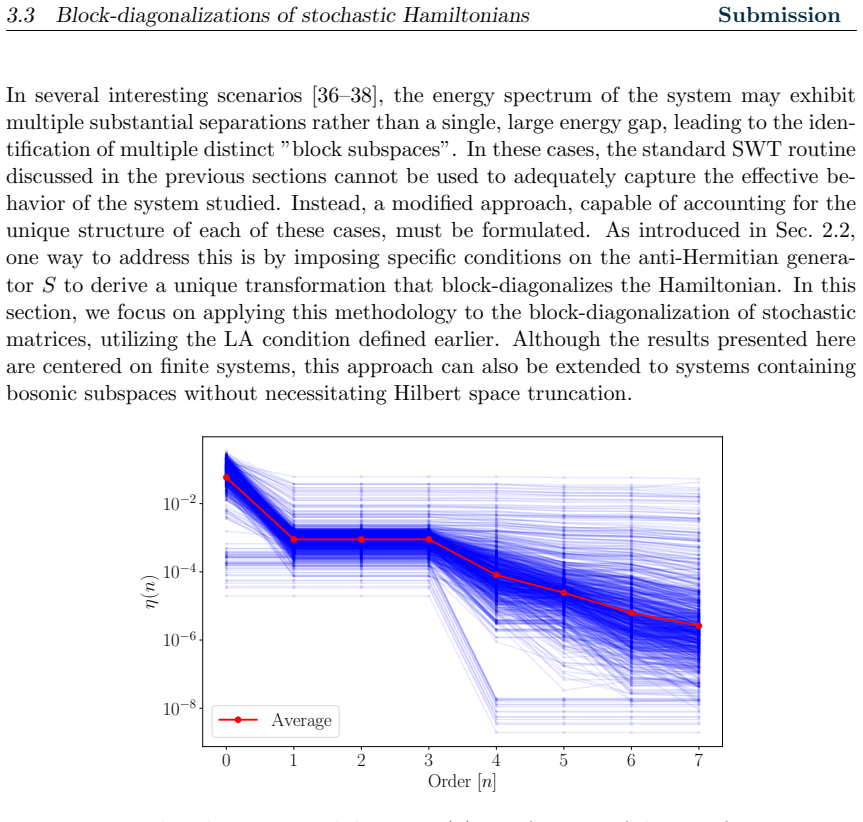
At the core of the paper is the claim that every variant of the SWT reduces to the same computational pattern: at each perturbative order $n$, impose a commutator condition on the anti-Hermitian generator $S^{(n)}$, solve that condition using the universal generator formula from the authors' companion work [25], and use integer partitions of $n$ to enumerate and cache the nested commutators contributing to the $n$-th order correction. On top of this pattern the paper adds three extensions: a full-diagonalization routine that requires no pre-decomposition of the Hamiltonian, an arbitrary-coupling-elimination routine driven by user-supplied masks, and a least-action multi-block routine in which the unitary is chosen to minimize $\|U-I\|$, so that it does no more than block-diagonalize; the generator for this routine is constructed recursively in Appendix A to any order, resolving a limitation of earlier work that only reached third order. The paper demonstrates the workflow on a driven spin qubit in a slanting field, a transmon-resonator system in the dispersive regime, and random Hamiltonians, where the least-action transformed Hamiltonian is compared with exact numerical block diagonalization and shown to converge in spectral norm over 900 instances.
Load-bearing premise
The load-bearing premise is that the universal closed-form generator solution from the authors' own preceding work [25] is correct and complete for arbitrary operator-valued Hamiltonians and that the formal power series used in the least-action derivation can be reorganized by perturbative order and truncated without convergence or remainder analysis.
Editorial extensions
If this is right
- Effective Hamiltonians for time-independent and time-periodic systems can be computed at operator level, so bosonic and other infinite-dimensional subspaces no longer need to be truncated.
- User-supplied masks in the ACE routine allow specific couplings to be removed while keeping the rest of the Hamiltonian structure, so effective models can be tailored to the physics one wants to isolate.
- The least-action multi-block routine extends block diagonalization beyond the third order, where earlier work stopped, making it applicable to systems with several well-separated energy windows.
- Because SymPT tracks the frame of the transformation and can rotate arbitrary operators into it, observables and drive terms can be transformed consistently with the Hamiltonian, which matters already at second order when different SWT flavors give different frames.
- The benchmark on 900 random Hamiltonians provides a recipe for checking any perturbative block-diagonalization code against exact numerical diagonalization.
Reading between the lines
- A natural next test the paper does not run is a head-to-head runtime benchmark against the optimized implementation [26] on the same high-order problems; the paper itself notes it lacks that implementation's commutator-reduction strategy, so such a comparison would reveal whether the universal generator's generality carries a performance cost.
- The partition-based caching scheme suggests the number of distinct nested commutators at order $n$ is the main complexity driver; if that count tracks the integer partition function $p(n)$, the cost of very high-order SWTs is intrinsic rather than an implementation artifact.
- Because the least-action recursion is derived at operator level using only block projectors, the same construction could plausibly be reused for non-Hermitian generators or dissipative Lindblad dynamics, an application the paper does not claim.
- The paper's numerical validation covers finite-dimensional random matrices; extending the same spectral-distance check to bosonic systems would require an independent reference, for example a truncated-but-converged calculation, which the method is designed to avoid.
Signed reviews
Editorial analysis
A structured set of objections, weighed in public.
Referee Report
Summary. The paper presents SymPT, a symbolic computation tool that automates the Schrieffer-Wolff transformation and its extensions: standard SWT, full diagonalization (FD), arbitrary-coupling elimination (ACE), and least-action (LA) multi-block diagonalization. The tool operates on operator-level (bosonic) and finite-dimensional matrix Hamiltonians without Hilbert-space truncation, and claims support for both time-independent and time-periodic systems. The manuscript describes the underlying algorithms, provides usage examples (EDSR in a slanting field, transmon coupled to a resonator, stochastic Hamiltonians), and validates the LA routine against exact numerical evaluation of Eq. (11) on 900 random Hamiltonians.
Significance. If correct, SymPT fills a genuine gap: no other publicly available tool automates high-order SWT and its variants at operator level for time-periodic systems. The stochastic LA benchmark is a positive feature, as it provides an independent check against exact numerics. The physics examples are relevant, and the operator-level, truncation-free approach is valuable. However, the tool's correctness rests on a universal generator from the authors' companion paper [25], which is not re-derived or independently verified here, and the time-dependent formalism is incompletely specified.
major comments (4)
- [Sec. 2.1, Eqs. (2)-(4)] The definition of H_eff for time-dependent S is incomplete. The BCH expansion H_eff = e^{-S} H e^S omits the gauge term -iℏ U ∂_t U† (equivalently, -iℏ e^{-S} ∂_t e^S) that is required for time-dependent unitary transformations. Equation (6) contains iℏ ∂_t S(1) only in the condition that determines S(1); the manuscript never states that this derivative contribution is added when the effective Hamiltonian is assembled. Consequently, the time-periodic capability advertised in the abstract and the time-dependent EDSR result (Eqs. (17)-(18)) are not derivable from the equations as written. Please either include the gauge term in the definition of H_eff and describe how SymPT evaluates it, or provide a derivation showing that the omitted term does not contribute.
- [Secs. 2.3-2.4] The generator S(n) is computed 'using a method that leverages the theoretical results described in [25]' with no derivation or independent verification in this manuscript. Because every routine in SymPT, including the FD routine used by the LA algorithm, depends on this external result, a flaw or restricted domain in [25] would propagate to all outputs. Please either include a self-contained derivation of the generator solution, or present a machine-checkable verification (e.g., comparing S(n) against an exact solution for a nontrivial operator-valued Hamiltonian). The stochastic LA benchmark in Sec. 3.3 does not isolate this issue, because it relies on the same generator through the FD step.
- [Appendix A, Eq. (32)] The reorganization of the binomial expansion of {B(X†)B(X)}^{-1/2} appears to misapply the binomial series. The binomial expansion involves powers ε^n, and the coefficient of a monomial that is a product of n terms is binom(-1/2,n); this coefficient cannot be applied to individual monomials of ε as written unless ε(θ) is defined as a product of ε factors. As written, the order-2 term θ=(1,1) would receive a coefficient binom(-1/2,2)=3/8, whereas the correct coefficient from -1/2 ε is -1/2. Please clarify the definition of ε(θ) and correct the derivation, or provide an alternative derivation that yields the same iterative formula Eq. (38). The numerical validation in Sec. 3.3 suggests the implementation is correct, so a notational fix may suffice.
- [Sec. 3.3, Fig. 3] The main quantitative validation, Fig. 3, reports only the average relative spectral distance over 900 Hamiltonians, with no error bars, percentiles, or other indication of the spread. This makes it difficult to assess the reliability of the LA convergence claim. Please include error bars or a distribution summary, and specify the random generation procedure (distributions, ranges, block sizes) so that the benchmark is reproducible.
minor comments (6)
- [Sec. 4.1.3, code listing] The code snippet defines HE = -E0 * sin(ω t) * (ad+a), but the Hamiltonian in Eq. (12) contains a drive term -E0 cos(ωd t)(a†+a); please ensure the code matches the Hamiltonian used in the derivation.
- [Sec. 4.1.3, code listing] The snippet uses the variable 'omega0' in H0, but only 'omega' and 'omegaz' are introduced earlier; the code appears to contain typos and should be corrected so that it is runnable as shown.
- [Sec. 3.2 and Appendix B] The transmon-resonator results are not compared with known expressions from the literature (e.g., standard dispersive shifts), which would provide an external validation of the FD routine; please add a comparison or an explicit reference for the expected form.
- [Sec. 2.5] The LA algorithm is described only at a high level; it would be helpful to state explicitly how the intermediate full diagonalization Z(j) is computed and how Eq. (38) is evaluated, since this is a novel part of the paper.
- [Throughout] The manuscript contains numerous typos and formatting errors ('declinated', 'obatined', 'targetting', 'inlcuded', 'implementd', and broken text in code comments), and the notation is inconsistent in places (e.g., ω vs ω_d in Sec. 3.1); a careful proofreading pass is recommended.
- [Sec. 1] The claim that no other comprehensive software tool automates SWTs without Hilbert-space truncation should be qualified, since Ref. [26] (PyMablock) may also operate on operator-level Hamiltonians; please clarify the distinction.
Circularity Check
Core generator is imported from the authors' own Ref [25] as a black box, but independent LA derivation and numerical benchmarks keep the paper from being wholly circular.
-
self citation load bearing
[Section 2.3, Algorithm for standard SWTs (see also Abstract: 'Building on a universal framework developed in recent research')]
"Once these conditions are resolved, the solution for S(n) is computed using a method that leverages the theoretical results described in [25]."
The paper's central advertised capability — systematic derivation of the SWT generator for arbitrary perturbative systems — is outsourced to a self-citation. Ref [25] is the authors' own prior preprint, not re-derived, machine-checked, or independently reproduced in this manuscript; every S(n), and therefore every effective Hamiltonian, inherits the correctness of that prior result. This is load-bearing because the Abstract announces the tool as built on that framework and Section 2.3 makes the generator solution the decisive step of each routine. The LA derivation in Appendix A and the numerical benchmark against Eq. (11) in Fig.
full rationale
SymPT's core generator for standard SWT, FD, and ACE is imported from the authors' own Ref [25], and the paper gives no independent derivation, machine-check, or external validation of that 'universal solution.' That is a genuine load-bearing self-citation: every computed S(n) and every effective Hamiltonian in the examples inherits the correctness of the prior preprint. I therefore flag one self-citation step. The paper is otherwise not circular: no parameter is fitted from the quantities it claims to predict; the LA routine is validated numerically against the exact unitary in Eq. (11) for 900 random Hamiltonians; the EDSR and transmon results are compared with known physics; and Appendix A derives the LA generator from Eq. (11) rather than importing it. The time-dependent gauge issue — the apparent omission of the -iℏ U ∂_t U† term in the definition of Heff — is a correctness risk rather than a circularity, because it concerns an omitted term rather than a quantity defined to equal its own input. Because the central software claim retains independent content, the circularity score is moderate rather than high.
Assumptions & free parameters
assumptions (4)
- domain assumption The universal SWT generator solution of Ref [25] is correct for arbitrary perturbative Hamiltonians.
- standard math The least-action block diagonalization is given by Eq. (11), U^dagger = X^dagger B(X) {B(X^dagger)B(X)}^{-1/2}, from Ref [28].
- domain assumption Perturbative series for S and H_eff converge or are asymptotic; off-block couplings are small compared to relevant energy gaps.
- domain assumption Symbolic computations with infinite-dimensional bosonic operators terminate and yield finite expressions at each order.
Cite this review
Pith. "Pith review of SymPT: a comprehensive tool for automating effective Hamiltonian derivations." pith.science (2026). https://pith.science/paper/DKTL7PXR
@misc{pith2026241210240,
  author       = {Pith},
  title        = {Pith review of: SymPT: a comprehensive tool for automating effective Hamiltonian derivations},
  year         = {2026},
  howpublished = {\url{https://pith.science/paper/DKTL7PXR}},
  note         = {Machine review of arXiv:2412.10240}
}
read the original abstract
The Schrieffer-Wolff transformation (SWT) is a foundational perturbative method for deriving effective Hamiltonians in quantum systems by systematically eliminating couplings between pairs of energy distant subspaces. Despite recent advancements, the implementation of SWTs for sufficiently complex systems remains computationally challenging and often requires extensive calculations that are prone to errors. In this work, we introduce an analytical software tool, SymPT (Symbolic Perturbation Theory), designed to automate the SWT and its extensions. Building on a universal framework developed in recent research, SymPT provides a systematic and generalizable solution for deriving the generator of the transformation, enabling accurate computation of effective Hamiltonians for arbitrary perturbative systems. The tool supports both time-independent and time-periodic Hamiltonians, extending beyond standard SWT to incorporate arbitrary coupling elimination, block-diagonalization and full-diagonalization routines, thus enabling precise handling of systems with intricate energy structures.
Figures


Figures from the paper (1 more)

Forward citations
Cited by 1 Pith paper
-
Closed-Form Generators for Perturbative Transformations in Static and Periodically Driven Quantum Systems
A closed-form, truncation-free expression for the Schrieffer-Wolff generator is derived for finite-plus-bosonic quantum systems, with a Fourier-space extension for periodic drives.
Reference graph
Works this paper leans on
-
[27]
I. N. H. Mankodi and D. P. DiVincenzo, Perturbative power series for block diago- nalisation of hermitian matrices (2024), 2408.14637
work page Pith review arXiv 2024
-
[25]
L. Reascos, G. F. Diotallevi and M. Benito, Universal solution to the schrieffer-wolff transformation generator (2024), 2411.11535
arXiv 2024
-
[1]
J. R. Schrieffer and P. A. Wolff, Relation between the anderson and kondo hamilto- nians, Phys. Rev. 149, 491 (1966), doi:10.1103/PhysRev.149.491
-
[2]
R. Winkler, Spin-orbit coupling effects in two-dimensional electron and hole systems , Springer tracts in modern physics. Springer, Berlin, doi:10.1007/b13586 (2003). 19 REFERENCES Submission
doi:10.1007/b13586 2003
-
[3]
J. Romh´ anyi, G. Burkard and A. P´ alyi, Subharmonic transitions and bloch- siegert shift in electrically driven spin resonance , Phys. Rev. B 92, 054422 (2015), doi:10.1103/PhysRevB.92.054422
-
[4]
S. Bravyi, D. P. DiVincenzo and D. Loss, Schrieffer–wolff transformation for quantum many-body systems , Annals of Physics 326(10), 2793 (2011), doi:https://doi.org/10.1016/j.aop.2011.06.004
-
[5]
J. Villarreal, J. Juan, P. Jasen and J. Ardenghi, Effective hopping between magnetic impurities in silicene , Journal of Magnetism and Magnetic Materials 562, 169726 (2022), doi:https://doi.org/10.1016/j.jmmm.2022.169726
-
[6]
A. Kale, J. H. Huhn, M. Xu, L. H. Kendrick, M. Lebrat, C. Chiu, G. Ji, F. Grusdt, A. Bohrdt and M. Greiner, Schrieffer-wolff transformations for experiments: Dy- namically suppressing virtual doublon-hole excitations in a fermi-hubbard simulator , Phys. Rev. A 106, 012428 (2022), doi:10.1103/PhysRevA.106.012428
Show all 39 references
-
[7]
Voleti, A
S. Voleti, A. Haldar and A. Paramekanti, Octupolar order and ising quantum crit- icality tuned by strain and dimensionality: Application to d-orbital mott insulators , Phys. Rev. B 104, 174431 (2021), doi:10.1103/PhysRevB.104.174431
2021 doi
-
[8]
H. Hu, B. A. Bernevig and A. M. Tsvelik, Kondo lattice model of magic-angle twisted- bilayer graphene: Hund’s rule, local-moment fluctuations, and low-energy effective theory, Phys. Rev. Lett. 131, 026502 (2023), doi:10.1103/PhysRevLett.131.026502
2023 doi
-
[9]
Manning-Coe and B
D. Manning-Coe and B. Bradlyn, Ground state stability, symmetry, and degeneracy in mott insulators with long-range interactions , Phys. Rev. B 108, 165136 (2023), doi:10.1103/PhysRevB.108.165136
2023 doi
-
[10]
Kolley and W
E. Kolley and W. Kolley, Schrieffer-wolff transformation of the emery model for cu–o superconductors , physica status solidi (b) 157(1), 399–409 (1990), doi:10.1002/pssb.2221570140
1990 doi
-
[11]
H¨ ormann and K
M. H¨ ormann and K. P. Schmidt,Projective cluster-additive transformation for quan- tum lattice models, SciPost Phys. 15, 097 (2023), doi:10.21468/SciPostPhys.15.3.097
2023 doi
-
[12]
S. V. Lovtsov and V. Yu. Yushankhai, Schrieffer-wolff transformation of the p–d model for oxide superconductors charge fluctuation regime , physica status solidi (b) 166(1), 209–217 (1991), doi:10.1002/pssb.2221660123
1991 doi
-
[13]
M. Sun, A. V. Parafilo, K. H. Villegas, V. M. Kovalev and I. G. Savenko, Theory of bcs-like bogolon-mediated superconductivity in transition metal dichalcogenides , New Journal of Physics 23(2), 023023 (2021), doi:10.1088/1367-2630/abe285
2021 doi
-
[14]
Weisse, R
A. Weisse, R. Gerstner and J. Sirker, Operator growth in disordered spin chains: Indications for the absence of many-body localization (2024), 2401.08031
2024 arXiv
-
[15]
Het´ enyi, S
B. Het´ enyi, S. Bosco and D. Loss, Anomalous zero-field splitting for hole spin qubits in si and ge quantum dots , Phys. Rev. Lett. 129, 116805 (2022), doi:10.1103/PhysRevLett.129.116805
2022 doi
-
[16]
Cayao, M
J. Cayao, M. Benito and G. Burkard, Programmable two-qubit gates in capac- itively coupled flopping-mode spin qubits , Phys. Rev. B 101, 195438 (2020), doi:10.1103/PhysRevB.101.195438. 20 REFERENCES Submission
2020 doi
-
[17]
Mar´ ecat, B
Q. Mar´ ecat, B. Senjean and M. Sauban` ere,Recursive relations and quantum eigen- solver algorithms within modified schrieffer-wolff transformations for the hubbard dimer, Phys. Rev. B 107, 155110 (2023), doi:10.1103/PhysRevB.107.155110
2023 doi
-
[18]
Y. Fang, P. Philippopoulos, D. Culcer, W. A. Coish and S. Chesi, Recent ad- vances in hole-spin qubits , Materials for Quantum Technology 3(1), 012003 (2023), doi:10.1088/2633-4356/acb87e
2023 doi
-
[19]
Consani and P
G. Consani and P. A. Warburton, Effective hamiltonians for interacting supercon- ducting qubits: Local basis reduction and the schrieffer–wolff transformation , New Journal of Physics 22(5), 053040 (2020), doi:10.1088/1367-2630/ab83d1
2020 doi
-
[20]
Blais, A
A. Blais, A. L. Grimsmo, S. M. Girvin and A. Wallraff, Circuit quantum electrody- namics, Rev. Mod. Phys. 93, 025005 (2021), doi:10.1103/RevModPhys.93.025005
2021 doi
-
[21]
Benito, J
M. Benito, J. R. Petta and G. Burkard, Optimized cavity-mediated disper- sive two-qubit gates between spin qubits , Phys. Rev. B 100, 081412 (2019), doi:10.1103/PhysRevB.100.081412
2019 doi
-
[22]
Pelegr ´ ı, S
G. Pelegr ´ ı, S. Flannigan and A. J. Daley, Few-body bound topological and flat-band states in a creutz ladder , Phys. Rev. B 109, 235412 (2024), doi:10.1103/PhysRevB.109.235412
2024 doi
-
[23]
Hohenester, Cavity quantum electrodynamics with semiconductor quantum dots: Role of phonon-assisted cavity feeding , Phys
U. Hohenester, Cavity quantum electrodynamics with semiconductor quantum dots: Role of phonon-assisted cavity feeding , Phys. Rev. B 81, 155303 (2010), doi:10.1103/PhysRevB.81.155303
2010 doi
-
[24]
S. B. J¨ ager, T. Schmit, G. Morigi, M. J. Holland and R. Betzholz, Lindblad master equations for quantum systems coupled to dissipative bosonic modes , Phys. Rev. Lett. 129, 063601 (2022), doi:10.1103/PhysRevLett.129.063601
2022 doi
-
[26]
I. A. Day, S. Miles, H. K. Kerstens, D. Varjas and A. R. Akhmerov, Pymablock: an algorithm and a package for quasi-degenerate perturbation theory (2024), 2404.03728
2024 arXiv
-
[28]
L. S. Cederbaum, J. Schirmer and H. D. Meyer, Block diagonalisation of hermitian matrices, Journal of Physics A: Mathematical and General 22(13), 2427 (1989), doi:10.1088/0305-4470/22/13/035
1989 doi
-
[29]
Tokura, W
Y. Tokura, W. G. van der Wiel, T. Obata and S. Tarucha, Coherent single elec- tron spin control in a slanting zeeman field , Phys. Rev. Lett. 96, 047202 (2006), doi:10.1103/PhysRevLett.96.047202
2006 doi
-
[30]
K. C. Nowack, F. H. L. Koppens, Y. V. Nazarov and L. M. K. Vandersypen, Coherent control of a single electron spin with electric fields , Science 318(5855), 1430 (2007), doi:10.1126/science.1148092, https://www.science.org/doi/pdf/10. 1126/science.1148092
2007 doi
-
[31]
Pioro-Ladriere, T
M. Pioro-Ladriere, T. Obata, Y. Tokura, Y.-S. Shin, T. Kubo, K. Yoshida, T. Taniyama and S. Tarucha, Electrically driven single-electron spin resonance in a slanting zeeman field , Nature Physics 4(10), 776 (2008). 21 REFERENCES Submission
2008
-
[32]
Brooks and G
M. Brooks and G. Burkard, Electric dipole spin resonance of two- dimensional semiconductor spin qubits , Phys. Rev. B 101, 035204 (2020), doi:10.1103/PhysRevB.101.035204
2020 doi
-
[33]
M. F. Dumas, B. Groleau-Par´ e, A. McDonald, M. H. Mu˜ noz Arias, C. Lled´ o, B. D’Anjou and A. Blais, Measurement-induced transmon ionization , Phys. Rev. X 14, 041023 (2024), doi:10.1103/PhysRevX.14.041023
2024 doi
-
[34]
F. m. c. Swiadek, R. Shillito, P. Magnard, A. Remm, C. Hellings, N. Lacroix, Q. Ficheux, D. C. Zanuz, G. J. Norris, A. Blais, S. Krinner and A. Wallraff, Enhancing dispersive readout of superconducting qubits through dynamic control of the dispersive shift: Experiment and theo...
2024 doi
-
[35]
T. Noh, Z. Xiao, X. Y. Jin, K. Cicak, E. Doucet, J. Aumentado, L. C. Govia, L. Ran- zani, A. Kamal and R. W. Simmonds, Strong parametric dispersive shifts in a stati- cally decoupled two-qubit cavity qed system, Nature Physics 19(10), 1445–1451 (2023), doi:10.1038/s41567-023-02107-2
2023 doi
-
[36]
B. Suri, Z. K. Keane, L. S. Bishop, S. Novikov, F. C. Wellstood and B. S. Palmer, Nonlinear microwave photon occupancy of a driven resonator strongly coupled to a transmon qubit, Phys. Rev. A 92, 063801 (2015), doi:10.1103/PhysRevA.92.063801
2015 doi
-
[37]
Kehrer, T
T. Kehrer, T. Nadolny and C. Bruder, Improving transmon qudit mea- surement on ibm quantum hardware , Phys. Rev. Res. 6, 013050 (2024), doi:10.1103/PhysRevResearch.6.013050
2024 doi
-
[38]
V. L. Grigoryan and K. Xia, Cavity-mediated dissipative spin-spin coupling , Phys. Rev. B 100, 014415 (2019), doi:10.1103/PhysRevB.100.014415
2019 doi
-
[39]
Gell-Mann, Symmetries of baryons and mesons , Phys
M. Gell-Mann, Symmetries of baryons and mesons , Phys. Rev. 125, 1067 (1962), doi:10.1103/PhysRev.125.1067. 22
1962 doi
Reviewed August 11, 2026 · model on record in the stance chip above.
Discussion (0). Continue with ORCID to comment.