REVIEW 3 major objections 6 minor 2 cited by
Closed-Form Generators for Perturbative Transformations in Static and Periodically Driven Quantum Systems
T0 review · 3 major / 6 minor · reviewed 2026-08-12 · deepseek-v4-flash
Pith's one-line read This paper claims that the generator of any perturbative unitary transformation for systems built from finite-dimensional and bosonic subspaces is fixed by a single closed-form operator expression…
desk verdict Handy closed-form Schrieffer-Wolff generator with a real but easily fixed sign slip; the central formula is new and the paper is worth refereeing once the convergence conditions are stated honestly. read the letter →
The pith
A machine-rendered reading of the paper's core claim, the machinery that carries it, and where it could break.
The reading
What carries the argument
The load-bearing object is the operator-valued decomposition of every term by the pair $(\mu,\nu,\Delta)$: a transition on the finite-dimensional factor, $\sigma_{\mu\nu}$, and a net change $\Delta$ in boson number carried by $a^\Delta$ (or $(a^\dagger)^\Delta$), with a coefficient that is a function of the number operator $N$. The identity that makes the argument work is the commutation relation $a^\Delta f(N)=f(N+\Delta)a^\Delta$, which converts the operator equation $[H^{(0)},S]=P$ into the algebraic ratio $s=-p/\omega$ with the operator-valued detuning $\omega_{\mu\nu}^{(\Delta)}=f_\nu(N+\Delta)-f_\mu(N)$. In the periodically driven case the same machinery is applied mode by mode in a Fourier expansion, producing $s_k(N,t)=-\sum_n p_k^{(n)}(N)e^{in\Omega t}/(\omega_k-n\hbar\Omega_k)$; the paper adds the condition that the transformation preserve the system's macromotion, i.e., the slow component of its dynamics. This machinery carries the whole argument because every later formula, including the eight-pole dispersive shift $\chi(N)$, is an explicit evaluation of these ratios.
What would settle it
Choose an anharmonic light-matter Hamiltonian of the paper's class with parameters arranged so that $f_\nu(N+\Delta)-f_\mu(N)=0$ at an integer $N$ within the physical spectrum (for example, tune $\alpha$ and $\Omega_z$ to make a detuning cross zero), then compare the second-order effective Hamiltonian predicted by Eq. (16) with high-precision exact diagonalization on a convergent truncated basis: the formula predicts a divergence in the generator and a resonance in $\chi(N)$ at that point, while a finite exact result away from the pole would show the assumption has failed. For the driven case, the analogous test is to sweep $\Omega$ through $\omega_k/n\hbar$ and check that the generator and effective couplings diverge exactly where Eq. (23) has its poles.
Extended reading notes
Core claim
On the paper's own terms, the central discovery is a universal solution to the generator equation of the Schrieffer-Wolff transformation. Writing any operator as $O_\pm=\sum_{\mu\nu}\sum_{\Delta\ge0} g_{\mu\nu}^{(\Delta)}(N)a^\Delta\sigma_{\mu\nu}+\mathrm{h.c.}$, with $N=a^\dagger a$ the boson number and $\sigma_{\mu\nu}=|\mu\rangle\langle\nu|$ on the finite subspace, the unperturbed Hamiltonian takes diagonal form $H^{(0)}=\sum_\mu f_\mu(N)\sigma_{\mu\mu}$. The commutator $[H^{(0)},S^{(j)}]=P^{(j)}$ then becomes a pointwise algebraic condition, because $a^\Delta f(N)=f(N+\Delta)a^\Delta$, and the generator coefficients are $s_{\mu\nu}^{(\Delta)}(N)=-p_{\mu\nu}^{(\Delta)}(N)/\omega_{\mu\nu}^{(\Delta)}$ with $\omega_{\mu\nu}^{(\Delta)}=f_\nu(N+\Delta)-f_\mu(N)$. Since $P^{(j)}$ is kept general, the formula applies not only to the standard two-subspace Schrieffer-Wolff transformation but to any perturbative scheme whose defining equations fix $P^{(j)}$, including multi-block diagonalization. The time-periodic extension replaces the static detuning by the shifted detuning $\omega_k-n\hbar\Omega_k$ and requires the drive's fundamental frequency to stay away from resonance. The authors state that these expressions hold without truncating the bosonic Hilbert space and that they recover earlier integral and matrix-element formulations as special cases.
Load-bearing premise
The load-bearing premise is that the operator-valued detuning $\omega_{\mu\nu}^{(\Delta)}(N)=f_\nu(N+\Delta)-f_\mu(N)$ is invertible at every occupation number the dynamics visits, and in the driven case that $\omega_k-n\hbar\Omega_k$ never vanishes; the paper requires the removed channels to be 'sufficiently detuned' but does not provide a general quantitative bound on how small $p/\omega$ must be for the truncated Baker-Campbell-Hausdorff series to converge.
Editorial extensions
If this is right
- Effective Hamiltonians for systems like anharmonic resonators coupled to few-level systems can be written down analytically to any desired perturbative order without fixing a photon-number cutoff.
- For time-periodic drives, the same closed form covers low-, intermediate-, and high-frequency regimes, so the choice of perturbation scheme no longer dictates which frequency window can be treated.
- When the drive has no static Fourier component and oscillates fast, the generator collapses to $S^{(j)}(t)=-(i/\hbar)\int_0^t P^{(j)}(\tau)d\tau$, eliminating the need to compute detuning frequencies.
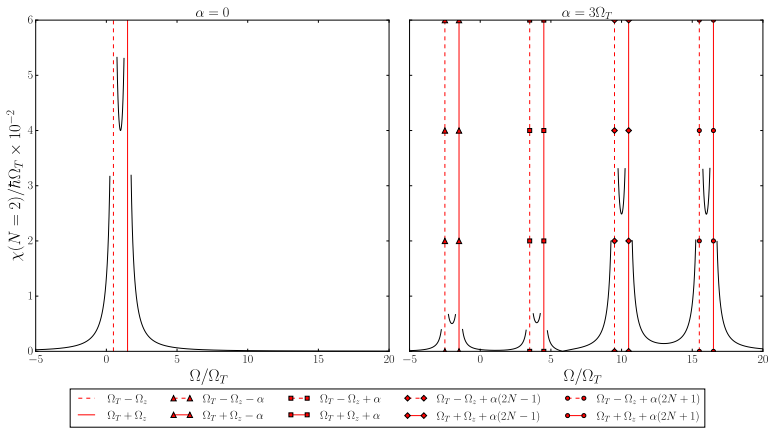
- The dispersive shift $\chi(N)$ of the worked example splits into eight divergences, four depending on $N$ when anharmonicity is present, giving a direct map of the plateaus where dispersive readout operates.
- Because $P^{(j)}$ is left general, the same formula applies to any perturbative transformation whose defining equation is brought to the form $[H^{(0)},S^{(j)}]=P^{(j)}$, including multi-block and full diagonalizations.
Reading between the lines
- One step the paper leaves implicit is convergence: the Baker-Campbell-Hausdorff expansion that defines the effective Hamiltonian is truncated at finite order, and the formula itself does not control the radius of that expansion. A natural follow-up would be to state quantitative smallness conditions on $\|p/\omega\|$ per order.
- Because the generator is an explicit rational function of $N$, the construction suggests an efficient numerical recipe: evaluate $p_{\mu\nu}^{(\Delta)}(N)/\omega_{\mu\nu}^{(\Delta)}(N)$ on the spectrum of $N$, then build $S$ by summing the resulting operator terms. That could make high-order effective Hamiltonians computable without ever constructing a large truncated matrix.
- The time-periodic result could be tested as a Floquet tool: in the regime where $\omega_k-n\hbar\Omega_k$ never vanishes, one could compare the effective Hamiltonian from Eq. (23) against direct Floquet diagonalization for moderate driving amplitudes to see where the perturbative breakdown actually occurs.
- The pole structure of $\chi(N)$ suggests a spectroscopic fingerprint: measuring the dispersive shift as a function of drive frequency should reveal the predicted plateaus, with plateau widths controlled by $2\Omega_z$ and $2\Omega_z+2\alpha$; this is a concrete, testable extension of the paper's example.
Signed reviews
Editorial analysis
A structured set of objections, weighed in public.
Referee Report
Summary. The manuscript proposes a closed-form solution for the Schrieffer-Wolff transformation generator in Hilbert spaces of the form H_f ⊗ H_b, where H_f is finite-dimensional and H_b is bosonic. Starting from an operator decomposition `O = Σ g^{(Δ)}_{μν}(N) a^Δ σ_{μν} + h.c.` and a diagonal unperturbed Hamiltonian `H0 = Σ f_μ(N) σ_{μμ}`, it solves `[H0,S]=P` by `s^{(Δ)}_{μν}(N) = -p^{(Δ)}_{μν}(N)/ω^{(Δ)}_{μν}` with `ω^{(Δ)}_{μν}=f_ν(N+Δ)-f_μ(N)` (Eq. (16)). The construction is extended to time-periodic perturbations, where the generator satisfies a first-order differential equation whose Fourier solution is `s_k(N,t) = -Σ_n p^{(n)}_k(N) e^{inΩt}/(ω_k - nℏΩ_k)` (Eq. (23)). The formalism is then applied to a two-level system coupled to an anharmonic resonator with a periodically modulated coupling, yielding a closed-form dispersive shift `χ(N)` (Eq. (36)) and plots of its divergence lines and plateaus. The paper claims that this provides a universal, truncation-free method valid across static and driven systems.
Significance. The algebraic core of the paper is clean and useful. The derivation of Eq. (16) is elementary and self-contained, and the equivalence with the interaction-picture integral formula in Appendix C is a valuable unifying observation. The application produces explicit, parameter-free analytical formulas (Eqs. (33) and (36)) that make the pole structure of the dispersive shift visible without truncating the bosonic subspace. If the technical issues below are repaired, the framework could serve as a convenient reference tool for constructing Schrieffer-Wolff generators in quantum-optics and condensed-matter settings. The main reservations are that the advertised 'universal, no-truncation' claim relies on an unproven smallness/invertibility condition, and that the time-dependent part of the paper contains sign inconsistencies that affect the effective-Hamiltonian formula.
major comments (3)
- [Sec. 3, Eqs. (16)-(17)] The solution `s = -p/ω` is only formal as written. For a bosonic subspace, N is unbounded, and `ω^{(Δ)}_{μν}(N)=f_ν(N+Δ)-f_μ(N)` may approach zero as N grows even if it never vanishes; in that case `||p/ω||` need not be small, and the paper gives no bound on `S` or any remainder estimate for the BCH/Magnus truncation in Eq. (3). The condition that eliminated channels remain 'sufficiently detuned' is qualitative. Consequently the central claim that Eq. (16) provides a truncation-free universal generator is not fully established. I recommend either supplying a quantitative smallness criterion for the class of functions `f_μ` considered, or stating explicitly that the result is a formal perturbative series whose convergence is left open.
- [Sec. 3.1, Eqs. (18)-(20) and Eq. (31)] The sign of the derivative term in the effective-Hamiltonian definition is inconsistent with the subsequent derivation. From Eq. (18) and Eq. (19), the first-order contribution of the derivative term is `-iℏ ∂S/∂t`. Therefore cancellation of first-order terms requires `[H0,S] - iℏ ∂S/∂t = -V`. Eq. (20), however, imposes `[H0,S] + iℏ ∂S/∂t = -V`. Substituting Eq. (20) into the expansion of Eq. (18) leaves first-order terms `-2iℏ ∂S/∂t` and an extra second-order term `-iℏ [∂_t S, S]`; Eq. (31), `H_eff = H0 + 1/2[V,S]`, does not follow. The same sign ambiguity appears in Section 4, where the condition is written as `[H(0),S(t)] = -V(t) + iℏ ∂S/∂t`, which is inconsistent with Eq. (20). The convention in Eq. (18), Eq. (20), or both must be corrected, and the application in Section 4 should be rederived accordingly.
- [Sec. 3.1, Eqs. (24)-(25)] Equation (25) does not follow from Eq. (24). For a Fourier component `p^{(n)} e^{inΩt}` with `n ≠ 0`, the high-frequency limit of Eq. (23) is `s = p^{(n)} e^{inΩt}/(nℏΩ)`, as stated in Eq. (24). However, `-i/ℏ ∫_0^t p(τ)dτ` contributes `p^{(n)}(1 - e^{inΩt})/(nℏΩ)`, which differs from the Eq. (24) term by a non-oscillatory constant and by the sign of the oscillating part. Hence Eq. (25) is not the high-frequency simplification of Eq. (23), and Eq. (26) is unsupported as derived. This issue directly affects the claimed simplified generator for fast periodic drives.
minor comments (6)
- [Throughout] There are several typographical errors: 'Lödwin' should be 'Löwdin', 'undersdood' should be 'understood', 'preturba-tive' should be 'perturbative', 'close-form' should be 'closed-form', and 'inifinite' should be 'infinite'.
- [Eq. (19)] The notation `[∂S/∂t, S]^{(l)}` for the repeated commutator is not defined in the text; please define it explicitly.
- [Sec. 3.1, Eq. (20)-(23)] The selection of the particular solution of Eq. (20) is justified only by a reference to the 'macromotion' condition in Ref. [60]; a brief statement of this condition would make the derivation self-contained.
- [Eq. (24)] The notation `p^{(n=0)}_k` is inconsistent with `p^{(n)}_k` used elsewhere; it should be written as `p^{(0)}_k`.
- [Sec. 4, Figs. 1-2] The figure captions refer to 'Panel 1' and 'Panel 2'; using 'left/right' or 'top/bottom' would be clearer for readers.
- [Eq. (36)] The dispersive shift is displayed as a single long expression. Presenting it as a sum of individual pole terms would make the divergence structure more transparent and easier to verify.
Circularity Check
No significant circularity: the generator formula is algebraically solved from the defining commutator equation, not assumed or fitted.
full rationale
The central result, Eq. (16), is obtained by directly solving the defining Schrieffer-Wolff equation [H^(0), S^(j)] = P^(j) using the operator expansion in Eq. (10) and the commutation relation a^Δ f(N) = f(N+Δ)a^Δ. This is a genuine derivation: the coefficients s^(Δ)_μν(N) are determined by matching the commutator to the given P^(j), and Eq. (17) is the resulting operator-valued detuning, not an input. The time-dependent generalization, Eq. (23), similarly solves the first-order differential equation (20) for a periodic P^(j); it is checked by direct substitution into the ODE, and the Fourier coefficients p^(n)_k are inputs from the perturbation, not fitted outputs. The operator representation in Eq. (10) is proved in Appendix A, and Appendix C shows that Eq. (16) is equivalent to the known interaction-picture integral construction; this equivalence is a consistency check, not a circular reuse of the target result. The dispersive shift in Eq. (36) is a derived consequence of the second-order effective Hamiltonian, not a fitted quantity. Self-citations in the introduction and the software reference [69] are contextual or supporting tools and are not load-bearing for the derivation. The reviewer concerns about formal invertibility of ω, convergence of the BCH/Magnus expansion, and the sign between Eqs. (24) and (25) are correctness or rigor issues, not circularity. The paper's derivation is self-contained and does not reduce any prediction to its own assumptions.
Assumptions & free parameters
assumptions (6)
- domain assumption H^(0) is diagonal in the product basis and a function only of the boson number operator: H^(0) = sum_mu f_mu(N) sigma_mu mu (Eq. 11).
- standard math Any operator on Hf x Hb can be expanded as O = sum_{mu nu, delta>=0} g^(delta)_mu nu(N) a^delta sigma_mu nu + h.c. (Eq. 10).
- domain assumption The operator omega^(delta)_mu nu(N) = f_nu(N+delta) - f_mu(N) is invertible on all relevant number sectors.
- domain assumption The Baker-Campbell-Hausdorff series can be ordered by perturbation order and converges; second-order truncation is justified for small perturbations.
- ad hoc to paper For periodic perturbations, a particular solution of Eq. (20) is selected by requiring the transformation to preserve the macromotion of the system (Ref. [60]).
- standard math Commutation relation a^delta f(N) = f(N+delta) a^delta.
Cite this review
Pith. "Pith review of Closed-Form Generators for Perturbative Transformations in Static and Periodically Driven Quantum Systems." pith.science (2026). https://pith.science/paper/ZO4LF2IH
@misc{pith2026241111535,
  author       = {Pith},
  title        = {Pith review of: Closed-Form Generators for Perturbative Transformations in Static and Periodically Driven Quantum Systems},
  year         = {2026},
  howpublished = {\url{https://pith.science/paper/ZO4LF2IH}},
  note         = {Machine review of arXiv:2411.11535}
}
read the original abstract
We introduce a unified framework for the practical implementation of perturbative transformations that overcomes the limitations of existing construction methods. The central result is a closed-form operator expression for the generator of a broad class of perturbative transformations in systems composed of finite-dimensional and bosonic subspaces. We further generalize the construction to time-dependent systems with periodic perturbations, obtaining a solution that remains valid across low-, intermediate-, and high-frequency regimes, provided that the transition channels eliminated by the transformation remain sufficiently detuned. The derived framework remains independent of the particular perturbative scheme and therefore applies to a large class of perturbative approaches for both time independent and time dependent transformations. We demonstrate the scope and accuracy of the method by deriving effective dispersive interactions in exemplary anharmonic and periodically driven light--matter systems.
Figures

Forward citations
Cited by 2 Pith papers
-
The toric code under antiferromagnetic isotropic Heisenberg interactions
An isotropic antiferromagnetic Heisenberg perturbation destroys toric-code topological order at Jc≈0.164, giving way to a fourfold-degenerate ±X/±Z Néel phase.
-
SymPT: a comprehensive tool for automating effective Hamiltonian derivations
SymPT automatically derives effective Hamiltonians via Schrieffer-Wolff transformations and extensions for time-independent and time-periodic quantum systems, without truncating the Hilbert space.
Reference graph
Works this paper leans on
- [34]
- [37]
-
[38]
G. T. Landi, (2024), arXiv:2409.10656 [quant- ph]
arXiv 2024
-
[69]
G. F. Diotallevi, L. Reascos, and M. Benito, (2024), arXiv:2412.10240 [quant-ph] . 12
arXiv 2024
-
[1]
Löwdin, The Journal of Chemical Physics 19, 1396 (1951)
P. Löwdin, The Journal of Chemical Physics 19, 1396 (1951)
work page 1951
-
[2]
A. Kale, J. H. Huhn, M. Xu, L. H. Kendrick, M. Lebrat, C. Chiu, G. Ji, F. Grusdt, A. Bohrdt, and M. Greiner, Phys. Rev. A 106, 012428 (2022)
work page 2022
-
[3]
S. V oleti, A. Haldar, and A. Paramekanti, Phys. Rev. B 104, 174431 (2021)
work page 2021
-
[4]
H. Hu, B. A. Bernevig, and A. M. Tsvelik, Phys. Rev. Lett. 131, 026502 (2023)
work page 2023
Show all 69 references
-
[5]
Manning-Coe and B
D. Manning-Coe and B. Bradlyn, Phys. Rev. B 108, 165136 (2023)
2023
-
[6]
Hörmann and K
M. Hörmann and K. P. Schmidt, SciPost Phys. 15, 097 (2023)
2023
-
[7]
S. V . Lovtsov and V . Yu. Yushankhai, physica status solidi (b) 166, 209–217 (1991)
1991
-
[8]
M. Sun, A. V . Parafilo, K. H. Villegas, V . M. Kovalev, and I. G. Savenko, New Journal of Physics 23, 023023 (2021)
2021
-
[9]
Weisse, R
A. Weisse, R. Gerstner, and J. Sirker, (2024), arXiv:2401.08031 [cond-mat.dis-nn]
2024 arXiv
-
[10]
T. F. Allard and G. Weick, Phys. Rev. B 108, 245417 (2023)
2023
-
[11]
S. B. Jäger, T. Schmit, G. Morigi, M. J. Holland, and R. Betzholz, Phys. Rev. Lett. 129, 063601 (2022)
2022
-
[12]
Solgun, D
F. Solgun, D. P. DiVincenzo, and J. M. Gam- betta, IEEE Transactions on Microwave Theory and Techniques 67, 928 (2019)
2019
-
[13]
Pelegrí, S
G. Pelegrí, S. Flannigan, and A. J. Daley, Phys. Rev. B 109, 235412 (2024)
2024
-
[14]
Shani, E
I. Shani, E. G. Dalla Torre, and M. Stern, Phys. Rev. A 105, 022617 (2022)
2022
-
[15]
Kawakami, J
E. Kawakami, J. Chen, M. Benito, and D. Kon- stantinov, Phys. Rev. Appl.20, 054022 (2023)
2023
-
[16]
Hetényi, S
B. Hetényi, S. Bosco, and D. Loss, Phys. Rev. Lett. 129, 116805 (2022)
2022
-
[17]
P. M. Mutter and G. Burkard, Phys. Rev. B 104, 195421 (2021)
2021
-
[18]
P. M. Mutter and G. Burkard, Phys. Rev. B 102, 205412 (2020)
2020
-
[19]
Benito, J
M. Benito, J. R. Petta, and G. Burkard, Phys. Rev. B 100, 081412 (2019)
2019
-
[20]
Liu, J.-X
Y . Liu, J.-X. Xiong, Z. Wang, W.-L. Ma, 10 S. Guan, J.-W. Luo, and S.-S. Li, Phys. Rev. B 105, 075313 (2022)
2022
-
[21]
Zhang, Annals of Physics 457, 169395 (2023)
Z. Zhang, Annals of Physics 457, 169395 (2023)
2023
-
[22]
Bosco, B
S. Bosco, B. Hetényi, and D. Loss, PRX Quan- tum 2, 010348 (2021)
2021
-
[23]
Bosco and D
S. Bosco and D. Loss, Phys. Rev. Appl. 18, 044038 (2022)
2022
-
[24]
Del Vecchio and O
P. Del Vecchio and O. Moutanabbir, Phys. Rev. B 107, L161406 (2023)
2023
-
[25]
Zhang, Y
Z. Zhang, Y . Yang, X. Xu, and Y . Li, Phys. Rev. Res. 4, 043023 (2022)
2022
-
[26]
Marécat, B
Q. Marécat, B. Senjean, and M. Saubanère, Phys. Rev. B 107, 155110 (2023)
2023
-
[27]
Kowalski and N
K. Kowalski and N. P. Bauman, Applied Sci- ences 13, 539 (2022)
2022
-
[28]
Y . Fang, P. Philippopoulos, D. Culcer, W. A. Coish, and S. Chesi, Materials for Quantum Technology 3, 012003 (2023)
2023
-
[29]
E. M. Kessler, Phys. Rev. A 86, 012126 (2012)
2012
-
[30]
von Witte, S
G. von Witte, S. Kozerke, and M. Ernst, Science Advances 11, eadr7168 (2025)
2025
-
[31]
Massarelli, I
G. Massarelli, I. Khait, and A. Paramekanti, Phys. Rev. B 106, 144434 (2022)
2022
-
[32]
G. A. Starkov, M. V . Fistul, and I. M. Eremin, Phys. Rev. B 108, 235417 (2023)
2023
-
[33]
A. S. Aramthottil, U. Bhattacharya, D. González-Cuadra, M. Lewenstein, L. Bar- biero, and J. Zakrzewski, Phys. Rev. B 106, L041101 (2022)
2022
-
[35]
Winkler, Spin-orbit coupling effects in two-dimensional electron and hole systems , Springer tracts in modern physics (Springer, Berlin, 2003)
R. Winkler, Spin-orbit coupling effects in two-dimensional electron and hole systems , Springer tracts in modern physics (Springer, Berlin, 2003)
2003
-
[36]
Bravyi, D
S. Bravyi, D. P. DiVincenzo, and D. Loss, An- nals of Physics 326, 2793–2826 (2011)
2011
-
[39]
J. R. Schrieffer and P. A. Wolff, Phys. Rev.149, 491 (1966)
1966
-
[40]
Kolley and W
E. Kolley and W. Kolley, physica status solidi (b) 157, 399–409 (1990)
1990
-
[41]
D.-W. Wang, C. Zhao, J. Yang, Y .-T. Yan, and L. Zhou, Phys. Rev. A 107, 053701 (2023)
2023
-
[42]
M. H. Ansari, Phys. Rev. B 100, 024509 (2019)
2019
-
[43]
Villarreal, J
J. Villarreal, J. Juan, P. Jasen, and J. Ardenghi, Journal of Magnetism and Magnetic Materials 562, 169726 (2022)
2022
-
[44]
Dey and J
B. Dey and J. Schliemann, Phys. Rev. B 109, 155419 (2024)
2024
-
[45]
Dey and J
B. Dey and J. Schliemann, Journal of Physics: Condensed Matter 37, 155702 (2025)
2025
-
[46]
A. E. Seedhouse, I. Hansen, A. Laucht, C. H. Yang, A. S. Dzurak, and A. Saraiva, Phys. Rev. B 104, 235411 (2021)
2021
-
[47]
Consani and P
G. Consani and P. A. Warburton, New Journal of Physics 22, 053040 (2020)
2020
-
[48]
Z. Wang, E. Marcellina, A. R. Hamilton, J. H. Cullen, S. Rogge, J. Salfi, and D. Culcer, npj Quantum Information 7, 10.1038/s41534-021- 00386-2 (2021)
2021 doi
-
[49]
Cayao, M
J. Cayao, M. Benito, and G. Burkard, Phys. Rev. B 101, 195438 (2020)
2020
-
[50]
Ban, Journal of Modern Optics 58, 640 (2011)
M. Ban, Journal of Modern Optics 58, 640 (2011)
2011
-
[51]
Shen, C.-Q
L.-T. Shen, C.-Q. Tang, Z. Shi, H. Wu, Z.- B. Yang, and S.-B. Zheng, Phys. Rev. A 106, 023705 (2022)
2022
-
[52]
Y .-T. Guo, F. Zou, J.-F. Huang, and J.-Q. Liao, Phys. Rev. A 105, 013705 (2022)
2022
-
[53]
Magesan and J
E. Magesan and J. M. Gambetta, Phys. Rev. A 101, 052308 (2020)
2020
-
[54]
I. A. Day, S. Miles, H. K. Kerstens, D. Varjas, and A. R. Akhmerov, SciPost Phys. Codebases , 50 (2025)
2025
-
[55]
I. N. H. Mankodi and D. P. DiVincenzo, (2024), arXiv:2408.14637 [quant-ph]
2024 arXiv
-
[56]
B. Li, T. Calarco, and F. Motzoi, PRX Quantum 3, 030313 (2022)
2022
-
[57]
M. M. Wysoki ´nski, M. Płodzie ´n, and M. Trif, Phys. Rev. B 104, L041402 (2021)
2021
-
[58]
Goldin and Y
Y . Goldin and Y . Avishai, Phys. Rev. B 61, 16750 (2000)
2000
-
[59]
Murakami, S
Y . Murakami, S. Takayoshi, A. Koga, and P. Werner, Phys. Rev. B103, 035110 (2021)
2021
-
[60]
X. Wang, F. P. M. Méndez-Córdoba, D. Jaksch, and F. Schlawin, Phys. Rev. B 110, 245108 (2024)
2024
-
[61]
Bukov, M
M. Bukov, M. Kolodrubetz, and A. Polkovnikov, Phys. Rev. Lett. 116, 125301 (2016)
2016
-
[62]
Romhányi, G
J. Romhányi, G. Burkard, and A. Pályi, Phys. Rev. B 92, 054422 (2015)
2015
-
[63]
Petrescu, C
A. Petrescu, C. Le Calonnec, C. Leroux, A. Di Paolo, P. Mundada, S. Sussman, A. Vra- 11 jitoarea, A. A. Houck, and A. Blais, Phys. Rev. Appl. 19, 044003 (2023)
2023
-
[64]
Rudin and T
S. Rudin and T. L. Reinecke, Phys. Rev. B 63, 075308 (2001)
2001
-
[65]
Z. Xiao, E. Doucet, T. Noh, L. Ranzani, R. Sim- monds, L. Govia, and A. Kamal, Phys. Rev. Appl. 18, 024009 (2022)
2022
-
[66]
Y . Wang, Z. You, and H. Ian, A VS Quantum Sci- ence 5, 036201 (2023)
2023
-
[67]
Itoko, M
T. Itoko, M. Malekakhlagh, N. Kanazawa, and M. Takita, Phys. Rev. Appl.21, 034018 (2024)
2024
-
[68]
Malekakhlagh and E
M. Malekakhlagh and E. Magesan, Phys. Rev. A 105, 012602 (2022)
2022
Reviewed August 12, 2026 · model on record in the stance chip above.
Discussion (0). Continue with ORCID to comment.