REVIEW 5 major objections 5 minor 29 references
COEF-VQ: Cost-Efficient Video Quality Understanding through a Cascaded Multimodal LLM Framework
T0 review · 5 major / 5 minor · reviewed 2026-08-11 · deepseek-v4-flash
Pith's one-line read A lightweight model's softmax entropy can route only uncertain videos to a 7B multimodal LLM, preserving accuracy at roughly 5 percent of full-deployment GPU cost.
desk verdict Genuine engineering contribution, but the 'maintaining strong performance' claim only holds at cherry-picked operating points. read the letter →
The pith
A machine-rendered reading of the paper's core claim, the machinery that carries it, and where it could break.
The reading
What carries the argument
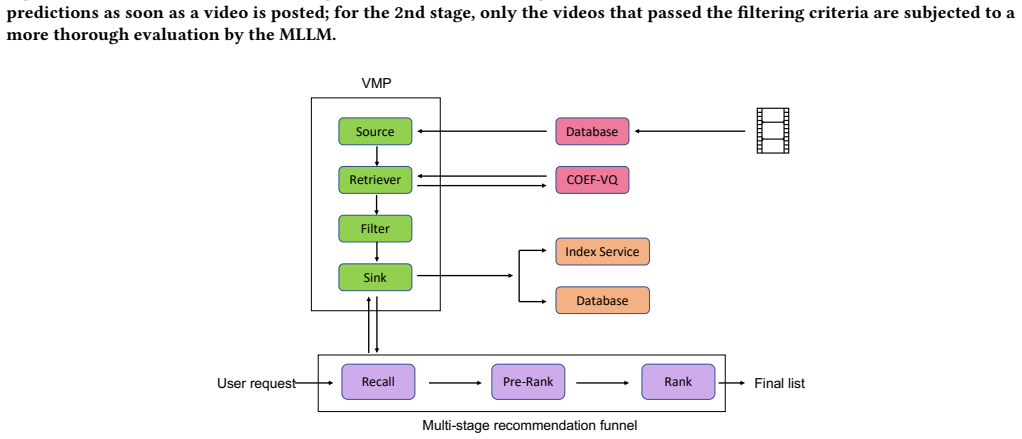
The load-bearing identity is the entropy of the base model's softmax output, H(p) = −∑_{i=1}^N p_i log p_i, used as a routing signal. The mechanism is the threshold: videos with entropy below the threshold are skipped, and the rest are escalated to the MLLM, so the operator has a single knob that trades GPU cost against how often the LLM gets the final say. The paper also uses metadata such as view counts as a supplementary filter in the production system, but the entropy criterion is what the experiments isolate and what carries the cost-accuracy argument.
What would settle it
Hold out a set of videos and compare the base model's low-entropy predictions against the MLLM's labels; if a sizable share of low-entropy videos are corrected by the MLLM, the routing signal is misaligned. A cleaner test is an online A/B comparison of entropy routing against random routing at the same LLM query rate, which isolates whether the entropy criterion itself adds value over merely downsampling.
Extended reading notes
Core claim
COEF-VQ is a two-stage serving framework: the first stage is the platform's existing lightweight model, which produces a softmax distribution over classes; the softmax entropy H = −∑ p_i log p_i is compared with a tunable threshold, and low-entropy videos are filtered out without further computation. Only high-entropy videos are reprocessed by a 7B multimodal LLM that fuses video frames and text tokens through a vision-language backbone (LLaVA-OneVision) and late-concatenates a Whisper audio embedding before a linear classification head. The paper's central empirical claim is that this routing preserves the full-LLM classification strength: at entropy thresholds of 0.6 for ICD and 0.3 for UCC, the cascade reaches recall at precision equal to or slightly above the LLM-only deployment while directing only 2.22% and 16.7% of the query rate to the LLM, respectively. In the online A/B test, the cascade (against a base-model-only control) reduced ic_vvr by 9.9% over 10 days using about 5% of the GPUs a full-traffic MLLM deployment would require, and a month of post-launch monitoring kept the reduction.
Load-bearing premise
The central premise is that a low-entropy prediction from the lightweight model is a prediction the MLLM would also get right, so skipping it loses nothing; if entropy does not track the MLLM's added value, the cascade either wastes GPU on easy videos or misses corrections it should have made.
Editorial extensions
If this is right
- The same cascade recipe should transfer to other high-cost classifiers: any domain where a cheap model already operates and an expensive model is more accurate can adopt entropy routing to cut serving cost.
- Entropy threshold becomes an operational safety dial: raising it sends more videos to the LLM and tightens moderation, lowering it frees GPU capacity.
- A 5% GPU footprint for a 7B MLLM makes multimodal video understanding feasible for real-time pipelines that previously could not afford it.
- The precision gains come mostly from the LLM removing false positives of the recall-hungry base model, so the framework is best suited to moderation-style tasks with high false-positive costs.
Reading between the lines
- The paper's Future Exploration section concedes that late-fused audio may not fully align with text and vision; a modality-alignment study would test whether the UCC gains grow with better audio fusion.
- The entropy threshold is used without a calibration analysis; a natural extension is to measure empirical agreement between base and MLLM as a function of entropy and set the threshold where disagreement begins to climb.
- Because the online experiment compares the cascade against the base-model-only control, it bundles the LLM's accuracy gain with the routing effect; a three-arm test with full-traffic LLM would separate the two contributions.
- As the system suppresses inappropriate videos, the input distribution shifts over time, so the authors' suggestion to recalibrate thresholds recurrently becomes a necessity rather than an option.
Editorial analysis
A structured set of objections, weighed in public.
Referee Report
Summary. The paper proposes COEF-VQ, a cascaded serving framework for video quality understanding on a short-video platform. A lightweight base model first scores each video and computes the softmax entropy of its prediction (Eq. 5); only videos whose entropy exceeds a threshold are sent to a fine-tuned 7B multimodal LLM (LLaVA-OneVision plus a Whisper audio encoder, with late fusion). The authors evaluate the framework on two in-house tasks, Inappropriate Content Detection (ICD) and Unoriginal Content Classification (UCC), report offline comparisons against the full MLLM at several entropy thresholds, and describe a production A/B test in which the cascade reduced the inappropriate-content video view rate by 9.9% while using roughly 5% of the GPUs of a full-traffic MLLM deployment.
Significance. The practical contribution is potentially significant: if the cascade truly preserves full-MLLM classification quality at a fraction of the GPU cost, it demonstrates a viable path to deploying expensive MLLMs for high-stakes content moderation at scale. The paper's strengths are its real production deployment, the 10-day online A/B test, the more-than-one-month post-launch monitoring, and the use of two large in-house datasets. However, the central claim that the cascade 'maintains the strong classification performance of a full MLLM deployment' is not fully established by the reported offline and online evidence, and several load-bearing points need additional analysis before the claim can be accepted as stated.
major comments (5)
- [Section 3.2, Table 2] The claim that COEF-VQ maintains full-MLLM performance is not supported at all operating points. On ICD, the highlighted efficient threshold H_base=0.6 gives R@P80=43.9 versus 53.1 for the full MLLM, a 9.2-point absolute drop, while R@P70 improves from 62.2 to 65.2; at H_base=0.3, R@P80 is 52.0 (still below 53.1) at 5.19% QPS. On UCC, R@P80 parity with the full MLLM is reached only at 16.7% QPS (H_base=0.3). The 'maintaining strong classification performance' statement is therefore true only for selected precision levels, and the choice of operating point is doing substantial work. Please report the full operating curves with a clearly defined acceptance criterion, or soften the claim to reflect the precision-level dependence.
- [Section 4, Online Evaluation] The online A/B test compares the cascade against a base-model-only control, not against a full-MLLM deployment. The 9.9% ic_vvr reduction therefore demonstrates that COEF-VQ improves on the base model, but it does not validate the abstract's assertion that the cascade maintains the strong classification performance of a full MLLM deployment under real traffic. Please state explicitly what the A/B contrast can and cannot show, or add a full-MLLM arm to the experiment.
- [Section 2.2.1, Eq. (5)] The routing criterion assumes that low-entropy base-model predictions can be safely skipped and that high-entropy videos benefit from MLLM review, but no calibration or decision-level analysis is provided. Table 6 compares entropy-based and confidence-based filters only on UCC at a single 10% QPS ratio; it does not show a monotone relationship between base-model entropy and the probability that the MLLM corrects an error or confirms a correct decision. Without such evidence, the 5% GPU result cannot be safely extrapolated to new tasks or traffic distributions. Please add calibration curves or an agreement analysis by entropy bin.
- [Section 3.1.3, Eq. (6), and Table 2] The offline comparisons report single point estimates without confidence intervals. The 'maximum Beta variance below 1%' criterion is a posterior variance of the positive-class proportion, not a confidence interval for recall at a given precision, and it is not reported per operating point. Since several key contrasts (e.g., ICD R@P80 52.0 versus 53.1 at H_base=0.3) are within plausible sampling error, please provide bootstrap or Bayesian intervals for the metrics in Tables 1 and 2.
- [Section 3.1.2 and Section 3.2] The entropy thresholds H_base are tuned on validation data, but the paper does not describe the threshold selection procedure or report how sensitive the Table 2 conclusions are to that choice. With a single threshold highlighted as efficient (H_base=0.6 for ICD), it is important to show that the qualitative conclusion is stable across thresholds and is not an artifact of validation-set selection.
minor comments (5)
- [Abstract] The abstract contains grammatical errors: 'in a online A/B test' should be 'in an online A/B test', and 'with limit resource consumption' should be 'with limited resource consumption'.
- [Section 3.3] The subsection heading 'Effects from Diffferent Rank and Alpha in LoRA' contains a typo: 'Diffferent' should be 'Different'.
- [Figure 2 caption] The caption text 'IF satisfiedcondition' is missing a space and is unclear; please specify what condition is being checked.
- [Section 3.1.2] The term 'ZERO2' appears to refer to the ZeRO optimization stage; please spell out and cite the correct name.
- [References] Several references are incomplete or link-only (e.g., [10] and [28]); please provide full bibliographic details.
Circularity Check
No significant circularity: COEF-VQ's cost and quality claims are empirical measurements, not quantities fitted to reproduce themselves.
full rationale
COEF-VQ makes no claim to derive its efficiency or accuracy from first principles. The GPU reduction is quantified by the measured QPS ratio to the MLLM stage (Table 2), the classification quality is measured on held-out test sets (Tables 1-2), and the online benefit is a measured ic_vvr reduction in an A/B test. The entropy threshold is a tunable operating parameter, and the paper reports performance across thresholds and compares entropy-based filtering against a confidence-based alternative (Table 6), so the central result is not an input to itself by construction. The only author self-citation (Ref. [19], appearing in Related Work to note the limited availability of triple-modality pretrained models) is not load-bearing. The critique that 'maintaining strong classification performance' is only true at selected precision operating points is an empirical-evidence concern, not a circularity.
Assumptions & free parameters
free parameters (4)
- Entropy threshold H_base =
0.6 (ICD), 0.3 (UCC) as reported operating points; 0.3/0.6/0.9 swept
- LoRA rank and alpha =
rank=32, alpha=64
- Number of video frames =
8 for ICD, 16 for UCC
- Beta variance certainty threshold =
1%
assumptions (4)
- domain assumption Softmax entropy of the base model is a reliable proxy for the incremental value of MLLM review.
- domain assumption Base model softmax probabilities are well-calibrated.
- standard math Beta-variance from [18] correctly characterizes uncertainty of precision/recall estimates.
- domain assumption The online A/B control and treatment groups differ only in use of the cascade.
Cite this review
Pith. "Pith review of COEF-VQ: Cost-Efficient Video Quality Understanding through a Cascaded Multimodal LLM Framework." pith.science (2026). https://pith.science/paper/3IFOBBNH
@misc{pith2026241210435,
  author       = {Pith},
  title        = {Pith review of: COEF-VQ: Cost-Efficient Video Quality Understanding through a Cascaded Multimodal LLM Framework},
  year         = {2026},
  howpublished = {\url{https://pith.science/paper/3IFOBBNH}},
  note         = {Machine review of arXiv:2412.10435}
}
read the original abstract
Recently, with the emergence of recent Multimodal Large Language Model (MLLM) technology, it has become possible to exploit its video understanding capability on different classification tasks. In practice, we face the difficulty of huge requirements for GPU resource if we need to deploy MLLMs online. In this paper, we propose COEF-VQ, a novel cascaded MLLM framework designed to enhance video quality understanding on the short-video platform while optimizing computational efficiency. Our approach integrates an entropy-based pre-filtering stage, where a lightweight model assesses uncertainty and selectively filters cases before passing them to the more computationally intensive MLLM for final evaluation. By prioritizing high-uncertainty samples for deeper analysis, our framework significantly reduces GPU usage while maintaining the strong classification performance of a full MLLM deployment. To demonstrate the effectiveness of COEF-VQ, we deploy this new framework onto the video management platform (VMP) at the short-video platform, and perform a series of detailed experiments on two in-house tasks related to video quality understanding. We show that COEF-VQ leads to substantial performance gains from the offline evaluation in these two tasks and effectively enhances platform safety with limit resource consumption, significantly reducing inappropriate content video view rate by 9.9% in a online A/B test without affecting engagement. Post-launch monitoring confirmed sustained improvements, validating its real-world impact.
Figures


Reference graph
Works this paper leans on
-
[1]
Josh Achiam, Steven Adler, Sandhini Agarwal, Lama Ahmad, Ilge Akkaya, Floren- cia Leoni Aleman, Diogo Almeida, Janko Altenschmidt, Sam Altman, Shyamal Anadkat, et al. 2023. Gpt-4 technical report. arXiv preprint arXiv:2303.08774 (2023)
arXiv 2023
-
[2]
Shuai Bai, Keqin Chen, Xuejing Liu, Jialin Wang, Wenbin Ge, Sibo Song, Kai Dang, Peng Wang, Shijie Wang, Jun Tang, et al . 2025. Qwen2. 5-vl technical report. arXiv preprint arXiv:2502.13923 (2025)
arXiv 2025
-
[3]
A Conneau. 2019. Unsupervised cross-lingual representation learning at scale. arXiv preprint arXiv:1911.02116 (2019)
arXiv 2019
-
[4]
Kaiming He, Xiangyu Zhang, Shaoqing Ren, and Jian Sun. 2016. Deep residual learning for image recognition. In Proceedings of the IEEE conference on computer vision and pattern recognition . 770–778
2016
-
[5]
Edward J Hu, Yelong Shen, Phillip Wallis, Zeyuan Allen-Zhu, Yuanzhi Li, Shean Wang, Lu Wang, and Weizhu Chen. 2021. Lora: Low-rank adaptation of large language models. arXiv preprint arXiv:2106.09685 (2021)
arXiv 2021
-
[6]
Bo Li, Yuanhan Zhang, Dong Guo, Renrui Zhang, Feng Li, Hao Zhang, Kaichen Zhang, Yanwei Li, Ziwei Liu, and Chunyuan Li. 2024. Llava-onevision: Easy visual task transfer. arXiv preprint arXiv:2408.03326 (2024)
arXiv 2024
-
[7]
Junnan Li, Ramprasaath Selvaraju, Akhilesh Gotmare, Shafiq Joty, Caiming Xiong, and Steven Chu Hong Hoi. 2021. Align before fuse: Vision and language repre- sentation learning with momentum distillation. Advances in neural information processing systems 34 (2021), 9694–9705
2021
-
[8]
Yangguang Li, Feng Liang, Lichen Zhao, Yufeng Cui, Wanli Ouyang, Jing Shao, Fengwei Yu, and Junjie Yan. 2021. Supervision exists everywhere: A data efficient contrastive language-image pre-training paradigm. arXiv preprint arXiv:2110.05208 (2021)
arXiv 2021
Show all 29 references
-
[9]
Ji Lin, Hongxu Yin, Wei Ping, Pavlo Molchanov, Mohammad Shoeybi, and Song Han. 2024. Vila: On pre-training for visual language models. In Proceedings of the IEEE/CVF Conference on Computer Vision and Pattern Recognition . 26689–26699
2024
-
[10]
Jian Liu, Yu Lee, and Ming Zhang. 2023. CAT: Enhancing Multimodal Large Language Model to Answer Questions in Dynamic Audio-Visual Scenarios. https: //link.springer.com/chapter/10.1007/978-3-031-72684-2_9
2023 doi
-
[11]
Ming Liu, Qi Zhang, and Jian Li. 2023. Macaw-LLM: Multi-Modal Language Modeling with Image, Audio, Video, and Text Integration. https://arxiv.org/abs/ 2306.09093
2023 arXiv
-
[12]
Ze Liu, Yutong Lin, Yue Cao, Han Hu, Yixuan Wei, Zheng Zhang, Stephen Lin, and Baining Guo. 2021. Swin transformer: Hierarchical vision transformer us- ing shifted windows. In Proceedings of the IEEE/CVF international conference on computer vision. 10012–10022
2021
-
[13]
Jiasen Lu, Dhruv Batra, Devi Parikh, and Stefan Lee. 2019. Vilbert: Pretrain- ing task-agnostic visiolinguistic representations for vision-and-language tasks. Advances in neural information processing systems 32 (2019)
2019
-
[14]
Shiyin Lu, Yang Li, Qing-Guo Chen, Zhao Xu, Weihua Luo, Kaifu Zhang, and Han-Jia Ye. 2024. Ovis: Structural embedding alignment for multimodal large language model. arXiv preprint arXiv:2405.20797 (2024)
2024 arXiv
-
[15]
Alec Radford, Jong Wook Kim, Chris Hallacy, Aditya Ramesh, Gabriel Goh, Sandhini Agarwal, Girish Sastry, Amanda Askell, Pamela Mishkin, Jack Clark, et al. 2021. Learning transferable visual models from natural language supervision. In International conference on machine learni...
2021
-
[16]
Alec Radford, Jong Wook Kim, Tao Xu, Greg Brockman, Christine McLeavey, and Ilya Sutskever. 2023. Robust speech recognition via large-scale weak supervision. In International conference on machine learning . PMLR, 28492–28518
2023
-
[17]
Samyam Rajbhandari, Jeff Rasley, Olatunji Ruwase, and Yuxiong He. 2020. Zero: Memory optimizations toward training trillion parameter models. In SC20: Inter- national Conference for High Performance Computing, Networking, Storage and Analysis. IEEE, 1–16
2020
-
[18]
Murat Sensoy, Lance Kaplan, and Melih Kandemir. 2018. Evidential Deep Learning to Quantify Classification Uncertainty. InAdvances in Neural Information Process- ing Systems, S. Bengio, H. Wallach, H. Larochelle, K. Grauman, N. Cesa-Bianchi, and R. Garnett (Eds.), Vol. 31. Curr...
2018
-
[19]
Yu Sun, Yin Li, Ruixiao Sun, Chunhui Liu, Fangming Zhou, Ze Jin, Linjie Wang, Xiang Shen, Zhuolin Hao, and Hongyu Xiong. 2025. Audio-Enhanced Vision- Language Modeling with Latent Space Broadening for High Quality Data Expan- sion. arXiv preprint arXiv:2503.17551 (2025)
2025
-
[20]
Gemini Team, Rohan Anil, Sebastian Borgeaud, Jean-Baptiste Alayrac, Jiahui Yu, Radu Soricut, Johan Schalkwyk, Andrew M Dai, Anja Hauth, Katie Millican, et al. 2023. Gemini: a family of highly capable multimodal models. arXiv preprint arXiv:2312.11805 (2023)
2023 arXiv
-
[21]
Peng Wang, Shuai Bai, Sinan Tan, Shijie Wang, Zhihao Fan, Jinze Bai, Keqin Chen, Xuejing Liu, Jialin Wang, Wenbin Ge, et al. 2024. Qwen2-vl: Enhancing vision-language model’s perception of the world at any resolution.arXiv preprint arXiv:2409.12191 (2024)
2024 arXiv
-
[22]
Wenhui Wang, Hangbo Bao, Li Dong, Johan Bjorck, Zhiliang Peng, Qiang Liu, Kriti Aggarwal, Owais Khan Mohammed, Saksham Singhal, Subhojit Som, et al
-
[23]
Lu Yuan, Dongdong Chen, Yi-Ling Chen, Noel Codella, Xiyang Dai, Jianfeng Gao, Houdong Hu, Xuedong Huang, Boxin Li, Chunyuan Li, et al. 2021. Florence: A new foundation model for computer vision. arXiv preprint arXiv:2111.11432 (2021)
2021 arXiv
-
[24]
Xiaohua Zhai, Basil Mustafa, Alexander Kolesnikov, and Lucas Beyer. 2023. Sig- moid loss for language image pre-training. In Proceedings of the IEEE/CVF Inter- national Conference on Computer Vision . 11975–11986
2023
-
[25]
Hang Zhang, Xin Li, and Lidong Bing. 2023. Video-llama: An instruction- tuned audio-visual language model for video understanding. arXiv preprint arXiv:2306.02858 (2023)
2023 arXiv
-
[26]
Pan Zhang, Xiaoyi Dong, Yuhang Zang, Yuhang Cao, Rui Qian, Lin Chen, Qipeng Guo, Haodong Duan, Bin Wang, Linke Ouyang, et al. 2024. Internlm-xcomposer- 2.5: A versatile large vision language model supporting long-contextual input and output. arXiv preprint arXiv:2407.03320 (2024)
2024 arXiv
-
[27]
Pengchuan Zhang, Xiujun Li, Xiaowei Hu, Jianwei Yang, Lei Zhang, Lijuan Wang, Yejin Choi, and Jianfeng Gao. 2021. Vinvl: Revisiting visual representations in vision-language models. In Proceedings of the IEEE/CVF conference on computer vision and pattern recognition . 5579–5588
2021
-
[28]
Qiang Zhu, Qi Zhang, and Zhen Lee. 2024. MEERKAT: Audio-Visual Large Language Model for Grounding in Space and Time. https://link.springer.com/ chapter/10.1007/978-3-031-73039-9_4
2024 doi
-
[2022]
arXiv preprint arXiv:2208.10442 (2022)
Image as a foreign language: Beit pretraining for all vision and vision- language tasks. arXiv preprint arXiv:2208.10442 (2022)
2022 arXiv
Reviewed August 11, 2026 · model on record in the stance chip above.
Discussion (0). Continue with ORCID to comment.