REVIEW 3 major objections 4 minor 76 references
Neutrinoless double beta decay with light sterile neutrinos: the contact terms
T0 review · 3 major / 4 minor · reviewed 2026-08-11 · deepseek-v4-flash
Pith's one-line read Sterile neutrino masses below 1 GeV shift the 0νββ short-range coupling by an order of magnitude more than assumed, lengthening predicted half-lives in the 200–800 MeV range.
desk verdict First real calculation of the ms-dependence of the 0νββ short-range couplings—likely right within the model, but the central ms^2 coefficient is a delicate cancellation and deserves a robustness check before it drives phenomenology. read the letter →
The pith
A machine-rendered reading of the paper's core claim, the machinery that carries it, and where it could break.
The reading
What carries the argument
The central object is the matching condition for the dimensionless low-energy constant $\widetilde{C}_1(\mu_\chi, m_s)$, defined from the $nn\to pp$ contact term by Eq. (2.6). The authors build a 'full' amplitude $a_<(|k|, m_s)$ for neutrino virtualities up to an arbitrary scale $\Lambda$ from chiral EFT at low momentum, dipole form factors and a Kaplan–Steele three-Yukawa potential for the two-nucleon half-off-shell amplitude (the momentum dependence of the short-range $^1S_0$ scattering amplitude away from the energy shell) at intermediate momentum, and an operator-product-expansion tail above $\Lambda$; they then equate this to the chiral EFT amplitude, whose singular piece contains the same topology plus the counterterm $\widetilde{C}_1$. The key structural step is subtracting the infrared behavior: the full amplitude contains powers of $m_s \tan^{-1}(\lambda/m_s)$ and logarithms of $m_s^2+|p|_{\rm ext}^2$, while the EFT amplitude reproduces them only after including the NLO term $d_{\rm NLO}\,\pi\, m_s$, so that the difference is the polynomial in $m_s^2$ that defines $C_1(m_s)$. The same machinery, with the $\pi^-\to\pi^+$ amplitude and the vector-like current $J_\mu^V=J_\mu^L+J_\mu^R$, extracts $C_1+C_2$ for left-right models via Eq. (3.28).
What would settle it
A concrete check is to re-run the matching with a different representation of the full amplitude—for instance, including inelastic $NN\pi$ intermediate states or using a different $NN$ potential such as Reid or CD-Bonn—and compare the extracted $m_s^2$ coefficient of $C_1(m_s)$ with the 12.062 GeV$^{-2}$ of Eq. (2.29); a shift larger than the paper's stated 30–50% uncertainty would falsify the prediction. A direct lattice QCD extraction of the $nn\to pp$ short-range amplitude at a few sterile masses between 100 and 500 MeV would settle the same question without the model assumption.
Extended reading notes
Core claim
On the paper's own terms, the discovery is an explicit, numerically evaluated mass dependence for the leading-order short-range $nn\to pp$ operators of 0νββ. For the minimal $\nu$SM, the dimensionless coupling evaluated at $\mu_\chi=m_\pi$ is $C_1(m_s) \simeq 1.377 + (12.062/\mathrm{GeV}^2)\, m_s^2 - (16.735/\mathrm{GeV}^4)\, m_s^4$, Eq. (2.29); for the left-right scenario, $C_1+C_2 \simeq 2.253 + (7.993/\mathrm{GeV}^2)\, m_s^2$, Eq. (3.34). These polynomials are extracted by matching a modeled full amplitude, split into low-, intermediate-, and high-momentum regions, against the chiral EFT amplitude, after including the NLO linear-in-$m_s$ term that carries the infrared behavior. The paper demonstrates that the extracted coupling is independent of the arbitrary matching scales and external momenta to within about 1%, and that the non-analytic $m_s$ logarithms cancel between the full and EFT amplitudes, so the coupling is the polynomial in $m_s^2$ that EFT principles require. The numerical consequence is that the $m_s^2$ coefficient is roughly an order of magnitude larger than the NDA-based estimate used in Ref. [34], which substantially alters half-life predictions when $200\ \mathrm{MeV} \lesssim m_s \lesssim 800\ \mathrm{MeV}$.
Load-bearing premise
The load-bearing premise is the model chosen for the full hadronic amplitude that is matched onto the EFT — chiral EFT at low momentum, dipole form factors with a three-Yukawa nucleon-nucleon potential in the intermediate region, and an OPE tail at high momentum — so if that interpolation misses an important intermediate state such as inelastic $NN\pi$, or if the assumed cancellation of non-analytic $m_s$ terms in the left-right extraction fails, the quoted polynomial coefficients shift.
Editorial extensions
If this is right
- For sterile neutrino masses between 200 and 800 MeV, the half-life of 0νββ in the 3+1 νSM scenario is up to six times longer than earlier NDA-based estimates, so interpreting a null experimental signal as a bound on sterile-neutrino parameters requires the new $C_1(m_s)$.
- The $m_s^2$ coefficient of $C_1+C_2$ in left-right symmetric models is also several times larger than NDA would suggest, shifting the predicted 0νββ amplitude in that scenario for $m_s$ up to about 1 GeV.
- The extracted low-energy constant remains polynomial in $m_s^2$ up to the breakdown scale $m_s\sim\Lambda_\chi$, confirming that the EFT description of Refs. [32–34] is consistent; only the numerical interpolation of $C_1(m_s)$ needs to be updated.
- The new interpolation of $C_1(m_s)$ follows the polynomial expansion up to about $3m_\pi$ before turning over to the $1/m_s^2$ behavior, which changes where the contact term's contribution is maximal relative to the long-range and ultrasoft contributions.
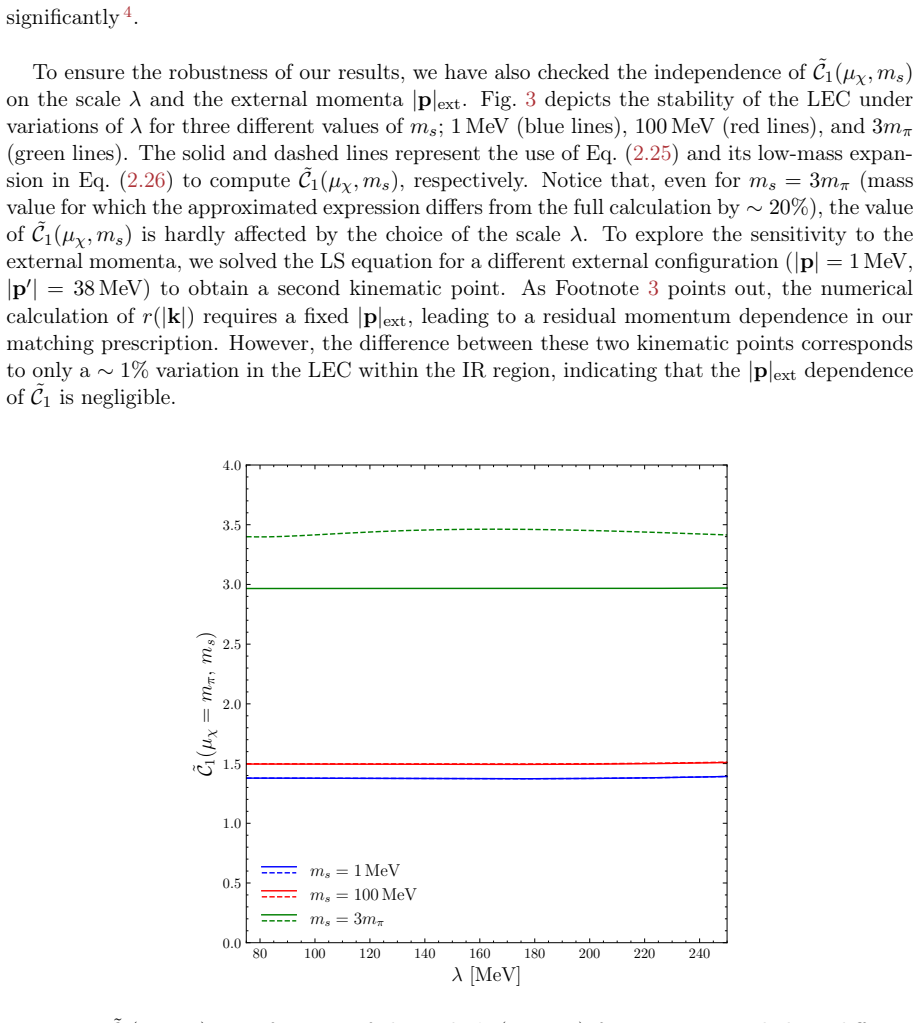
- Varying the arbitrary matching scales $\lambda$, $\Lambda$, and external momenta changes the extracted coupling by only about 1%, so the numerical result is stable within the chosen model.
Reading between the lines
- If the assumed cancellation of non-analytic $m_s$ terms in Section 3.2.2 were found to fail in a complete N2LO calculation, the left-right coefficient $C_1+C_2$ quoted in Eq. (3.34) could shift at the same order as its $m_s^2$ term; a full two-loop EFT calculation would be the direct test.
- The same matching approach could be applied to sterile masses above O(1 GeV) with the $1/m_s^2$ dimension-nine operator description restored, in principle connecting the low-mass polynomial and the heavy-mass tail by a single hadronic model.
- Because the contact term is isospin-symmetric and nuclear-structure independent, comparing 0νββ rates across different isotopes in the $m_s=200$–$800\ \mathrm{MeV}$ window could separate the $C_1(m_s)$ contribution from the long-range potential, providing an observable cross-check on the nuclear matrix elements used in the interpolation.
- If a future lattice QCD calculation confirms the large $m_s^2$ coefficient found here, then previous sterile-neutrino interpretations of 0νββ limits—which used the NDA-sized coefficient—will need to be re-evaluated, and the allowed parameter space will shift toward larger mixings.
Editorial analysis
A structured set of objections, weighed in public.
Referee Report
Summary. The paper derives the sterile-neutrino-mass dependence of the leading short-range nn→pp couplings in chiral EFT for 0νββ, for the minimal νSM (LL) scenario and for left-right (LR) scenarios. Using a Cottingham-style matching between a modeled full hadronic amplitude and chiral EFT, it obtains Eq. (2.29) for C1(ms) and Eq. (3.34) for C1+C2(ms), and uses these results to update the prediction of 0νββ half-lives in a simplified 3+1 model, finding a lengthening by up to a factor of roughly six for ms between 200 and 800 MeV.
Significance. If correct, the extracted ms^2 coefficient C~(2)_1 ≈ 12 GeV^-2 is an order of magnitude larger than the NDA estimate used in Ref. [34], and it materially changes the sterile-neutrino interpretation of 0νββ searches in a mass range that is otherwise difficult to probe. The paper's strengths include explicit analytic matching expressions, a transparent polynomial expansion in ms (Eqs. (2.29) and (3.34)), stability checks against the arbitrary scales λ and Λ and against the external momenta, and a falsifiable prediction that can be confronted with future lattice-QCD or alternative NN-potential calculations. The paper also identifies a small (≈ -0.6) shift in the ms=0 LR contact term relative to Ref. [46], which is a useful technical advance. The main limitation is that the full hadronic amplitude is modeled rather than computed from QCD, and the LR extraction relies on an assumed cancellation of non-analytic terms, so the accuracy of the headline coefficients rests on model assumptions that are not yet fully quantified.
major comments (3)
- [§2.2, Eqs. (2.27)–(2.29)]
- [§3.2.2, Eq. (3.28)]
- [§4, Eq. (4.5) and Fig. 6]
minor comments (4)
- [§2.2, Eq. (2.29)]
- [§3.4, Eq. (3.34)]
- [§4, Eq. (4.4)]
- [§5, Conclusions]
Circularity Check
No load-bearing circularity; the ms-dependent short-range couplings are extracted from independent hadronic inputs, with reliance on the authors' own matching methodology being methodological rather than input-output circular.
full rationale
The derivation of C1(ms) and C1(ms)+C2(ms) is not circular in the sense required by the analysis. The couplings are obtained by matching chiral EFT amplitudes to a modeled full amplitude built from independent inputs: nucleon form factors, the Kaplan-Steel three-Yukawa NN potential, the OPE tail with gbar_NN^1 treated as an unknown range, and lattice/experimental inputs such as Z(0) and gbar_pi_pi_LR. No low-energy constant is fitted to 0nubb data; the half-life calculation in Sec. 4 is an application of the extracted C1(ms), not an input to it. The paper self-cites Refs. [45,46] for the Cottingham-style matching methodology and states 'we extend the methodology of Refs. [45,46], to which we refer the reader for details'; this is methodological inheritance, and the ms-dependence computed here is new content, so it does not reduce the central claim to the cited work. The largest caveat is explicit in the text: in Sec. 3.2.2 the authors state, 'we simply assume the cancellation takes place and subtract any non-analytic terms in ms from Eq (3.24) in the matching condition.' This is an unproven EFT-consistency assumption that adds model dependence, but it is not circular because the subtracted terms are prescribed by the required polynomial form of the LEC, not by a fitted target observable. Similarly, the conclusion's admission of 'an overall 30-50% fractional error' from missing inelastic NNpi states and NN-potential model dependence is a limitation, not an input-output inversion. Therefore no specific equation reduces by construction to its inputs, and the score reflects only the minor self-citation reliance in the matching framework.
Assumptions & free parameters
free parameters (5)
- dNLO = 8 C2 / (m_N C^2), with C2/C^2 approximately 0.38 =
0.38 (from Ref. [54])
- Kaplan-Steel three-Yukawa potential parameters =
not quoted; from Ref. [51]
- gbar_NN^1, nn to pp matrix element of the local operator in the OPE tail =
varied over [-10, +10]
- gbar_NN^LR, analogous nucleon matrix element for the left-right scenario =
varied over [-10, +10]
- Interpolation coefficients a2, a4, b4, b6 in Eq. (4.5) =
a2 = 8.8 GeV^-2, a4 = -1.9 GeV^-4, b4 = 10 GeV^-4, b6 = 11 GeV^-6
assumptions (5)
- domain assumption Chiral EFT expansion in ms / Lambda_chi is valid for the mass range studied, with the polynomial expansion valid up to approximately m_K or 3 m_pi.
- ad hoc to paper The full hadronic amplitude in the Cottingham matching is adequately represented by the low-energy chiral EFT model, the form-factor and NN-potential model, and the OPE tail, with an interpolation between regions.
- domain assumption The operator product expansion sets in above a scale Lambda of order GeV, and the high-momentum contribution can be computed with the unknown matrix element gbar_NN^1.
- ad hoc to paper In the left-right matching, uncalculated N2LO chiral EFT loops exactly cancel the non-analytic ms terms present in the modeled full amplitude.
- ad hoc to paper The high-mass behavior of C1(ms) is captured by dimension-nine operator matching plus the interpolation ansatz Eq. (4.5), with a maximum near 3 m_pi.
Cite this review
Pith. "Pith review of Neutrinoless double beta decay with light sterile neutrinos: the contact terms." pith.science (2026). https://pith.science/paper/7B2EJWAG
@misc{pith2026241210497,
  author       = {Pith},
  title        = {Pith review of: Neutrinoless double beta decay with light sterile neutrinos: the contact terms},
  year         = {2026},
  howpublished = {\url{https://pith.science/paper/7B2EJWAG}},
  note         = {Machine review of arXiv:2412.10497}
}
abstract
We study neutrinoless double-beta decay in extensions of the Standard Model that include $n$ right-handed neutrino singlets, with masses $m_s$ below the GeV scale. Generalizing recently developed matching methods, we determine the $m_s$ dependence of the short-range $nn \to pp$ couplings that appear to leading order in the chiral effective field theory description of neutrinoless double beta decay. We focus on two scenarios, corresponding to the minimal $\nu$SM and left-right symmetric models. We illustrate the impact of our new results in the case of the $\nu$SM, showing a significant impact on the neutrinoless double-beta decay half-life when $m_s$ is in the 200-800 MeV range.
Figures


Figures from the paper (3 more)


Reference graph
Works this paper leans on
-
[46]
V. Cirigliano, W. Dekens, J. de Vries, M. Hoferichter and E. Mereghetti,Determining the leading-order contact term in neutrinoless doubleβ decay, JHEP 05 (2021) 289, [2102.03371]
arXiv 2021
-
[71]
G. Van Goffrier,An Improved Precision Calculation of the0νββ Contact Term within Chiral Effective Field Theory, 2412.08638
- [34]
-
[1]
S. L. Glashow,The renormalizability of vector meson interactions, Nucl. Phys. 10 (1959) 107–117
work page 1959
-
[2]
A. Salam and J. C. Ward,Weak and electromagnetic interactions, Nuovo Cim. 11 (1959) 568–577
work page 1959
-
[3]
Weinberg,A Model of Leptons, Phys
S. Weinberg,A Model of Leptons, Phys. Rev. Lett.19 (1967) 1264–1266
work page 1967
-
[4]
Fukuda et al.,Evidence for oscillation of atmospheric neutrinos, Phys
Super-Kamiokande collaboration, Y. Fukuda et al.,Evidence for oscillation of atmospheric neutrinos, Phys. Rev. Lett.81 (1998) 1562–1567
work page 1998
-
[5]
SNO collaboration, Q. R. Ahmad et al.,Measurement of the rate ofνe + d → p + p + e− interactions produced by8B solar neutrinos at the Sudbury Neutrino Observatory, Phys. Rev. Lett.87 (2001) 071301, [nucl-ex/0106015]
arXiv 2001
Show all 76 references
-
[6]
Eguchi et al.,First results from KamLAND: Evidence for reactor anti-neutrino disappearance, Phys
KamLAND collaboration, K. Eguchi et al.,First results from KamLAND: Evidence for reactor anti-neutrino disappearance, Phys. Rev. Lett.90 (2003) 021802, [hep-ex/0212021]
2003 arXiv
-
[7]
Navas et al.,Review of particle physics, Phys
Particle Data Group collaboration, S. Navas et al.,Review of particle physics, Phys. Rev. D 110 (2024) 030001
2024
-
[8]
Fukugita and T
M. Fukugita and T. Yanagida,Baryogenesis Without Grand Unification, Phys. Lett. B 174 (1986) 45–47. 28
1986
-
[9]
Asaka and M
T. Asaka and M. Shaposhnikov,The νMSM, dark matter and baryon asymmetry of the universe, Phys. Lett. B620 (2005) 17–26, [hep-ph/0505013]
2005 arXiv
-
[10]
Dodelson and L
S. Dodelson and L. M. Widrow,Sterile-neutrinos as dark matter, Phys. Rev. Lett.72 (1994) 17–20, [hep-ph/9303287]
1994 arXiv
-
[11]
Weinberg,Baryon and Lepton Nonconserving Processes, Phys
S. Weinberg,Baryon and Lepton Nonconserving Processes, Phys. Rev. Lett.43 (1979) 1566–1570
1979
-
[12]
Shaposhnikov,A Possible symmetry of the nuMSM, Nucl
M. Shaposhnikov,A Possible symmetry of the nuMSM, Nucl. Phys. B763 (2007) 49–59, [hep-ph/0605047]
2007 arXiv
-
[13]
Shaposhnikov,The nuMSM, leptonic asymmetries, and properties of singlet fermions, JHEP 08 (2008) 008, [0804.4542]
M. Shaposhnikov,The nuMSM, leptonic asymmetries, and properties of singlet fermions, JHEP 08 (2008) 008, [0804.4542]
2008 arXiv
-
[14]
Canetti, M
L. Canetti, M. Drewes, T. Frossard and M. Shaposhnikov,Dark Matter, Baryogenesis and Neutrino Oscillations from Right Handed Neutrinos, Phys. Rev. D87 (2013) 093006, [1208.4607]
2013 arXiv
-
[15]
Canetti, M
L. Canetti, M. Drewes and M. Shaposhnikov,Sterile Neutrinos as the Origin of Dark and Baryonic Matter, Phys. Rev. Lett.110 (2013) 061801, [1204.3902]
2013 arXiv
-
[16]
Drewes, B
M. Drewes, B. Garbrecht, D. Gueter and J. Klaric,Testing the low scale seesaw and leptogenesis, JHEP 08 (2017) 018, [1609.09069]
2017 arXiv
-
[17]
Drewes, B
M. Drewes, B. Garbrecht, P. Hernandez, M. Kekic, J. Lopez-Pavon, J. Racker et al.,ARS Leptogenesis, Int. J. Mod. Phys. A33 (2018) 1842002, [1711.02862]
2018 arXiv
-
[18]
Drewes, Y
M. Drewes, Y. Georis and J. Klarić,Mapping the Viable Parameter Space for Testable Leptogenesis, Phys. Rev. Lett.128 (2022) 051801, [2106.16226]
2022 arXiv
-
[19]
Boyarsky, M
A. Boyarsky, M. Drewes, T. Lasserre, S. Mertens and O. Ruchayskiy,Sterile neutrino Dark Matter, Prog. Part. Nucl. Phys.104 (2019) 1–45, [1807.07938]
2019 arXiv
-
[20]
Blennow, E
M. Blennow, E. Fernandez-Martinez, J. Lopez-Pavon and J. Menéndez,Neutrinoless double beta decay in seesaw models, JHEP 07 (2010) 096, [1005.3240]
2010 arXiv
-
[21]
Mitra, G
M. Mitra, G. Senjanović and F. Vissani,Neutrinoless Double Beta Decay and Heavy Sterile Neutrinos, Nucl. Phys. B856 (2012) 26–73, [1108.0004]
2012 arXiv
-
[22]
Y. F. Li and S.-s. Liu,Vanishing effective mass of the neutrinoless double beta decay including light sterile neutrinos, Phys. Lett. B706 (2012) 406–411, [1110.5795]
2012 arXiv
-
[23]
de Gouvêa and W.-C
A. de Gouvêa and W.-C. Huang,Constraining the (Low-Energy) Type-I Seesaw, Phys. Rev. D85 (2012) 053006, [1110.6122]
2012 arXiv
-
[24]
Faessler, M
A. Faessler, M. González, S. Kovalenko and F. Šimkovic,Arbitrary mass Majorana neutrinos in neutrinoless double beta decay, Phys. Rev. D90 (2014) 096010, [1408.6077]
2014 arXiv
-
[25]
Barea, J
J. Barea, J. Kotila and F. Iachello,Limits on sterile neutrino contributions to neutrinoless double beta decay, Phys. Rev. D92 (2015) 093001, [1509.01925]. 29
2015 arXiv
-
[26]
Giunti and E
C. Giunti and E. M. Zavanin,Predictions for Neutrinoless Double-Beta Decay in the 3+1 Sterile Neutrino Scenario, JHEP 07 (2015) 171, [1505.00978]
2015 arXiv
-
[27]
Asaka, S
T. Asaka, S. Eijima and H. Ishida,Mixing of Active and Sterile Neutrinos, JHEP 04 (2011) 011, [1101.1382]
2011 arXiv
-
[28]
Asaka and S
T. Asaka and S. Eijima,Direct Search for Right-handed Neutrinos and Neutrinoless Double Beta Decay, PTEP 2013 (2013) 113B02, [1308.3550]
2013 arXiv
-
[29]
Asaka, S
T. Asaka, S. Eijima and H. Ishida,On neutrinoless double beta decay in theνMSM, Phys. Lett. B762 (2016) 371–375, [1606.06686]
2016 arXiv
-
[30]
de Vries, G
J. de Vries, G. Li, M. J. Ramsey-Musolf and J. C. Vasquez,Light sterile neutrinos, left-right symmetry, and 0νββ decay, JHEP 11 (2022) 056, [2209.03031]
2022 arXiv
-
[31]
de Vries, M
J. de Vries, M. Drewes, Y. Georis, J. Klarić and V. Plakkot,Confronting the low-scale seesaw and leptogenesis with neutrinoless double beta decay, 2407.10560
-
[32]
Dekens, J
W. Dekens, J. de Vries, K. Fuyuto, E. Mereghetti and G. Zhou,Sterile neutrinos and neutrinoless double beta decay in effective field theory, JHEP 06 (2020) 097, [2002.07182]
2020 arXiv
-
[33]
Dekens, J
W. Dekens, J. de Vries, E. Mereghetti, J. Menéndez, P. Soriano and G. Zhou,Neutrinoless double-β decay in the neutrino-extended standard model, Phys. Rev. C 108 (2023) 045501, [2303.04168]
2023 arXiv
-
[35]
Cabibbo,Unitary Symmetry and Leptonic Decays, Phys
N. Cabibbo,Unitary Symmetry and Leptonic Decays, Phys. Rev. Lett.10 (1963) 531–533
1963
-
[36]
Kobayashi and T
M. Kobayashi and T. Maskawa,CP Violation in the Renormalizable Theory of Weak Interaction, Prog. Theor. Phys.49 (1973) 652–657
1973
-
[37]
Weinberg,Phenomenological Lagrangians, Physica A96 (1979) 327–340
S. Weinberg,Phenomenological Lagrangians, Physica A96 (1979) 327–340
1979
-
[38]
Gasser and H
J. Gasser and H. Leutwyler,Chiral Perturbation Theory to One Loop, Annals Phys. 158 (1984) 142
1984
-
[39]
Gasser and H
J. Gasser and H. Leutwyler,Chiral Perturbation Theory: Expansions in the Mass of the Strange Quark, Nucl. Phys. B250 (1985) 465–516
1985
-
[40]
Weinberg,Nuclear forces from chiral Lagrangians, Phys
S. Weinberg,Nuclear forces from chiral Lagrangians, Phys. Lett. B251 (1990) 288–292
1990
-
[41]
Weinberg,Effective chiral Lagrangians for nucleon - pion interactions and nuclear forces, Nucl
S. Weinberg,Effective chiral Lagrangians for nucleon - pion interactions and nuclear forces, Nucl. Phys. B 363 (1991) 3–18
1991
-
[42]
Nicholson et al.,Heavy physics contributions to neutrinoless double beta decay from QCD, Phys
A. Nicholson et al.,Heavy physics contributions to neutrinoless double beta decay from QCD, Phys. Rev. Lett.121 (2018) 172501, [1805.02634]
2018 arXiv
-
[43]
Detmold, W
W. Detmold, W. I. Jay, D. J. Murphy, P. R. Oare and P. E. Shanahan,Neutrinoless double beta decay from lattice QCD: The short-distance amplitude, Phys. Rev. D107 (2023) 094501, [2208.05322]. 30
2023 arXiv
-
[44]
Cirigliano, W
V. Cirigliano, W. Dekens, J. De Vries, M. L. Graesser, E. Mereghetti, S. Pastore et al.,A renormalized approach to neutrinoless double-beta decay, Phys. Rev. C100 (2019) 055504, [1907.11254]
2019 arXiv
-
[45]
Cirigliano, W
V. Cirigliano, W. Dekens, J. de Vries, M. Hoferichter and E. Mereghetti,Toward Complete Leading-Order Predictions for Neutrinoless Doubleβ Decay, Phys. Rev. Lett.126 (2021) 172002, [2012.11602]
2021 arXiv
-
[47]
Manohar and H
A. Manohar and H. Georgi,Chiral Quarks and the Nonrelativistic Quark Model, Nucl. Phys. B234 (1984) 189–212
1984
-
[48]
Weinberg,Larger Higgs Exchange Terms in the Neutron Electric Dipole Moment, Phys
S. Weinberg,Larger Higgs Exchange Terms in the Neutron Electric Dipole Moment, Phys. Rev. Lett.63 (1989) 2333
1989
-
[49]
Cirigliano, W
V. Cirigliano, W. Dekens, J. De Vries, M. L. Graesser, E. Mereghetti, S. Pastore et al.,A new leading contribution to neutrinoless double-beta decay, Phys. Rev. Lett.120 (2018) 202001, [1802.10097]
2018 arXiv
-
[50]
M. K. Srivastava and D. W. L. Sprung,Off-Shell Behavior of the Nucleon-Nucleon Interaction, pp. 121–218. Springer US, Boston, MA, 1975
1975
-
[51]
D. B. Kaplan and J. V. Steele,The Long and short of nuclear effective field theory expansions, Phys. Rev. C 60 (1999) 064002, [nucl-th/9905027]
1999 arXiv
-
[52]
R. V. Reid, Jr.,Local phenomenological nucleon-nucleon potentials, Annals Phys. 50 (1968) 411–448
1968
-
[53]
R. B. Wiringa, V. G. J. Stoks and R. Schiavilla,An Accurate nucleon-nucleon potential with charge independence breaking, Phys. Rev. C 51 (1995) 38–51, [nucl-th/9408016]
1995 arXiv
-
[54]
D. B. Kaplan, M. J. Savage and M. B. Wise,Nucleon - nucleon scattering from effective field theory, Nucl. Phys. B478 (1996) 629–659, [nucl-th/9605002]
1996 arXiv
-
[55]
del Aguila, S
F. del Aguila, S. Bar-Shalom, A. Soni and J. Wudka,Heavy Majorana Neutrinos in the Effective Lagrangian Description: Application to Hadron Colliders, Phys. Lett. B670 (2009) 399–402, [0806.0876]
2009 arXiv
-
[56]
Cirigliano, S
V. Cirigliano, S. Gardner and B. Holstein,Beta Decays and Non-Standard Interactions in the LHC Era, Prog. Part. Nucl. Phys.71 (2013) 93–118, [1303.6953]
2013 arXiv
-
[57]
Liao and X.-D
Y. Liao and X.-D. Ma,Operators up to Dimension Seven in Standard Model Effective Field Theory Extended with Sterile Neutrinos, Phys. Rev. D96 (2017) 015012, [1612.04527]
2017 arXiv
-
[58]
J. C. Pati and A. Salam,Lepton Number as the Fourth Color, Phys. Rev. D10 (1974) 275–289
1974
-
[59]
R. N. Mohapatra and J. C. Pati,Left-Right Gauge Symmetry and an Isoconjugate Model of CP Violation, Phys. Rev. D11 (1975) 566–571. 31
1975
-
[60]
Senjanović and R
G. Senjanović and R. N. Mohapatra,Exact Left-Right Symmetry and Spontaneous Violation of Parity, Phys. Rev. D12 (1975) 1502
1975
-
[61]
Fileviez Perez and M
P. Fileviez Perez and M. B. Wise,Low Scale Quark-Lepton Unification, Phys. Rev. D88 (2013) 057703, [1307.6213]
2013 arXiv
-
[62]
Doršner, S
I. Doršner, S. Fajfer, A. Greljo, J. F. Kamenik and N. Košnik,Physics of leptoquarks in precision experiments and at particle colliders, Phys. Rept. 641 (2016) 1–68, [1603.04993]
2016 arXiv
-
[63]
Grinstein, V
B. Grinstein, V. Cirigliano, G. Isidori and M. B. Wise,Grand Unification and the Principle of Minimal Flavor Violation, Nucl. Phys. B763 (2007) 35–48, [hep-ph/0608123]
2007 arXiv
-
[64]
G. Li, M. J. Ramsey-Musolf, S. Urrutia Quiroga and J. C. Vasquez,Dissecting Lepton Number Violation in the Left-Right Symmetric Model:0νββ decay, Møller scattering, and collider searches, 2408.06306
-
[65]
Prézeau, M
G. Prézeau, M. Ramsey-Musolf and P. Vogel,Neutrinoless double beta decay and effective field theory, Phys. Rev. D68 (2003) 034016, [hep-ph/0303205]
2003 arXiv
-
[66]
G. Li, M. Ramsey-Musolf and J. C. Vasquez,Left-Right Symmetry and Leading Contributions to Neutrinoless Double Beta Decay, Phys. Rev. Lett.126 (2021) 151801, [2009.01257]
2021 arXiv
-
[67]
X.-Y. Tuo, X. Feng and L.-C. Jin,Lattice QCD calculation of the light sterile neutrino contribution in 0ν2β decay, Phys. Rev. D106 (2022) 074510, [2206.00879]
2022 arXiv
-
[68]
Cirigliano, W
V. Cirigliano, W. Dekens, E. Mereghetti and A. Walker-Loud,Neutrinoless double-β decay in effective field theory: The light-Majorana neutrino-exchange mechanism, Phys. Rev. C 97 (2018) 065501, [1710.01729]
2018 arXiv
-
[69]
Horoi and A
M. Horoi and A. Neacsu,Towards an effective field theory approach to the neutrinoless double-beta decay, 1706.05391
-
[70]
Jokiniemi, P
L. Jokiniemi, P. Soriano and J. Menéndez,Impact of the leading-order short-range nuclear matrix element on the neutrinoless double-beta decay of medium-mass and heavy nuclei, Phys. Lett. B823 (2021) 136720, [2107.13354]
2021 arXiv
-
[72]
X.-Y. Tuo, X. Feng and L.-C. Jin,Long-distance contributions to neutrinoless double beta decay π− → π+ee, Phys. Rev. D100 (2019) 094511, [1909.13525]
2019 arXiv
-
[73]
Feng, L.-C
X. Feng, L.-C. Jin, X.-Y. Tuo and S.-C. Xia,Light-Neutrino Exchange and Long-Distance Contributions to 0ν2β Decays: An Exploratory Study onππ → ee, Phys. Rev. Lett.122 (2019) 022001, [1809.10511]
2019 arXiv
-
[74]
Davoudi and S
Z. Davoudi and S. V. Kadam,Path from Lattice QCD to the Short-Distance Contribution to 0νββ Decay with a Light Majorana Neutrino, Phys. Rev. Lett.126 (2021) 152003, [2012.02083]. 32
2021 arXiv
-
[75]
D. B. Kaplan, M. J. Savage and M. B. Wise,Two nucleon systems from effective field theory, Nucl. Phys. B 534 (1998) 329–355, [nucl-th/9802075]
1998 arXiv
-
[76]
D. B. Kaplan, M. J. Savage and M. B. Wise,A New expansion for nucleon-nucleon interactions, Phys. Lett. B424 (1998) 390–396, [nucl-th/9801034]. 33
1998 arXiv
Reviewed August 11, 2026 · model on record in the stance chip above.
Discussion (0). Continue with ORCID to comment.