REVIEW 3 major objections 5 minor 67 references
Tunable Coupling, Topology, and Chirality by Antimagnons in Magnetic Multilayer
T0 review · 3 major / 5 minor · reviewed 2026-08-11 · deepseek-v4-flash
Pith's one-line read By coupling ordinary magnons to left-handed antimagnons via layer-to-layer dipolar forces, the authors construct a 2D-SSH4 chain whose bands carry nonzero Chern numbers and argue that the resulting surface states share the topological…
desk verdict Clear, inventive antimagnon-based topological magnonics, but the Chern number may be ill-defined in the dissipative-coupling regime. read the letter →
The pith
A machine-rendered reading of the paper's core claim, the machinery that carries it, and where it could break.
The reading
What carries the argument
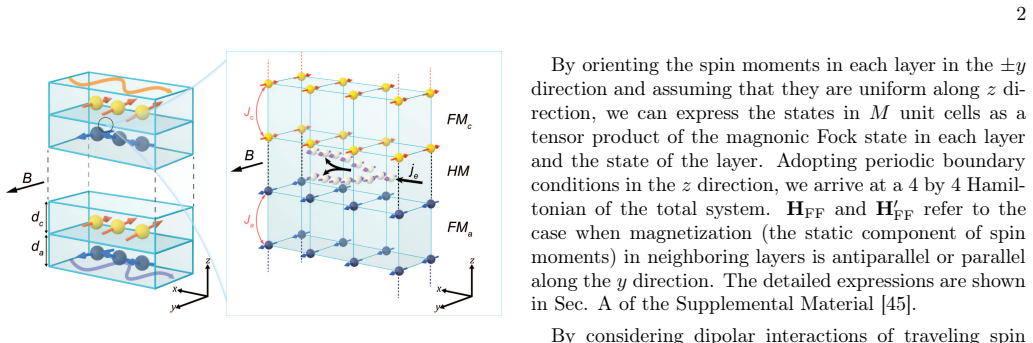
The central object is the 2D-SSH4 chain: a two-dimensional Su-Schrieffer-Heeger model with four internal states per magnetic bilayer unit cell (magnons a and c, antimagnons a-bar and c-bar) stacked along the film normal. A Bogoliubov-de Gennes Hamiltonian with metric eta = diag(1,1,-1,-1) doubles the magnon sector to include antimagnons; the interlayer dipolar matrix elements acquire a phase pi when coupling magnon to antimagnon, making that coupling dissipative (level attraction) rather than coherent (level repulsion). The Chern number computed with the eta-metric Berry connection is the topological invariant, and it becomes nonzero when the dipolar coupling breaks chiral and time-reversal symmetries.
What would settle it
A micromagnetic simulation of a 40-layer YIG film or a YIG/permalloy multilayer that keeps all dipolar couplings, with no nearest-neighbor truncation and no d_ph compensation, would settle the question: if the bands claimed to have Chern number plus or minus one become trivial, or the nonreciprocal spectral peak near 5 GHz disappears, the central claim is falsified. Equivalently, an experiment measuring transmission in the propagating spin-wave geometry at kx = +-k0 should show a one-way peak at the predicted frequency.
Extended reading notes
Core claim
The central claim is that incorporating left-handed spin waves (antimagnons) into an enlarged bosonic Hamiltonian fundamentally reorganizes band topology. In the 2D-SSH4 model, interlayer dipolar interactions connect magnon states in one layer to antimagnon states in the next, generating dissipative (level-attractive) couplings alongside coherent ones; together with intralayer dipolar terms, these couplings open topological gaps with Chern number plus or minus one. The paper identifies the resulting nonreciprocal surface states with the same topological origin as magnetostatic surface spin waves, and shows that the hybridized bands can be tuned from trivial to nontrivial by external magnetic fields and spin torques, with all four layer-resolved chirality combinations accessible.
Load-bearing premise
The model's predictions rest on truncating layer-to-layer dipolar interactions to nearest neighbors and correcting the resulting thickness error with a fitted 0.1-micrometer scaling; if full long-range dipolar forces alter the band topology rather than merely renormalize the thickness, the predicted surface states and their identification with magnetostatic surface spin waves would not hold as stated.
Editorial extensions
If this is right
- If the central claim is correct, a dipolar-coupled YIG/permalloy multilayer should display nonreciprocal topological surface states at GHz frequencies, detectable by propagating spin-wave spectroscopy.
- The same model applies to AFM/FM multilayers, where two coupled 2D-SSH4 chains produce tunable surface states, with extra band crossings from the three atom types.
- All four chirality combinations (RH-LH, LH-RH, LH-LH, RH-RH) are achievable in a single bilayer by tuning external fields and wavevector, with some states protected by the topological surface states.
- Coherent coupling gives level-repulsive anticrossings while dissipative magnon-antimagnon coupling gives level-attractive anticrossings, and both can be controlled by fields and spin torques.
- Magnetostatic surface spin waves in a single ferromagnetic film appear as the single-chain limit of this model, unifying a classic surface wave with modern topological magnonics.
Reading between the lines
- A natural extension the paper leaves implicit: the same antimagnon-mediated, dipolar mechanism might generate topological bands in other bosonic systems with a negative-frequency branch, such as coupled photonic or phononic waveguides with analogous left-handed modes.
- Because the dissipative coupling strength decays exponentially with layer separation, engineering interlayer gaps could tune the level-attractive gap size, shifting surface-state frequency without changing external fields.
- The empirical thickness compensation (d_ph) suggests that a fully long-range treatment might alter band topology for very thin films; a systematic study of surface-state onset versus layer count would test where the nearest-neighbor truncation breaks down.
- The claim that antimagnons connect otherwise disconnected magnon bands implies that future magnon-only models could miss entire classes of topological transitions; direct observation of the predicted nonreciprocal transmission peak would strengthen the case for always coupling to the negative-frequency sector.
Signed reviews
Editorial analysis
A structured set of objections, weighed in public.
Referee Report
Summary. This paper revisits the spin-wave bands of ferromagnetic multilayers with dipolar interactions, treating magnon and antimagnon sectors on an equal footing in a Bogoliubov–de Gennes formalism. The authors introduce the '2D-SSH4 chain', a nearest-neighbor SSH-like model in which interlayer and intralayer dipolar couplings connect magnon and antimagnon states. They compute band structures and Chern numbers from the η-metric Berry connection, identify nonreciprocal surface states in antiparallel and parallel FM multilayers, and argue that these states share a common topological origin with magnetostatic surface spin waves (MSSW). They further demonstrate tunable coherent/dissipative interlayer coupling and layer-resolved chirality, and extend the model to AFM/FM multilayers. Micromagnetic COMSOL simulations for small stacks and a proposed propagating spin-wave spectroscopy measurement are used to support the band-structure and detectability claims.
Significance. If the central topological claim is valid, the work offers a compact phenomenological model connecting antimagnon physics to spin-wave topology, and it makes a concrete, testable prediction that MSSW-type nonreciprocal surface states are bulk-Chern protected. The paper's strengths include a careful second-quantization derivation of the BdG Hamiltonian in Section A, a gauge-invariant plaquette formula for the η-metric Chern number (Eqs. S55–S57), and COMSOL simulations that include the full dipolar interaction rather than the nearest-neighbor approximation. The propagating spin-wave spectroscopy calculation (Fig. S7) provides a falsifiable experimental signature. The significance is tempered by the fact that the Chern-number computation is only meaningful for gapped real-frequency bands, and the manuscript does not demonstrate that the parameter regimes used for the topological figures avoid the complex-frequency regions it explicitly associates with dissipative coupling.
major comments (3)
- [Sec. A (Supplemental), Eqs. (S41) and (S57); Figs. 2 and 3] The Chern number is computed from eigenvectors of the non-Hermitian matrix ηH_BdG using the η-metric Berry connection, but this invariant requires a real line gap separating the band from all others over the entire Brillouin zone. The manuscript itself states that the dissipative (ϕ=π) coupling channel produces 'level attraction and imaginary-frequency states between the anticrossing' (Eq. S41 and the following discussion), and the captions of Figs. 2 and 3 place the topological surface states 'between the level-attraction anticrossing bulk states'. In such regions the eigenvalues of ηH_BdG are complex and the eigenvectors can coalesce at exceptional points; the normalization ⟨χ_m|η|χ_m⟩ = ±1 used in Eq. (S50) is then not guaranteed, and the plaquette sum in Eq. (S57) does not define an integer invariant. The paper does not show that the parameter sets used for Ch_m avoid complex eigenvalues over the entire BZ, nor does it use a non-Hermitian topological invariant appropriate for complex line gaps. This is load-bearing because the bulk-boundary correspondence claim rests entirely on Ch_m being well-defined.
- [Sec. B (Supplemental), MSSW comparison] The identification of the multilayer surface states with MSSW relies on a nearest-neighbor truncation of dipolar interactions together with a phenomenological thickness d_ph = 0.1 μm introduced to compensate for the truncation. The paper states that the truncation underestimates the effective film thickness and that d_ph ≈ 4d restores the missing dipolar weight, but no independent derivation or convergence test is provided. Since d_ph is adjusted so that the 40-layer calculation matches the classical MSSW dispersion, the quantitative identification is not parameter-free. The topological-origin claim would be substantially stronger if the authors showed that the Chern numbers and the surface-state spectrum are robust when the long-range dipolar interaction is included, for example by comparing directly with the full-dipolar COMSOL results or by varying the truncation range and d_ph systematically.
- [Sec. C (Supplemental), AFM/FM model] The AFM/FM multilayer model inherits the same complex-gap issue: the 6×6 Hamiltonian is treated with the same η-metric Chern-number formalism, and the surface states in Fig. 6 are identified without specifying whether the relevant bands have real eigenvalues across the BZ. In addition, the model excludes same-sublattice FM exchange within the AFM layer (only J_bc is retained), an approximation whose effect on the topological phase is not discussed. Please clarify whether the topological conclusions for Figs. 6(b,c) are independent of these two assumptions.
minor comments (5)
- [Main text, Sec. B (page 4)] The text reads 'we show that MWWS has the same topological origin as the 2D-SSH model' — 'MWWS' should be 'MSSW'.
- [Fig. 3 caption] The caption for Fig. 3(b) says 'three antiparallel FM-bilayer unit cells', but the configuration is the parallel one (Fig. 3(a) and the surrounding text); it should read 'parallel'.
- [Eq. (5) and Sec. C] In Eq. (5), the term \hat H_bc^0 is used without being defined in the main text; please define it explicitly or refer the reader to Eq. (S60) in the Supplemental Material.
- [Sec. A (Supplemental), Eq. (S50)] The biorthonormalization ⟨χ_m|η|χ_m⟩ = ±1 is stated, but the paper does not explain how the sign is fixed for a band that changes from magnon-like to antimagnon-like across the BZ; this matters for the Berry-connection definition and should be clarified.
- [Sec. D (Supplemental), Fig. S5] The simulation details do not specify the size of the air domain or the boundary conditions beyond 'Magnetic Insulation'; adding these parameters would improve reproducibility.
Circularity Check
Localized circularity: the MSSW comparison in Sec. B is secured by the fitted d_ph parameter, while the antimagnon Chern-number derivation and COMSOL verification are independent.
-
fitted input called prediction
[Supplemental Material, Section B (Topological Origin of MSSW), pp. 10-11]
"To compensate, we introduce a phenomenological thickness d_ph = 0.1µm, which corresponds to four times the single-layer thickness (d) once the stack contains many layers, i.e., d_ph ≈ 4d. This empirical scaling effectively captures the long-range nature of dipolar interactions in multilayer systems. With this adjustment, a 40-layer discretization of a 1µm-thick YIG film yields a spin-wave spectrum nearly identical to those obtained using 50 or 60 layers. ... The result is consistent with the phenomenological predictionω2 = (ωH + ωM/2)^2 − (ωM/2)^2 exp(−2kxd_ph) [59]."
The MSSW validation is circular because d_ph is introduced specifically to compensate the nearest-neighbor truncation, and the same d_ph is then inserted into the 'phenomenological prediction' with which the calculation is compared. The agreement is fixed by construction: the model spectrum is matched to the formula by adjusting d_ph, and that matching is then quoted as consistency. The paper itself labels the parameter 'phenomenological' and 'empirical' and calls the rule a 'four-layer rule,' confirming that it is a fitted compensation rather than a derived predictor.
full rationale
The paper's central derivation is not circular. The Hamiltonian is built from Zeeman, Heisenberg exchange, and dipolar integrals; the Chern numbers are evaluated numerically from the η-metric Berry connection; and Sec. D confirms the surface states with COMSOL simulations that explicitly do not rely on the nearest-neighbor approximation. The antimagnon sector is part of the Hamiltonian by construction, but the nonzero Chern numbers and surface states are computed consequences, not inputs. No load-bearing self-citation chain was found: Refs. [29], [58], and [60] are external prior work, and the authors' own citations (e.g., [3], [22]) are not used to justify the central claims. The only genuine reduction of a 'prediction' to its input is the Section B MSSW comparison, where the fitted d_ph appears on both sides of the validation. This is a localized circularity, not a systemic one; hence score 4 rather than 6+. The complex-frequency/Chern-validity concern raised by the skeptic is a correctness risk, not circularity, and is not scored here.
Assumptions & free parameters
free parameters (1)
- d_ph =
0.1 um (about four times single-layer thickness d)
assumptions (6)
- standard math Holstein-Primakoff transformation truncated at quadratic order
- domain assumption Continuous magnetization approximation replacing lattice sums by integrals
- domain assumption Nearest-neighbor approximation for interlayer dipolar coupling
- domain assumption Spin waves propagate only along x (k_y=0) and are uniform along z within each layer
- domain assumption The eta-metric inner product defines Berry connection and Chern number for bosonic bands
- ad hoc to paper AFM layer exchange modeled only between b and c sublattices; same-type FM exchange in AFM layers ignored
Cite this review
Pith. "Pith review of Tunable Coupling, Topology, and Chirality by Antimagnons in Magnetic Multilayer." pith.science (2026). https://pith.science/paper/67KOHYOJ
@misc{pith2026241210888,
  author       = {Pith},
  title        = {Pith review of: Tunable Coupling, Topology, and Chirality by Antimagnons in Magnetic Multilayer},
  year         = {2026},
  howpublished = {\url{https://pith.science/paper/67KOHYOJ}},
  note         = {Machine review of arXiv:2412.10888}
}
read the original abstract
Realizing novel topological states in magnonic systems unlocks robust, low-power spin-wave devices. In this letter, we show that incorporating left-handed spin waves (antimagnons) fundamentally reorganizes band topology, and enables tunable spin-wave coupling and chirality. We proposed a two-dimensional Su-Schrieffer-Heeger like model, the 2D-SSH4 chain, where dipolar interactions between magnons and antimagnons generate topological bands with nonzero Chern numbers. This framework explains the origin of topological surface states in ferromagnetic multilayer and shows they share the same topological origin as classic magnetostatic surface spin waves. Our model also offers a straightforward framework for designing more complex magnetic multilayer connected by dipolar interactions, such as antiferromagnetic/ferromagnetic multilayer. In these dipolar-coupled multilayers, both coherent and dissipative interlayer spin-wave couplings together with the layer resolved chirality, are tunable via external magnetic fields and spin torques. Our results provide a practical platform for topological magnonics, enabling control of magnon chirality and coupling in future devices.
Figures


Figures from the paper (3 more)


Reference graph
Works this paper leans on
-
[1]
Fukuhara, P
T. Fukuhara, P. Schauß, M. Endres, S. Hild, M. Che- neau, I. Bloch, and C. Gross, Microscopic observation of magnon bound states and their dynamics, Nature502, 76 (2013)
2013
-
[2]
W. Yu, J. Lan, and J. Xiao, Magnetic logic gate based on polarized spin waves, Physical Review Applied13, 024055 (2020)
work page 2020
-
[3]
Q. Shao, Magnetic Memory with Topological Insulators and Ferrimagnetic Insulators (University of California, Los Angeles, 2019)
work page 2019
-
[4]
J. E. Moore, The birth of topological insulators, Nature 464, 194 (2010)
2010
-
[5]
J. K. Asbóth, L. Oroszlány, and A. Pályi, A short course on topological insulators, Lecture notes in physics 919 (2016)
work page 2016
-
[6]
Qi and S.-C
X.-L. Qi and S.-C. Zhang, Topological insulators and superconductors, Reviews of modern physics 83, 1057 (2011)
2011
- [7]
- [8]
Show all 67 references
-
[9]
Yokouchi, S
T. Yokouchi, S. Sugimoto, B. Rana, S. Seki, N. Ogawa, S. Kasai, and Y. Otani, Creation of magnetic skyrmions by surface acoustic waves, Nature nanotechnology15, 361 (2020)
2020
-
[10]
P. M. Gunnink, J. S. Harms, R. A. Duine, and A. Mook, Zero-frequency chiral magnonic edge states protected by nonequilibrium topology, Physical Review Letters 131, 126601 (2023)
2023
-
[11]
Owerre, A first theoretical realization of honeycomb topological magnon insulator, Journal of Physics: Con- densed Matter 28, 386001 (2016)
S. Owerre, A first theoretical realization of honeycomb topological magnon insulator, Journal of Physics: Con- densed Matter 28, 386001 (2016)
2016
-
[12]
Chisnell, J
R. Chisnell, J. Helton, D. Freedman, D. Singh, R. Bewley, D. Nocera, and Y. Lee, Topological magnon bands in a kagome lattice ferromagnet, Physical review letters115, 147201 (2015)
2015
-
[13]
A. Mook, K. Plekhanov, J. Klinovaja, and D. Loss, Interaction-stabilized topological magnon insulator in fer- romagnets, Physical Review X11, 021061 (2021)
2021
-
[14]
P. A. McClarty, Topological magnons: A review, Annual Review of Condensed Matter Physics13, 171 (2022)
2022
-
[15]
Wang and X
X. Wang and X. Wang, Topological magnonics, Journal of Applied Physics129 (2021)
2021
-
[16]
Chen, J.-H
L. Chen, J.-H. Chung, B. Gao, T. Chen, M. B. Stone, A. I. Kolesnikov, Q. Huang, and P. Dai, Topological spin exci- tations in honeycomb ferromagnet cri 3, Physical Review X 8, 041028 (2018)
2018
-
[17]
Harms, H
J. Harms, H. Yuan, and R. A. Duine, Antimagnonics, AIP Advances 14 (2024)
2024
-
[18]
Wang and C.-M
Y.-P. Wang and C.-M. Hu, Dissipative couplings in cavity magnonics, Journal of Applied Physics127 (2020)
2020
-
[19]
B. Z. Rameshti, S. V. Kusminskiy, J. A. Haigh, K. Us- ami, D. Lachance-Quirion, Y. Nakamura, C.-M. Hu, H. X. Tang, G. E. Bauer, and Y. M. Blanter, Cavity magnonics, Physics Reports 979, 1 (2022)
2022
-
[20]
Qiu, Chirality dependence of spin current in spin pumping, nature communications13, 5229 (2022)
Z. Qiu, Chirality dependence of spin current in spin pumping, nature communications13, 5229 (2022)
2022
-
[21]
T. Yu, Z. Luo, and G. E. Bauer, Chirality as general- ized spin–orbit interaction in spintronics, Physics Reports 1009, 1 (2023)
2023
-
[22]
Q. Shao, P. Li, L. Liu, H. Yang, S. Fukami, A. Razavi, H. Wu, K. Wang, F. Freimuth, Y. Mokrousov, et al. , Roadmap of spin–orbit torques, IEEE transactions on magnetics 57, 1 (2021)
2021
-
[23]
Lachance-Quirion, Y
D. Lachance-Quirion, Y. Tabuchi, A. Gloppe, K. Usami, and Y. Nakamura, Hybrid quantum systems based on magnonics, Applied Physics Express12, 070101 (2019)
2019
-
[24]
Y. Li, W. Zhang, V. Tyberkevych, W.-K. Kwok, A. Hoff- mann, and V. Novosad, Hybrid magnonics: Physics, cir- cuits, and applications for coherent information process- ing, Journal of Applied Physics128 (2020)
2020
-
[25]
J. Chen, C. Liu, T. Liu, Y. Xiao, K. Xia, G. E. Bauer, M. Wu, and H. Yu, Strong interlayer magnon-magnon coupling in magnetic metal-insulator hybrid nanostruc- tures, Physical review letters120, 217202 (2018)
2018
-
[26]
Zhang, C.-L
X. Zhang, C.-L. Zou, L. Jiang, and H. X. Tang, Strongly coupled magnons and cavity microwave photons, Physical review letters 113, 156401 (2014)
2014
-
[27]
H. Yuan, P. Yan, S. Zheng, Q. He, K. Xia, and M.-H. Yung, Steady bell state generation via magnon-photon coupling, Physical Review Letters124, 053602 (2020)
2020
-
[28]
Ren, J.-k
Y.-l. Ren, J.-k. Xie, X.-k. Li, S.-l. Ma, and F.-l. Li, Long- range generation of a magnon-magnon entangled state, Physical Review B105, 094422 (2022)
2022
-
[29]
Z. Hu, L. Fu, and L. Liu, Tunable magnonic chern bands and chiral spin currents in magnetic multilayers, Phys. Rev. Lett. 128, 217201 (2022)
2022
-
[30]
J. Chen, T. Yu, C. Liu, T. Liu, M. Madami, K. Shen, J. Zhang, S. Tu, M. S. Alam, K. Xia,et al., Excitation of 7 unidirectional exchange spin waves by a nanoscale mag- netic grating, Physical Review B100, 104427 (2019)
2019
-
[31]
T.Yu, C.Liu, H.Yu, Y.M.Blanter,andG.E.Bauer,Chi- ral excitation of spin waves in ferromagnetic films by mag- netic nanowire gratings, Physical Review B 99, 134424 (2019)
2019
-
[32]
J. Liu, L. Wang, and K. Shen, Tunable topological magnonphasesinlayeredferrimagnets,Phys.Rev.B 107, 174404 (2023)
2023
-
[33]
Shen, Magnon spin relaxation and spin hall effect due to the dipolar interaction in antiferromagnetic insulators, Phys
K. Shen, Magnon spin relaxation and spin hall effect due to the dipolar interaction in antiferromagnetic insulators, Phys. Rev. Lett.124, 077201 (2020)
2020
-
[34]
J. Liu, L. Wang, and K. Shen, Dipolar spin waves in uni- axial easy-axis antiferromagnets: A natural topological nodal-line semimetal, Phys. Rev. Res.2, 023282 (2020)
2020
-
[35]
Richtering, Condensed matter physics, Applied Rhe- ology 14, 81 (2004)
W. Richtering, Condensed matter physics, Applied Rhe- ology 14, 81 (2004)
2004
-
[36]
W.-P. Su, J. R. Schrieffer, and A. J. Heeger, Solitons in polyacetylene, Physical review letters42, 1698 (1979)
1979
-
[37]
D. Xie, W. Gou, T. Xiao, B. Gadway, and B. Yan, Topo- logical characterizations of an extended su–schrieffer– heeger model, npj Quantum Information5, 55 (2019)
2019
-
[38]
Maffei, A
M. Maffei, A. Dauphin, F. Cardano, M. Lewenstein, and P. Massignan, Topological characterization of chiral mod- els through their long time dynamics, New Journal of Physics 20, 013023 (2018)
2018
-
[39]
Agrawal and J
A. Agrawal and J. N. Bandyopadhyay, Cataloging topo- logical phases of n stacked su-schrieffer-heeger chains by a systematic breaking of symmetries, Physical Review B 108, 104101 (2023)
2023
-
[40]
Mahfouzi, B
F. Mahfouzi, B. K. Nikolić, and N. Kioussis, Antidamp- ing spin-orbit torque driven by spin-flip reflection mech- anism on the surface of a topological insulator: A time- dependent nonequilibrium green function approach, Phys. Rev. B 93, 115419 (2016)
2016
-
[41]
Zhang, S
E. Zhang, S. Zhu, W. Li, X. Lin, Y. Deng, X. Liu, and K. Wang, Accurate estimation of spin-orbit torque in heavy-metal multilayers with account of thermoelectric effects, Phys. Rev. B107, 214440 (2023)
2023
-
[42]
Y. Zhuo, W. Cai, D. Zhu, H. Zhang, A. Du, K. Cao, J. Yin, Y. Huang, K. Shi, and W. ZHAO, Mechanism of field-like torque in spin-orbit torque switching of perpen- dicular magnetic tunnel junction, Science China Physics, Mechanics & Astronomy65 (2022)
2022
-
[43]
A. Meo, C. E. Cronshaw, S. Jenkins, A. Lees, and R. F. L. Evans, Spin-transfer and spin-orbit torques in the lan- dau–lifshitz–gilbert equation, Journal of Physics: Con- densed Matter 35, 025801 (2022)
2022
-
[44]
Y. Fan, P. Quarterman, J. Finley, J. Han, P. Zhang, J. T. Hou, M. D. Stiles, A. J. Grutter, and L. Liu, Manipula- tion of coupling and magnon transport in magnetic metal- insulator hybrid structures, Phys. Rev. Appl.13, 061002 (2020)
2020
-
[45]
See Supplemental Material for (a) derivation details of the band structure of FM multilayer, physical origin of coher- ent and dissipative coupling, and AFM/FM multilayer and magnonic Chern number, (b) topological origin of MSSW with breaking TRS, (c) simulation of band struc-...
-
[46]
Harder, Y
M. Harder, Y. Yang, B. M. Yao, C. H. Yu, J. W. Rao, Y. S. Gui, R. L. Stamps, and C.-M. Hu, Level attraction due to dissipative magnon-photon coupling, Phys. Rev. Lett. 121, 137203 (2018)
2018
-
[47]
Z.-Q. Jiao, S. Longhi, X.-W. Wang, J. Gao, W.-H. Zhou, Y. Wang, Y.-X. Fu, L. Wang, R.-J. Ren, L.-F. Qiao, and X.-M. Jin, Experimentally detecting quantized zak phases without chiral symmetry in photonic lattices, Phys. Rev. Lett. 127, 147401 (2021)
2021
-
[48]
Longhi, Probing one-dimensional topological phases in waveguide lattices with broken chiral symmetry, Optics Letters 43, 4639 (2018)
S. Longhi, Probing one-dimensional topological phases in waveguide lattices with broken chiral symmetry, Optics Letters 43, 4639 (2018)
2018
-
[49]
He, X.-C
C. He, X.-C. Sun, X.-P. Liu, M.-H. Lu, Y. Chen, L. Feng, and Y.-F. Chen, Photonic topological insulator with bro- ken time-reversal symmetry, Proceedings of the National Academy of Sciences113, 4924 (2016)
2016
-
[50]
F. D. M. Haldane and S. Raghu, Possible realization of di- rectionalopticalwaveguidesinphotonic crystalswithbro- ken time-reversal symmetry, Phys. Rev. Lett.100, 013904 (2008)
2008
-
[51]
Schwarze,Spin waves in 2D and 3D magnonic crystals: from nanostructured ferromagnetic materials to chiral he- limagnets, Ph.D
T. Schwarze,Spin waves in 2D and 3D magnonic crystals: from nanostructured ferromagnetic materials to chiral he- limagnets, Ph.D. thesis, Technische Universität München (2013)
2013
-
[52]
G. F. Dürr,Spin waves in nanochannels, created by indi- vidual and periodic bi-component ferromagnetic devices , Ph.D. thesis, Technische Universität München (2012)
2012
-
[53]
Yu, Micromagnetics module user’s guide v1.2 (2021)
W. Yu, Micromagnetics module user’s guide v1.2 (2021)
2021
-
[54]
COMSOL AB,AC/DC Module User’s Guide , Stockholm, Sweden, comsol multiphysics® v. 6.3 ed. (2024)
2024
-
[55]
Holstein and H
T. Holstein and H. Primakoff, Field dependence of the intrinsic domain magnetization of a ferromagnet, Phys. Rev. 58, 1098 (1940)
1940
-
[56]
course team, Additional notes on computing chern number — topology in condensed matter: tying quantum knots (2021), accessed: 2024-11-28
T. course team, Additional notes on computing chern number — topology in condensed matter: tying quantum knots (2021), accessed: 2024-11-28
2021
-
[57]
Guan, Calculation of the chern number (efficient method for multiple energy bands, with python code) (2022), accessed: 2024-11-28
J.-H. Guan, Calculation of the chern number (efficient method for multiple energy bands, with python code) (2022), accessed: 2024-11-28
2022
-
[58]
Shindou, J.-i
R. Shindou, J.-i. Ohe, R. Matsumoto, S. Murakami, and E. Saitoh, Chiral spin-wave edge modes in dipolar mag- netic thin films, Phys. Rev. B87, 174402 (2013)
2013
-
[59]
Gurevich and G
A. Gurevich and G. Melkov,Magnetization Oscillations and Waves, 1st ed. (CRC Press, 1996)
1996
-
[60]
Yamamoto, G
K. Yamamoto, G. C. Thiang, P. Pirro, K.-W. Kim, K. Everschor-Sitte, and E. Saitoh, Topological characteri- zation of classical waves: The topological origin of magne- tostatic surface spin waves, Phys. Rev. Lett.122, 217201 (2019)
2019
-
[61]
J. R. Eshbach and R. W. Damon, Surface magnetostatic modes and surface spin waves, Phys. Rev. 118, 1208 (1960). 8
1960
-
[62]
S. M. Rezende, A. Azevedo, and R. L. Rodríguez-Suárez, Introduction to antiferromag- netic magnons, Journal of Applied Physics 126, 151101 (2019), https://pubs.aip.org/aip/jap/article- pdf/doi/10.1063/1.5109132/19897889/151101_1_1.5109132.pdf
2019 doi
-
[63]
Coey,Magnetism and Magnetic Materials (Cambridge University Press, 2019)
J. Coey,Magnetism and Magnetic Materials (Cambridge University Press, 2019)
2019
-
[64]
Kittel, Theory of antiferromagnetic resonance, Phys
C. Kittel, Theory of antiferromagnetic resonance, Phys. Rev. 82, 565 (1951)
1951
-
[65]
Cheng, J
R. Cheng, J. Xiao, Q. Niu, and A. Brataas, Spin pumping and spin-transfer torques in antiferromagnets, Phys. Rev. Lett. 113, 057601 (2014)
2014
-
[66]
Nambu, J
Y. Nambu, J. Barker, Y. Okino, T. Kikkawa, Y. Sh- iomi, M. Enderle, T. Weber, B. Winn, M. Graves-Brook, J. M. Tranquada, T. Ziman, M. Fujita, G. E. W. Bauer, E. Saitoh, and K. Kakurai, Observation of magnon polar- ization, Phys. Rev. Lett.125, 027201 (2020)
2020
-
[67]
four-layer rule
Y. Liu, Z. Xu, L. Liu, K. Zhang, Y. Meng, Y. Sun, P. Gao, H.-W. Zhao, Q. Niu, and J. Li, Switching magnon chiral- ity in artificial ferrimagnet, Nature communications13, 1264 (2022). 1 Supplementary Materials CONTENTS Section A: Calculation of Band Structure of FM Multilayer a...
2022
Reviewed August 11, 2026 · model on record in the stance chip above.
Discussion (0). Continue with ORCID to comment.