REVIEW 3 major objections 10 minor 26 references
DisCo-DSO: Coupling Discrete and Continuous Optimization for Efficient Generative Design in Hybrid Spaces
T0 review · 3 major / 10 minor · reviewed 2026-08-11 · deepseek-v4-flash
Pith's one-line read The paper claims that jointly sampling discrete designs and their continuous parameters in one autoregressive pass finds better black-box optima per evaluation than decoupled skeleton-then-optimize approaches, with the gap widening on…
desk verdict A genuine joint-sampling extension of DSO with sound math, but the decision-tree baseline comparison is confounded by missing constraint handling, and the SOTA claim overreaches. read the letter →
The pith
A machine-rendered reading of the paper's core claim, the machinery that carries it, and where it could break.
The reading
What carries the argument
The central object is the joint token distribution $p((l_i, \beta_i) \mid (l, \beta)_{1:i-1}, \theta)$, with discrete logits $\psi^{(i)}$ and continuous distribution $D(\beta \mid l, \phi^{(i)})$ emitted per step; for parametrized tokens $D$ is a normal or truncated-normal with fixed scale $\sigma = 0.5$. The distribution is trained with the risk-seeking policy gradient $J_\varepsilon(\theta) = \mathbb{E}[R(\tau) \mid R(\tau) \geq R_\varepsilon(\theta)] \log p(\tau \mid \theta)$, which concentrates probability on above-quantile designs. For decision trees, Algorithm 3 propagates parent-threshold bounds down the tree so each threshold is sampled from a truncated normal within its feasible interval, and prefix-dependent constraints mask infeasible tokens in the logits.
What would settle it
Run DisCo-DSO and a decoupled optimizer on a synthetic hybrid problem where the global optimum is known and its continuous parameter lies at the boundary of the propagated bound or is much narrower than $0.5$; if DisCo-DSO reliably misses it while the decoupled method finds it within the same evaluation budget, the distributional and bound assumptions are the limiting factor.
Extended reading notes
Core claim
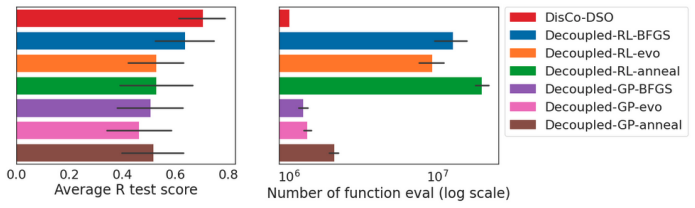
DisCo-DSO extends autoregressive deep symbolic optimization by having the model emit, at each step, both a logit vector over token types and the parameters of a continuous distribution for tokens that carry a numeric value; the token and its parameter are sampled together under a risk-seeking policy gradient that conditions on rewards above a quantile threshold. This makes every sampled sequence a complete design, so the reward can be assigned immediately, and it makes the continuous parameters part of the learned generative process rather than a post-hoc optimization task. The paper claims this joint treatment produces better final rewards per function evaluation on all tested tasks, with the margin over decoupled approaches widening on harder problems.
Load-bearing premise
The load-bearing premise is that the fixed normal or truncated-normal family with scale $\sigma = 0.5$, together with the propagated threshold bounds, can represent the optimal continuous parameters; if the optimum lies outside those ranges or needs a different spread, the joint search cannot express it and the claimed advantage would collapse on exactly the hard cases.
Editorial extensions
If this is right
- Every candidate design is complete at sampling time, so the reward from one design costs exactly one objective evaluation; the decoupled baselines spend multiple evaluations to refine a single skeleton.
- Because the discrete token and its continuous parameter share one learned distribution, information from past high-reward designs can steer both the structure and the numeric values at once, which should help avoid local optima that a fixed skeleton cannot escape.
- On the decision-tree RL benchmarks the learned trees are univariate, compact, and match or beat prior evolutionary, cascading, and differentiable-tree policies at lower or comparable parameter counts.
- In symbolic regression the joint approach reaches the best average test-set reward with the fewest function evaluations and avoids the bloat-driven overfitting seen in the genetic-programming baselines.
- The reported trend that the advantage grows with complexity implies the method is aimed at settings where evaluation is expensive and hybrid structure is nontrivial.
Reading between the lines
- The fixed scale $\sigma = 0.5$ for the continuous generator is a design choice the paper does not vary; one immediate test is to let the model learn a per-token scale, which could matter for problems whose optimal constants span very different magnitudes.
- The bound-propagation rule for decision-tree thresholds is a small recursive procedure that could transfer to any generative model over nested comparisons, such as rule lists or program sketches, wherever a parent condition tightens the feasible range of a child.
- If the sample-efficiency result is general, then in expensive black-box settings the first question shifts from 'which downstream optimizer?' to 'can the whole design be sampled jointly?', since the evaluation budget is the real currency.
- The paper compares against decoupled methods with fixed inner-optimizer budgets; a decisive stress test would let the decoupled methods spend far more evaluations per skeleton and see whether the joint advantage survives.
Editorial analysis
A structured set of objections, weighed in public.
Referee Report
Summary. The paper proposes DisCo-DSO, an autoregressive generative model that jointly samples discrete tokens and their continuous parameters for black-box optimization in hybrid, variable-length spaces. The model is trained with a risk-seeking policy gradient extended to mixed discrete-continuous distributions, with continuous parameters drawn from a normal or truncated-normal distribution whose location is emitted by the model. The method is evaluated on a parameterized bitstring benchmark, decision-tree policy search in four RL environments, and a 45-benchmark symbolic regression suite, and is compared against decoupled RL/GP baselines and several literature methods. The central claim is that joint generative sampling is more sample-efficient and yields better designs than skeleton-then-optimize approaches, with the advantage growing as problem complexity increases.
Significance. If the empirical claims hold, DisCo-DSO would make joint generative sampling a strong default for hybrid black-box optimization and would extend deep symbolic optimization in a useful direction. The risk-seeking gradient derivation in the appendix is correct, and the bitstring and symbolic-regression experiments are consistent with the claimed sample-efficiency mechanism. The paper is also honest about several limitations, including reliance on domain-specific ranges and the restriction to univariate decision trees. However, the decision-tree experiments contain a constraint-handling confound, the bound-propagation algorithm is under-specified and internally inconsistent, and the fixed continuous scale in Table 12 is a restrictive design choice that is not tested. These issues need to be resolved before the headline claims are fully supported.
major comments (3)
- [§4.2 (Decision tree policies) and Algorithm 3] The decision-tree experiments confound joint sampling with constraint handling. DisCo-DSO samples each threshold from a truncated normal whose bounds are propagated by Algorithm 3, so every sampled tree respects parent-child ordering on thresholds. The Decoupled-RL-* and Decoupled-GP-* baselines are described only as optimizing continuous parameters with SciPy solvers, and no prefix-dependent bound constraints are specified for them. An unconstrained solver can set a left-child threshold above its parent threshold on the same feature, producing an unreachable branch and a tree whose semantics differ from the skeleton that the generative model scored. Those baselines therefore search over a superset of semantically valid trees and are systematically handicapped. Because the bitstring and symbolic-regression tasks have no prefix-dependent constraints, they cannot control for this confound. Please either apply the same bound propagation to the decoupled baselines or report a decoupled variant that is constrained consistently, and state the outcome.
- [Algorithm 3 and Figure 3] Algorithm 3 is under-specified and internally inconsistent. The resolution h > 0 is never assigned a value in Table 12 or anywhere else, so the decision-tree results cannot be reproduced from the text. More seriously, the fallback rule that maintains a minimal distance can return a range that violates the parent threshold. For example, with parent bounds (0, 5), h = 0.5, and parent threshold beta_p = 0.1, the left child gets beta_max = 0.1 - 0.5 = -0.4, which is below beta_min = 0; the rule then sets beta_max = 0 + 0.25 = 0.25, which is larger than beta_p. A left-child threshold in (0.1, 0.25] makes the right branch of that child unreachable, so the sampled object is not a semantically valid decision tree. In addition, the bounds shown for the node x1 < 3 in Figure 3 (beta_1 in (2, 3)) cannot be derived from the parent-only updates in Algorithm 3 when the parent is x2 < 6. Please specify the full propagation over all active ancestor constraints and give the actual value of h used.
- [Table 12 and §4.3 (symbolic regression)] The fixed continuous-parameter distribution is a restrictive design choice whose consequences are not tested. Table 12 fixes sigma = 0.5, disables learning the scale, and the paper does not report the initialization of the location parameter phi emitted by the autoregressive model. For a normal with sigma = 0.5, the probability of drawing a value more than about three units from the current location is negligible, so exploration of the continuous component is effectively local. On symbolic-regression instances where the optimal constants are far from the initial phi, DisCo-DSO would need many gradient steps before it can even sample near the optimum, and if the reward is uninformative away from the optimum the risk-seeking estimator may not provide a directional signal. The paper should report the initialization, run a sensitivity sweep over sigma (or allow a learned scale), and discuss how the method behaves when the optimal constants are far from the initial location. Without this, the symbolic-regression comparison does not yet establish the claimed robustness to non-differentiable objectives in general.
minor comments (10)
- [Acknowledgments] The line "Release code is LLNL-CONF-854776" is a release identifier, not a URL or repository; for an empirical machine-learning paper, please provide a persistent link to the code and data used in the experiments.
- [Tables 8 and 9] The headers of Tables 8 and 9 contain "All Table 3", which appears to be a copy-paste artifact and should be corrected to "All".
- [Table 4] In Table 4, the CartPole-v1 gaps for Decoupled-RL-evo and Decoupled-RL-anneal are 0.00, so the statement that DisCo-DSO outperforms decoupled approaches on all tasks should be qualified as a sample-efficiency advantage rather than a final best-reward advantage on every environment.
- [Figure 2] The BO baseline is described as performing fewer function evaluations than the other methods because of its O(n^3) complexity, but the x-axis is the number of function evaluations; please clarify whether the comparison is under a wall-clock budget or some other computational budget.
- [Figure 4] The x-axis is labeled "Number of environment episodes" while the text discusses objective-function evaluations; because each objective evaluation uses N = 100 episodes, please state the conversion in the caption.
- [Table 10] Table 10 lists a "Moving average coefficient (beta)" and Algorithm 1 does not appear to use it; please clarify what quantity this coefficient smooths and where it enters the update.
- [Table 12] The entry "Parameter shift 0.0" is not explained anywhere; please define it and state whether it is applied to the location, the sampled value, or something else.
- [Related work] The sentence describing Hausknecht and Stone [2016] as handling "continuous state and action spaces" should say "parameterized action spaces," which is the relevant hybrid-action setting.
- [Abstract and Table 1] The abstract's claim of superiority over state-of-the-art methods for interpretable RL with decision trees is scoped to univariate trees only in the conclusion; the abstract should state this scope, especially because oblique decision trees in Custode and Iacca [2023] are not compared.
- [§3 (Problem definition)] The formal definition of prefix-dependent positional constraints only masks discrete tokens (C subset of L), but the decision-tree parameter bounds in Algorithm 3 constrain the continuous parameter beta_i and are not covered by the formal definition or by the logit prior; please extend the problem statement to represent continuous-parameter constraints.
Circularity Check
No circularity found: DisCo-DSO's joint sampling objective is derived from a risk-seeking policy gradient and benchmarked against external baselines; self-citations are building blocks, not forced premises.
full rationale
The central claim—that jointly generating discrete tokens and continuous parameters improves sample efficiency—is supported by the paper's own derived training objective and by comparisons against decoupled baselines on independent tasks. No equation defines a predicted quantity in terms of a fitted parameter, and no result is equivalent to an input by construction. The fixed scale sigma=0.5 and the truncated-normal sampling ranges are stated modeling assumptions, not outputs of the experiments. Self-citations to the authors' prior DSO work are used to import the policy-gradient framework, entropy regularization, and standard symbolic-regression constraints, but the discrete-continuous extension is derived in the appendix, and the empirical advantages are measured against external methods such as GP, evolutionary decision trees, cascading decision trees, differentiable decision trees, Bayesian optimization, and transformer-based symbolic regression. The possible benchmarking confound that decoupled decision-tree baselines may not enforce prefix-dependent threshold bounds is a fairness or correctness concern, not circularity, because it does not make DisCo-DSO's produced designs reduce to the method's own inputs by its equations. Therefore no specific circular step can be exhibited, and the score is 0.
Assumptions & free parameters
free parameters (5)
- Continuous-parameter sampling scale sigma =
0.5
- Risk factor epsilon =
0.2
- Entropy coefficient lambda_H =
0.01
- Bound-resolution h in Algorithm 3 =
not reported
- Parameter shift =
0.0
assumptions (5)
- domain assumption The reward R(tau) can be estimated by averaging over N episodes and used as a scalar reward signal for policy gradient training.
- ad hoc to paper The distribution family D(beta | l, phi), a normal or truncated normal with fixed scale sigma = 0.5, covers the relevant continuous parameters A(l).
- ad hoc to paper For decision trees, the permissible interval for each threshold is inherited from the parent threshold and shrunk by resolution h in Algorithm 3, and this propagated interval contains the optimal threshold.
- domain assumption Prefix-dependent positional constraints are exactly representable by masking discrete logits to -infinity during sampling.
- domain assumption Expanding each symbolic-regression benchmark's domain and doubling the number of evaluation points is a valid proxy for generalization.
Cite this review
Pith. "Pith review of DisCo-DSO: Coupling Discrete and Continuous Optimization for Efficient Generative Design in Hybrid Spaces." pith.science (2026). https://pith.science/paper/5HF56TCR
@misc{pith2026241211051,
  author       = {Pith},
  title        = {Pith review of: DisCo-DSO: Coupling Discrete and Continuous Optimization for Efficient Generative Design in Hybrid Spaces},
  year         = {2026},
  howpublished = {\url{https://pith.science/paper/5HF56TCR}},
  note         = {Machine review of arXiv:2412.11051}
}
read the original abstract
We consider the challenge of black-box optimization within hybrid discrete-continuous and variable-length spaces, a problem that arises in various applications, such as decision tree learning and symbolic regression. We propose DisCo-DSO (Discrete-Continuous Deep Symbolic Optimization), a novel approach that uses a generative model to learn a joint distribution over discrete and continuous design variables to sample new hybrid designs. In contrast to standard decoupled approaches, in which the discrete and continuous variables are optimized separately, our joint optimization approach uses fewer objective function evaluations, is robust against non-differentiable objectives, and learns from prior samples to guide the search, leading to significant improvement in performance and sample efficiency. Our experiments on a diverse set of optimization tasks demonstrate that the advantages of DisCo-DSO become increasingly evident as the complexity of the problem increases. In particular, we illustrate DisCo-DSO's superiority over the state-of-the-art methods for interpretable reinforcement learning with decision trees.
Figures


Figures from the paper (7 more)




Reference graph
Works this paper leans on
-
[1]
Neural combinatorial optimization with reinforcement learning
Irwan Bello, Hieu Pham, Quoc V Le, Mohammad Norouzi, and Samy Bengio. Neural combinatorial optimization with reinforcement learning. arXiv preprint arXiv:1611.09940,
-
[2]
4: R ← {R(τ (i))}N i=1 Compute rewards 5: Rϵ ← (1 − ϵ)-quantile of R Compute reward threshold 6: T ← {τ (i) : R(τ (i)) ≥ Rϵ} Select subset of expressions above threshold 7: R ← {R(τ (i)) : R(τ (i)) ≥ Rϵ} Select corresponding subset of rewards 8: ˆg1 ← ReduceMean((R −Rϵ)S(T , θ)) Compute risk-seeking policy gradient 9: ˆg2 ← ReduceMean(−λH∇θH(T |θ)) Comput...
work page 2014
-
[4]
Mixed-Variable Bayesian Optimization
URL https://link.springer.com/article/10.1007/s00521- 023-08802-8. Erik Daxberger, Anastasia Makarova, Matteo Turchetta, and Andreas Krause. Mixed- variable bayesian optimization. arXiv preprint arXiv:1907.01329,
work page Pith review arXiv 1907
-
[6]
mark’s domain (a, b) and increasing the number of data points on which an expression is evaluated
The test set is obtained by expanding the bench- 25 (a) MountainCar-v0 (b) CartPole-v1 Figure 9: Best decision trees found by DisCo-DSO on the decision tree policy tasks for MountainCar-v0 and CartPole-v1. mark’s domain (a, b) and increasing the number of data points on which an expression is evaluated. Since all experiments were conducted with 10 differe...
work page 2021
-
[11]
Mikel Landajuela, Brenden K. Petersen, Soo K. Kim, Claudio P. Santiago, Ruben Glatt, T. Nathan Mundhenk, Jacob F. Pettit, and Daniel M. Faissol. Improving exploration in policy gradient search: Application to symbolic optimization. In1st Mathematical Reasoning in General Artificial Intelligence Workshop, ICLR 2021 . arXiv, 2021a. doi: 10.48550/ARXIV .2107...
-
[13]
URL https://proceedings.neurips.cc/paper/2021/file/ d073bb8d0c47f317dd39de9c9f004e9d-Paper.pdf. Vinod Nair, Sergey Bartunov, Felix Gimeno, Ingrid von Glehn, Pawel Lichocki, Ivan Lobov, Brendan O’Donoghue, Nicolas Sonnerat, Christian Tjandraatmadja, Peng- ming Wang, Ravichandra Addanki, Tharindi Hapuarachchi, Thomas Keck, James Keeling, Pushmeet Kohli, Ira...
work page 2021
-
[20]
doi: https://doi.org/10.1016/j.ins.2015.11.010
ISSN 0020-0255. doi: https://doi.org/10.1016/j.ins.2015.11.010. URL https://www. sciencedirect.com/science/article/pii/S0020025515008038. Nguyen Quang Uy, Nguyen Xuan Hoai, Michael O’Neill, R. I. McKay, and Edgar Galvan-Lopez. Semantically-based crossover in genetic programming: application to real-valued symbolic regression. Genetic Programming and Evolv...
-
[22]
Pauli Virtanen, Ralf Gommers, Travis E
URL https://arxiv.org/abs/2207.01018. Pauli Virtanen, Ralf Gommers, Travis E. Oliphant, Matt Haberland, Tyler Reddy, David Cournapeau, Evgeni Burovski, Pearu Peterson, Warren Weckesser, Jonathan Bright, St´efan J. van der Walt, Matthew Brett, Joshua Wilson, K. Jarrod Millman, Nikolay Mayorov, Andrew R. J. Nelson, Eric Jones, Robert Kern, Eric Larson, C J ...
Show all 26 references
-
[23]
Yang Xiang, DY Sun, W Fan, and XG Gong
doi: 10.1038/s41592-019-0686-2. Yang Xiang, DY Sun, W Fan, and XG Gong. Generalized simulated anneal- ing algorithm and its application to the thomson model. Physics Letters A , 233(3):216–220,
-
[24]
Jiechao Xiong, Qing Wang, Zhuoran Yang, Peng Sun, Lei Han, Yang Zheng, Haobo Fu, Tong Zhang, Ji Liu, and Han Liu
URL https://www.sciencedirect.com/science/article/abs/pii/ S037596019700474X. Jiechao Xiong, Qing Wang, Zhuoran Yang, Peng Sun, Lei Han, Yang Zheng, Haobo Fu, Tong Zhang, Ji Liu, and Han Liu. Parametrized deep q-networks learning: Re- inforcement learning with discrete-continu...
-
[25]
19 Barret Zoph and Quoc V . Le. Neural architecture search with reinforcement learning. In 5th International Conference on Learning Representations, ICLR 2017, Toulon, France, April 24-26, 2017, Conference Track Proceedings. OpenReview.net,
2017
-
[28]
We define computational efficiency as the ratio between the final objective value and the total time required to reach that value
To quantify improvements in terms of computational time of DisCo-DSO over the decoupled baselines, we provide in Table 14 the average computational efficiency for all the environments in the Decision Tree Policies for Reinforcement Learning task. We define computational effici...
2019
-
[29]
On the other hand, the restriction on maximum length is applied by constraining unary and/or binary tokens when their selection, followed by the choice of only termi- nal tokens, would lead to a traversal surpassing the prescribed maximum length. 31 Benchmark Name Expression D...
2022
-
[1994]
Gongjin Lan, Jakub M Tomczak, Diederik M Roijers, and AE Eiben
URL https://link.springer.com/ article/10.1007/BF00175355. Gongjin Lan, Jakub M Tomczak, Diederik M Roijers, and AE Eiben. Time efficiency in optimization with a bayesian-evolutionary algorithm. Swarm and Evolutionary Computation, 69:100970,
-
[1997]
Richard S Sutton and Andrew G Barto
URL https://link.springer.com/article/10.1023/A:1008202821328. Richard S Sutton and Andrew G Barto. Reinforcement learning: An introduction. MIT press,
-
[2001]
Leonardo Trujillo, Luis Mu ˜noz, Edgar Galv ´an-L´opez, and Sara Silva
URL https://dl.acm.org/doi/10.5555/2955239.2955258. Leonardo Trujillo, Luis Mu ˜noz, Edgar Galv ´an-L´opez, and Sara Silva. neat genetic programming: Controlling bloat naturally. Information Sciences, 333:21–43,
-
[2007]
Greg Brockman, Vicki Cheung, Ludwig Pettersson, Jonas Schneider, John Schulman, Jie Tang, and Wojciech Zaremba
URL https://www.pnas.org/doi/10.1073/pnas.0609476104. Greg Brockman, Vicki Cheung, Ludwig Pettersson, Jonas Schneider, John Schulman, Jie Tang, and Wojciech Zaremba. Openai gym,
-
[2014]
Faster genetic programming based on local gradient search of numeric leaf values
Alexander Topchy, William F Punch, et al. Faster genetic programming based on local gradient search of numeric leaf values. In Proceedings of the genetic and evolution- ary computation conference (GECCO-2001) , volume 155162. Morgan Kaufmann San Francisco, CA,
2001
-
[2016]
Terrell Mundhenk, Mikel Landajuela, Ruben Glatt, Claudio P Santiago, Daniel faissol, and Brenden K Petersen
URL https://arxiv.org/abs/1610.02995. Terrell Mundhenk, Mikel Landajuela, Ruben Glatt, Claudio P Santiago, Daniel faissol, and Brenden K Petersen. Symbolic regression via deep reinforcement 17 learning enhanced genetic programming seeding. In M. Ranzato, A. Beygelz- imer, Y . ...
-
[2017]
John R Koza
URL https://arxiv.org/abs/1412.6980. John R Koza. Genetic programming: A paradigm for genetically breeding populations of computer programs to solve problems , volume
-
[2018]
Policy gradients beyond expecta- tions: Conditional value-at-risk
Aviv Tamar, Yonatan Glassner, and Shie Mannor. Policy gradients beyond expecta- tions: Conditional value-at-risk. arXiv preprint arXiv:1404.3862,
-
[2019]
Subham Sahoo, Christoph Lampert, and Georg Martius
URL https://arxiv.org/abs/1905.13372. Subham Sahoo, Christoph Lampert, and Georg Martius. Learning equations for ex- trapolation and control. In International Conference on Machine Learning , pages 4442–4450. PMLR,
1905 arXiv
-
[2020]
End-to-end symbolic regression with transformers
Pierre-Alexandre Kamienny, St ´ephane d’Ascoli, Guillaume Lample, and Franc ¸ois Charton. End-to-end symbolic regression with transformers. arXiv preprint arXiv:2204.10532,
-
[2021]
Diederik P
URL https://arxiv.org/abs/2104.05930. Diederik P. Kingma and Jimmy Ba. Adam: A method for stochastic optimization,
-
[2023]
Felipe Leno da Silva, Andre Goncalves, Sam Nguyen, Denis Vashchenko, Ruben Glatt, Thomas Desautels, Mikel Landajuela, Daniel Faissol, and Brenden Petersen
URL https://ieeexplore.ieee.org/ document/10015004. Felipe Leno da Silva, Andre Goncalves, Sam Nguyen, Denis Vashchenko, Ruben Glatt, Thomas Desautels, Mikel Landajuela, Daniel Faissol, and Brenden Petersen. Lan- guage model-accelerated deep symbolic optimization.Neural Comput...
-
[2024]
Zihan Ding, Pablo Hernandez-Leal, Gavin Weiguang Ding, Changjian Li, and Ruitong Huang
doi: 10.1109/TEVC.2024.3423681. Zihan Ding, Pablo Hernandez-Leal, Gavin Weiguang Ding, Changjian Li, and Ruitong Huang. Cdt: Cascading decision trees for explainable reinforcement learning. arXiv preprint: arXiv:2011.07553v2,
2024
Reviewed August 11, 2026 · model on record in the stance chip above.
Discussion (0). Continue with ORCID to comment.