REVIEW 4 major objections 5 minor 1 cited by
Topology and Spectrum in Measurement-Induced Phase Transitions
T0 review · 4 major / 5 minor · reviewed 2026-08-11 · deepseek-v4-flash
Pith's one-line read Monitored Majorana circuits obey a bulk-edge correspondence in gapped phases.
desk verdict A numerically convincing extension of bulk-edge correspondence to monitored Majorana circuits via Lyapunov analysis and a twisted-boundary parity invariant, with two rigor gaps that a revision should close. read the letter →
The pith
A machine-rendered reading of the paper's core claim, the machinery that carries it, and where it could break.
The reading
What carries the argument
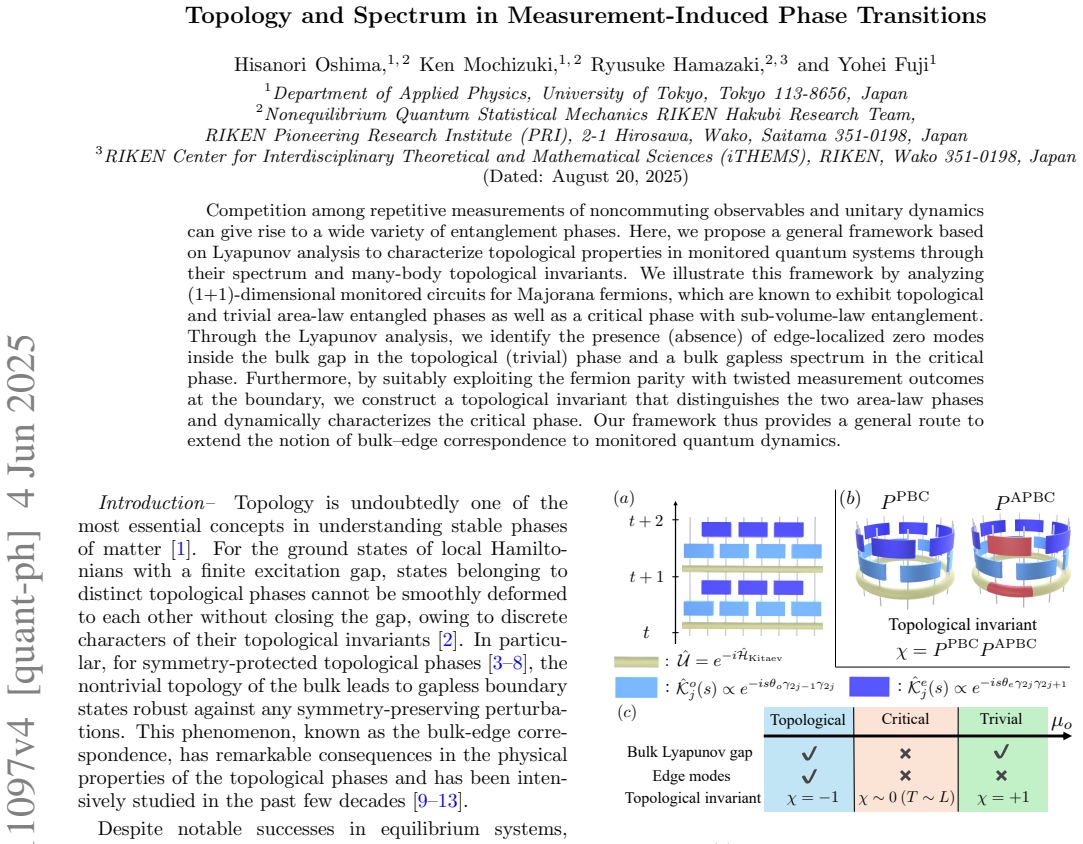
Lyapunov analysis of the random matrix product $K_T(s)$ governing the evolution of Majorana operators: the spectrum of the effective Hamiltonian $H_{\mathrm{eff},T}(s) = -\frac{i}{2T}\ln[K_T(s)K_T^\dagger(s)]$ converges to the Lyapunov spectrum, whose lowest non-negative exponent serves as the bulk gap. The corresponding Lyapunov vectors form an orthogonal matrix $O_T(s)$ that diagonalizes the effective Hamiltonian. The topological invariant is built from determinant products $\det[O_T^{\mathrm{PBC}}(s)]$ and $\det[O_T^{\mathrm{APBC}}(s)]$, with the antiperiodic boundary condition defined by twisting only the boundary measurement outcomes relative to the periodic trajectory; this is a fermion-parity difference generalizing the static Majorana-chain construction.
What would settle it
Look at the lowest Lyapunov exponent under open boundary conditions at parameters inside the claimed topological area-law phase: if it remains finite as the system size grows, or if the corresponding mode's squared weight at the edges does not approach 1, then the edge zero mode does not exist and the bulk-edge correspondence claim collapses.
Extended reading notes
Core claim
The central claim is that monitored Majorana circuits in gapped phases satisfy a bulk-edge correspondence. The paper defines an effective Hamiltonian from the long-time Lyapunov analysis of the random matrix product that evolves Majorana operators, and shows that in the topological area-law phase the lowest Lyapunov exponent under open boundaries vanishes and the corresponding mode is localized at the edges, while in the trivial area-law phase it stays finite and delocalized. A bulk topological invariant is obtained by multiplying the fermion parities of the ground states of the effective Hamiltonian under periodic and antiperiodic boundary conditions, where the antiperiodic circuit is defined by flipping the boundary measurement outcomes of the periodic trajectory; this invariant is $\chi_T(s) = P_{\mathrm{PBC}}(s) P_{\mathrm{APBC}}(s)$, converging to $\pm 1$ in the two gapped phases. In the critical sub-volume-law phase the bulk Lyapunov gap closes, and the same invariant characterizes the phase dynamically through its slow relaxation at times $T = O(L)$.
Load-bearing premise
The argument assumes that the random matrix product built from a monitored circuit has a well-defined Lyapunov spectrum that is independent of the particular measurement-outcome sequence; the paper provides numerical support but no proof in the Born-rule setting.
Editorial extensions
If this is right
- In the topological area-law phase, open-boundary monitored circuits host edge-localized Majorana zero modes inside the bulk Lyapunov gap.
- In the trivial area-law phase, no such edge modes appear, so the two gapped phases are distinguished by both the Lyapunov spectrum and the parity invariant.
- The critical phase has a gapless Lyapunov spectrum, and the invariant fails to converge on the $O(L)$ timescale, giving a dynamical signature of the two transition points.
- The framework extends the bulk-edge correspondence to monitored dynamics and suggests how to define topological invariants for symmetry-protected monitored phases.
Reading between the lines
- The same Lyapunov edge-mode diagnostic should work for other monitored free-fermion circuits, but the twisted-boundary outcome prescription may need modification when measurements have more than two outcomes.
- Because evaluating the antiperiodic trajectory requires postselecting on the periodic outcome sequence, direct large-scale measurement of $\chi_T$ is exponentially costly; a cheaper experimental proxy might be the slow relaxation of parity fluctuations near the critical phase.
- If the assumption that Oseledec's theorem applies to Born-rule trajectories is eventually proven, the Lyapunov spectrum could serve as a rigorous classification tool for measurement-induced topological phases rather than a numerical diagnostic.
Editorial analysis
A structured set of objections, weighed in public.
Referee Report
Summary. This Letter proposes a Lyapunov-analysis framework for monitored Majorana circuits and uses it to claim a bulk-edge correspondence in the gapped measurement-induced phases: the topological area-law phase is distinguished by edge-localized Majorana zero modes within the bulk Lyapunov gap, the trivial area-law phase has no such modes, and a fermion-parity invariant χ_T(s) = P_T^PBC(s) P_T^APBC(s), built from QR-based Lyapunov vectors, takes χ = -1 (+1) in the topological (trivial) phase. The antiperiodic boundary condition is defined by twisting only the boundary measurement outcomes relative to a PBC trajectory, with the unitary boundary term J' = -J. The critical sub-volume-law phase is claimed to be gapless in the Lyapunov spectrum and is dynamically characterized by χ evaluated at T = O(L). The paper is transparent about its main assumptions: applicability of Oseledec's theorem to Born-rule-generated outcome sequences is flagged as mathematically nontrivial (main text after Eq. (4); Supp. Sec. I.B), and the critical-phase scaling is stated to be inconclusive at available sizes (Supp. Sec. III).
Significance. If the central claim holds, the paper is a substantive step: it extends bulk-edge correspondence, a cornerstone of equilibrium topology, to monitored dynamics and supplies a concrete invariant (the PBC/APBC parity product with twisted boundary measurement outcomes) that sharply separates the two area-law phases. The paper has notable strengths: the APBC construction is a new idea; the Lyapunov-gap criterion gives falsifiable predictions (edge-mode localization, χ = ±1, gapless critical spectrum); code and data are shared (Ref. [91]); and no free parameters are fitted to the target result, since the model parameters are scanned. The authors are also unusually explicit about which steps are numerically checked rather than proved. The main weakness is that the convergence of the QR-based determinant to the Pfaffian parity, on which the invariant rests, is asserted rather than demonstrated.
major comments (4)
- [Topological invariant and bulk-edge correspondence, Eqs. (7)-(8)] The statement that χ_T(s) 'approximates and converges to Q_T(s) for T → ∞' is the linchpin of the phase discrimination, but it is not demonstrated. For finite T, Õ_T(s) is not orthogonal, and det[Õ_T(s)] depends on the QR convention and on the random initial matrix W_0 used in the QR iteration; convergence of the Lyapunov exponents (Supp. Fig. S1) does not by itself establish that sign(det[Õ_T]) stabilizes to the Kitaev parity for both PBC and APBC. The trajectory-averaged χ_T in Figs. 2(e) and 3(d) shows that the sign is stable across outcomes, but it does not test equality with Q_T(s) = sgn(Pf[H_eff,T^PBC] Pf[H_eff,T^APBC]) or invariance under re-initialization of W_0. I ask for (i) a direct comparison of sign(det[Õ_T(s)]) with Q_T(s) for small L and T, where Pf[H_eff,T(s)] is computable; (ii) a check that the sign is unchanged under different random W_0 and QR conventions; and (iii) both checks in each gapped phase and boundary condition.
- [Model and Lyapunov analysis, after Eq. (4); Supp. Sec. I.B] The entire Lyapunov construction rests on Oseledec's theorem for products K_T(s) whose factors depend on the Born-rule-generated outcome sequence s. The authors correctly flag the Born-rule complication as mathematically nontrivial and cite Refs. [66,67], but the supporting numerics in Supp. Fig. S1 are a single trajectory at one parameter set (L=4, J=0.5, μ_o=0.5) compared with a 100-trajectory average. Since the edge-mode and invariant claims are conditional on this convergence, and since convergence could in principle fail in some phases, I request additional single-trajectory-versus-ensemble convergence checks in all three phases and under OBC, PBC, and APBC, or a more prominent statement that the bulk-edge conclusions are conditional on this numerically checked assumption.
- [Critical gapless phase with additional unitary; Supp. Sec. III] The abstract and summary state that the critical phase has 'a bulk gapless spectrum in the critical phase,' but the evidence is the decay of z1 with L in the window 0.4 ≲ μ_o ≲ 0.6 (Fig. 3 and Fig. S3), with scaling close to 1/L, which the authors themselves describe as inconclusive ('we cannot conclude the true scaling form especially inside the critical phase'). A 1/L decay of the lowest Lyapunov exponent is consistent with gaplessness, but the claim as stated is stronger than the data. Either the claim should be softened to 'consistent with a gapless phase' or a more conclusive scaling analysis should be provided, for example with subleading corrections or an independent probe such as the (ln L)^2 entanglement scaling already used to identify the phase.
- [Topological invariant and bulk-edge correspondence, APBC definition] The APBC is defined by flipping only the boundary outcomes s_{2L,t} relative to a PBC trajectory, so the APBC circuit is not sampled from the APBC Born rule (the postselection overhead is acknowledged). This is a legitimate construction, but the paper gives no argument, beyond the numerical sharpness of Fig. 2(e), that this particular twist is the correct monitored analogue of antiperiodic boundary conditions. Because χ_∞ = -1/+1 in the two gapped phases is the central quantitative claim, I ask for a robustness check of the invariant under alternative twists (for example, flipping a different boundary degree of freedom, or using only the unitary twist J' = -J without flipping outcomes) and a brief justification of why the flipped-outcome twist tracks the parity sector in which the APBC gap closes at the transition.
minor comments (5)
- [Supp. Sec. I.B, stationarity criterion] The stopping criterion 'less than √10 × 10^{-3}' is unexplained; the factor √10 appears to be a typo, and the criterion should be stated plainly.
- [Paragraph after Eq. (8)] The sentence 'P_T^PBC(s) = 1 is satisfied in the whole parameter region' reads like an exact identity, although the following sentence explains it numerically via the finite-size splitting z1 ~ 1/L; please rephrase as a numerical observation for the finite systems studied.
- [Fig. 2(e) caption] The caption states 'after a sufficiently long time,' but the temporal-averaging and stopping criteria are given only in the supplement; please state the criterion in the caption or in the main text.
- [Sentence following Eq. (8)] Minor grammar: 'we will also call χT (s) as the topological invariant' should read 'we will also call χT(s) the topological invariant.'
- [Abstract] The abstract promises 'a general framework' for monitored quantum systems, while the demonstration is for free-fermion Gaussian states; the outlook acknowledges this, but the abstract should qualify the claim, for example as a framework demonstrated on free-fermion monitored systems with a proposed route to interacting systems.
Circularity Check
No significant circularity: the parity invariant is a construction from Lyapunov data, not a fitted input, and the phase diagram is benchmarked by independent entanglement diagnostics.
full rationale
The paper's central derivation chain is self-contained rather than circular. The Lyapunov spectrum is computed from the random matrix product K_T(s) in Eq. (4) via standard QR-based Oseledec analysis; the effective Hamiltonian in Eq. (5) is defined from that product, and the edge modes are read off from the corresponding Lyapunov vectors. The topological invariant in Eqs. (7)-(8) is a parity product det[eO_T^{PBC}] det[eO_T^{APBC}], constructed to approximate Kitaev's Pfaffian formula Q_T(s); it contains no parameter fitted to the target value chi = -1 versus +1. The APBC is deliberately defined relative to the PBC with flipped boundary outcomes, but this is a stated construction, not an extraction from the data being predicted. Phase boundaries are independently benchmarked by topological entanglement entropy and bipartite mutual information in Supplemental Sec. II, following Refs. [34,41,42]. The convergence of det[eO_T] to Q_T is asserted and numerically supported, and the applicability of Oseledec's theorem under the Born rule is flagged as a mathematically nontrivial assumption; these are correctness or rigor risks, not circularity. Self-citations [57,60] appear only as background for Lyapunov analysis and are not load-bearing; the load-bearing external input is Oseledec's theorem [63-65]. No step reduces a prediction to its own input by definition or by fitted parameter, so no circularity is found.
Assumptions & free parameters
assumptions (4)
- domain assumption Oseledec's theorem applies to the Born-rule random matrix product K_T(s), giving a trajectory-independent Lyapunov spectrum.
- standard math Gaussian states remain Gaussian under the unitary evolution and weak measurements used in the circuit.
- ad hoc to paper The APBC circuit defined by flipping only boundary measurement outcomes s_{2L,t} relative to the PBC is the correct monitored analogue of antiperiodic boundary conditions.
- domain assumption The non-orthogonal matrix eO_T(s) converges to the orthogonal matrix of Lyapunov vectors, so det[eO_T(s)] converges to the fermion parity.
invented entities (1)
-
Antiperiodic boundary condition with twisted measurement outcomes (APBC)
Cite this review
Pith. "Pith review of Topology and Spectrum in Measurement-Induced Phase Transitions." pith.science (2026). https://pith.science/paper/HTX4W7JJ
@misc{pith2026241211097,
  author       = {Pith},
  title        = {Pith review of: Topology and Spectrum in Measurement-Induced Phase Transitions},
  year         = {2026},
  howpublished = {\url{https://pith.science/paper/HTX4W7JJ}},
  note         = {Machine review of arXiv:2412.11097}
}
read the original abstract
Competition among repetitive measurements of noncommuting observables and unitary dynamics can give rise to a wide variety of entanglement phases. Here, we propose a general framework based on Lyapunov analysis to characterize topological properties in monitored quantum systems through their spectrum and many-body topological invariants. We illustrate this framework by analyzing (1+1)-dimensional monitored circuits for Majorana fermions, which are known to exhibit topological and trivial area-law entangled phases as well as a critical phase with sub-volume-law entanglement. Through the Lyapunov analysis, we identify the presence (absence) of edge-localized zero modes inside the bulk gap in the topological (trivial) phase and a bulk gapless spectrum in the critical phase. Furthermore, by suitably exploiting the fermion parity with twisted measurement outcomes at the boundary, we construct a topological invariant that distinguishes the two area-law phases and dynamically characterizes the critical phase. Our framework thus provides a general route to extend the notion of bulk-edge correspondence to monitored quantum dynamics.
Figures


Forward citations
Cited by 1 Pith paper
-
Symmetry and Topology of Monitored Quantum Dynamics
Monitored free fermions are classified into the tenfold symmetry/topology table, with bulk-boundary correspondence appearing as Lyapunov zero modes and chiral edge modes.
Reference graph
Works this paper leans on
-
[90]
Z. Xiao and K. Kawabata, Topology of monitored quan- tum dynamics (2024), arXiv:2412.06133 [cond-mat.stat- mech]
arXiv 2024
- [42]
-
[91]
H. Oshima, K. Mochizuki, R. Hamazaki, and Y. Fuji, Codes and data available for publication in Zenodo, https://doi.org/10.5281/zenodo.15369377 (2025)
-
[1]
Wen, Colloquium: Zoo of quantum-topological phases of matter, Rev
X.-G. Wen, Colloquium: Zoo of quantum-topological phases of matter, Rev. Mod. Phys. 89, 041004 (2017)
2017
-
[2]
Chen, Z.-C
X. Chen, Z.-C. Gu, and X.-G. Wen, Local unitary trans- formation, long-range quantum entanglement, wave func- tion renormalization, and topological order, Phys. Rev. B 82, 155138 (2010)
2010
-
[3]
Gu and X.-G
Z.-C. Gu and X.-G. Wen, Tensor-entanglement-filtering renormalization approach and symmetry-protected topo- logical order, Phys. Rev. B 80, 155131 (2009)
2009
-
[4]
Pollmann, A
F. Pollmann, A. M. Turner, E. Berg, and M. Oshikawa, Entanglement spectrum of a topological phase in one di- mension, Phys. Rev. B 81, 064439 (2010)
2010
-
[5]
Chen, Z.-C
X. Chen, Z.-C. Gu, and X.-G. Wen, Classification of gapped symmetric phases in one-dimensional spin sys- tems, Phys. Rev. B 83, 035107 (2011)
2011
Show all 105 references
-
[6]
Fidkowski and A
L. Fidkowski and A. Kitaev, Topological phases of 6 fermions in one dimension, Phys. Rev. B 83, 075103 (2011)
2011
-
[7]
Lu and A
Y.-M. Lu and A. Vishwanath, Theory and classifica- tion of interacting integer topological phases in two di- mensions: A Chern-Simons approach, Phys. Rev. B 86, 125119 (2012)
2012
-
[8]
Chen, Z.-C
X. Chen, Z.-C. Gu, Z.-X. Liu, and X.-G. Wen, Symmetry protected topological orders and the group cohomology of their symmetry group, Phys. Rev. B 87, 155114 (2013)
2013
-
[9]
M. Z. Hasan and C. L. Kane, Colloquium: Topological insulators, Rev. Mod. Phys. 82, 3045 (2010)
2010
-
[10]
Qi and S.-C
X.-L. Qi and S.-C. Zhang, Topological insulators and su- perconductors, Rev. Mod. Phys. 83, 1057 (2011)
2011
-
[11]
Senthil, Symmetry-Protected Topological Phases of Quantum Matter, Ann
T. Senthil, Symmetry-Protected Topological Phases of Quantum Matter, Ann. Rev. Condens. Matter Phys. 6, 299 (2015)
2015
-
[12]
Witten, Fermion path integrals and topological phases, Rev
E. Witten, Fermion path integrals and topological phases, Rev. Mod. Phys. 88, 035001 (2016)
2016
-
[13]
C.-K. Chiu, J. C. Y. Teo, A. P. Schnyder, and S. Ryu, Classification of topological quantum matter with sym- metries, Rev. Mod. Phys. 88, 035005 (2016)
2016
-
[14]
Y. Li, X. Chen, and M. P. A. Fisher, Quantum Zeno effect and the many-body entanglement transition, Phys. Rev. B 98, 205136 (2018)
2018
-
[15]
Skinner, J
B. Skinner, J. Ruhman, and A. Nahum, Measurement- Induced Phase Transitions in the Dynamics of Entangle- ment, Phys. Rev. X 9, 031009 (2019)
2019
-
[16]
A. Chan, R. M. Nandkishore, M. Pretko, and G. Smith, Unitary-projective entanglement dynamics, Phys. Rev. B 99, 224307 (2019)
2019
-
[17]
Szyniszewski, A
M. Szyniszewski, A. Romito, and H. Schomerus, Entan- glement transition from variable-strength weak measure- ments, Phys. Rev. B 100, 064204 (2019)
2019
-
[18]
Y. Li, X. Chen, and M. P. A. Fisher, Measurement- driven entanglement transition in hybrid quantum cir- cuits, Phys. Rev. B 100, 134306 (2019)
2019
-
[19]
Jian, Y.-Z
C.-M. Jian, Y.-Z. You, R. Vasseur, and A. W. W. Ludwig, Measurement-induced criticality in random quantum cir- cuits, Phys. Rev. B 101, 104302 (2020)
2020
-
[20]
Y. Bao, S. Choi, and E. Altman, Theory of the phase transition in random unitary circuits with measurements, Phys. Rev. B 101, 104301 (2020)
2020
-
[21]
S. Choi, Y. Bao, X.-L. Qi, and E. Altman, Quan- tum Error Correction in Scrambling Dynamics and Measurement-Induced Phase Transition, Phys. Rev. Lett. 125, 030505 (2020)
2020
-
[22]
M. J. Gullans and D. A. Huse, Dynamical Purification Phase Transition Induced by Quantum Measurements, Phys. Rev. X 10, 041020 (2020)
2020
-
[23]
M. J. Gullans and D. A. Huse, Scalable Probes of Measurement-Induced Criticality, Phys. Rev. Lett. 125, 070606 (2020)
2020
-
[24]
A. C. Potter and R. Vasseur, Entanglement Dynamics in Hybrid Quantum Circuits, in Entanglement in Spin Chains: From Theory to Quantum Technology Applications, edited by A. Bayat, S. Bose, and H. Johannesson (Springer International Publishing, Cham, 2022) pp. 211–249
2022
-
[25]
M. P. A. Fisher, V. Khemani, A. Nahum, and S. Vijay, Random Quantum Circuits, Annu. Rev. Condens. Matter Phys. 14, 335 (2023)
2023
-
[26]
Lavasani, Y
A. Lavasani, Y. Alavirad, and M. Barkeshli, Measurement-induced topological entanglement transi- tions in symmetric random quantum circuits, Nat. Phys. 17, 342 (2021)
2021
-
[27]
Lavasani, Y
A. Lavasani, Y. Alavirad, and M. Barkeshli, Topological Order and Criticality in (2 + 1)D Monitored Random Quantum Circuits, Phys. Rev. Lett. 127, 235701 (2021)
2021
-
[28]
Klocke and M
K. Klocke and M. Buchhold, Topological order and en- tanglement dynamics in the measurement-only XZZX quantum code, Phys. Rev. B 106, 104307 (2022)
2022
-
[29]
Lavasani, Z.-X
A. Lavasani, Z.-X. Luo, and S. Vijay, Monitored quantum dynamics and the Kitaev spin liquid, Phys. Rev. B 108, 115135 (2023)
2023
-
[30]
Sriram, T
A. Sriram, T. Rakovszky, V. Khemani, and M. Ippoliti, Topology, criticality, and dynamically generated qubits in a stochastic measurement-only Kitaev model, Phys. Rev. B 108, 094304 (2023)
2023
-
[31]
G.-Y. Zhu, N. Tantivasadakarn, and S. Trebst, Struc- tured volume-law entanglement in an interacting, moni- tored majorana spin liquid, Phys. Rev. Res. 6, L042063 (2024)
2024
-
[32]
Morral-Yepes, F
R. Morral-Yepes, F. Pollmann, and I. Lovas, Detect- ing and stabilizing measurement-induced symmetry- protected topological phases in generalized cluster mod- els, Phys. Rev. B 108, 224304 (2023)
2023
-
[33]
Kuno and I
Y. Kuno and I. Ichinose, Production of lattice gauge Higgs topological states in a measurement-only quantum circuit, Phys. Rev. B 107, 224305 (2023)
2023
-
[34]
Nehra, A
R. Nehra, A. Romito, and D. Meidan, Controlling measurement-induced phase transitions with tunable de- tector coupling, Quantum 9, 1697 (2025)
2025
-
[35]
Kelson-Packer and A
C. Kelson-Packer and A. Miyake, Phase transitions in (2 + 1)D subsystem-symmetric monitored quantum cir- cuits, Phys. Rev. B 111, 075109 (2025)
2025
-
[36]
Klocke, D
K. Klocke, D. Simm, G.-Y. Zhu, S. Trebst, and M. Buch- hold, Entanglement dynamics in monitored kitaev cir- cuits: loop models, symmetry classification, and quan- tum lifshitz scaling (2024), arXiv:2409.02171 [quant-ph]
2024 arXiv
-
[37]
Nahum and B
A. Nahum and B. Skinner, Entanglement and dynamics of diffusion-annihilation processes with Majorana defects, Phys. Rev. Res. 2, 023288 (2020)
2020
-
[38]
Y. Bao, S. Choi, and E. Altman, Symmetry enriched phases of quantum circuits, Ann. Phys. 435, 168618 (2021), special issue on Philip W. Anderson
2021
-
[39]
C.-M. Jian, H. Shapourian, B. Bauer, and A. W. W. Lud- wig, Measurement-induced entanglement transitions in quantum circuits of non-interacting fermions: Born-rule versus forced measurements (2023), arXiv:2302.09094 [cond-mat.stat-mech]
2023 arXiv
-
[40]
Klocke and M
K. Klocke and M. Buchhold, Majorana Loop Models for Measurement-Only Quantum Circuits, Phys. Rev. X 13, 041028 (2023)
2023
-
[41]
Kells, D
G. Kells, D. Meidan, and A. Romito, Topological tran- sitions in weakly monitored free fermions, SciPost Phys. 14, 031 (2023)
2023
-
[43]
Lang and H
N. Lang and H. P. B¨ uchler, Entanglement transition in the projective transverse field Ising model, Phys. Rev. B 102, 094204 (2020)
2020
-
[44]
Sang and T
S. Sang and T. H. Hsieh, Measurement-protected quan- tum phases, Phys. Rev. Res. 3, 023200 (2021)
2021
-
[45]
Ippoliti, M
M. Ippoliti, M. J. Gullans, S. Gopalakrishnan, D. A. Huse, and V. Khemani, Entanglement Phase Transi- tions in Measurement-Only Dynamics, Phys. Rev. X 11, 011030 (2021). 7
2021
-
[46]
Under the Jordan-Wigner transformation, the measure- ments of the parities for neighboring Majorana fermions on an odd bond iγ2j−1γ2j and an even bond iγ2jγ2j+1 are mapped to measurements of Zj and XjXj+1, respec- tively
-
[47]
R. M. Lutchyn, E. P. A. M. Bakkers, L. P. Kouwen- hoven, P. Krogstrup, C. M. Marcus, and Y. Oreg, Majo- rana zero modes in superconductor–semiconductor het- erostructures, Nature Reviews Materials 3, 52 (2018)
2018
-
[48]
Bravyi, Lagrangian representation for fermionic linear optics, Quantum Inf
S. Bravyi, Lagrangian representation for fermionic linear optics, Quantum Inf. Comput. 5, 216–238 (2005)
2005
-
[49]
Turkeshi, A
X. Turkeshi, A. Biella, R. Fazio, M. Dalmonte, and M. Schir´ o, Measurement-induced entanglement transi- tions in the quantum Ising chain: From infinite to zero clicks, Phys. Rev. B 103, 224210 (2021)
2021
-
[50]
Surace and L
J. Surace and L. Tagliacozzo, Fermionic Gaussian states: an introduction to numerical approaches, SciPost Phys. Lect. Notes , 54 (2022)
2022
-
[51]
Fidkowski, J
L. Fidkowski, J. Haah, and M. B. Hastings, How Dynam- ical Quantum Memories Forget, Quantum 5, 382 (2021)
2021
-
[52]
Piccitto, A
G. Piccitto, A. Russomanno, and D. Rossini, Entangle- ment transitions in the quantum Ising chain: A compar- ison between different unravelings of the same Lindbla- dian, Phys. Rev. B 105, 064305 (2022)
2022
-
[53]
M. Fava, L. Piroli, T. Swann, D. Bernard, and A. Nahum, Nonlinear Sigma Models for Monitored Dynamics of Free Fermions, Phys. Rev. X 13, 041045 (2023)
2023
-
[54]
Ravindranath and X
V. Ravindranath and X. Chen, Robust Oscillations and Edge Modes in Nonunitary Floquet Systems, Phys. Rev. Lett. 130, 230402 (2023)
2023
-
[55]
[92–95], for details of the Gaussian-state simulation and addi- tional numerical data
See Supplemental Material, which includes Refs. [92–95], for details of the Gaussian-state simulation and addi- tional numerical data
-
[56]
Zabalo, M
A. Zabalo, M. J. Gullans, J. H. Wilson, R. Vasseur, A. W. W. Ludwig, S. Gopalakrishnan, D. A. Huse, and J. H. Pixley, Operator Scaling Dimensions and Multifrac- tality at Measurement-Induced Transitions, Phys. Rev. Lett. 128, 050602 (2022)
2022
-
[57]
Mochizuki and R
K. Mochizuki and R. Hamazaki, Absorption to fluctuat- ing bunching states in nonunitary boson dynamics, Phys. Rev. Res. 6, 013004 (2024)
2024
-
[58]
Kumar, K
A. Kumar, K. Aziz, A. Chakraborty, A. W. W. Ludwig, S. Gopalakrishnan, J. H. Pixley, and R. Vasseur, Bound- ary transfer matrix spectrum of measurement-induced transitions, Phys. Rev. B 109, 014303 (2024)
2024
-
[59]
A. D. Luca, C. Liu, A. Nahum, and T. Zhou, Universality classes for purification in nonunitary quantum processes (2024), arXiv:2312.17744 [cond-mat.stat-mech]
2024 arXiv
-
[60]
Mochizuki and R
K. Mochizuki and R. Hamazaki, Measurement-induced spectral transition, Phys. Rev. Lett. 134, 010410 (2025)
2025
-
[61]
V. B. Bulchandani, S. L. Sondhi, and J. T. Chalker, Random-Matrix Models of Monitored Quantum Circuits, J. Stat. Phys. 191, 55 (2024)
2024
-
[62]
Z. Xiao, T. Ohtsuki, and K. Kawabata, Universal stochastic equations of monitored quantum dynamics, Phys. Rev. Lett. 134, 140401 (2025)
2025
-
[63]
Crisanti, G
A. Crisanti, G. Paladin, and A. Vulpiani, Products of Random Matrices in Statistical Shysics, Vol. 104 (Springer-Verlag, Berlin, 1993)
1993
-
[64]
S. V. Ershov and A. B. Potapov, On the concept of sta- tionary Lyapunov basis, Physica D 118, 167 (1998)
1998
-
[65]
Ginelli, H
F. Ginelli, H. Chat´ e, R. Livi, and A. Politi, Covariant Lyapunov vectors, J. Phys. A 46, 254005 (2013)
2013
-
[66]
Benoist, M
T. Benoist, M. Fraas, Y. Pautrat, and C. Pellegrini, Invariant measure for quantum trajectories, Probability Theory and Related Fields 174, 307 (2019)
2019
-
[67]
Benoist, M
T. Benoist, M. Fraas, Y. Pautrat, and C. Pellegrini, In- variant Measure for Stochastic Schr¨ odinger Equations, Ann. Henri Poincar´ e22, 347 (2021)
2021
-
[68]
A. Y. Kitaev, Unpaired Majorana fermions in quantum wires, Physics-Uspekhi 44, 131 (2001)
2001
-
[69]
G. B. Mbeng, A. Russomanno, and G. E. Santoro, The quantum Ising chain for beginners, SciPost Phys. Lect. Notes , 82 (2024)
2024
-
[70]
C. W. J. Beenakker, Random-matrix theory of Majorana fermions and topological superconductors, Rev. Mod. Phys. 87, 1037 (2015)
2015
-
[71]
Kawabata, R
K. Kawabata, R. Kobayashi, N. Wu, and H. Katsura, Exact zero modes in twisted Kitaev chains, Phys. Rev. B 95, 195140 (2017)
2017
-
[72]
F. Venn, J. Behrends, and B. B´ eri, Coherent-error thresh- old for surface codes from majorana delocalization, Phys. Rev. Lett. 131, 060603 (2023)
2023
-
[73]
Behrends, F
J. Behrends, F. Venn, and B. B´ eri, Surface codes, quan- tum circuits, and entanglement phases, Phys. Rev. Res. 6, 013137 (2024)
2024
-
[74]
C. Noel, P. Niroula, D. Zhu, A. Risinger, L. Egan, D. Biswas, M. Cetina, A. V. Gorshkov, M. J. Gullans, D. A. Huse, and C. Monroe, Measurement-induced quan- tum phases realized in a trapped-ion quantum computer, Nat. Phys. 18, 760 (2022)
2022
-
[75]
G. Q. AI and Collaborators, Measurement-induced en- tanglement and teleportation on a noisy quantum pro- cessor, Nature 622, 481 (2023)
2023
-
[76]
Agrawal, J
U. Agrawal, J. Lopez-Piqueres, R. Vasseur, S. Gopalakr- ishnan, and A. C. Potter, Observing quantum measure- ment collapse as a learnability phase transition, Phys. Rev. X 14, 041012 (2024)
2024
-
[77]
Kamakari, J
H. Kamakari, J. Sun, Y. Li, J. J. Thio, T. P. Gujarati, M. P. A. Fisher, M. Motta, and A. J. Minnich, Exper- imental demonstration of scalable cross-entropy bench- marking to detect measurement-induced phase transi- tions on a superconducting quantum processor, Phys. Rev. Lett...
2025
-
[78]
Barratt, U
F. Barratt, U. Agrawal, A. C. Potter, S. Gopalakrishnan, and R. Vasseur, Transitions in the learnability of global charges from local measurements, Phys. Rev. Lett. 129, 200602 (2022)
2022
-
[79]
Dehghani, A
H. Dehghani, A. Lavasani, M. Hafezi, and M. J. Gullans, Neural-network decoders for measurement induced phase transitions, Nature Communications 14, 2918 (2023)
2023
-
[80]
S. J. Garratt, Z. Weinstein, and E. Altman, Measure- ments conspire nonlocally to restructure critical quantum states, Phys. Rev. X 13, 021026 (2023)
2023
-
[81]
S. J. Garratt and E. Altman, Probing postmeasurement entanglement without postselection, PRX Quantum 5, 030311 (2024)
2024
-
[82]
Iadecola, S
T. Iadecola, S. Ganeshan, J. H. Pixley, and J. H. Wilson, Measurement and feedback driven entanglement transi- tion in the probabilistic control of chaos, Phys. Rev. Lett. 131, 060403 (2023)
2023
-
[83]
Buchhold, T
M. Buchhold, T. M¨ uller, and S. Diehl, Revealing measurement-induced phase transitions by pre-selection (2022), arXiv:2208.10506 [cond-mat.dis-nn]
2022 arXiv
-
[84]
Yamamoto and R
K. Yamamoto and R. Hamazaki, Measurement-induced crossover of quantum jump statistics in postselection-free many-body dynamics (2025), arXiv:2503.02418 [cond- mat.stat-mech]. 8
2025 arXiv
-
[85]
J. M. Koh, S.-N. Sun, M. Motta, and A. J. Minnich, Measurement-induced entanglement phase transition on a superconducting quantum processor with mid-circuit readout, Nature Physics 19, 1314 (2023)
2023
-
[86]
S. Sang, Y. Li, T. Zhou, X. Chen, T. H. Hsieh, and M. P. Fisher, Entanglement Negativity at Measurement- Induced Criticality, PRX Quantum 2, 030313 (2021)
2021
-
[87]
C.-M. Jian, B. Bauer, A. Keselman, and A. W. W. Lud- wig, Criticality and entanglement in nonunitary quantum circuits and tensor networks of noninteracting fermions, Phys. Rev. B 106, 134206 (2022)
2022
-
[88]
L´ oio, A
H. L´ oio, A. De Luca, J. De Nardis, and X. Turkeshi, Purification timescales in monitored fermions, Phys. Rev. B 108, L020306 (2023)
2023
-
[89]
Merritt and L
J. Merritt and L. Fidkowski, Entanglement transitions with free fermions, Phys. Rev. B 107, 064303 (2023)
2023
-
[92]
Fromholz, G
P. Fromholz, G. Magnifico, V. Vitale, T. Mendes-Santos, and M. Dalmonte, Entanglement topological invariants for one-dimensional topological superconductors, Phys. Rev. B 101, 085136 (2020)
2020
-
[93]
Calabrese and J
P. Calabrese and J. Cardy, Entanglement entropy and conformal field theory, J. Phys. A: Math. Theor. 42, 504005 (2009)
2009
-
[94]
X. Chen, Y. Li, M. P. A. Fisher, and A. Lucas, Emergent conformal symmetry in nonunitary random dynamics of free fermions, Phys. Rev. Res. 2, 033017 (2020)
2020
-
[95]
Di Francesco, P
P. Di Francesco, P. Mathieu, and D. S´ en´ echal, Conformal Field Theory (Springer-Verlag, New York, 1997). 1 Supplemental Material: Topology and Spectrum in Measurement-Induced Phase Transitions I. NUMERICAL DET AILS In this section, we provide a brief overview of the numeric...
1997
-
[97]
Unitary dynamics The Kitaev chain Hamiltonian considered in the main text is given by ˆHkitaev = iJ 2L−1X ℓ=1 γlγl+1 + iJ ′γ2Lγ1 (S3) = −J L−1X j=1 (c† jcj+1 + c† jc† j+1 + h.c.) − J ′(c† Lc1 + c† Lc† 1 + h.c.) + J LX j=1 (2c† jcj − 1). (S4) The single-particle Hamiltonians fo...
-
[98]
The measurements considered in the main text are given by the Kraus operators ˆKe/o j (s) ∝ e ˆΘe/o j (s) up to the normalization factor
Non-unitary evolution caused by measurements We now consider the non-unitary dynamics caused by measurements. The measurements considered in the main text are given by the Kraus operators ˆKe/o j (s) ∝ e ˆΘe/o j (s) up to the normalization factor. Here, the Hermitian operators...
-
[99]
Born probability We next provide a way to compute the Born probabilities based on the correlation matrix when the weak measure- ments are applied. The Kraus operators corresponding to the weak measurements of the Majorana pairs on jth odd and even bonds are written by ˆKo j (s...
-
[100]
Apply the circuit operators fMt(st) in one time step to Wt−1(s) as W′ t(s) = fMt(st)Wt−1(s)
-
[101]
Apply QR decomposition to W′ t(s) as W′ t(s) = Qt(s)Rt(s), and set Wt(s) = Qt(s)
-
[102]
6bZHkPzyfp9G6DM8e2EUMraHXHU=
Store the diagonal elements {(Rt(s))jj } of Rt(s). We note that Qt(s) used here are not related to Q used in the Sec. I A 2. Then, the snapshot Lyapunov spectrum at time t = T is given by ez2j−1,T (s) = 1 T TX t=1 ln(Rt(s))jj , (S27) which converges to the non-negative Lyapuno...
-
[103]
= sin(πx1/L) sin(πx2/L) sin2[π(x1 − x2)/2L] , (S39) η′ 2 = (w′ 2 − ¯w′ 2)(w′ 3 − ¯w′ 3) (w′ 2 − w′ 3)( ¯w′ 2 − ¯w′
-
[104]
= sin(πx2/L) sin(πx3/L) sin2[π(x2 − x3)/2L] , (S40) η′ 3 = (w′ 1 − ¯w′ 1)(w′ 3 − ¯w′ 3) (w′ 1 − w′ 3)( ¯w′ 1 − ¯w′
-
[105]
60yHuR8lwHfjE3AnRW1gzQzWeLI=
= sin(πx1/L) sin(πx3/L) sin2[π(x1 − x3)/2L] . (S41) For the partition of the system into four segments of the equal lengthL/4, the cross ratios become η′ 1 = η′ 2 = 2/( √ 2−1) and η′ 3 = 1. Since they are independent of the system size L, the topological entanglement entropy o...
-
[128]
60yHuR8lwHfjE3AnRW1gzQzWeLI=
Importantly, z1 takes a finite value for µo > 0.5, while it vanishes for µo ≤ 0.5. Vanishing of z1 under the OBC in the topological area-law phase implies the many-body Lyapunov gap closing for ˆHeff,T (s), which is reminiscent of the appearance of Majorana zero modes for the ...
Reviewed August 11, 2026 · model on record in the stance chip above.
Discussion (0). Continue with ORCID to comment.