REVIEW 4 major objections 5 minor 1 cited by
Segment-Level Diffusion: A Framework for Controllable Long-Form Generation with Diffusion Language Models
T0 review · 4 major / 5 minor · reviewed 2026-08-11 · deepseek-v4-flash
Pith's one-line read Segment-Level Diffusion claims that splitting long texts into small latent segments, planning them jointly with a diffusion model, and decoding them in parallel produces longer, more coherent, and better-controlled text than whole-passage…
desk verdict A credible, incremental diffusion-LM framework for long-form generation whose main claim is supported but whose evidence and core mechanism need tighter testing before the strong wording is justified. read the letter →
The pith
A machine-rendered reading of the paper's core claim, the machinery that carries it, and where it could break.
The reading
What carries the argument
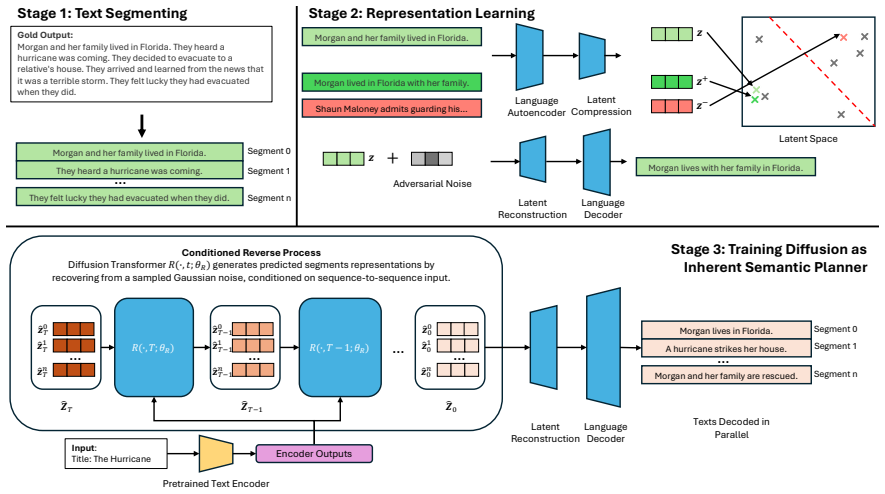
The central object is the segment-level latent plan: the output is partitioned into a sequence of segments $P = \{p_1, \dots, p_j\}$, each encoded into its own length-independent latent $z_j$, and the diffusion transformer predicts the full set $Z = \{z_1, \dots, z_j\}$ jointly, conditioned on the frozen input encoder. A parallel autoregressive decoder then reconstructs text from each latent independently. The robustness of the latent space is engineered with contrastive learning (using paraphrases as positives and out-of-domain text as negatives) and adversarial noise injection, while post-diffusion losses ($L_{\text{rec}}$ and $L_{\text{dec}}$) explicitly couple the diffusion predictions to the decoder, making the planner aware of how its outputs will be read.
What would settle it
Take a trained SLD model and decode each segment from its latent without the joint plan (e.g., de-noise each segment separately with no cross-attention to other segments); if the resulting text is just as coherent as the full model's output, then the jointly planned latents are not carrying cross-segment coherence, contradicting the framework's core mechanism.
Extended reading notes
Core claim
The paper's central claim is that a diffusion model can act as a semantic planner for text when the output is segmented: instead of de-noising one latent vector for an entire passage, the model de-noises a sequence of segment-level latents, each corresponding to a sentence or utterance, with the original input as cross-attention context. To make these latents usable, the paper trains the encoder-compressor-decoder stack with a cross-entropy conversion loss, a contrastive loss that pulls paraphrases together and pushes out-of-domain text apart, and an adversarial noise term that simulates worst-case perturbations. It then trains the diffusion model not only to predict clean latents but also with reconstruction and decoding losses that teach it how the decoder will interpret its outputs. The result, the paper argues, is a framework that scales to longer outputs, reduces repetition, and improves topic adherence over both whole-passage latent diffusion and fine-tuned autoregressive models.
Load-bearing premise
The decoder generates each segment independently, so the entire output can only be coherent if the jointly planned segment latents encode the relationships between segments, and the paper never directly verifies that they do.
Editorial extensions
If this is right
- If SLD's claims hold, diffusion-based text generation can be extended to long-form outputs without retraining the diffusion model on longer windows, since segment latents are length-independent.
- The parallel decoding of segments means inference time does not grow linearly with the number of segments, offering a practical speed advantage over autoregressive generation for long documents.
- The explicit one-to-one mapping between segments and latents opens a direct route to controllable generation: steering a specific sentence or utterance's latent should steer that part of the output.
- Because the autoregressive decoder handles fluency, the framework can inherit the strengths of pre-trained language models while avoiding their fine-tuning repetition failures, which the paper observes in Flan-T5.
Reading between the lines
- A direct test of the framework's load-bearing premise would be to decode each segment latent in isolation, without the joint plan; if coherence does not collapse, then the joint planning is not actually carrying cross-segment discourse information.
- The segmentation principle might transfer to other modalities where long-range structure matters, such as video or long-form audio, treating each shot or phrase as a planned segment.
- Contrastive learning here depends on high-quality paraphrase generation (the paper uses an instruction-tuned language model for that); a cheaper or weaker paraphrase source could erode the reported gains, suggesting a sensitivity worth probing.
- The paper reports no inference-speed comparison, but if the parallel decoding advantage holds, SLD-style frameworks could become the default way to apply diffusion models to production long-form generation.
Editorial analysis
A structured set of objections, weighed in public.
Referee Report
Summary. The paper proposes Segment-Level Diffusion (SLD), a framework for long-form conditional text generation that combines latent-space diffusion with output segmentation. The output text is split into segments (sentences or utterances), each encoded into a fixed-size latent representation; a diffusion transformer denoises the full set of segment latents jointly as a semantic plan, and a frozen autoregressive decoder reconstructs each segment in parallel. Training proceeds in three stages: output segmentation, representation learning with contrastive and adversarial losses, and diffusion training with additional reconstruction and decoding losses. Experiments are reported on XSum, ROCStories, DialogSum, and DeliData against diffusion baselines (GENIE, LD4LG, Diffuse-CG) and an autoregressive baseline (Flan-T5), using ROUGE, perplexity, and human ratings of repetition, fluency, coherence, compatibility, and hallucination. The paper claims SLD achieves competitive or superior fluency, coherence, and contextual compatibility, especially on long-form tasks.
Significance. If the empirical claims hold, SLD would be a practically useful and reproducible framework: it is simple to describe, builds on existing components (Flan-T5 backbone, Perceiver Resampler, DiT), and the authors release code. The paper also contributes a useful analysis of latent-space robustness (PCA visualization and denoising trajectories) and a knowledge-preservation study on ECQA, which are informative beyond the main method. However, the central qualitative claims currently outrun the reported evidence: automatic metrics are point estimates without variance or significance testing, the human evaluation is small and lacks agreement statistics, and the key architectural assumption that jointly denoised segment latents carry cross-segment discourse structure is not directly tested. The novelty relative to LD4LG and ML-Planner is real but incremental, and the paper would be strengthened by targeted ablations and statistical grounding.
major comments (4)
- [Section 5, Table 1] Automatic metrics are reported as single point estimates with no variance, confidence intervals, or significance tests. For example, on ROCStories the ROUGE-L values are 16.13 (Ours), 16.57 (LD4LG), and 16.46 (Flan-T5); on DialogSum the ROUGE-L differences are 27.97 (Ours) versus 26.34 (Flan-T5). Given that the abstract and Section 5 claim 'consistently highest ROUGE-L' for long-form tasks, the differences need to be shown to be statistically reliable, e.g., with paired bootstrap confidence intervals or significance tests. As it stands, a reader cannot distinguish a real advantage from noise.
- [Section 3.2, Figure 1, Eq. (17)] The central design premise is that joint denoising of the flattened segment latents is sufficient to make the decoded segments cohere, because the AR decoder processes each segment independently in parallel and never conditions on tokens from other segments. This premise is never directly tested. The training losses Lnoise and Lrec operate in latent space, and Ldec is a per-segment cross-entropy loss; no objective explicitly encourages the latent set to encode inter-segment discourse relations such as anaphora, event ordering, or topic continuity. The aggregate human coherence scores cannot distinguish coherence produced by the planned latents from coherence inherited from the input condition or from within-segment fluency. I recommend a direct mechanism test, for example: (a) compare against a variant that denoises each segment latent independently (removing cross-segment self-attention), and/or (b) measure discourse-specific outcomes such as coreference accuracy and narrative-order violations, and/or (c) condition the decoder on previously decoded segments to see whether cross-segment conditioning changes the qualitative results. Without such evidence, the claim that SLD improves long-form coherence through segment-level planning is not established.
- [Section 5, Appendix C] The human evaluation is the primary evidence for the fluency/coherence claims, but it uses only 25 generated outputs per model per dataset and 5 annotators, and no inter-annotator agreement is reported. Moreover, the results in Table 1 do not uniformly support the statement that 'our model shows better overall performance, especially in repetition, fluency and compatibility.' On ROCStories, Flan-T5 scores higher than SLD on both fluency (2.62 vs 2.41) and coherence (2.33 vs 2.10); SLD's advantages are on repetition and compatibility. Please clarify the exact basis for the qualitative summary, and report agreement statistics (e.g., Krippendorff's alpha or pairwise agreement) so the reader can gauge reliability of the 0.2-0.4 mean differences.
- [Appendix A, Table 4] The framework introduces four loss weights (lambda1-lambda4) that are chosen empirically without systematic exploration, as acknowledged in the Limitations. Because the contribution rests on the combination of contrastive, adversarial, reconstruction, and decoding losses, the absence of any sensitivity analysis makes it difficult to know whether the reported results are stable or artifacts of particular hyperparameter choices. A small sensitivity study (e.g., varying one lambda at a time over a small grid) or an ablation that removes each term would substantially strengthen the claim that the whole framework is needed.
minor comments (5)
- [Table 1 footnote] The baseline is referred to as 'Diffuse-CG' in Section 4.1 and 'Diffusion-CG' in the Table 1 footnote; please make the naming consistent.
- [Table 4] The dataset is called 'DeliData' throughout the paper but 'Delibot' in the hyperparameter table; please unify the terminology.
- [Algorithm 1] In the final line of Algorithm 1, the diffusion loss is written as Ldiff = Ls2s + lambda3 Lrec + lambda4 Ldec, but Ls2s is not defined anywhere in the paper; the main text uses Lnoise in Eq. (15). Please align the algorithm with the main text.
- [Equation (8)] The symbol p is used both for a text segment and for a probability distribution in Eq. (8); this is confusing, especially in the line 'for a patch of text p = ...'. Consider using a different symbol for the segment, such as s or P.
- [Appendix C] The Gemini-1.5 fluency judge for XSum is described as achieving 'high alignment with human annotators,' but no alignment statistic is reported. Please add a number (e.g., agreement rate or correlation) or soften the claim.
Circularity Check
No significant circularity: SLD is an empirical evaluation paper whose losses target gold data and whose claims are checked against independent baselines and references.
full rationale
SLD is an empirical method paper, not a derivation, so the circularity burden is low. The central claims are supported by automatic and human evaluations in Table 1, where SLD is compared against independent baselines (GENIE, LD4LG, Diffuse-CG, Flan-T5) and against gold references. The training losses Lnoise, Lrec, and Ldec (Eqs. 15-17) all minimize distances or cross-entropy with respect to gold latent representations and gold text segments; nothing in those objectives makes the reported fluency, coherence, or compatibility scores true by construction. No fitted parameter is later renamed as a prediction, and the hyperparameters are chosen on a development set rather than tuned to the test metrics. The only notable self-citation is DeliData (Karadzhov et al., 2023), which is used as an evaluation corpus with external annotations; that citation is not load-bearing for the method's derivation and does not make the evaluation circular. The skeptic's concern about cross-segment coherence being carried by jointly denoised segment latents is a correctness or robustness assumption, not a circularity: the paper does not define coherence so that SLD's architecture satisfies it by definition, and the human and automatic metrics provide an external check. Accordingly, no specific circular step can be exhibited, and the correct finding is no significant circularity.
Assumptions & free parameters
free parameters (5)
- lambda1 (contrastive loss weight) =
0.5 (XSum, DialogSum), 0.2 (ROCStories), 0 (DeliData)
- lambda2 (adversarial loss weight) =
0.2 (all datasets)
- lambda3 (reconstruction loss weight) =
0.5 (all datasets)
- lambda4 (decoding loss weight) =
0.5 (all datasets)
- latent dimensions (k x h_rep) =
32 x 64 in the analysis, not systematically varied
assumptions (4)
- standard math Denoising diffusion probabilistic model forward process q(z_t|z_{t-1}) = N(z_t; sqrt(1-beta_t) z_{t-1}, beta_t I)
- domain assumption A pre-trained frozen context encoder (Flan-T5) provides sufficient conditioning for the diffusion transformer.
- domain assumption Segments (sentences or utterances) are coherent units suitable for independent latent encoding.
- ad hoc to paper Paraphrases from Llama-3-8B-Instruct are valid contrastive positives and OOD samples from CNN/Daily Mail are valid negatives.
Cite this review
Pith. "Pith review of Segment-Level Diffusion: A Framework for Controllable Long-Form Generation with Diffusion Language Models." pith.science (2026). https://pith.science/paper/DOTI2QRW
@misc{pith2026241211333,
  author       = {Pith},
  title        = {Pith review of: Segment-Level Diffusion: A Framework for Controllable Long-Form Generation with Diffusion Language Models},
  year         = {2026},
  howpublished = {\url{https://pith.science/paper/DOTI2QRW}},
  note         = {Machine review of arXiv:2412.11333}
}
read the original abstract
Diffusion models have shown promise in text generation, but often struggle with generating long, coherent, and contextually accurate text. Token-level diffusion doesn't model word-order dependencies explicitly and operates on short, fixed output windows, while passage-level diffusion struggles with learning robust representations for long-form text. To address these challenges, we propose Segment-Level Diffusion (SLD), a framework that enhances diffusion-based text generation through text segmentation, robust representation training with adversarial and contrastive learning, and improved latent-space guidance. By segmenting long-form outputs into multiple latent representations and decoding them with an autoregressive decoder, SLD simplifies diffusion predictions and improves scalability. Experiments on four datasets demonstrate that, when compared to other diffusion and autoregressive baselines SLD achieves competitive or superior fluency, coherence, and contextual compatibility in automatic and human evaluations.
Figures


Figures from the paper (3 more)


Forward citations
Cited by 1 Pith paper
-
A Survey on Diffusion Language Models
A comprehensive survey of diffusion language models covering taxonomy, training and inference techniques, and comparisons with autoregressive models.
Reference graph
Works this paper leans on
-
[1]
Comprehensible Determine if the dialogue is readable and understandable, even if it contains minor grammatical errors. If the answer is No, skip the remaining questions for that dialogue. Examples: Positive Example: #Person2#: "Yes. How are you, Anna?" #Person1#: "I am fine. What have you been doing?" #Person2#: "Working." Answer: Yes (The dialogue is cle...
-
[2]
Repetition Rate the dialogue on a scale of 1 to 3: 1: Excessive repetition that impacts the overall meaning. 3: Minimal to no unnecessary repetition. Examples: Rating 1: #Person1#: "Did you like the trip?" #Person2#: "Yes, I liked the trip. The trip was great. I enjoyed the trip." #Person1#: "Did you like the trip?" #Person2#: "Yes, I liked the trip. The ...
-
[3]
Strengthen Guidance with Post-training: Freeze θg and θdec and compute: ˆZt = R(Zt+1, t+ 1, Encctx(i; θctx)) Lrec(θR) = E P,i,t g( ˆZt; θg) − g(Zt; θg) 2 2 , Ldec(θR) = E P,i,t " − pX l=1 log p(ol|o<l, ˆZt; θdec) #
-
[4]
Diffusion models for non-autoregressive text generation: A survey. In Proceedings of the Thirty- Second International Joint Conference on Artificial Intelligence, IJCAI 2023, 19th-25th August 2023, Macao, SAR, China, pages 6692–6701. ijcai.org. Yunzhe Li, Qian Chen, Weixiang Yan, Wen Wang, Qinglin Zhang, and Hari Sundaram. 2024. Advanc- ing precise outlin...
work page 2023
-
[5]
Text generation with diffusion language mod- els: A pre-training approach with continuous para- graph denoise. In International Conference on Ma- chine Learning, ICML 2023, 23-29 July 2023, Hon- olulu, Hawaii, USA, volume 202 of Proceedings of Machine Learning Research , pages 21051–21064. PMLR. AI @ Meta Llama Team. 2024. The llama 3 herd of models. Aaro...
work page 2023
-
[8]
ArXiv preprint, abs/2403.05530
Gemini 1.5: Unlocking multimodal under- standing across millions of tokens of context. ArXiv preprint, abs/2403.05530. Naftali Tishby and Noga Zaslavsky. 2015. Deep learn- ing and the information bottleneck principle. In 2015 ieee information theory workshop (itw), pages 1–5. IEEE. Arash Vahdat, Karsten Kreis, and Jan Kautz. 2021. Score-based generative m...
arXiv 2023
-
[9]
Compatibility - Evaluate whether the dialogue accurately reflects the facts provided in the summary. Rate from 1 to 3: - 1: The dialogue significantly deviates from the summary, either by altering key facts or diverging from the main topic. - 3: The dialogue faithfully reflects the summary, covering all key ideas accurately. Examples: - Summary: Anna asks...
-
[12]
Fluency/Grammar Rate the grammatical quality of sentences in the dialogue on a scale of 1 to 3: 1: Excessive grammatical and spelling errors, making the dialogue unnatural. 3: Completely fluent with no grammatical errors. Examples: Rating 1: #Person1#: "What doing you?" #Person2#: "Be to park and run." Rating: 1 (Frequent grammatical errors). Rating 2: #P...
Show all 18 references
-
[13]
What time is it?
Coherency Assess the logical flow and natural interaction of the dialogue on a scale of 1 to 3: 1: The dialogue lacks logical flow, and the interaction feels unnatural. 3: The dialogue flows logically and resembles a natural conversation. Examples: Rating 1: #Person1#: "What t...
-
[14]
How was your weekend?
Compatibility Evaluate whether the dialogue accurately reflects the facts provided in the summary. Rate from 1 to 3: 1: The dialogue significantly deviates from the summary, either by altering key facts or diverging from the main topic. 3: The dialogue faithfully reflects the ...
-
[15]
Contrastive Representation Learning: Sample positive and negative examples (p+, p−) and compute: Lcst(θin) =− log e(sim(z,z+)/τ ) e(sim(z,z+)/τ ) + e(sim(z,z−)/τ )
-
[16]
Noise Robustness Training: Add random noise to patches and latent space z: Ladv(θout) =− pX l=1 log p(ol|o<l, z + radv; θout), where radv is adversarial noise computed using a frozen offline copy of θout. 6 6. Update Parameters: Combine losses and update θrep: Lrep(θrep) = 1 N...
-
[18]
Lilo’s Walk
Update Parameters: Combine losses and update θR: Ldiff(θR) =Ls2s(θR) +λ3Lrec(θR) +λ4Ldec(θR) 14 end 15 Return: Trained model parameters θrep and θR. 30 20 10 0 10 20 30 40 20 10 0 10 20 30 40 0.00 0.33 0.67 1.00 Vanilla 30 20 10 0 10 20 30 40 0.00 0.33 0.67 1.00 Noise Robust 3...
-
[2017]
In Proceedings of the 55th An- nual Meeting of the Association for Computational Linguistics (Volume 1: Long Papers), pages 1073– 1083, Vancouver, Canada
Get to the point: Summarization with pointer- generator networks. In Proceedings of the 55th An- nual Meeting of the Association for Computational Linguistics (Volume 1: Long Papers), pages 1073– 1083, Vancouver, Canada. Association for Computa- tional Linguistics. Lakshay Sha...
2019
-
[2018]
In Proceedings of the 2018 Conference on Empirical Methods in Natural Lan- guage Processing, pages 1797–1807, Brussels, Bel- gium
Don’t give me the details, just the summary! topic-aware convolutional neural networks for ex- treme summarization. In Proceedings of the 2018 Conference on Empirical Methods in Natural Lan- guage Processing, pages 1797–1807, Brussels, Bel- gium. Association for Computational ...
2018
-
[2021]
In Findings of the Association for Computational Linguistics: ACL-IJCNLP 2021, pages 5062–5074, Online
DialogSum: A real-life scenario dialogue sum- marization dataset. In Findings of the Association for Computational Linguistics: ACL-IJCNLP 2021, pages 5062–5074, Online. Association for Computa- tional Linguistics. Hyung Won Chung, Le Hou, Shayne Longpre, Barret Zoph, Yi Tay, ...
2021
-
[2023]
Proceedings of the ACM on Human-Computer Interaction, 7(CSCW2):1–25
Delidata: A dataset for deliberation in multi- party problem solving. Proceedings of the ACM on Human-Computer Interaction, 7(CSCW2):1–25. Yukyung Lee, Soonwon Ka, Bokyung Son, Pilsung Kang, and Jaewook Kang. 2024. Navigating the path of writing: Outline-guided text generation...
2024 arXiv
-
[2024]
Journal of Machine Learning Research, 25(70):1–53
Scaling instruction-finetuned language models. Journal of Machine Learning Research, 25(70):1–53. Elizabeth Clark, Shruti Rijhwani, Sebastian Gehrmann, Joshua Maynez, Roee Aharoni, Vitaly Nikolaev, Thibault Sellam, Aditya Siddhant, Dipanjan Das, and Ankur Parikh. 2023. SEAHORS...
2023 arXiv
Reviewed August 11, 2026 · model on record in the stance chip above.
Discussion (0). Continue with ORCID to comment.