REVIEW 5 major objections 5 minor 1 cited by
Skip Tuning: Pre-trained Vision-Language Models are Effective and Efficient Adapters Themselves
T0 review · 5 major / 5 minor · reviewed 2026-08-11 · deepseek-v4-flash
Pith's one-line read Reducing the length and width of feature-gradient propagation flows is the key to efficient vision-language adaptation.
desk verdict Skip Tuning is a genuinely simpler and faster way to adapt CLIP, and the accuracy gains are plausible but partly in-sample because the three hyperparameters are tuned on the same 11 benchmarks used for the headline results. read the letter →
The pith
A machine-rendered reading of the paper's core claim, the machinery that carries it, and where it could break.
The reading
What carries the argument
The central object is the Feature-Gradient Propagation Flow (FGPF): the forward flows of image and text features and the backward flows of gradients through the vision and text encoders. The paper models total cost as $C_{\mathrm{total}} = N \times (C_V + C_T \times M)$, where $N$ is the number of layers, $M$ the number of class tokens, and $C_V, C_T$ the per-layer costs of the vision and text encoders, so layer count is the FGPF length and class-token count the FGPF width. Two diagnostic metrics justify the skipping: Feature Sensitivity (FS), the Euclidean distance between a layer's feature before and after fine-tuning, identifies shallow layers as dispensable, and Gradient Dependence (GD), the change in feature gradients when a class token is removed, identifies most class tokens as dispensable for any given image. LSkip and CSkip operationalize these observations by cutting length and width respectively.
What would settle it
Measure Feature Sensitivity on all 11 datasets before fixing $\omega$; if any dataset shows large FS values in the first six layers, the LSkip premise fails there. A direct test is to run Skip Tuning on a dataset where shallow layers carry task-specific structure, such as a texture- or edge-dominated benchmark, and compare base and new accuracy against full fine-tuning; a large accuracy drop would falsify the claim that shallow layers are universally dispensable.
Extended reading notes
Core claim
The paper's central claim is that reducing both the length and the width of the feature-gradient propagation flows (FGPFs) of the full fine-tuning baseline is the key to effective and efficient knowledge transfer. Length means the number of transformer layers that features and gradients traverse; width means the number of class tokens used in the image-text matching loss for each training image. Layer-wise Skipping (LSkip) caches intermediate features after the first $\omega$ layers and fine-tunes only the remaining deep layers; Class-wise Skipping (CSkip) samples a small image-conditioned subset of class tokens, keeping the top similar classes and probabilistically including others. The authors report that this two-way skipping improves base-to-new, cross-dataset, and domain generalization accuracy over state-of-the-art prompt tuning while cutting time and memory by large factors, and that it also beats adapter-based methods such as LoRA and CLIP-adapter.
Load-bearing premise
The paper assumes that the importance rankings of layers and class tokens measured by Feature Sensitivity and Gradient Dependence on only two datasets (Caltech101 and Food101) hold across all 11 evaluation datasets and for unseen classes, so that one fixed skipped-layer count ($\omega=6$) and one fixed class-sampling rule ($r=0.5$, $\lambda=0.3$) work everywhere.
Editorial extensions
If this is right
- Fine-tuning only the last $N-\omega$ layers of CLIP, with features cached from frozen shallow layers, preserves or improves accuracy relative to full fine-tuning on the tested benchmarks.
- Sampling a small image-conditioned subset of class tokens per training image (with $r=0.5$ and $\lambda=0.3$) cuts memory and time while improving generalization, because it filters redundant text features.
- Skip Tuning outperforms prompt-tuning methods on base-to-new generalization (known and unseen classes), cross-dataset transfer, and domain generalization, and outperforms LoRA and CLIP-adapter in both accuracy and efficiency.
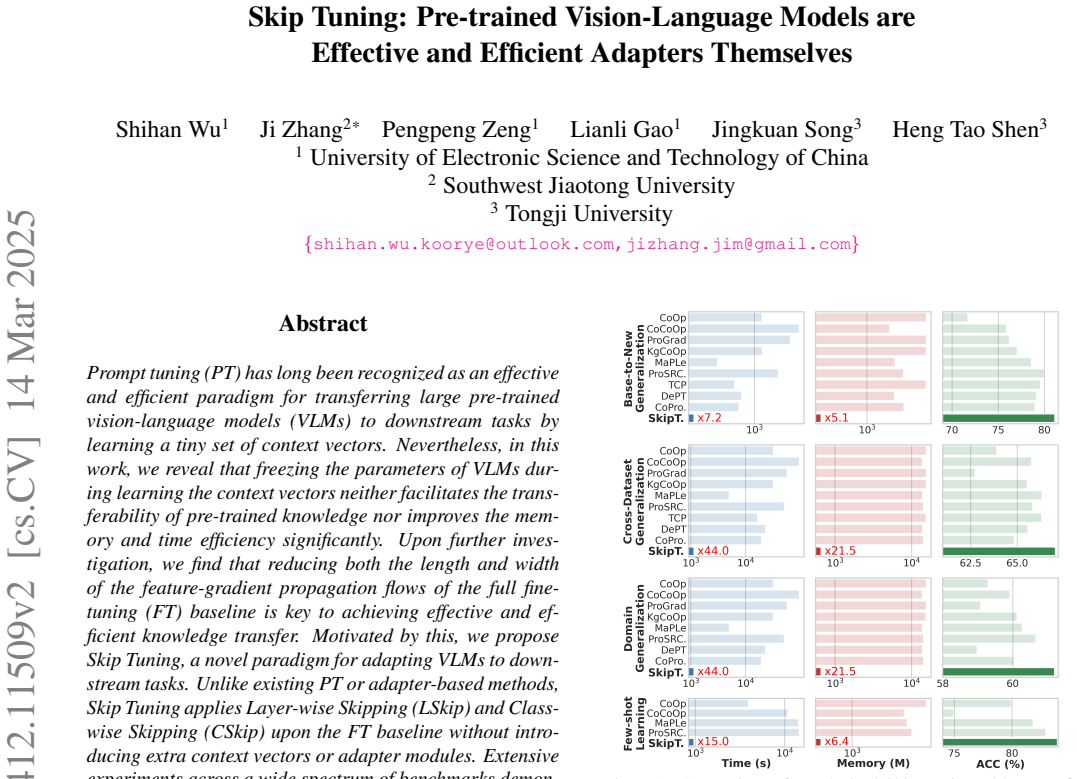
- Efficiency gains grow with dataset size: on cross-dataset ImageNet training, Skip Tuning reports roughly 44 times less time and 21.5 times less memory than PromptSRC.
- No learnable prompt vectors or adapter modules are introduced, so the adapted model is still the pre-trained weights plus cached intermediate features.
Reading between the lines
- The FS and GD diagnostics could be reused as a cheap dataset profiler: measuring layer and class-token importance on a small validation set before choosing $\omega$, $r$, and $\lambda$ could let the skipping hyper-parameters be selected per task rather than fixed.
- The same length-and-width reduction logic may transfer to other large frozen models beyond CLIP, wherever shallow layers and many label tokens are redundant for a target task.
- If shallow-layer features are genuinely task-agnostic, caching them once per dataset would let many tasks share the same cache, making per-task fine-tuning nearly as cheap as linear probing.
- The reported insensitivity of accuracy to $r$ between 0.4 and 1.0 suggests the benefit of CSkip is mainly distraction removal rather than hard class selection; a direct test is whether random class dropping without similarity sorting gives the same gain.
Editorial analysis
A structured set of objections, weighed in public.
Referee Report
Summary. The paper proposes Skip Tuning, an adaptation method for CLIP that reduces feature-gradient propagation flows (FGPFs) through two operations: Layer-wise Skipping (LSkip), which caches features at the omega-th layer and fine-tunes only the remaining deep layers, and Class-wise Skipping (CSkip), which samples a subset of class tokens per training image when computing the image-text matching loss. The authors argue that freezing shallow layers and sampling class tokens yields both higher accuracy and much higher efficiency than prompt tuning and adapter-based baselines. They support this with: (i) FS/GD metrics showing shallow layers and most class tokens contribute little during fine-tuning on two datasets; (ii) experiments on 11 benchmarks across base-to-new, cross-dataset, domain generalization, and few-shot settings, reporting higher harmonic-mean accuracy with substantially lower time and memory than prior methods; (iii) ablations showing that LSkip and CSkip both improve on the full fine-tuning baseline.
Significance. If the reported results hold, Skip Tuning is an conceptually simple and parameter-free (beyond three hyperparameters) alternative to prompt tuning and adapter modules, with structurally plausible efficiency gains: skipping layers and class tokens directly shortens the per-example forward/backward path. The paper ships a public code repository, and the efficiency advantages are reported consistently across multiple evaluation settings. However, the effectiveness claim is currently weakened by the in-sample selection of the three hyperparameters on the very benchmarks used for the final results, and by the absence of any variance or significance measures despite the paper stating that all results are averaged over three runs. The method's novel contribution, LSkip and CSkip, is a genuine and potentially useful idea, but the evidence as presented does not yet establish that the accuracy edge over prior art generalizes beyond the tuned configuration.
major comments (5)
- [§3.3, Figure 4] The hyperparameters ω=6, r=0.5, λ=0.3 are selected by maximizing the average harmonic-mean accuracy on the same 11 datasets that are then reported as the final results in Table 1. This is an in-sample model-selection procedure: the test splits are used both to choose the hyperparameters and to report the headline 81.11 H versus 79.97 for PromptSRC. Part or all of the claimed accuracy advantage may reflect tuning on the evaluation benchmarks rather than a general property of skipping layers and class tokens. The authors should either choose hyperparameters on a separate validation split (e.g., a subset of datasets or a train/validation split of each dataset) or report performance across the full hyperparameter grid to demonstrate that the result is not an artifact of selection. Given that the method has only three tunable scalars, this is straightforward to address.
- [§2.2, Figure 2(b,c)] The motivation for skipping layers and class tokens rests on FS and GD metrics computed on only two datasets (Caltech101 and Food101). The paper then applies the fixed choice ω=6 across all 11 evaluation datasets. No evidence is provided that the sensitivity profile measured on these two datasets transfers to the other nine tasks, which include fine-grained (Aircraft, Cars) and scene/dataset categories with very different properties. The Euclidean-distance heuristics in Eqs. (3) and (4) are also not validated against any downstream performance criterion. The authors should either compute FS/GD on more datasets or, better, connect the FS/GD ranking to held-out validation performance before the skipping strategy is fixed.
- [§3.1 (Implementation details)] The paper states that 'all experimental results are the average of 3 runs with different seeds,' but Tables 1–3 and 5 report only point estimates without standard deviations or error bars. Consequently, the reader cannot assess whether the reported improvements (e.g., 1.14% H over PromptSRC in Table 1, or 0.02% for CSkip-only in Table 4) are statistically meaningful. The authors should report standard deviations or confidence intervals for at least the main base-to-new results and the ablations.
- [§3.3, Table 4] The text states that 'both LSkip and CSkip contribute to performance improvement,' but the ablation table shows that CSkip alone (Base 84.77, New 74.48, H 79.29) yields essentially no harmonic-mean improvement over the FT baseline (H 79.27), while LSkip alone yields H 81.00. The only substantial benefit of CSkip alone is efficiency (time drops from 1002s to 440s, memory from 1846M to 919M). The claim should be corrected to state that LSkip is the main accuracy driver and that CSkip contributes primarily to efficiency, with only a marginal accuracy effect when used alone.
- [§2.3, Eq. (2) and Eq. (7)] CSkip samples a subset of class tokens for each image, but the paper does not specify whether the softmax normalization in Eq. (2) is over the sampled subset (with M replaced by the per-image m) or over all M classes using the cached text features. This distinction is essential for reproducibility: if the denominator still sums over all classes, the loss is unchanged except for the absence of gradients for unsampled classes; if it sums over the sampled subset, the loss itself changes. The implementation in the released code may resolve this, but the manuscript should state the choice explicitly.
minor comments (5)
- [§3.2] The text refers to 'Table 6' for cross-dataset and domain generalization results, but in the main paper these are Tables 2 and 3; the supplementary also contains Tables 6 and 7. The cross-references are inconsistent and should be harmonized.
- [§3.4] The text refers to 'Table 8' for adapter-based comparisons, but the corresponding table in the main text is Table 5. Please align the numbering.
- [Supplementary A] There are typos: 'training apochs' should be 'training epochs', and in Supplementary B 'target ddomains' should be 'target domains'.
- [§1, Figure 1 caption] The caption states that '× indicates the performance improvement over the state-of-the-art,' but the figure itself is not shown in the manuscript text and the exact meaning of the multiplicative factors is not defined. Please clarify.
- [Table 1] The column header 'ProSRC.' should be 'PromptSRC' for consistency with the text and other tables; the same abbreviation appears in Tables 2 and 3.
Circularity Check
Hyperparameters ω, r, and λ are tuned on the same 11-dataset benchmark used for the headline accuracy, so the reported effectiveness edge is partly an in-sample selection artifact.
-
fitted input called prediction
[Section 3.3, 'Impact of the CSkip Hyper-parameter r' and Figure 4; final results in Table 1.]
"we respectively set r to {0.1, 0.3, 0.5, 0.7, 0.9, 1.0}, and report the average testing results on the 11 datasets in Figure 4 ( Mid.)."
The CSkip ratio r is selected by maximizing the average H accuracy computed on the same 11 datasets that are later reported as the headline result. The parallel sweeps in Figure 4 select ω=6 and λ=0.3 by the same 'average testing results on the 11 datasets' criterion. Those chosen hyperparameters are then fixed for Table 1, where Skip Tuning's 81.11 average H is compared with PromptSRC's 79.97. Thus the reported accuracy advantage is the value at the in-sample optimum of the evaluation metric on exactly those datasets, not an unbiased estimate for unseen tasks; part of the gap is forced by the selection procedure.
full rationale
The paper's core mechanism — freezing shallow layers via LSkip and subsampling class tokens via CSkip — is not definitionally circular: the FS and GD metrics are external observations about CLIP's features/gradients, and the cost model Ctotal = N × (CV + CT × M) directly implies the efficiency gains from reducing length and width. No load-bearing self-citation or imported uniqueness theorem is used; DePT is only a code base, not an argument. The main circularity is the hyperparameter-selection protocol: Section 3.3 sweeps ω, r, and λ and reports 'average testing results on the 11 datasets', then adopts the best values and presents Table 1 on those same datasets as evidence of superiority. This makes the headline base-to-new and cross-dataset accuracy comparisons partly in-sample: the chosen hyperparameters are fitted to the evaluation benchmark, so the magnitude of the claimed effectiveness advantage is statistically forced to be favorable. The claim retains independent content through held-out domain-generalization targets and structural efficiency advantages, but the reported accuracy edge should be re-evaluated with a held-out validation split before being treated as an unbiased prediction.
Assumptions & free parameters
free parameters (3)
- omega (number of skipped layers) =
6
- r (class sampling ratio) =
0.5
- lambda (exponential decay coefficient) =
0.3
assumptions (3)
- domain assumption Feature Sensitivity (FS) and Gradient Dependence (GD) computed with Euclidean distances on two datasets correctly identify dispensable layers and class tokens across all evaluation benchmarks.
- domain assumption Cached features from the frozen first omega layers of the vision and text encoders are representative and remain valid inputs for fine-tuning the remaining deep layers on new tasks.
- ad hoc to paper The image-conditioned exponential class sampling in Eq. 7 provides a loss that is effective for learning a good classifier over all classes, despite ignoring most class tokens per image.
Cite this review
Pith. "Pith review of Skip Tuning: Pre-trained Vision-Language Models are Effective and Efficient Adapters Themselves." pith.science (2026). https://pith.science/paper/LYQVU7KN
@misc{pith2026241211509,
  author       = {Pith},
  title        = {Pith review of: Skip Tuning: Pre-trained Vision-Language Models are Effective and Efficient Adapters Themselves},
  year         = {2026},
  howpublished = {\url{https://pith.science/paper/LYQVU7KN}},
  note         = {Machine review of arXiv:2412.11509}
}
read the original abstract
Prompt tuning (PT) has long been recognized as an effective and efficient paradigm for transferring large pre-trained vision-language models (VLMs) to downstream tasks by learning a tiny set of context vectors. Nevertheless, in this work, we reveal that freezing the parameters of VLMs during learning the context vectors neither facilitates the transferability of pre-trained knowledge nor improves the memory and time efficiency significantly. Upon further investigation, we find that reducing both the length and width of the feature-gradient propagation flows of the full fine-tuning (FT) baseline is key to achieving effective and efficient knowledge transfer. Motivated by this, we propose Skip Tuning, a novel paradigm for adapting VLMs to downstream tasks. Unlike existing PT or adapter-based methods, Skip Tuning applies Layer-wise Skipping (LSkip) and Class-wise Skipping (CSkip) upon the FT baseline without introducing extra context vectors or adapter modules. Extensive experiments across a wide spectrum of benchmarks demonstrate the superior effectiveness and efficiency of our Skip Tuning over both PT and adapter-based methods. Code: https://github.com/Koorye/SkipTuning.
Figures


Figures from the paper (2 more)


Forward citations
Cited by 1 Pith paper
-
Dynamic Rank Adaptation for Vision-Language Models
A CLIP adapter variant that varies per-token adaptation capacity by token importance improves new-class generalization by about one point over prior adapters.
Reference graph
Works this paper leans on
-
[1]
Josh Achiam, Steven Adler, Sandhini Agarwal, Lama Ah- mad, Ilge Akkaya, Florencia Leoni Aleman, Diogo Almeida, Janko Altenschmidt, Sam Altman, Shyamal Anadkat, et al. Gpt-4 technical report. arXiv preprint arXiv:2303.08774 ,
-
[2]
Food-101–mining discriminative components with random forests
Lukas Bossard, Matthieu Guillaumin, and Luc Van Gool. Food-101–mining discriminative components with random forests. In Computer vision–ECCV 2014: 13th European conference, zurich, Switzerland, September 6-12, 2014, pro- ceedings, part VI 13, pages 446–461. Springer, 2014. 5
2014
-
[3]
Describing textures in the wild
Mircea Cimpoi, Subhransu Maji, Iasonas Kokkinos, Sammy Mohamed, and Andrea Vedaldi. Describing textures in the wild. In Proceedings of the IEEE conference on computer vision and pattern recognition, pages 3606–3613, 2014. 5
2014
-
[4]
Imagenet: A large-scale hierarchical image database
Jia Deng, Wei Dong, Richard Socher, Li-Jia Li, Kai Li, and Li Fei-Fei. Imagenet: A large-scale hierarchical image database. In 2009 IEEE conference on computer vision and pattern recognition, pages 248–255. Ieee, 2009. 5
2009
-
[5]
Li Fei-Fei, Rob Fergus, and Pietro Perona. Learning gener- ative visual models from few training examples: An incre- mental bayesian approach tested on 101 object categories. Computer vision and Image understanding , 106(1):59–70,
-
[6]
Prompt- det: Towards open-vocabulary detection using uncurated im- ages
Chengjian Feng, Yujie Zhong, Zequn Jie, Xiangxiang Chu, Haibing Ren, Xiaolin Wei, Weidi Xie, and Lin Ma. Prompt- det: Towards open-vocabulary detection using uncurated im- ages. In European Conference on Computer Vision , pages 701–717. Springer, 2022. 8
work page 2022
-
[7]
Generalized meta-fdmixup: Cross-domain few-shot learning guided by labeled target data
Yuqian Fu, Yanwei Fu, Jingjing Chen, and Yu-Gang Jiang. Generalized meta-fdmixup: Cross-domain few-shot learning guided by labeled target data. IEEE Transactions on Image Processing, 31:7078–7090, 2022. 8
work page 2022
-
[8]
Styleadv: Meta style adversarial training for cross-domain few-shot learning
Yuqian Fu, Yu Xie, Yanwei Fu, and Yu-Gang Jiang. Styleadv: Meta style adversarial training for cross-domain few-shot learning. In Proceedings of the IEEE/CVF con- ference on computer vision and pattern recognition , pages 24575–24584, 2023. 8
work page 2023
Show all 44 references
-
[9]
Cross-domain few-shot object detection via enhanced open-set object detector
Yuqian Fu, Yu Wang, Yixuan Pan, Lian Huai, Xingyu Qiu, Zeyu Shangguan, Tong Liu, Yanwei Fu, Luc Van Gool, and Xingqun Jiang. Cross-domain few-shot object detection via enhanced open-set object detector. InECCV, pages 247–264. Springer, 2025. 8
2025
-
[10]
Clip-adapter: Better vision-language models with feature adapters
Peng Gao, Shijie Geng, Renrui Zhang, Teli Ma, Rongyao Fang, Yongfeng Zhang, Hongsheng Li, and Yu Qiao. Clip-adapter: Better vision-language models with feature adapters. International Journal of Computer Vision, 132(2): 581–595, 2024. 7, 8, 11
2024
-
[11]
Open-vocabulary object detection via vision and language knowledge distillation
Xiuye Gu, Tsung-Yi Lin, Weicheng Kuo, and Yin Cui. Open-vocabulary object detection via vision and language knowledge distillation. arXiv preprint arXiv:2104.13921 ,
-
[12]
Eurosat: A novel dataset and deep learning benchmark for land use and land cover classification
Patrick Helber, Benjamin Bischke, Andreas Dengel, and Damian Borth. Eurosat: A novel dataset and deep learning benchmark for land use and land cover classification. IEEE Journal of Selected Topics in Applied Earth Observations and Remote Sensing, 12(7):2217–2226, 2019. 5
2019
-
[13]
The many faces of robust- ness: A critical analysis of out-of-distribution generalization
Dan Hendrycks, Steven Basart, Norman Mu, Saurav Kada- vath, Frank Wang, Evan Dorundo, Rahul Desai, Tyler Zhu, Samyak Parajuli, Mike Guo, et al. The many faces of robust- ness: A critical analysis of out-of-distribution generalization. In Proceedings of the IEEE/CVF internation...
2021
-
[14]
Natural adversarial examples
Dan Hendrycks, Kevin Zhao, Steven Basart, Jacob Stein- hardt, and Dawn Song. Natural adversarial examples. In Proceedings of the IEEE/CVF conference on computer vi- sion and pattern recognition, pages 15262–15271, 2021. 5
2021
-
[15]
Lora: Low-rank adaptation of large language models
Edward J Hu, Yelong Shen, Phillip Wallis, Zeyuan Allen- Zhu, Yuanzhi Li, Shean Wang, Lu Wang, and Weizhu Chen. Lora: Low-rank adaptation of large language models. arXiv preprint arXiv:2106.09685, 2021. 2, 7, 11
2021 arXiv
-
[16]
Scaling up visual and vision-language representa- tion learning with noisy text supervision
Chao Jia, Yinfei Yang, Ye Xia, Yi-Ting Chen, Zarana Parekh, Hieu Pham, Quoc Le, Yun-Hsuan Sung, Zhen Li, and Tom Duerig. Scaling up visual and vision-language representa- tion learning with noisy text supervision. In International conference on machine learning, pages 4904–4916. PMLR,
-
[17]
Maple: Multi-modal prompt learning
Muhammad Uzair Khattak, Hanoona Rasheed, Muhammad Maaz, Salman Khan, and Fahad Shahbaz Khan. Maple: Multi-modal prompt learning. In Proceedings of the IEEE/CVF Conference on Computer Vision and Pattern Recognition, pages 19113–19122, 2023. 8, 11
2023
-
[18]
Self-regulating prompts: Foundational model adaptation without forgetting
Muhammad Uzair Khattak, Syed Talal Wasim, Muzam- mal Naseer, Salman Khan, Ming-Hsuan Yang, and Fa- had Shahbaz Khan. Self-regulating prompts: Foundational model adaptation without forgetting. In Proceedings of the IEEE/CVF International Conference on Computer Vision , pages 15...
2023
-
[19]
3d object representations for fine-grained categorization
Jonathan Krause, Michael Stark, Jia Deng, and Li Fei-Fei. 3d object representations for fine-grained categorization. In Proceedings of the IEEE international conference on com- puter vision workshops, pages 554–561, 2013. 5
2013
-
[20]
Image segmenta- tion using text and image prompts
Timo L ¨uddecke and Alexander Ecker. Image segmenta- tion using text and image prompts. In Proceedings of the IEEE/CVF conference on computer vision and pattern recognition, pages 7086–7096, 2022. 8
2022
-
[21]
Fine-grained visual classi- fication of aircraft
Subhransu Maji, Esa Rahtu, Juho Kannala, Matthew Blaschko, and Andrea Vedaldi. Fine-grained visual classi- fication of aircraft. arXiv preprint arXiv:1306.5151 , 2013. 5
2013 arXiv
-
[22]
Automated flower classification over a large number of classes
Maria-Elena Nilsback and Andrew Zisserman. Automated flower classification over a large number of classes. In 2008 Sixth Indian conference on computer vision, graphics & im- age processing, pages 722–729. IEEE, 2008. 5
2008
-
[23]
Cats and dogs
Omkar M Parkhi, Andrea Vedaldi, Andrew Zisserman, and CV Jawahar. Cats and dogs. In 2012 IEEE conference on computer vision and pattern recognition, pages 3498–3505. IEEE, 2012. 5
2012
-
[24]
Learning transferable visual models from natural language supervi- sion
Alec Radford, Jong Wook Kim, Chris Hallacy, Aditya Ramesh, Gabriel Goh, Sandhini Agarwal, Girish Sastry, Amanda Askell, Pamela Mishkin, Jack Clark, et al. Learning transferable visual models from natural language supervi- sion. In International conference on machine learning, ...
2021
-
[25]
Denseclip: Language-guided dense prediction with context- aware prompting
Yongming Rao, Wenliang Zhao, Guangyi Chen, Yansong Tang, Zheng Zhu, Guan Huang, Jie Zhou, and Jiwen Lu. Denseclip: Language-guided dense prediction with context- aware prompting. In Proceedings of the IEEE/CVF con- ference on computer vision and pattern recognition , pages 180...
2022
-
[26]
Do imagenet classifiers generalize to im- agenet? In International conference on machine learning , pages 5389–5400
Benjamin Recht, Rebecca Roelofs, Ludwig Schmidt, and Vaishaal Shankar. Do imagenet classifiers generalize to im- agenet? In International conference on machine learning , pages 5389–5400. PMLR, 2019. 5
2019
-
[27]
Consistency-guided prompt learning for vision-language models
Shuvendu Roy and Ali Etemad. Consistency-guided prompt learning for vision-language models. arXiv preprint arXiv:2306.01195, 2023. 8
2023 arXiv
-
[28]
Ucf101: A dataset of 101 human actions classes from videos in the wild
Khurram Soomro, Amir Roshan Zamir, and Mubarak Shah. Ucf101: A dataset of 101 human actions classes from videos in the wild. arXiv preprint arXiv:1212.0402, 2012. 5
2012 arXiv
-
[29]
Llama: Open and efficient foundation language models
Hugo Touvron, Thibaut Lavril, Gautier Izacard, Xavier Martinet, Marie-Anne Lachaux, Timoth´ee Lacroix, Baptiste Rozi`ere, Naman Goyal, Eric Hambro, Faisal Azhar, et al. Llama: Open and efficient foundation language models. arXiv preprint arXiv:2302.13971, 2023. 1
2023 arXiv
-
[30]
Learning robust global representations by penalizing local predictive power.Advances in Neural Information Pro- cessing Systems, 32, 2019
Haohan Wang, Songwei Ge, Zachary Lipton, and Eric P Xing. Learning robust global representations by penalizing local predictive power.Advances in Neural Information Pro- cessing Systems, 32, 2019. 5
2019
-
[31]
Sun database: Large-scale scene recognition from abbey to zoo
Jianxiong Xiao, James Hays, Krista A Ehinger, Aude Oliva, and Antonio Torralba. Sun database: Large-scale scene recognition from abbey to zoo. In 2010 IEEE computer so- ciety conference on computer vision and pattern recognition, pages 3485–3492. IEEE, 2010. 5
2010
-
[32]
Visual- language prompt tuning with knowledge-guided context op- timization
Hantao Yao, Rui Zhang, and Changsheng Xu. Visual- language prompt tuning with knowledge-guided context op- timization. In Proceedings of the IEEE/CVF conference on computer vision and pattern recognition, pages 6757–6767,
-
[33]
Tcp: Textual- based class-aware prompt tuning for visual-language model
Hantao Yao, Rui Zhang, and Changsheng Xu. Tcp: Textual- based class-aware prompt tuning for visual-language model. In Proceedings of the IEEE/CVF Conference on Computer Vision and Pattern Recognition, pages 23438–23448, 2024. 8
2024
-
[34]
Filip: Fine-grained interactive language-image pre-training
Lewei Yao, Runhui Huang, Lu Hou, Guansong Lu, Minzhe Niu, Hang Xu, Xiaodan Liang, Zhenguo Li, Xin Jiang, and Chunjing Xu. Filip: Fine-grained interactive language-image pre-training. arXiv preprint arXiv:2111.07783, 2021. 8
2021 arXiv
-
[35]
Open-vocabulary detr with conditional matching
Yuhang Zang, Wei Li, Kaiyang Zhou, Chen Huang, and Chen Change Loy. Open-vocabulary detr with conditional matching. In European Conference on Computer Vision , pages 106–122. Springer, 2022. 8
2022
-
[36]
Lit: Zero-shot transfer with locked-image text tuning
Xiaohua Zhai, Xiao Wang, Basil Mustafa, Andreas Steiner, Daniel Keysers, Alexander Kolesnikov, and Lucas Beyer. Lit: Zero-shot transfer with locked-image text tuning. In Proceedings of the IEEE/CVF conference on computer vi- sion and pattern recognition, pages 18123–18133, 2022. 8
2022
-
[37]
Free-lunch for cross-domain few-shot learning: Style-aware episodic training with robust contrastive learning
Ji Zhang, Jingkuan Song, Lianli Gao, and Hengtao Shen. Free-lunch for cross-domain few-shot learning: Style-aware episodic training with robust contrastive learning. In Pro- ceedings of the 30th ACM International Conference on Mul- timedia, pages 2586–2594, 2022. 8
2022
-
[38]
Deta: Denoised task adaptation for few-shot learning
Ji Zhang, Lianli Gao, Xu Luo, Hengtao Shen, and Jingkuan Song. Deta: Denoised task adaptation for few-shot learning. In ICCV, pages 11541–11551, 2023. 8
2023
-
[39]
Dept: Decoupled prompt tuning
Ji Zhang, Shihan Wu, Lianli Gao, Heng Tao Shen, and Jingkuan Song. Dept: Decoupled prompt tuning. In Pro- ceedings of the IEEE/CVF Conference on Computer Vision and Pattern Recognition, pages 12924–12933, 2024. 5, 8
2024
-
[40]
Tip-adapter: Training-free clip-adapter for better vision- language modeling
Renrui Zhang, Rongyao Fang, Wei Zhang, Peng Gao, Kunchang Li, Jifeng Dai, Yu Qiao, and Hongsheng Li. Tip-adapter: Training-free clip-adapter for better vision- language modeling. arXiv preprint arXiv:2111.03930, 2021. 8
2021 arXiv
-
[41]
Conditional prompt learning for vision-language mod- els
Kaiyang Zhou, Jingkang Yang, Chen Change Loy, and Ziwei Liu. Conditional prompt learning for vision-language mod- els. In Proceedings of the IEEE/CVF conference on com- puter vision and pattern recognition , pages 16816–16825,
-
[42]
Learning to prompt for vision-language models
Kaiyang Zhou, Jingkang Yang, Chen Change Loy, and Ziwei Liu. Learning to prompt for vision-language models. In- ternational Journal of Computer Vision, 130(9):2337–2348,
-
[43]
Detecting twenty-thousand classes using image-level supervision
Xingyi Zhou, Rohit Girdhar, Armand Joulin, Philipp Kr¨ahenb¨uhl, and Ishan Misra. Detecting twenty-thousand classes using image-level supervision. In European Confer- ence on Computer Vision , pages 350–368. Springer, 2022. 8
2022
-
[44]
Prompt-aligned gradient for prompt tuning
Beier Zhu, Yulei Niu, Yucheng Han, Yue Wu, and Han- wang Zhang. Prompt-aligned gradient for prompt tuning. In Proceedings of the IEEE/CVF International Conference on Computer Vision, pages 15659–15669, 2023. 8 Supplementary Materials A. Experimental Setups for FT and PT While ...
2023
Reviewed August 11, 2026 · model on record in the stance chip above.
Discussion (0). Continue with ORCID to comment.