REVIEW 5 major objections 6 minor 1 cited by
Meta Curvature-Aware Minimization for Domain Generalization
T0 review · 5 major / 6 minor · reviewed 2026-08-11 · deepseek-v4-flash
Pith's one-line read The paper claims that jointly minimizing the vanilla loss, the SAM surrogate gap, and the meta-learning surrogate gap—derived from a curvature metric—steers models to flatter minima and improves domain generalization on five benchmarks.
desk verdict A plausible empirical recipe for DG buried under a theory section that does not actually show it minimizes curvature. read the letter →
The pith
A machine-rendered reading of the paper's core claim, the machinery that carries it, and where it could break.
The reading
What carries the argument
The curvature metric $\mathcal{C}(f(\theta)) = \|H(\theta)\| / (\|\nabla f(\theta)\|^2 + 1)$, which equals $\lambda_{\max}(H(\theta))$ at a local minimum when $H$ is positive semi-definite. The metric is small far from convergence because the gradient norm is large, and it grows as the gradient vanishes, so it selectively penalizes curvature near minima. The algorithm is then obtained by substituting the central-difference approximation $H \approx (f(\theta+h)+f(\theta-h)-2f(\theta))/h^2$ with $h=\delta$ along the SAM perturbation direction and absorbing $1/h^2$ into the weight $\alpha$, yielding the three-term objective in Eq. (11).
What would settle it
On a small network or synthetic loss landscape, compute the true largest eigenvalue of the Hessian at the endpoints found by MeCAM, ERM, and SAM, and compare it with the paper's curvature metric $\mathcal{C}$. If MeCAM endpoints do not have lower $\lambda_{\max}$ than SAM or ERM endpoints, or if $\mathcal{C}$ and $\lambda_{\max}$ diverge, the central claim that MeCAM minimizes spectral curvature would be refuted.
Extended reading notes
Core claim
The central discovery is a derivable training objective that simultaneously minimizes the regular training loss, the SAM surrogate gap $f(\theta+\delta)-f(\theta)$, and the meta-learning surrogate gap $m(\theta-\delta)-f(\theta)$. Using the identity $\lambda_{\max}(H(\theta)) = \|H(\theta)\| / (\|\nabla f(\theta)\|^2 + 1)$ at a local minimum, the paper treats the Hessian spectral norm as the sharpness measure, approximates the Hessian by central differences with step $\delta = \rho \nabla f(\theta)/(\|\nabla f(\theta)\|+\epsilon)$, and replaces $1/h^2$ with a hyperparameter $\alpha$. The meta term is justified by a first-order expansion equating $\alpha(f(\theta-\delta)-f(\theta))$ with $\beta(m(\theta-\delta)-f(\theta))$ under $\beta \le \alpha$. The paper claims MeCAM finds flatter minima than SAM and its variants and reports superior accuracy on five domain-generalization benchmarks.
Load-bearing premise
The whole curvature argument rests on treating a one-dimensional central difference along the SAM perturbation direction as the Hessian's spectral norm; if that scalar does not track the largest Hessian eigenvalue, the algorithm is not minimizing $\lambda_{\max}$ as claimed.
Editorial extensions
If this is right
- MeCAM should reach flatter minima than SAM-style training, since it explicitly reduces curvature only near convergence.
- The objective remains a first-order optimizer in practice, so it can be used like Adam without Hessian computation.
- MeCAM integrates with existing DG methods such as SWAD, CORAL, and RSC without extra hyperparameter search and improves their average accuracy.
- The PAC-Bayesian bound suggests that the surrogate-gap terms tighten the generalization upper bound, so minimizing them should transfer better to unseen domains.
- The convergence rate matches first-order methods, so the extra curvature terms do not slow optimization asymptotically.
Reading between the lines
- The curvature metric's denominator makes $\mathcal{C}$ scale-sensitive to the gradient norm, so a natural test is whether normalizing gradients before computing $\delta$ changes which minima MeCAM selects.
- Because the central-difference step is tied to the SAM perturbation direction, the method measures curvature along one direction, not the full Hessian; a variant that averages several perturbation directions might track $\lambda_{\max}$ more faithfully.
- The $\beta \le \alpha$ condition and the MixStyle-based meta term suggest that MeCAM could be combined with other domain-perturbation strategies, such as style transfer or adversarial augmentation, to strengthen the meta surrogate gap.
- If the flatness claim is right, MeCAM should also improve performance in other out-of-distribution settings, such as corrupted or shifted test data in image classification, which the paper does not test.
Signed reviews
Editorial analysis
A structured set of objections, weighed in public.
Referee Report
Summary. The paper proposes MeCAM (Meta Curvature-Aware Minimization), a sharpness-based training algorithm for domain generalization. Starting from a curvature metric C(f(θ)) = ||H(θ)||/(||∇f(θ)||²+1), the authors approximate the Hessian via central differences, replace the step-size with a tunable hyperparameter α, and arrive at an objective that minimizes the vanilla loss, a SAM surrogate gap f(θ+δ)−f(θ), and a meta-learning surrogate gap m(θ−δ)−f(θ), with Mixstyle used to construct the virtual meta-test domain. The paper claims a PAC-Bayesian generalization bound and an O(log T/√T) non-convex convergence rate, and reports experiments on PACS, VLCS, OfficeHome, TerraIncognita, and DomainNet under the DomainBed protocol, showing an average 2.7% gain over ERM and top results on several benchmarks.
Significance. If the theoretical derivation were sound, the paper would provide a principled connection between Hessian spectral-norm minimization and a practical SAM-plus-meta-learning update, which would be a useful contribution to sharpness-based domain generalization. The empirical evaluation is a genuine strength: five standard DG benchmarks, DomainBed protocol, three seeds, comparison with 22 DG methods and 6 sharpness-based methods, plus extensibility experiments. The paper also ships a concrete algorithm with hyperparameter search details. However, the central mechanistic claim—that MeCAM minimizes the Hessian spectral norm or λmax—is not established, because the derivation conflates a directional second derivative with a matrix norm and because Proposition 3.5 is proved circularly. The convergence proof does not match the algorithm's update rule. These issues are load-bearing for the paper's main narrative, even though the algorithm may still work as a heuristic combination of SAM and Mixstyle consistency.
major comments (5)
- [Theorem 3.2 and Eq. (5)] The central-difference identity is stated for the Hessian matrix, but the right-hand side is a scalar. For vector h, f(θ+h)+f(θ−h)−2f(θ) ≈ hᵀH(θ)h, which divided by ||h||² is a Rayleigh quotient, not the spectral norm ||H(θ)|| nor λmax. With h=δ=ρ∇f/||∇f||, this quantity is only the second derivative along the current gradient direction. A Hessian with a large eigenvalue in an orthogonal direction makes the surrogate small while λmax is large, so minimizing Eq. (7) is not shown to minimize λmax or ||H(θ)||. This conflation directly undermines the claim that MeCAM minimizes curvature around the local minimum.
- [Eqs. (6)-(7) and Table 5] Replacing 1/h² with a free hyperparameter α is not a step-size choice: h is a vector, so 1/h² is not defined, and the scalar α absorbs the unknown directional scale. Consequently, the term α(f(θ+δ)+f(θ−δ)−2f(θ)) is not an approximation of ||H(θ)||. This also affects Table 5, where C is computed as α|f(θ+δ)+f(θ−δ)−2f(θ)|/(||∇f(θ)||²+1); that quantity is not the metric C(f(θ)) defined in Eq. (2). The absolute value in Table 5 additionally differs from the signed term in Eq. (7), whose role when far from convergence is claimed to vanish.
- [Proposition 3.5 and Supplementary A.3] The proof of Proposition 3.5 is circular: Eq. (46) begins with 'By assuming this proposition holds' and then solves for β. The subsequent algebra, including the step f(θ)−m(θ)≈C′ and β≈α∇f/∇m+C′/δ, does not derive Eq. (10) from the definitions of f and m; it assumes the desired equivalence. Please either provide a direct derivation or explicitly present Eq. (10) as a heuristic assumption rather than a proposition.
- [Theorem 3.4 and Algorithm 1] The convergence proof uses the update dt = −ηt(γgt + αgsam_t + αgmeta_t) with γ = 1−2α (Eq. (17)), i.e., equal coefficients α on the SAM and meta terms. The actual update in Algorithm 1 is θt+1 ← θt − ηt((1−α−β)∇f(θt) + α∇f(θt+δt) + β∇m(θt−δt)). Unless β=α, which the reported hyperparameters in Table I do not satisfy (e.g., PACS α=0.1, β=0.1 only coincidentally; VLCS α=0.2, β=0.1), the proof's cancellation of the Hessian terms, which relies on equal coefficients for θ+δ and θ−δ, does not apply to the algorithm. The statement 'aligning our MeCAM with the convergence rate of first-order gradient methods' is therefore unsupported for the implemented method.
- [Proposition 3.3 and Supplementary A.1] The generalization bound is not rigorously derived. In Eq. (15), δ is a vector but δ² and δ∇f are written as scalars, and the Hessian matrix is replaced by a scalar central-difference term without justification. The inequality hat f(θ+δ) ≤ hat f(θ) + hat H(θ) is not a valid Taylor bound in multiple dimensions, and the identification of hat H(θ) with α(hat f(θ+δ)+hat f(θ−δ)−2hat f(θ)) repeats the conflation from Theorem 3.2. Either provide a correct derivation with explicit matrix-vector notation and a clear relation between the central-difference term and the Hessian, or state this as heuristic motivation.
minor comments (6)
- [Algorithm 1] Line 6 contains the typo 'Forwad' and should read 'Forward'.
- [Eq. (8)] The square-root expression contains a LaTeX artifact 'vuut' and is difficult to read; please reformat the equation.
- [Supplementary A.2.3, Eq. (39)] The L-smoothness expansion for f(θmeta_t) writes ⟨∇f(θsam_t), θmeta_{t+1} − θmeta_t⟩; the gradient should presumably be ∇f(θmeta_t). Please correct this typo.
- [References] Several reference entries contain stray numbers after the page ranges (e.g., [20], [88], [4]) that appear to be leftover formatting artifacts; these should be cleaned before publication.
- [Table 5 and Section 4.6] The caption says the table reports the curvature metric C, but the formula used is a directional central difference with α omitted. Please state the exact quantity reported and its relation to Eq. (2).
- [Abstract] The abstract says 'a flat minima' (singular) in two places; use 'a flat minimum' or 'flat minima' consistently.
Circularity Check
MeCAM's derivation is partially circular: Proposition 3.5's proof assumes the proposition, and Eqs. (5)-(7) identify a directional second derivative with the Hessian spectral norm, packaging the target objective into the approximation.
-
self definitional
[Supplementary A.3, Proof of Proposition 3.5 (and Eq. (10) in Section 3.3)]
"By assuming this proposition holds, we have: α(f (θ − δ) − f (θ)) ≈ β(m(θ − δ) − f (θ))."
Proposition 3.5 is exactly the statement α(f(θ−δ)−f(θ)) ≈ β(m(θ−δ)−f(θ)). The proof's first substantive step assumes that equality, and the rest of the proof only solves for the hyperparameter β (β ≈ α∇f/∇m + C′/δ) under the assumed equality. Therefore Eq. (10) is not established independently. Since Eq. (11) is obtained by 'combining both Eq. (7) and Eq. (10)', the meta-learning surrogate gap in the final MeCAM objective is posited rather than derived from the curvature metric.
-
other
[Section 3.3, Theorem 3.2 and Eqs. (5)-(7)]
"Using the central difference method, we have H(θ) ≈ f (θ + h) + f (θ − h) − 2f (θ) h2 ... and utilize a hyperparameter α to replace 1 h2 ... minθ f (θ) + α(f (θ + δ) − f (θ)) + α(f (θ − δ) − f (θ))."
For vector h, the scalar central difference equals hᵀH(θ)h/∥h∥², a directional second derivative, not the Hessian matrix H(θ) and not its spectral norm. With h=δ=ρ∇f/∥∇f∥, the quantity is the Rayleigh quotient along the current gradient only. Replacing 1/h² by α then turns Eq. (7) into exactly the two surrogate-gap terms that later appear in Eq. (11) as the SAM and meta-learning gaps. Thus the target objective is built into the approximation: the paper does not show that minimizing Eq. (7) controls λmax(H(θ)), which is the central mechanistic claim of MeCAM.
full rationale
The empirical evaluation is self-contained against external benchmarks (PACS, VLCS, OfficeHome, TerraIncognita, DomainNet) and the reported gains over ERM and other DG methods are not themselves circular. There is no load-bearing self-citation chain: the authors' own prior work is cited only in related work and is not used to justify the main construction. However, the derivation chain from the curvature metric C(f(θ)) to the final objective Eq. (11) contains two load-bearing reductions. First, Theorem 3.2 and Eqs. (5)-(7) treat a scalar directional second derivative as though it were the Hessian matrix or its spectral norm; with h=δ the resulting objective is the SAM surrogate term plus its mirror term, so Eq. (7) is the surrogate objective by construction rather than a proven λmax-minimizer. Second, Proposition 3.5, which supplies the meta-learning surrogate gap in Eq. (11), is proved by assuming the proposition itself in Supplementary A.3 and then solving for β. These steps mean the final algorithm is best understood as a proposed combination of SAM and Mixstyle-based meta-learning with per-dataset tuned weights α and β, rather than as a derived consequence of minimizing λmax. Because the central theoretical derivation is partly circular while the empirical content remains independent, a score of 6 is appropriate.
Assumptions & free parameters
free parameters (3)
- α =
0.05-0.2 per dataset
- β =
0.05-0.1 per dataset
- ρ =
0.01-0.2 per dataset
assumptions (5)
- domain assumption H(θ) is positive semi-definite at local minima
- standard math f is L-Lipschitz smooth
- standard math f is twice-differentiable
- ad hoc to paper f is monotonic and smooth within [θ+δ, θ−δ] when unconverged
- ad hoc to paper f(θ) − m(θ) is a small constant C' (Prop 3.5)
Cite this review
Pith. "Pith review of Meta Curvature-Aware Minimization for Domain Generalization." pith.science (2026). https://pith.science/paper/AQP2NMJY
@misc{pith2026241211542,
  author       = {Pith},
  title        = {Pith review of: Meta Curvature-Aware Minimization for Domain Generalization},
  year         = {2026},
  howpublished = {\url{https://pith.science/paper/AQP2NMJY}},
  note         = {Machine review of arXiv:2412.11542}
}
read the original abstract
Domain generalization (DG) aims to enhance the ability of models trained on source domains to generalize effectively to unseen domains. Recently, Sharpness-Aware Minimization (SAM) has shown promise in this area by reducing the sharpness of the loss landscape to obtain more generalized models. However, SAM and its variants sometimes fail to guide the model toward a flat minimum, and their training processes exhibit limitations, hindering further improvements in model generalization. In this paper, we first propose an improved model training process aimed at encouraging the model to converge to a flat minima. To achieve this, we design a curvature metric that has a minimal effect when the model is far from convergence but becomes increasingly influential in indicating the curvature of the minima as the model approaches a local minimum. Then we derive a novel algorithm from this metric, called Meta Curvature-Aware Minimization (MeCAM), to minimize the curvature around the local minima. Specifically, the optimization objective of MeCAM simultaneously minimizes the regular training loss, the surrogate gap of SAM, and the surrogate gap of meta-learning. We provide theoretical analysis on MeCAM's generalization error and convergence rate, and demonstrate its superiority over existing DG methods through extensive experiments on five benchmark DG datasets, including PACS, VLCS, OfficeHome, TerraIncognita, and DomainNet. Code will be available on GitHub.
Figures
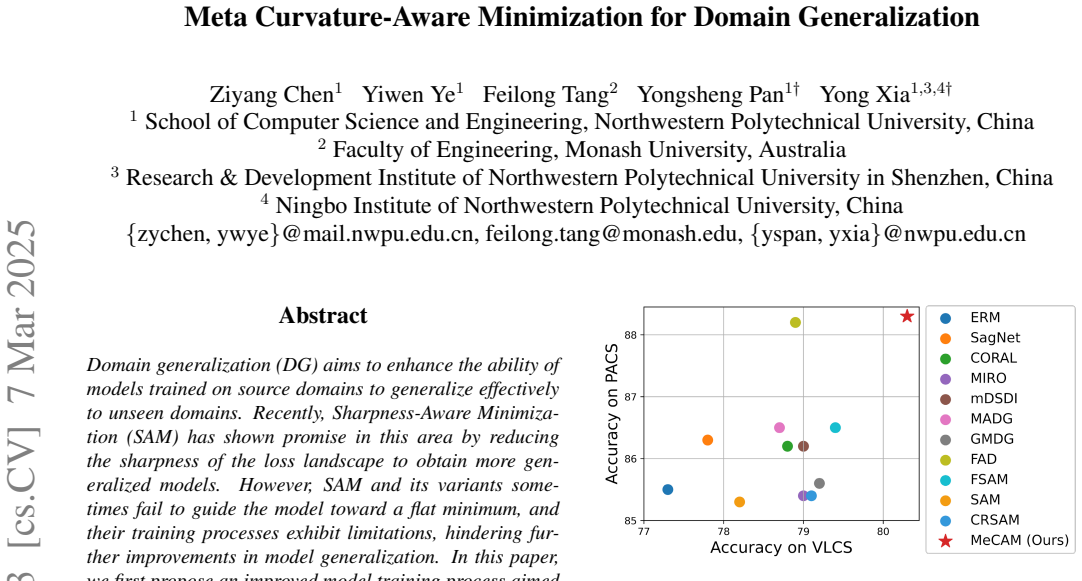


Figures from the paper (1 more)

Forward citations
Cited by 1 Pith paper
-
Decoding the Flow: CauseMotion for Emotional Causality Analysis in Long-form Conversations
CauseMotion reportedly improves LLM emotional-causality accuracy on long dialogues and on DiaASQ, but the headline gain of 8.7 percent is inconsistent with the reported numbers in Table II.
Reference graph
Works this paper leans on
-
[1]
Survey on deep neural networks in speech and vision systems
Mahbubul Alam, Manar D Samad, Lasitha Vidyaratne, Alexander Glandon, and Khan M Iftekharuddin. Survey on deep neural networks in speech and vision systems. Neuro- computing, 417:302–321, 2020. 1
2020
-
[2]
A state-of-the-art survey on deep learning theory and architectures
Md Zahangir Alom, Tarek M Taha, Chris Yakopcic, Ste- fan Westberg, Paheding Sidike, Mst Shamima Nasrin, Mah- mudul Hasan, Brian C Van Essen, Abdul AS Awwal, and Vijayan K Asari. A state-of-the-art survey on deep learning theory and architectures. electronics, 8(3):292, 2019. 1
2019
-
[3]
Towards understanding sharpness-aware minimization
Maksym Andriushchenko and Nicolas Flammarion. Towards understanding sharpness-aware minimization. In Int. Conf. Mach. Learn., pages 639–668. PMLR, 2022. 2
2022
-
[4]
Martin Arjovsky, L ´eon Bottou, Ishaan Gulrajani, and David Lopez-Paz. Invariant risk minimization. arXiv preprint arXiv:1907.02893, 2019. 5, 6, 4, 7, 8, 9
arXiv 1907
-
[5]
Metareg: Towards domain generalization using meta- regularization
Yogesh Balaji, Swami Sankaranarayanan, and Rama Chel- lappa. Metareg: Towards domain generalization using meta- regularization. Advances in neural information processing systems, 31, 2018. 3
2018
-
[6]
Recognition in terra incognita
Sara Beery, Grant Van Horn, and Pietro Perona. Recognition in terra incognita. In ECCV, pages 456–473, 2018. 5
2018
-
[7]
Domain generalization by marginal transfer learning
Gilles Blanchard, Aniket Anand Deshmukh, Urun Dogan, Gyemin Lee, and Clayton Scott. Domain generalization by marginal transfer learning. Journal of machine learning re- search, 22(2):1–55, 2021. 5, 6, 4, 7, 8, 9
2021
-
[8]
Ex- ploiting domain-specific features to enhance domain gener- alization
Manh-Ha Bui, Toan Tran, Anh Tran, and Dinh Phung. Ex- ploiting domain-specific features to enhance domain gener- alization. NeurIPS, 34:21189–21201, 2021. 5, 6
2021
Show all 88 references
-
[9]
Swad: Domain generalization by seeking flat minima
Junbum Cha, Sanghyuk Chun, Kyungjae Lee, Han-Cheol Cho, Seunghyun Park, Yunsung Lee, and Sungrae Park. Swad: Domain generalization by seeking flat minima. NeurIPS, 34:22405–22418, 2021. 6
2021
-
[10]
Domain generalization by mutual-information regu- larization with pre-trained models
Junbum Cha, Kyungjae Lee, Sungrae Park, and Sanghyuk Chun. Domain generalization by mutual-information regu- larization with pre-trained models. InECCV, pages 440–457. Springer, 2022. 5, 6
2022
-
[11]
When vision transformers outperform resnets without pre-training or strong data augmentations
Xiangning Chen, Cho-Jui Hsieh, and Boqing Gong. When vision transformers outperform resnets without pre-training or strong data augmentations. In ICLR, 2022. 3
2022
-
[12]
Treasure in distribution: a domain randomiza- tion based multi-source domain generalization for 2d medi- cal image segmentation
Ziyang Chen, Yongsheng Pan, Yiwen Ye, Hengfei Cui, and Yong Xia. Treasure in distribution: a domain randomiza- tion based multi-source domain generalization for 2d medi- cal image segmentation. In Int. Conf. Med. Image Comput. Comput.-Assist. Intervent., pages 89–99. Springer, 2023. 2
2023
-
[13]
Madg: margin-based adversarial learning for domain gener- alization
Aveen Dayal, Vimal KB, Linga Reddy Cenkeramaddi, C Mohan, Abhinav Kumar, and Vineeth N Balasubramanian. Madg: margin-based adversarial learning for domain gener- alization. NeurIPS, 36, 2024. 5, 6, 4, 7, 8, 9
2024
-
[14]
Numerical meth- ods for unconstrained optimization and nonlinear equations
John E Dennis Jr and Robert B Schnabel. Numerical meth- ods for unconstrained optimization and nonlinear equations. SIAM, 1996. 4
1996
-
[15]
Sharp minima can generalize for deep nets
Laurent Dinh, Razvan Pascanu, Samy Bengio, and Yoshua Bengio. Sharp minima can generalize for deep nets. In Int. Conf. Mach. Learn., pages 1019–1028. PMLR, 2017. 2
2017
-
[16]
Efficient 9 sharpness-aware minimization for improved training of neu- ral networks
Jiawei Du, Hanshu Yan, Jiashi Feng, Joey Tianyi Zhou, Lian- gli Zhen, Rick Siow Mong Goh, and Vincent Tan. Efficient 9 sharpness-aware minimization for improved training of neu- ral networks. In ICLR, 2021. 2
2021
-
[17]
Unbiased met- ric learning: On the utilization of multiple datasets and web images for softening bias
Chen Fang, Ye Xu, and Daniel N Rockmore. Unbiased met- ric learning: On the utilization of multiple datasets and web images for softening bias. In ICCV, pages 1657–1664, 2013. 5
2013
-
[18]
Curvature measures
Herbert Federer. Curvature measures. Transactions of the American Mathematical Society, 93(3):418–491, 1959. 3
1959
-
[19]
Model- agnostic meta-learning for fast adaptation of deep networks
Chelsea Finn, Pieter Abbeel, and Sergey Levine. Model- agnostic meta-learning for fast adaptation of deep networks. In Int. Conf. Mach. Learn., pages 1126–1135. PMLR, 2017. 2
2017
-
[20]
Sharpness-aware minimization for efficiently improving generalization
Pierre Foret, Ariel Kleiner, Hossein Mobahi, and Behnam Neyshabur. Sharpness-aware minimization for efficiently improving generalization. In ICLR, 2021. 1, 2, 3, 7, 8, 4, 5, 6, 9
2021
-
[21]
Domain-adversarial training of neural networks
Yaroslav Ganin, Evgeniya Ustinova, Hana Ajakan, Pas- cal Germain, Hugo Larochelle, Franc ¸ois Laviolette, Mario March, and Victor Lempitsky. Domain-adversarial training of neural networks. Journal of machine learning research , 17(59):1–35, 2016. 5, 6, 4, 7, 8, 9
2016
-
[22]
Loss surfaces, mode connectivity, and fast ensembling of dnns
Timur Garipov, Pavel Izmailov, Dmitrii Podoprikhin, Dmitry P Vetrov, and Andrew G Wilson. Loss surfaces, mode connectivity, and fast ensembling of dnns. NeurIPS, 31, 2018. 1, 2
2018
-
[23]
In search of lost do- main generalization
Ishaan Gulrajani and David Lopez-Paz. In search of lost do- main generalization. In ICLR, 2021. 5, 4
2021
-
[24]
Deep residual learning for image recognition
Kaiming He, Xiangyu Zhang, Shaoqing Ren, and Jian Sun. Deep residual learning for image recognition. In CVPR, pages 770–778, 2016. 5
2016
-
[25]
Simplifying neu- ral nets by discovering flat minima
Sepp Hochreiter and J ¨urgen Schmidhuber. Simplifying neu- ral nets by discovering flat minima. NeurIPS, 7, 1994. 1, 2
1994
-
[26]
Self-challenging improves cross-domain generalization
Zeyi Huang, Haohan Wang, Eric P Xing, and Dong Huang. Self-challenging improves cross-domain generalization. In ECCV, pages 124–140. Springer, 2020. 6
2020
-
[27]
A survey of deep meta-learning
Mike Huisman, Jan N Van Rijn, and Aske Plaat. A survey of deep meta-learning. Artificial Intelligence Review, 54(6): 4483–4541, 2021. 2
2021
-
[28]
On the maximum hessian eigenvalue and generalization
Simran Kaur, Jeremy Cohen, and Zachary Chase Lipton. On the maximum hessian eigenvalue and generalization. In I Can’t Believe It’s Not Better Workshop: Understanding Deep Learning Through Empirical Falsification , pages 51–
-
[29]
On large- batch training for deep learning: Generalization gap and sharp minima
Nitish Shirish Keskar, Dheevatsa Mudigere, Jorge Nocedal, Mikhail Smelyanskiy, and Ping Tak Peter Tang. On large- batch training for deep learning: Generalization gap and sharp minima. In ICLR, 2016. 1, 2, 3
2016
-
[30]
Domain generalization through meta-learning: a survey
Arsham Gholamzadeh Khoee, Yinan Yu, and Robert Feldt. Domain generalization through meta-learning: a survey. Ar- tificial Intelligence Review, 57(10):285, 2024. 2
2024
-
[31]
Selfreg: Self-supervised contrastive regu- larization for domain generalization
Daehee Kim, Youngjun Yoo, Seunghyun Park, Jinkyu Kim, and Jaekoo Lee. Selfreg: Self-supervised contrastive regu- larization for domain generalization. In Proceedings of the IEEE/CVF International Conference on Computer Vision , pages 9619–9628, 2021. 5, 6
2021
-
[32]
Adam: A method for stochastic opti- mization
Diederik P Kingma. Adam: A method for stochastic opti- mization. arXiv preprint arXiv:1412.6980, 2014. 5, 7, 4, 6, 8, 9
2014 arXiv
-
[33]
Out-of-distribution gener- alization via risk extrapolation (rex)
David Krueger, Ethan Caballero, Joern-Henrik Jacobsen, Amy Zhang, Jonathan Binas, Dinghuai Zhang, Remi Le Priol, and Aaron Courville. Out-of-distribution gener- alization via risk extrapolation (rex). In Int. Conf. Mach. Learn., pages 5815–5826. PMLR, 2021. 5, 6, 4, 7, 8, 9
2021
-
[34]
Fine-tuning can distort pre- trained features and underperform out-of-distribution
Ananya Kumar, Aditi Raghunathan, Robbie Matthew Jones, Tengyu Ma, and Percy Liang. Fine-tuning can distort pre- trained features and underperform out-of-distribution. In ICLR, 2022. 5, 6
2022
-
[35]
Asam: Adaptive sharpness-aware minimiza- tion for scale-invariant learning of deep neural networks
Jungmin Kwon, Jeongseop Kim, Hyunseo Park, and In Kwon Choi. Asam: Adaptive sharpness-aware minimiza- tion for scale-invariant learning of deep neural networks. In ICLR, pages 5905–5914. PMLR, 2021. 2
2021
-
[36]
Adaptive estimation of a quadratic functional by model selection
Beatrice Laurent and Pascal Massart. Adaptive estimation of a quadratic functional by model selection. Annals of statis- tics, pages 1302–1338, 2000. 1
2000
-
[37]
Gradient alignment for cross- domain face anti-spoofing
Binh M Le and Simon S Woo. Gradient alignment for cross- domain face anti-spoofing. In CVPR, pages 188–199, 2024. 1, 2
2024
-
[38]
Deeper, broader and artier domain generaliza- tion
Da Li, Yongxin Yang, Yi-Zhe Song, and Timothy M Hospedales. Deeper, broader and artier domain generaliza- tion. In ICCV, pages 5542–5550, 2017. 5
2017
-
[39]
Learning to generalize: Meta-learning for do- main generalization
Da Li, Yongxin Yang, Yi-Zhe Song, and Timothy Hospedales. Learning to generalize: Meta-learning for do- main generalization. In AAAI, 2018. 3, 5, 6, 4, 7, 8, 9
2018
-
[40]
Domain generalization with adversarial feature learning
Haoliang Li, Sinno Jialin Pan, Shiqi Wang, and Alex C Kot. Domain generalization with adversarial feature learning. In CVPR, pages 5400–5409, 2018. 5, 6, 4, 7, 8, 9
2018
-
[41]
Visualizing the loss landscape of neural nets
Hao Li, Zheng Xu, Gavin Taylor, Christoph Studer, and Tom Goldstein. Visualizing the loss landscape of neural nets. NeurIPS, 31, 2018. 8
2018
-
[42]
Friendly sharpness-aware minimization
Tao Li, Pan Zhou, Zhengbao He, Xinwen Cheng, and Xiaolin Huang. Friendly sharpness-aware minimization. In CVPR, pages 5631–5640, 2024. 1, 7, 8, 4, 5, 6, 9
2024
-
[43]
Domain generalization via conditional invari- ant representations
Ya Li, Mingming Gong, Xinmei Tian, Tongliang Liu, and Dacheng Tao. Domain generalization via conditional invari- ant representations. In AAAI, 2018. 5, 6, 4, 7, 8, 9
2018
-
[44]
Deep domain generaliza- tion via conditional invariant adversarial networks
Ya Li, Xinmei Tian, Mingming Gong, Yajing Liu, Tongliang Liu, Kun Zhang, and Dacheng Tao. Deep domain generaliza- tion via conditional invariant adversarial networks. InECCV, pages 624–639, 2018. 2
2018
-
[45]
Ms- net: multi-site network for improving prostate segmentation with heterogeneous mri data
Quande Liu, Qi Dou, Lequan Yu, and Pheng Ann Heng. Ms- net: multi-site network for improving prostate segmentation with heterogeneous mri data. IEEE Trans. Med. Imaging, 39 (9):2713–2724, 2020. 1, 2
2020
-
[46]
Towards efficient and scalable sharpness-aware minimization
Yong Liu, Siqi Mai, Xiangning Chen, Cho-Jui Hsieh, and Yang You. Towards efficient and scalable sharpness-aware minimization. In CVPR, pages 12360–12370, 2022. 2
2022
-
[47]
Decoupled weight decay regularization
I Loshchilov. Decoupled weight decay regularization. arXiv preprint arXiv:1711.05101, 2017. 7, 4, 5, 6, 8, 9
2017 arXiv
-
[48]
Pac-bayesian model averaging
David A McAllester. Pac-bayesian model averaging. In Pro- ceedings of the twelfth annual conference on Computational learning theory, pages 164–170, 1999. 4 10
1999
-
[49]
A survey on modeling and improving relia- bility of dnn algorithms and accelerators
Sparsh Mittal. A survey on modeling and improving relia- bility of dnn algorithms and accelerators. Journal of Systems Architecture, 104:101689, 2020. 1
2020
-
[50]
Domain generalization via invariant fea- ture representation
Krikamol Muandet, David Balduzzi, and Bernhard Sch¨olkopf. Domain generalization via invariant fea- ture representation. In Int. Conf. Mach. Learn., pages 10–18. PMLR, 2013. 1, 2
2013
-
[51]
Domain generaliza- tion via ensemble stacking for face presentation attack detec- tion
Usman Muhammad, Jorma Laaksonen, Djamila Ro- maissa Beddiar, and Mourad Oussalah. Domain generaliza- tion via ensemble stacking for face presentation attack detec- tion. IJCV, pages 1–24, 2024. 2
2024
-
[52]
Reducing domain gap by reduc- ing style bias
Hyeonseob Nam, HyunJae Lee, Jongchan Park, Wonjun Yoon, and Donggeun Yoo. Reducing domain gap by reduc- ing style bias. In CVPR, pages 8690–8699, 2021. 5, 6, 4, 7, 8, 9
2021
-
[53]
A method for solving the convex program- ming problem with convergence rate o (1/k2)
Yurii Nesterov. A method for solving the convex program- ming problem with convergence rate o (1/k2). In Dokl akad nauk Sssr, page 543, 1983. 7, 4, 5, 6, 8, 9
1983
-
[54]
Multi-view domain general- ization for visual recognition
Li Niu, Wen Li, and Dong Xu. Multi-view domain general- ization for visual recognition. In ICCV, pages 4193–4201,
-
[55]
Numerical optimiza- tion
Jorge Nocedal and Stephen J Wright. Numerical optimiza- tion. Springer, 1999. 4
1999
-
[56]
Learning expla- nations that are hard to vary
Giambattista Parascandolo, Alexander Neitz, Antonio Orvi- eto, Luigi Gresele, and Bernhard Sch¨olkopf. Learning expla- nations that are hard to vary. In ICLR. OpenReview, 2021. 4
2021
-
[57]
Moment matching for multi-source domain adaptation
Xingchao Peng, Qinxun Bai, Xide Xia, Zijun Huang, Kate Saenko, and Bo Wang. Moment matching for multi-source domain adaptation. In Proceedings of the IEEE/CVF inter- national conference on computer vision , pages 1406–1415,
-
[58]
Domain agnostic learning with disentangled rep- resentations
Xingchao Peng, Zijun Huang, Ximeng Sun, and Kate Saenko. Domain agnostic learning with disentangled rep- resentations. In Int. Conf. Mach. Learn., pages 5102–5112. PMLR, 2019. 1, 2
2019
-
[59]
Ef- ficient domain generalization via common-specific low-rank decomposition
Vihari Piratla, Praneeth Netrapalli, and Sunita Sarawagi. Ef- ficient domain generalization via common-specific low-rank decomposition. In Int. Conf. Mach. Learn. , pages 7728–
-
[60]
Fishr: Invariant gradient variances for out-of-distribution generalization
Alexandre Rame, Corentin Dancette, and Matthieu Cord. Fishr: Invariant gradient variances for out-of-distribution generalization. In Int. Conf. Mach. Learn. , pages 18347– 18377. PMLR, 2022. 5, 6, 4, 7, 8, 9
2022
-
[61]
Imagenet large scale visual recognition challenge.IJCV, 115:211–252,
Olga Russakovsky, Jia Deng, Hao Su, Jonathan Krause, San- jeev Satheesh, Sean Ma, Zhiheng Huang, Andrej Karpa- thy, Aditya Khosla, Michael Bernstein, et al. Imagenet large scale visual recognition challenge.IJCV, 115:211–252,
-
[62]
Distributionally robust neural networks
Shiori Sagawa, Pang Wei Koh, Tatsunori B Hashimoto, and Percy Liang. Distributionally robust neural networks. In ICLR, 2019. 5, 6, 4, 7, 8, 9
2019
-
[63]
Learning from synthetic data: Addressing domain shift for semantic segmentation
Swami Sankaranarayanan, Yogesh Balaji, Arpit Jain, Ser Nam Lim, and Rama Chellappa. Learning from synthetic data: Addressing domain shift for semantic segmentation. In CVPR, pages 3752–3761, 2018. 1
2018
-
[64]
Sand-mask: An enhanced gradient masking strategy for the discovery of invariances in domain generalization
Soroosh Shahtalebi, Jean-Christophe Gagnon-Audet, Touraj Laleh, Mojtaba Faramarzi, Kartik Ahuja, and Irina Rish. Sand-mask: An enhanced gradient masking strategy for the discovery of invariances in domain generalization. arXiv preprint arXiv:2106.02266, 2021. 5, 6, 7, 8, 9
2021 arXiv
-
[65]
Multi-adversarial discriminative deep domain generalization for face presentation attack detection
Rui Shao, Xiangyuan Lan, Jiawei Li, and Pong C Yuen. Multi-adversarial discriminative deep domain generalization for face presentation attack detection. In CVPR, pages 10023–10031, 2019. 2
2019
-
[66]
Gradient matching for domain generalization
Yuge Shi, Jeffrey Seely, Philip Torr, N Siddharth, Awni Hannun, Nicolas Usunier, and Gabriel Synnaeve. Gradient matching for domain generalization. In ICLR, 2021. 5, 6
2021
-
[67]
Deep coral: Correlation alignment for deep domain adaptation
Baochen Sun and Kate Saenko. Deep coral: Correlation alignment for deep domain adaptation. InECCV, pages 443–
-
[68]
Rethinking domain generalization for face anti- spoofing: Separability and alignment
Yiyou Sun, Yaojie Liu, Xiaoming Liu, Yixuan Li, and Wen- Sheng Chu. Rethinking domain generalization for face anti- spoofing: Separability and alignment. In CVPR, pages 24563–24574, 2023. 2
2023
-
[69]
Statistical learning theory
Vladimir Vapnik. Statistical learning theory. NY: Wiley, 2: 831–842, 1998. 5, 6, 8, 4, 7, 9
1998
-
[70]
Deep hashing network for unsupervised domain adaptation
Hemanth Venkateswara, Jose Eusebio, Shayok Chakraborty, and Sethuraman Panchanathan. Deep hashing network for unsupervised domain adaptation. In CVPR, pages 5018– 5027, 2017. 5
2017
-
[71]
Cross-domain face presentation attack detection via multi- domain disentangled representation learning
Guoqing Wang, Hu Han, Shiguang Shan, and Xilin Chen. Cross-domain face presentation attack detection via multi- domain disentangled representation learning. In CVPR, pages 6678–6687, 2020. 1, 2
2020
-
[72]
Generalizing to unseen domains: A survey on do- main generalization
Jindong Wang, Cuiling Lan, Chang Liu, Yidong Ouyang, Tao Qin, Wang Lu, Yiqiang Chen, Wenjun Zeng, and S Yu Philip. Generalizing to unseen domains: A survey on do- main generalization. IEEE Trans. Knowledge Data Eng., 35 (8):8052–8072, 2022. 2
2022
-
[73]
Inter-class and inter- domain semantic augmentation for domain generalization
Mengzhu Wang, Yuehua Liu, Jianlong Yuan, Shanshan Wang, Zhibin Wang, and Wei Wang. Inter-class and inter- domain semantic augmentation for domain generalization. IEEE TIP, 2024. 1, 2
2024
-
[74]
Sharpness-aware gradient matching for domain generaliza- tion
Pengfei Wang, Zhaoxiang Zhang, Zhen Lei, and Lei Zhang. Sharpness-aware gradient matching for domain generaliza- tion. In CVPR, pages 3769–3778, 2023. 1, 2, 3, 5, 6, 7, 8, 4, 9
2023
-
[75]
CR-SAM: Cur- vature regularized sharpness-aware minimization
Tao Wu, Tie Luo, and Donald C Wunsch II. CR-SAM: Cur- vature regularized sharpness-aware minimization. In AAAI, pages 6144–6152, 2024. 1, 2, 7, 8, 4, 5, 6, 9
2024
-
[76]
Adversarial domain adaptation with domain mixup
Minghao Xu, Jian Zhang, Bingbing Ni, Teng Li, Chengjie Wang, Qi Tian, and Wenjun Zhang. Adversarial domain adaptation with domain mixup. In AAAI, pages 6502–6509,
-
[77]
Pyhessian: Neural networks through the lens of the hessian
Zhewei Yao, Amir Gholami, Kurt Keutzer, and Michael W Mahoney. Pyhessian: Neural networks through the lens of the hessian. In 2020 IEEE international conference on big data (Big data), pages 581–590. IEEE, 2020. 3
2020
-
[78]
Adahessian: An adap- tive second order optimizer for machine learning
Zhewei Yao, Amir Gholami, Sheng Shen, Mustafa Mustafa, Kurt Keutzer, and Michael Mahoney. Adahessian: An adap- tive second order optimizer for machine learning. In AAAI, pages 10665–10673, 2021. 7, 4, 5, 6, 8, 9 11
2021
-
[79]
Adaptive methods for nonconvex optimization
Manzil Zaheer, Sashank Reddi, Devendra Sachan, Satyen Kale, and Sanjiv Kumar. Adaptive methods for nonconvex optimization. NeurIPS, 31, 2018. 7, 4, 5, 6, 8, 9
2018
-
[80]
Adaptive risk minimization: A meta-learning approach for tackling group shift
Marvin Zhang, Henrik Marklund, Abhishek Gupta, Sergey Levine, and Chelsea Finn. Adaptive risk minimization: A meta-learning approach for tackling group shift. arXiv preprint arXiv:2007.02931, 8(9), 2020. 5, 6, 4, 7, 8, 9
2007 arXiv
-
[81]
Flatness-aware minimization for domain generalization
Xingxuan Zhang, Renzhe Xu, Han Yu, Yancheng Dong, Pengfei Tian, and Peng Cui. Flatness-aware minimization for domain generalization. In Proceedings of the IEEE/CVF International Conference on Computer Vision, pages 5189– 5202, 2023. 7, 4, 5, 6, 8, 9
2023
-
[82]
Gradient norm aware minimization seeks first-order flatness and improves generalization
Xingxuan Zhang, Renzhe Xu, Han Yu, Hao Zou, and Peng Cui. Gradient norm aware minimization seeks first-order flatness and improves generalization. In CVPR, pages 20247–20257, 2023. 2, 3, 7, 1, 4, 5, 6, 8, 9
2023
-
[83]
Learning to generate novel domains for domain gen- eralization
Kaiyang Zhou, Yongxin Yang, Timothy Hospedales, and Tao Xiang. Learning to generate novel domains for domain gen- eralization. In ECCV, pages 561–578. Springer, 2020. 1, 2
2020
-
[84]
Do- main generalization with mixstyle
Kaiyang Zhou, Yongxin Yang, Yu Qiao, and Tao Xiang. Do- main generalization with mixstyle. In ICLR, 2021. 2, 4, 5, 6, 7, 8, 9
2021
-
[85]
Do- main adaptive ensemble learning
Kaiyang Zhou, Yongxin Yang, Yu Qiao, and Tao Xiang. Do- main adaptive ensemble learning. IEEE TIP, 30:8008–8018,
-
[86]
Domain generalization: A survey
Kaiyang Zhou, Ziwei Liu, Yu Qiao, Tao Xiang, and Chen Change Loy. Domain generalization: A survey. IEEE TPAMI, 45(4):4396–4415, 2022. 2
2022
-
[87]
Adabelief optimizer: Adapting stepsizes by the belief in observed gradients
Juntang Zhuang, Tommy Tang, Yifan Ding, Sekhar C Tatikonda, Nicha Dvornek, Xenophon Papademetris, and James Duncan. Adabelief optimizer: Adapting stepsizes by the belief in observed gradients. NeurIPS, 33:18795–18806,
-
[88]
Surrogate gap minimization improves sharpness- aware training
Juntang Zhuang, Boqing Gong, Liangzhe Yuan, Yin Cui, Hartwig Adam, Nicha C Dvornek, James s Duncan, Ting Liu, et al. Surrogate gap minimization improves sharpness- aware training. In ICLR, 2022. 1, 2, 3, 5 12 Meta Curvature-Aware Minimization for Domain Generalization Suppleme...
2022
Reviewed August 11, 2026 · model on record in the stance chip above.
Discussion (0). Continue with ORCID to comment.