REVIEW 4 major objections 6 minor 40 references
The Impact of Generalization Techniques on the Interplay Among Privacy, Utility, and Fairness in Image Classification
T0 review · 4 major / 6 minor · reviewed 2026-08-11 · deepseek-v4-flash
Pith's one-line read This paper claims that swapping DP-SGD for DP-SAT inside a set of generalization techniques pushes differentially private CIFAR-10 accuracy to 81.11% under $(8, 10^{-5})$-DP, and that the same techniques systematically amplify model bias…
desk verdict A solid empirical paper with a new DP-SAT accuracy record and useful fairness findings; the headline privacy guarantee needs implementation-level verification. read the letter →
The pith
A machine-rendered reading of the paper's core claim, the machinery that carries it, and where it could break.
The reading
What carries the argument
The empirical engine is DP-SAT, differentially private sharpness-aware training, which seeks flat minima by reusing the previous step's perturbed gradient rather than perturbing the current batch twice; according to [25] this costs no additional privacy budget. It is appended to the generalization pipeline from [8]: group normalization, optimal batch size, weight standardization, augmentation multiplicity, and parameter averaging, each defined in the paper as a modification that improves private training without extra privacy cost. Differential privacy itself is the $(\epsilon,\delta)$ guarantee that adding or removing one example changes output probabilities by at most $\exp(\epsilon)$ plus $\delta$, with cumulative loss tracked by a privacy accountant. The measurement side uses membership inference attacks summarized by MIA AUC, the bias metrics of [36] on CIFAR-10S, CIFAR-100S, and CelebA, and the proposed harmonic score, which turns accuracy, MIA AUC, and bias into a single value in (0,1].
What would settle it
Trace a single DP-SAT update and check whether the reused perturbed gradient is a function of previous steps only; if it depends on any sample in the current batch, the claimed $(8, 10^{-5})$ guarantee does not hold. A simpler check is to reproduce the exact CIFAR-10 recipe and see whether a strong membership inference attack keeps MIA AUC near 0.5 despite the stated DP budget.
Extended reading notes
Core claim
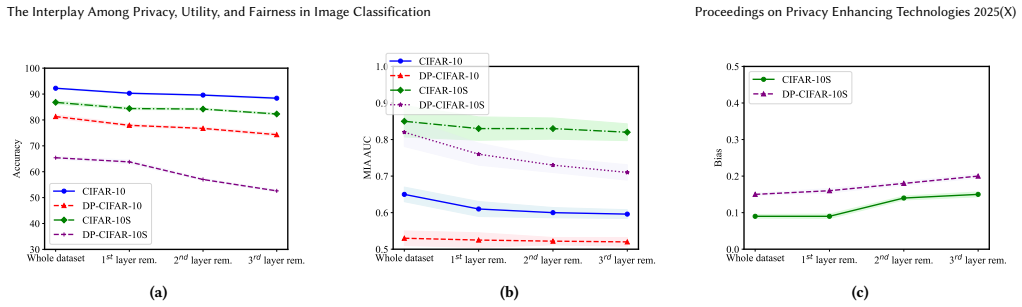
On the paper's own terms, the central claim is that DP-SAT, placed as the final step of the generalization pipeline from [8], is a drop-in replacement for DP-SGD that improves the privacy-utility frontier at the same DP guarantee. The headline number is 81.11% test accuracy on CIFAR-10 under $(8, 10^{-5})$-DP with a 16-layer Wide-ResNet and no extra data, above the 79.5% previously reported, with similar gains across privacy budgets on CIFAR-10 and CIFAR-100. The paper further claims that the same recipe that lifts accuracy sharply also amplifies bias on synthetic-bias benchmarks by factors between 2.6 and 9, and that more biased training data lowers accuracy and raises membership-inference vulnerability even under DP. It reports that vulnerable samples can be memorized before the early-stopping or overfitting point, so generalization techniques do not guarantee privacy, and that repeatedly deleting the highest-risk outlier samples lowers accuracy and increases bias instead of removing privacy risk. Finally, it introduces the harmonic score, the harmonic mean of accuracy, one minus scaled MIA AUC, and one minus scaled bias, as a single number for judging the three-way balance.
Load-bearing premise
The privacy-utility point rests entirely on the theorem from [25] that DP-SAT's reuse of the previous step's perturbed gradient costs no additional privacy budget; the paper adopts that theorem without independently verifying the implementation, and if the reused gradient carries information from the current batch, the effective privacy loss would exceed the stated bound.
Editorial extensions
If this is right
- If correct, DP-SAT can replace DP-SGD inside the standard generalization pipeline and improve accuracy at every tested privacy budget on CIFAR-10 and CIFAR-100, making it the better default private optimizer for these image benchmarks.
- The accuracy gains from group normalization, large batches, weight standardization, augmentation multiplicity, parameter averaging, and SAT come with measurable bias amplification in both private and non-private models, so private-model deployments should monitor fairness jointly with accuracy.
- Biased training data makes membership inference easier and private training less protective, implying that data-cleaning or debiasing is itself a privacy measure.
- Because memorization can begin before overfitting, early stopping and generalization techniques do not by themselves prevent privacy leakage; MIA-based auditing is still needed.
- Outlier removal cannot be used as a simple privacy defense: it lowers accuracy, amplifies bias, and exposes new vulnerable samples, consistent with the Onion Effect the paper extends.
Reading between the lines
- Editorial extension: the paper does not claim bias amplification is unavoidable; a direct test would combine the same pipeline with bias-mitigation reweighting and see whether the accuracy gains persist while bias growth shrinks.
- The harmonic score is a concrete scalarization, so a natural next step the paper leaves implicit is hyperparameter selection (noise multiplier, batch size, SAT radius) that directly optimizes HS instead of accuracy, which would change the chosen operating point.
- The Onion Effect result suggests outlier removal alone cannot secure a model; pairing outlier removal with differential privacy, a combination the paper measures but does not optimize, is the more promising direction its own data hints at.
Editorial analysis
A structured set of objections, weighed in public.
Referee Report
Summary. This paper empirically studies how a set of generalization techniques (group normalization, optimal batch size, weight standardization, augmentation multiplicity, parameter averaging, and sharpness-aware training) affects the interplay between privacy, utility, and fairness in image classification. The authors report a headline accuracy of 81.11% under (8, 10^-5)-DP on CIFAR-10 using DP-SAT combined with the De et al. (2022) generalization techniques, surpassing the previously reported 79.5%. They also introduce a Harmonic Score (HS) metric to balance accuracy, privacy (measured by MIA AUC), and fairness (measured by bias), analyze memorization before overfitting, study the effect of training-data bias on privacy and fairness in synthetic (CIFAR-10S/100S) and real-world (CelebA) settings, and extend the Onion Effect analysis to multiple datasets and private/non-private models. The paper is primarily empirical, with five-seed runs and median reporting, and it provides an anonymous code link.
Significance. If the 81.11% result is valid, it is a useful benchmark point: it demonstrates that DP-SAT can replace DP-SGD inside the De et al. pipeline and achieve a nontrivial accuracy gain under the same nominal DP guarantee. The paper also contributes a broad set of empirical observations about how generalization techniques affect fairness and privacy leakage, and it proposes a simple aggregate metric (HS). The reproducibility efforts (seed-averaged results, public code) are commendable. However, the breadth of claims comes at the cost of depth: several supporting results rest on single-sample evidence, missing control conditions, or inconsistent metric choices, and the central privacy claim depends on an unverified implementation assumption about DP-SAT.
major comments (4)
- [Section 2.2 and Table 4] The (8, 10^-5)-DP guarantee for the headline 81.11% accuracy is not verified. The paper relies on Park et al.'s theorem that reusing the previous step's perturbed gradient in DP-SAT does not consume additional privacy budget, but it does not provide the exact DP-SAT update equations used, nor does it show that the implementation satisfies the theorem's assumptions, especially when combined with augmentation multiplicity and parameter averaging. If the implementation ever computes an ascent gradient from the current batch, the per-step sensitivity would increase and the Rényi accountant would undercount epsilon. Because the central contribution is an accuracy number under a stated DP guarantee, the authors should either provide a precise algorithm description and a privacy proof for their composed pipeline, or explicitly identify the exact DP-SAT implementation used and how the privacy accountant is composed with it.
- [Section 4.4 and Figures 5, 6, 9] The Onion Effect claim is not supported by a random-removal baseline. The authors repeatedly remove the 5,000 samples with the highest MIA risk and observe that MIA AUC stays roughly constant or decreases slightly. Without a control condition that removes the same number of samples at random, the persistence of MIA AUC cannot be attributed to a 'peeling' phenomenon; it could be a general property of the reduced dataset size or of the retraining procedure. The authors should add a random-removal baseline (or another appropriate null model) before claiming that removing outliers exposes new vulnerable layers.
- [Section 2.3, Table 3, and Table 6] The Harmonic Score is not computed under a consistent privacy metric across datasets. The paper reports MIA AUC of the MLP attack for all experiments except for the DP-trained model on CIFAR-100S, where it reports the RF attack (Section 2.3), while Table 3's caption states that the highest MIA AUC among the four attacks is reported. HS comparisons across datasets (e.g., Table 6, Figure 1e) therefore mix attack models, and a difference in HS could be an artifact of attack choice rather than a genuine difference in the privacy-utility-fairness trade-off. The authors should either report HS under a single attack consistently or justify why the exception does not affect comparability.
- [Section 4.1.1 and Figure 2] The claim that memorization can begin before the overfitting point is based on tracking a single training sample. The abstract and conclusions state this as a general finding ('memorization of training samples can begin before the overfitting point'), but with n=1 the result is anecdotal. The authors should aggregate membership-probability trajectories over multiple samples (e.g., report the distribution of the epoch at which high membership probability first appears) or otherwise show that the phenomenon is not specific to the single plotted sample.
minor comments (6)
- [Equation (3)] The HS formula is undefined when 1 - AUCscaled = 0 (i.e., AUC = 1) or 1 - Biasscaled = 0 (i.e., scaled bias = 1); the domain of the inputs should be stated explicitly.
- [Table 3 caption] The caption says 'the highest MIA AUC among the four attacks is reported,' but Section 2.3 says the MLP attack is reported everywhere except for DP-CIFAR-100S, where RF is used; please clarify which attack corresponds to each column.
- [Section 4.4] The percentages for outlier removal (10%, 11.1%, 12.5%) are relative to the remaining dataset size; state the absolute number of samples removed in each round to avoid ambiguity.
- [Figure 2] The subplots are dense and the labels (ES, OF, MP, AUC) are small; consider larger fonts and separate curves for readability.
- [Table 5] There is a typo in the column header 'Wihtout DP' that should read 'Without DP.'
- [Section 5] The weighted mAP formula is described in words but not defined precisely; please provide the explicit equation used for the weighted average precision.
Circularity Check
No significant circularity: the empirical benchmark claims are compared against external baselines, and the paper's own metric is presented as a definition rather than as a derived prediction.
full rationale
The paper's central claim, the 81.11% accuracy under (8, 10^-5)-DP on CIFAR-10, is an empirical result measured on the official test set and compared with De et al.'s published 79.5% external baseline. The DP-SAT privacy guarantee is adopted from Park et al. (ICML 2023), an external source with no author overlap with this paper; whether the implementation matches the theorem is a verifiability or correctness risk, not a circular derivation. The newly introduced Harmonic Score (Eq. 3) is explicitly defined as the harmonic mean of accuracy, (1 - normalized MIA AUC), and (1 - normalized bias), and it is used descriptively to rank models; it is not used to derive a prediction from its own definition, so no self-definitional circularity is present. The Onion Effect analysis selects outliers using the MLP attack's privacy risk scores and then measures MIA AUC of the same attack family after removal; the reported stability or slight decline in AUC after removing high-risk samples is an empirical observation that is not forced by construction, because the AUC could plausibly have dropped substantially. The only self-citation, reference [10] by co-author de Oliveira, appears in a background list of studies on differential privacy's disparate impact and is not load-bearing for any central result. Overall, no step in the paper's claimed derivation chain reduces by construction to its own inputs, so the circularity score is 0.
Assumptions & free parameters
free parameters (4)
- SAT perturbation radius =
0.05 for CIFAR-10/10S; 0.03 for CIFAR-100/100S and CelebA
- Batch size (OBS) =
4096 private CIFAR-10/10S and CelebA; 16348 private CIFAR-100/100S; 32 or 64 non-private
- Learning rate =
4, 2, or 1 for private CIFAR settings; 0.01 for non-private CIFAR; 10^-4 for CelebA without DP
- Group normalization groups and augmentation multiplicity =
GN=16 for CIFAR/CelebA private, 1 for non-private CIFAR; AM=16 for CIFAR, absent for CelebA without DP
assumptions (5)
- standard math RDP accountant (Mironov et al. 2019) gives valid privacy loss bounds for the DP-SGD noise schedules.
- domain assumption DP-SAT's reuse of the previous perturbed gradient does not consume additional privacy budget.
- domain assumption Equation (1) bias metric isolates spurious color/gray bias from model accuracy on balanced test sets.
- domain assumption MIA AUC from TensorFlow Privacy is a valid proxy for membership privacy risk in these private and non-private models.
- domain assumption Feldman's definition of memorization is captured by per-sample membership probability from an MIA.
invented entities (1)
-
Harmonic Score (HS)
Cite this review
Pith. "Pith review of The Impact of Generalization Techniques on the Interplay Among Privacy, Utility, and Fairness in Image Classification." pith.science (2026). https://pith.science/paper/4R365VKL
@misc{pith2026241211951,
  author       = {Pith},
  title        = {Pith review of: The Impact of Generalization Techniques on the Interplay Among Privacy, Utility, and Fairness in Image Classification},
  year         = {2026},
  howpublished = {\url{https://pith.science/paper/4R365VKL}},
  note         = {Machine review of arXiv:2412.11951}
}
abstract
This study investigates the trade-offs between fairness, privacy, and utility in image classification using machine learning (ML). Recent research suggests that generalization techniques can improve the balance between privacy and utility. One focus of this work is sharpness-aware training (SAT) and its integration with differential privacy (DP-SAT) to further improve this balance. Additionally, we examine fairness in both private and non-private learning models trained on datasets with synthetic and real-world biases. We also measure the privacy risks involved in these scenarios by performing membership inference attacks (MIAs) and explore the consequences of eliminating high-privacy risk samples, termed outliers. Moreover, we introduce a new metric, named \emph{harmonic score}, which combines accuracy, privacy, and fairness into a single measure. Through empirical analysis using generalization techniques, we achieve an accuracy of 81.11\% under $(8, 10^{-5})$-DP on CIFAR-10, surpassing the 79.5\% reported by De et al. (2022). Moreover, our experiments show that memorization of training samples can begin before the overfitting point, and generalization techniques do not guarantee the prevention of this memorization. Our analysis of synthetic biases shows that generalization techniques can amplify model bias in both private and non-private models. Additionally, our results indicate that increased bias in training data leads to reduced accuracy, greater vulnerability to privacy attacks, and higher model bias. We validate these findings with the CelebA dataset, demonstrating that similar trends persist with real-world attribute imbalances. Finally, our experiments show that removing outlier data decreases accuracy and further amplifies model bias.
Figures


Figures from the paper (6 more)



Reference graph
Works this paper leans on
-
[1]
2024. TensorFlow-Privacy. https://github.com/tensorflow/privacy/tree/master/ tensorflow_privacy/privacy/privacy_tests/membership_inference_attack Ac- cessed: 2024-03-25
work page 2024
-
[2]
Martin Abadi, Andy Chu, Ian Goodfellow, H Brendan McMahan, Ilya Mironov, Kunal Talwar, and Li Zhang. 2016. Deep learning with differential privacy. In Proceedings of the 2016 ACM SIGSAC conference on computer and communications security. 308–318
2016
-
[3]
Rohan Anil, Badih Ghazi, Vineet Gupta, Ravi Kumar, and Pasin Manurangsi. 2021. Large-scale differentially private BERT. arXiv preprint arXiv:2108.01624 (2021)
arXiv 2021
-
[4]
Eugene Bagdasaryan, Omid Poursaeed, and Vitaly Shmatikov. 2019. Differential privacy has disparate impact on model accuracy. Advances in neural information processing systems 32 (2019)
2019
-
[5]
Nicholas Carlini, Matthew Jagielski, Chiyuan Zhang, Nicolas Papernot, Andreas Terzis, and Florian Tramer. 2022. The privacy onion effect: Memorization is relative. Advances in Neural Information Processing Systems 35 (2022), 13263– 13276
work page 2022
-
[6]
Nicholas Carlini, Florian Tramer, Eric Wallace, Matthew Jagielski, Ariel Herbert- Voss, Katherine Lee, Adam Roberts, Tom Brown, Dawn Song, Ulfar Erlingsson, et al. 2021. Extracting training data from large language models. In 30th USENIX Security Symposium (USENIX Security 21) . 2633–2650
2021
-
[7]
Hongyan Chang and Reza Shokri. 2021. On the privacy risks of algorithmic fairness. In 2021 IEEE European Symposium on Security and Privacy (EuroS&P) . IEEE, 292–303
work page 2021
-
[8]
Soham De, Leonard Berrada, Jamie Hayes, Samuel L Smith, and Borja Balle. 2022. Unlocking high-accuracy differentially private image classification through scale. arXiv preprint arXiv:2204.13650 (2022)
arXiv 2022
Show all 40 references
-
[9]
Soham De and Sam Smith. 2020. Batch normalization biases residual blocks towards the identity function in deep networks. Advances in Neural Information Processing Systems 33 (2020), 19964–19975
2020
-
[10]
Anderson Santana de Oliveira, Caelin Kaplan, Khawla Mallat, and Tanmay Chakraborty. 2023. An empirical analysis of fairness notions under differen- tial privacy. arXiv preprint arXiv:2302.02910 (2023)
2023 arXiv
-
[11]
Friedrich Dörmann, Osvald Frisk, Lars Nørvang Andersen, and Christian Fischer Pedersen. 2021. Not all noise is accounted equally: How differentially private learning benefits from large sampling rates. In 2021 IEEE 31st International Work- shop on Machine Learning for Signal P...
2021
-
[12]
Jiawei Du, Hanshu Yan, Jiashi Feng, Joey Tianyi Zhou, Liangli Zhen, Rick Siow Mong Goh, and Vincent YF Tan. 2021. Efficient sharpness-aware minimiza- tion for improved training of neural networks. arXiv preprint arXiv:2110.03141 (2021)
2021 arXiv
-
[13]
Cynthia Dwork, Frank McSherry, Kobbi Nissim, and Adam Smith. 2006. Cali- brating noise to sensitivity in private data analysis. In Theory of Cryptography: Third Theory of Cryptography Conference, TCC 2006, New York, NY, USA, March 4-7, 2006. Proceedings 3 . Springer, 265–284
2006
-
[14]
Cynthia Dwork, Aaron Roth, et al. 2014. The algorithmic foundations of differ- ential privacy. Foundations and Trends® in Theoretical Computer Science 9, 3–4 (2014), 211–407
2014
-
[15]
Vitaly Feldman. 2020. Does learning require memorization? a short tale about a long tail. In Proceedings of the 52nd Annual ACM SIGACT Symposium on Theory of Computing. 954–959
2020
-
[16]
Pierre Foret, Ariel Kleiner, Hossein Mobahi, and Behnam Neyshabur. 2021. Sharpness-aware Minimization for Efficiently Improving Generalization. In Inter- national Conference on Learning Representations . https://openreview.net/forum? id=6Tm1mposlrM
2021
-
[17]
Georgi Ganev, Bristena Oprisanu, and Emiliano De Cristofaro. 2022. Robin hood and matthew effects: Differential privacy has disparate impact on synthetic data. In International Conference on Machine Learning . PMLR, 6944–6959
2022
-
[18]
Alexander Kolesnikov, Lucas Beyer, Xiaohua Zhai, Joan Puigcerver, Jessica Yung, Sylvain Gelly, and Neil Houlsby. 2020. Big transfer (bit): General visual repre- sentation learning. In Computer Vision–ECCV 2020: 16th European Conference, Glasgow, UK, August 23–28, 2020, Proceed...
2020
-
[19]
Alexey Kurakin, Shuang Song, Steve Chien, Roxana Geambasu, Andreas Terzis, and Abhradeep Thakurta. 2022. Toward training at imagenet scale with differen- tial privacy. arXiv preprint arXiv:2201.12328 (2022)
2022 arXiv
-
[20]
Ziwei Liu, Ping Luo, Xiaogang Wang, and Xiaoou Tang. 2015. Deep learning face attributes in the wild. In Proceedings of the IEEE international conference on computer vision. 3730–3738
2015
-
[21]
Yunhui Long, Vincent Bindschaedler, Lei Wang, Diyue Bu, Xiaofeng Wang, Haixu Tang, Carl A Gunter, and Kai Chen. 2018. Understanding membership inferences on well-generalized learning models. arXiv preprint arXiv:1802.04889 (2018)
2018 arXiv
-
[22]
Zelun Luo, Daniel J Wu, Ehsan Adeli, and Li Fei-Fei. 2021. Scalable differential privacy with sparse network finetuning. InProceedings of the IEEE/CVF Conference on Computer Vision and Pattern Recognition . 5059–5068
2021
-
[23]
Ninareh Mehrabi, Fred Morstatter, Nripsuta Saxena, Kristina Lerman, and Aram Galstyan. 2021. A Survey on Bias and Fairness in Machine Learning.ACM Comput. Surv. 54, 6, Article 115 (July 2021), 35 pages. https://doi.org/10.1145/3457607
2021 doi
-
[24]
Ilya Mironov, Kunal Talwar, and Li Zhang. 2019. R\’enyi differential privacy of the sampled gaussian mechanism. arXiv preprint arXiv:1908.10530 (2019)
2019 arXiv
-
[25]
Jinseong Park, Hoki Kim, Yujin Choi, and Jaewook Lee. 2023. Differentially private sharpness-aware training. InInternational Conference on Machine Learning. PMLR, 27204–27224
2023
-
[26]
Boris T Polyak and Anatoli B Juditsky. 1992. Acceleration of stochastic approx- imation by averaging. SIAM journal on control and optimization 30, 4 (1992), 838–855
1992
-
[27]
S Qiao, H Wang, C Liu, W Shen, and A Yuille. 2019. Micro-batch training with batch-channel normalization and weight standardization. arXiv 2019. arXiv preprint arXiv:1903.10520 (2019)
2019 arXiv
-
[28]
Pierre H Richemond, Jean-Bastien Grill, Florent Altché, Corentin Tallec, Florian Strub, Andrew Brock, Samuel Smith, Soham De, Razvan Pascanu, Bilal Piot, et al
-
[29]
Olga Russakovsky, Jia Deng, Hao Su, Jonathan Krause, Sanjeev Satheesh, Sean Ma, Zhiheng Huang, Andrej Karpathy, Aditya Khosla, Michael Bernstein, et al
-
[30]
Ahmed Salem, Yang Zhang, Mathias Humbert, Pascal Berrang, Mario Fritz, and Michael Backes. 2018. Ml-leaks: Model and data independent membership inference attacks and defenses on machine learning models. arXiv preprint arXiv:1806.01246 (2018)
2018 arXiv
-
[31]
Shokri, M
R. Shokri, M. Stronati, C. Song, and V. Shmatikov. 2017. Membership Inference Attacks Against Machine Learning Models. In 2017 IEEE Symposium on Security and Privacy (SP). IEEE Computer Society, Los Alamitos, CA, USA, 3–18. https: //doi.ieeecomputersociety.org/10.1109/SP.2017.41
2017 doi
-
[32]
Liwei Song and Prateek Mittal. 2021. Systematic evaluation of privacy risks of machine learning models. In 30th USENIX Security Symposium (USENIX Security 21). 2615–2632
2021
-
[33]
Jasper Tan, Daniel LeJeune, Blake Mason, Hamid Javadi, and Richard G Baraniuk
-
[34]
Mingxing Tan and Quoc Le. 2019. Efficientnet: Rethinking model scaling for convolutional neural networks. In International conference on machine learning . PMLR, 6105–6114
2019
-
[35]
Archit Uniyal, Rakshit Naidu, Sasikanth Kotti, Sahib Singh, Patrik Joslin Kenfack, Fatemehsadat Mireshghallah, and Andrew Trask. 2021. Dp-sgd vs pate: Which has less disparate impact on model accuracy? arXiv preprint arXiv:2106.12576 (2021)
2021 arXiv
-
[36]
Zeyu Wang, Klint Qinami, Ioannis Christos Karakozis, Kyle Genova, Prem Nair, Kenji Hata, and Olga Russakovsky. 2020. Towards fairness in visual recognition: Effective strategies for bias mitigation. In Proceedings of the IEEE/CVF conference on computer vision and pattern recog...
2020
-
[37]
Lauren Watson, Chuan Guo, Graham Cormode, and Alex Sablayrolles. 2021. On the importance of difficulty calibration in membership inference attacks. arXiv preprint arXiv:2111.08440 (2021). 14 The Interplay Among Privacy, Utility, and Fairness in Image Classification Proceedings...
2021 arXiv
-
[2015]
International journal of computer vision 115 (2015), 211–252
Imagenet large scale visual recognition challenge. International journal of computer vision 115 (2015), 211–252
2015
-
[2020]
arXiv preprint arXiv:2010.10241 (2020)
Byol works even without batch statistics. arXiv preprint arXiv:2010.10241 (2020)
2020 arXiv
-
[2023]
In International Conference on Artificial Intelligence and Statistics
A blessing of dimensionality in membership inference through regular- ization. In International Conference on Artificial Intelligence and Statistics . PMLR, 10968–10993. 13 Proceedings on Privacy Enhancing Technologies 2025(X) Hassanpour et al
2025
Reviewed August 11, 2026 · model on record in the stance chip above.
Discussion (0). Continue with ORCID to comment.