REVIEW 3 major objections 5 minor 52 references
Evidence for the Sombrero Galaxy as an Accelerator of the Highest-Energy Cosmic Rays
T0 review · 3 major / 5 minor · reviewed 2026-08-11 · deepseek-v4-flash
Pith's one-line read The paper claims a 25.7-event cosmic-ray multiplet above 40 EeV, found in 17 years of Pierre Auger Phase I data, is spatially associated with the Sombrero Galaxy at 4.5σ local and 3.3σ global significance, providing evidence that active…
desk verdict The reported 3.3σ Sombrero association rests on a likelihood equation with a dimensionally wrong Fisher concentration parameter; the paper needs a major correction or a code release before the result can be believed. read the letter →
The pith
A machine-rendered reading of the paper's core claim, the machinery that carries it, and where it could break.
The reading
What carries the argument
The load-bearing object is a refined maximum-likelihood function that models each cosmic-ray event as either isotropic background or as a member of a point-source multiplet whose apparent direction is shifted by a regular magnetic deflection proportional to 100 EeV divided by energy and smeared by a random deflection with the same energy scaling, convolved with an angular scatter distribution for the random walk. The six free parameters are source right ascension and declination, the regular deflection amplitude, the random deflection amplitude, the regular-deflection direction angle, and the multiplet count; the test statistic compares this model against a background-only hypothesis. Because the method fits the deflection parameters from data rather than assuming a specific Galactic magnetic-field model, the source identification is tied to the energy ordering of the multiplet rather than to prior assumptions about field geometry. A conservative horizon distance for the 165 EeV event is used to restrict the source search to a sphere of radius 39.6 Mpc.
What would settle it
Compare the atomic-number composition of the 25 multiplet members: if they are not consistent with a single nucleus type, the assumed 1/E deflection scaling fails. A direct test is whether the multiplet reappears at the same sky position in the next independent dataset, for example future data from the same observatory or from the other large cosmic-ray detector; if the excess does not grow, the association would be a fluctuation.
Extended reading notes
Core claim
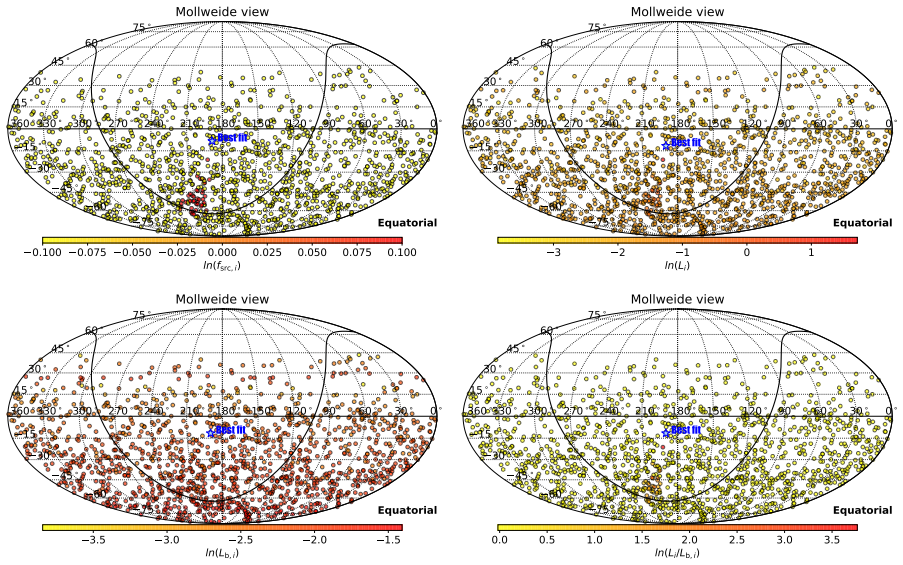
Using a six-parameter maximum-likelihood search over the 1,387 Phase I events above 40 EeV, the paper finds a multiplet of 25.7 events whose apparent source sits near the Sombrero Galaxy, with the 165 EeV event arriving closest to the source direction and lower-energy members spread systematically farther away. The energy-dependent spread matches the expectation for a single cosmic-ray nucleus type being deflected by Galactic magnetic fields, with regular and random deflection amplitudes of about 20.7 degrees and 2.7 degrees at 100 EeV. Fixing the source to the Sombrero gives a test statistic of 37.6, a local p-value of 7×$10^{-6}$, and a global p-value of 9.8×$10^{-4}$; excluding the 165 EeV event lowers the source test statistic by only 3.6, so the association is not carried by that single extreme event. The paper concludes that active supermassive black holes can accelerate cosmic rays to energies beyond 100 EeV.
Load-bearing premise
The analysis assumes every cosmic ray above 40 EeV has the same atomic number; if the true composition is a mixture or varies with energy, the energy-scaling pattern that ties the multiplet to the Sombrero could be distorted and the fitted position could shift.
Editorial extensions
If this is right
- If the association holds, active galactic nuclei with powerful jets and lobes become the leading identified source class for the highest-energy cosmic rays.
- The Sombrero's jet power of about 2.3×10^42 erg per second is more than sufficient: the derived UHECR luminosity of about 1.9×10^40 erg per second is roughly one percent of the jet power, comfortably within the energy budget.
- The multiplet pattern predicts that higher-energy cosmic rays from the Sombrero arrive closer to its direction, so future events above 100 EeV should cluster around the fitted source position.
- The method can be applied to other nearby active galaxies to decide whether Sombrero-like objects are common ultrahigh-energy cosmic-ray accelerators.
- Improved energy and composition measurements from next-generation observatories should sharpen the source position and test the pure-composition assumption directly.
Reading between the lines
- Inference: at 3.3σ global significance, the result is suggestive but not yet a claimed discovery; an independent dataset of comparable size is the natural next check.
- Inference: the same likelihood machinery could be pointed at every active galaxy with kilo- or tens-of-kiloparsec radio lobes within roughly 40 Mpc, converting a single-source case into a population test.
- Inference: the fitted small random deflection of about 2.7 degrees makes a testable prediction for Galactic magnetic-field models: along the line of sight to the Sombrero, the turbulent field must be weak enough to keep a 100 EeV nucleus within a few degrees.
- Inference: if future composition data show the multiplet is actually a mixture of nucleus types, the pure-composition likelihood would need to be replaced by a rigidity-dependent model and the apparent source position could shift, providing a direct falsification test.
Editorial analysis
A structured set of objections, weighed in public.
Referee Report
Summary. The paper searches for ultrahigh-energy cosmic-ray (UHECR) multiplets in 17 years of Pierre Auger Phase I data above 40 EeV, using a six-parameter maximum-likelihood method that fits source coordinates, regular and random magnetic deflection parameters, and the number of source events, against an isotropic background weighted by the Auger exposure. The authors report a best-fit multiplet of about 25 events with TS = 41.1 (global significance 3.7 sigma) and, after fixing the source to the Sombrero Galaxy (M104), TS = 37.6 with local and global significances of 4.5 sigma and 3.3 sigma, respectively. They argue that M104 is the only cataloged candidate within the 95% confidence region of the fitted source position and within a conservative 39.6 Mpc horizon, and they support the interpretation with CRPropa simulations of magnetic deflections in a Galactic magnetic field model.
Significance. If the statistical claim holds, this would be an important step in identifying a plausible nearby AGN accelerator of the highest-energy cosmic rays: the multiplet contains a 165 EeV event, is spatially associated with a known supermassive black hole with jets and lobes, and the energy-ordered pattern is consistent with magnetic deflection expectations. The paper has clear strengths: it uses public Auger data, estimates significances with background-only Monte Carlo simulations including exposure and energy uncertainties, applies a look-elsewhere penalty, tests robustness by removing the highest-energy event, and uses an independent CRPropa simulation. However, the central likelihood formula appears dimensionally wrong as written, so the reported TS values and significances cannot currently be reproduced from the manuscript; this issue must be resolved before the statistical claim can be assessed.
major comments (3)
- [Methods, Eq. (4) and surrounding text] The definition of the Fisher concentration parameter is dimensionally inconsistent and appears to make the source likelihood nearly isotropic. The paper states kappa = 2/sqrt(sigma_ran^2 + sigma_ang^2), with sigma_ran and sigma_ang quoted in degrees. For the Sombrero fit (A_ran = 2.7 deg, sigma_ang = 1 deg, at 100 EeV) this gives kappa ~ 0.7, for which a Fisher distribution is only weakly peaked: f_src(0)/f_src(pi) = exp(2 kappa) ~ 4, so an event at the source direction is only mildly favored over an event on the opposite side of the sky. Such a likelihood cannot produce the tight energy-ordered multiplet of Figure 1 or the reported TS = 37.6. The correct small-angle relation is kappa ~ 1/sigma^2 with sigma in radians, giving kappa ~ 450 for the same parameters. Because every likelihood ratio in Eqs. (5)-(9), and hence every quoted TS value, best-fit n_s, source position, and significance, flows through Eq. (4), this is a load-bearing issue. The authors must either correct the definition and recompute all results, or explicitly report the formula actually used in the code and show that it matches the corrected expression.
- [Methods, Eqs. (2)-(3), pure-composition assumption] The analysis assumes a pure composition for all UHECRs above 40 EeV. This assumption is load-bearing because the energy-dependent deflection law in Eqs. (2)-(3) is linear in Z, and the apparent source position S'(E) is defined using one Z. If the composition is mixed or energy-dependent, events of different Z at the same energy have different deflections, so the fitted multiplet shape and the best-fit source coordinates can be biased. The paper acknowledges this qualitatively but does not quantify the effect. Please repeat the 6-parameter fit under alternative composition assumptions (e.g., Z=1, Z=7, and Z=26, or a two-component mixture) and report the changes in the fitted source position, n_s, TS, and the resulting significances.
- [Methods, Source Catalogs, and Conclusions] The claim that the Sombrero Galaxy is 'the' source rather than 'the only cataloged candidate' depends on the completeness of the adopted catalogs. The paper correctly notes that the van Velzen et al. radio-galaxy sample excludes sources below 213 mJy, and the Updated Nearby Galaxy Catalog is not a complete flux-limited sample for faint jets and lobes. Therefore the statement that no other source lies within the 95% confidence region is only as strong as the completeness limits of the catalogs used. Please state the effective completeness limits for the relevant source classes, or explicitly soften the source-identification claim to 'the only known candidate within the adopted horizon and confidence region'.
minor comments (5)
- [Methods, Eq. (7)] The product in Eq. (7) runs from i=0 to n_tot; it should run from i=1 to n_tot.
- [Throughout] There are several typographical issues: 'invariance' should likely be 'concentration parameter'; 'extragalacitc' should be 'extragalactic'; 'Jasson' should be 'Jansson'; 'Mattews' should be 'Matthews'; and 'PAOphase Idata' needs spacing.
- [Author contributions] The text refers to 'Figure S3', but no supplementary figure S3 appears in the manuscript; please correct the reference.
- [Figure 3 and simulation comparison] The similarity between the observed and simulated multiplets is assessed only visually. A quantitative comparison (e.g., a two-sample test on angular distances from the source, or a likelihood ratio between the observed data and the simulated pattern) would make the supporting argument more convincing.
- [Table 2] For the Sombrero rows in Table 2 the source coordinates are fixed at the known galaxy position, unlike the fitted coordinates in the best-fit column; this should be indicated explicitly to avoid confusion.
Circularity Check
No significant circularity: the likelihood method is self-contained, significance is Monte Carlo against background-only simulations, and the CRPropa simulation uses an independent GMF model.
full rationale
The derivation chain is not circular by construction. The multiplet search uses a six-parameter maximum-likelihood fit (Eqs. 2-8) in which source coordinates, magnetic-deflection parameters, and multiplet size are all fitted to the data; the reported significance is obtained by comparing the observed TS to TS values from 5x10^4 background-only simulations that contain no multiplet. The claim that the observed multiplet is 'consistent with the theoretical expected distribution' is a description of the best-fit model, not an independent prediction, and the association significance rests on the Monte Carlo p-value rather than on that consistency. The source identification is a posterior localization step: the 68% and 95% confidence regions of the fitted source coordinates are searched against external catalogs, and the Sombrero Galaxy is found to be the only candidate within the adopted horizon distance. This is standard catalog matching, not an input assumed to produce the answer. The CRPropa simulation with the Jansson & Farrar (2012) Galactic magnetic field is independent of the fitted parameters and is used only for qualitative comparison. The citation to He et al. (2016) for the maximum-likelihood approach is a self-citation, but the method is fully re-derived in the Methods section and the conclusion does not depend on an unverified theorem imported from that paper; it is a tool, not the result. The paper also checks robustness by removing the 165 EeV event. The dimensional issue noted for kappa in Eq. (4) (kappa = 2/sqrt(sigma_ran^2 + sigma_ang^2) with angles in degrees) is a potential correctness or reproducibility problem, not a circularity problem, because it does not make the analysis assume its own conclusion. No circular step can be exhibited from the text.
Assumptions & free parameters
free parameters (6)
- source right ascension alpha_s =
188.7 deg
- source declination delta_s =
-8.3 deg
- regular deflection amplitude A_reg =
22.8 deg
- random deflection amplitude A_ran =
2.5 deg
- regular deflection direction phi_reg =
197.5 deg
- source event count n_s =
25.2
assumptions (6)
- domain assumption Pure composition of UHECRs above 40 EeV
- domain assumption Deflection model with 1/E scaling for regular and random components
- standard math Fisher distribution for angular scatter
- domain assumption Isotropic background with PAO exposure
- domain assumption Horizon distance of the 165 EeV event is <= 39.6 Mpc
- domain assumption Source catalog completeness within the horizon
Cite this review
Pith. "Pith review of Evidence for the Sombrero Galaxy as an Accelerator of the Highest-Energy Cosmic Rays." pith.science (2026). https://pith.science/paper/5MIY26FD
@misc{pith2026241211966,
  author       = {Pith},
  title        = {Pith review of: Evidence for the Sombrero Galaxy as an Accelerator of the Highest-Energy Cosmic Rays},
  year         = {2026},
  howpublished = {\url{https://pith.science/paper/5MIY26FD}},
  note         = {Machine review of arXiv:2412.11966}
}
abstract
Ultrahigh-energy cosmic rays (UHECRs) are the highest energy messenger from space, with energies exceeding 1 EeV. Although UHECRs were discovered over 60 years ago, their origin still remains a mystery. Pinpointing sources of UHECRs is crucial for understanding the extreme astrophysical processes that accelerate particles to such extraordinary energies. We searched for UHECR multiplets via analyzing 17 years of data with energies greater than 40 EeV from the Pierre Auger Observatory. A spatial association is found between a multiplet of $25.7^{+6.2}_{-7.0}$ cosmic rays and the Sombrero galaxy with a local (global) significance of $4.5~\sigma~(3.3~\sigma)$. The Sombrero galaxy hosts a supermassive central black hole with a mass of $\sim1\times 10^9 M_{\odot}$ and exhibits large-scale radio lobes and jets. Our finding provides critical evidence on active supermassive black holes as the source of the highest-energy cosmic rays.
Figures


Figures from the paper (4 more)



Reference graph
Works this paper leans on
-
[1]
Ultra-High Energy Cosmic Rays: A Probe of Physics and Astrophysics at Extreme Energies
Sigl, G. Ultrahigh-Energy Cosmic Rays: Physics and Astrophysics at Extreme Energies. Science 291, 73–79 (2001). astro-ph/0104291
work page Pith review arXiv 2001
-
[2]
Correlation of the Highest-Energy Cosmic Rays with Nearby Extragalactic Objects
Pierre Auger Collaboration et al. Correlation of the Highest-Energy Cosmic Rays with Nearby Extragalactic Objects. Science 318, 938 (2007). 0711.2256
arXiv 2007
-
[3]
Abbasi, R. U. et al. Indications of Intermediate-scale Anisotropy of Cosmic Rays with Energy Greater Than 57 EeV in the Northern Sky Measured with the Surface Detector of the Telescope Array Experiment. Astrophys. J. Let. 790, L21 (2014). 1404.5890
arXiv 2014
-
[4]
Observation of a large-scale anisotropy in the arrival directions of cosmic rays above 8 × 10¹⁸ eV
Pierre Auger Collaboration et al. Observation of a large-scale anisotropy in the arrival directions of cosmic rays above 8 × 10¹⁸ eV. Science 357, 1266–1270 (2017). 1709.07321
arXiv 2017
-
[5]
Aab, A. et al. Features of the Energy Spectrum of Cosmic Rays above 2.5×10¹⁸ eV Using the Pierre Auger Observatory. Phys. Rev. Let. 125, 121106 (2020). 2008.06488
arXiv 2020
-
[6]
Abreu, P. et al. Arrival Directions of Cosmic Rays above 32 EeV from Phase One of the Pierre Auger Observatory. Astrophys. J. 935, 170 (2022). 2206.13492
arXiv 2022
-
[7]
An extremely energetic cosmic ray observed by a surface detector array
Telescope Array Collaboration et al. An extremely energetic cosmic ray observed by a surface detector array. Science 382, 903–907 (2023). 2311.14231
arXiv 2023
- [8]
Show all 52 references
-
[9]
Harari, S
D. Harari, S. Mollerach, E. Roulet, and F. S ´anchez. Lensing of ultra-high energy cosmic rays in turbulent magnetic fields. Journal of High Energy Physics 3, 45 (2002)
2002
-
[10]
P. G. Tinyakov and I. I. Tkachev. Deflections of cosmic rays in a random component of the Galactic magnetic field. Astroparticle Physics 24, 32 (2005)
2005
-
[11]
Search for signatures of magnetically-induced alignment in the arrival directions measured by the Pierre Auger Observatory
Pierre Auger Collaboration et al. Search for signatures of magnetically-induced alignment in the arrival directions measured by the Pierre Auger Observatory. Astroparticle Physics 35, 354–361 (2012). 1111.2472
2012 arXiv
-
[12]
Monte Carlo Bayesian search for the plausible source of the Telescope Array hotspot
Hao-Ning He, Alexander Kusenko, Shigehiro Nagataki, Bin-Bin Zhang, Rui-Zhi Yang, and Yi-Zhong Fan. Monte Carlo Bayesian search for the plausible source of the Telescope Array hotspot. Phys. Rev. D 93, 043011 (2016)
2016
-
[13]
Aab, A. et al. Search for patterns by combining cosmic-ray energy and arrival directions at the Pierre Auger Observatory. European Physical Journal C 75, 269 (2015). 1410.0515. 21
2015 arXiv
-
[14]
Aab et al
A. Aab et al. (The Pierre Auger Collaboration). Search for magnetically-induced signatures in the arrival directions of ultra-high-energy cosmic rays measured at the Pierre Auger Observa- tory. Journal of Cosmology and Astroparticle Physics 06, 017 (2020) (2020)
2020
-
[15]
Abbasi, R. U. et al. Evidence for a Supergalactic Structure of Magnetic Deflection Multiplets of Ultra-high-energy Cosmic Rays. Astrophys. J. 899, 86 (2020)
2020
-
[16]
Mayotte, E. W. et al. Measurement of the mass composition of ultra-high-energy cosmic rays at the Pierre Auger Observatory. PoS ICRC2023, 365 (2023)
2023
-
[17]
Abdul Halim, A. et al. A Catalog of the Highest-energy Cosmic Rays Recorded during Phase I of Operation of the Pierre Auger Observatory. Astrophys. J. Supp. 264, 50 (2023)
2023
-
[18]
End to the Cosmic-Ray Spectrum? Phys
Greisen, K. End to the Cosmic-Ray Spectrum? Phys. Rev. Let. 16, 748–750 (1966)
1966
-
[19]
Zatsepin, G. T. & Kuz’min, V. A. Upper Limit of the Spectrum of Cosmic Rays.Soviet Journal of Experimental and Theoretical Physics Letters 4, 78 (1966)
1966
-
[20]
& Blandford, R
Globus, N., Fedynitch, A. & Blandford, R. D. Treasure Maps for Detections of Extreme Energy Cosmic Rays. Astrophys. J. 945, 12 (2023). 2210.15885
2023 arXiv
-
[21]
Anchordoqui, L. A. Ultra-High-Energy Cosmic Rays. Phys. Rept. 801, 1–93 (2019). 1807. 09645
2019
-
[22]
Koulouridis, E. et al. The X-CLASS survey: A catalogue of 1646 X-ray-selected galaxy clusters up to z∼ 1.5. Astron. Astrophys. 652, A12 (2021). 2104.06617
2021 arXiv
-
[23]
Baumgartner, W. H. et al. The 70 Month Swift-BAT All-sky Hard X-Ray Survey. Astrophys. J. Supp. 207, 19 (2013). 1212.3336
2013 arXiv
-
[25]
& Kampert, K.-H
van Velzen, S., Falcke, H., Schellart, P., Nierstenh ¨ofer, N. & Kampert, K.-H. Radio galaxies of the local universe. All-sky catalog, luminosity functions, and clustering. Astron. Astrophys. 544, A18 (2012). 1206.0031
2012 arXiv
-
[26]
D., Makarov, D
Karachentsev, I. D., Makarov, D. I. & Kaisina, E. I. Updated Nearby Galaxy Catalog. Astron. J. 145, 101 (2013). 1303.5328
2013 arXiv
-
[27]
& Farrar, G
Jansson, R. & Farrar, G. R. A New Model of the Galactic Magnetic Field. Astrophys. J. 757, 14 (2012). 1204.3662. 22
2012 arXiv
-
[28]
& Farrar, G
Jansson, R. & Farrar, G. R. The Galactic Magnetic Field. Astrophys. J. Let. 761, L11 (2012). 1210.7820
2012 arXiv
-
[29]
Alves Batista, R. et al. CRPropa 3.2 - an advanced framework for high-energy particle propagation in extragalactic and galactic spaces. Journal of Cosmology and Astroparticle Physics 2022, 035 (2022). 2208.00107
2022 arXiv
-
[30]
McQuinn, K. B. W., Skillman, E. D., Dolphin, A. E., Berg, D. & Kennicutt, R. The Distance to M104. Astron. J. 152, 144 (2016)
2016
-
[31]
Evidence for a Central Dark Mass in NGC 4594 (The Sombrero Galaxy)
Kormendy, J. Evidence for a Central Dark Mass in NGC 4594 (The Sombrero Galaxy). Astrophys. J. 335, 40 (1988)
1988
-
[32]
Kormendy, J. et al. Hubble Space Telescope Spectroscopic Evidence for a 1 X 10 9 M 𝑠𝑢𝑛 Black Hole in NGC 4594. Astrophys. J. Let. 473, L91 (1996)
1996
-
[33]
Y., Semikoz, D
Neronov, A. Y., Semikoz, D. V. & Tkachev, I. I. Ultra-high energy cosmic ray production in the polar cap regions of black hole magnetospheres. New Journal of Physics 11, 065015 (2009). 0712.1737
2009 arXiv
-
[34]
& Ahmedov, B
Tursunov, A., Stuchl ´ık, Z., Kolo ˇs, M., Dadhich, N. & Ahmedov, B. Supermassive Black Holes as Possible Sources of Ultrahigh-energy Cosmic Rays. Astrophys. J. 895, 14 (2020). 2004.07907
2020 arXiv
-
[35]
F., Axon, D
Gallimore, J. F., Axon, D. J., O’Dea, C. P., Baum, S. A. & Pedlar, A. A Survey of Kiloparsec- Scale Radio Outflows in Radio-Quiet Active Galactic Nuclei. Astron. J. 132, 546–569 (2006). astro-ph/0604219
2006 arXiv
-
[36]
Li, Z. et al. X-ray Emission from the Sombrero Galaxy: A Galactic-scale Outflow. Astrophys. J. 730, 84 (2011). 1009.5767
2011 arXiv
-
[37]
Hada, K. et al. Evidence for a Nuclear Radio Jet and its Structure down to lsim100 Schwarzschild Radii in the Center of the Sombrero Galaxy (M 104, NGC 4594).Astrophys. J. 779, 6 (2013). 1310.0488
2013 arXiv
-
[38]
& Prieto, M
Mezcua, M. & Prieto, M. A. Evidence of Parsec-scale Jets in Low-luminosity Active Galactic Nuclei. Astrophys. J. 787, 62 (2014). 1403.6675
2014 arXiv
-
[39]
Yang, Y. et al. CHANG-ES. XXX. 10 kpc Radio Lobes in the Sombrero Galaxy. Astrophys. J. 966, 213 (2024). 2403.16682. 23
2024 arXiv
-
[40]
Yan, X. et al. Multifrequency Very Long Baseline Interferometry Imaging of the Subparsec- scale Jet in the Sombrero Galaxy (M104). Astrophys. J. 965, 128 (2024). 2403.04215
2024 arXiv
-
[41]
P., Zrake, J
Alves, E. P., Zrake, J. & Fiuza, F. Efficient Nonthermal Particle Acceleration by the Kink Instability in Relativistic Jets. Phys. Rev. Let. 121, 245101 (2018). 1810.05154
2018 arXiv
-
[42]
H., Bell, A
Matthews, J. H., Bell, A. R., Blundell, K. M. & Araudo, A. T. Ultrahigh energy cosmic rays from shocks in the lobes of powerful radio galaxies.Mon. Not. R. Astron. Soc. 482, 4303–4321 (2019). 1810.12350
2019 arXiv
-
[43]
Hillas, A. M. The Origin of Ultra-High-Energy Cosmic Rays. Annu. Rev. Astron. Astrophys. 22, 425–444 (1984)
1984
-
[44]
Wykes, S. et al. Mass entrainment and turbulence-driven acceleration of ultra-high energy cosmic rays in Centaurus A. Astron. Astrophys. 558, A19 (2013). 1305.2761
2013 arXiv
-
[45]
Han, J. L. Observing Interstellar and Intergalactic Magnetic Fields. Annu. Rev. Astron. Astrophys. 55, 111–157 (2017)
2017
-
[46]
& Han, J
Xu, J. & Han, J. L. The Huge Magnetic Toroids in the Milky Way Halo. Astrophys. J. 966, 240 (2024). 2404.02038
2024 arXiv
-
[47]
´Alvarez-Mu˜niz, J. et al. The Giant Radio Array for Neutrino Detection (GRAND): Science and design. Science China Physics, Mechanics, and Astronomy 63, 219501 (2020). 1810.09994
2020 arXiv
-
[48]
AugerPrime - The upgrade of the Pierre Auger Observatory.International Journal of Modern Physics A 37, 2240012–251 (2022)
Stasielak, J. AugerPrime - The upgrade of the Pierre Auger Observatory.International Journal of Modern Physics A 37, 2240012–251 (2022). 2110.09487
2022 arXiv
-
[49]
& Fan, Y.-Z
Xia, Z.-Q., Wang, Y., Yuan, Q. & Fan, Y.-Z. A delayed 400 GeV photon from GRB 221009A and implication on the intergalactic magnetic field.Nature Commun.15, 4280 (2024).2210.13052
2024 arXiv
-
[50]
Dispersion on a Sphere
Fisher, R. Dispersion on a Sphere. Proceedings of the Royal Society of London Series A 217, 295–305 (1953)
1953
-
[51]
Oh, K. et al. The 105-Month Swift-BAT All-sky Hard X-Ray Survey.Astrophys. J. Supp. 235, 4 (2018). 1801.01882
2018 arXiv
-
[52]
Ajello, M. et al. 3FHL: The Third Catalog of Hard Fermi-LAT Sources. Astrophys. J. Supp. 232, 18 (2017). 1702.00664
2017 arXiv
-
[53]
& Capel, F
Bourriche, N. & Capel, F. Cosmic cartography with UHECRs: Source constraints from individual events at the highest energies. PoS ICRC2023, 362 (2023). 24 Acknowledgements We thank the useful discussions with Ruoyu Liu, Tianqi Huang, Bing Theodore Zhang, Gwenael Giacinti, Jun X...
2023
Reviewed August 11, 2026 · model on record in the stance chip above.
Discussion (0). Continue with ORCID to comment.