REVIEW 3 major objections 4 minor 1 cited by
LLM-RG4: Flexible and Factual Radiology Report Generation across Diverse Input Contexts
T0 review · 3 major / 4 minor · reviewed 2026-08-11 · deepseek-v4-flash
Pith's one-line read One 7B model, trained on an input-aligned cleaned dataset, generates radiology reports across four scenarios with only 0.2–2.1 percent input-agnostic hallucinations.
desk verdict A genuinely useful four-scenario dataset and an efficient fixed-token fusion idea, but the 'minimal hallucination' headline is measured by a discriminator trained inside the same cleaning pipeline that built the training data. read the letter →
The pith
A machine-rendered reading of the paper's core claim, the machinery that carries it, and where it could break.
The reading
What carries the argument
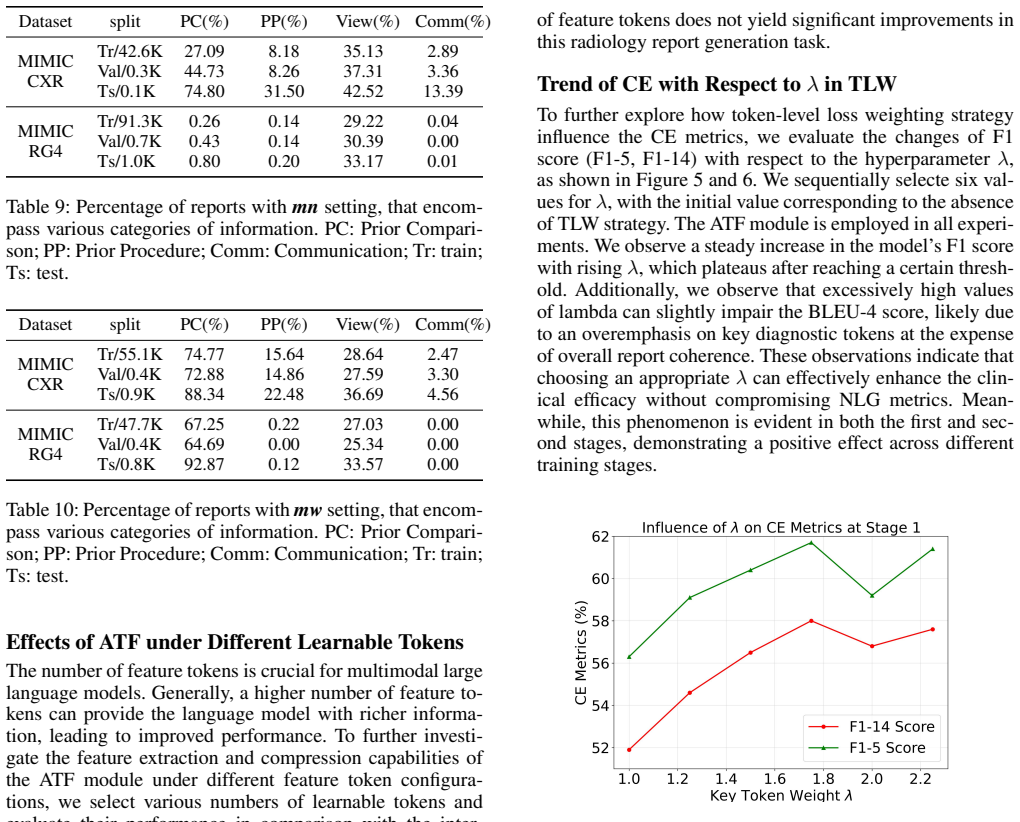
The argument is carried by three mechanisms. The adaptive token fusion module (ATF) uses the frontal image's perceiver output as query tokens for the lateral image and prior-report text streams, then concatenates the compressed token features along the feature dimension and projects them back to a fixed length, so the LLM always sees the same number of tokens no matter how many inputs are present; the paper reports roughly 60 percent fewer tokens than interleaved inputs with similar or better scores. The token-level loss weighting strategy (TLW) runs CheXbert to flag positive or uncertain disease labels, uses Integrated Gradients to attribute those labels to tokens, smooths the attributions, and raises the loss weight to λ=1.75 for entire sentences whose attribution exceeds a threshold, pushing the model to spend capacity on diagnostic content. The dataset pipeline matters as the third mechanism: Llama3-70B rewrites reports in up to three iterative rounds judged by DiscBERT, and any rewrite that changes CheXbert's disease labels is discarded, which is what makes low hallucination rates measurable and trainable.
What would settle it
Take a random sample of several thousand MIMIC-RG4 reports, have radiologists compare each reconstructed report with the original MIMIC-CXR report, and count how often a CheXbert-positive finding is dropped, added, or changed; if that rate is non-negligible, the reported CE and hallucination gains are attributable to the cleaning pipeline rather than to LLM-RG4. A cheaper check is to run LLM-RG4 on original un-cleaned MIMIC-CXR inputs and see whether the hallucination rate stays near 1.5 percent.
Extended reading notes
Core claim
The central claim is that the standard single-image-to-full-report paradigm causes input-agnostic hallucinations, and that replacing it with a scenario-aware paradigm removes most of them. In MIMIC-RG4, each report is reconstructed so that its content is a function of the four possible input combinations—frontal image, lateral image, prior report text, and indication/history—with prior comparisons, prior procedures, view statements, and communications deleted or rewritten when the input cannot support them. LLM-RG4 then learns all four scenarios in one model: the adaptive token fusion module compresses available modalities into a fixed number of tokens seeded by the frontal image, and the token-level loss weighting uses CheXbert and Integrated Gradients to raise the training weight of sentences carrying positive or uncertain diagnoses. The reported outcome is state-of-the-art clinical-efficiency and language scores on both MIMIC-RG4 and the conventional MIMIC-CXR task, with essentially no input-agnostic hallucinations; the only exception the authors acknowledge is that cross-scenario consistency (e.g., mentioning pneumonia in one setting but not another) is not yet fully solved.
Load-bearing premise
The load-bearing premise is that the automatic report-cleaning pipeline removes input-agnostic content from 172.6K training reports without distorting clinical meaning or injecting its own artifacts, since only 200 reports were manually validated and a CheXbert label-consistency filter is the main large-scale guard.
Editorial extensions
If this is right
- A single 7B model can serve all four input scenarios with CE F1 0.559–0.610 and hallucination rates 0.002–0.021, outperforming per-task baselines, so hospitals would not need separate models for each workflow.
- Adaptive token fusion keeps the LLM's token count constant, cutting tokens by about 60 percent when multi-view and longitudinal data are present, with similar or better scores than interleaved inputs—so adding modalities need not proportionally increase compute.
- Token-level loss weighting improves CE F1 on both ATF and interleaved architectures, meaning loss-layer emphasis on positive and uncertain diagnoses is a transferable way to improve clinical accuracy without reinforcement learning or inference-time classifiers.
- Mixed training across the four scenarios acts like data augmentation, with the largest CE gains in the harder multi-view and longitudinal settings.
- Training on reconstructed reports makes generated reports nearly free of prior-comparison, prior-procedure, view, and communication hallucinations, while remaining competitive on original MIMIC-CXR NLG metrics against closed-source and specialized models.
Reading between the lines
- A natural extension is to apply the same cyclic Llama3/DiscBERT reconstruction to other imaging modalities (CT, MRI, ultrasound), where input-dependent content rules differ but the need to remove uninferable text is identical; DiscBERT could then serve as a real-time hallucination monitor during deployment.
- The fixed-token ATF bottleneck suggests a testable hypothesis the paper leaves implicit: in narrowly specialized medical tasks, token-count compression does not cost accuracy, so the same design could fuse non-image inputs such as lab values or ECG traces without retraining the decoder.
- Because original-MIMIC-CXR NLG scores stay competitive despite training on cleaned reports, one could test whether MIMIC-RG4-trained models adapt to institution-specific report styles with only light fine-tuning, which would bear on real deployment.
- The paper's own case study shows cross-scenario inconsistency (pneumonia mentioned in some settings but not others); a concrete next step is combining TLW with decoding-time constraints that align diagnoses across the four scenarios.
Editorial analysis
A structured set of objections, weighed in public.
Referee Report
Summary. This paper addresses radiology report generation from diverse input contexts. The authors construct MIMIC-RG4 from MIMIC-CXR using Llama3-70B to rewrite reports and a BERT-based discriminator (DiscBERT) to identify input-agnostic content (prior comparisons, prior procedures, view descriptions, communications) across four scenarios: single view with/without longitudinal data and multi-view with/without longitudinal data. They propose LLM-RG4, a Vicuna-7B-based model with an adaptive token fusion module that maps frontal, lateral, and previous-report inputs into a fixed number of tokens, and a token-level loss weighting scheme that up-weights sentences containing positive or uncertain CheXbert findings. Experiments on MIMIC-CXR and MIMIC-RG4 compare clinical efficiency (CheXbert F1), natural language generation (BLEU/ROUGE/METEOR), and hallucination (DiscBERT) against open-source baselines and retrained CXRMate, reporting state-of-the-art CE and low hallucination rates. Ablations show that ATF reduces token count while retaining performance, and that TLW improves CE.
Significance. If validated, the paper would make a useful practical contribution: a multi-scenario RRG benchmark, a flexible model that handles varying inputs in one framework, and a token-compression design that reduces the computational burden of additional inputs. The strengths are concrete: the MIMIC-RG4 dataset is a potentially reusable resource, the authors retrain CXRMate on the new benchmark, they apply Wilcoxon signed-rank tests, the code is released, and there is some manual validation of DiscBERT and of reconstruction quality. However, the central factual/hallucination claim relies on an evaluator (DiscBERT) that is trained inside the same data-cleaning pipeline that produced the training set, and the clinical-efficiency metric (CheXbert) is the same labeler used to filter training data. The external manual validation is small and does not break this circularity. The paper's significance therefore hinges on whether those claims survive independent, scenario-conditioned evaluation.
major comments (3)
- [Dataset Generation Pipeline; Tables 2-3, 6] The central hallucination claim is partially self-referential and needs external validation.
- [Dataset Generation Pipeline; Experimental Setup] The CE metric and the training-data filter share the same labeler, so an independent clinical check is needed.
- [Tables 2-5; Table 4] Single-run results are not sufficient for the strength of the SOTA and ablation claims.
minor comments (4)
- [Abstract; Tables 7-10] The phrase 'perfectly corresponded input and output' overstates the dataset: Table 7 shows residual uninferable content even under the single-view no-longitudinal setting (e.g., 5.5% View), and Tables 8 and 10 show that prior comparisons are intentionally retained in sw and mw. Suggest using 'aligned' or 'minimized' instead of 'perfectly corresponded'.
- [Table 2] It is unclear whether the hallucination scores for the baseline models were computed by the authors using DiscBERT or quoted from the original papers; please specify the evaluation protocol for each baseline.
- [Appendix; Table 15] There is a typo: 'as shown in Tabel 15' should read 'as shown in Table 15'.
- [Abstract] The phrase 'radiologists tail content' should be 'radiologists tailor content'.
Circularity Check
Hallucination claim is partially circular: the DiscBERT/Llama3 cleaning filter that built MIMIC-RG4 is also the metric used to report the model's hallucination rates.
-
fitted input called prediction
[Dataset Generation Pipeline; Experimental Setup, Datasets and Metrics; Tables 2-3 and Table 6]
"DiscBERT is trained with the Llama3-70B’s judgment results, and exhibits judgement capabilities comparable to Llama3-70B. ... DiscBERT, as a byproduct of the pipeline, allows for convenient dataset analysis that distinguishes information categories within the generated reports, offering a tool for evaluating input-agnostic hallucinations. ... For hallucinations, we emphasize input-agnostic hallucinations ( hall.) and employ DiscBERT to measure the proportion of generated reports containing input-agnostic information."
The quantity reported as the model's hallucination rate is measured by DiscBERT, the same fitted classifier that operationalized 'input-agnostic information' during the construction of MIMIC-RG4. LLM-RG4 is trained on reports that were filtered and rewritten precisely to minimize DiscBERT/Llama3-detected prior comparisons, prior procedures, view references, and communications. A model that imitates that cleaned distribution will therefore score low on DiscBERT by construction; the metric does not independently verify that generated content is supported by the actual inputs. Table 6 confirms DiscBERT is an imperfect proxy (e.g., prior-procedure recall 79.3%, F1 86.0%), so content it misses is neither removed from training data nor counted as hallucination.
full rationale
The core NLG and most CE comparisons rest on external metrics (BLEU, ROUGE-L, METEOR, CheXbert labels) and held-out splits, so the general state-of-the-art claim is not circular. The circularity is concentrated in the 'minimal input-agnostic hallucinations' claim: the data-generation pipeline uses Llama3-70B judgments, approximated by the fitted DiscBERT, to define which content is input-agnostic and to clean the training reports; the same DiscBERT is then used as the hallucination evaluator. Thus low hall. scores reflect the model's fidelity to the cleaning distribution rather than an independent measurement of input grounding. The CheXbert filter/evaluator overlap is a related but weaker concern because CheXbert is a fixed external labeler and all baselines are scored with the same CE metric. No load-bearing self-citations or uniqueness-theorem arguments appear. Overall score 6: one central claim is partially circular by construction, while the remaining empirical contributions remain independently testable.
Assumptions & free parameters
free parameters (3)
- TLW lambda =
1.75
- TLW attribution threshold =
0.4
- Perceiver latent token count =
128
assumptions (4)
- domain assumption CheXbert's 14-label classification of radiology reports is accurate enough for evaluation, dataset filtering, and token attribution.
- ad hoc to paper Integrated Gradients on CheXbert identifies the report tokens that express each positive or uncertain finding.
- ad hoc to paper Llama3-70B's judgments about prior comparison, prior procedure, view, and communication content are correct and transferable to DiscBERT.
- domain assumption The four input scenarios and the Nguyen et al. (2023) information taxonomy cover the clinically meaningful report content.
invented entities (2)
-
MIMIC-RG4 dataset
independent evidence
-
DiscBERT
independent evidence
Cite this review
Pith. "Pith review of LLM-RG4: Flexible and Factual Radiology Report Generation across Diverse Input Contexts." pith.science (2026). https://pith.science/paper/XQNSZA4L
@misc{pith2026241212001,
  author       = {Pith},
  title        = {Pith review of: LLM-RG4: Flexible and Factual Radiology Report Generation across Diverse Input Contexts},
  year         = {2026},
  howpublished = {\url{https://pith.science/paper/XQNSZA4L}},
  note         = {Machine review of arXiv:2412.12001}
}
read the original abstract
Drafting radiology reports is a complex task requiring flexibility, where radiologists tail content to available information and particular clinical demands. However, most current radiology report generation (RRG) models are constrained to a fixed task paradigm, such as predicting the full ``finding'' section from a single image, inherently involving a mismatch between inputs and outputs. The trained models lack the flexibility for diverse inputs and could generate harmful, input-agnostic hallucinations. To bridge the gap between current RRG models and the clinical demands in practice, we first develop a data generation pipeline to create a new MIMIC-RG4 dataset, which considers four common radiology report drafting scenarios and has perfectly corresponded input and output. Secondly, we propose a novel large language model (LLM) based RRG framework, namely LLM-RG4, which utilizes LLM's flexible instruction-following capabilities and extensive general knowledge. We further develop an adaptive token fusion module that offers flexibility to handle diverse scenarios with different input combinations, while minimizing the additional computational burden associated with increased input volumes. Besides, we propose a token-level loss weighting strategy to direct the model's attention towards positive and uncertain descriptions. Experimental results demonstrate that LLM-RG4 achieves state-of-the-art performance in both clinical efficiency and natural language generation on the MIMIC-RG4 and MIMIC-CXR datasets. We quantitatively demonstrate that our model has minimal input-agnostic hallucinations, whereas current open-source models commonly suffer from this problem.
Figures


Figures from the paper (5 more)




Forward citations
Cited by 1 Pith paper
-
Activating Associative Disease-Aware Vision Token Memory for LLM-Based X-ray Report Generation
AM-MRG combines disease-region extraction with two Hopfield memory retrievers to improve LLM-generated chest X-ray reports on IU X-ray, MIMIC-CXR, and Chexpert Plus.
Reference graph
Works this paper leans on
-
[1]
Delete the sentence that includes the comparison behavior, but retain the result
For sentences that mention comparison with a certain check, they often contain ‘ ’. Delete the sentence that includes the comparison behavior, but retain the result
-
[2]
For adverbs related to time and program, such as again and so, delete them directly
For adjectives related to time, such as new and old, delete them directly. For adverbs related to time and program, such as again and so, delete them directly
-
[3]
If there is no change, slight improvement, or deterioration in the description of previous positive symptoms that still exist, rewrite it to directly state this symptom
-
[4]
For sentences describing a symptom that has disappeared, rewrite them as negative and mention it. Please only give me the rewritten report, and if there is a situation where the above rules cannot be rewritten, please output: ‘attention! a certain expression exceeds the current rule range.’ Rewritten Report: . . . Prior Procedure Reconstruction Rule: Syst...
-
[6]
Seeing the Image: Prioritizing Visual Correlation by Contrastive Alignment
Seeing the Image: Prioritizing Visual Correlation by Contrastive Alignment. arXiv preprint arXiv:2405.17871. Yan, A.; He, Z.; Lu, X.; Du, J.; Chang, E.; Gentili, A.; McAuley, J.; and Hsu, C.-N. 2021. Weakly supervised con- trastive learning for chest x-ray report generation. arXiv preprint arXiv:2109.12242. Yan, S.; Cheung, W. K.; Tsang, I. W.; Chiu, K.; ...
work page Pith review arXiv 2021
-
[7]
The lateral view is recommended to as- sist in diagnosis
When radiology report generation meets knowledge graph. In Proceedings of the AAAI conference on artificial intelligence, volume 34, 12910–12917. Zhao, Z.; Wang, S.; Gu, J.; Zhu, Y .; Mei, L.; Zhuang, Z.; Cui, Z.; Wang, Q.; and Shen, D. 2024. Chatcad+: Towards a universal and reliable interactive cad using llms. IEEE Transactions on Medical Imaging. Appen...
work page 2021
-
[12]
For sentences that mention the patient’s postoperative state, delete the description of what postoperative state they are in
-
[13]
For examination results obtained using other non X-ray examination methods, such as CT, MRI, PET, these examination results shall be directly deleted
Show all 18 references
-
[14]
For sentences describing the removal of previous treatment devices such as pacemakers, clips, etc., delete them directly. Please only give me the rewritten report, and if there is a situation where the above rules cannot be applied, please answer: ‘attention! a certain express...
-
[15]
For expressions provided for different views, such as AP and later views are provided, remove the expression directly while retaining the inspection results
-
[16]
For statements that clearly state what symptoms are seen or confirmed from the lateral view, remove the statement and replace it with the statement that ‘the lateral view is recommended to assist in diagnosis.’
-
[17]
For conclusions obtained from both frontal and lateral views, delete the description of the view and retain the conclusion. Please only give me the rewritten report, and if there is a situation where the above rules cannot be applied, please answer: ‘attention! a certain expre...
-
[18]
If a sentence describes communication with doctors and nurses, delete that sentence directly. Please only give me the rewritten report, and if there is a situation where the above rules cannot be applied, please answer: ‘attention! a certain expression exceeds the current rule...
-
[21]
Bu, S.; Li, T.; Yang, Y .; and Dai, Z
Springer. Bu, S.; Li, T.; Yang, Y .; and Dai, Z. 2024. Instance- level Expert Knowledge and Aggregate Discriminative At- tention for Radiology Report Generation. In Proceedings of the IEEE/CVF Conference on Computer Vision and Pattern Recognition, 14194–14204. Chen, Z.; Shen, ...
2024 arXiv
-
[664]
Woolson, R
Springer. Woolson, R. F. 2005. Wilcoxon signed-rank test. Encyclo- pedia of Biostatistics, 8. Wu, C.; Zhang, X.; Zhang, Y .; Wang, Y .; and Xie, W. 2023. Towards generalist foundation model for radiology. arXiv preprint arXiv:2308.02463. Wu, Y .; Huang, I.-C.; and Huang, X. 20...
2005 arXiv
-
[2020]
Radiograph- ics, 40(6): 1658–1670
How to create a great radiology report. Radiograph- ics, 40(6): 1658–1670. Hu, E. J.; Shen, Y .; Wallis, P.; Allen-Zhu, Z.; Li, Y .; Wang, S.; Wang, L.; and Chen, W. 2021. Lora: Low-rank adaptation of large language models. arXiv preprint arXiv:2106.09685. Huang, Z.; Zhang, X....
2021 arXiv
-
[2023]
See https://vicuna
Vicuna: An open-source chatbot impressing gpt-4 with 90%* chatgpt quality. See https://vicuna. lmsys. org (accessed 14 April 2023), 2(3): 6. Dalla Serra, F.; Wang, C.; Deligianni, F.; Dalton, J.; and O’Neil, A. 2023. Controllable Chest X-Ray Report Genera- tion from Longitudin...
2023 arXiv
-
[2024]
NEJM AI, 1(3): AIoa2300138
Towards generalist biomedical AI. NEJM AI, 1(3): AIoa2300138. Wang, J.; Bhalerao, A.; and He, Y . 2022. Cross-modal proto- type driven network for radiology report generation. In Eu- ropean Conference on Computer Vision, 563–579. Springer. Wang, S.; Zhao, Z.; Ouyang, X.; Wang,...
2022 arXiv
Reviewed August 11, 2026 · model on record in the stance chip above.
Discussion (0). Continue with ORCID to comment.