Systems and Control · arXiv:2412.12146 v1 · submitted 10 Dec 2024 · 12 references
Generative Modeling and Data Augmentation for Power System Production Simulation
The paper says
“As a key component of power system production simulation, load forecasting is critical for the stable operation of power systems. Machine learning methods prevail in this field. However, the limited training data can be a challenge.”
more of the abstract
This paper proposes a generative model-assisted approach for load forecasting under small sample scenarios, consisting of two steps: expanding the dataset using a diffusion-based generative model and then training various machine learning regressors on the augmented dataset to identify the best performer. The expanded dataset significantly reduces forecasting errors compared to the original dataset, and the diffusion model outperforms the generative adversarial model by achieving about 200 times smaller errors and better alignment in latent data distributions.
from the abstract
Pith says
Machine review · deepseek-v4-flash · 11 Aug 2026 · what was read was not recorded · not checked by a person
It can be wrong. Challenge this review or reply to it.
Holds up, with conditions. A plausible but thinly evidenced application of diffusion-based augmentation; the 200x claim is a single-week point estimate that needs repeated experiments before it can be trusted. This line is wrong
4 major objections · 5 minor
How often objections from reviews like this one are right: not yet measured
Not checked: figures, code, what the 12 references say.
The paper says, at Section 2.1 and Section 3.1, Table 1
The review did not quote this passage.
Pith says: Objection 1 of 4 · major
The headline improvement (e.g., ExtraTree RMSE 0.00023 vs. 0.05356 for TimeGAN, or vs. 0.04467 on original data) is computed from a single 8:2 split of one continuous 168-hour week from one household. The 34-hour test block immediately follows the 134-hour training block in the same week, and residential load has strong diurnal and day-of-week autocorrelation.
more of objection 1
Consequently, the test set is not an independent sample of load conditions: the same hour-of-day patterns already appear in the training block, so the near-zero errors are consistent with interpolation or pattern memorization rather than a general improvement in forecasting. The authors should demonstrate robustness across multiple households and seasons, using blocked or rolling-origin cross-validation and reporting error bars or confidence intervals.
The paper says, at Section 3.1
The review did not quote this passage.
Pith says: Objection 2 of 4 · major
The paper states that 'each model is independently trained once' and the best model (ExtraTree) is selected based on its test-set performance. This introduces selection circularity: the reported 'about 200 times' ratio is the maximum over four models on the same test set, not a pre-specified comparison.
more of objection 2
With a single seed, the differences among 0.00023, 0.00153, and 0.00236 could be within run-to-run variation. The authors should use a separate validation set for model selection, report means and standard deviations over multiple random seeds, and apply a paired statistical test (e.g., a Diebold-Mariano test) before claiming that TS-Diffusion augmentation improves forecasting accuracy relative to the original and TimeGAN-augmented datasets.
The paper says, at Appendix A.2, Eqs. (9)-(10)
The review did not quote this passage.
Pith says: Objection 3 of 4 · major
The reproducibility of the central experiment is compromised by missing implementation details for the TS-Diffusion model. The noise schedule beta_t, the loss weights lambda, lambda1, and lambda2, the number of diffusion steps, the network architecture, training epochs, and data normalization procedures are not specified.
more of objection 3
Since the entire conclusion depends on the quality of the generated data, the absence of these details prevents independent verification of the reported 0.00023 RMSE. Please include these hyperparameters or a complete pointer to the configuration used.
The paper says, at Section 3.3, Eqs. (1)-(4)
The review did not quote this passage.
Pith says: Objection 4 of 4 · major
The production-simulation showcase is currently a trivial dispatch example and does not demonstrate that the improved forecast has economic value. Given that PV cost (0.4 $/kWh) is lower than grid cost (1 $/kWh) and there is no curtailment or ramping constraint, the optimizer will always set Ppv(t) = min(Pload(t), Ppv,max(t)) regardless of which forecasting model is used.
more of objection 4
If this section is meant only as a feasibility illustration, the authors should say so explicitly and remove the implicit claim that the improved forecast improves the simulation outcome. Otherwise, they should compare the dispatch cost under the forecast load and under perfect load information to quantify the benefit.
5 minor objections
The paper says, at References and Introduction
Pith says: minor objection 1 of 5
Reference [10] is cited for TimeGAN, but the bibliography entry [10] is a multi-energy load forecasting paper; the correct reference for TimeGAN is [12] (Yoon et al.). The introductory sentence crediting 'Yuan et al.' for an interpretable diffusion model also appears to cite [12] incorrectly. Please fix the citation mapping.
The paper says, at Appendix A.2
Pith says: minor objection 2 of 5
The phrase 'reserve processes' should be 'reverse processes' throughout the appendix.
show 3 more
The paper says, at Section 3.1
Pith says: minor objection 3 of 5
The 'replicated' dataset is not defined precisely. The authors should state exactly how the 134 training samples are replicated to 3456 samples (e.g., random oversampling with or without replacement, with what seed) so that this control condition is reproducible.
The paper says, at Appendix A.4
Pith says: minor objection 4 of 5
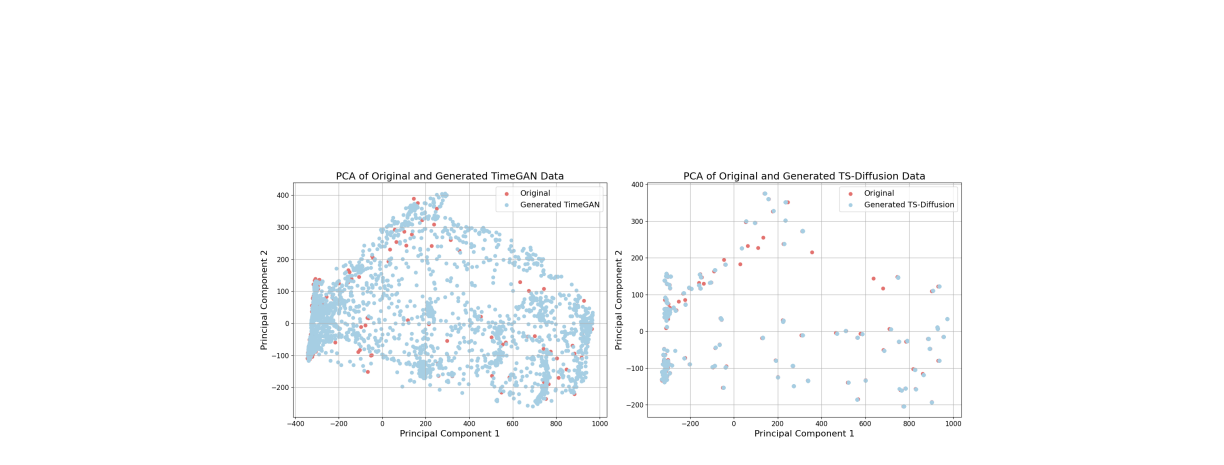
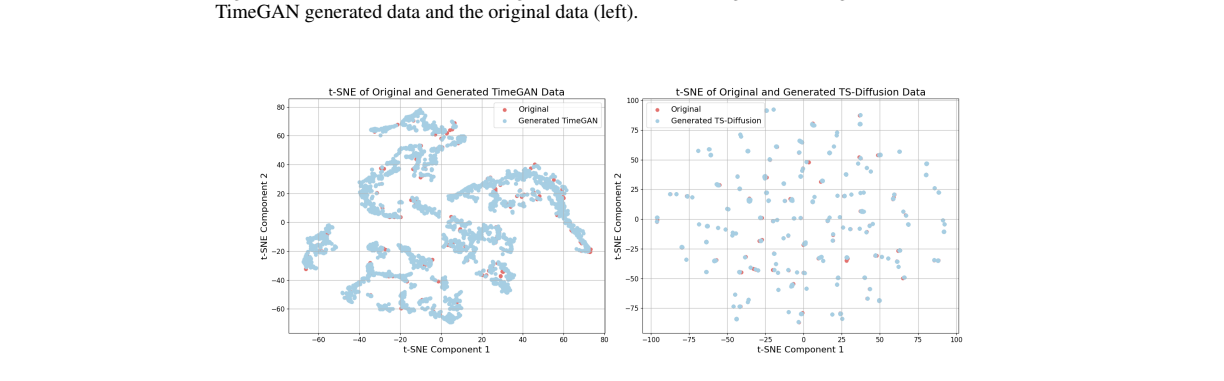
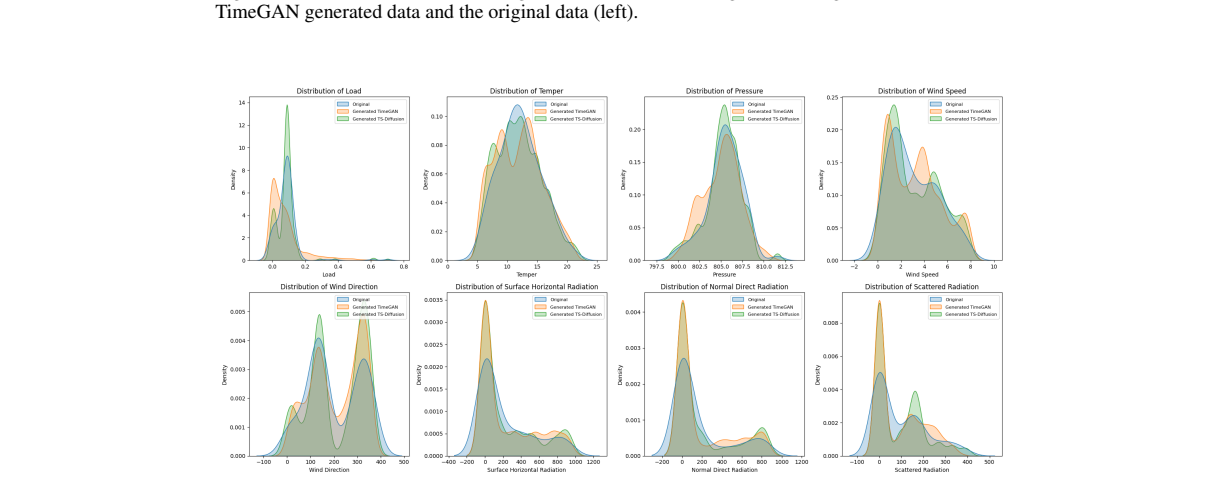
The distribution-quality comparisons (PCA, t-SNE, KDE, Table 4) are descriptive. Quantitative distribution distance metrics on held-out generated samples, such as Wasserstein distance, would strengthen the claim that TS-Diffusion matches the original distribution better than TimeGAN.
The paper says, at Section 3.1
Pith says: minor objection 5 of 5
The leakage-prevention bullet states 'only the training set is used to establish the GAN model,' but the augmentation is also performed with TS-Diffusion; the sentence should refer to both generative models.
What would settle it
Carry out a rolling-origin temporal cross-validation on the same data (or preferably several households/months): train on each 134-hour block and test on the following 34 hours for all non-overlapping weeks, repeating each generative model with 10 random seeds. Report mean±std RMSE/MAE for original, replicated, and augmented training sets. If the TS-Diffusion advantage over the original data is no longer ~200x (or overlaps with TimeGAN) across folds, the single-split result in Table 1 does not support the central claim. As a secondary check, compute nearest-neighbor distances from the 34 test points to the augmented training set; near-zero distances would confirm memorization.
from the skeptic's reading
How the review went
4 readings by deepseek-v4-flash · 11 Aug 2026
- Reader holds up, with conditions
- Skeptic partly agrees
- Editor wrote the verdict above
- Referee major revision: 4 major objections, 5 minor
Not run on this paper: the simulated authors' defence.
Pith did not check this review's objections against the paper.
The review in full
The review in brief, machine-written
Plain take: this is a legitimate but thinly evidenced application of an existing diffusion model (TS-Diffusion) to load-data augmentation for power forecasting. The paper ships code and data, and the core question — whether generative augmentation helps when load history is short — is worth asking. The answer it gives is plausible but not established: the 200x improvement is a single-split, single-run point estimate from one household, one week.
What is new: applying TS-Diffusion to load augmentation and benchmarking it against TimeGAN across four regressors. The appendix's distribution checks (PCA, t-SNE, KDE, mean/std tables) are a reasonable attempt to characterize generation quality, and the observation that TimeGAN augmentation lowers MAE but raises RMSE — consistent with tail outliers — is genuinely useful. Public code and data are a plus.
Where it is soft: the whole empirical case rests on 168 hourly records from one household in one week. The 34-hour test block comes from the same week as the 134 training hours, so diurnal and weather patterns in the test set are already densely represented in training. A diffusion model can memorize a small repetitive series, and ExtraTree is well suited to interpolate such a manifold; RMSE 0.00023 against a load standard deviation of about 0.08 is close to memorization territory. The best regressor is selected on the test set before the '200 times' comparison is computed, which is a mild selection circularity. There are no repeated splits, no seeds, no error bars. The authors' own limitation statement — the trained model may not transfer to neighboring regions — is honest but does not address the within-week autocorrelation issue. Separately, the reference list is mismatched with the in-text citations around TimeGAN and the diffusion model; that must be corrected.
Who it is for: practitioners wanting a quick demonstration of diffusion-based augmentation in small-sample load forecasting, and workshop readers comfortable treating a single case study as a proof of concept rather than a measured claim.
Recommendation: send it to peer review. The idea is worth referee time, but expect heavy revision: repeated splits, multiple seeds, error bars, and ideally more households or weeks before the 200x figure is reported as a result. I would not cite that figure in my own work as it stands.
The strongest objection
Section 2.1 uses one 168-hour household series (April 16-22, 2024); Section 3.1 applies an 8:2 split (134 train/34 test), augments the 134 points to 3456, and trains each regressor once. Table 1 shows ExtraTree RMSE 0.00023 vs 0.04467 on original data, an ~190x reduction the abstract calls 'about 200 times.' A 168-hour week has strong diurnal and day-of-week periodicities; the 34-hour test block comes from the same week as the training block, so hour-of-day patterns are already densely represented in training. TS-Diffusion can memorize or interpolate these repetitive patterns, and ExtraTree can then match test points by nearest-neighbor in feature space without learning a generalizable relationship. No repeated splits, no multiple seeds, and no error bars are reported, and the best model is selected on the test set. The '200x' result is therefore a single point estimate that may be an artifact of within-week autocorrelation and memorization rather than a true benefit of diffusion-based augmentation.
The reader's weakest assumption identifies the lack of representativeness from a single week/split. My concern is more specific: the near-perfect test errors may be produced by the test block sharing the same weekly periodicity as the training block, so the diffusion model can generate synthetic points that effectively cover the test patterns, and the downstream regressor can memorize rather than generalize. This would make the reported 200x improvement an evaluation artifact, not a robust property of the method. The paper does provide code/data and some distributional analysis (PCA, t-SNE, KDE) showing the generated data overlaps the original data, which is useful supporting evidence for generation quality, but it does not address predictive generalization beyond one split. The proposed rolling-origin cross-validation is a direct way to test whether the improvement persists when the test block is truly temporally separated from training. Given the current evidence, the central claim should remain conditional until such an evaluation is done.
The referee's report
If the reported result were robust, the paper would be practically significant: it would show that diffusion-based augmentation can rescue ML load forecasting when only a week of data is available, and the replication baseline used in Table 1 is a sensible control that guards against the trivial explanation of simply adding copies of the training data. The authors also provide a public code/data URL and complement forecast metrics with distribution-level diagnostics (PCA, t-SNE, KDE, and summary statistics in Table 4). However, the central claim is currently supported by a single run on a single split of a single week, with no error bars, no repeated seeds, no cross-validation, and test-set model selection. The near-zero errors are plausible artifacts of the short, highly autocorrelated series rather than evidence of a generalizable forecasting improvement. As written, the paper is more of a limited case study than a demonstrated method.
Pith's reading of the paper (a machine's summary, not the authors')
Load forecasting under small samples is a real operational problem: new communities, meter failures, and communication outages leave too little history for machine-learning models. This paper proposes a two-step remedy: train a diffusion-based generator (TS-Diffusion) on the small real dataset, expand it from 134 to 3,456 synthetic hours, and then train standard regressors on the augmented data. Across XGBoost, CatBoost, RandomForest, and ExtraTree, the augmented dataset improves test RMSE and MAE over both the original data and a simply replicated version, with ExtraTree reaching RMSE 0.00023 and MAE 0.00004. The paper also reports that this diffusion-based augmentation beats the GAN baseline TimeGAN by roughly 200-fold and that the generated distribution aligns with the original in PCA, t-SNE, KDE, and moment statistics. If the result holds beyond the single test week, generative augmentation could make load forecasting viable where data is scarce.
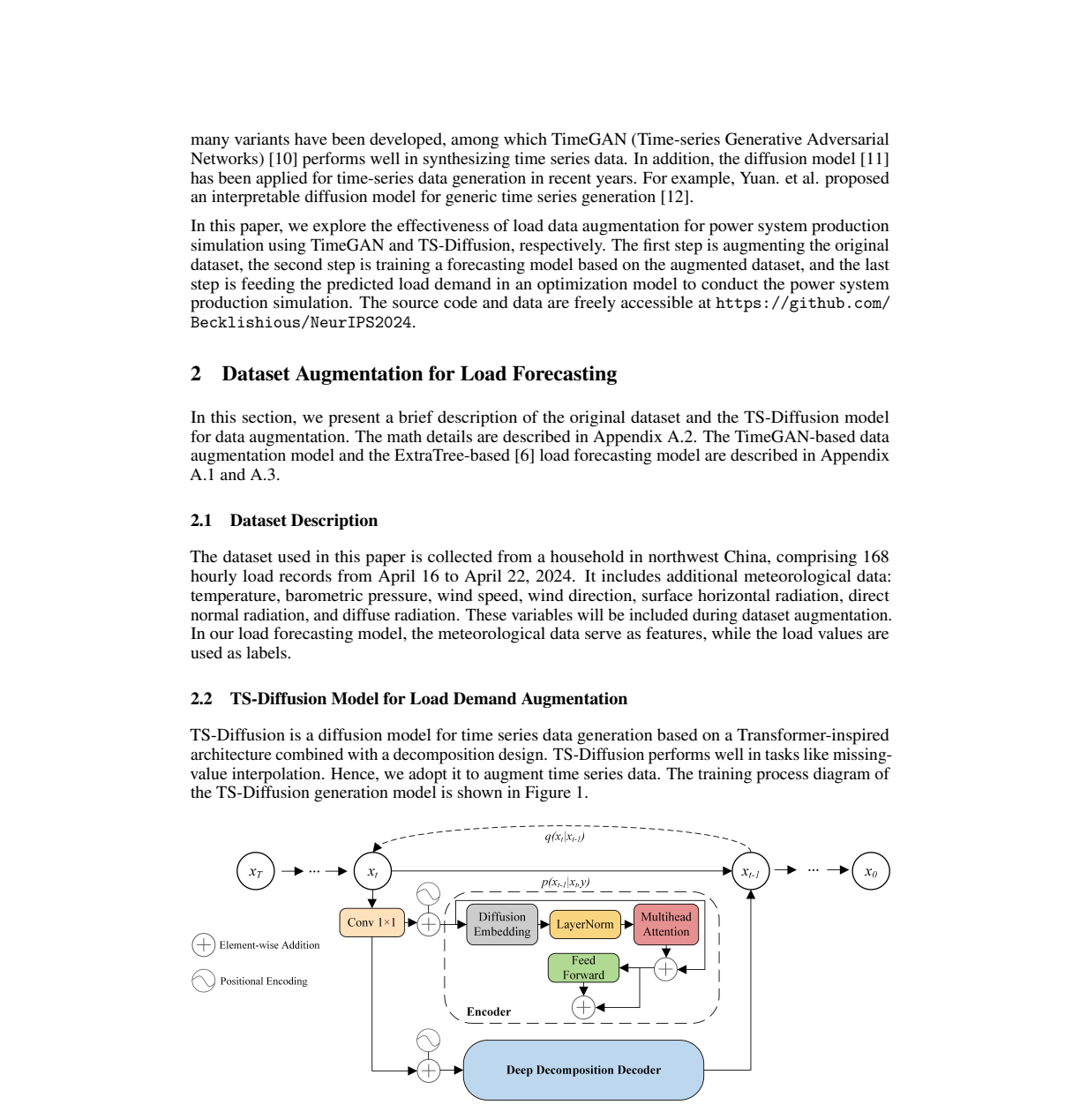
What carries the argument. The central object is TS-Diffusion, a Transformer-based conditional diffusion model for time series. It runs a forward noising process $q(x_t|x_{t-1}) = \mathcal{N}(x_t; \sqrt{1-\beta_t}x_{t-1}, \beta_t I)$ and learns a reverse denoising process $p_\theta(x_{t-1}|x_t)$; training minimizes a weighted reconstruction loss $L_\theta = \mathbb{E}_{t,x_0}[w_t(\lambda_1\|x_0-\hat{x}_0(\cdot)\|^2 + \lambda_2\|FFT(x_0)-FFT(\hat{x}_0(\cdot))\|^2)]$. The deep decomposition design captures trend and seasonality, while the Fourier-domain term forces fidelity across frequencies. This is what lets the model generate 3,456 samples from 134 real hours while preserving the original distribution's position and shape, and it is the mechanism the paper credits for the large error reduction.
Core claim. On its own terms, the paper's finding is that generative augmentation works when the generator is a diffusion model: after TS-Diffusion expands the 134-hour training set to 3,456 synthetic samples, every tested regressor improves over both the original training set and a simply replicated version, and the best model (ExtraTree) reaches RMSE 0.00023 and MAE 0.00004 on the held-out 34 hours. The same procedure with TimeGAN produces a dataset whose predictions are worse in RMSE than the original-data baseline, and roughly 200 times larger errors in the ExtraTree comparison. The paper interprets the gap as alignment: PCA and t-SNE show TS-Diffusion samples overlapping the original distribution much more closely than TimeGAN samples, while KDE and moment tables show the diffusion model still introduces diversity rather than copying.
The premise it rests on. The entire comparison assumes one household's single week of 168 hourly records, split 134/34, is representative enough that error reductions measured on those 34 hours generalize to other load data.
If the paper is right (Pith's inferences, not the authors')
Four regressors (XGBoost, CatBoost, RandomForest, ExtraTree) all improve when trained on the TS-Diffusion-augmented dataset, whereas simple replication alone does not.
The best model, ExtraTree, forecasts the held-out 34 hours with RMSE 0.00023 and MAE 0.00004, a level that makes the synthetic dataset effectively a drop-in replacement for larger historical records.
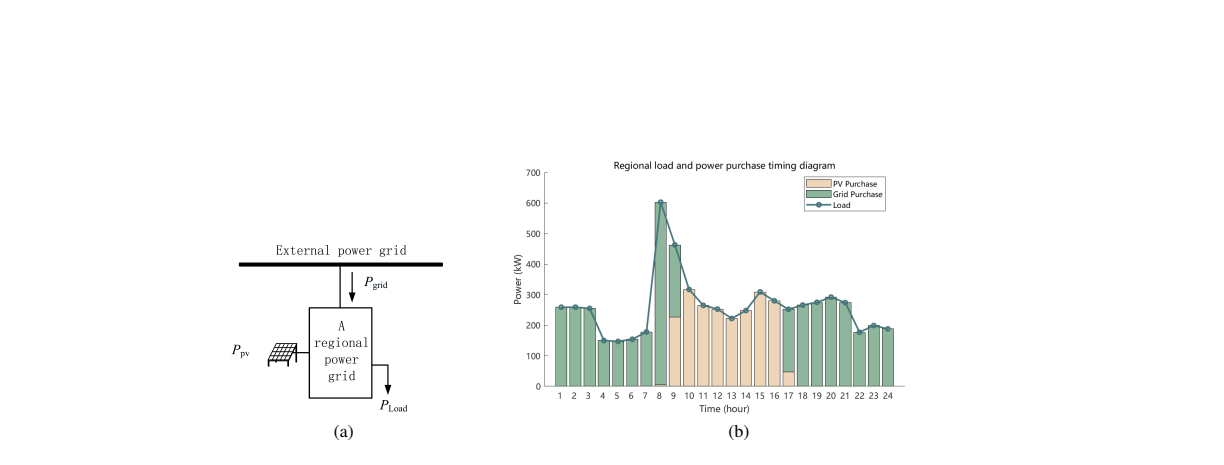
The augmented data can be plugged into a standard 24-hour production-simulation optimization; the showcase simulation schedules zero grid purchase in midday PV hours.
Diffusion-generated samples retain the original distribution's mean and standard deviation while not simply copying it, so the augmentation adds diversity rather than memorization.
Compared to TimeGAN augmentation, TS-Diffusion's latent-distribution overlap (PCA and t-SNE) is far better, explaining the roughly 200-fold smaller errors.
An implicit consequence, not stated in the paper: if diffusion augmentation works for one week of load, the same pipeline could be applied to other small-sample operating data such as PV output, electricity price, or EV charging profiles, wherever the underlying series has learnable temporal structure.
The near-zero test numbers should be checked against the strong autocorrelation of hourly load and the 34-hour test horizon; a stress test across seasons, households, or missing-data regimes would show whether the 200-fold claim survives distribution shift.
A cheap baseline would be adding noise or interpolating between real points; if simple perturbation matches the diffusion gains, the alignment mechanism the paper emphasizes would need refinement.
Check this review
Pith stored no record of this review's passes and took no fingerprint of it. Reviews made by code from 13 Nov 2026 on carry both.
How often reviews like this one are right
Reviews like this one: written by deepseek-v4-flash, where what was read was not recorded.
How often objections from reviews like this one are right: not yet measured
Reviews by people
This review was written by a machine. No person has reviewed this paper on Pith yet. A scientist listed on Pith can review it for a fee, and their review is published here whatever it concludes.
The paper
Abstract
As a key component of power system production simulation, load forecasting is critical for the stable operation of power systems. Machine learning methods prevail in this field. However, the limited training data can be a challenge. This paper proposes a generative model-assisted approach for load forecasting under small sample scenarios, consisting of two steps: expanding the dataset using a diffusion-based generative model and then training various machine learning regressors on the augmented dataset to identify the best performer. The expanded dataset significantly reduces forecasting errors compared to the original dataset, and the diffusion model outperforms the generative adversarial model by achieving about 200 times smaller errors and better alignment in latent data distributions.
The paper's own sentences, arranged, kept beside the review and separate from it. Each label is drawn from a closed vocabulary; the number beside it is the probability the classifier gave that label. No sentence in this record was written by a model.
abstract compiled · 2026-09-23
The authors' main claim, as the classifier picked it out 1.00
“The expanded dataset significantly reduces forecasting errors compared to the original dataset, and the diffusion model outperforms the generative adversarial model by achieving about 200 times smaller errors and better alignment in latent data distributions.”
How the main claim is stated: asserted 1.00
What the abstract itself states, as probabilities: claims first 0.03 · states limitation 0.18 · human participants 0.02 · controlled comparison 0.89 · randomized assignment 0.01 · states quantitative result 0.98 · compares with prior results 0.93 · mentions code or data availability 0.03
The abstract, sentence by sentence
This table labels the abstract only (arXiv listing abstract v1). The number is the probability the classifier gave the label.
| Sentence | Role | The authors' own work | States the main conclusion | Strength |
|---|---|---|---|---|
| As a key component of power system production simulation, load forecasting is critical for the stable operation of power systems. | background 1.00 | 0.05 | 0.02 | asserted 1.00 |
| Machine learning methods prevail in this field. | background 1.00 | 0.05 | 0.02 | asserted 1.00 |
| However, the limited training data can be a challenge. | gap 0.68 | 0.07 | 0.02 | asserted 0.59 |
| This paper proposes a generative model-assisted approach for load forecasting under small sample scenarios, consisting of two steps: expanding the dataset using a diffusion-based generative model and then training various machine learning regressors on the augmented dataset to identify the best performer. | method 0.71 | 0.89 | 0.15 | asserted 0.99 |
| The expanded dataset significantly reduces forecasting errors compared to the original dataset, and the diffusion model outperforms the generative adversarial model by achieving about 200 times smaller errors and better alignment in latent data distributions. | result 1.00 | 0.92 | 0.82 | asserted 1.00 |
What kind of paper the classifier reports this is: method or tool 1.00 · evidence from simulation or computation 0.72
What was examined, and what was not
Sources read
- arXiv listing abstract v1
Not examined
- full text
- figures and tables
- references and citing sentences
- relations to other papers
Levels run
- P abstract
Not run
- S sections
- T body sentences
- C citations
- R cross-paper relations
How the labels were made
Compiled by classifier-1.13.0 via TypeSafe API, question bank abstract-p1-20260923, 2026-09-23: 1 request, 4,214 input tokens.
Every quoted sentence on this record is the authors'. Every label is from Pith's closed vocabulary, with the probability shown beside it. This record as JSON
Figures (7)
Figures are the authors', reproduced from the paper.
References (12)
- [1] Zhang, Y . H., Qiu, C. M., He, X., Ling, Z. N., & Shi, X. (2017). A short-term load forecasting based on LSTM neural network. Electric power information and communication technology , 15(9), 19-25 on Pith
- [2] Kong, W., Dong, Z. Y ., Jia, Y ., Hill, D. J., Xu, Y ., & Zhang, Y . (2017). Short-term residential load forecasting based on LSTM recurrent neural network. IEEE transactions on smart grid , 10(1), 841-851 on Pith
- [3] Dudek, G. (2015). Short-term load forecasting using random forests. In Intelligent Systems’ 2014: Pro- ceedings of the 7th IEEE International Conference Intelligent Systems IS’2014 , September 24-26, 2014, Warsaw, Poland, V olume 2: Tools, Architectures, Systems, Applications ... on Pith
- [4] Liu, S., Cui, Y ., Ma, Y ., & Liu, P. (2018, October). Short-term load forecasting based on GBDT combinatorial optimization. In 2018 2nd IEEE conference on energy internet and energy system integration (EI2) (pp. 1-5). IEEE on Pith
- [5] Prokhorenkova, L., Gusev, G., V orobev, A., Dorogush, A. V ., & Gulin, A. (2018). CatBoost: unbiased boosting with categorical features. Advances in neural information processing systems , 31 on Pith
- [6] Geurts, P., Ernst, D., & Wehenkel, L. (2006). Extremely randomized trees. Machine learning, 63, 3-42 on Pith
- [7] A. Waheed, M. Goyal, D. Gupta, A. Khanna, F. Al-Turjman and P. R. Pinheiro.(2020), CovidGAN: Data Augmentation Using Auxiliary Classifier GAN for Improved Covid-19 Detection, in IEEE Access, vol. 8, pp. 91916-91923 on Pith
- [8] W. Li et al.(2023), DLS-GAN: Generative Adversarial Nets for Defect Location Sensitive Data Augmenta- tion, in IEEE Transactions on Automation Science and Engineering on Pith
- [9] J. -H. Kim and Y . Hwang(2022), "GAN-Based Synthetic Data Augmentation for Infrared Small Target Detection," in IEEE Transactions on Geoscience and Remote Sensing, vol. 60, pp. 1-12, 2022, Art no. 5002512 on Pith
- [10] Tan, M., Liao, C., Chen, J., Cao, Y ., Wang, R., & Su, Y . (2023). A multi-task learning method for multi-energy load forecasting based on synthesis correlation analysis and load participation factor. Applied Energy, 343, 121177 on Pith
- [11] Goodfellow, I., Pouget-Abadie, J., Mirza, M., Xu, B., Warde-Farley, D., Ozair, S., ... & Bengio, Y . (2020). Generative adversarial networks. Communications of the ACM, 63(11), 139-144 on Pith
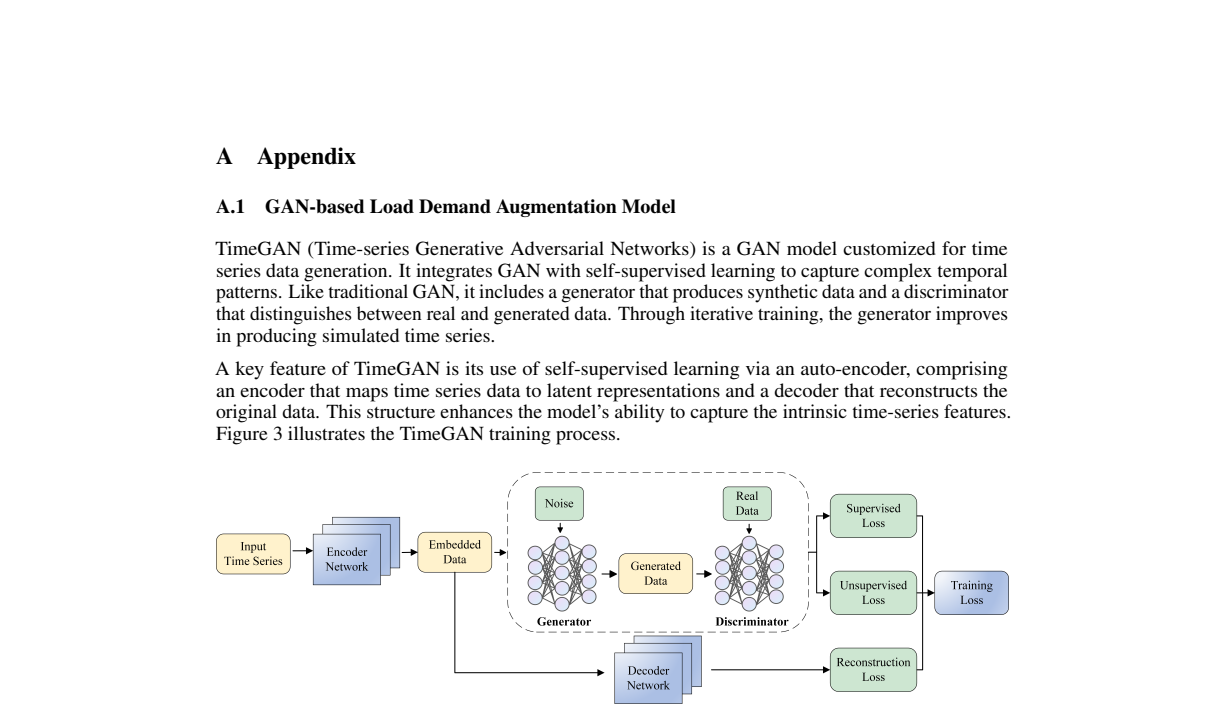
- [12] Yoon, J., Jarrett, D., & Van der Schaar, M. (2019). Time-series generative adversarial networks. Advances in neural information processing systems , 32. 5 A Appendix A.1 GAN-based Load Demand Augmentation Model TimeGAN (Time-series Generative Adversarial Networks) is a GAN mod... on Pith
Challenges and discussion
Disagree with the review, or know something it missed? Leave a comment, or challenge this review formally: a challenge becomes a permanent entry in this paper's record, and its decision is published here.
Come back by email
A short list of the week's newly reviewed papers. Nothing is sent until you confirm from your inbox, and every email has a link that stops it. No account.
No comments yet.
Sign in to comment