REVIEW 3 major objections 4 minor 2 cited by
Gauge-Fermion Cartography: from confinement and chiral symmetry breaking to conformality
T0 review · 3 major / 4 minor · reviewed 2026-08-11 · deepseek-v4-flash
Pith's one-line read Using a simplified functional-RG scheme, the paper tracks confinement and chiral symmetry breaking across flavour number, finds a new 'locking' regime, and pins the conformal-window boundary at $N_f^{\rm crit}(N_c=3)=9.60^{+0.55}_{-0.53}$…
desk verdict A serious, readable fRG study of the Nf–Nc plane; the headline Nf^crit = 9.60 is a genuine first-principles estimate, but it leans on an acknowledged heuristic in the gauge sector that likely makes the error bars optimistic. read the letter →
The pith
A machine-rendered reading of the paper's core claim, the machinery that carries it, and where it could break.
The reading
What carries the argument
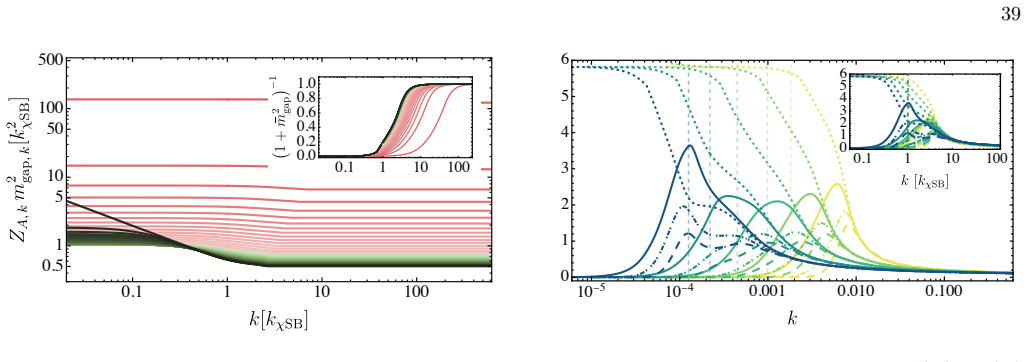
The load-bearing identity is the conformal-window condition $\alpha^{\rm crit}_{\chi\rm SB}=\alpha_*^g$, with $\alpha^{\rm crit}_{\chi\rm SB}$ the gauge coupling at which the $\beta$ function of the scalar-pseudoscalar four-fermion coupling becomes everywhere negative (the merging of the Nambu-Jona-Lasinio-type fixed points), and $\alpha_*^g$ the infrared Caswell-Banks-Zaks fixed-point coupling. It is carried by a novel fRG expansion in which the Landau-gauge gluon propagator is replaced, inside loop diagrams, by a momentum-independent wave function $Z_A$ and a confining mass gap $m_{\rm gap}$, whose flow is fixed by a bootstrap condition requiring the gluon dressing to reach the confining infrared scaling. On the matter side, the resonant scalar-pseudoscalar channel is bosonised into meson fields (the emergent-composite / dynamical-hadronisation formalism), which captures multi-scattering fermionic interactions in the chiral potential. The two dynamical scales are read off as proxies---the peak of the gluon dressing for $k_{\rm conf}$, and the onset of the chiral condensate for $k_{\chi\rm SB}$---and their ratio $k_{\rm conf}/k_{\chi\rm SB}(N_f)$ is the quantity that exhibits the three regimes.
What would settle it
Measure the gluon mass-gap scale (the peak of the gluon dressing) on the lattice for $SU(3)$ with $N_f=5$ and $N_f=6$ massless flavours in the chiral limit: the paper predicts $k_{\rm conf}\approx k_{\chi\rm SB}$ there, so a clear deviation would falsify the $N_f=3$ mass-gap flow assumption. A lattice determination of whether $SU(3)$ with $N_f=9$ or $N_f=10$ is conformal in the chiral limit would test the boundary $9.60^{+0.55}_{-0.53}$.
Extended reading notes
Core claim
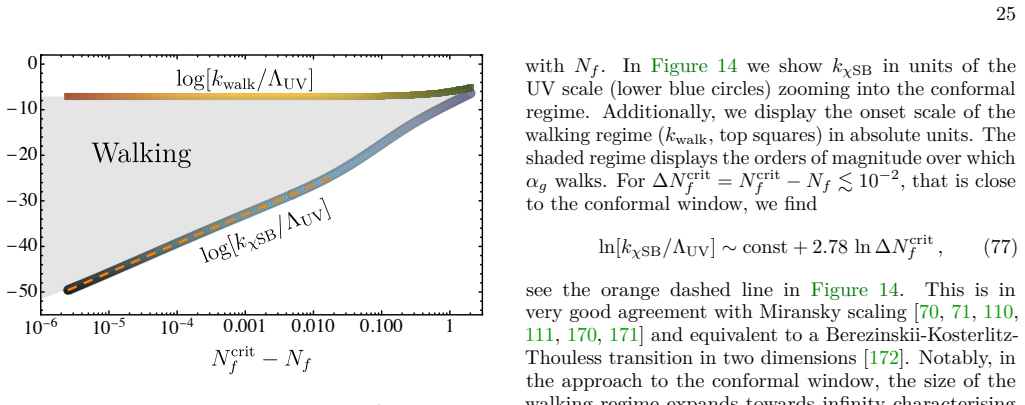
The paper claims that the flavour dependence of gauge-fermion dynamics organises itself into three regimes, and that the boundary of the conformal window can be computed rather than guessed. In the QCD-like regime ($N_f\lesssim4$) the confinement scale is moderately larger than the chiral symmetry-breaking scale; in the newly discovered locking regime ($5\lesssim N_f\lesssim7$) the two scales nearly coincide, $k_{\rm conf}/k_{\chi\rm SB}\approx1$; and for $8\lesssim N_f<N_f^{\rm crit}$ a walking regime sets in with an exponential decay of the ratio and Miransky-type scaling of the chiral scale as the critical flavour number is approached. The boundary itself is obtained from the condition $\alpha^{\rm crit}_{\chi\rm SB}=\alpha_*^g$, where the left-hand side is the minimum gauge coupling at which chiral symmetry breaking becomes inevitable in the emergent-composite fRG, and the right-hand side is the infrared Caswell-Banks-Zaks fixed-point coupling taken from high-loop MS $\beta$ functions. The result is $N_f^{\rm crit}(N_c=3)=9.60^{+0.55}_{-0.53}$, and the same machinery provides the boundary curve $N_f^{\rm crit}(N_c)$ across colours.
Load-bearing premise
The paper assumes that the flavour dependence of the confining gluon mass-gap flow is negligible, so it uses the three-flavour flow for every flavour number, capping fermionic contributions at $N_f=N_c$; if the true mass-gap flow depends more strongly on flavour, the locking regime and the conformal-window boundary would shift.
Editorial extensions
If this is right
- For flavour numbers $5\lesssim N_f\lesssim7$, confinement and chiral symmetry breaking must be treated as a single coupled phenomenon rather than sequential ones; composite-Higgs or technicolour models in this region inherit that locking.
- In the walking regime ($8\lesssim N_f<N_f^{\rm crit}$), glueballs are predicted to become increasingly light compared with mesons and baryons as the conformal window is approached, since $k_{\rm conf}$ is exponentially smaller than $k_{\chi\rm SB}$.
- The conformal-window boundary $N_f^{\rm crit}(N_c=3)=9.60^{+0.55}_{-0.53}$ is a concrete lattice target: $SU(3)$ with ten massless flavours should be conformal, while nine flavours should show walking with chiral symmetry breaking.
- The same computation maps the boundary $N_f^{\rm crit}(N_c)$ for other numbers of colours, turning the conformal window into a computed curve in the $(N_f,N_c)$ plane.
- Close to the boundary, the size of the walking regime grows as $\ln(k_{\chi\rm SB}/\Lambda)\sim 2.78\,\ln(N_f^{\rm crit}-N_f)$, giving a quantitative, first-principles handle on how many orders of magnitude of walking a near-conformal theory provides.
Reading between the lines
- Editorial inference: the locking regime suggests that at finite temperature, $SU(3)$ with $N_f\approx5$--$7$ should show a single, combined chiral/deconfinement transition; the paper observes a similar locking in two-flavour QCD at finite temperature and notes the analogy, which could be turned into a testable prediction for the $N_f$-dependence of the transition temperatures.
- Editorial inference: because the framework is semi-analytic, its mass-gap bootstrap could be applied to fermions in other representations (adjoint, two-index symmetric), where the conformal window shifts to smaller $N_f/N_c$; the paper does not do this, but nothing in the scheme appears to restrict it to fundamental fermions.
- Editorial inference: the non-perturbative value $|\gamma_m^*|(N_f^{\rm crit})\approx 1.49$ at the boundary is a concrete target for conformal-bootstrap and lattice studies of near-conformal theories at $N_f=9$--$10$, and suggests that perturbative estimates of this quantity should be viewed with caution near the boundary.
Editorial analysis
A structured set of objections, weighed in public.
Referee Report
Summary. The paper develops a functional renormalisation group (fRG) description of SU(Nc) gauge-fermion theories with general flavour number, combining a simplified mass-gap treatment of confinement (Sections IIIB and Appendix C3) with a bosonised chiral sector (Section IIID). It benchmarks the gluon dressing against lattice and quantitative fRG data for Nf=2,3 (Figure 1), then maps kconf/kχSB as a function of Nf, identifying a QCD-like regime (Nf≲4), a novel 'locking' regime (5≲Nf≲7) in which kconf≈kχSB, and a walking regime (8≲Nf<Ncrit) with an exponentially decreasing scale ratio (Figure 11). Using the condition αcrit_χSB=α*g (Eq. 81), the lower boundary of the conformal window is estimated as Ncrit_f(Nc=3)=9.60^{+0.55}_{-0.53} (Eq. 83), with Miransky-type scaling (77) and |γ_m^*|=1.49 at the boundary (84).
Significance. If the central results hold, the paper provides a useful first-principles map of non-perturbative gauge-fermion theory space, connecting lattice-validated QCD dynamics to the conformal window and giving a quantitative crossing point for the onset of conformality. The work deserves credit for grounding the method in lattice data for Nf=2 and 3, for explicit convergence checks in the chiral potential (Figure 28 and Nmax studies), for scanning the onset parameter γconf (Figure 18), and for comparing single-avatar and multi-avatar truncations. The stated error budgets and the detailed appendices make most of the computation reproducible from the written equations. The main obstacle to taking the quantitative claims at face value is the acknowledged heuristic for the flavour dependence of the gluon mass-gap flow, which enters both the confinement scale and the chiral critical coupling; this heuristic is only benchmarked for Nf=2,3 and is not directly tested in the 5≤Nf≤7 locking window that is a central new result.
major comments (3)
- [Section IIIB2 and Appendix C3b (Eqs. C9, C12, C15)] The central result is controlled by a flavour-dependence heuristic that is not benchmarked in the relevant range. In Eq. (C9) the explicit fermionic contribution to the mass-gap flow is evaluated with the Nf=3 flow for all flavours and capped at Nf=Nc, and in Eq. (C15) the flow is switched on only below γconf kconf. Since kconf is then read off from the same flow via Eq. (37), the locking plateau kconf/kχSB≈1 in Fig. 11 for 5≤Nf≤7 is computed with the flavour dependence of the confinement scale suppressed by construction. The direct benchmark in Fig. 1 covers Nf=2,3 only, and for Nf=2 the agreement is only semi-quantitative in the deep IR. The same mgap appears in the gluon threshold of the chiral-potential flow (C19), so αcrit_χSB and hence the boundary condition (81) leading to Eq. (83) inherit this uncertainty. I would like the revision to include explicitly uncapped Nf-dependence runs (at least Nf=4,6,8,10) with two regulator choices and a report of how kconf, kconf/kχSB, and Ncrit move. If they move by more than the quoted errors, the error bars in (83) and the existence of the locking regime need to be revised accordingly.
- [Section VIB and Eq. (F1)] The boundary condition (81) compares an fRG-computed αcrit_χSB with a perturbative input α*g from MS beta functions; Eq. (F1) is deliberately constructed so that its UV running reproduces those same beta functions. The result Ncrit=9.60 in (83) is therefore not a fully emergent fRG prediction for the fixed point, but a crossing of a non-perturbative critical coupling with an imported, scheme-dependent fixed point. This is largely stated, but the quoted 10% uncertainty on α*g is justified only by the 3-loop versus 4-loop difference in the MS scheme, which does not quantify scheme dependence at fixed loop order. A cross-check with a second scheme (for example mMOM) or with a resummed beta function is needed before the central number can be claimed as a quantitative first-principles estimate.
- [Section VB and Appendix F3 (Figs. 11, 12, 23)] The locking regime is the paper's most novel qualitative claim, but the evidence is currently confined to the single-avatar truncation. The multi-avatar results in Fig. 23 stop at Nf=5, and Fig. 12 shows absolute scales for both truncations rather than the ratio kconf/kχSB itself. Since the text explicitly says that the confined and chiral dynamics are fully intertwined and only semi-quantitative in this window, the revision should either present the single-avatar versus multi-avatar ratio through Nf=7 or state plainly that the locking regime is a prediction of the single-avatar scheme pending confirmation.
minor comments (4)
- [Section IIB] In the sentence before Eq. (12), 'qauge-fermion systems' should read 'gauge-fermion systems'.
- [Section IIID2, around Eq. (59)] The text says 'Together with kconf in (59)', but (59) defines kχSB; the confinement scale kconf is defined in Eq. (37).
- [Section IIIB2, paragraph after Eq. (C15) discussion] The phrase 'allows use to still use the flat regulators' should read 'allows us to still use the flat regulators'.
- [Section IIA4, discussion around Eq. (7)] Equation (7), together with the ultraviolet decay of the dressing, guarantees at least one maximum of p^2G_A(p), not its uniqueness; the proxy ppeak in (10) is a good working definition, but the wording should not imply that (7) alone selects the peak.
Circularity Check
No significant circularity: the conformal-window boundary follows from an independent fRG chiral critical coupling matched to a perturbative fixed point, and the mass-gap approximations are explicit, benchmarked heuristics rather than hidden fits.
full rationale
The main result, Ncrit_f(Nc=3)=9.60+0.55-0.53, is obtained from the physical criterion αcrit_χSB = α*_g (Eq. 81). The left-hand side is computed in the emergent-composites fRG from the bosonised chiral potential (up to Nmax=5) and is not fitted to the fixed point; the right-hand side is taken from four-loop MS results with a stated 10% scheme error. These two quantities are not equal by construction, and their crossing in Nf is a non-trivial result. The many-flavour gauge flow (F1) is indeed seeded with perturbative MS beta functions, but it is used to generate the running coupling and thresholds, not to define αcrit_χSB; the boundary condition remains a dynamical statement about chiral symmetry breaking rather than a restatement of the input beta function. Similarly, the heuristic replacement of the flavour-dependent mass-gap flow by the Nf=3 flow (Section IIIB2 and App. C3) is an explicitly acknowledged approximation, not a fitted parameter disguised as a prediction; kconf and kχSB are separately computed, and the locking ratio kconf/kχSB≈1 is a consequence of the dynamics in the chiral sector as much as of the chosen glue-sector input. Self-citations to earlier fRG bootstrap and Schwinger-mechanism work are supported by independent lattice benchmarks for Nf=2,3 and are not used as unverified uniqueness theorems. The principal limitations (momentum-dependent vertices, mSTI artefacts, extrapolation of the mass-gap flavour dependence) are stated in the text and enter the error estimates, but they constitute systematic-uncertainty concerns rather than circular reasoning.
Assumptions & free parameters
free parameters (3)
- Onset scale for confining mass-gap flow =
alphaApsi psi = 1.5
- Fermionic contribution cap Nf to Nc in mass-gap flow =
Nf = Nc for Nf > Nc
- gamma_conf factor for onset of mass-gap scaling =
1 <= gamma_conf <= 2
assumptions (4)
- domain assumption Existence of a BRST charge and Kugo-Ojima IR scaling uniquely fixes the confining mass-gap initial condition (Eq. 30).
- domain assumption The flavour dependence of the confining mass gap is universally small, so the Nf = 3 mass-gap flow is used for all Nf.
- domain assumption Perturbative four-loop MS beta functions can be injected into the fRG gauge flow despite a scheme mismatch and possible double counting.
- domain assumption Truncated effective action with only the classical fermion-gauge tensor structure and a Fierz-complete set of momentum-independent four-Fermi operators is sufficient.
Cite this review
Pith. "Pith review of Gauge-Fermion Cartography: from confinement and chiral symmetry breaking to conformality." pith.science (2026). https://pith.science/paper/R4OP7PLE
@misc{pith2026241212254,
  author       = {Pith},
  title        = {Pith review of: Gauge-Fermion Cartography: from confinement and chiral symmetry breaking to conformality},
  year         = {2026},
  howpublished = {\url{https://pith.science/paper/R4OP7PLE}},
  note         = {Machine review of arXiv:2412.12254}
}
abstract
We study, for the first time, the interplay between colour-confining and chiral symmetry-breaking dynamics in gauge-fermion systems with a general number of flavours and colours. Specifically, we work out the flavour dependence of the confinement and chiral symmetry breaking scales. We connect the QCD-like regime, in quantitative agreement with lattice data, with the perturbative conformal limit, thereby exploring uncharted region of theory space. This analysis is done within the first-principles functional renormalisation group approach to gauge-fermion systems and is facilitated by a novel approximation scheme introduced here. This novel scheme enables a relatively simple access to the confining dynamics. This allows us to investigate the whole landscape of many-flavour theories and to provide a cartography of their phase structure. In particular, we uncover a novel phase with the locking of confining and chiral dynamics at intermediate flavour numbers. We also explore the close-conformal region that displays a walking behaviour. Finally, we provide a quantitative estimate for the lower boundary of the conformal Caswell-Banks-Zaks window, with a $N^{\rm crit}_f(N_c=3)= 9.60^{+0.55}_{-0.53}$. This work offers a self-consistent framework for charting the landscape of strongly interacting gauge-fermion theories necessary to reliably study strongly coupled extensions of the Standard Model of particle physics.
Figures


Figures from the paper (21 more)








Forward citations
Cited by 2 Pith papers
-
To Break or Not to Break: A Review of a No-Go Theorem on Chiral Symmetry Breaking in QCD-like Theories
A review showing that if a QCD-like theory with enough massless flavors is fully color-screened in the infrared, then chiral symmetry must be spontaneously broken.
-
A beginner's guide to functional methods in particle physics
A pedagogical review showing how Dyson-Schwinger, 3PI, and Bethe-Salpeter equations can be chained together to compute glueball masses in pure Yang-Mills theory, matching lattice QCD.
Reference graph
Works this paper leans on
-
[1]
(C2) In this work we obtain a system of anomalous dimensions including ηA, ηc, ηψ, ηπ and ησ
Anomalous dimensions The anomalous dimensions of any componentφ = Φi of the superfield (20), ηφ =−∂tZφ,k Zφ,k (C1) have been derived from the respective two-point functions by applying the suitable projection, ∂tZφ,k = ∂p2∂tΓ(φφ) k (p2) ⏐⏐⏐ p=0 . (C2) In this work we obtain a system of anomalous dimensions including ηA, ηc, ηψ, ηπ and ησ. Its resolution i...
-
[2]
Flow of the gauge avatars In (38) and (41) we have defined the exchange couplings for each of the gauge avatars of the effective action. The flow for the fermion-gauge coupling reads ∂tλA ¯ψψ = (1 2ηA +ηψ ) λA ¯ψψ + 1 Z1/2 A Zψ tr [ P(A ¯ψψ)∂tΓ(A ¯ψψ) k ] tr [( P(A ¯ψψ))2] ⏐⏐⏐⏐⏐⏐ p=0 , (C3) Here,P(A ¯ψψ) = iγµδa1a2Tij is the projection operator carrying t...
-
[3]
Flow of the gauge two-point function In covariant gauges confinement is carried by the mass gap in the gauge propagator as explained in Sections IIA and IIIB. One of the novel achievements in this work is the inclusion of the confining mass gap in a rather simple and semi-analytical manner, enabled by an appropriate parametrisation and approximation of th...
-
[4]
Flow of the four-Fermi couplings Part of the high-order correlations of the full effective action are carried by the four-Fermi interactions which are accounted for in the Fierz complete basis in (42). The flow of the respective dimensionless RG-invariant couplings ¯λj =λjk2 can be obtained by adequately projections of the flow of the fermionic four-point...
-
[5]
Multi- avatar: Enhanced
Flows of the bosonised sector In this Appendix, we discuss the derivation of the flow equations for the Yukawa couplinghϕ between fermions and mesons, as well as the chiral effective potential. Com- bined with the meson kinetic term, these flows gener- ate higher-order fermionic self-interactions in the scalar- pseudoscalar channel; see Section IIID. If u...
-
[6]
The scaling solu- tion is uniquely defined by the scaling of correlation functions as explained in Section IIA
Scaling solution: it is given by the left-most point (black) in the left panel of Figure 20 and the trajec- tories are displayed in the right panel of the same Figure as well as in Figure 7. The scaling solu- tion is uniquely defined by the scaling of correlation functions as explained in Section IIA. This is also reflected by the flattening of the gauge-...
-
[7]
For these, the gauge field propagator has a finite limit in the IR
Decoupling regime: when increasing the value of the gluon mass gap in the UV from the scaling one, confining decoupling or massive solutions are found. For these, the gauge field propagator has a finite limit in the IR. This region of equivalent solutions (shaded in light blue) spans until themaximally decouplingsolution. This solution is approximately de...
-
[8]
Within this realm, we identify a critical UV mass (plain grey line) value beyond which dχSB is lost
Massive YM or Higgs regime: For even larger UV masses, we enter a regime where the theory simply is massive YM (shaded orange and red in Figures 20 to 22), or can be understood as an approximation of a gauge-fermion system coupled to a scalar field in the Higgs phase. Within this realm, we identify a critical UV mass (plain grey line) value beyond which d...
Show all 222 references
-
[9]
Multi-avatar results In this Appendix we discuss results within the multi- avatar approximation put forward in Section IV. In Fig- ure 23 we show the gauge-fermion (plain), gauge-ghost (dotted), three-gluon(dashed)andfour-gluon(dotdashed) exchange couplings (see (38) and (41))...
-
[10]
In the conformal and near- conformal limits, the exact Nc-Nf dependence of the gauge beta function is crucial for quantitatively deter- mining the CBZ fixed-point value
Improved single-avatar truncation A precise resolution of the perturbative higher orders of the running coupling is key in the many-flavour limit of gauge-fermion QFTs. In the conformal and near- conformal limits, the exact Nc-Nf dependence of the gauge beta function is crucia...
-
[11]
In this Appendix we discuss the regime of reliability of this truncation as well as provide an error estimate
Error estimate of the many-flavour truncation The single-avatar truncation discussed in the previ- ous Appendix provides a simplified setup to describe the pure gauge and chiral dynamics in a unified manner. In this Appendix we discuss the regime of reliability of this truncat...
-
[12]
Many-flavour scaling of fundamental quantities In this Appendix we provide more results on the de- pendence of fundamental quantities and parameters as a function of the number of flavours. In Figure 24, we show the equivalent to Figure 12 for the constituent fermion massesmψ ...
-
[13]
In con- trast, in this work, we progress by bosonising the (σ−π)) channel while keeping the remaining tensor structures in their original four-Fermi form
Convergence of the truncation The lower boundary of the conformal window was pre- viously estimated using the fRG in [112], employing the four-Fermi language introduced in Section IIIC. In con- trast, in this work, we progress by bosonising the (σ−π)) channel while keeping the...
-
[14]
Moreover, its determination leads to two sources of error in the determination of the critical number of flavours in (83)
Systematics of the boundary For the determination of the boundary of the conformal window we have employed the relation (81) which requires of the determination of the critical coupling fordχSB, αcrit χSB, and the CBZ fixed point,α∗ g as a function ofNc andNf. Moreover, its de...
-
[15]
Deep in the conformal regime,γm≪ 1 and goes to zero at the upper boundary of the conformal window, see Figure 16
γm in the fRG and perturbation theory A common approach employed for the analysis ofdχSB is based on the magnitude of the anomalous dimension γm of the fermion mass in the chiral limit. Deep in the conformal regime,γm≪ 1 and goes to zero at the upper boundary of the conformal ...
- [16]
-
[17]
Chatrchyanet al.(CMS), Phys
S. Chatrchyanet al.(CMS), Phys. Lett.B716, 30 (2012), arXiv:1207.7235 [hep-ex]
2012 arXiv
- [18]
-
[19]
Bai and P
Y. Bai and P. Schwaller, Phys. Rev. D89, 063522 (2014), arXiv:1306.4676 [hep-ph]
2014 arXiv
-
[20]
J. M. Cline, Z. Liu, G. D. Moore, and W. Xue, Phys. Rev. D90, 015023 (2014), arXiv:1312.3325 [hep-ph]
2014 arXiv
- [21]
-
[22]
D. B. Kaplan and H. Georgi, Phys. Lett. B136, 183 (1984)
1984
-
[23]
D. B. Kaplan, H. Georgi, and S. Dimopoulos, Phys. Lett. B136B, 187 (1984). 46
1984
-
[24]
Georgi, D
H. Georgi, D. B. Kaplan, and P. Galison, Phys. Lett. B 143, 152 (1984)
1984
-
[25]
M. J. Dugan, H. Georgi, and D. B. Kaplan, Nucl. Phys. B B254, 299 (1985)
1985
-
[26]
Contino, Y
R. Contino, Y. Nomura, and A. Pomarol, Nucl. Phys. B 671, 148 (2003), arXiv:hep-ph/0306259
2003 arXiv
-
[27]
Agashe, R
K. Agashe, R. Contino, and A. Pomarol, Nucl. Phys. B 719, 165 (2005), arXiv:hep-ph/0412089
2005 arXiv
-
[28]
Susskind, Phys
L. Susskind, Phys. Rev. D20, 2619 (1979)
1979
-
[29]
Weinberg, Phys
S. Weinberg, Phys. Rev. D13, 974 (1976), [Addendum: Phys.Rev.D 19, 1277–1280 (1979)]
1976
-
[30]
R. S. Chivukula, in Les Houches Summer School in Theoretical Physics, Session 68: Probing the Standard Model of Particle Interactions (1998) pp. 1339–1407, arXiv:hep-ph/9803219
1998 arXiv
-
[31]
Susskind, Phys
L. Susskind, Phys. Rept.104, 181 (1984)
1984
-
[32]
C. T. Hill and E. H. Simmons, Phys. Rept.381, 235 (2003), technicolor, arXiv:hep-ph/0203079 [hep-ph]
2003 arXiv
-
[33]
Yamawaki, M
K. Yamawaki, M. Bando, and K.-i. Matumoto, Phys. Rev. Lett.56, 1335 (1986)
1986
-
[34]
Galloway, J
J. Galloway, J. A. Evans, M. A. Luty, and R. A. Tacchi, JHEP 10, 086 (2010), arXiv:1001.1361 [hep-ph]
2010 arXiv
-
[35]
Appelquist and Y
T. Appelquist and Y. Bai, Phys. Rev. D82, 071701 (2010), arXiv:1006.4375 [hep-ph]
2010 arXiv
-
[36]
Belyaev, M
A. Belyaev, M. S. Brown, R. Foadi, and M. T. Frandsen, Phys. Rev. D90, 035012 (2014), arXiv:1309.2097 [hep- ph]
2014 arXiv
-
[37]
Arbey, G
A. Arbey, G. Cacciapaglia, H. Cai, A. Deandrea, S. Le Corre, and F. Sannino, Phys. Rev. D95, 015028 (2017), arXiv:1502.04718 [hep-ph]
2017 arXiv
-
[38]
Cacciapaglia, C
G. Cacciapaglia, C. Pica, and F. Sannino, Phys. Rept. 877, 1 (2020), arXiv:2002.04914 [hep-ph]
2020 arXiv
-
[39]
C. G., D. A., and S. K., Eur. Phys. J. Spec. Top.231, 1221 (2022)
2022
-
[40]
Pastor-Gutiérrez, J
A. Pastor-Gutiérrez, J. M. Pawlowski, and M. Reichert, SciPost Phys.15, 105 (2023), arXiv:2207.09817 [hep-th]
2023 arXiv
- [41]
-
[42]
Dupuis, L
N. Dupuis, L. Canet, A. Eichhorn, W. Metzner, J. M. Pawlowski, M. Tissier, and N. Wschebor, Phys. Rept. 910, 1 (2021), arXiv:2006.04853 [cond-mat.stat-mech]
2021 arXiv
-
[43]
jie Fu, Commun
W. jie Fu, Commun. Theor. Phys.74, 97304 (2022), arXiv:2205.00468 [hep-ph]
2022 arXiv
-
[44]
Ihssen, J
F. Ihssen, J. M. Pawlowski, F. R. Sattler, and N. Wink, (2024), arXiv:2408.08413 [hep-ph]
2024 arXiv
-
[45]
Gies and C
H. Gies and C. Wetterich, Phys.Rev.D65, 065001 (2002), arXiv:hep-th/0107221 [hep-th]
2002 arXiv
-
[46]
J. M. Pawlowski, Annals Phys. 322, 2831 (2007), arXiv:hep-th/0512261 [hep-th]
2007 arXiv
-
[47]
Floerchinger and C
S. Floerchinger and C. Wetterich, Phys.Lett.B680, 371 (2009), arXiv:0905.0915 [hep-th]
2009 arXiv
-
[48]
Kugo and I
T. Kugo and I. Ojima, Prog. Theor. Phys. Suppl.66, 1 (1979)
1979
-
[49]
J. M. Cornwall, Phys. Rev.D26, 1453 (1982), decou- pling
1982
-
[50]
J. M. Pawlowski, C. S. Schneider, J. Turnwald, J. M. Urban, and N. Wink, Phys. Rev. D108, 076018 (2023), arXiv:2212.01113 [hep-ph]
2023 arXiv
-
[51]
M. Q. Huber, C. S. Fischer, and H. Sanchis-Alepuz, Nuovo Cim. C47, 184 (2024), arXiv:2312.12029 [hep- ph]
2024 arXiv
-
[52]
M. Q. Huber, C. S. Fischer, and H. Sanchis-Alepuz, EPJ Web Conf.274, 03016 (2022), arXiv:2211.09131 [hep-ph]
2022 arXiv
-
[53]
C. J. Morningstar and M. J. Peardon, Phys. Rev. D60, 034509 (1999), arXiv:hep-lat/9901004
1999 arXiv
-
[54]
Athenodorou and M
A. Athenodorou and M. Teper, JHEP11, 172 (2020), arXiv:2007.06422 [hep-lat]
2020 arXiv
-
[55]
A. K. Cyrol, M. Mitter, J. M. Pawlowski, and N. Strodthoff, Phys. Rev. D97, 054006 (2018), arXiv:1706.06326 [hep-ph]
2018 arXiv
-
[56]
Sternbeck, K
A. Sternbeck, K. Maltman, M. Muller-Preussker, and L. von Smekal, PoS LATTICE2012, 243 (2012), arXiv:1212.2039 [hep-lat]
2012 arXiv
-
[57]
Zafeiropoulos, P
S. Zafeiropoulos, P. Boucaud, F. De Soto, J. Rodríguez- Quintero, and J. Segovia, Phys. Rev. Lett.122, 162002 (2019), arXiv:1902.08148 [hep-ph]
2019 arXiv
-
[58]
Eichhorn, H
A. Eichhorn, H. Gies, and J. M. Pawlowski, Phys. Rev. D 83, 045014 (2011), [Erratum: Phys.Rev.D 83, 069903 (2011)], arXiv:1010.2153 [hep-ph]
2011 arXiv
-
[59]
Horak, F
J. Horak, F. Ihssen, J. Papavassiliou, J. M. Pawlowski, A. Weber, and C. Wetterich, SciPost Phys.13, 042 (2022), arXiv:2201.09747 [hep-ph]
2022 arXiv
-
[60]
Peláez, U
M. Peláez, U. Reinosa, J. Serreau, M. Tissier, and N. Wschebor, (2024), arXiv:2405.20532 [hep-th]
2024
-
[61]
A. K. Cyrol, J. M. Pawlowski, A. Rothkopf, and N. Wink, SciPost Phys.5, 065 (2018), arXiv:1804.00945 [hep-ph]
2018 arXiv
- [62]
-
[63]
M. N. Ferreira, J. Papavassiliou, J. M. Pawlowski, and N. Wink, (2024), in preparation
2024
-
[64]
Horak, J
J. Horak, J. M. Pawlowski, and N. Wink, (2024), in preparation
2024
-
[65]
A. K. Cyrol, M. Mitter, J. M. Pawlowski, and N. Strodthoff, Phys. Rev. D 97, 054015 (2018), arXiv:1708.03482 [hep-ph]
2018 arXiv
-
[66]
D. J. Gross, R. D. Pisarski, and L. G. Yaffe, Rev.Mod.Phys. 53, 43 (1981)
1981
-
[67]
Weiss, Phys.Rev.D24, 475 (1981)
N. Weiss, Phys.Rev.D24, 475 (1981)
1981
-
[68]
Braun, H
J. Braun, H. Gies, and J. M. Pawlowski, Phys.Lett. B684, 262 (2010), arXiv:0708.2413 [hep-th]
2010 arXiv
-
[69]
Braun, A
J. Braun, A. Eichhorn, H. Gies, and J. M. Pawlowski, Eur.Phys.J. C70, 689 (2010), arXiv:1007.2619 [hep-ph]
2010 arXiv
-
[70]
Fister and J
L. Fister and J. M. Pawlowski, Phys.Rev.D88, 045010 (2013), arXiv:1301.4163 [hep-ph]
2013 arXiv
-
[71]
Braun, J.Phys.G39, 033001 (2012), arXiv:1108.4449 [hep-ph]
J. Braun, J.Phys.G39, 033001 (2012), arXiv:1108.4449 [hep-ph]
2012 arXiv
-
[72]
W. E. Caswell, Phys. Rev. Lett.33, 244 (1974)
1974
-
[73]
Banks and A
T. Banks and A. Zaks, Nucl. Phys. B196, 189 (1982)
1982
-
[74]
Weinberg,The quantum theory of fields
S. Weinberg,The quantum theory of fields. Vol. 2: Mod- ern applications (Cambridge University Press, Cam- bridge, 1996) cambridge, UK: Univ. Pr. (1996) 489 p
1996
-
[75]
Herzog, B
F. Herzog, B. Ruijl, T. Ueda, J. A. M. Vermaseren, and A. Vogt, JHEP02, 090 (2017), arXiv:1701.01404 [hep-ph]
2017 arXiv
-
[76]
Di Pietro and M
L. Di Pietro and M. Serone, JHEP 07, 049 (2020), arXiv:2003.01742 [hep-th]
2020 arXiv
-
[77]
D. B. Kaplan, J.-W. Lee, D. T. Son, and M. A. Stephanov, Phys. Rev. D 80, 125005 (2009), arXiv:0905.4752 [hep-th]
2009 arXiv
-
[78]
Kusafuka and H
Y. Kusafuka and H. Terao, Phys. Rev. D84, 125006 (2011), arXiv:1104.3606 [hep-ph]
2011 arXiv
-
[79]
Antipin, S
O. Antipin, S. Di Chiara, M. Mojaza, E. Mølgaard, and F. Sannino, Phys. Rev. D 86, 085009 (2012), arXiv:1205.6157 [hep-ph]
2012 arXiv
- [80]
-
[81]
Yamawaki, in14th Symposium on Theoretical Physics: Dynamical Symmetry Breaking and Effective Field The- ory (1996) arXiv:hep-ph/9603293
K. Yamawaki, in14th Symposium on Theoretical Physics: Dynamical Symmetry Breaking and Effective Field The- ory (1996) arXiv:hep-ph/9603293
1996 arXiv
-
[82]
V. A. Miransky, M. Tanabashi, and K. Yamawaki, Phys. Lett. B221, 177 (1989)
1989
-
[83]
V. A. Miransky, M. Tanabashi, and K. Yamawaki, Mod. Phys. Lett. A4, 1043 (1989)
1989
-
[84]
V. A. Miransky and K. Yamawaki, Mod. Phys. Lett. A 4, 129 (1989)
1989
-
[85]
V. A. Miransky and K. Yamawaki, Phys. Rev. D55, 5051 (1997), [Erratum: Phys.Rev.D 56, 3768 (1997)], arXiv:hep-th/9611142
1997 arXiv
-
[86]
Miransky, Phys.Rev.D59, 105003 (1999), conformal theories, arXiv:hep-ph/9812350 [hep-ph]
V. Miransky, Phys.Rev.D59, 105003 (1999), conformal theories, arXiv:hep-ph/9812350 [hep-ph]
1999 arXiv
-
[87]
Appelquist, K
T. Appelquist, K. D. Lane, and U. Mahanta, Phys. Rev. Lett. 61, 1553 (1988)
1988
-
[88]
Appelquist, J
T. Appelquist, J. Terning, and L. C. R. Wijewardhana, Phys. Rev. Lett.77, 1214 (1996), arXiv:hep-ph/9602385
1996 arXiv
-
[89]
D. D. Dietrich and F. Sannino, Phys. Rev. D75, 085018 (2007), arXiv:hep-ph/0611341
2007 arXiv
-
[90]
Appelquist, A
T. Appelquist, A. Ratnaweera, J. Terning, and L. C. R. Wijewardhana, Phys. Rev. D58, 105017 (1998), arXiv:hep-ph/9806472
1998 arXiv
-
[91]
T. A. Ryttov and R. Shrock, Phys. Rev. D83, 56011 (2011)
2011
-
[92]
T. A. Ryttov and R. Shrock, Phys. Rev. D94, 125005 (2016)
2016
-
[93]
T. A. Ryttov and R. Shrock, Phys. Rev. D94, 105015 (2016)
2016
-
[94]
T. A. Ryttov and R. Shrock, Phys. Rev. D95, 105004 (2017)
2017
-
[95]
T. A. Ryttov and R. Shrock, Phys. Rev. D98, 96003 (2018)
2018
- [96]
- [97]
- [98]
-
[99]
Y. Aoki, T. Aoyama, M. Kurachi, T. Maskawa, K.-i. Nagai, H. Ohki, A. Shibata, K. Yamawaki, and T. Ya- mazaki,Phys.Rev.D 85,074502(2012),arXiv:1201.4157 [hep-lat]
2012 arXiv
-
[100]
Miura, K.-i
K. Miura, K.-i. Nagai, and A. Shibata, inSakata Memo- rial KMI Workshop on Origin of Mass and Strong Cou- pling Gauge Theories(2015) arXiv:1510.03603 [hep-lat]
2015 arXiv
-
[101]
Appelquist, G
T. Appelquist, G. T. Fleming, and E. T. Neil, Phys. Rev. Lett.100, 171607 (2008), [Erratum: Phys.Rev.Lett. 102, 149902 (2009)], arXiv:0712.0609 [hep-ph]
2008 arXiv
-
[102]
DeGrand and A
T. DeGrand and A. Hasenfratz, Phys.Rev.D80, 034506 (2009), technicolor, arXiv:0906.1976 [hep-lat]
2009 arXiv
-
[103]
Iwasaki, K
Y. Iwasaki, K. Kanaya, S. Kaya, S. Sakai, and T. Yoshie, Phys. Rev. D69, 014507 (2004), arXiv:hep-lat/0309159
2004 arXiv
-
[104]
Appelquist, G
T. Appelquist, G. T. Fleming, M. F. Lin, E. T. Neil, and D. A. Schaich, Phys. Rev. D84, 054501 (2011), arXiv:1106.2148 [hep-lat]
2011 arXiv
-
[105]
Hasenfratz, E
A. Hasenfratz, E. T. Neil, Y. Shamir, B. Svetitsky, and O. Witzel, Phys. Rev. D 107, 114504 (2023), arXiv:2304.11729 [hep-lat]
2023 arXiv
-
[106]
Ayyar and P
V. Ayyar and P. Vranas (LSD), in 40th Interna- tional Symposium on Lattice Field Theory (2024) arXiv:2402.07362 [hep-lat]
2024 arXiv
-
[107]
Appelquist et al
T. Appelquist et al. (LSD), Phys. Rev. D89, 094508 (2014), arXiv:1402.6656 [hep-lat]
2014 arXiv
-
[108]
Appelquistet al.(Lattice Strong Dynamics (LSD)), Phys
T. Appelquistet al.(Lattice Strong Dynamics (LSD)), Phys. Rev. D88, 014502 (2013), arXiv:1301.1693 [hep- ph]
2013 arXiv
- [109]
-
[110]
Del Debbio, B
L. Del Debbio, B. Lucini, A. Patella, C. Pica, and A. Rago, Phys. Rev. D82, 014510 (2010), arXiv:1004.3206 [hep-lat]
2010 arXiv
-
[111]
Appelquistet al.(LSD), Phys
T. Appelquistet al.(LSD), Phys. Rev. Lett.104, 071601 (2010), arXiv:0910.2224 [hep-ph]
2010 arXiv
-
[112]
C. T. Peterson and A. Hasenfratz, (2024), arXiv:2402.18038 [hep-lat]
2024 arXiv
-
[113]
Hasenfratz and D
A. Hasenfratz and D. Schaich, JHEP02, 132 (2018), arXiv:1610.10004 [hep-lat]
2018 arXiv
-
[114]
Y. Aoki, T. Aoyama, M. Kurachi, T. Maskawa, K.-i. Nagai, H. Ohki, A. Shibata, K. Yamawaki, and T. Ya- mazaki,Phys.Rev.D 86,054506(2012),arXiv:1207.3060 [hep-lat]
2012 arXiv
-
[115]
Appelquistet al.(Lattice Strong Dynamics), Phys
T. Appelquistet al.(Lattice Strong Dynamics), Phys. Rev. D103, 014504 (2021), arXiv:2007.01810 [hep-ph]
2021 arXiv
-
[116]
Hasenfratz, E
A. Hasenfratz, E. T. Neil, Y. Shamir, B. Svetitsky, and O. Witzel, Phys. Rev. D 108, L071503 (2023), arXiv:2306.07236 [hep-lat]
2023 arXiv
- [117]
-
[118]
Hayakawa, K
M. Hayakawa, K. I. Ishikawa, Y. Osaki, S. Takeda, S. Uno, and N. Yamada, Phys. Rev. D 83, 074509 (2011), arXiv:1011.2577 [hep-lat]
2011 arXiv
-
[119]
Hasenfratz, C
A. Hasenfratz, C. Rebbi, and O. Witzel, Phys. Rev. D 101, 114508 (2020), arXiv:2004.00754 [hep-lat]
2020 arXiv
-
[120]
Hasenfratz, C
A. Hasenfratz, C. Rebbi, and O. Witzel, Phys. Lett. B 798, 134937 (2019), arXiv:1710.11578 [hep-lat]
2019 arXiv
-
[121]
Hasenfratz, C
A. Hasenfratz, C. Rebbi, and O. Witzel, Phys. Rev. D 106, 114509 (2022), arXiv:2209.14224 [hep-lat]
2022 arXiv
-
[122]
Aokiet al.(LatKMI), Phys
Y. Aokiet al.(LatKMI), Phys. Rev. D96, 014508 (2017), arXiv:1610.07011 [hep-lat]
2017 arXiv
-
[123]
Hasenfratz, C
A. Hasenfratz, C. Rebbi, and O. Witzel, Phys. Rev. D 107, 114508 (2023), arXiv:2210.16760 [hep-lat]
2023 arXiv
-
[124]
Appelquistet al.(Lattice Strong Dynamics), Phys
T. Appelquistet al.(Lattice Strong Dynamics), Phys. Rev. D99, 014509 (2019), arXiv:1807.08411 [hep-lat]
2019 arXiv
-
[125]
Braun, C
J. Braun, C. S. Fischer, and H. Gies, Phys. Rev. D84, 034045 (2011), arXiv:1012.4279 [hep-ph]
2011 arXiv
- [126]
- [127]
-
[128]
H. Gies, J. Jaeckel, and C. Wetterich, Phys. Rev.D69, 105008 (2004), arXiv:hep-ph/0312034
2004 arXiv
-
[129]
Ferretti and D
G. Ferretti and D. Karateev, JHEP 03, 077 (2014), arXiv:1312.5330 [hep-ph]
2014 arXiv
-
[130]
D. B. Kaplan, Nucl. Phys. B365, 259 (1991)
1991
-
[131]
Goertz, A
F. Goertz, A. Pastor-Gutiérrez, and J. M. Pawlowski, Phys. Rev. D108, 095019 (2023), arXiv:2307.11148 [hep- ph]
2023 arXiv
-
[132]
Sannino, A
F. Sannino, A. Strumia, A. Tesi, and E. Vigiani, JHEP 11, 029 (2016), arXiv:1607.01659 [hep-ph]
2016 arXiv
- [133]
-
[134]
Del Debbio, B
L. Del Debbio, B. Lucini, A. Patella, C. Pica, and A.Rago,Phys.Rev. D82,014509(2010),arXiv:1004.3197 [hep-lat]
2010 arXiv
-
[135]
Foadi, M
R. Foadi, M. T. Frandsen, T. A. Ryttov, and F. Sannino, Phys. Rev. D76, 055005 (2007), arXiv:0706.1696 [hep- ph]
2007 arXiv
-
[136]
S. B. Gudnason, C. Kouvaris, and F. Sannino, Phys. 48 Rev. D73, 115003 (2006), arXiv:hep-ph/0603014
2006 arXiv
-
[137]
Gorbenko, S
V. Gorbenko, S. Rychkov, and B. Zan, JHEP10, 108 (2018), arXiv:1807.11512 [hep-th]
2018 arXiv
-
[138]
Benini, C
F. Benini, C. Iossa, and M. Serone, Phys. Rev. Lett. 124, 051602 (2020), arXiv:1908.04325 [hep-th]
2020 arXiv
-
[139]
Wetterich, Z.Phys.C57, 451 (1993)
C. Wetterich, Z.Phys.C57, 451 (1993)
1993
-
[140]
T. R. Morris, Int. J. Mod. Phys. A9, 2411 (1994), arXiv:hep-ph/9308265
1994 arXiv
-
[141]
Ellwanger,Proceedings, Workshop on Quantum field theoretical aspects of high energy physics: Bad Franken- hausen, Germany, September 20-24, 1993, Z
U. Ellwanger,Proceedings, Workshop on Quantum field theoretical aspects of high energy physics: Bad Franken- hausen, Germany, September 20-24, 1993, Z. Phys.C62, 503 (1994), arXiv:hep-ph/9308260 [hep-ph]
1994 arXiv
- [142]
-
[143]
Braun, L
J. Braun, L. Fister, J. M. Pawlowski, and F. Rennecke, Phys. Rev. D94, 34016 (2016), arXiv:1412.1045 [hep- ph]
2016 arXiv
-
[144]
Mitter, J
M. Mitter, J. M. Pawlowski, and N. Strodthoff, Phys. Rev. D91, 054035 (2015), arXiv:1411.7978 [hep-ph]
2015 arXiv
-
[145]
Corell, A
L. Corell, A. K. Cyrol, M. Mitter, J. M. Pawlowski, and N. Strodthoff, SciPost Phys. 5, 066 (2018), arXiv:1803.10092 [hep-ph]
2018 arXiv
-
[146]
W.-j. Fu, J. M. Pawlowski, and F. Rennecke, Phys. Rev. D 101, 054032 (2020), arXiv:1909.02991 [hep-ph]
2020 arXiv
-
[147]
Braun, M
J. Braun, M. Leonhardt, and J. M. Pawlowski,
-
[148]
J.BraunandH.Gies,JHEP 0606,024(2006),arXiv:hep- ph/0602226 [hep-ph]
2006
-
[149]
H. Gies, C. Gneiting, and R. Sondenheimer, Phys. Rev. D89, 045012 (2014), arXiv:1308.5075 [hep-ph]
2014 arXiv
-
[150]
Gies and R
H. Gies and R. Sondenheimer, Eur. Phys. J.C75, 68 (2015), arXiv:1407.8124 [hep-ph]
2015 arXiv
-
[151]
Eichhorn, H
A. Eichhorn, H. Gies, J. Jaeckel, T. Plehn, M. M. Scherer, and R. Sondenheimer, JHEP04, 022 (2015), arXiv:1501.02812 [hep-ph]
2015 arXiv
-
[152]
J. M. Pawlowski, M. Reichert, C. Wetterich, and M. Ya- mada, Phys. Rev. D99, 086010 (2019), arXiv:1811.11706 [hep-th]
2019 arXiv
- [153]
-
[154]
Eichhorn, J
A. Eichhorn, J. Lumma, J. M. Pawlowski, M. Reichert, and M. Yamada, JCAP05, 006 (2021), arXiv:2010.00017 [hep-ph]
2021 arXiv
-
[155]
H. Gies, R. Schmieden, and L. Zambelli, (2023), arXiv:2306.05943 [hep-th]
2023 arXiv
-
[156]
A. K. Cyrol, L. Fister, M. Mitter, J. M. Pawlowski, and N. Strodthoff, Phys. Rev. D94, 054005 (2016), arXiv:1605.01856 [hep-ph]
2016 arXiv
-
[157]
C. S. Fischer, A. Maas, and J. M. Pawlowski, Annals Phys. 324, 2408 (2009), arXiv:0810.1987 [hep-ph]
2009 arXiv
- [158]
-
[159]
A. C. Aguilar, D. Ibanez, V. Mathieu, and J. Papavas- siliou, Phys. Rev. D85, 014018 (2012), arXiv:1110.2633 [hep-ph]
2012 arXiv
-
[160]
A. C. Aguilar, M. N. Ferreira, and J. Papavassiliou, Phys. Rev. D105, 014030 (2022), arXiv:2111.09431 [hep-ph]
2022 arXiv
-
[161]
M. N. Ferreira and J. Papavassiliou, Particles6, 312 (2023), arXiv:2301.02314 [hep-ph]
2023 arXiv
-
[162]
A. C. Aguilar, F. De Soto, M. N. Ferreira, J. Pa- pavassiliou, F. Pinto-Gómez, C. D. Roberts, and J. Rodríguez-Quintero, Phys. Lett. B841, 137906 (2023), arXiv:2211.12594 [hep-ph]
2023 arXiv
- [163]
-
[164]
Peláez, U
M. Peláez, U. Reinosa, J. Serreau, M. Tissier, and N. Wschebor, Rept. Prog. Phys. 84, 124202 (2021), arXiv:2106.04526 [hep-th]
2021 arXiv
-
[165]
Gies and C
H. Gies and C. Wetterich, Phys.Rev.D69, 025001 (2004), arXiv:hep-th/0209183 [hep-th]
2004 arXiv
- [166]
-
[167]
Fukushima, J
K. Fukushima, J. M. Pawlowski, and N. Strodthoff, (2021), arXiv:2103.01129 [hep-ph]
2021 arXiv
-
[168]
’t Hooft, Phys
G. ’t Hooft, Phys. Rev. D14, 3432 (1976), [Erratum: Phys.Rev.D 18, 2199 (1978)]
1976
-
[169]
Pawlowski, Phys.Rev.D58, 045011 (1998), arXiv:hep- th/9605037 [hep-th]
J. Pawlowski, Phys.Rev.D58, 045011 (1998), arXiv:hep- th/9605037 [hep-th]
1998
-
[170]
Braun, M
J. Braun, M. Leonhardt, J. M. Pawlowski, and D. Rosen- blüh (QCD), (2020), arXiv:2012.06231 [hep-ph]
2020 arXiv
-
[171]
Hubbard, Phys
J. Hubbard, Phys. Rev. Lett.3, 77 (1959)
1959
-
[172]
R. L. Stratonovich, Soviet Physics Doklady2, 416 (1957)
1957
-
[173]
W.-j. Fu, C. Huang, J. M. Pawlowski, and Y.-y. Tan, SciPost Phys.14, 069 (2023), arXiv:2209.13120 [hep-ph]
2023 arXiv
-
[174]
W.-j. Fu, C. Huang, J. M. Pawlowski, and Y.-y. Tan, (2024), arXiv:2401.07638 [hep-ph]
2024 arXiv
-
[175]
Santowsky, G
N. Santowsky, G. Eichmann, C. S. Fischer, P. C. Wall- bott, and R. Williams, Phys. Rev. D102, 056014 (2020), arXiv:2007.06495 [hep-ph]
2020 arXiv
-
[176]
Eichmann, C
G. Eichmann, C. S. Fischer, W. Heupel, N. Santowsky, and P. C. Wallbott, Few Body Syst. 61, 38 (2020), arXiv:2008.10240 [hep-ph]
2020 arXiv
-
[177]
Santowsky and C
N. Santowsky and C. S. Fischer, Eur. Phys. J. C82, 313 (2022), arXiv:2111.15310 [hep-ph]
2022 arXiv
-
[178]
Santowsky and C
N. Santowsky and C. S. Fischer, Phys. Rev. D105, 034025 (2022), arXiv:2109.00755 [hep-ph]
2022 arXiv
-
[179]
Santowsky, G
N. Santowsky, G. Eichmann, C. S. Fischer, P. C. Wall- bott, and R. Williams, (2021), arXiv:2103.14673 [hep- ph]
2021 arXiv
-
[180]
’t Hooft, NATO Sci
G. ’t Hooft, NATO Sci. Ser. B59, 135 (1980)
1980
-
[181]
Ciambriello, R
L. Ciambriello, R. Contino, A. Luzio, M. Romano, and L.-X. Xu, (2024), arXiv:2404.02967 [hep-th]
2024 arXiv
- [182]
- [183]
-
[184]
Braun, W.-j
J. Braun, W.-j. Fu, J. M. Pawlowski, F. Rennecke, D. Rosenblüh, and S. Yin, Phys. Rev. D102, 056010 (2020), arXiv:2003.13112 [hep-ph]
2020 arXiv
- [185]
-
[186]
A. Y. Kotov, M. P. Lombardo, and A. Trunin, Symmetry 13, 1833 (2021), arXiv:2111.00569 [hep-lat]
2021 arXiv
-
[187]
J. M. Kosterlitz, J. Phys. C7, 1046 (1974)
1974
-
[188]
N. Khan, J. M. Pawlowski, F. Rennecke, and M. M. Scherer, (2015), arXiv:1512.03673 [hep-ph]
2015 arXiv
- [189]
-
[190]
P. A. Baikov, K. G. Chetyrkin, and J. H. Kühn, JHEP 10, 076 (2014), arXiv:1402.6611 [hep-ph]
2014 arXiv
-
[191]
P. A. Baikov, K. G. Chetyrkin, and J. H. Kühn, Phys. Rev. Lett.118, 082002 (2017), arXiv:1606.08659 [hep- ph]
2017 arXiv
-
[192]
K. G. Chetyrkin, G. Falcioni, F. Herzog, and J. A. M. Vermaseren, JHEP10, 179 (2017), [Addendum: JHEP 12, 006 (2017)], arXiv:1709.08541 [hep-ph]
2017 arXiv
-
[193]
van Ritbergen, J
T. van Ritbergen, J. A. M. Vermaseren, and S. A. Larin, Phys. Lett. B400, 379 (1997). 49
1997
-
[194]
J. A. M. Vermaseren, S. A. Larin, and T. van Ritbergen, Phys. Lett. B405, 327 (1997), arXiv:hep-ph/9703284
1997 arXiv
-
[195]
Ruijl, T
B. Ruijl, T. Ueda, J. A. M. Vermaseren, and A. Vogt, JHEP 06, 040 (2017), arXiv:1703.08532 [hep-ph]
2017 arXiv
-
[196]
F. Gao, J. Papavassiliou, and J. M. Pawlowski, Phys. Rev. D103, 94013 (2021), arXiv:2102.13053 [hep-ph]
2021 arXiv
-
[197]
J. A. Gracey, J. Phys. A 46, 225403 (2013), arXiv:1304.5347 [hep-ph]
2013 arXiv
-
[198]
von Smekal, K
L. von Smekal, K. Maltman, and A. Sternbeck, Phys. Lett. B681, 336 (2009), miniMOM, arXiv:0903.1696 [hep-ph]
2009 arXiv
-
[199]
V. A. Novikov, M. A. Shifman, A. I. Vainshtein, and V. I. Zakharov, Nucl. Phys. B229, 381 (1983)
1983
-
[200]
T. A. Ryttov and F. Sannino, Phys. Rev. D78, 065001 (2008), arXiv:0711.3745 [hep-th]
2008 arXiv
-
[201]
Pica and F
C. Pica and F. Sannino, Phys. Rev. D83, 116001 (2011), arXiv:1011.3832 [hep-ph]
2011 arXiv
-
[202]
B. S. Kim, D. K. Hong, and J.-W. Lee, Phys. Rev. D 101, 056008 (2020), arXiv:2001.02690 [hep-ph]
2020 arXiv
-
[203]
Jaeckel, Effective actions for strongly interacting fermionic systems, Other thesis (2003), arXiv:hep- ph/0309090
J. Jaeckel, Effective actions for strongly interacting fermionic systems, Other thesis (2003), arXiv:hep- ph/0309090
2003
-
[204]
D. F. Litim, Phys.Rev.D64, 105007 (2001), arXiv:hep- th/0103195 [hep-th]
2001
-
[205]
J. M. Pawlowski, C. S. Schneider, and N. Wink, (2022), arXiv:2202.11123 [hep-th]
2022 arXiv
-
[206]
Geißel, B
A. Geißel, B. Jens, J. M. Pawlowski, and F. R. Sattler, (2024)
2024
-
[207]
Gehring, H
F. Gehring, H. Gies, and L. Janssen, Phys. Rev. D92, 085046 (2015), arXiv:1506.07570 [hep-th]
2015 arXiv
-
[208]
Braun, M
J. Braun, M. Leonhardt, and M. Pospiech, Phys. Rev. D 97, 076010 (2018), arXiv:1801.08338 [hep-ph]
2018 arXiv
-
[209]
Braun, M
J. Braun, M. Leonhardt, and M. Pospiech, Phys. Rev. D 101, 036004 (2020), arXiv:1909.06298 [hep-ph]
2020 arXiv
-
[210]
Sternbeck, The infrared behavior of lattice QCD Green’s functions, Ph.D
A. Sternbeck, The infrared behavior of lattice QCD Green’s functions, Ph.D. thesis, Humboldt-University Berlin (2006), arXiv:hep-lat/0609016
2006 arXiv
-
[211]
Gao and J
F. Gao and J. M. Pawlowski, Phys. Rev. D102, 034027 (2020), arXiv:2002.07500 [hep-ph]
2020 arXiv
-
[212]
J. A. M. Vermaseren, (2000), 10.48550/arxiv.math- ph/0010025, arXiv:math-ph/0010025 [math-ph]
2000 doi
-
[213]
H. Gies, R. Sondenheimer, and M. Warschinke, Eur. Phys. J.C77, 743 (2017), arXiv:1707.04394 [hep-ph]
2017 arXiv
-
[214]
H. Gies, R. Sondenheimer, A. Ugolotti, and L. Zam- belli, European Physical Journal C 79, 463 (2019), arXiv:1901.08581 [hep-th]
2019 arXiv
-
[215]
H. Gies, R. Sondenheimer, A. Ugolotti, and L. Zambelli, Eur. Phys. J. C79, 101 (2019), arXiv:1804.09688 [hep- th]
2019 arXiv
-
[216]
Gies and L
H. Gies and L. Zambelli, Phys. Rev. D92, 025016 (2015), arXiv:1502.05907 [hep-ph]
2015 arXiv
-
[217]
H. Gies, S. Rechenberger, M. M. Scherer, and L. Zam- belli, Eur. Phys. J. C73, 2652 (2013), arXiv:1306.6508 [hep-th]
2013 arXiv
- [218]
-
[219]
Ingoldby (Lattice Strong Dynamics), in40th Inter- national Symposium on Lattice Field Theory (2023) arXiv:2401.00267 [hep-lat]
J. Ingoldby (Lattice Strong Dynamics), in40th Inter- national Symposium on Lattice Field Theory (2023) arXiv:2401.00267 [hep-lat]
2023 arXiv
-
[220]
Appelquist, J
T. Appelquist, J. Ingoldby, and M. Piai, Phys. Rev. D 101, 075025 (2020), arXiv:1908.00895 [hep-ph]
2020 arXiv
-
[221]
Appelquist et al
T. Appelquist et al. (LSD), Phys. Rev. D98, 114510 (2018), arXiv:1809.02624 [hep-ph]
2018 arXiv
-
[222]
Appelquist, J
T. Appelquist, J. Ingoldby, and M. Piai, JHEP07, 035 (2017), arXiv:1702.04410 [hep-ph]
2017 arXiv
Reviewed August 11, 2026 · model on record in the stance chip above.
Discussion (0). Continue with ORCID to comment.