Relativistic particles in super-periodic potentials: exploring graphene and fractal systems
Pith reviewed 2026-05-23 07:22 UTC · model grok-4.3
The pith
Spinless relativistic particles in super-periodic potentials exhibit Klein tunneling with higher reflection than non-relativistic cases and transmission resonances that depend on barrier count and periodicity order.
A machine-rendered reading of the paper's core claim, the machinery that carries it, and where it could break.
Core claim
Using the transfer matrix method, the authors show that spinless Klein particles in super-periodic potentials of order n exhibit Klein tunneling with a significantly higher degree of reflection compared to non-relativistic counterparts. For graphene, transmission probability, conductance, and Fano factor depend on barrier number, super-periodicity order, and incidence angle, displaying a series of resonances. In the GSVC fractal system, nearly unity tunneling coefficients occur when the scaling parameter gamma is approximately 1, while the General Cantor system shows sharp transmission peaks with progressively thinner unit cell potentials as the generation increases.
What carries the argument
The transfer matrix method applied to rectangular potential barriers repeated in super-periodic patterns of order n, extended to Unified Cantor Potentials with scaling parameter gamma greater than 1.
If this is right
- Transmission probability exhibits a series of resonances whose locations depend on the number of barriers and the order of super-periodicity.
- In graphene, conductance and Fano factor vary systematically with incidence angle and the parameters of the super-periodic pattern.
- In the GSVC system, transmission coefficients approach unity when the scaling parameter gamma is near 1 and saturate at higher generations.
- In the General Cantor fractal system, tunneling probability displays sharp peaks and the unit cell potentials become progressively thinner with increasing generation.
Where Pith is reading between the lines
- The dependence on arbitrary order n implies that increasing the super-periodicity order can be used to tune the density and spacing of transmission resonances.
- Saturation of transmission at higher generations in the GSVC case points to a limiting transport behavior that becomes independent of further fractal iterations.
- The ideal-scatterer assumption leaves open how disorder or finite barrier width would shift the resonance positions in an actual device.
Load-bearing premise
Rectangular potential barriers arranged in super-periodic repetition can be treated as ideal non-interacting one-dimensional scatterers to which the transfer matrix method applies directly.
What would settle it
A measurement in a graphene device with super-periodic rectangular barriers that fails to produce transmission resonances whose positions and number depend on the barrier count and super-periodicity order.
Figures


read the original abstract
In this article, we employ the transfer matrix method to investigate relativistic particles in super-periodic potentials (SPPs) of arbitrary order $n \in I^{+}$. We calculate the reflection and transmission probabilities for spinless Klein particles encountering rectangular potential barriers with super-periodic repetition. It is found that spinless relativistic particles exhibit Klein tunneling and a significantly higher degree of reflection compared to their non-relativistic counterparts. Additionally, we analytically explore the behavior of experimentally realizable massless Dirac electrons as they encounter rectangular potential barriers with a super-periodic pattern in a monolayer of graphene. In this system, the transmission probability, conductance, and Fano factor are evaluated as functions of the number of barriers, the order of super-periodicity, and the angle of incidence. Our findings reveal that the transmission probability shows a series of resonances that depend on the number of barriers and the order of super-periodicity. We extend our analysis to specific cases within the Unified Cantor Potentials (UCPs)-$\gamma$ system ($\gamma$ is a scaling parameter greater than $1$), focusing on the General Cantor fractal system and the General Smith-Volterra-Cantor (GSVC) system. For the General Cantor fractal system, we calculate the tunneling probability, which reveals sharp transmission peaks and progressively thinner unit cell potentials as $G$ increases. In the GSVC system, we analyze the potential segment length and tunneling probability, observing nearly unity tunneling coefficients when $\gamma \approx 1$, as well as saturation behavior in transmission coefficients at higher stages $G$.
Editorial analysis
A structured set of objections, weighed in public.
Referee Report
Summary. The manuscript applies the transfer matrix method to the 1D Dirac equation for spinless relativistic particles incident on rectangular barriers arranged in super-periodic repetition of arbitrary order n. It reports Klein tunneling accompanied by higher reflection than the corresponding non-relativistic problem, together with transmission resonances that depend on barrier number and super-periodicity order. The same formalism is used for massless Dirac electrons in graphene at oblique incidence, yielding transmission probability, conductance and Fano factor as functions of those parameters and incidence angle. The analysis is extended to the Unified Cantor Potentials-γ family, specifically the General Cantor and General Smith-Volterra-Cantor (GSVC) fractals, where tunneling coefficients exhibit sharp peaks, progressive thinning of unit cells with generation G, near-unity transmission when γ≈1, and saturation at higher G.
Significance. If the calculations are correct, the work demonstrates that the standard transfer-matrix treatment of the Dirac equation extends without modification to super-periodic and fractal rectangular potentials, producing concrete, falsifiable predictions for transmission resonances and near-perfect tunneling in the GSVC case at γ≈1. These results are directly relevant to engineered graphene structures and to the broader study of relativistic scattering in complex one-dimensional potentials. The approach is parameter-free once the potential geometry is fixed and rests on recursive application of the exact transfer matrices rather than on fitting or additional approximations.
minor comments (3)
- The abstract states that the graphene case is 'analytically explored,' yet the transfer-matrix construction for oblique incidence and for the recursive super-periodic stacking is not written out; adding the explicit 2×2 matrix elements (or at least their recursive definition) in the main text would improve reproducibility.
- The scaling parameter γ in the UCP-γ family is introduced only by the phrase 'γ is a scaling parameter greater than 1'; a precise definition of how γ enters the segment lengths or barrier heights of the GSVC construction should be supplied, preferably with a figure or equation.
- The manuscript repeatedly refers to 'the number of barriers' and 'the order of super-periodicity' without a compact notation or a table that maps these integers to the actual potential profile; a short table or diagram would remove ambiguity when comparing different n and G.
Simulated Author's Rebuttal
We thank the referee for the careful reading, positive significance assessment, and recommendation of minor revision. No specific major comments were provided in the report.
Circularity Check
Standard transfer-matrix method applied to new geometries; no circularity
full rationale
The derivation relies on the standard transfer-matrix formalism for the 1D Dirac equation applied to piecewise-constant rectangular barriers arranged in super-periodic or fractal (Cantor/GSVC) patterns. Transmission, reflection, conductance, and Fano factor are obtained by direct recursive multiplication of the individual barrier matrices; no parameters are fitted to data and then re-predicted, no self-definitional loops exist, and no load-bearing uniqueness theorems or ansatzes are imported via self-citation. The reported resonances and near-unity transmission at γ≈1 emerge algebraically from the geometry and the Dirac dispersion without external validation steps that reduce to the inputs. This is the expected honest non-finding for a paper whose central results are exact consequences of an established method on novel potential profiles.
Axiom & Free-Parameter Ledger
axioms (1)
- domain assumption Transfer matrix method applies directly to the Dirac or Klein-Gordon equation for piecewise-constant potentials.
Reference graph
Works this paper leans on
-
[1]
In certain energy ranges, the reflection probability in the relativistic case approaches zero, similar to the be- havior observed in the non-relativistic case. However, in these energy ranges, the relativistic wave experiences a higher degree of reflection compared to its non-relativistic counterpart as shown in FIG. 3(a) and FIG. 3(b). The Chebyshev poly...
-
[2]
Klein Tunneling In this subsection we demonostrate Klein-tunneling when relativistic particle encounter SPPs. In the limit of V0 → ∞ the transmission probability given by Eq.(6) for the periodic potentials or SPPs of order-1 have the form: T (N1, q) → 4 4 + [V0 sin(2V0a)UN1−1(Ξ1)]2 (20) While, the transmission probability for the SPPs of arbi- trary order...
-
[3]
The CP UN2−1(ξ2) in the equation (29) determines the N2 number of resonance peaks
Resonance band: In this subsection we explain the reason of N2 number of resonance peaks observed in transmission coefficient. The CP UN2−1(ξ2) in the equation (29) determines the N2 number of resonance peaks. A CP of degree N2−1 has N2 −1 roots within the interval from −1 to 1. Therefore, equation (29) exhibits that there are N2 − 1 resonance peaks when ...
-
[4]
Conductance and shot noise: In this subsection we explore the conductance in pres- ence of periodic potentials and SPPs. The zero tempera- ture Landauer-Buttiker formalism for conductances and the fano factors for the finite potential has been demon- strated in Ref. [49]. In this section, we calculate the conductance and fano factor for periodic potential...
-
[5]
This observation aligns with the findings reported by Tworzydlo et al [50]. Furthermore, for both the periodic and super-periodic gap structures, the Fano factor converges towards 1 3 at the Dirac point, accompanied by significant fluctuations in amplitude, as demonstrated in FIG. 9(b). IV. CANTOR POTENTIALS In this section we extend our formalism to frac...
-
[6]
Case 1: General cantor potentials (α = 1, β = 0) General Cantor fractal system is a particular instance of UCPs- γ system. Thus, for a general Cantor fractal system, length lG of the potential segment at any given stage G can be expressed using Eq.(38). lG = L γ − 1 2γ G (48) The equation (43) can be used to define the Bloch phase for the General Cantor f...
work page 2000
-
[7]
When α and β are substituted in Eq
Case 2: GSVC potentials (α = 0, β = 1) GSVC is also an special case of UCPs-γ system [46, 47]. When α and β are substituted in Eq. (38), lG for general SVC is expressed as follows: lG = L 2G GY j=1 1 − 1 γj (49) Similarly, the Bloch phase for the GSVC fractal system can be defined using equation (43), and the tunneling probability based on the previously ...
work page 2000
-
[8]
In conclusion, we have examined the behavior of a rel- ativistic particle in the presence of a SPPs
Notably, for γ ≈ 1, the GSVC potentials has shown near-unity tunneling coefficients, reflecting the reduced barrier presence. In conclusion, we have examined the behavior of a rel- ativistic particle in the presence of a SPPs. We have derived exact analytical expressions for the transmission and reflection coefficients when a relativistic particle has enc...
work page 2022
-
[9]
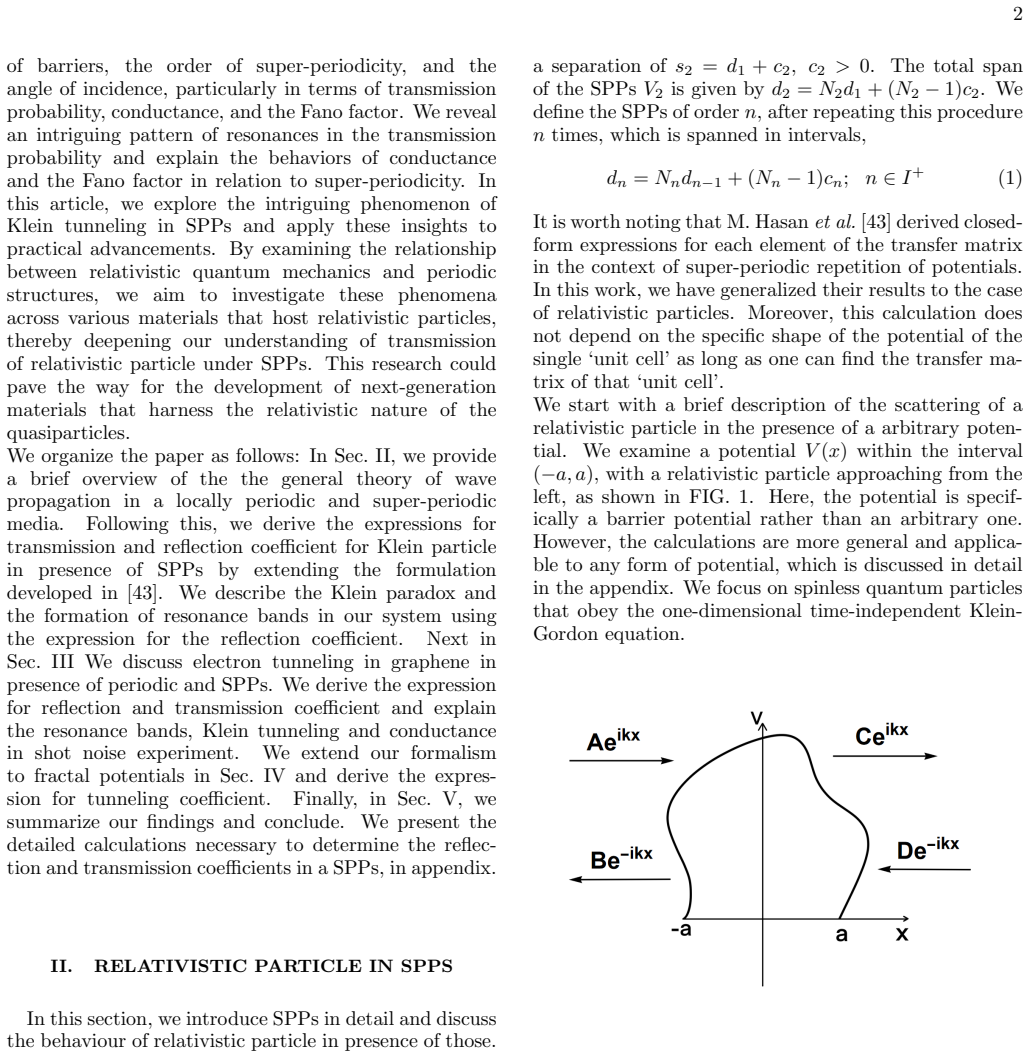
F or one-dimensional scattering In this section, we discuss the transfer matrix method for studying the one-dimensional scattering of quantum particles from a potential barrier, represented by a po- tential V (x) for −a < x < a as shown in FIG. 1. The general form of the time-independent wave function can be expressed as: ψ(x) = Aeikx + Be−ikx for...
-
[10]
F or two-dimensional scattering Now, we discuss the transfer matrix method for study- ing a special case (y-component of the momentum is con- served) of two-dimensional scattering of particles from a potential, represented by a potentialV (x) for −a < x < a as shown in FIG. 13. Because of the conservation of the y-component of the momentum, the general fo...
-
[11]
K. S. Novoselov, A. K. Geim, S. V. Morozov, D. Jiang, M. I. Katsnelson, I. V. Grigorieva, S. V. Dubonos, and A. A. Firsov, Two-dimensional gas of massless dirac fermions in graphene, nature 438, 197 (2005)
work page 2005
-
[12]
K. S. Novoselov, A. K. Geim, S. V. Morozov, D.-e. Jiang, Y. Zhang, S. V. Dubonos, I. V. Grigorieva, and A. A. Firsov, Electric field effect in atomically thin carbon films, science 306, 666 (2004)
work page 2004
-
[13]
Y. Zhang, Y.-W. Tan, H. L. Stormer, and P. Kim, Ex- perimental observation of the quantum hall effect and berry’s phase in graphene, nature 438, 201 (2005)
work page 2005
-
[14]
C.-H. Park, L. Yang, Y.-W. Son, M. L. Cohen, and S. G. Louie, Anisotropic behaviours of massless dirac fermions in graphene under periodic potentials, Nature Physics 4, 14 213 (2008)
work page 2008
- [15]
-
[16]
A. Hui, C. Pozderac, and B. Skinner, Two-dimensional hydrodynamic electron flow through periodic and ran- dom potentials, Physical Review B 109, 155145 (2024)
work page 2024
-
[17]
L. Brey and H. Fertig, Emerging zero modes for graphene in a periodic potential, Physical Review Letters 103, 046809 (2009)
work page 2009
-
[18]
T. Ohta, J. T. Robinson, P. J. Feibelman, A. Bostwick, E. Rotenberg, and T. E. Beechem, Evidence for interlayer coupling and moir´ e periodic potentials in twisted bilayer graphene, Physical Review Letters 109, 186807 (2012)
work page 2012
-
[19]
T. Li, H. Chen, K. Wang, Y. Hao, L. Zhang, K. Watan- abe, T. Taniguchi, and X. Hong, Transport anisotropy in one-dimensional graphene superlattice in the high kronig- penney potential limit, Physical Review Letters 132, 056204 (2024)
work page 2024
- [20]
- [21]
-
[22]
C. Berger, Z. Song, T. Li, X. Li, A. Y. Ogbazghi, R. Feng, Z. Dai, A. N. Marchenkov, E. H. Conrad, P. N. First, et al., Ultrathin epitaxial graphite: 2d electron gas prop- erties and a route toward graphene-based nanoelectron- ics, The Journal of Physical Chemistry B 108, 19912 (2004)
work page 2004
-
[23]
L. Wang, A. Baumgartner, P. Makk, S. Zihlmann, B. S. Varghese, D. I. Indolese, K. Watanabe, T. Taniguchi, and C. Sch¨ onenberger, Global strain-induced scalar po- tential in graphene devices, Communications Physics 4, 147 (2021)
work page 2021
-
[24]
E. Azarova and G. Maksimova, Transport in graphene nanostructures with spatially modulated gap and poten- tial, Physica E: Low-dimensional Systems and Nanos- tructures 61, 118 (2014)
work page 2014
-
[25]
X. Xu, G. Xu, and J. Cao, Electron tunneling through a trapezoidal barrier in graphene, Japanese journal of applied physics 49, 085201 (2010)
work page 2010
-
[26]
H. Dakhlaoui, W. Belhadj, and B. M. Wong, Quantum tunneling mechanisms in monolayer graphene modulated by multiple electrostatic barriers, Results in Physics 26, 104403 (2021)
work page 2021
-
[27]
F. Pakdel and M. A. Maleki, Transport properties through graphene with sequence of alternative magnetic barriers and wells in the presence of time-periodic scalar potential, Scientific Reports 11, 13293 (2021)
work page 2021
-
[28]
T. Zhan, X. Shi, Y. Dai, X. Liu, and J. Zi, Transfer matrix method for optics in graphene layers, Journal of Physics: Condensed Matter 25, 215301 (2013)
work page 2013
- [29]
-
[30]
J. Williams, L. DiCarlo, and C. Marcus, Quantum hall effect in a gate-controlled pn junction of graphene, Sci- ence 317, 638 (2007)
work page 2007
-
[31]
J. B. Oostinga, H. B. Heersche, X. Liu, A. F. Morpurgo, and L. M. Vandersypen, Gate-induced insulating state in bilayer graphene devices, Nature materials 7, 151 (2008)
work page 2008
-
[32]
R. V. Gorbachev, A. S. Mayorov, A. K. Savchenko, D. W. Horsell, and F. Guinea, Conductance of pnp graphene structures with “air-bridge” top gates, Nano letters 8, 1995 (2008)
work page 1995
-
[33]
G. Liu, J. Velasco, W. Bao, and C. N. Lau, Fabrication of graphene p-n-p junctions with contactless top gates, Applied Physics Letters 92 (2008)
work page 2008
-
[34]
V. V. Cheianov and V. I. Fal’ko, Selective transmission of dirac electrons and ballistic magnetoresistance of n-p junctions in graphene, Physical Review B—Condensed Matter and Materials Physics 74, 041403 (2006)
work page 2006
-
[35]
D. Abanin and L. Levitov, Quantized transport in graphene pn junctions in a magnetic field, Science 317, 641 (2007)
work page 2007
-
[37]
D. J. Griffiths and N. F. Taussig, Scattering from a locally periodic potential, American journal of physics 60, 883 (1992)
work page 1992
-
[38]
H.-W. Lee, A. Zysnarski, and P. Kerr, One-dimensional scattering by a locally periodic potential, American Jour- nal of Physics 57, 729 (1989)
work page 1989
-
[39]
M. Hasan and B. P. Mandal, Tunneling time from locally periodic potential in space fractional quantum mechan- ics, The European Physical Journal Plus135, 127 (2020)
work page 2020
-
[40]
Y. Xu, Y. He, and Y. Yang, Transmission gaps in graphene superlattices with periodic potential patterns, Physica B: Condensed Matter 457, 188 (2015)
work page 2015
-
[41]
Y. Hasegawa and M. Kohmoto, Periodic landau gauge and quantum hall effect in twisted bilayer graphene, Physical Review B—Condensed Matter and Materials Physics 88, 125426 (2013)
work page 2013
-
[42]
C.-H. Park, Y.-W. Son, L. Yang, M. L. Cohen, and S. G. Louie, Landau levels and quantum hall effect in graphene superlattices, Physical review letters 103, 046808 (2009)
work page 2009
-
[43]
L. Wang, Y. Gao, B. Wen, Z. Han, T. Taniguchi, K. Watanabe, M. Koshino, J. Hone, and C. R. Dean, Evidence for a fractional fractal quantum hall effect in graphene superlattices, Science 350, 1231 (2015)
work page 2015
-
[44]
C. R. Dean, L. Wang, P. Maher, C. Forsythe, F. Ghahari, Y. Gao, J. Katoch, M. Ishigami, P. Moon, M. Koshino, et al., Hofstadter’s butterfly and the fractal quantum hall effect in moir´ e superlattices, Nature497, 598 (2013)
work page 2013
-
[45]
Usov, Theory of the quantum hall effect in a two- dimensional periodic potential, Sov
N. Usov, Theory of the quantum hall effect in a two- dimensional periodic potential, Sov. Phys. JETP 67, 2565 (1988)
work page 1988
- [46]
-
[47]
Y. Tan, Localization and quantum hall effect in a two- dimensional periodic potential, Journal of Physics: Con- densed Matter 6, 7941 (1994)
work page 1994
-
[48]
F. Capasso, S. Sen, F. Beltram, and A. Cho, Resonant tunnelling and superlattice devices: Physics and circuits, in Physics of quantum electron devices (Springer, 1990) pp. 181–252
work page 1990
-
[49]
J. C. Slater, Electrons in perturbed periodic lattices, Physical Review 76, 1592 (1949)
work page 1949
-
[50]
C. Beenakker, Colloquium: Andreev reflection and klein tunneling in graphene, Reviews of Modern Physics 80, 1337 (2008). 15
work page 2008
-
[51]
P. E. Allain and J.-N. Fuchs, Klein tunneling in graphene: optics with massless electrons, The European Physical Journal B 83, 301 (2011)
work page 2011
-
[52]
N. Stander, B. Huard, and D. Goldhaber-Gordon, Evi- dence for klein tunneling in graphene p-n junctions, Phys- ical review letters 102, 026807 (2009)
work page 2009
-
[53]
M. Hasan and B. P. Mandal, Super periodic potential, Annals of Physics 391, 240 (2018)
work page 2018
-
[54]
M. Umar, V. N. Singh, M. Hasan, and B. P. Mandal, Quantum tunneling from a new type of unified cantor potential, Annals of Physics 458, 169485 (2023)
work page 2023
- [55]
- [56]
-
[57]
V. Narayan Singh, M. Umar, M. Hasan, and B. Prasad Mandal, Tunneling from general smith– volterra–cantor potential, Journal of Mathematical Physics 64 (2023)
work page 2023
-
[58]
M. I. Katsnelson, K. S. Novoselov, and A. K. Geim, Chi- ral tunneling and the klein paradox in graphene, Nature physics 2, 620 (2006)
work page 2006
-
[59]
Titov, Impurity-assisted tunneling in graphene, Eu- rophysics Letters 79, 17004 (2007)
M. Titov, Impurity-assisted tunneling in graphene, Eu- rophysics Letters 79, 17004 (2007)
work page 2007
-
[60]
M. Katsnelson, Zitterbewegung, chirality, and minimal conductivity in graphene, The European Physical Jour- nal B-Condensed Matter and Complex Systems 51, 157 (2006)
work page 2006
-
[61]
V. N. Singh, M. Umar, M. Hasan, and B. P. Mandal, Quantum tunneling from family of cantor potentials in fractional quantum mechanics, Annals of Physics 450, 169236 (2023)
work page 2023
-
[62]
D. J. Griffiths and C. A. Steinke, Waves in locally peri- odic media, American Journal of Physics 69, 137 (2001)
work page 2001
discussion (0)
Sign in with ORCID, Apple, or X to comment. Anyone can read and Pith papers without signing in.