REVIEW 4 major objections 5 minor 38 references
ConDo: Continual Domain Expansion for Absolute Pose Regression
T0 review · 4 major / 5 minor · reviewed 2026-08-11 · deepseek-v4-flash
Pith's one-line read The paper claims that a deployed absolute-pose-regression model, which directly maps images to camera poses, can continually expand its generalization domain by distilling knowledge from scene-agnostic localization methods on unlabeled…
desk verdict ConDo is a genuine, well-executed step for APR under distribution shift, but the headline robustness to teacher noise doesn't survive its own Table 5. read the letter →
The pith
A machine-rendered reading of the paper's core claim, the machinery that carries it, and where it could break.
The reading
What carries the argument
The mechanism is knowledge distillation from a scene-agnostic teacher $f_{\text{teacher}}$ (default HLoc, a hierarchical localization pipeline) applied to unlabeled inference images, with the distillation loss $L_{\text{distill}} = L(I^\Delta, f_{\text{teacher}}(I^\Delta))$ substituted into the APR regression loss. The second load-bearing mechanism is uniform sampling from the union of historical labeled data and newly collected unlabeled data, which prevents forgetting and lets new-domain knowledge improve old-domain robustness.
What would settle it
A clean falsification would be to run ConDo on a scan where the teacher is known to be systematically wrong and check whether held-out error still drops below Train-only; if it does not, the distillation premise fails. The NetVLAD row of the paper's Table 5 is a partial version of this test, showing a median error of 49.39 m versus 42.15 m for Train-only on inference scans.
Extended reading notes
Core claim
The paper's central claim is that distillation from scene-agnostic localization methods converts unlabeled inference data into a usable supervision signal for APR, and that uniform replay sampling preserves old domains while absorbing new ones. ConDo's objective, Eq. (2), is a normalized sum of the standard regression loss on labeled training data plus a distillation loss on unlabeled data, where the teacher's output replaces ground truth in the regression loss. With HLoc as the default teacher, this simple loss approaches the performance of retraining with ground-truth poses, while weaker teachers produce smaller gains. The paper also claims that ConDo extends to sequentially revealed scenes by adding regression heads, and that it is robust to compute budgets, replay buffer sizes, and teacher prediction noise.
Load-bearing premise
The whole scheme leans on the teacher being right on the unlabeled images: ConDo's only supervision on new data is the teacher's output, and when the teacher is inaccurate, as with the NetVLAD teacher on Office Loop, the measured improvement disappears.
Editorial extensions
If this is right
- Deployed APR systems can improve localization accuracy after deployment without new labeled data, as long as unlabeled images from operation are collected and a scene-agnostic teacher is available.
- With a fixed compute budget, continual unlabeled updates can match the accuracy of ground-truth retraining up to 25x faster, and the advantage grows as more scans accumulate.
- Uniform replay sampling keeps prior domains from being forgotten; reservoir-sampled replay buffers with only 10% of the dataset retain most of the benefit.
- For multi-scene APR architectures, adding regression heads lets ConDo absorb sequentially revealed new scenes with minimal parameter growth.
- Stronger pre-trained backbones improve but do not replace ConDo; combining them with ConDo gives lower error than either alone.
- The method is robust to weaker teachers in the sense that they still give reasonable improvements, but the gains are positively correlated with teacher accuracy.
Reading between the lines
- Editorial inference: The practical ceiling of this approach is set by teacher coverage; if the teacher fails on some novel condition, ConDo inherits that failure, so ensembles or self-consistency checks among multiple teachers would be a natural next step.
- Editorial inference: The observed improvement on training-scan held-out data after seeing new unlabeled scans suggests that domain diversity itself generalizes; a testable extension is whether synthetic weather or lighting augmentation could substitute for collected unlabeled data.
- Editorial inference: The server-based update loop assumes clients can upload raw images; for privacy-constrained deployments, one would need on-device distillation or feature-space adaptation, likely with lower teacher accuracy.
- Editorial inference: Because new data with pure pose change can hurt training-scan accuracy even with ground truth, APR architectures that learn from pose-diverse data without cross-scene interference remain an open problem.
Editorial analysis
A structured set of objections, weighed in public.
Referee Report
Summary. The paper proposes ConDo (Continual Domain Expansion), a method for updating Absolute Pose Regression (APR) models on unlabeled inference data after deployment. ConDo distills pseudo-labels from a teacher localization method (HLoc by default) and combines them with ground-truth-labeled replay data from the training scan, uniformly sampling from historical and new data. The authors construct benchmarks from 4Seasons (Office Loop, Neighborhood), 7Scenes, and Cambridge to cover scene-condition changes and novel-pose/multi-scene settings. They report that ConDo substantially reduces median/mean pose error on inference scans compared to training-only baselines and standard UDA methods, approaches the performance of retraining with ground-truth labels, and does so with lower compute. They also analyze effects of compute budget, replay buffer size, teacher choice, and backbone pretraining.
Significance. If the central claims hold, ConDo provides a practical recipe for continually adapting lightweight APR models to changing environments without new labeled data, with a clear compute advantage over retraining. The paper's strengths include large-scale benchmark construction across four datasets, evaluation on two APR architectures, explicit comparison to UDA baselines, compute-budget and replay-buffer sensitivity analyses, and a public code release. The result is not obviously circular: the teacher is an external localization method, and evaluation is on held-out images not used in the ConDo updates. However, the main empirical claims rest on a single training run per condition, and the teacher-robustness claim is contradicted by the NetVLAD row of Table 5, which tempers the significance.
major comments (4)
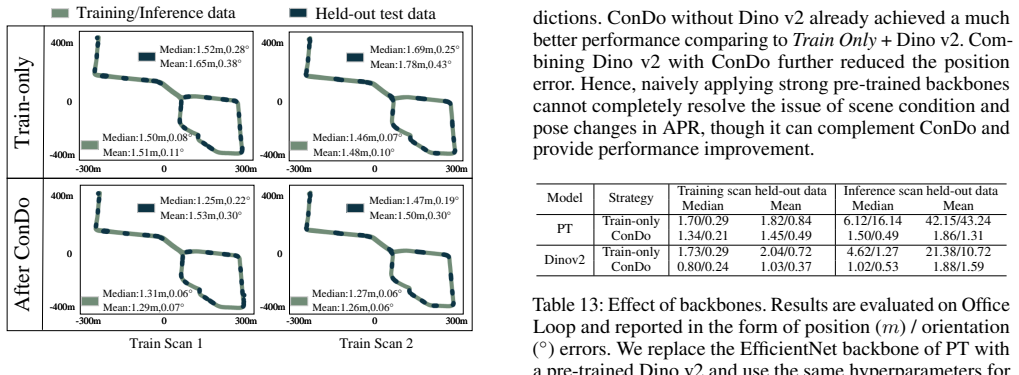
- [Table 5 / §5.2] The abstract's claim of robustness to teacher prediction noise is contradicted by the NetVLAD row of Table 5. Eq. (2) defines L_distill = L(I_delta, f_teacher(I_delta)) with no confidence weighting or outlier rejection. With NetVLAD as teacher, whose mean position error on Office Loop inference scans is 44.50 m, ConDo's mean held-out error on the same scans increases to 49.39 m, worse than the Train-only baseline's 42.15 m. The median improves from 6.12 m to 3.00 m, but the mean degradation indicates that the method can act as a conduit for teacher outliers. The paper should either add a mechanism to detect or weight unreliable teacher predictions, or substantially temper the robustness claim.
- [§5.2 / Tables 1-5] No repeated-run statistics are reported. Every table lists single median/mean values, so it is impossible to assess whether the improvements are significant, particularly in Table 4, where the difference between ConDo and Re-train at the 1/4 budget is about 0.7-0.8 m median position error, and in Table 2, where ConDo degrades training-scan performance (e.g., PN from 0.023 m to 0.069 m median). The authors should report mean ± std or median with MAD over at least 3-5 independent training/update seeds for the main comparisons.
- [§4 / Fig. 3] The benchmark construction does not demonstrate that the held-out test trajectories are spatially disjoint from the unlabeled ConDo update data within the same scan. The paper holds out several continuous 16-image trajectories from each scan, but if those trajectories revisit the same route segments as the remaining data, the held-out evaluation measures interpolation rather than domain expansion. Please provide a quantitative analysis of the spatial separation between the held-out trajectories and the ConDo update data, and consider an evaluation protocol that enforces spatial disjointness.
- [§3.2 / Table 1] The default teacher HLoc is not scene-agnostic: as stated in §3.2, it uses a scene map built on (S_Omega, P_Omega). This restricts ConDo to scenes for which a labeled reference map already exists, and in a genuinely new scene with changed geometry the teacher itself may fail. The experiments only evaluate within mapped scenes. The paper should clarify this scope and discuss whether the method can be applied when no map is available, for example using only relative-pose teachers.
minor comments (5)
- [§3.2] Typos: 'asyncronously' should be 'asynchronously', and 'pre-exectued' should be 'pre-executed'.
- [Introduction] The phrase 'order of mangnitude' in the Introduction contains a misspelling; it should be 'order of magnitude'.
- [Eq. (2)] The subscript formatting for f_teacher is inconsistent between the text and the equation; please unify the notation.
- [Table 5] The column header 'Teacher err in infer scan' is informal; use 'Teacher error on inference scans'.
- [Fig. 7] The y-axis label should specify the units and metric explicitly, e.g., 'median position error (m)'.
Circularity Check
No significant circularity: ConDo's teacher-distillation results are empirically measured against held-out data and can fail, so the central claim is not forced by construction.
full rationale
The derivation chain is not circular. ConDo's supervision is an external teacher (HLoc, Sarlin et al. 2019) whose outputs are substituted into Eq. (1) via L_distill = L(I_delta, f_teacher(I_delta)) in Eq. (2); the student APR is updated on unlabeled inference data and evaluated on held-out images from the same scans. The improvement is an empirical outcome, not a definitional identity: the objective does not contain the held-out test labels, and the teacher is not fit to the test data. The teacher's scene map is built from the labeled training set, but the pseudo-labels on inference scans are not constructed from the evaluation targets, and the paper reports a case (NetVLAD teacher, Table 5) where mean error on Office Loop inference scans worsens relative to Train-only, which shows the central claim is falsifiable rather than forced. Self-citations (Cai et al. 2021; Cai and Müller 2023; Prabhu et al. 2023) are used only for experimental conventions such as the compute-budget schedule and reservoir sampling; they do not supply the load-bearing premise. No equation reduces to its own input, no fitted parameter is relabeled as a prediction, and no uniqueness claim is imported from the authors' prior work. The main risks—teacher accuracy and the transductive nature of the evaluation—are correctness and benchmark-validity concerns, not circularity.
Assumptions & free parameters
free parameters (1)
- compute budget b (iterations per image per update) =
4200 for Office Loop and Neighborhood; 1800 for Cambridge and 7Scenes; 300 for Pose-Transformer on 7Scenes
assumptions (5)
- domain assumption The scene-agnostic teacher f_teacher (HLoc by default) provides sufficiently accurate pseudo-labels on unlabeled inference data for distillation to help.
- domain assumption Unlabeled images from deployment can be collected and uploaded, and a labeled training set with a precomputed scene map is available for each scene.
- domain assumption Uniform sampling from S^Omega U Delta prevents catastrophic forgetting and preserves old-domain accuracy.
- ad hoc to paper The compute budget defined by b is a meaningful measure for comparing ConDo to retraining.
- domain assumption Held-out continuous trajectories of 16 images are representative for evaluating adaptation to each scan's novel conditions.
Cite this review
Pith. "Pith review of ConDo: Continual Domain Expansion for Absolute Pose Regression." pith.science (2026). https://pith.science/paper/BX5MI4JI
@misc{pith2026241213452,
  author       = {Pith},
  title        = {Pith review of: ConDo: Continual Domain Expansion for Absolute Pose Regression},
  year         = {2026},
  howpublished = {\url{https://pith.science/paper/BX5MI4JI}},
  note         = {Machine review of arXiv:2412.13452}
}
read the original abstract
Visual localization is a fundamental machine learning problem. Absolute Pose Regression (APR) trains a scene-dependent model to efficiently map an input image to the camera pose in a pre-defined scene. However, many applications have continually changing environments, where inference data at novel poses or scene conditions (weather, geometry) appear after deployment. Training APR on a fixed dataset leads to overfitting, making it fail catastrophically on challenging novel data. This work proposes Continual Domain Expansion (ConDo), which continually collects unlabeled inference data to update the deployed APR. Instead of applying standard unsupervised domain adaptation methods which are ineffective for APR, ConDo effectively learns from unlabeled data by distilling knowledge from scene-agnostic localization methods. By sampling data uniformly from historical and newly collected data, ConDo can effectively expand the generalization domain of APR. Large-scale benchmarks with various scene types are constructed to evaluate models under practical (long-term) data changes. ConDo consistently and significantly outperforms baselines across architectures, scene types, and data changes. On challenging scenes (Fig.1), it reduces the localization error by >7x (14.8m vs 1.7m). Analysis shows the robustness of ConDo against compute budgets, replay buffer sizes and teacher prediction noise. Comparing to model re-training, ConDo achieves similar performance up to 25x faster.
Figures


Figures from the paper (6 more)



Reference graph
Works this paper leans on
-
[1]
, " * write output.state after.block = add.period write newline
ENTRY address archivePrefix author booktitle chapter edition editor eid eprint howpublished institution isbn journal key month note number organization pages publisher school series title type volume year label extra.label sort.label short.list INTEGERS output.state before.all mid.sentence after.sentence after.block FUNCTION init.state.consts #0 'before.a...
-
[2]
write newline
" write newline "" before.all 'output.state := FUNCTION n.dashify 't := "" t empty not t #1 #1 substring "-" = t #1 #2 substring "--" = not "--" * t #2 global.max substring 't := t #1 #1 substring "-" = "-" * t #2 global.max substring 't := while if t #1 #1 substring * t #2 global.max substring 't := if while FUNCTION word.in bbl.in capitalize " " * FUNCT...
-
[3]
Aljundi, R.; Chakravarty, P.; and Tuytelaars, T. 2017. Expert gate: Lifelong learning with a network of experts. In Proceedings of the IEEE conference on computer vision and pattern recognition, 3366--3375
work page 2017
-
[4]
Arandjelovic, R.; Gronat, P.; Torii, A.; Pajdla, T.; and Sivic, J. 2016. NetVLAD: CNN architecture for weakly supervised place recognition. In Proceedings of the IEEE conference on computer vision and pattern recognition, 5297--5307
2016
-
[5]
Brachmann, E.; and Rother, C. 2019. Expert sample consensus applied to camera re-localization. In Proceedings of the IEEE/CVF International Conference on Computer Vision, 7525--7534
work page 2019
-
[6]
Brahmbhatt, S.; Gu, J.; Kim, K.; Hays, J.; and Kautz, J. 2018. Geometry-aware learning of maps for camera localization. In Proceedings of the IEEE conference on computer vision and pattern recognition, 2616--2625
2018
-
[7]
Cai, Z.; and M \"u ller, M. 2023. CLNeRF: Continual Learning Meets NeRF. In Proceedings of the IEEE/CVF International Conference on Computer Vision, 23185--23194
2023
-
[8]
Cai, Z.; Sener, O.; and Koltun, V. 2021. Online continual learning with natural distribution shifts: An empirical study with visual data. In Proceedings of the IEEE/CVF international conference on computer vision, 8281--8290
work page 2021
Show all 38 references
-
[9]
Campos, C.; Elvira, R.; Rodr \' guez, J. J. G.; Montiel, J. M.; and Tard \'o s, J. D. 2021. Orb-slam3: An accurate open-source library for visual, visual--inertial, and multimap slam. IEEE Transactions on Robotics, 37(6): 1874--1890
2021
-
[10]
Chen, S.; Li, X.; Wang, Z.; and Prisacariu, V. A. 2022. Dfnet: Enhance absolute pose regression with direct feature matching. In European Conference on Computer Vision, 1--17. Springer
2022
-
[11]
Chen, S.; Wang, Z.; and Prisacariu, V. 2021. Direct-posenet: Absolute pose regression with photometric consistency. In 2021 International Conference on 3D Vision (3DV), 1175--1185. IEEE
2021
-
[12]
Chen, X.; Wang, S.; Wang, J.; and Long, M. 2021. Representation Subspace Distance for Domain Adaptation Regression. In ICML, 1749--1759
2021
-
[13]
Finn, C.; Abbeel, P.; and Levine, S. 2017. Model-agnostic meta-learning for fast adaptation of deep networks. In International conference on machine learning, 1126--1135. PMLR
2017
-
[14]
Glocker, B.; Izadi, S.; Shotton, J.; and Criminisi, A. 2013. Real-time RGB-D camera relocalization. In 2013 IEEE International Symposium on Mixed and Augmented Reality (ISMAR), 173--179. IEEE
2013
-
[15]
Hoyer, L.; Dai, D.; Wang, H.; and Van Gool, L. 2023. MIC: Masked image consistency for context-enhanced domain adaptation. In Proceedings of the IEEE/CVF conference on computer vision and pattern recognition, 11721--11732
2023
-
[16]
Hyeon, J.; Kim, J.; and Doh, N. 2021. Pose correction for highly accurate visual localization in large-scale indoor spaces. In Proceedings of the IEEE/CVF International Conference on Computer Vision, 15974--15983
2021
-
[17]
a ppeler, M.; Petek, K.; V \
K \"a ppeler, M.; Petek, K.; V \"o disch, N.; Burgard, W.; and Valada, A. 2023. Few-shot panoptic segmentation with foundation models. arXiv preprint arXiv:2309.10726
2023 arXiv
-
[18]
M.; Scherer, S.; Krishna, M.; and Garg, S
Keetha, N.; Mishra, A.; Karhade, J.; Jatavallabhula, K. M.; Scherer, S.; Krishna, M.; and Garg, S. 2023. Anyloc: Towards universal visual place recognition. IEEE Robotics and Automation Letters
2023
-
[19]
Kendall, A.; and Cipolla, R. 2017. Geometric loss functions for camera pose regression with deep learning. In Proceedings of the IEEE conference on computer vision and pattern recognition, 5974--5983
2017
-
[20]
Kendall, A.; Grimes, M.; and Cipolla, R. 2015. Posenet: A convolutional network for real-time 6-dof camera relocalization. In Proceedings of the IEEE international conference on computer vision, 2938--2946
2015
-
[21]
Kim, M.; Koo, J.; and Kim, G. 2023. EP2P-Loc: End-to-End 3D Point to 2D Pixel Localization for Large-Scale Visual Localization. In Proceedings of the IEEE/CVF International Conference on Computer Vision, 21527--21537
2023
-
[22]
A.; Milan, K.; Quan, J.; Ramalho, T.; Grabska-Barwinska, A.; et al
Kirkpatrick, J.; Pascanu, R.; Rabinowitz, N.; Veness, J.; Desjardins, G.; Rusu, A. A.; Milan, K.; Quan, J.; Ramalho, T.; Grabska-Barwinska, A.; et al. 2017. Overcoming catastrophic forgetting in neural networks. Proceedings of the national academy of sciences, 114(13): 3521--3526
2017
-
[23]
Moreau, A.; Piasco, N.; Bennehar, M.; Tsishkou, D.; Stanciulescu, B.; and de La Fortelle, A. 2023. CROSSFIRE: Camera Relocalization On Self-Supervised Features from an Implicit Representation. In Proceedings of the IEEE/CVF International Conference on Computer Vision (ICCV), 252--262
2023
-
[24]
Moreau, A.; Piasco, N.; Tsishkou, D.; Stanciulescu, B.; and de La Fortelle, A. 2022. Lens: Localization enhanced by nerf synthesis. In Conference on Robot Learning, 1347--1356. PMLR
2022
-
[25]
Nejjar, I.; Wang, Q.; and Fink, O. 2023. DARE-GRAM: Unsupervised domain adaptation regression by aligning inverse gram matrices. In Proceedings of the IEEE/CVF conference on computer vision and pattern recognition, 11744--11754
2023
-
[26]
Oquab, M.; Darcet, T.; Moutakanni, T.; Vo, H.; Szafraniec, M.; Khalidov, V.; Fernandez, P.; Haziza, D.; Massa, F.; El-Nouby, A.; et al. 2023. Dinov2: Learning robust visual features without supervision. arXiv preprint arXiv:2304.07193
2023 arXiv
-
[27]
Prabhu, A.; Cai, Z.; Dokania, P.; Torr, P.; Koltun, V.; and Sener, O. 2023. Online continual learning without the storage constraint. arXiv preprint arXiv:2305.09253
2023 arXiv
-
[28]
Rebuffi, S.-A.; Kolesnikov, A.; Sperl, G.; and Lampert, C. H. 2017. icarl: Incremental classifier and representation learning. In Proceedings of the IEEE conference on Computer Vision and Pattern Recognition, 2001--2010
2017
-
[29]
Sarlin, P.-E.; Cadena, C.; Siegwart, R.; and Dymczyk, M. 2019. From coarse to fine: Robust hierarchical localization at large scale. In Proceedings of the IEEE/CVF Conference on Computer Vision and Pattern Recognition, 12716--12725
2019
-
[30]
Sattler, T.; Zhou, Q.; Pollefeys, M.; and Leal-Taixe, L. 2019. Understanding the limitations of cnn-based absolute camera pose regression. In Proceedings of the IEEE/CVF conference on computer vision and pattern recognition, 3302--3312
2019
-
[31]
Shavit, Y.; Ferens, R.; and Keller, Y. 2021. Learning multi-scene absolute pose regression with transformers. In Proceedings of the IEEE/CVF International Conference on Computer Vision, 2733--2742
2021
-
[32]
Shavit, Y.; Ferens, R.; and Keller, Y. 2023. Coarse-to-Fine Multi-Scene Pose Regression with Transformers. IEEE Transactions on Pattern Analysis and Machine Intelligence
2023
-
[33]
Torii, A.; Arandjelovic, R.; Sivic, J.; Okutomi, M.; and Pajdla, T. 2015. 24/7 place recognition by view synthesis. In Proceedings of the IEEE conference on computer vision and pattern recognition, 1808--1817
2015
-
[34]
Von Stumberg, L.; and Cremers, D. 2022. Dm-vio: Delayed marginalization visual-inertial odometry. IEEE Robotics and Automation Letters, 7(2): 1408--1415
2022
-
[35]
X.; Zhao, P.; Trigoni, N.; and Markham, A
Wang, B.; Chen, C.; Lu, C. X.; Zhao, P.; Trigoni, N.; and Markham, A. 2020. Atloc: Attention guided camera localization. In Proceedings of the AAAI Conference on Artificial Intelligence, volume 34, 10393--10401
2020
-
[36]
P.; Hartmannsgruber, A.; and Navarro, D
Wang, S.; Kang, Q.; She, R.; Tay, W. P.; Hartmannsgruber, A.; and Navarro, D. N. 2023. RobustLoc: Robust camera pose regression in challenging driving environments. In Proceedings of the AAAI Conference on Artificial Intelligence, volume 37, 6209--6216
2023
-
[37]
Wenzel, P.; Wang, R.; Yang, N.; Cheng, Q.; Khan, Q.; von Stumberg, L.; Zeller, N.; and Cremers, D. 2021. 4Seasons: A cross-season dataset for multi-weather SLAM in autonomous driving. In Pattern Recognition: 42nd DAGM German Conference, DAGM GCPR 2020, T \"u bingen, Germany, S...
2021
-
[38]
Xue, F.; Wang, X.; Yan, Z.; Wang, Q.; Wang, J.; and Zha, H. 2019. Local supports global: Deep camera relocalization with sequence enhancement. In Proceedings of the IEEE/CVF International Conference on Computer Vision, 2841--2850
2019
Reviewed August 11, 2026 · model on record in the stance chip above.
Discussion (0). Continue with ORCID to comment.