REVIEW 3 major objections 5 minor 53 references
FlexPose: Pose Distribution Adaptation with Limited Guidance
T0 review · 3 major / 5 minor · reviewed 2026-08-11 · deepseek-v4-flash
Pith's one-line read FlexPose claims that adapting a pre-trained pose generator to a new pose distribution requires fine-tuning only a few linear blocks of the style transform, using as few as 12 to 30 target annotations.
desk verdict A solid few-shot pose distribution adaptation method with a clear idea and consistent experiments, though the fixed layer choice is an empirical tuning decision rather than a validated principle. read the letter →
The pith
A machine-rendered reading of the paper's core claim, the machinery that carries it, and where it could break.
The reading
What carries the argument
The load-bearing object is the transfer function $\tau$, a block-diagonal matrix applied to the style code at the output of the source transform $\delta_s$. Only selected blocks of $\tau$ are learned; the rest are fixed as identity, so the adaptation is sparse and linear. Pose-mixup (keypoint-space interpolation of target poses) enlarges the guidance set, and the frozen StyleGAN backbone keeps the pose prior fixed. Together these pieces localize the domain shift to a single geometric layer, which is what makes few-shot adaptation work in the paper's account.
What would settle it
Apply FlexPose to a source-target pair whose pose shift also includes viewpoint-dependent foreshortening or non-uniform body scaling, and check whether downstream keypoint accuracy still beats simply training on the source poses. If PCK or MSE stays at the no-adaptation baseline level, the block-diagonal linear-shift assumption is falsified.
Extended reading notes
Core claim
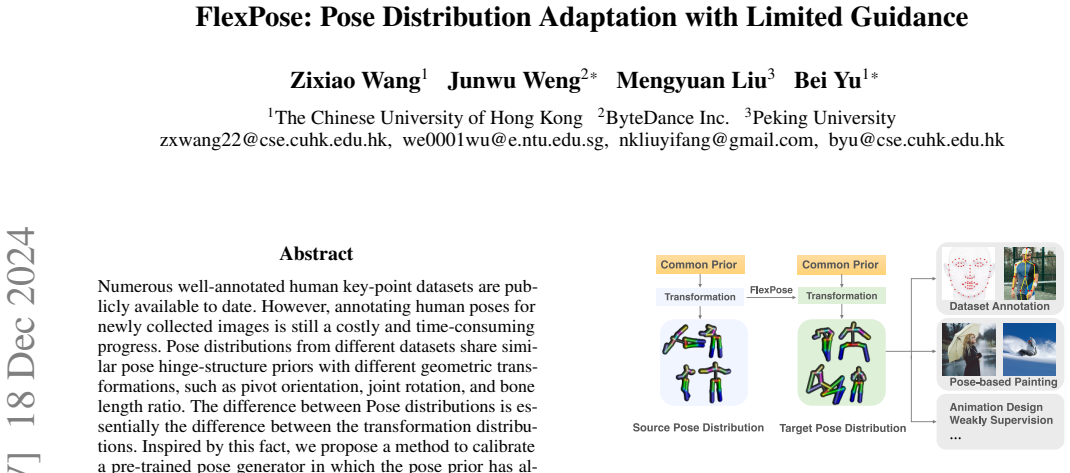
The paper's central claim is that a pose distribution can be transferred from source to target by changing only the affine style code, while freezing the generative backbone that holds the shared hinge-structure prior. Formally, the generator factorizes as $g = \phi \circ \delta$, where $\phi$ preserves the pose prior and $\delta$ maps that prior to a domain's skeleton images; FlexPose learns a block-diagonal transfer matrix $\tau$ so that the target generator is $g_t = \phi \circ (\tau \circ \delta_s)$. With $\tau$ constrained to be identity except for a small number of blocks (layer 3 in most experiments), plus interpolation-based Pose-mixup and linear/sparse regularization, this single small module is enough to align the generated pose distribution with the target in the paper's experiments. The adapted generator then yields synthetic keypoint annotations that improve unsupervised matching and downstream pose-related tasks over adapting the whole generator.
Load-bearing premise
The premise is that different pose datasets differ only in a geometric transformation, and that one small linear adjustment to a single generator layer is enough to capture it.
Editorial extensions
If this is right
- With 30 COCO-derived guide poses, the transferred generator produces skeletons whose Fréchet distance and MMD to Human3.6M are below those of the AdaGAN, FreezeD, and LoRA baselines.
- Using the adapted skeletons to train an unsupervised keypoint detector raises PCK to 0.585 on COCO-to-Human3.6M and 0.770 on COCO-to-Simplified-Human3.6M, well above the no-adaptation baselines.
- The same transfer works for facial landmarks: 30 target annotations from WFLW improve the detector's MSE from 18.78 to 11.64 over the baseline.
- Mixing multiple source datasets increases source diversity and improves downstream accuracy, while increasing the number of target shots beyond 12 brings little gain.
Reading between the lines
- If the linear-shift mechanism is right, FlexPose's performance on a new source-target pair is a direct probe of how geometric the domain shift is; it should degrade exactly as appearance-level differences start to dominate.
- The recipe should transfer to other keypoint-structured domains, such as hands or animal skeletons, wherever an affine style block can express the shift; testing that would confirm the prior-sharing assumption beyond human pose.
- The learned transfer matrix is effectively a low-dimensional measurement of the pose shift, so its rank or singular values across dataset pairs could predict how many target annotations are actually needed.
Signed reviews
Editorial analysis
A structured set of objections, weighed in public.
Referee Report
Summary. The paper proposes FlexPose, a method to adapt a pre-trained StyleGAN-based pose generator (trained on skeleton images rendered from 2D keypoints) to a target pose distribution using only a few annotated target poses. Adaptation is performed by inserting a block-diagonal affine transfer function τ that multiplies the style codes at a small number of layers, with linear, sparse, and keypoint-mixup regularizations to avoid collapse. The adapted generator then produces synthetic poses that are used for downstream tasks such as human pose annotation via a matching algorithm, face landmark annotation, and pose-conditional image generation. Experiments across several source/target dataset pairs show improvements over AdaGAN, FreezeD, and LoRA baselines on the human pose annotation task, with more modest results on face landmarks.
Significance. If the central claim holds, FlexPose offers a computationally efficient (under 5 minutes on a V100) and data-efficient approach to pose distribution transfer that avoids using human appearance images, which is attractive for privacy-sensitive applications. The paper provides a clear pipeline and a reasonable set of comparisons. However, the significance is limited by the strong expressivity assumption that a single linear style block at a fixed layer can capture real cross-dataset pose shifts, and by the absence of statistical validation, especially in the face landmark experiment where gains are marginal.
major comments (3)
- [Section 3.3, Eq. (6), and Appendix Figure 9] The method restricts the transfer to a block-diagonal affine map τ acting on a single style layer (l=3), chosen empirically on the target guidance. However, the paper's own analysis in Section 9 shows that global transformations (rotation, scale) are best fitted at layers 3–4 while local joint rotations are best fitted at layers 5–6. Real cross-dataset shifts such as 3DHP→S-H3.6M presumably contain both local and global components, yet the paper fixes l=3 without verifying that the dominant component of each real shift is global. This is a load-bearing point: if a target shift lies primarily in the local-joint regime, the single-layer τ at l=3 cannot express it, and the central claim that a limited linear layer shift suffices for few-shot pose distribution adaptation would fail for such cases. Please either (a) provide an adaptive layer-selection criterion that does not require the target annotation set, or (b) present evidence (e.g., reconstruction losses per layer for the actual dataset shifts) that the studied shifts are captured by l=3, or (c) explicitly re-scope the claim to shifts that are predominantly global.
- [Tables 2 and 3] The experimental comparisons report single runs with no error bars or significance tests. In the face landmark experiment (Table 3), FlexPose is best on MSE (11.64 vs 11.77 for LoRA) but not on PCK, where AdaGAN (0.785) and FreezeD (0.779) outperform FlexPose (0.766). Differences of this size are plausibly within run-to-run noise, especially since the downstream evaluation involves a separately trained KeypointGAN. Please report means and standard deviations over at least three seeds, or otherwise demonstrate that the observed improvements are statistically reliable, before claiming state-of-the-art performance.
- [Abstract and Table 3] The abstract and introduction state that FlexPose 'achieves state-of-the-art performance' and 'outperforms baselines by a large margin,' but Table 3 shows that on the face landmark task FlexPose does not achieve the best PCK among the compared methods. This overclaim should be corrected: either soften the abstract to say 'state-of-the-art on human pose annotation' or provide a quantitative justification for why the face landmark result is considered competitive rather than superior.
minor comments (5)
- [Abstract] In the abstract, 'progress' should be 'process'.
- [Section 3.3] The phrase 'data-starving deep learning model' should be rephrased to 'data-scarce' or 'small-sample'.
- [Equation (5)] Equation (5) is typeset ambiguously; the summation index and the definition of Γ should be spelled out so readers can verify the objective.
- [Section 4.4] The paper says 'we set l=3 in all experiments,' yet the same section's ablation table varies l (rows #2–#4). Rephrase to clarify that l=3 is the default choice and variants are part of the ablation.
- [Reproducibility] A statement on code and data availability would improve reproducibility.
Circularity Check
No significant circularity: FlexPose is an explicit few-shot fitting procedure whose generalization is measured on held-out target data.
full rationale
FlexPose's derivation is an explicit fitting procedure rather than a claimed derivation from first principles. The transfer function tau is trained by minimizing the perceptual reconstruction loss in Eq. (5) against the few target guide poses, and the paper's claims are then evaluated against the full target distribution (FD and MMD over all Human3.6M samples in Table 1) and on held-out downstream annotation tasks (Tables 2 and 3). The fitted quantity (reconstruction of the few-shot set) is not renamed as the predicted quantity; instead, generalization is measured on target data not used in the fit. The load-bearing premise that a pose shift can be expressed by a block-diagonal affine style perturbation (Eq. 6, with l=3) is an explicit ansatz motivated by StyleGAN's style-control properties, not a result derived from the conclusion. The paper's own Appendix (Fig. 9) shows that global versus local transformations favor different layers, which is a correctness or expressivity risk rather than a circularity. The only self-citation (Wang et al. 2023) appears in a related-work list for weakly-supervised methods and does not support any load-bearing step. No equation or evaluation metric reduces by construction to its input; the adaptation objective and the evaluation protocol are distinct.
Assumptions & free parameters
free parameters (3)
- Transfer layer index l =
3
- Sparse block selection in tau (Eq. 6) =
only layer 3 blocks adjusted
- Pose-mixup ratio lambda =
lambda in [0,1], sampling distribution unspecified
assumptions (3)
- domain assumption Pose distributions share a common hinge-structure prior and differ only by geometric transformations such as pivot orientation, joint rotation, and bone length ratio.
- ad hoc to paper StyleGAN style layers are hierarchically disentangled for skeleton images, so adjusting a single coarse layer can represent the global pose transformation.
- domain assumption The source-trained keypoint regressor beta generalizes to target-generated skeleton images without retraining.
Cite this review
Pith. "Pith review of FlexPose: Pose Distribution Adaptation with Limited Guidance." pith.science (2026). https://pith.science/paper/SCRWEHZC
@misc{pith2026241213463,
  author       = {Pith},
  title        = {Pith review of: FlexPose: Pose Distribution Adaptation with Limited Guidance},
  year         = {2026},
  howpublished = {\url{https://pith.science/paper/SCRWEHZC}},
  note         = {Machine review of arXiv:2412.13463}
}
read the original abstract
Numerous well-annotated human key-point datasets are publicly available to date. However, annotating human poses for newly collected images is still a costly and time-consuming progress. Pose distributions from different datasets share similar pose hinge-structure priors with different geometric transformations, such as pivot orientation, joint rotation, and bone length ratio. The difference between Pose distributions is essentially the difference between the transformation distributions. Inspired by this fact, we propose a method to calibrate a pre-trained pose generator in which the pose prior has already been learned to an adapted one following a new pose distribution. We treat the representation of human pose joint coordinates as skeleton image and transfer a pre-trained pose annotation generator with only a few annotation guidance. By fine-tuning a limited number of linear layers that closely related to the pose transformation, the adapted generator is able to produce any number of pose annotations that are similar to the target poses. We evaluate our proposed method, FlexPose, on several cross-dataset settings both qualitatively and quantitatively, which demonstrates that our approach achieves state-of-the-art performance compared to the existing generative-model-based transfer learning methods when given limited annotation guidance.
Figures


Figures from the paper (5 more)


Reference graph
Works this paper leans on
-
[1]
, " * write output.state after.block = add.period write newline
ENTRY address archivePrefix author booktitle chapter edition editor eid eprint howpublished institution isbn journal key month note number organization pages publisher school series title type volume year label extra.label sort.label short.list INTEGERS output.state before.all mid.sentence after.sentence after.block FUNCTION init.state.consts #0 'before.a...
-
[2]
write newline
" write newline "" before.all 'output.state := FUNCTION n.dashify 't := "" t empty not t #1 #1 substring "-" = t #1 #2 substring "--" = not "--" * t #2 global.max substring 't := t #1 #1 substring "-" = "-" * t #2 global.max substring 't := while if t #1 #1 substring * t #2 global.max substring 't := if while FUNCTION word.in bbl.in capitalize " " * FUNCT...
-
[3]
Andriluka, M.; Roth, S.; and Schiele, B. 2009. Pictorial structures revisited: People detection and articulated pose estimation. In CVPR, 1014--1021. IEEE
work page 2009
-
[4]
Bai, Y.; and Wang, W. 2019. Acpnet: anchor-center based person network for human pose estimation and instance segmentation. In ICME, 1072--1077. IEEE
work page 2019
-
[5]
Belagiannis, V.; and Zisserman, A. 2017. Recurrent human pose estimation. In FG, 468--475. IEEE
work page 2017
-
[6]
Buolamwini, J.; and Gebru, T. 2018. Gender shades: Intersectional accuracy disparities in commercial gender classification. In Conference on fairness, accountability and transparency, 77--91. PMLR
2018
-
[7]
Cao, J.; Tang, H.; Fang, H.-S.; Shen, X.; Lu, C.; and Tai, Y.-W. 2019. Cross-domain adaptation for animal pose estimation. In ICCV, 9498--9507
work page 2019
-
[8]
Csurka, G. 2017. Domain adaptation for visual applications: A comprehensive survey. arXiv preprint arXiv:1702.05374
arXiv 2017
Show all 53 references
-
[9]
Cui, Q.; Sun, H.; Lu, J.; Li, W.; Li, B.; Yi, H.; and Wang, H. 2023. Test-time Personalizable Forecasting of 3D Human Poses. In Proceedings of the IEEE/CVF International Conference on Computer Vision, 274--283
2023
-
[10]
Daum \'e III, H. 2009. Frustratingly easy domain adaptation. arXiv preprint arXiv:0907.1815
2009 arXiv
-
[11]
Ganin, Y.; and Lempitsky, V. 2015. Unsupervised domain adaptation by backpropagation. In ICML, 1180--1189. PMLR
2015
-
[12]
Gecer, B.; Ploumpis, S.; Kotsia, I.; and Zafeiriou, S. 2019. Ganfit: Generative adversarial network fitting for high fidelity 3d face reconstruction. In CVPR, 1155--1164
2019
-
[13]
Geng, Z.; Cao, C.; and Tulyakov, S. 2019. 3d guided fine-grained face manipulation. In CVPR, 9821--9830
2019
-
[14]
J.; Pouget-Abadie, J.; Mirza, M.; Xu, B.; Warde-Farley, D.; Ozair, S.; Courville, A
Goodfellow, I. J.; Pouget-Abadie, J.; Mirza, M.; Xu, B.; Warde-Farley, D.; Ozair, S.; Courville, A. C.; and Bengio, Y. 2014. Generative Adversarial Nets. In NeurIPS
2014
-
[15]
He, K.; Gkioxari, G.; Doll \'a r, P.; and Girshick, R. 2017. Mask r-cnn. In ICCV, 2961--2969
2017
-
[16]
Heusel, M.; Ramsauer, H.; Unterthiner, T.; Nessler, B.; and Hochreiter, S. 2017. Gans trained by a two time-scale update rule converge to a local nash equilibrium. NeurIPS, 30
2017
-
[17]
Ho, J.; Jain, A.; and Abbeel, P. 2020. Denoising diffusion probabilistic models. NeurIPS, 33: 6840--6851
2020
-
[18]
J.; Shen, Y.; Wallis, P.; Allen-Zhu, Z.; Li, Y.; Wang, S.; Wang, L.; and Chen, W
Hu, E. J.; Shen, Y.; Wallis, P.; Allen-Zhu, Z.; Li, Y.; Wang, S.; Wang, L.; and Chen, W. 2021. Lora: Low-rank adaptation of large language models. arXiv preprint arXiv:2106.09685
2021 arXiv
-
[19]
Hu, S.; Sun, H.; Li, B.; Wei, D.; Li, W.; and Lu, J. 2024. Fast Adaptation for Human Pose Estimation via Meta-Optimization. In Proceedings of the IEEE/CVF Conference on Computer Vision and Pattern Recognition, 1792--1801
2024
-
[20]
Inoue, N.; Furuta, R.; Yamasaki, T.; and Aizawa, K. 2018. Cross-domain weakly-supervised object detection through progressive domain adaptation. In CVPR, 5001--5009
2018
-
[21]
Ionescu, C.; Papava, D.; Olaru, V.; and Sminchisescu, C. 2014. Human3.6M: Large Scale Datasets and Predictive Methods for 3D Human Sensing in Natural Environments. TPAMI, 36(7): 1325--1339
2014
-
[22]
Jakab, T.; Gupta, A.; Bilen, H.; and Vedaldi, A. 2018. Unsupervised learning of object landmarks through conditional image generation. NeurIPS, 31
2018
-
[23]
Jakab, T.; Gupta, A.; Bilen, H.; and Vedaldi, A. 2020. Self-supervised learning of interpretable keypoints from unlabelled videos. In CVPR, 8787--8797
2020
-
[24]
J.; Jacobs, D
Kanazawa, A.; Black, M. J.; Jacobs, D. W.; and Malik, J. 2018. End-to-end recovery of human shape and pose. In CVPR, 7122--7131
2018
-
[25]
Karras, T.; Laine, S.; and Aila, T. 2019. A style-based generator architecture for generative adversarial networks. In CVPR, 4401--4410
2019
-
[26]
P.; and Welling, M
Kingma, D. P.; and Welling, M. 2014. Auto-encoding variational bayes. ICLR
2014
-
[27]
B.; and Wang, X
Li, Y.; Hao, M.; Di, Z.; Gundavarapu, N. B.; and Wang, X. 2021. Test-time personalization with a transformer for human pose estimation. Advances in Neural Information Processing Systems, 34: 2583--2597
2021
-
[28]
Lin, T.-Y.; Maire, M.; Belongie, S.; Hays, J.; Perona, P.; Ramanan, D.; Doll \'a r, P.; and Zitnick, C. L. 2014. Microsoft coco: Common objects in context. In ECCV, 740--755. Springer
2014
-
[29]
Long, M.; Cao, Y.; Wang, J.; and Jordan, M. 2015. Learning transferable features with deep adaptation networks. In ICML, 97--105. PMLR
2015
-
[30]
Lorenz, D.; Bereska, L.; Milbich, T.; and Ommer, B. 2019. Unsupervised part-based disentangling of object shape and appearance. In CVPR, 10955--10964
2019
-
[31]
Luo, Y.; Zheng, L.; Guan, T.; Yu, J.; and Yang, Y. 2019. Taking a closer look at domain shift: Category-level adversaries for semantics consistent domain adaptation. In CVPR, 2507--2516
2019
-
[32]
Mehta, D.; Rhodin, H.; Casas, D.; Fua, P.; Sotnychenko, O.; Xu, W.; and Theobalt, C. 2017. Monocular 3d human pose estimation in the wild using improved cnn supervision. In 2017 international conference on 3D vision (3DV), 506--516. IEEE
2017
-
[33]
Mo, S.; Cho, M.; and Shin, J. 2020. Freeze the discriminator: a simple baseline for fine-tuning gans. CVPR Workshop
2020
-
[34]
Mou, C.; Wang, X.; Xie, L.; Wu, Y.; Zhang, J.; Qi, Z.; and Shan, Y. 2024. T2i-adapter: Learning adapters to dig out more controllable ability for text-to-image diffusion models. In Proceedings of the AAAI Conference on Artificial Intelligence, volume 38, 4296--4304
2024
-
[35]
Noguchi, A.; and Harada, T. 2019. Image generation from small datasets via batch statistics adaptation. In ICCV, 2750--2758
2019
-
[36]
Oquab, M.; Bottou, L.; Laptev, I.; and Sivic, J. 2014. Learning and transferring mid-level image representations using convolutional neural networks. In CVPR, 1717--1724
2014
-
[37]
Sagonas, C.; Tzimiropoulos, G.; Zafeiriou, S.; and Pantic, M. 2013. 300 faces in-the-wild challenge: The first facial landmark localization challenge. In ICCVW, 397--403
2013
-
[38]
Shin, S.; Hwang, K.; and Sung, W. 2016. Generative knowledge transfer for neural language models. arXiv preprint arXiv:1608.04077
2016 arXiv
-
[39]
A.; Samaras, D.; Paragios, N.; and Kokkinos, I
Shu, Z.; Sahasrabudhe, M.; Guler, R. A.; Samaras, D.; Paragios, N.; and Kokkinos, I. 2018. Deforming autoencoders: Unsupervised disentangling of shape and appearance. In ECCV, 650--665
2018
-
[40]
Sohl-Dickstein, J.; Weiss, E.; Maheswaranathan, N.; and Ganguli, S. 2015. Deep unsupervised learning using nonequilibrium thermodynamics. In ICML, 2256--2265. PMLR
2015
-
[41]
Thewlis, J.; Bilen, H.; and Vedaldi, A. 2017. Unsupervised learning of object landmarks by factorized spatial embeddings. In ICCV, 5916--5925
2017
-
[42]
Vahdat, A.; and Kautz, J. 2020. NVAE: A deep hierarchical variational autoencoder. NeurIPS, 33: 19667--19679
2020
-
[43]
J.; Laptev, I.; and Schmid, C
Varol, G.; Romero, J.; Martin, X.; Mahmood, N.; Black, M. J.; Laptev, I.; and Schmid, C. 2017. Learning from Synthetic Humans. In CVPR
2017
-
[44]
Wang, D.; and Zhang, S. 2022. Contextual Instance Decoupling for Robust Multi-Person Pose Estimation. In CVPR, 11060--11068
2022
-
[45]
Wang, Y.; Wu, C.; Herranz, L.; van de Weijer, J.; Gonzalez-Garcia, A.; and Raducanu, B. 2018. Transferring gans: generating images from limited data. In ECCV, 218--234
2018
-
[46]
Wang, Z.; Weng, J.; Yuan, C.; and Wang, J. 2023. Truncate-split-contrast: a framework for learning from mislabeled videos. In Proceedings of the AAAI Conference on Artificial Intelligence, volume 38, 2751--2758
2023
-
[47]
Wu, W.; Qian, C.; Yang, S.; Wang, Q.; Cai, Y.; and Zhou, Q. 2018. Look at Boundary: A Boundary-Aware Face Alignment Algorithm. In CVPR
2018
-
[48]
Yin, F.; Zhang, Y.; Cun, X.; Cao, M.; Fan, Y.; Wang, X.; Bai, Q.; Wu, B.; Wang, J.; and Yang, Y. 2022. Styleheat: One-shot high-resolution editable talking face generation via pretrained stylegan. arXiv preprint arXiv:2203.04036
2022 arXiv
-
[49]
N.; and Lopez-Paz, D
Zhang, H.; Cisse, M.; Dauphin, Y. N.; and Lopez-Paz, D. 2017. mixup: Beyond empirical risk minimization. ICLR
2017
-
[50]
Zhang, L.; and Agrawala, M. 2023. Adding Conditional Control to Text-to-Image Diffusion Models. arXiv:2302.05543
2023 arXiv
-
[51]
Zhang, Y.; Guo, Y.; Jin, Y.; Luo, Y.; He, Z.; and Lee, H. 2018. Unsupervised discovery of object landmarks as structural representations. In CVPR, 2694--2703
2018
-
[52]
a henb \
Zhu, J.-Y.; Kr \"a henb \"u hl, P.; Shechtman, E.; and Efros, A. A. 2016. Generative visual manipulation on the natural image manifold. In ECCV, 597--613. Springer
2016
-
[53]
Zhu, J.-Y.; Park, T.; Isola, P.; and Efros, A. A. 2017. Unpaired image-to-image translation using cycle-consistent adversarial networks. In CVPR, 2223--2232
2017
Reviewed August 11, 2026 · model on record in the stance chip above.
Discussion (0). Continue with ORCID to comment.