REVIEW 5 major objections 5 minor 48 references
Socio-Culturally Aware Evaluation Framework for LLM-Based Content Moderation
T0 review · 5 major / 5 minor · reviewed 2026-08-11 · deepseek-v4-flash
Pith's one-line read Persona-driven generation produces broader, harder content-moderation benchmarks than diversity-focused generation alone, with small LLMs hit hardest.
desk verdict Good framework, broken headline claim: uncontrolled comparisons and synthetic labels don't support 'greater challenges.' read the letter →
The pith
A machine-rendered reading of the paper's core claim, the machinery that carries it, and where it could break.
The reading
What carries the argument
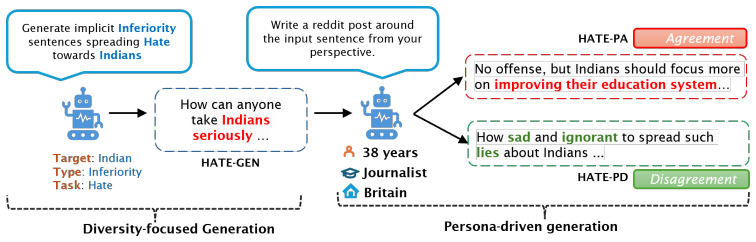
The framework's central mechanism is a two-step generation pipeline. The first step, diversity-focused generation, varies Task (HATE-GEN, FACT-GEN, MIS-GEN, SLHM-GEN, SXL-GEN), Target (over 300 social groups and topics drawn from existing datasets), and Type (e.g., Irony, Incitement, White Grievance, Inferiority for hate; implicit vs explicit for sexual content) to create base statements. The second step, persona-driven generation, takes each base statement and asks GPT-4 Turbo to write a Twitter- or Reddit-style post from a predefined persona who is prompted to agree (PA) or disagree (PD) with the statement. The prompt instruction fixes the gold label, HATE-PA meaning the persona was told to agree and HATE-PD meaning told to disagree, so the benchmark measures whether a classifier reproduces the generator's intended stance. For FACT and MIS, personas are defined by profession, social belief, and political belief, with labels such as FACT-PD and MIS-PA marking stances toward factual or false content.
What would settle it
Take a random sample of, say, 500 posts from the HATE-PA and HATE-PD sets, remove the PA/PD labels, and have independent human annotators from varied backgrounds judge whether each post is hateful or harmful. If human labels agree only weakly with the prompt-assigned classes, or if agreement differs across personas, then the benchmark's accuracy numbers are not measuring real moderation difficulty and the 'harder than diversity-focused' conclusion would need to be re-examined against human-validated labels.
Extended reading notes
Core claim
On its own terms, the paper claims that persona-based generation produces evaluation data that is more diverse and more challenging than diversity-focused generation without personas. Using 19 personas drawn from combinations of age, gender, religion, nationality, race, profession, sexual orientation, and immigrant status, and over 300 targets for hate plus additional misinformation and fact targets, the authors generate 11.4k persona-driven hate instances and comparable sets for fact/misinformation tasks. Zero-shot classification by GPT-3.5, GPT-3-xl, ChatGPT, Mistral, and Phi-3 shows lower accuracy on persona-driven sets than on diversity-focused sets, with the smallest models hurt most: Phi-3 reaches 19.5% on HATE-PD and 6.98% on MIS-PD, and GPT-3.5 reaches 10.9% on MIS-PD. The paper also demonstrates via word clouds and attribute prediction that personas influence content generation, with immigrant status and age group having the strongest measurable effect on hate content.
Load-bearing premise
The paper's accuracy numbers rest on the assumption that a generated post is harmful exactly when the persona was prompted to agree with it, with only a 100-sample human check to confirm.
Editorial extensions
If this is right
- Persona-driven sets can serve as stress tests that expose moderation failures that diversity-focused sets miss.
- Small open-weights models show large accuracy drops on disagreement classes, so deployments would need fine-tuning or fallback strategies for such content.
- Persona attributes measurably change generated text, so moderation accuracy should be reported per persona group rather than as a single average.
- The two-step pipeline gives benchmark builders a minimal-annotation recipe for generating diverse evaluation data.
Reading between the lines
- Because labels are assigned by prompt instruction, the reported accuracy should be read as agreement with the generator's intended stance, not as agreement with independent human judgments of harm.
- The same Task/Target/Type × Persona grid could be extended to multilingual settings to test whether the difficulty transfers across languages.
- The attribute-prediction probe offers a general way to verify when a synthetic-data variable actually shapes output, usable beyond content moderation.
- Reporting per-persona accuracy would likely reveal that some personas are systematically harder than others, a testable extension of the paper's results.
Editorial analysis
A structured set of objections, weighed in public.
Referee Report
Summary. The paper proposes a two-stage synthetic-data pipeline for content-moderation evaluation: first, diversity-focused generation using GPT-4 Turbo across five tasks (hate, misinformation, fact, self-harm, sexual content) with variations in task, target, and type; second, persona-driven generation in which GPT-4 Turbo, conditioned on a persona description, produces agreement/disagreement posts labeled HATE-PA/HATE-PD, FACT-PA/FACT-PD, or MIS-PA/MIS-PD. The authors evaluate five LLMs zero-shot on both sets and report accuracy. The central claim is that the persona-driven datasets provide broader perspectives and pose greater challenges for LLMs than diversity-focused generation without personas, with the challenge especially pronounced in smaller LLMs.
Significance. The paper has useful ingredients: a broad target set (300+ hate targets, many misinformation topics, 125 adult entities, and numerous suicide methods), explicit persona definitions in the appendix, a scalable generation approach, and a good-faith attempt to include non-GPT evaluators such as Mistral and Phi3 to mitigate generator-evaluator bias. If the evaluation were properly controlled and the labels independently validated, the resulting benchmark could be a valuable stress test for LLM content moderation. However, in the current form the central claim is not established: the comparison between diversity-focused and persona-driven sets is confounded, and the reference labels are prompt-assigned rather than independently verified. The framework is therefore not yet demonstrated to be a reliable content-moderation evaluation tool.
major comments (5)
- [Abstract; Tables 6-8] The headline comparison is not controlled. HATE-GEN (Table 6) is single-class: every example is hateful by construction, so accuracy is essentially positive-class recall and the majority-class baseline is 100%. The persona-driven condition introduces HATE-PD, a class of safe counter-speech by construction, giving a different label distribution; FACT-GEN versus FACT-PA/FACT-PD and MIS-GEN versus MIS-PA/MIS-PD similarly differ in label semantics. The two conditions also use different target lists (Table 12 vs. Table 23) and different generation prompts (Appendix A.3 vs. A.4). Lower accuracy on the persona-driven rows cannot therefore be attributed to the persona mechanism. A controlled comparison that fixes class balance, targets, and prompts and reports macro-F1 or false-positive/false-negative rates is required. The abstract's additional claim that the challenge is 'especially pronounced in smaller LLMs' rests on point estimates in Table 8 with no confidence intervals or significance tests, and the ranking is not consistent across tasks.
- [Sections 3.2 and 5] The reference labels for the persona-driven sets are assigned by the generation prompt (agree implies HATE-PA, disagree implies HATE-PD, and similarly for FACT and MIS), and Table 8 scores models against these intended labels. This measures agreement with GPT-4 Turbo's generation conditions, not agreement with independent human judgments of harm. The validation described in Section 5 is a single sentence: 100 random samples, 98.3% accuracy, and Cohen's kappa 0.978, without stating the reference standard, the sampling procedure, or per-task breakdown. For a benchmark of tens of thousands of examples spanning 300+ targets and 34 personas, this is insufficient support for treating the prompt-assigned labels as ground truth for content-moderation evaluation.
- [Sections 1 and 3.2] The paper's scope is narrower than the abstract implies. The introduction claims a framework covering hate speech, misinformation, sexual content, and self-harm, but persona-driven generation explicitly excludes SLHM-GEN and SXL-GEN because 'societal biases tend to have a lesser impact' on those topics. The claimed 'greater challenges' finding, even if established, applies only to hate, factual, and misinformation tasks. The abstract's unqualified statement overclaims the breadth of the framework, and the exclusion is not empirically justified.
- [Section 6; Figures 2a-2b] The persona-influence analysis is self-referential. GPT-4 Turbo generated the statements from explicit persona descriptions, and GPT-4 Turbo is then used to predict the persona attributes from those same statements. High prediction accuracy may reflect prompt adherence or surface cues rather than a measurable causal influence of the attribute on content. No human baseline or held-out generator is provided, and the 5% exclusion threshold is not justified. The conclusions about which attributes 'exhibit the highest influence' are therefore not established.
- [Section 5; Table 5] The dataset statistics are internally inconsistent. Section 5 states that 600 instances from HATE-GEN are combined with 19 personas to produce 11.4k instances, but Table 5 reports 15,423 HATE-PA/HATE-PD instances (8,671 + 6,752). The source of this discrepancy is unexplained and must be resolved before the benchmark can be reproduced or used for quantitative claims.
minor comments (5)
- [Section 5; Table 8] The evaluation protocol is underspecified: it is not stated what the expected output class is for each row (e.g., whether HATE-PD is to be classified as SAFE), nor whether per-row accuracy is computed as a binary task or from the full five-class prompt in Appendix A.5.
- [Table 4] The table caption says 'P18 persona is defined in Table 20,' but the rows use P12; the caption and table content should be aligned.
- [Section 6; Figure 4c] The category 'Intermediate' in Figure 4c is not defined in Tables 20-22; please clarify what this category represents or remove it.
- [Overall] No dataset or code release link is provided; for a benchmark contribution, a public release or an explicit availability plan is necessary for reproducibility.
- [Appendix A.5] The evaluation prompt defines five classes including SELF-HARM and SEXUAL, but the persona-driven experiments cover only HATE, FACT, and MIS; the paper should state how the extra classes were handled when computing accuracy for the persona-driven rows.
Circularity Check
Auxiliary persona-influence analysis is self-referential; the central benchmark claim is empirical, not circular.
-
self definitional
[Section 6, 'Analysis on Influence of Persona' (Figure 2)]
"We investigate the influence of persona on content generation by examining GPT-4 Turbo’s ability to predict personal attributes associated with a given statement (Staab et al., 2024). To minimize hallucinations and improve the reliability of predictions, we provide five distinct statements generated from the same persona. The accuracy of these predictions reflects the extent to which each persona attribute influences the content generation process, with higher accuracy indicating a stronger influence."
The attributes being predicted are exactly the attributes that were supplied in the generation prompt, and the predictor is the same model (GPT-4 Turbo) that generated the texts. High prediction accuracy therefore primarily measures how well GPT-4 can recover its own prompt-conditioned stylistic cues, i.e., the generator's self-consistency, rather than an independent estimate of how personas shape socio-cultural content. The paper's phrasing—'higher accuracy indicating a stronger influence'—presents this internal consistency as an external measurement, so the 'influence' conclusion is largely a restatement of the construction procedure.
full rationale
The main benchmark claim—that persona-driven datasets pose greater challenges than diversity-focused ones—rests on empirical accuracy comparisons (Tables 6 vs 8) and is not circular: a perfect classifier would score 100 on the persona-driven sets, so the low HATE-PD accuracy is not logically forced by the label definitions. The more serious problems are experimental confounds (all-hate HATE-GEN vs. a mixed PA/PD set, different target lists, different prompts) and reliance on prompt-assigned labels with only a 100-sample human check; these are validity and annotation concerns, not circularity in the derivation. The one genuinely self-referential element is the auxiliary persona-influence analysis, where GPT-4 Turbo both generates the texts and predicts the attributes used to generate them. Because that analysis is secondary and the central claim retains independent empirical content, the circularity score is moderate rather than high.
Assumptions & free parameters
free parameters (3)
- Number of personas for HATE-GEN =
19
- Instances sampled from HATE-GEN for persona generation =
600
- Attribute prediction exclusion threshold =
< 5%
assumptions (5)
- domain assumption Persona agreement and disagreement labels assigned by prompt instructions are valid ground truth for content moderation.
- domain assumption The five-category rubric (HATE, MISINFORMATION, SELF-HARM, SEXUAL, SAFE) is a sufficient operationalization of content moderation.
- domain assumption GPT-4 Turbo reliably generates accurate and diverse content across all 300 targets.
- domain assumption Token-overlap and word-cloud statistics are adequate measures of socio-cultural diversity.
- domain assumption The preliminary 100-sample evaluation is representative of the full dataset.
Cite this review
Pith. "Pith review of Socio-Culturally Aware Evaluation Framework for LLM-Based Content Moderation." pith.science (2026). https://pith.science/paper/JMTNEIRB
@misc{pith2026241213578,
  author       = {Pith},
  title        = {Pith review of: Socio-Culturally Aware Evaluation Framework for LLM-Based Content Moderation},
  year         = {2026},
  howpublished = {\url{https://pith.science/paper/JMTNEIRB}},
  note         = {Machine review of arXiv:2412.13578}
}
read the original abstract
With the growth of social media and large language models, content moderation has become crucial. Many existing datasets lack adequate representation of different groups, resulting in unreliable assessments. To tackle this, we propose a socio-culturally aware evaluation framework for LLM-driven content moderation and introduce a scalable method for creating diverse datasets using persona-based generation. Our analysis reveals that these datasets provide broader perspectives and pose greater challenges for LLMs than diversity-focused generation methods without personas. This challenge is especially pronounced in smaller LLMs, emphasizing the difficulties they encounter in moderating such diverse content.
Figures


Figures from the paper (8 more)


Reference graph
Works this paper leans on
-
[1]
online" 'onlinestring :=
ENTRY address archivePrefix author booktitle chapter edition editor eid eprint eprinttype howpublished institution journal key month note number organization pages publisher school series title type volume year doi pubmed url lastchecked label extra.label sort.label short.list INTEGERS output.state before.all mid.sentence after.sentence after.block STRING...
-
[2]
write newline
" write newline "" before.all 'output.state := FUNCTION n.dashify 't := "" t empty not t #1 #1 substring "-" = t #1 #2 substring "--" = not "--" * t #2 global.max substring 't := t #1 #1 substring "-" = "-" * t #2 global.max substring 't := while if t #1 #1 substring * t #2 global.max substring 't := if while FUNCTION word.in bbl.in capitalize " " * FUNCT...
-
[3]
Marah Abdin, Sam Ade Jacobs, Ammar Ahmad Awan, Jyoti Aneja, Ahmed Awadallah, Hany Awadalla, Nguyen Bach, Amit Bahree, Arash Bakhtiari, Harkirat Behl, et al. 2024. Phi-3 technical report: A highly capable language model locally on your phone. arXiv preprint arXiv:2404.14219
arXiv 2024
-
[4]
Falwah Alhamed, Julia Ive, and Lucia Specia. 2024. https://aclanthology.org/2024.clpsych-1.22 Using large language models ( LLM s) to extract evidence from pre-annotated social media data . In Proceedings of the 9th Workshop on Computational Linguistics and Clinical Psychology (CLPsych 2024), pages 232--237, St. Julians, Malta. Association for Computation...
work page 2024
-
[5]
Tom Brown, Benjamin Mann, Nick Ryder, Melanie Subbiah, Jared D Kaplan, Prafulla Dhariwal, Arvind Neelakantan, Pranav Shyam, Girish Sastry, Amanda Askell, Sandhini Agarwal, Ariel Herbert-Voss, Gretchen Krueger, Tom Henighan, Rewon Child, Aditya Ramesh, Daniel Ziegler, Jeffrey Wu, Clemens Winter, Chris Hesse, Mark Chen, Eric Sigler, Mateusz Litwin, Scott Gr...
2020
-
[6]
S \'e bastien Bubeck, Varun Chandrasekaran, Ronen Eldan, Johannes Gehrke, Eric Horvitz, Ece Kamar, Peter Lee, Yin Tat Lee, Yuanzhi Li, Scott Lundberg, et al. 2023. Sparks of artificial general intelligence: Early experiments with gpt-4. arXiv preprint arXiv:2303.12712
arXiv 2023
-
[7]
Tommaso Caselli, Valerio Basile, Jelena Mitrovi \'c , and Michael Granitzer. 2021. https://doi.org/10.18653/v1/2021.woah-1.3 H ate BERT : Retraining BERT for abusive language detection in E nglish . In Proceedings of the 5th Workshop on Online Abuse and Harms (WOAH 2021), pages 17--25, Online. Association for Computational Linguistics
-
[8]
Myra Cheng, Esin Durmus, and Dan Jurafsky. 2023. https://doi.org/10.18653/v1/2023.acl-long.84 Marked personas: Using natural language prompts to measure stereotypes in language models . In Proceedings of the 61st Annual Meeting of the Association for Computational Linguistics (Volume 1: Long Papers), pages 1504--1532, Toronto, Canada. Association for Comp...
Show all 48 references
-
[9]
Ke-Li Chiu, Annie Collins, and Rohan Alexander. 2022. https://arxiv.org/abs/2103.12407 Detecting hate speech with gpt-3 . Preprint, arXiv:2103.12407
2022 arXiv
-
[10]
Thomas Davidson, Debasmita Bhattacharya, and Ingmar Weber. 2019. https://doi.org/10.18653/v1/W19-3504 Racial bias in hate speech and abusive language detection datasets . In Proceedings of the Third Workshop on Abusive Language Online, pages 25--35, Florence, Italy. Associatio...
2019 doi
-
[11]
Fabio Del Vigna12, Andrea Cimino23, Felice Dell’Orletta, Marinella Petrocchi, and Maurizio Tesconi. 2017. Hate me, hate me not: Hate speech detection on facebook. In Proceedings of the first Italian conference on cybersecurity (ITASEC17), pages 86--95
2017
-
[12]
Thomas Diggelmann, Jordan Boyd-Graber, Jannis Bulian, Massimiliano Ciaramita, and Markus Leippold. 2021. https://arxiv.org/abs/2012.00614 Climate-fever: A dataset for verification of real-world climate claims . Preprint, arXiv:2012.00614
2021 arXiv
-
[13]
Mai ElSherief, Caleb Ziems, David Muchlinski, Vaishnavi Anupindi, Jordyn Seybolt, Munmun De Choudhury, and Diyi Yang. 2021. https://doi.org/10.18653/v1/2021.emnlp-main.29 Latent hatred: A benchmark for understanding implicit hate speech . In Proceedings of the 2021 Conference ...
2021 doi
-
[14]
Haimson, Daniel Delmonaco, Peipei Nie, and Andrea Wegner
Oliver L. Haimson, Daniel Delmonaco, Peipei Nie, and Andrea Wegner. 2021. https://doi.org/10.1145/3479610 Disproportionate removals and differing content moderation experiences for conservative, transgender, and black social media users: Marginalization and moderation gray are...
2021 doi
-
[15]
Thomas Hartvigsen, Saadia Gabriel, Hamid Palangi, Maarten Sap, Dipankar Ray, and Ece Kamar. 2022. Toxigen: A large-scale machine-generated dataset for implicit and adversarial hate speech detection. In Proceedings of the 60th Annual Meeting of the Association for Computational...
2022
-
[16]
Beizhe Hu, Qiang Sheng, Juan Cao, Yuhui Shi, Yang Li, Danding Wang, and Peng Qi. 2024. https://doi.org/10.1609/aaai.v38i20.30214 Bad actor, good advisor: Exploring the role of large language models in fake news detection . Proceedings of the AAAI Conference on Artificial Intel...
2024 doi
-
[17]
Tao Huang. 2024. https://arxiv.org/abs/2409.03219 Content moderation by llm: From accuracy to legitimacy . Preprint, arXiv:2409.03219
2024 arXiv
-
[18]
Sadar Jaf and Basel Barakat. 2024. https://arxiv.org/abs/2407.12018 Empirical evaluation of public hatespeech datasets . Preprint, arXiv:2407.12018
2024 arXiv
-
[19]
Albert Q Jiang, Alexandre Sablayrolles, Arthur Mensch, Chris Bamford, Devendra Singh Chaplot, Diego de las Casas, Florian Bressand, Gianna Lengyel, Guillaume Lample, Lucile Saulnier, et al. 2023. Mistral 7b. arXiv preprint arXiv:2310.06825
2023 arXiv
-
[20]
Chris J Kennedy, Geoff Bacon, Alexander Sahn, and Claudia von Vacano. 2020. Constructing interval variables via faceted rasch measurement and multitask deep learning: a hate speech application. arXiv preprint arXiv:2009.10277
2020 arXiv
-
[21]
Sahas Koka, Anthony Vuong, and Anish Kataria. 2024. https://arxiv.org/abs/2406.06584 Evaluating the efficacy of large language models in detecting fake news: A comparative analysis . Preprint, arXiv:2406.06584
2024 arXiv
-
[22]
Deepak Kumar, Yousef AbuHashem, and Zakir Durumeric. 2024. https://arxiv.org/abs/2309.14517 Watch your language: Investigating content moderation with large language models . Preprint, arXiv:2309.14517
2024 arXiv
-
[23]
Deepak Kumar, Patrick Gage Kelley, Sunny Consolvo, Joshua Mason, Elie Bursztein, Zakir Durumeric, Kurt Thomas, and Michael Bailey. 2021. https://arxiv.org/abs/2106.04511 Designing toxic content classification for a diversity of perspectives . Preprint, arXiv:2106.04511
2021 arXiv
-
[24]
Soveatin Kuntur, Anna Wróblewska, Marcin Paprzycki, and Maria Ganzha. 2024. https://arxiv.org/abs/2407.02122 Fake news detection: It's all in the data! Preprint, arXiv:2407.02122
2024
-
[25]
Louis Kwok, Michal Bravansky, and Lewis D. Griffin. 2024. https://arxiv.org/abs/2408.06929 Evaluating cultural adaptability of a large language model via simulation of synthetic personas . Preprint, arXiv:2408.06929
2024 arXiv
-
[26]
Nayeon Lee, Chani Jung, Junho Myung, Jiho Jin, Juho Kim, and Alice Oh. 2023 a . Crehate: Cross-cultural re-annotation of english hate speech dataset. arXiv preprint arXiv:2308.16705
2023 arXiv
-
[27]
Nayeon Lee, Chani Jung, and Alice Oh. 2023 b . https://doi.org/10.18653/v1/2023.c3nlp-1.5 Hate speech classifiers are culturally insensitive . In Proceedings of the First Workshop on Cross-Cultural Considerations in NLP (C3NLP), pages 35--46, Dubrovnik, Croatia. Association fo...
2023 doi
-
[28]
Lingyao Li, Lizhou Fan, Shubham Atreja, and Libby Hemphill. 2024. https://doi.org/10.1145/3643829 “hot” chatgpt: The promise of chatgpt in detecting and discriminating hateful, offensive, and toxic comments on social media . ACM Transactions on the Web, 18(2):1–36
2024 doi
-
[29]
Ye Liu, Jiajun Zhu, Kai Zhang, Haoyu Tang, Yanghai Zhang, Xukai Liu, Qi Liu, and Enhong Chen. 2024 a . https://arxiv.org/abs/2407.08952 Detect, investigate, judge and determine: A novel llm-based framework for few-shot fake news detection . Preprint, arXiv:2407.08952
2024 arXiv
-
[30]
Yiqi Liu, Nafise Sadat Moosavi, and Chenghua Lin. 2024 b . https://arxiv.org/abs/2311.09766 Llms as narcissistic evaluators: When ego inflates evaluation scores . Preprint, arXiv:2311.09766
2024 arXiv
-
[31]
Huan Ma, Changqing Zhang, Huazhu Fu, Peilin Zhao, and Bingzhe Wu. 2024. https://arxiv.org/abs/2310.03400 Adapting large language models for content moderation: Pitfalls in data engineering and supervised fine-tuning . Preprint, arXiv:2310.03400
2024 arXiv
-
[32]
Binny Mathew, Punyajoy Saha, Seid Muhie Yimam, Chris Biemann, Pawan Goyal, and Animesh Mukherjee. 2021. Hatexplain: A benchmark dataset for explainable hate speech detection. In Proceedings of the AAAI Conference on Artificial Intelligence, volume 35, pages 14867--14875
2021
-
[33]
Alessandro Miani, Thomas Hills, and Adrian Bangerter. 2021. https://doi.org/10.3758/s13428-021-01698-z Loco: The 88-million-word language of conspiracy corpus . Behavior Research Methods, 54
2021 doi
-
[34]
Sagnik Mukherjee, Muhammad Farid Adilazuarda, Sunayana Sitaram, Kalika Bali, Alham Fikri Aji, and Monojit Choudhury. 2024. https://arxiv.org/abs/2406.11661 Cultural conditioning or placebo? on the effectiveness of socio-demographic prompting . Preprint, arXiv:2406.11661
2024 arXiv
-
[35]
Thanh Thi Nguyen, Campbell Wilson, and Janis Dalins. 2023. https://arxiv.org/abs/2308.14683 Fine-tuning llama 2 large language models for detecting online sexual predatory chats and abusive texts . Preprint, arXiv:2308.14683
2023 arXiv
-
[36]
OpenAI. 2023. https://arxiv.org/abs/2303.08774 Gpt-4 technical report . Preprint, arXiv:2303.08774
2023 arXiv
-
[37]
Flor Miriam Plaza-del arco, Debora Nozza, and Dirk Hovy. 2023. https://doi.org/10.18653/v1/2023.woah-1.6 Respectful or toxic? using zero-shot learning with language models to detect hate speech . In The 7th Workshop on Online Abuse and Harms (WOAH), pages 60--68, Toronto, Cana...
2023 doi
-
[38]
Kristina Radivojevic, Nicholas Clark, and Paul Brenner. 2024. https://arxiv.org/abs/2402.07940 Llms among us: Generative ai participating in digital discourse . Preprint, arXiv:2402.07940
2024 arXiv
-
[39]
Smith, and Yejin Choi
Maarten Sap, Saadia Gabriel, Lianhui Qin, Dan Jurafsky, Noah A. Smith, and Yejin Choi. 2020. https://doi.org/10.18653/v1/2020.acl-main.486 Social bias frames: Reasoning about social and power implications of language . In Proceedings of the 58th Annual Meeting of the Associati...
2020 doi
-
[40]
Robin Staab, Mark Vero, Mislav Balunović, and Martin Vechev. 2024. https://arxiv.org/abs/2310.07298 Beyond memorization: Violating privacy via inference with large language models . Preprint, arXiv:2310.07298
2024 arXiv
-
[41]
James Thorne, Andreas Vlachos, Christos Christodoulopoulos, and Arpit Mittal. 2018. https://arxiv.org/abs/1803.05355 Fever: a large-scale dataset for fact extraction and verification . Preprint, arXiv:1803.05355
2018 arXiv
-
[42]
Petter Törnberg, Diliara Valeeva, Justus Uitermark, and Christopher Bail. 2023. https://arxiv.org/abs/2310.05984 Simulating social media using large language models to evaluate alternative news feed algorithms . Preprint, arXiv:2310.05984
2023 arXiv
-
[43]
Collins Udanor and Chinatu C Anyanwu. 2019. Combating the challenges of social media hate speech in a polarized society: A twitter ego lexalytics approach. Data Technologies and Applications, 53(4):501--527
2019
-
[44]
Michael Wiegand, Josef Ruppenhofer, and Elisabeth Eder. 2021. https://doi.org/10.18653/v1/2021.naacl-main.48 Implicitly abusive language -- what does it actually look like and why are we not getting there? In Proceedings of the 2021 Conference of the North American Chapter of ...
2021 doi
-
[45]
Wenjie Yin and Arkaitz Zubiaga. 2021. https://arxiv.org/abs/2102.08886 Towards generalisable hate speech detection: a review on obstacles and solutions . Preprint, arXiv:2102.08886
2021 arXiv
-
[46]
Zehui Yu, Indira Sen, Dennis Assenmacher, Mattia Samory, Leon Fröhling, Christina Dahn, Debora Nozza, and Claudia Wagner. 2024. https://doi.org/10.1177/08944393241258771 The unseen targets of hate: A systematic review of hateful communication datasets . Social Science Computer Review
2024 doi
-
[47]
Hanna Yukhymenko, Robin Staab, Mark Vero, and Martin Vechev. 2024. https://arxiv.org/abs/2406.07217 A synthetic dataset for personal attribute inference . Preprint, arXiv:2406.07217
2024 arXiv
-
[48]
Min Zhang, Jianfeng He, Taoran Ji, and Chang-Tien Lu. 2024. https://arxiv.org/abs/2402.11406 Don't go to extremes: Revealing the excessive sensitivity and calibration limitations of llms in implicit hate speech detection . Preprint, arXiv:2402.11406
2024 arXiv
Reviewed August 11, 2026 · model on record in the stance chip above.
Discussion (0). Continue with ORCID to comment.