REVIEW 4 major objections 7 minor 63 references
AI-Powered Algorithm-Centric Quantum Processor Topology Design
T0 review · 4 major / 7 minor · reviewed 2026-08-11 · deepseek-v4-flash
Pith's one-line read A reinforcement learning framework designs a degree-4 qubit topology for each quantum circuit and cuts compiled circuit depth by up to 46% compared with a fixed 100-qubit grid, with gains increasing as circuits grow.
desk verdict Useful RL formulation for algorithm-specific qubit topologies, but the 20–46% depth claims rest on an unfair 100-node versus n-node comparison. read the letter →
The pith
A machine-rendered reading of the paper's core claim, the machinery that carries it, and where it could break.
The reading
What carries the argument
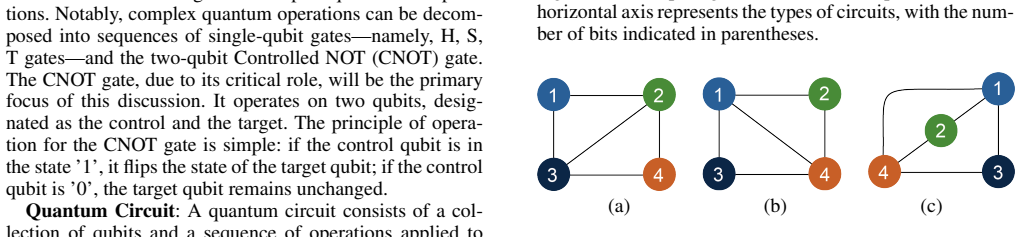
The machinery is a graph-building Markov decision process. The state is the flattened adjacency matrix of the partial topology; each action selects one unordered qubit pair to connect; the reward is the relative depth improvement of the circuit compiled on the updated graph. Training uses Proximal Policy Optimization augmented with a Reward-Replay cache that reuses the reward of a previously evaluated edge action, treating r(a) as an approximation to r(s,a), with a replay threshold that forgets old entries to prevent error accumulation. A force-directed grid layout then converts the learned graph into a layout with grid-aligned qubits and reduced edge crossings, making the design manufacturable in the grid-like architectures common for superconducting processors.
What would settle it
Map the same benchmark circuits with the same compiler onto a fixed degree-4 grid with exactly n nodes, one per circuit qubit, instead of a 10x10 grid, and compare depths; if Qtailor's advantage over that equal-size baseline falls below the claimed 20 to 46 percent range, the baseline asymmetry explains the result.
Extended reading notes
Core claim
The central discovery is that the topology itself, not just the mapping, is a tunable resource that an RL agent can exploit. The paper formalizes topology design as minimizing mapped circuit depth over all graphs with maximum vertex degree 4, and lets the agent decide, one edge at a time, which qubit pairs deserve a connection. The reward function combines the depth change relative to the initial graph and to the previous step, so the agent learns which edges matter most. The final graph is then embedded onto a grid by a force-directed layout that avoids wire crossings. Across circuits from a public benchmark suite, the resulting topologies beat a fixed 100-node square grid under the same degree bound on depth, total gate count, and estimated fidelity.
Load-bearing premise
The claim depends on treating a fixed 100-node grid as the standard baseline for comparison, even though Qtailor's tailored topologies use only as many qubits as the circuit under test; if a degree-4 topology with the same number of nodes were the baseline, the reported 20 to 46 percent depth reductions could be smaller or disappear.
Editorial extensions
If this is right
- If the central claim holds, processor designers can co-design a qubit layout for a known workload instead of assuming a universal grid.
- Larger circuits should see larger depth savings, so the benefit is not confined to toy examples.
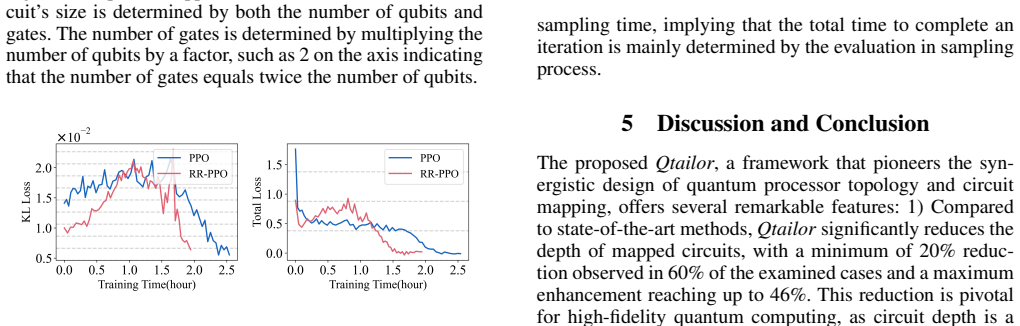
- Because the reward function can be re-targeted, the same framework can optimize gate count or fidelity rather than depth alone, with reported gate reductions of 4.78 to 36.39 percent.
- The reward-replay cache cuts training time, making the search affordable enough to repeat for many circuits.
- The force-directed grid embedding keeps the learned topologies compatible with fabricated superconducting processors.
Reading between the lines
- Editorial inference: a fairer and stricter baseline would be a fixed degree-4 topology on exactly the same n qubits the circuit uses; the paper's baseline grid has 100 nodes for every circuit, so part of the measured gain may come from that asymmetry rather than from genuine tailoring.
- Editorial inference: the reward-replay approximation r(s,a) is approximately r(a) is plausible when an edge's value does not depend on which other edges exist, but it could mislead when edge benefits interact; the forgetting threshold limits but does not remove this bias.
- Editorial inference: the same machinery could be applied to noise-aware design by replacing depth with calibration-based error rates in the reward, a direction the paper only gestures at.
- Editorial inference: in practice, the per-circuit search cost needs amortization, for example across parametrized families of circuits, for the method to be economical on real workloads.
Editorial analysis
A structured set of objections, weighed in public.
Referee Report
Summary. The paper proposes Qtailor, a reinforcement-learning framework that designs a degree-constrained (maximum degree 4) qubit topology for a given quantum circuit, then maps the circuit onto that topology. The RL agent uses PPO with a custom depth-reduction reward, a reward-replay approximation to avoid repeated circuit evaluations, and a force-directed grid layout to make the resulting topology manufacturable. The authors report depth reductions of up to 46% compared with Qiskit's Sabre mapper on a fixed 10x10 grid, a minimum 20% reduction in 60% of cases, gate-count reductions of 4.78-36.39%, fidelity improvements on small ansatz circuits, and faster training with reward-replay.
Significance. If the reported gains survive a fair control condition, the paper would make a useful conceptual contribution: co-designing processor topology with a target algorithm is a plausible and relatively underexplored direction for NISQ compilation. The strengths include a public code repository, a cross-compiler check with tket (Appendix A.3), and a concrete manufacturing-oriented layout post-processing step. However, the central experimental claim is currently supported only by a comparison against a mismatched fixed baseline, and the evaluation does not separate the fitted training objective from a predictive claim. The significance of the paper therefore depends on whether the authors can repair the experimental protocol with a size-matched fixed topology and held-out circuit evaluation.
major comments (4)
- [Section 4.1, Evaluation Protocol] The baseline is not size-matched. Qtailor searches over graphs with exactly n vertices, one per circuit qubit (Section 2.1), while Sabre is given a 100-node 10x10 grid for every benchmark circuit regardless of n. A 100-node degree-4 graph has far larger diameter and routing distances than an n-node degree-4 graph, so the 20-46% depth reductions in Figure 5 and Table 1 may be largely due to node-count mismatch rather than to algorithm-tailored connectivity. The authors should add a same-size fixed baseline (e.g., an n-node 4-regular grid or circulant graph routed by Sabre) and report the number of qubits for every benchmark circuit.
- [Sections 4.2-4.3, RQ1/RQ2] No held-out evaluation is described. The reward function in Eq. (4) is exactly a function of the depth reduction on the circuits being optimized, and Figures 5 and 8 appear to report results on the same circuits used during training. The reported depth reductions are therefore fitted values of the optimized objective rather than predictions. To support the claim that tailoring topologies generalizes, the authors should train on one set of circuits and evaluate on a disjoint set, or at minimum compare against non-learned tailored topologies such as a 4-regular graph optimized by a greedy edge-insertion heuristic.
- [Section 2.2, Reward-Replay PPO] The central approximation r(a,s) ≈ r(a) is asserted from a 'notable observation' but no quantitative evidence is provided. If this approximation is poor for some edges, replayed rewards can systematically bias the policy. The authors should show the empirical distribution of r(s,a) for a fixed action a across many states, and provide a sensitivity analysis of the replay threshold; the current ablation (Figure 9) demonstrates only a training-time speedup, not that the final topology quality is unchanged by the approximation.
- [Section 4.1 and Section 4.2] The paper reports only three-run averages for depth and gives no error bars, confidence intervals, or number of RL seeds for any result. Given that Qiskit's Sabre routing is randomized and PPO training is stochastic, the abstract's claim that '60% of cases' show at least a 20% reduction needs statistical support. In addition, the fidelity computation of Eq. (6) and Figure 7 omits the noise model entirely (gate error rates, decoherence times, or error channels), so the fidelity improvements are not reproducible.
minor comments (7)
- [Section 2.1, Eq. (1)] Equation (1) writes min f(G,c) but the earlier text defines f_depth(G,c); the notation should be made consistent. Also, 'e ⊆ E' should be 'e ∈ E', because an edge is an element of the edge set, not a subset.
- [Section 2.1, action space] The action is written as ⟨vi, vj⟩ while the graph is undirected; the paper should clarify whether both orientations are valid actions and how the symmetry of the adjacency matrix is handled in the action space.
- [Section 3, Force-directed grid layout] The constants k1 and k2, the grid-attraction coefficient, and the number of iterations are not specified; these parameters determine the quality of the layout and should be reported for reproducibility.
- [Table 1] The caption refers to 'statistics ... of the line' and the column 'Idle(%)' is used before the idle-ratio formula in Eq. (5) is properly introduced; please define the metric in the main text before the table.
- [Appendix A.3] There is a typo: 'Tekt' should be 'tket', and the paper is inconsistent in capitalizing 'Qtailor' versus 'QTailor' throughout.
- [Appendix A.4] The text says the graphs satisfy 'the aforementioned five conditions', but only three conditions are listed; the count should be corrected or the remaining conditions added.
- [Appendix A.5, Table 2] The replay threshold, which is a key hyperparameter of reward-replay, is not listed in the hyperparameter table; please report its value and how it was chosen.
Circularity Check
No circularity: Qtailor's depth reductions are optimization outcomes, not fitted predictions; baseline asymmetry is a validity concern, not a circular step.
full rationale
Qtailor's central claim is an optimization result, not a prediction from a fitted parameter. The objective in Eq. (1) is to minimize fdepth(G, c) over topologies G with degree ≤ 4, and the reward in Eq. (4) guides that search. The depth reductions reported in Figures 5 and Table 1 are measurements of this optimized objective on the benchmark circuits, rather than held-out predictions derived from a fitted input. The reward function does not by construction force the reported margin over the Sabre baseline: beating Sabre is not part of the reward, and the final reduction is an empirical comparison between an optimized n-node topology and a fixed 100-node grid. The Tket experiment in Appendix A.3 provides an independent cross-compiler check of the same designed topologies, which weakens any claim that the reported gains are merely the training objective re-reported. The asymmetry between Qtailor's n-node topologies and the 100-node Sabre baseline is a real experimental-design concern about fairness and external validity, but it is not a circularity: it does not make the conclusion equivalent to the inputs by definition. The paper contains no load-bearing self-citation, no imported uniqueness theorem, and no ansatz smuggled in via citation. Self-citations in the introduction and related work are background only. Therefore no specific circular step can be exhibited under the required standard.
Assumptions & free parameters
free parameters (4)
- Sabre baseline grid size =
10x10 (100 nodes)
- Replay threshold =
not specified (example mentions 2)
- Force-directed layout constants =
not specified (k1, k2, iteration count)
- Maximum connectivity degree =
4
assumptions (5)
- domain assumption Qiskit's depth calculation fdepth is a valid objective and is used both as the RL reward and the evaluation metric.
- ad hoc to paper The reward for adding an edge is approximately state-independent: r(a,s) ≈ r(a).
- domain assumption Benchmark circuits from MQT Bench are representative of quantum workloads and were not cherry-picked.
- domain assumption The force-directed grid layout preserves the graph's connectivity while reducing edge crossings.
- domain assumption Reducing circuit depth and gate count improves fidelity on real devices under the model of Eq. (6).
Cite this review
Pith. "Pith review of AI-Powered Algorithm-Centric Quantum Processor Topology Design." pith.science (2026). https://pith.science/paper/N3BAJYA6
@misc{pith2026241213805,
  author       = {Pith},
  title        = {Pith review of: AI-Powered Algorithm-Centric Quantum Processor Topology Design},
  year         = {2026},
  howpublished = {\url{https://pith.science/paper/N3BAJYA6}},
  note         = {Machine review of arXiv:2412.13805}
}
read the original abstract
Quantum computing promises to revolutionize various fields, yet the execution of quantum programs necessitates an effective compilation process. This involves strategically mapping quantum circuits onto the physical qubits of a quantum processor. The qubits' arrangement, or topology, is pivotal to the circuit's performance, a factor that often defies traditional heuristic or manual optimization methods due to its complexity. In this study, we introduce a novel approach leveraging reinforcement learning to dynamically tailor qubit topologies to the unique specifications of individual quantum circuits, guiding algorithm-driven quantum processor topology design for reducing the depth of mapped circuit, which is particularly critical for the output accuracy on noisy quantum processors. Our method marks a significant departure from previous methods that have been constrained to mapping circuits onto a fixed processor topology. Experiments demonstrate that we have achieved notable enhancements in circuit performance, with a minimum of 20\% reduction in circuit depth in 60\% of the cases examined, and a maximum enhancement of up to 46\%. Furthermore, the pronounced benefits of our approach in reducing circuit depth become increasingly evident as the scale of the quantum circuits increases, exhibiting the scalability of our method in terms of problem size. This work advances the co-design of quantum processor architecture and algorithm mapping, offering a promising avenue for future research and development in the field.
Figures


Figures from the paper (10 more)





Reference graph
Works this paper leans on
-
[1]
Abadi, M.; Agarwal, A.; Barham, P.; Brevdo, E.; Chen, Z.; Citro, C.; Corrado, G. S.; Davis, A.; Dean, J.; Devin, M.; Ghemawat, S.; Goodfellow, I.; Harp, A.; Irving, G.; Isard, M.; Jia, Y.; Jozefowicz, R.; Kaiser, L.; Kudlur, M.; Levenberg, J.; Man\' e , D.; Monga, R.; Moore, S.; Murray, D.; Olah, C.; Schuster, M.; Shlens, J.; Steiner, B.; Sutskever, I.; T...
work page 2015
-
[2]
C.; Barends, R.; Biswas, R.; Boixo, S.; Brandao, F
Arute, F.; Arya, K.; Babbush, R.; Bacon, D.; Bardin, J. C.; Barends, R.; Biswas, R.; Boixo, S.; Brandao, F. G. S. L.; Buell, D. A.; Burkett, B.; Chen, Y.; Chen, Z.; Chiaro, B.; Collins, R.; Courtney, W.; Dunsworth, A.; Farhi, E.; Foxen, B.; Fowler, A.; Gidney, C.; Giustina, M.; Graff, R.; Guerin, K.; Habegger, S.; Harrigan, M. P.; Hartmann, M. J.; Ho, A.;...
work page 2019
-
[3]
Bauer, B.; Bravyi, S.; Motta, M.; and Chan, G. K.-L. 2020. Quantum Algorithms for Quantum Chemistry and Quantum Materials Science . Chemical Reviews, 120(22): 12685--12717
work page 2020
-
[4]
J.; Salzmann, R.; Scheiermann, D.; and Wolf, R
Beer, K.; Bondarenko, D.; Farrelly, T.; Osborne, T. J.; Salzmann, R.; Scheiermann, D.; and Wolf, R. 2020. Training Deep Quantum Neural Networks. Nature Communications, 11(1): 808
work page 2020
-
[5]
Bhattacharjee, D.; and Chattopadhyay, A. 2017. Depth- Optimal Quantum Circuit Placement for Arbitrary Topologies . arxiv:1703.08540
arXiv 2017
-
[6]
Biamonte, J.; Wittek, P.; Pancotti, N.; Rebentrost, P.; Wiebe, N.; and Lloyd, S. 2017. Quantum Machine Learning. Nature, 549(7671): 195--202
work page 2017
-
[7]
Boixo, S.; Isakov, S. V.; Smelyanskiy, V. N.; Babbush, R.; Ding, N.; Jiang, Z.; Bremner, M. J.; Martinis, J. M.; and Neven, H. 2018. Characterizing quantum supremacy in near-term devices. Nature Physics, 14(6): 595--600
work page 2018
-
[8]
Burgholzer, L.; Schneider, S.; and Wille, R. 2022. Limiting the Search Space in Optimal Quantum Circuit Mapping . In 2022 27th Asia and South Pacific Design Automation Conference ( ASP-DAC ) , 466--471. Taipei, Taiwan: IEEE. ISBN 978-1-66542-135-5
work page 2022
Show all 63 references
-
[9]
P.; Degroote, M.; Johnson, P
Cao, Y.; Romero, J.; Olson, J. P.; Degroote, M.; Johnson, P. D.; Kieferov \'a , M.; Kivlichan, I. D.; Menke, T.; Peropadre, B.; Sawaya, N. P. D.; Sim, S.; Veis, L.; and Aspuru-Guzik , A. 2019. Quantum Chemistry in the Age of Quantum Computing . Chemical Reviews, 119(19): 10856--10915
2019
-
[10]
Contributors and IBM . 2024. Qiskit: an open-source SDK for working with quantum computers at the level of extended quantum circuits, operators, and primitives. https://github.com/Qiskit/qiskit
2024
-
[11]
W.; Javadi-Abhari , A.; Alexander, T.; de Beaudrap , N.; Bishop, L
Cross, A. W.; Javadi-Abhari , A.; Alexander, T.; de Beaudrap , N.; Bishop, L. S.; Heidel, S.; Ryan, C. A.; Sivarajah, P.; Smolin, J.; Gambetta, J. M.; and Johnson, B. R. 2022. OpenQASM 3: A Broader and Deeper Quantum Assembly Language. ACM Transactions on Quantum Computing, 3(...
2022
-
[12]
de Moura, L.; and Bj rner, N. 2008. Z3: An Efficient SMT Solver. In Ramakrishnan, C. R.; and Rehof, J., eds., Tools and Algorithms for the Construction and Analysis of Systems, 337--340. Berlin, Heidelberg: Springer Berlin Heidelberg. ISBN 978-3-540-78800-3
2008
-
[13]
Deutsch, D.; and Jozsa, R. 1997. Rapid Solution of Problems by Quantum Computation. Proceedings of the Royal Society of London. Series A: Mathematical and Physical Sciences, 439(1907): 553--558
1907
-
[14]
Ding, C.; Bao, T.-Y.; and Huang, H.-L. 2022. Quantum-Inspired Support Vector Machine. IEEE Transactions on Neural Networks and Learning Systems, 33(12): 7210--7222
2022
-
[15]
F.; Rines, R.; Propson, T.; and Chong, F
Ding, Y.; Gokhale, P.; Lin, S. F.; Rines, R.; Propson, T.; and Chong, F. T. 2020. Systematic Crosstalk Mitigation for Superconducting Qubits via Frequency-Aware Compilation. In 2020 53rd Annual IEEE/ACM International Symposium on Microarchitecture (MICRO), 201--214
2020
-
[16]
G.; and Pineau, J
François-Lavet, V.; Henderson, P.; Islam, R.; Bellemare, M. G.; and Pineau, J. 2018
2018
-
[17]
A.; Bultink, C
Fu, X.; Rol, M. A.; Bultink, C. C.; van Someren, J.; Khammassi, N.; Ashraf, I.; Vermeulen, R. F. L.; de Sterke, J. C.; Vlothuizen, W. J.; Schouten, R. N.; Almudever, C. G.; DiCarlo, L.; and Bertels, K. 2017. An experimental microarchitecture for a superconducting quantum proce...
2017
-
[18]
Huang, H.-L.; Du, Y.; Gong, M.; Zhao, Y.; Wu, Y.; Wang, C.; Li, S.; Liang, F.; Lin, J.; Xu, Y.; Yang, R.; Liu, T.; Hsieh, M.-H.; Deng, H.; Rong, H.; Peng, C.-Z.; Lu, C.-Y.; Chen, Y.-A.; Tao, D.; Zhu, X.; and Pan, J.-W. 2021. Experimental Quantum Generative Adversarial Networks...
2021
-
[19]
Huang, H.-L.; Wu, D.; Fan, D.; and Zhu, X. 2020. Superconducting Quantum Computing: A Review. Science China Information Sciences, 63(8): 180501
2020
-
[20]
Huang, H.-L.; Xu, X.-Y.; Guo, C.; Tian, G.; Wei, S.-J.; Sun, X.; Bao, W.-S.; and Long, G.-L. 2023. Near-term quantum computing techniques: Variational quantum algorithms, error mitigation, circuit compilation, benchmarking and classical simulation. Science China Physics, Mecha...
2023
-
[21]
IBM . 2022. CPLEX Optimization Studio. https://www.ibm.com/products/ilog-cplex-optimization-studio/cplex-optimizer
2022
-
[22]
Kobourov, S. G. 2012. Spring Embedders and Force Directed Graph Drawing Algorithms. CoRR, abs/1201.3011
2012 arXiv
-
[23]
Li, G.; Ding, Y.; and Xie, Y. 2019. Tackling the Qubit Mapping Problem for NISQ-Era Quantum Devices. ASPLOS '19, 1001–1014. New York, NY, USA: Association for Computing Machinery. ISBN 9781450362405
2019
-
[24]
D.; Clare , Z.; and Feng , Y
Li , S.; Nguyen , K. D.; Clare , Z.; and Feng , Y. 2023. Single-Qubit Gates Matter for Optimising Quantum Circuit Depth in Qubit Mapping . arXiv e-prints, arXiv:2308.00876
2023 arXiv
-
[25]
Li, S.; Zhou, X.; and Feng, Y. 2021. Qubit Mapping Based on Subgraph Isomorphism and Filtered Depth-Limited Search. IEEE Transactions on Computers, 70(11): 1777--1788
2021
-
[26]
E.; Jordan, M
Liang, E.; Liaw, R.; Moritz, P.; Nishihara, R.; Fox, R.; Goldberg, K.; Gonzalez, J. E.; Jordan, M. I.; and Stoica, I. 2018. RLlib : Abstractions for Distributed Reinforcement Learning . arxiv:1712.09381
2018 arXiv
-
[27]
Liu, J.; Li, P.; and Zhou, H. 2022. Not All SWAPs Have the Same Cost \: A Case for Optimization-Aware Qubit Routing . In 2022 IEEE International Symposium on High-Performance Computer Architecture ( HPCA ) , 709--725. IEEE. ISBN 978-1-66542-027-3
2022
-
[28]
H.; Wood, K
Liu, J.; Lim, K. H.; Wood, K. L.; Huang, W.; Guo, C.; and Huang, H.-L. 2021. Hybrid Quantum-Classical Convolutional Neural Networks . Science China Physics, Mechanics & Astronomy, 64(9): 290311
2021
-
[29]
Lye, A.; Wille, R.; and Drechsler, R. 2015. Determining the minimal number of swap gates for multi-dimensional nearest neighbor quantum circuits. In The 20th Asia and South Pacific Design Automation Conference, 178--183
2015
-
[30]
Moura, L.; and Bj rner, N. 2009. Satisfiability Modulo Theories: An Appetizer, 23–36. Berlin, Heidelberg: Springer-Verlag. ISBN 9783642104510
2009
-
[31]
MQT Bench . 2023. Brief Description of Benchmarks. https://www.cda.cit.tum.de/mqtbench/benchmark_description
2023
-
[32]
M.; Javadi-Abhari , A.; Chong, F
Murali, P.; Baker, J. M.; Javadi-Abhari , A.; Chong, F. T.; and Martonosi, M. 2019. Noise- Adaptive Compiler Mappings for Noisy Intermediate-Scale Quantum Computers . In Proceedings of the Twenty-Fourth International Conference on Architectural Support for Programming Language...
2019
-
[33]
S.; G\" u nl\" u k, O.; and Jurcevic, P
Nannicini, G.; Bishop, L. S.; G\" u nl\" u k, O.; and Jurcevic, P. 2022. Optimal Qubit Assignment and Routing via Integer Programming. ACM Transactions on Quantum Computing, 4(1)
2022
-
[34]
D.; and Treinish, M
Nation, P. D.; and Treinish, M. 2023. Suppressing Quantum Circuit Errors Due to System Variability . PRX Quantum, 4(1): 010327
2023
-
[35]
A.; and Chuang, I
Nielsen, M. A.; and Chuang, I. L. 2010. Quantum Computation and Quantum Information: 10th Anniversary Edition. Cambridge University Press
2010
-
[36]
Nishio, S.; Pan, Y.; Satoh, T.; Amano, H.; and Van Meter, R. 2020. Extracting Success from IBM 's 20- Qubit Machines Using Error-Aware Compilation . ACM Journal on Emerging Technologies in Computing Systems, 16(3): 1--25
2020
-
[37]
Oddi, A.; and Rasconi, R. 2018. Greedy Randomized Search for Scalable Compilation of Quantum Circuits. In van Hoeve, W.-J., ed., Integration of Constraint Programming, Artificial Intelligence, and Operations Research, 446--461. Cham: Springer International Publishing. ISBN 978...
2018
-
[38]
Quetschlich, N.; Burgholzer, L.; and Wille, R. 2023. MQT Bench : Benchmarking Software and Design Automation Tools for Quantum Computing. Quantum
2023
-
[39]
Sarovar, M.; Proctor, T.; Rudinger, K.; Young, K.; Nielsen, E.; and Blume-Kohout , R. 2020. Detecting Crosstalk Errors in Quantum Information Processors. Quantum, 4: 321
2020
-
[40]
Schlosshauer, M. 2019. Quantum decoherence. Physics Reports, 831: 1--57
2019
-
[41]
Schrijver, A. 1986. Theory of linear and integer programming. In Wiley-Interscience series in discrete mathematics and optimization
1986
-
[42]
Schulman, J.; Wolski, F.; Dhariwal, P.; Radford, A.; and Klimov, O. 2017. Proximal Policy Optimization Algorithms . arxiv:1707.06347
2017 arXiv
-
[43]
Shor, P. 1994. Algorithms for Quantum Computation: Discrete Logarithms and Factoring. In Proceedings 35th Annual Symposium on Foundations of Computer Science , 124--134. IEEE Comput. Soc. Press. ISBN 978-0-8186-6580-6
1994
-
[44]
Shor, P. W. 1997. Polynomial-Time Algorithms for Prime Factorization and Discrete Logarithms on a Quantum Computer. SIAM Journal on Computing, 26(5): 1484--1509
1997
-
[45]
Silver, D.; Schrittwieser, J.; Simonyan, K.; Antonoglou, I.; Huang, A.; Guez, A.; Hubert, T.; Baker, L.; Lai, M.; Bolton, A.; Chen, Y.; Lillicrap, T.; Hui, F.; Sifre, L.; van den Driessche , G.; Graepel, T.; and Hassabis, D. 2017. Mastering the Game of Go without Human Knowled...
2017
-
[46]
Y.; Santos, V
Siraichi, M. Y.; Santos, V. F. D.; Collange, C.; and Pereira, F. M. Q. 2018. Qubit Allocation. In Proceedings of the 2018 International Symposium on Code Generation and Optimization , 113--125. ACM. ISBN 978-1-4503-5617-6
2018
-
[47]
Y.; Santos, V
Siraichi, M. Y.; Santos, V. F. D.; Collange, C.; and Pereira, F. M. Q. 2019. Qubit Allocation as a Combination of Subgraph Isomorphism and Token Swapping. Proceedings of the ACM on Programming Languages, 3(OOPSLA): 1--29
2019
-
[48]
Sivarajah, S.; Dilkes, S.; Cowtan, A.; Simmons, W.; Edgington, A.; and Duncan, R. 2021. Tket : A Retargetable Compiler for NISQ Devices . 6(1): 014003
2021
-
[49]
S.; and Qureshi, M
Tannu, S. S.; and Qureshi, M. K. 2019. Not All Qubits Are Created Equal : A Case for Variability-Aware Policies for NISQ-Era Quantum Computers . In Proceedings of the Twenty-Fourth International Conference on Architectural Support for Programming Languages and Operating System...
2019
-
[50]
Venturelli, D.; Do, M.; Rieffel, E.; and Frank, J. 2017. Temporal Planning for Compilation of Quantum Approximate Optimization Circuits. In Proceedings of the Twenty-Sixth International Joint Conference on Artificial Intelligence, IJCAI-17 , 4440--4446
2017
-
[51]
Venturelli, D.; Do, M.; Rieffel, E.; and Frank, J. 2018. Compiling quantum circuits to realistic hardware architectures using temporal planners. Quantum Science and Technology, 3(2): 025004
2018
-
[52]
Wille, R.; Burgholzer, L.; and Zulehner, A. 2019. Mapping Quantum Circuits to IBM QX Architectures Using the Minimal Number of SWAP and H Operations . In Proceedings of the 56th Annual Design Automation Conference 2019 , 1--6. ACM. ISBN 978-1-4503-6725-7
2019
-
[53]
H.; Deng, H.; Du, Y.; Fan, D.; Gong, M.; Guo, C.; Guo, C.; Guo, S.; Han, L.-F.; Hong, L.; Huang, H.; Huo, Y.; Li, L.; Li, N.; Li, S.; Li, Y
Wu, Y.; Bao, W.; Cao, S.; Chen, F.; Chen, M.-C.; Chen, X.; Chung, T. H.; Deng, H.; Du, Y.; Fan, D.; Gong, M.; Guo, C.; Guo, C.; Guo, S.; Han, L.-F.; Hong, L.; Huang, H.; Huo, Y.; Li, L.; Li, N.; Li, S.; Li, Y. Y.; Liang, F.; Lin, C.; Lin, J.; Qian, H.; Qiao, D.; Rong, H.; Su, ...
2021
-
[54]
Zeng, W.; and Church, R. L. 2009. Finding shortest paths on real road networks: the case for A*. Int. J. Geogr. Inf. Sci., 23(4): 531–543
2009
-
[55]
Zhang, C.; Chen, Y.; Jin, Y.; Ahn, W.; Zhang, Y.; and Zhang, E. Z. 2020. A Depth-Aware Swap Insertion Scheme for the Qubit Mapping Problem . arxiv:2002.07289
2020 arXiv
-
[56]
B.; Qiu, L.; Jin, Y.; Chen, Y.; and Zhang, E
Zhang, C.; Hayes, A. B.; Qiu, L.; Jin, Y.; Chen, Y.; and Zhang, E. Z. 2021. Time-optimal Qubit mapping. In Proceedings of the 26th ACM International Conference on Architectural Support for Programming Languages and Operating Systems, ASPLOS '21, 360–374. New York, NY, USA: Ass...
2021
-
[57]
Zhang, H.; Wu, A.; Wang, Y.; Li, G.; Shapourian, H.; Shabani, A.; and Ding, Y. 2023. OneQ : A Compilation Framework for Photonic One-Way Quantum Computation . In Proceedings of the 50th Annual International Symposium on Computer Architecture , ISCA '23, 1--14. New York, NY, US...
2023
-
[58]
Zhou, X.; Feng, Y.; and Li, S. 2022. Quantum Circuit Transformation: A Monte Carlo Tree Search Framework. ACM Trans. Des. Autom. Electron. Syst., 27(6)
2022
-
[59]
Zhou, X.; Li, S.; and Feng, Y. 2020. Quantum Circuit Transformation Based on Simulated Annealing and Heuristic Search. IEEE Transactions on Computer-Aided Design of Integrated Circuits and Systems, 39(12): 4683--4694
2020
-
[60]
Zhu, Q.; Cao, S.; Chen, F.; Chen, M.-C.; Chen, X.; Chung, T.-H.; Deng, H.; Du, Y.; Fan, D.; Gong, M.; Guo, C.; Guo, C.; Guo, S.; Han, L.; Hong, L.; Huang, H.-L.; Huo, Y.-H.; Li, L.; Li, N.; Li, S.; Li, Y.; Liang, F.; Lin, C.; Lin, J.; Qian, H.; Qiao, D.; Rong, H.; Su, H.; Sun,...
2022
-
[61]
Zulehner, A.; Paler, A.; and Wille, R. 2018. Efficient mapping of quantum circuits to the IBM QX architectures. In 2018 Design, Automation & Test in Europe Conference & Exhibition (DATE), 1135--1138
2018
-
[62]
, " * write output.state after.block = add.period write newline
ENTRY address archivePrefix author booktitle chapter edition editor eid eprint howpublished institution isbn journal key month note number organization pages publisher school series title type volume year label extra.label sort.label short.list INTEGERS output.state before.all...
-
[63]
write newline
" write newline "" before.all 'output.state := FUNCTION n.dashify 't := "" t empty not t #1 #1 substring "-" = t #1 #2 substring "--" = not "--" * t #2 global.max substring 't := t #1 #1 substring "-" = "-" * t #2 global.max substring 't := while if t #1 #1 substring * t #2 gl...
Reviewed August 11, 2026 · model on record in the stance chip above.
Discussion (0). Continue with ORCID to comment.