REVIEW 1 major objections 4 minor 135 references
Future Research Avenues for Artificial Intelligence in Digital Gaming: An Exploratory Report
T0 review · 1 major / 4 minor · reviewed 2026-08-11 · deepseek-v4-flash
Pith's one-line read The report's central claim: five deep-learning research lines, from LLM-driven game agents to generative world models from unlabelled video, are the most encouraging near-term directions for AI in digital gaming.
desk verdict A competent, honest exploratory report that maps five AI-in-gaming directions; useful as a briefing, not a research contribution. read the letter →
The pith
A machine-rendered reading of the paper's core claim, the machinery that carries it, and where it could break.
The reading
What carries the argument
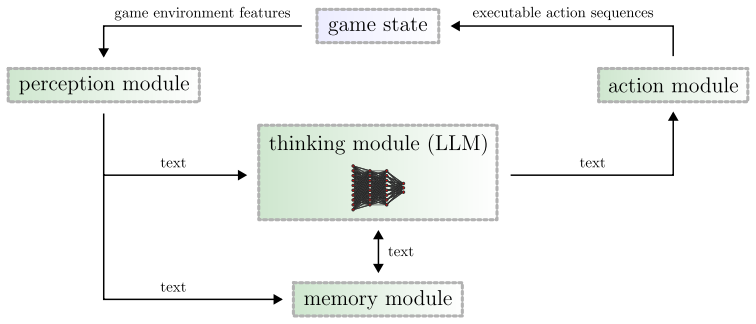
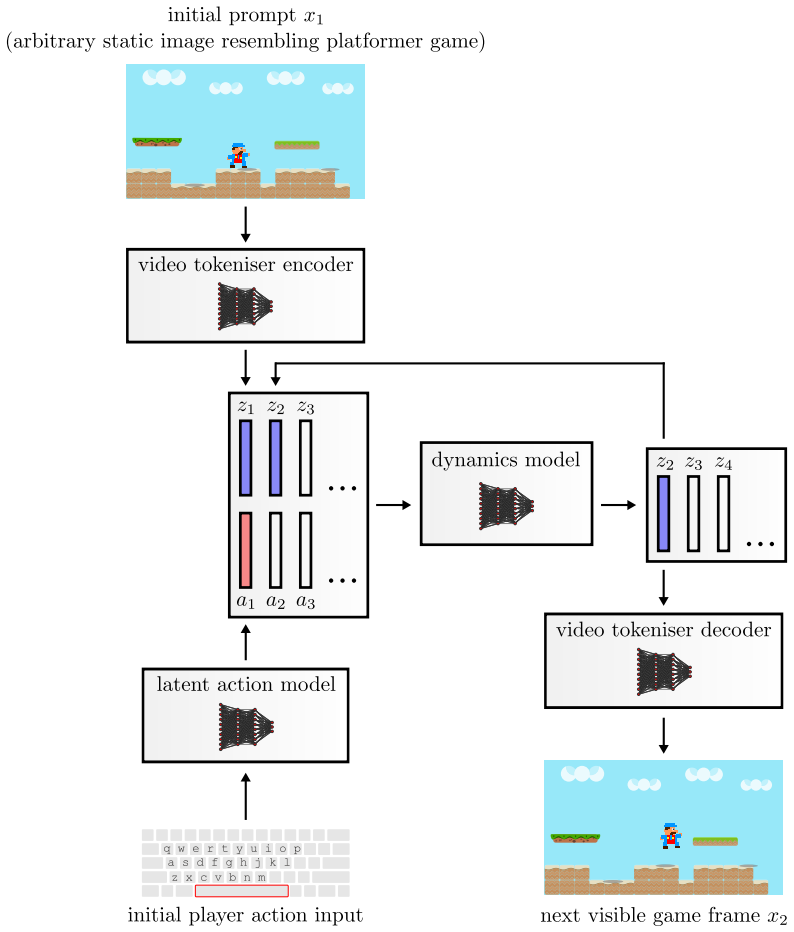
The organizing mechanism is a three-way taxonomy of AI-for-game applications—agent modelling, procedural content generation, and player modelling—drawn from [20], which the report uses to position its five avenues. Within each avenue, a specific technical object carries the argument: an LLM-based cognitive architecture with perception, memory, thinking, action, role-playing, and learning modules; a neural cellular automaton, meaning a cellular automaton whose local transition rule is a trained neural network; a deep surrogate model, a network $\Phi_\theta$ trained on input/output pairs from an expensive function $f$ to approximate or optimise it at far lower cost; a joint-embedding predictive architecture, in which an encoder maps a current state to an embedding and a predictor forecasts the embedding of a related state given a latent variable; and a tokeniser/latent-action/dynamics-model stack that turns unlabelled video into an interactive world. The report argues that each mechanism addresses a known weakness of prior approaches, such as lack of control in cellular automata or the prohibitive cost of repeated simulation.
What would settle it
A systematic, criteria-driven literature review with a scoring rubric could settle the selection claim: if a direction outside these five, such as quality-diversity optimisation or deep reinforcement learning for game balance, consistently ranks above one of the five on demonstrated results, the roadmap is not representative.
Extended reading notes
Core claim
On the report's own terms, its central claim is that five research avenues currently offer the most encouraging openings for applying deep learning to digital games: LLMs as the cognitive core of game agents; neural cellular automata as controllable generators of game content; deep surrogate models that approximate expensive in-game simulations; self-supervised learning to produce reusable game state embeddings; and generative interactive-world models trained from unlabelled video. Each avenue is anchored to existing evidence, such as an LLM-based multi-agent society with memory streams, level-generating neural cellular automata, surrogate models that accelerate environment generation, benchmarked self-supervised game state representations, and an 11-billion-parameter world model that learns latent actions without labels. The report does not claim to prove these are the best directions; it presents the list as a curated, necessarily subjective selection intended to inspire more rigorous work, and it pairs the list with an explicit catalog of technical challenges that currently limit deployment.
Load-bearing premise
The value of the report rests on the author's own selection of these five avenues being a fair representation of the most promising research directions, a premise the report explicitly labels as curated and necessarily subjective rather than evidence-based.
Editorial extensions
If this is right
- LLM-based agents with persistent memory streams would make unscripted dialogue and emergent social interaction among NPCs a default feature rather than a hand-coded exception.
- Neural cellular automata trained with constraint-aware loss functions could generate playable levels, textures, and regenerative objects while keeping the designer's requirements as part of the optimisation objective.
- Deep surrogates trained on costly in-game simulations could cut evaluation time by orders of magnitude, making tasks such as level balancing and automated playtesting feasible at design time.
- Self-supervised embeddings learned from pixels alone could serve as a common perception layer for many downstream tasks, from agent control and player affect prediction to game-state description.
- Interactive world models trained from unlabelled video could let a user seed a game from a single image and play it, turning video libraries into a renewable source of game content.
Reading between the lines
- The five avenues could be combined rather than pursued separately: an LLM agent could be trained or evaluated inside worlds generated by a latent-action world model, with self-supervised embeddings as the perception layer; the report does not spell out these couplings.
- The report's own 'curated and necessarily subjective' caveat suggests the natural next step is a systematic, criterion-based survey or a community-ranked map; until then, the practical value of the roadmap is a hypothesis to test, not an established ranking.
- For game developers, the least risky near-term adoption is likely in offline and pre-production tasks such as content generation, simulation acceleration, and playtest analysis, rather than in real-time player-facing AI, because the report's own challenge list places runtime efficiency and debuggability as unresolved.
- The latent action model idea points to a concrete testable extension: measuring whether actions inferred from unlabelled gameplay video align with the action vocabulary of a real game engine, which would determine whether world models can be plugged into existing games.
Editorial analysis
A structured set of objections, weighed in public.
Referee Report
Summary. This exploratory report identifies and discusses five research avenues for applying deep learning to digital gaming: (i) LLM-based game agent modelling, (ii) neural cellular automata for procedural content generation, (iii) deep surrogate models to accelerate in-game simulations, (iv) self-supervised game state representation learning, and (v) generative world models trained from unlabelled video. The paper explicitly frames itself as a curated, non-exhaustive, and subjective collection of ideas rather than a systematic survey or a presentation of new empirical results. Each avenue is described with reference to representative prior work, and a final section summarizes technical challenges such as computational cost, interpretability, data requirements, and integration into game development workflows.
Significance. Judged on its own terms, the report is a competently written and useful roadmap for researchers entering the AI-gaming intersection. Its factual descriptions of cited works are largely accurate, and it is commendably transparent about its scope, its speculative nature, and its commissioned context. The central claim is not a formal result but a curated judgment of promising directions; the paper states this limitation clearly in Sections 1 and 8, so the absence of a systematic selection methodology does not undermine the claim as presented. The main value of the report is as an accessible overview and idea generator; it makes no new empirical or theoretical contribution, so its significance is modest but legitimate for an exploratory report.
major comments (1)
- [2] The paper's central claim is explicitly framed as a 'curated and necessarily subjective collection of ideas' (Section 1) and the report does not claim exhaustiveness or ranking. The five selected avenues are each supported by credible representative citations, and the limitations are acknowledged in Section 7. I therefore identified no load-bearing technical error requiring major revision.
minor comments (4)
- [2, first paragraph] The text attributes Llama 3 to Google ('Google's Llama 3 [34]'), but the cited reference [34] is the Meta AI 'Llama 3 herd of models'; this should be corrected to Meta.
- [5, second paragraph] The statement that 'A literature search for studies that use concepts from self-supervised learning in digital gaming revealed only 12 instances' would benefit from a brief description of the search strategy, databases consulted, and search date, or from softer phrasing such as 'a non-systematic search identified 12 instances'. As written, the count cannot be independently verified and may mislead readers into treating it as a comprehensive enumeration.
- [6, 'Genie 2' paragraph] The description of Genie 2 relies on a public announcement rather than a peer-reviewed technical report; the paper does acknowledge this, but the sentence 'It has been stated, however, that Genie 2 is an autoregressive latent diffusion model' could more explicitly attribute the claim to DeepMind's announcement to avoid giving it the same evidentiary weight as the peer-reviewed Genie 1 description.
- [References] Reference [113] is malformed: it appears as 'Super Mario as a string: Platformer level generation via LSTMs, author=Summerville, Adam and Mateas, Michael, journal=...' with a visible 'author=' field. This should be reformatted in the standard style used by the other entries.
Circularity Check
No significant circularity: the report is an explicitly curated, non-derivational survey with no fitted predictions and no load-bearing self-citation.
full rationale
This paper makes no technical derivation that could reduce to its own inputs. It explicitly states in Section 1 that its objective 'is not to provide a comprehensive set of mature research proposals, or to present novel original research findings,' and that the five avenues 'represent a curated and necessarily subjective collection of ideas.' Because the central claim is a subjective, non-exhaustive selection of promising research directions, there is no prediction, fitted parameter, or uniqueness theorem whose content is imported from the authors' prior work. The supporting evidence for each avenue consists of external prior work (e.g., Park et al. for LLM agents, Earle et al. for neural cellular automata, Bhatt et al. for deep surrogates, Anand et al. for self-supervised embeddings, and Bruce et al. for Genie), not self-citations by the author. The formal definitions in Section 4 (the surrogate function f and network Φθ) are expository and are not used to derive a result that is equivalent to an input. The limitations acknowledged in Section 7 temper the report's claims but do not create circularity. The only identified issue, the attribution of Llama 3 to Google rather than Meta, is a factual accuracy concern outside the circularity framework. Overall, the report is self-contained as a survey and does not engage in circular reasoning.
Assumptions & free parameters
assumptions (3)
- ad hoc to paper The five selected research avenues are the most promising directions at the AI-gaming intersection.
- domain assumption The cited prior works accurately represent the state of the art.
- ad hoc to paper Genie 2 capabilities described from a public announcement are trustworthy.
Cite this review
Pith. "Pith review of Future Research Avenues for Artificial Intelligence in Digital Gaming: An Exploratory Report." pith.science (2026). https://pith.science/paper/PDILH3ME
@misc{pith2026241214085,
  author       = {Pith},
  title        = {Pith review of: Future Research Avenues for Artificial Intelligence in Digital Gaming: An Exploratory Report},
  year         = {2026},
  howpublished = {\url{https://pith.science/paper/PDILH3ME}},
  note         = {Machine review of arXiv:2412.14085}
}
read the original abstract
Video games are a natural and synergistic application domain for artificial intelligence (AI) systems, offering both the potential to enhance player experience and immersion, as well as providing valuable benchmarks and virtual environments to advance AI technologies in general. This report presents a high-level overview of five promising research pathways for applying state-of-the-art AI methods, particularly deep learning, to digital gaming within the context of the current research landscape. The objective of this work is to outline a curated, non-exhaustive list of encouraging research directions at the intersection of AI and video games that may serve to inspire more rigorous and comprehensive research efforts in the future. We discuss (i) investigating large language models as core engines for game agent modelling, (ii) using neural cellular automata for procedural game content generation, (iii) accelerating computationally expensive in-game simulations via deep surrogate modelling, (iv) leveraging self-supervised learning to obtain useful video game state embeddings, and (v) training generative models of interactive worlds using unlabelled video data. We also briefly address current technical challenges associated with the integration of advanced deep learning systems into video game development, and indicate key areas where further progress is likely to be beneficial.
Figures


Figures from the paper (2 more)

Reference graph
Works this paper leans on
-
[1]
Alex Krizhevsky, Ilya Sutskever, and Geoffrey E. Hinton. ImageNet classification with deep convolutional neural networks. Advances in Neural Information Processing Systems, 25, 2012
2012
-
[2]
Very deep convolutional networks for large-scale image recognition
Karen Simonyan and Andrew Zisserman. Very deep convolutional networks for large-scale image recognition. arXiv preprint arXiv:1409.1556, 2014
arXiv 2014
-
[3]
Zeiler and Rob Fergus
Matthew D. Zeiler and Rob Fergus. Visualizing and understanding convolutional networks. Proceedings of the European Conference on Computer Vision, pages 818–833, 2014
2014
-
[4]
Going deeper with convolutions
Christian Szegedy, Wei Liu, Yangqing Jia, Pierre Sermanet, Scott Reed, Dragomir Anguelov, Dumitru Erhan, Vincent Vanhoucke, and Andrew Rabinovich. Going deeper with convolutions. Proceedings of the IEEE Conference on Computer Vision and Pattern Recognition, pages 1–9, 2015
2015
-
[5]
Deep residual learning for image recognition
Kaiming He, Xiangyu Zhang, Shaoqing Ren, and Jian Sun. Deep residual learning for image recognition. Proceedings of the IEEE Conference on Computer Vision and Pattern Recognition, pages 770–778, 2016
2016
-
[6]
Le, Mohammad Norouzi, Wolfgang Macherey, Maxim Krikun, Yuan Cao, Qin Gao, Klaus Macherey, et al
Yonghui Wu, Mike Schuster, Zhifeng Chen, Quoc V . Le, Mohammad Norouzi, Wolfgang Macherey, Maxim Krikun, Yuan Cao, Qin Gao, Klaus Macherey, et al. Google’s neural machine translation system: Bridging the gap between human and machine translation. arXiv preprint arXiv:1609.08144, 2016
arXiv 2016
-
[7]
Gomez, Łukasz Kaiser, and Illia Polosukhin
Ashish Vaswani, Noam Shazeer, Niki Parmar, Jakob Uszkoreit, Llion Jones, Aidan N. Gomez, Łukasz Kaiser, and Illia Polosukhin. Attention is all you need. Advances in Neural Information Processing Systems, 30, 2017
2017
-
[8]
Tom B. Brown, Benjamin Mann, Nick Ryder, Melanie Subbiah, Jared Kaplan, Prafulla Dhariwal, Arvind Neelakantan, Pranav Shyam, Girish Sastry, Amanda Askell, et al. Language models are few-shot learners. arXiv preprint arXiv:2005.14165, 2020
arXiv 2005
Show all 135 references
-
[9]
Colin Raffel, Noam Shazeer, Adam Roberts, Katherine Lee, Sharan Narang, Michael Matena, Yanqi Zhou, Wei Li, and Peter J. Liu. Exploring the limits of transfer learning with a unified text-to-text transformer. Journal of Machine Learning Research, 21(140):1–67, 2020
2020
-
[10]
Kingma and Max Welling
Diederik P. Kingma and Max Welling. Auto-encoding variational Bayes. arXiv preprint arXiv:1312.6114, 2013
2013 arXiv
-
[11]
Generative adversarial nets
Ian Goodfellow, Jean Pouget-Abadie, Mehdi Mirza, Bing Xu, David Warde-Farley, Sherjil Ozair, Aaron Courville, and Yoshua Bengio. Generative adversarial nets. Advances in Neural Information Processing Systems, 27, 2014
2014
-
[12]
High-resolution image synthesis with latent diffusion models
Robin Rombach, Andreas Blattmann, Dominik Lorenz, Patrick Esser, and Björn Ommer. High-resolution image synthesis with latent diffusion models. Proceedings of the IEEE/CVF Conference on Computer Vision and Pattern Recognition, pages 10684–10695, 2022
2022
-
[13]
Denoising diffusion probabilistic models.Advances in Neural Information Processing Systems, 33, 2020
Jonathan Ho, Ajay Jain, and Pieter Abbeel. Denoising diffusion probabilistic models.Advances in Neural Information Processing Systems, 33, 2020
2020
-
[14]
Schoenholz, Patrick F
Justin Gilmer, Samuel S. Schoenholz, Patrick F. Riley, Oriol Vinyals, and George E. Dahl. Neu- ral message passing for quantum chemistry. International Conference on Machine Learning, 70, 2017. 5/eHomepage | X 13
2017
-
[15]
Wei, David Duvenaud, José Miguel Hernández-Lobato, Benjamín Sánchez-Lengeling, Dennis Sheberla, Jorge Aguilera-Iparraguirre, Timothy D
Rafael Gómez-Bombarelli, Jennifer N. Wei, David Duvenaud, José Miguel Hernández-Lobato, Benjamín Sánchez-Lengeling, Dennis Sheberla, Jorge Aguilera-Iparraguirre, Timothy D. Hirzel, Ryan P. Adams, and Alán Aspuru-Guzik. Automatic chemical design using a data- driven continuous ...
2018
-
[16]
Duvenaud, Dougal Maclaurin, Jorge Iparraguirre, Rafael Bombarell, Timothy Hirzel, Alán Aspuru-Guzik, and Ryan P
David K. Duvenaud, Dougal Maclaurin, Jorge Iparraguirre, Rafael Bombarell, Timothy Hirzel, Alán Aspuru-Guzik, and Ryan P. Adams. Convolutional networks on graphs for learning molecular fingerprints. Advances in Neural Information Processing Systems, 28, 2015
2015
-
[17]
How powerful are graph neural networks? arXiv preprint arXiv:1810.00826, 2018
Keyulu Xu, Weihua Hu, Jure Leskovec, and Stefanie Jegelka. How powerful are graph neural networks? arXiv preprint arXiv:1810.00826, 2018
2018 arXiv
-
[18]
Highly accurate protein structure prediction with AlphaFold
John Jumper, Richard Evans, Alexander Pritzel, Tim Green, Michael Figurnov, Olaf Ron- neberger, Kathryn Tunyasuvunakool, Russ Bates, Augustin Žídek, Anna Potapenko, et al. Highly accurate protein structure prediction with AlphaFold. Nature, 596(7873):583–589, 2021
2021
-
[19]
Games for artificial intelligence research: A review and perspectives
Chengpeng Hu, Yunlong Zhao, Ziqi Wang, Haocheng Du, and Jialin Liu. Games for artificial intelligence research: A review and perspectives. IEEE Transactions on Artificial Intelligence, 2024
2024
-
[20]
Yannakakis and Julian Togelius.Artificial intelligence and games
Georgios N. Yannakakis and Julian Togelius.Artificial intelligence and games. Springer, 2018. https://gameaibook.org
2018
-
[21]
Maddison, Arthur Guez, Laurent Sifre, George Van Den Driessche, Julian Schrittwieser, Ioannis Antonoglou, Veda Panneershelvam, Marc Lanctot, et al
David Silver, Aja Huang, Chris J. Maddison, Arthur Guez, Laurent Sifre, George Van Den Driessche, Julian Schrittwieser, Ioannis Antonoglou, Veda Panneershelvam, Marc Lanctot, et al. Mastering the game of Go with deep neural networks and tree search. Nature, 529(7587): 484–489, 2016
2016
-
[22]
Czarnecki, Michaël Mathieu, Andrew Dudzik, Junyoung Chung, David H
Oriol Vinyals, Igor Babuschkin, Wojciech M. Czarnecki, Michaël Mathieu, Andrew Dudzik, Junyoung Chung, David H. Choi, Richard Powell, Timo Ewalds, Petko Georgiev, et al. Grandmaster level in StarCraft II using multi-agent reinforcement learning. Nature, 575(7782): 350–354, 2019
2019
-
[23]
Dota 2 with large scale deep reinforcement learning
Christopher Berner, Greg Brockman, Brooke Chan, Vicki Cheung, Przemysław D˛ ebiak, Christy Dennison, David Farhi, Quirin Fischer, Shariq Hashme, Chris Hesse, et al. Dota 2 with large scale deep reinforcement learning. arXiv preprint arXiv:1912.06680, 2019
1912 arXiv
-
[24]
Multi-game decision transformers
Kuang-Huei Lee, Ofir Nachum, Mengjiao Sherry Yang, Lisa Lee, Daniel Freeman, Sergio Guadarrama, Ian Fischer, Winnie Xu, Eric Jang, Henryk Michalewski, et al. Multi-game decision transformers. Advances in Neural Information Processing Systems, 35, 2022
2022
-
[25]
A generalist agent
Scott Reed, Konrad Zolna, Emilio Parisotto, Sergio Gomez Colmenarejo, Alexander Novikov, Gabriel Barth-Maron, Mai Gimenez, Yury Sulsky, Jackie Kay, Jost Tobias Springenberg, et al. A generalist agent. arXiv preprint arXiv:2205.06175, 2022
2022 arXiv
-
[26]
Rusu, Joel Veness, Marc G
V olodymyr Mnih, Koray Kavukcuoglu, David Silver, Andrei A. Rusu, Joel Veness, Marc G. Bellemare, Alex Graves, Martin Riedmiller, Andreas K. Fidjeland, Georg Ostrovski, et al. Human-level control through deep reinforcement learning. Nature, 518(7540):529–533, 2015
2015
-
[27]
Bryant, Ryan Cornelius, Igor V
Risto Miikkulainen, Bobby D. Bryant, Ryan Cornelius, Igor V . Karpov, Kenneth O. Stanley, and Chern Han Yong. Computational intelligence in games. Computational Intelligence: Principles and Practice, pages 155–191, 2006
2006
-
[28]
Three states and a plan: The AI of FEAR
Jeff Orkin. Three states and a plan: The AI of FEAR. Game Developers Conference, 2006:4, 2006
2006
-
[29]
Action-based character AI in video-games with CogBots architecture: A preliminary report
Davide Aversa and Stavros Vassos. Action-based character AI in video-games with CogBots architecture: A preliminary report. arXiv preprint arXiv:1307.3195, 2013
2013 arXiv
-
[30]
The AI systems of Left 4 Dead
Michael Booth. The AI systems of Left 4 Dead. Artificial Intelligence and Interactive Digital Entertainment Conference at Stanford, 2009. 14
2009
-
[31]
Noor Shaker, Julian Togelius, and Mark J. Nelson. Procedural content generation in games. Springer, 2016
2016
-
[32]
Yannakakis, Pieter Spronck, Daniele Loiacono, and Elisabeth André
Georgios N. Yannakakis, Pieter Spronck, Daniele Loiacono, and Elisabeth André. Player modeling. Dagstuhl Publishing, 2013
2013
-
[33]
GPT-4 technical report
Josh Achiam, Steven Adler, Sandhini Agarwal, Lama Ahmad, Ilge Akkaya, Florencia Leoni Aleman, Diogo Almeida, Janko Altenschmidt, Sam Altman, Shyamal Anadkat, et al. GPT-4 technical report. arXiv preprint arXiv:2303.08774, 2023
2023 arXiv
-
[34]
The Llama 3 herd of models
Abhimanyu Dubey, Abhinav Jauhri, Abhinav Pandey, Abhishek Kadian, Ahmad Al-Dahle, Aiesha Letman, Akhil Mathur, Alan Schelten, Amy Yang, Angela Fan, et al. The Llama 3 herd of models. arXiv preprint arXiv:2407.21783, 2024
2024 arXiv
-
[35]
From LLM to NMT: Advancing low-resource machine translation with Claude
Maxim Enis and Mark Hopkins. From LLM to NMT: Advancing low-resource machine translation with Claude. arXiv preprint arXiv:2404.13813, 2024
2024 arXiv
-
[36]
A survey of LLM datasets: From autoregressive model to AI chatbot
Fei Du, Xin-Jian Ma, Jing-Ru Yang, Yi Liu, Chao-Ran Luo, Xue-Bin Wang, Hai-Ou Jiang, and Xiang Jing. A survey of LLM datasets: From autoregressive model to AI chatbot. Journal of Computer Science and Technology, 39(3):542–566, 2024
2024
-
[37]
Yannakakis
Roberto Gallotta, Graham Todd, Marvin Zammit, Sam Earle, Antonios Liapis, Julian Togelius, and Georgios N. Yannakakis. Large language models and games: A survey and roadmap. arXiv preprint arXiv:2402.18659, 2024
2024 arXiv
-
[38]
Large language models and video games: A preliminary scoping review
Penny Sweetser. Large language models and video games: A preliminary scoping review. Proceedings of the 6th ACM Conference on Conversational User Interfaces, pages 1–8, 2024
2024
-
[39]
MarioGPT: Open-ended text2level generation through large language models
Shyam Sudhakaran, Miguel González-Duque, Matthias Freiberger, Claire Glanois, Elias Najarro, and Sebastian Risi. MarioGPT: Open-ended text2level generation through large language models. Advances in Neural Information Processing Systems, 36, 2024
2024
-
[40]
V oyager: An open-ended embodied agent with large language models
Guanzhi Wang, Yuqi Xie, Yunfan Jiang, Ajay Mandlekar, Chaowei Xiao, Yuke Zhu, Linxi Fan, and Anima Anandkumar. V oyager: An open-ended embodied agent with large language models. arXiv preprint arXiv:2305.16291, 2023
2023 arXiv
-
[41]
Leveraging the OPT large language model for sentiment analysis of game reviews
Markos Viggiato and Cor-Paul Bezemer. Leveraging the OPT large language model for sentiment analysis of game reviews. IEEE Transactions on Games, 2023
2023
-
[42]
Towards automated video game commentary using generative AI
Noah Ranella and Markus Eger. Towards automated video game commentary using generative AI. EXAG@ AIIDE, 2023
2023
-
[43]
Chatter generation through language models
Matthias Müller-Brockhausen, Giulio Barbero, and Mike Preuss. Chatter generation through language models. IEEE Conference on Games, pages 1–6, 2023
2023
-
[44]
Bernstein
Joon Sung Park, Joseph O’Brien, Carrie Jun Cai, Meredith Ringel Morris, Percy Liang, and Michael S. Bernstein. Generative agents: Interactive simulacra of human behavior.Proceedings of the 36th Annual ACM Symposium on User Interface Software and Technology, pages 1–22, 2023
2023
-
[45]
What if Red can talk? Dynamic dialogue generation using large language models
Navapat Nananukul and Wichayaporn Wongkamjan. What if Red can talk? Dynamic dialogue generation using large language models. arXiv preprint arXiv:2407.20382, 2024
2024 arXiv
-
[46]
A survey on large language model-based game agents
Sihao Hu, Tiansheng Huang, Fatih Ilhan, Selim Tekin, Gaowen Liu, Ramana Kompella, and Ling Liu. A survey on large language model-based game agents. arXiv preprint arXiv:2404.02039, 2024
2024 arXiv
-
[47]
Generative AI vs
Ben Goertzel. Generative AI vs. AGI: The cognitive strengths and weaknesses of modern LLMs. arXiv preprint arXiv:2309.10371, 2023
2023 arXiv
-
[48]
Sparks of artificial general intelligence: Early experiments with GPT-4
Sébastien Bubeck, Varun Chandrasekaran, Ronen Eldan, Johannes Gehrke, Eric Horvitz, Ece Kamar, Peter Lee, Yin Tat Lee, Yuanzhi Li, Scott Lundberg, et al. Sparks of artificial general intelligence: Early experiments with GPT-4. arXiv preprint arXiv:2303.12712, 2023. 15
2023 arXiv
-
[49]
University of Illinois Press Urbana, 1966
John V on Neumann and Arthur Walter Burks.Theory of self-reproducing automata. University of Illinois Press Urbana, 1966
1966
-
[50]
A brief history of cellular automata
Palash Sarkar. A brief history of cellular automata. ACM Computing Surveys, 32(1):80–107, 2000
2000
-
[51]
Mathematical games
Martin Gardner. Mathematical games. Scientific American, 222(6):132–140, 1970
1970
-
[52]
Yannakakis, and Julian Togelius
Lawrence Johnson, Georgios N. Yannakakis, and Julian Togelius. Cellular automata for real- time generation of infinite cave levels. Proceedings of the Workshop on Procedural Content Generation in Games, pages 1–4, 2010
2010
-
[53]
Procedural maze level generation with evolutionary cellular automata
Chad Adams and Sushil Louis. Procedural maze level generation with evolutionary cellular automata. IEEE Symposium Series on Computational Intelligence, pages 1–8, 2017
2017
-
[54]
Schuster
Jonathan Devlin and Micah D. Schuster. Probabilistic cellular automata for granular media in video games. The Computer Games Journal, 10(1):111–120, 2021
2021
-
[55]
Realtime procedural terrain generation
Jacob Olsen. Realtime procedural terrain generation. 2004
2004
-
[56]
Sensitive dependence on initial conditions for cellular automata
Jesús Urıas, Raúl Rechtman, and Agustın Enciso. Sensitive dependence on initial conditions for cellular automata. Chaos: An Interdisciplinary Journal of Nonlinear Science, 7(4):688–693, 1997
1997
-
[57]
Wulff and J
N. Wulff and J. A. Hertz. Learning cellular automaton dynamics with neural networks. Advances in Neural Information Processing Systems, 5, 1992
1992
-
[58]
Ca-NEAT: Evolved compositional pattern producing networks for cellular automata morphogenesis and replication
Stefano Nichele, Mathias Berild Ose, Sebastian Risi, and Gunnar Tufte. Ca-NEAT: Evolved compositional pattern producing networks for cellular automata morphogenesis and replication. IEEE Transactions on Cognitive and Developmental Systems, 10(3):687–700, 2017
2017
-
[59]
Growing neural cellular automata
Alexander Mordvintsev, Ettore Randazzo, Eyvind Niklasson, and Michael Levin. Growing neural cellular automata. Distill, 2020. doi: 10.23915/distill.00023. https://distill.pub/ 2020/growing-ca
2020 doi
-
[60]
Fontaine, Stefanos Nikolaidis, and Julian Togelius
Sam Earle, Justin Snider, Matthew C. Fontaine, Stefanos Nikolaidis, and Julian Togelius. Illuminating diverse neural cellular automata for level generation. Proceedings of the Genetic and Evolutionary Computation Conference, pages 68–76, 2022
2022
-
[61]
µNCA: Texture generation with ultra-compact neural cellular automata
Alexander Mordvintsev and Eyvind Niklasson. µNCA: Texture generation with ultra-compact neural cellular automata. arXiv preprint arXiv:2111.13545, 2021
2021 arXiv
-
[62]
DyNCA: Real-time dynamic texture synthesis using neural cellular automata
Ehsan Pajouheshgar, Yitao Xu, Tong Zhang, and Sabine Süsstrunk. DyNCA: Real-time dynamic texture synthesis using neural cellular automata. Proceedings of the IEEE/CVF Conference on Computer Vision and Pattern Recognition, pages 20742–20751, 2023
2023
-
[63]
Growing 3D artefacts and functional machines with neural cellular automata
Shyam Sudhakaran, Djordje Grbic, Siyan Li, Adam Katona, Elias Najarro, Claire Glanois, and Sebastian Risi. Growing 3D artefacts and functional machines with neural cellular automata. Artificial Life Conference Proceedings 33, 2021(1):108, 2021
2021
-
[64]
Mesh neural cellular automata
Ehsan Pajouheshgar, Yitao Xu, Alexander Mordvintsev, Eyvind Niklasson, Tong Zhang, and Sabine Süsstrunk. Mesh neural cellular automata. ACM Transactions on Graphics, 43(4): 1–16, 2024
2024
-
[65]
Automata quest: NCAs as a video game life mechanic
Hiroki Sato, Tanner Lund, Takahide Yoshida, and Atsushi Masumori. Automata quest: NCAs as a video game life mechanic. arXiv preprint arXiv:2309.14364, 2023
2023 arXiv
-
[66]
Yannakakis, and Julian Togelius
Jialin Liu, Sam Snodgrass, Ahmed Khalifa, Sebastian Risi, Georgios N. Yannakakis, and Julian Togelius. Deep learning for procedural content generation. Neural Computing and Applications, 33(1):19–37, 2021
2021
-
[67]
Dral, Matthias Rupp, and O
Raghunathan Ramakrishnan, Pavlo O. Dral, Matthias Rupp, and O. Anatole V on Lilienfeld. Quantum chemistry structures and properties of 134 kilo molecules. Scientific Data, 1(1):1–7, 2014. 16
2014
-
[68]
Axel D. Becke. Density-functional thermochemistry. I. The effect of the exchange-only gradient correction. The Journal of Chemical Physics, 96(3):2155–2160, 1992
1992
-
[69]
Surrogate models for uncertainty quantification: An overview
Bruno Sudret, Stefano Marelli, and Joe Wiart. Surrogate models for uncertainty quantification: An overview. 11th European Conference on Antennas and Propagation, pages 793–797, 2017
2017
-
[70]
Physics- constrained deep learning for high-dimensional surrogate modeling and uncertainty quantifica- tion without labeled data
Yinhao Zhu, Nicholas Zabaras, Phaedon-Stelios Koutsourelakis, and Paris Perdikaris. Physics- constrained deep learning for high-dimensional surrogate modeling and uncertainty quantifica- tion without labeled data. Journal of Computational Physics, 394:56–81, 2019
2019
-
[71]
Durlofsky
Meng Tang, Yimin Liu, and Louis J. Durlofsky. A deep-learning-based surrogate model for data assimilation in dynamic subsurface flow problems. Journal of Computational Physics, 413:109456, 2020
2020
-
[72]
Radaideh and Tomasz Kozlowski
Majdi I. Radaideh and Tomasz Kozlowski. Surrogate modeling of advanced computer simula- tions using deep Gaussian processes. Reliability Engineering & System Safety, 195:106731, 2020
2020
-
[73]
Yannakakis
Daniel Karavolos, Antonios Liapis, and Georgios N. Yannakakis. A multifaceted surrogate model for search-based procedural content generation. IEEE Transactions on Games, 13(1): 11–22, 2019
2019
-
[74]
Deep surrogate assisted generation of environments
Varun Bhatt, Bryon Tjanaka, Matthew Fontaine, and Stefanos Nikolaidis. Deep surrogate assisted generation of environments. Advances in Neural Information Processing Systems, 35: 37762–37777, 2022
2022
-
[75]
Yannakakis
Daniel Karavolos, Antonios Liapis, and Georgios N. Yannakakis. Pairing character classes in a deathmatch shooter game via a deep-learning surrogate model. Proceedings of the 13th International Conference on the Foundations of Digital Games, pages 1–10, 2018
2018
-
[76]
Yannakakis
Daniel Karavolos, Antonios Liapis, and Georgios N. Yannakakis. Using a surrogate model of gameplay for automated level design. IEEE Conference on Computational Intelligence and Games, pages 1–8, 2018
2018
-
[77]
Fontaine, Amy K
Yulun Zhang, Matthew C. Fontaine, Amy K. Hoover, and Stefanos Nikolaidis. Deep surrogate assisted map-elites for automated hearthstone deckbuilding. Proceedings of the Genetic and Evolutionary Computation Conference, pages 158–167, 2022
2022
-
[78]
SuSketch: Surrogate models of gameplay as a design assistant
Panagiotis Migkotzidis and Antonios Liapis. SuSketch: Surrogate models of gameplay as a design assistant. IEEE Transactions on Games, 14(2):273–283, 2021
2021
-
[79]
Yannakakis
Daniel Karavolos, Antonios Liapis, and Georgios N. Yannakakis. Learning the patterns of balance in a multi-player shooter game. Proceedings of the 12th International Conference on the Foundations of Digital Games, pages 1–10, 2017
2017
-
[80]
De- von Hjelm
Ankesh Anand, Evan Racah, Sherjil Ozair, Yoshua Bengio, Marc-Alexandre Côté, and R. De- von Hjelm. Unsupervised state representation learning in Atari. Advances in Neural Informa- tion Processing Systems, 32, 2019
2019
-
[81]
Yannakakis
Konstantinos Makantasis, Antonios Liapis, and Georgios N. Yannakakis. From pixels to affect: A study on games and player experience. 8th International Conference on Affective Computing and Intelligent Interaction, pages 1–7, 2019
2019
-
[82]
Lewis, and Satinder Singh
Junhyuk Oh, Xiaoxiao Guo, Honglak Lee, Richard L. Lewis, and Satinder Singh. Action- conditional video prediction using deep networks in atari games. Advances in Neural Informa- tion Processing Systems, 28, 2015
2015
-
[83]
Generative music in video games: State of the art, challenges, and prospects
Cale Plut and Philippe Pasquier. Generative music in video games: State of the art, challenges, and prospects. Entertainment Computing, 33:100337, 2020
2020
-
[84]
Self-supervised learning: Generative or contrastive
Xiao Liu, Fanjin Zhang, Zhenyu Hou, Li Mian, Zhaoyu Wang, Jing Zhang, and Jie Tang. Self-supervised learning: Generative or contrastive. IEEE Transactions on Knowledge and Data Engineering, 35(1):857–876, 2021. 17
2021
-
[85]
Saquib Sarfraz, and Rainer Stiefelhagen
Vivek Sharma, Makarand Tapaswi, M. Saquib Sarfraz, and Rainer Stiefelhagen. Self- supervised learning of face representations for video face clustering. 14th IEEE International Conference on Automatic Face & Gesture Recognition, pages 1–8, 2019
2019
-
[86]
Seungdong Yoa, Seungjun Lee, Chiyoon Kim, and Hyunwoo J. Kim. Self-supervised learning for anomaly detection with dynamic local augmentation. IEEE Access, 9:147201–147211, 2021
2021
-
[87]
Hin- ton
Ting Chen, Simon Kornblith, Kevin Swersky, Mohammad Norouzi, and Geoffrey E. Hin- ton. Big self-supervised models are strong semi-supervised learners. Advances in Neural Information Processing Systems, 33:22243–22255, 2020
2020
-
[88]
A survey on contrastive self-supervised learning
Ashish Jaiswal, Ashwin Ramesh Babu, Mohammad Zaki Zadeh, Debapriya Banerjee, and Fillia Makedon. A survey on contrastive self-supervised learning. Technologies, 9(1):2, 2020
2020
-
[89]
Yannakakis
Chintan Trivedi, Konstantinos Makantasis, Antonios Liapis, and Georgios N. Yannakakis. Learning task-independent game state representations from unlabeled images. IEEE Confer- ence on Games, pages 88–95, 2022
2022
-
[90]
Yannakakis
Chintan Trivedi, Konstantinos Makantasis, Antonios Liapis, and Georgios N. Yannakakis. Towards general game representations: Decomposing games pixels into content and style. arXiv preprint arXiv:2307.11141, 2023
2023 arXiv
-
[91]
Yannakakis
Chintan Trivedi, Antonios Liapis, and Georgios N. Yannakakis. Contrastive learning of generalized game representations. IEEE Conference on Games, pages 1–8, 2021
2021
-
[92]
Self-supervised contrastive learning for predicting game strategies
Young Jae Lee, Insung Baek, Uk Jo, Jaehoon Kim, Jinsoo Bae, Keewon Jeong, and Seoung Bum Kim. Self-supervised contrastive learning for predicting game strategies. Pro- ceedings of SAI Intelligent Systems Conference, pages 136–147, 2022
2022
-
[93]
Comparing learning methodologies for self-supervised audio-visual representation learning
Hacene Terbouche, Liam Schoneveld, Oisin Benson, and Alice Othmani. Comparing learning methodologies for self-supervised audio-visual representation learning. IEEE Access, 10: 41622–41638, 2022
2022
-
[94]
Yannakakis
Nemanja Rašajski, Chintan Trivedi, Konstantinos Makantasis, Antonios Liapis, and Geor- gios N. Yannakakis. BehA VE: Behaviour alignment of video game encodings.arXiv preprint arXiv:2402.01335, 2024
2024 arXiv
-
[95]
Yannakakis
Chintan Trivedi, Konstantinos Makantasis, Antonios Liapis, and Georgios N. Yannakakis. Game state learning via game scene augmentation. Proceedings of the 17th International Conference on the Foundations of Digital Games, pages 1–4, 2022
2022
-
[96]
Creating multimodal interactive agents with imitation and self-supervised learning
DeepMind Interactive Agents Team, Josh Abramson, Arun Ahuja, Arthur Brussee, Federico Carnevale, Mary Cassin, Felix Fischer, Petko Georgiev, Alex Goldin, Mansi Gupta, et al. Creating multimodal interactive agents with imitation and self-supervised learning. arXiv preprint arXi...
2021 arXiv
-
[97]
STARLING: Self-supervised training of text-based reinforcement learning agent with large language models
Shreyas Basavatia, Keerthiram Murugesan, and Shivam Ratnakar. STARLING: Self-supervised training of text-based reinforcement learning agent with large language models. arXiv preprint arXiv:2406.05872, 2024
2024 arXiv
-
[98]
Entity embedding as game represen- tation
Nazanin Yousefzadeh Khameneh and Matthew Guzdial. Entity embedding as game represen- tation. arXiv preprint arXiv:2010.01685, 2020
2010 arXiv
-
[99]
CURL: Contrastive unsupervised representations for reinforcement learning
Michael Laskin, Aravind Srinivas, and Pieter Abbeel. CURL: Contrastive unsupervised representations for reinforcement learning. International Conference on Machine Learning, pages 5639–5650, 2020
2020
-
[100]
A path towards autonomous machine intelligence version 0.9
Yann LeCun. A path towards autonomous machine intelligence version 0.9. 2, 2022-06-27. Open Review, 62(1):1–62, 2022
2022
-
[101]
Introduction to latent variable energy-based models: A path toward autonomous machine intelligence
Anna Dawid and Yann LeCun. Introduction to latent variable energy-based models: A path toward autonomous machine intelligence. Journal of Statistical Mechanics: Theory and Experiment, 2024(10):104011, 2024. 18
2024
-
[102]
Self-supervised learning from images with a joint- embedding predictive architecture
Mahmoud Assran, Quentin Duval, Ishan Misra, Piotr Bojanowski, Pascal Vincent, Michael Rabbat, Yann LeCun, and Nicolas Ballas. Self-supervised learning from images with a joint- embedding predictive architecture. Proceedings of the IEEE/CVF Conference on Computer Vision and Pat...
2023
-
[103]
Bootstrap your own latent - a new approach to self-supervised learning
Jean-Bastien Grill, Florian Strub, Florent Altché, Corentin Tallec, Pierre Richemond, Elena Buchatskaya, Carl Doersch, Bernardo Avila Pires, Zhaohan Guo, Mohammad Gheshlaghi Azar, et al. Bootstrap your own latent - a new approach to self-supervised learning. Advances in Neural...
2020
-
[104]
Dennis, Ashley Edwards, Jack Parker-Holder, Yuge Shi, Edward Hughes, Matthew Lai, Aditi Mavalankar, Richie Steigerwald, Chris Apps, et al
Jake Bruce, Michael D. Dennis, Ashley Edwards, Jack Parker-Holder, Yuge Shi, Edward Hughes, Matthew Lai, Aditi Mavalankar, Richie Steigerwald, Chris Apps, et al. Genie: Generative interactive environments. International Conference on Machine Learning, 2024
2024
-
[105]
Spatial-temporal transformer networks for traffic flow forecasting
Mingxing Xu, Wenrui Dai, Chunmiao Liu, Xing Gao, Weiyao Lin, Guo-Jun Qi, and Hongkai Xiong. Spatial-temporal transformer networks for traffic flow forecasting. arXiv preprint arXiv:2001.02908, 2020
2001 arXiv
-
[106]
Neural discrete representation learning
Aaron Van Den Oord, Oriol Vinyals, and Koray Kavukcuoglu. Neural discrete representation learning. Advances in Neural Information Processing Systems, 30, 2017
2017
-
[107]
Huiwen Chang, Han Zhang, Lu Jiang, Ce Liu, and William T. Freeman. Maskgit: Masked generative image transformer. Proceedings of the IEEE/CVF Conference on Computer Vision and Pattern Recognition, pages 11315–11325, 2022
2022
-
[108]
Denton, Kamyar Ghasemipour, Raphael Gontijo Lopes, Burcu Karagol Ayan, Tim Salimans, et al
Chitwan Saharia, William Chan, Saurabh Saxena, Lala Li, Jay Whang, Emily L. Denton, Kamyar Ghasemipour, Raphael Gontijo Lopes, Burcu Karagol Ayan, Tim Salimans, et al. Photorealistic text-to-image diffusion models with deep language understanding. Advances in Neural Informatio...
2022
-
[109]
World models
David Ha and Jürgen Schmidhuber. World models. arXiv preprint arXiv:1803.10122, 2018
2018 arXiv
-
[110]
Genie 2: A large-scale foundation world model
Google DeepMind. Genie 2: A large-scale foundation world model. https://deepmind. google/discover/blog/genie-2-a-large-scale-foundation-world-model . Ac- cessed: 2024-12-11
2024
-
[111]
Scaling instructable agents across many simulated worlds
Maria Abi Raad, Arun Ahuja, Catarina Barros, Frederic Besse, Andrew Bolt, Adrian Bolton, Bethanie Brownfield, Gavin Buttimore, Max Cant, Sarah Chakera, et al. Scaling instructable agents across many simulated worlds. arXiv preprint arXiv:2404.10179, 2024
2024 arXiv
-
[112]
A survey on simulators for testing self-driving cars
Prabhjot Kaur, Samira Taghavi, Zhaofeng Tian, and Weisong Shi. A survey on simulators for testing self-driving cars. Fourth International Conference on Connected and Autonomous Driving, pages 62–70, 2021
2021
-
[113]
Super Mario as a string: Platformer level generation via LSTMs, author=Summerville, Adam and Mateas, Michael, journal=arXiv preprint arXiv:1603.00930, year=2016
2016 arXiv
-
[114]
Ruthenbeck and Karen J
Greg S. Ruthenbeck and Karen J. Reynolds. Virtual reality for medical training: The state-of- the-art. Journal of Simulation, 9(1):16–26, 2015
2015
-
[115]
Alfred T. Lee. Flight simulation: Virtual environments in aviation. Routledge, 2017
2017
-
[116]
Augmenting LLMs with knowledge: A survey on hallucination prevention
Konstantinos Andriopoulos and Johan Pouwelse. Augmenting LLMs with knowledge: A survey on hallucination prevention. arXiv preprint arXiv:2309.16459, 2023
2023 arXiv
-
[117]
Vipula Rawte, Swagata Chakraborty, Agnibh Pathak, Anubhav Sarkar, S. M. Tonmoy, Aman Chadha, Amit P. Sheth, and Amitava Das. The troubling emergence of hallucination in large language models–an extensive definition, quantification, and prescriptive remediations. arXiv preprint...
-
[118]
Efficient deep learning: A survey on making deep learning models smaller, faster, and better
Gaurav Menghani. Efficient deep learning: A survey on making deep learning models smaller, faster, and better. ACM Computing Surveys, 55(12):1–37, 2023. 19
2023
-
[119]
Latent action pretraining from videos
Seonghyeon Ye, Joel Jang, Byeongguk Jeon, Sejune Joo, Jianwei Yang, Baolin Peng, Ajay Mandlekar, Reuben Tan, Yu-Wei Chao, Bill Yuchen Lin, et al. Latent action pretraining from videos. arXiv preprint arXiv:2410.11758, 2024
2024 arXiv
-
[120]
LLM4GEN: Leveraging semantic representation of LLMs for text-to-image generation
Mushui Liu, Yuhang Ma, Yang Zhen, Jun Dan, Yunlong Yu, Zeng Zhao, Zhipeng Hu, Bai Liu, and Changjie Fan. LLM4GEN: Leveraging semantic representation of LLMs for text-to-image generation. arXiv preprint arXiv:2407.00737, 2024
2024 arXiv
-
[121]
LayoutLLM-T2I: Eliciting layout guidance from LLM for text-to-image generation
Leigang Qu, Shengqiong Wu, Hao Fei, Liqiang Nie, and Tat-Seng Chua. LayoutLLM-T2I: Eliciting layout guidance from LLM for text-to-image generation. Proceedings of the 31st ACM International Conference on Multimedia, pages 643–654, 2023
2023
-
[122]
LLM-grounded diffusion: Enhancing prompt understanding of text-to-image diffusion models with large language models
Long Lian, Boyi Li, Adam Yala, and Trevor Darrell. LLM-grounded diffusion: Enhancing prompt understanding of text-to-image diffusion models with large language models. arXiv preprint arXiv:2305.13655, 2023
2023 arXiv
-
[123]
Deep learning for video game playing
Niels Justesen, Philip Bontrager, Julian Togelius, and Sebastian Risi. Deep learning for video game playing. IEEE Transactions on Games, 12(1):1–20, 2019
2019
-
[124]
Data management challenges for deep learning
Aiswarya Munappy, Jan Bosch, Helena Holmström Olsson, Anders Arpteg, and Björn Brinne. Data management challenges for deep learning. 45th Euromicro Conference on Software Engineering and Advanced Applications, pages 140–147, 2019
2019
-
[125]
Understanding intermediate layers using linear classifier probes
Guillaume Alain and Yoshua Bengio. Understanding intermediate layers using linear classifier probes. arXiv preprint arXiv:1610.01644, 2016
2016 arXiv
-
[126]
Opening the black box of deep neural networks via information
Ravid Shwartz-Ziv and Naftali Tishby. Opening the black box of deep neural networks via information. arXiv preprint arXiv:1703.00810, 2017
2017 arXiv
-
[127]
Misbehaviour prediction for autonomous driving systems
Andrea Stocco, Michael Weiss, Marco Calzana, and Paolo Tonella. Misbehaviour prediction for autonomous driving systems. Proceedings of the ACM/IEEE 42nd International Conference on Software Engineering, pages 359–371, 2020
2020
-
[128]
Nikolenko
Sergey I. Nikolenko. Synthetic data for deep learning, volume 174. Springer, 2021
2021
-
[129]
Distilling the knowledge in a neural network
Geoffrey Hinton, Oriol Vinyals, and Jeff Dean. Distilling the knowledge in a neural network. arXiv preprint arXiv:1503.02531, 2015
2015 arXiv
-
[130]
What is the state of neural network pruning? Proceedings of Machine Learning and Systems, 2:129–146, 2020
Davis Blalock, Jose Javier Gonzalez Ortiz, Jonathan Frankle, and John Guttag. What is the state of neural network pruning? Proceedings of Machine Learning and Systems, 2:129–146, 2020
2020
-
[131]
The super weight in large language models
Mengxia Yu, De Wang, Qi Shan, and Alvin Wan. The super weight in large language models. arXiv preprint arXiv:2411.07191, 2024
2024 arXiv
-
[132]
Opportunities and challenges in explainable artificial intelligence (XAI): A survey
Arun Das and Paul Rad. Opportunities and challenges in explainable artificial intelligence (XAI): A survey. arXiv preprint arXiv:2006.11371, 2020
2006 arXiv
-
[133]
Opportunities and challenges in deep learning adversarial robustness: A survey
Samuel Henrique Silva and Peyman Najafirad. Opportunities and challenges in deep learning adversarial robustness: A survey. arXiv preprint arXiv:2007.00753, 2020
2007 arXiv
-
[134]
Procedural content generation through quality diversity.IEEE Conference on Games, pages 1–8, 2019
Gravina, Daniele and Khalifa, Ahmed and Liapis, Antonios and Togelius, Julian and Yan- nakakis, Georgios N. Procedural content generation through quality diversity.IEEE Conference on Games, pages 1–8, 2019
2019
-
[135]
Differentiable quality diversity
Matthew Fontaine and Stefanos Nikolaidis. Differentiable quality diversity. Advances in Neural Information Processing Systems, 34:10040–10052, 2021. 20
2021
Reviewed August 11, 2026 · model on record in the stance chip above.
Discussion (0). Continue with ORCID to comment.